Construction Dewatering
At Griffin, our expertise is in
groundwater control
for challenging construction
projects and subsurface
conditions. Griffin specializes
in dewatering and
groundwater control, utilizing
such techniques as eductors,
deep wells, wellpoints, slurry
walls, and relief wells.
What Is Dewatering?
Dewatering means
“the separation of
water from the soil,”
or perhaps “taking
the water out of the
particular
construction
problem
completely.”
This leads to concepts
like pre-drainage of
soil, control of ground
water, and even the
improvement of
physical properties of
Controls ground water, and
even the improvement of
physical properties of soil.
Intercepts Seepage
Achieves waterproofing
objectives
What Does Dewatering Do?
Origins Of
Dewatering Human efforts to control
water predate recorded
history.
The first practical
wellpoint dewatering
system in the U.S. was
used in Hackensack,
NJ in 1925.
Excavation Support Systems
Rendered Unstable
Future Settling
Lost Time
Decreased Worksite Safety
Increased Cost
Consequences
Of Improper
Dewatering
Dewatering Methods
Wellpoint System
A wellpoint system consists of a
number of wellpoints spaced along a
trench or around an excavation site,
all connected to a common header,
which is attached to one or more
wellpoint pumps.
Wellpoint systems are most suitable
in shallow aquifers where the water
level needs to be lowered no more
than 15 or 20 feet. Due to the
vacuum limitation of the pump,
excavations that are deeper will
require multiple stages of wellpoint
systems.
Deep Well System
Deep well systems consist of one
or more individual wells, each of
which has its own submersible
pump at the bottom of the well.
Deep well systems are suitable
for water-table or confined
aquifers and will lower the water
table 100 feet or more in a single
lift without staging.
Eductor System
The eductor system is
generally used in areas
where the soils have a low
permeability. It is especially
well suited for deep
excavations with stratified
soils. The eductors are
installed at relatively close
spacing similar to the array in
wellpoint systems, but
require only a single stage to
effect draw downs of up to
100 + feet.
Open Pumping
Axial flow pumps on a
temporary pump station
was capable of pumping
200,000 gallons per
minute (gpm) with a
standby capacity of
30,000 gpm.
The removal of water
from a site or an area
commonly called;
sumping, unwatering, or
open pumping.
Temporary & Permanent
Dewatering Systems
Intercept Seepage
Improve the excavation and the backfill
characteristics of the excavation to allow
construction to proceed in a safe and
efficient manner.
Achieve waterproofing objectives.
Reduce or eliminate lateral and/or
uplift pressures.
PermanentPermanentTemporary
Details Of A Dewatering System
Considerations When Selecting
A Dewatering System
Size & Depth Of The Excavation
Location And Environment
Proximity Of Existing Structures
Existence Of Any Contamination
Soil Characteristics And
Subsurface Conditions
Aquifer composition and
distribution
Hydraulic conductivity,
transmissivity, storage
coefficient
Flow rate calculation for
proposed construction
area to be dewatered
Aquifer Characteristics
Construction
Schedule
Time always equals money in
construction
How does the Dewatering System
impact the budget and schedule?
The Dewatering system should be a
long term asset for ongoing
operations
Dewatering Case Studies
The dam’s construction
method comprises its
problem- the sluiced fill
materials. This
material has a loose (or very
loose) relative density.
Consequently, the dam is
susceptible to
liquefaction during an
earthquake.
Need for Renovation
Saluda Dam Remediation
Case Study
Griffin installed Deepwells, Eductors, & Wellpoints on downstream toe of
dam for excavation of up to 80ft. in depth.
Saluda Dam Remediation
Case Study
The project was a significant
undertaking. In addition to
keeping the 48,000 acre
reservoir nearly full, which is
rimmed with businesses and
houses, and keeping the
hydroelectric plant and coal fired
steam plant operational, the
project also required that we
ensure the safety of the
120,000 residents living in the
flood plain downstream in
Columbia, SC. All the above was
required, while also addressing
the environmental concerns
regarding the wetlands encircling
the Saluda Dam.
Owner: SCE&G – Columbia, SC
General Contractor: Paul C. Rizzo Associates,
Monroeville, PA
Specialty Sub Contractor: Griffin Dewatering
Batchtown Wildlife Refuge
Case Study
Griffin deep wells installed on a oval earthen
berm directly in the Mississippi River
A deep well dewatering
system for the Batchtown
Wildlife Refuge
Rehabilitation project
near St. Louis, Missouri.
The wells were installed
on a oval earthen berm
directly in the Mississippi
River. Individual wells
were pumping roughly
1750 gallons per minute
each.
Building Team/Key Players: Army Corp of Engineers, US Fish and Wildlife Service,
Griffin Dewatering North Central, LLC
Case Study
Deep well dewatering system in operation at
an excavation near the Mississippi River
A deep well installed at an
excavation for a pumping
station being built in New
Madrid Missouri in close
proximity to the Mississippi
river for the Army Corps of
Engineers.
Building Team/Key Players: Army Corp of Engineers: Memphis District, Hill Brothers
Construction & Engineering Co., Griffin Dewatering Southwest
New Madrid Pump Station
Installation of high
volume deepwells for
excavation 51ft. below
high Mississippi River
elevation.
Case Study
Riverpoint West Street Improvement project
Sewerline installation located in Des Moines, IA
This photo depicts an
excavation in Des Moines,
Iowa of a 30 foot deep
sewerline installation located
3 feet above the bedrock.
Deep dewatering wells were
used to lower the groundwater
8 feet and a 600 foot long,
200 point wellpoint system
was installed 17 feet below
existing grade to handle the
rest of the groundwater.
Building Team/Key Players: J&K Contracting General Contractor – Ames, IA,
Griffin Dewatering North Central, LLC Sub Contractor – Omaha, NE
Case Study
Pearland Town Center - Detention Pond
Building Team/Key Players: EMJ Construction General Contractor – Chattanooga, TN,
Griffin Dewatering Southwest, LLC Sub Contractor – Houston, TX
A Wellpoint System was
used for the construction
of a detention pond at the
Pearland Town Center in
Pearland, Texas
Case Study
Crystal River Power Plant Expansion
Installation of high
volume sumping
equipment for
excavation into
Florida limestone
formations.
General Contractor:
Zachary Construction
Specialty Sub-Contractor:
Griffin Dewatering
Case Study
Lake Fork Pumping Station
Installation of deepwells
and wellpoints for +65ft
excavation.
The Lake Fork Pump Station
project was constructed by
Bar Constructors. Lake Fork
is the first new water source
connected to the DWU raw
water system in 40 years.
The Lake Fork Pump Station
is a 240 MGD raw water
pump station located
approximately 95 miles east
of Dallas on Lake Fork.
General Contractor:
Bar Constructors
Specialty Sub-Contractor:
Griffin Dewatering
Case Study
El Cajon Public Safety Center
This construction project is
located in the County of San
Diego for the city of El Cajon.
The dewatering system on this
excavation consists of a
dewatering system installed
around the perimeter of the
excavation. It consists of a
series of electric submersible
pumps installed inside of deep
wells by Griffin Dewatering
Farwest.
General Contractor:
Ledcor Construction Inc.
Specialty Sub-Contractor:
Griffin Dewatering Farwest
Location:
El Cajon, CA (San Diego County)
Case Study
Galena River Bypass
The pump in the foreground is
a 12” Non-Clog pump for
bypass pumping of the Galena
River around an excavation for
a new railroad bridge. The
pump in the middle was a high
pressure 6” pump used to
install the wick points. The
pump in the foreground is an
8” Non-Clog Variable Use
Pump for the wick point
dewatering system.
General Contractor:
Rieth-Riley Construction
Specialty Sub-Contractor:
Griffin Dewatering Midwest
Location:
LaPorte County, Indiana
Case Study
Lake Isabella Bypass
Griffin axial flow pumps on
Lake Isabella. Fed by the Kern
River, the lake is a primary
source of water for farmers in
the southern part of the largest
agricultural area in California.
Griffin Dewatering Corporation
was called in to design,
construct, and operate a
temporary pump station that
would run for five months. The
station was capable of
pumping 200,000 gallons per
minute (gpm) with a standby
capacity of 30,000 gpm. The
quantity the station actually
pumped was dependent upon
the demand downstream.Location: High in the desert mountains above
Bakersfield, California and San Joaquin Valley.
General Contractor: Griffin Dewatering Farwest
Owner: Isabella Partners
Case Study
Prado Dam Embankment and Outlet
Works
General Contractor: Doty Brothers Equipment Company
Owner: U.S. Army Corps of Engineers, Los Angeles District
Sub Contractor: Griffin Dewatering Farwest
Location: Dam on the Santa Ana River in Riverside County, California
Griffin Bypass equipment
installation. Prado Dam
sewer bypass pumping at
22 million gallons per day
located in Santa Ana River
near Corona, California.
Temporary bypass systems
are used to transfer water
supplies and sewage flow,
so that vital services are
uninterrupted during
construction.
Case Study
General Contractor: Olsson Construction Inc.
Owner: Orange County Sanitation District
Sub Contractor: Griffin Dewatering Farwest
Location: Costa Mesa, California
At the heart of the bypass at
the Olsson Construction Inc.
Westside Pump Station job are
these two 16” vacuum assisted
non clog pumps, fitted with
100hp electric motors. Two
10” diesel powered, vacuum
assisted non clog pumps are
also installed, as back up for
the system. Fitting this many
large pumps into the very small
space allotted was difficult;
however, Griffin’s field crew did
an excellent job.
College Avenue Pump Station
Case Study
General Contractor: Judds Brothers Construction
Owner: City of Iowa City, The Public Works Department
Sub Contractor: Griffin Dewatering North Central
Location: Iowa City, Iowa
The project is the replacment of
a siphon sewer under the Iowa
River. Griffin is bypassing the
sewage from the old structures
while the new sewer
connections are made. Total
volume is about 6,300 gallons
per minute. Total duration of the
job is 2 weeks from startup to
shut down of the new 18 inch
non-clog pumps. Griffin is
bypassing sewage from 3
different locations on site and 2
operate at any one time.
Siphon Sewer - Iowa City
General Contractor: Linbeck Construction
Owner: Rice University
Sub Contractor: Griffin Dewatering Southwest
Location: Houston, Texas
Case Study
Rice University Collaborative Research Center
The project (CRC Rice
University) consists of a ten
story building next to the Rice
University Campus inside of
Houston Medical Center.
Griffin installed a 1400 linear
foot eductor system to lower
the groundwater below the
deepest cut (40 feet deep
from the street level). These
eductors are 65 to 80 feet
deep and drilled outside the
excavation area along the
property line. The eductor
system with two pump
stations has lowered
groundwater more than 5 feet
below the deepest
excavation.
Case Study
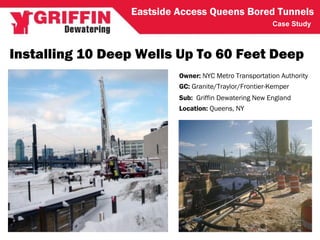
Installing 10 Deep Wells Up To 60 Feet Deep
GC: Granite/Traylor/Frontier-Kemper
Owner: NYC Metro Transportation Authority
Sub: Griffin Dewatering New England
Location: Queens, NY
Eastside Access Queens Bored Tunnels
Case Study
Love Field Airport Modernization
GC: Hensel Phelps Construction Co.
Owner: Southwest Airlines, Dallas
Sub: Griffin Dewatering Southwest
Location: Dallas, TX
Installed 7 Deep Wells
and 70 Wickpoints on
Concourse Area and 20
Deep Wells in the
Ticketing Area

Construction Dewatering PowerPoint

  • 1.
    Construction Dewatering At Griffin,our expertise is in groundwater control for challenging construction projects and subsurface conditions. Griffin specializes in dewatering and groundwater control, utilizing such techniques as eductors, deep wells, wellpoints, slurry walls, and relief wells.
  • 2.
    What Is Dewatering? Dewateringmeans “the separation of water from the soil,” or perhaps “taking the water out of the particular construction problem completely.” This leads to concepts like pre-drainage of soil, control of ground water, and even the improvement of physical properties of
  • 3.
    Controls ground water,and even the improvement of physical properties of soil. Intercepts Seepage Achieves waterproofing objectives What Does Dewatering Do?
  • 4.
    Origins Of Dewatering Humanefforts to control water predate recorded history. The first practical wellpoint dewatering system in the U.S. was used in Hackensack, NJ in 1925.
  • 5.
    Excavation Support Systems RenderedUnstable Future Settling Lost Time Decreased Worksite Safety Increased Cost Consequences Of Improper Dewatering
  • 6.
  • 7.
    Wellpoint System A wellpointsystem consists of a number of wellpoints spaced along a trench or around an excavation site, all connected to a common header, which is attached to one or more wellpoint pumps. Wellpoint systems are most suitable in shallow aquifers where the water level needs to be lowered no more than 15 or 20 feet. Due to the vacuum limitation of the pump, excavations that are deeper will require multiple stages of wellpoint systems.
  • 8.
    Deep Well System Deepwell systems consist of one or more individual wells, each of which has its own submersible pump at the bottom of the well. Deep well systems are suitable for water-table or confined aquifers and will lower the water table 100 feet or more in a single lift without staging.
  • 9.
    Eductor System The eductorsystem is generally used in areas where the soils have a low permeability. It is especially well suited for deep excavations with stratified soils. The eductors are installed at relatively close spacing similar to the array in wellpoint systems, but require only a single stage to effect draw downs of up to 100 + feet.
  • 10.
    Open Pumping Axial flowpumps on a temporary pump station was capable of pumping 200,000 gallons per minute (gpm) with a standby capacity of 30,000 gpm. The removal of water from a site or an area commonly called; sumping, unwatering, or open pumping.
  • 11.
    Temporary & Permanent DewateringSystems Intercept Seepage Improve the excavation and the backfill characteristics of the excavation to allow construction to proceed in a safe and efficient manner. Achieve waterproofing objectives. Reduce or eliminate lateral and/or uplift pressures. PermanentPermanentTemporary
  • 12.
    Details Of ADewatering System
  • 13.
  • 14.
    Size & DepthOf The Excavation
  • 15.
  • 16.
  • 17.
    Existence Of AnyContamination
  • 18.
  • 19.
    Aquifer composition and distribution Hydraulicconductivity, transmissivity, storage coefficient Flow rate calculation for proposed construction area to be dewatered Aquifer Characteristics
  • 20.
    Construction Schedule Time always equalsmoney in construction How does the Dewatering System impact the budget and schedule? The Dewatering system should be a long term asset for ongoing operations
  • 21.
  • 32.
    The dam’s construction methodcomprises its problem- the sluiced fill materials. This material has a loose (or very loose) relative density. Consequently, the dam is susceptible to liquefaction during an earthquake. Need for Renovation Saluda Dam Remediation Case Study Griffin installed Deepwells, Eductors, & Wellpoints on downstream toe of dam for excavation of up to 80ft. in depth.
  • 33.
    Saluda Dam Remediation CaseStudy The project was a significant undertaking. In addition to keeping the 48,000 acre reservoir nearly full, which is rimmed with businesses and houses, and keeping the hydroelectric plant and coal fired steam plant operational, the project also required that we ensure the safety of the 120,000 residents living in the flood plain downstream in Columbia, SC. All the above was required, while also addressing the environmental concerns regarding the wetlands encircling the Saluda Dam. Owner: SCE&G – Columbia, SC General Contractor: Paul C. Rizzo Associates, Monroeville, PA Specialty Sub Contractor: Griffin Dewatering
  • 34.
    Batchtown Wildlife Refuge CaseStudy Griffin deep wells installed on a oval earthen berm directly in the Mississippi River A deep well dewatering system for the Batchtown Wildlife Refuge Rehabilitation project near St. Louis, Missouri. The wells were installed on a oval earthen berm directly in the Mississippi River. Individual wells were pumping roughly 1750 gallons per minute each. Building Team/Key Players: Army Corp of Engineers, US Fish and Wildlife Service, Griffin Dewatering North Central, LLC
  • 35.
    Case Study Deep welldewatering system in operation at an excavation near the Mississippi River A deep well installed at an excavation for a pumping station being built in New Madrid Missouri in close proximity to the Mississippi river for the Army Corps of Engineers. Building Team/Key Players: Army Corp of Engineers: Memphis District, Hill Brothers Construction & Engineering Co., Griffin Dewatering Southwest New Madrid Pump Station Installation of high volume deepwells for excavation 51ft. below high Mississippi River elevation.
  • 36.
    Case Study Riverpoint WestStreet Improvement project Sewerline installation located in Des Moines, IA This photo depicts an excavation in Des Moines, Iowa of a 30 foot deep sewerline installation located 3 feet above the bedrock. Deep dewatering wells were used to lower the groundwater 8 feet and a 600 foot long, 200 point wellpoint system was installed 17 feet below existing grade to handle the rest of the groundwater. Building Team/Key Players: J&K Contracting General Contractor – Ames, IA, Griffin Dewatering North Central, LLC Sub Contractor – Omaha, NE
  • 37.
    Case Study Pearland TownCenter - Detention Pond Building Team/Key Players: EMJ Construction General Contractor – Chattanooga, TN, Griffin Dewatering Southwest, LLC Sub Contractor – Houston, TX A Wellpoint System was used for the construction of a detention pond at the Pearland Town Center in Pearland, Texas
  • 38.
    Case Study Crystal RiverPower Plant Expansion Installation of high volume sumping equipment for excavation into Florida limestone formations. General Contractor: Zachary Construction Specialty Sub-Contractor: Griffin Dewatering
  • 39.
    Case Study Lake ForkPumping Station Installation of deepwells and wellpoints for +65ft excavation. The Lake Fork Pump Station project was constructed by Bar Constructors. Lake Fork is the first new water source connected to the DWU raw water system in 40 years. The Lake Fork Pump Station is a 240 MGD raw water pump station located approximately 95 miles east of Dallas on Lake Fork. General Contractor: Bar Constructors Specialty Sub-Contractor: Griffin Dewatering
  • 40.
    Case Study El CajonPublic Safety Center This construction project is located in the County of San Diego for the city of El Cajon. The dewatering system on this excavation consists of a dewatering system installed around the perimeter of the excavation. It consists of a series of electric submersible pumps installed inside of deep wells by Griffin Dewatering Farwest. General Contractor: Ledcor Construction Inc. Specialty Sub-Contractor: Griffin Dewatering Farwest Location: El Cajon, CA (San Diego County)
  • 41.
    Case Study Galena RiverBypass The pump in the foreground is a 12” Non-Clog pump for bypass pumping of the Galena River around an excavation for a new railroad bridge. The pump in the middle was a high pressure 6” pump used to install the wick points. The pump in the foreground is an 8” Non-Clog Variable Use Pump for the wick point dewatering system. General Contractor: Rieth-Riley Construction Specialty Sub-Contractor: Griffin Dewatering Midwest Location: LaPorte County, Indiana
  • 42.
    Case Study Lake IsabellaBypass Griffin axial flow pumps on Lake Isabella. Fed by the Kern River, the lake is a primary source of water for farmers in the southern part of the largest agricultural area in California. Griffin Dewatering Corporation was called in to design, construct, and operate a temporary pump station that would run for five months. The station was capable of pumping 200,000 gallons per minute (gpm) with a standby capacity of 30,000 gpm. The quantity the station actually pumped was dependent upon the demand downstream.Location: High in the desert mountains above Bakersfield, California and San Joaquin Valley. General Contractor: Griffin Dewatering Farwest Owner: Isabella Partners
  • 43.
    Case Study Prado DamEmbankment and Outlet Works General Contractor: Doty Brothers Equipment Company Owner: U.S. Army Corps of Engineers, Los Angeles District Sub Contractor: Griffin Dewatering Farwest Location: Dam on the Santa Ana River in Riverside County, California Griffin Bypass equipment installation. Prado Dam sewer bypass pumping at 22 million gallons per day located in Santa Ana River near Corona, California. Temporary bypass systems are used to transfer water supplies and sewage flow, so that vital services are uninterrupted during construction.
  • 44.
    Case Study General Contractor:Olsson Construction Inc. Owner: Orange County Sanitation District Sub Contractor: Griffin Dewatering Farwest Location: Costa Mesa, California At the heart of the bypass at the Olsson Construction Inc. Westside Pump Station job are these two 16” vacuum assisted non clog pumps, fitted with 100hp electric motors. Two 10” diesel powered, vacuum assisted non clog pumps are also installed, as back up for the system. Fitting this many large pumps into the very small space allotted was difficult; however, Griffin’s field crew did an excellent job. College Avenue Pump Station
  • 45.
    Case Study General Contractor:Judds Brothers Construction Owner: City of Iowa City, The Public Works Department Sub Contractor: Griffin Dewatering North Central Location: Iowa City, Iowa The project is the replacment of a siphon sewer under the Iowa River. Griffin is bypassing the sewage from the old structures while the new sewer connections are made. Total volume is about 6,300 gallons per minute. Total duration of the job is 2 weeks from startup to shut down of the new 18 inch non-clog pumps. Griffin is bypassing sewage from 3 different locations on site and 2 operate at any one time. Siphon Sewer - Iowa City
  • 46.
    General Contractor: LinbeckConstruction Owner: Rice University Sub Contractor: Griffin Dewatering Southwest Location: Houston, Texas Case Study Rice University Collaborative Research Center The project (CRC Rice University) consists of a ten story building next to the Rice University Campus inside of Houston Medical Center. Griffin installed a 1400 linear foot eductor system to lower the groundwater below the deepest cut (40 feet deep from the street level). These eductors are 65 to 80 feet deep and drilled outside the excavation area along the property line. The eductor system with two pump stations has lowered groundwater more than 5 feet below the deepest excavation.
  • 47.
    Case Study Installing 10Deep Wells Up To 60 Feet Deep GC: Granite/Traylor/Frontier-Kemper Owner: NYC Metro Transportation Authority Sub: Griffin Dewatering New England Location: Queens, NY Eastside Access Queens Bored Tunnels
  • 48.
    Case Study Love FieldAirport Modernization GC: Hensel Phelps Construction Co. Owner: Southwest Airlines, Dallas Sub: Griffin Dewatering Southwest Location: Dallas, TX Installed 7 Deep Wells and 70 Wickpoints on Concourse Area and 20 Deep Wells in the Ticketing Area