Isoprenoids R. Kennedy Keller, Ph.D.   Professor, Molecular Medicine, USF Health President, Isoprenoids, LC Grand Prismatic Spring, Yellowstone Natl Park  Jim Peaco, NPS
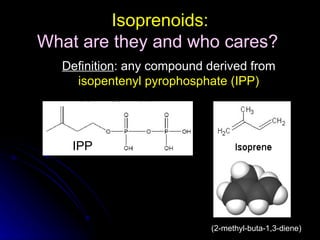
Isoprenoids: What are they and who cares?   Definition : any compound derived from  isopentenyl pyrophosphate (IPP) (2-methyl-buta-1,3-diene) IPP
Isoprenoids in animals
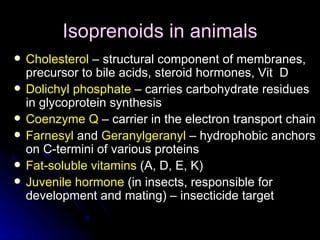
Isoprenoids in animals Cholesterol  – structural component of membranes, precursor to bile acids, steroid hormones, Vit  D Dolichyl phosphate  – carries carbohydrate residues in glycoprotein synthesis Coenzyme Q  – carrier in the electron transport chain Farnesyl  and  Geranylgeranyl  – hydrophobic anchors on C-termini of various proteins Fat-soluble vitamins  (A, D, E, K) Juvenile hormone  (in insects, responsible for development and mating) – insecticide target
Coenzyme Q  (a.k.a.  ubiquinone ) and dolichyl phosphate (Dol-P): two compounds synthesized from IPP
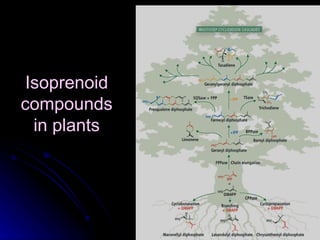
Isoprenoid compounds in plants
Isoprenoids in plants Sterols   (structure)  Chlorophyll  (light absorption) Carotenoids  (energy transfer and photoprotection) Absisic acid  (hormone) Zeatin  (cytokines) Gibberillins  (growth regulator) Isoprene  (gas)
Drugs : taxol (anticancer); artemesinin (antimalarial) Rubber  (latex, gutta-percha) Perfumes  (geraniol, etc.) Cleansing Agents  (PineSol ® ) Isoprenoids in modern life
How is IPP biosynthesized?
In animals, IPP is synthesized from  mevalonate (MVA)
In bacteria, plastids and some protozoa, IPP is synthesized via methylerythritol phosphate (MEP)
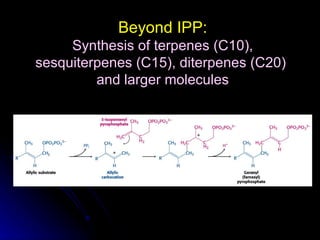
Beyond IPP: Synthesis of terpenes (C10), sesquiterpenes (C15), diterpenes (C20)  and larger molecules
IPP reacts with GPP to make FPP.  In animals, FPP can be metabolized to cholesterol, Dol-P, ubiquinone, GGPP, or farnesylated proteins.
Isoprenoid  Research:  How best to synthesize the isoprenoid pyrophosphate intermediates?
Synthesis of Isoprenoid Pyrophosphates -  “ Classical” method  (Cramer, F.; Rittersdorf, W.; Bohm, M.  Liebigs Ann. Chem.   1962 ,  654 , 180 ) -  Poulter method  (Davisson, V.J.; Woodside, A.B.; Poulter, C.D.  Methods Enzymol.   1985 ,  110 , 130-144)
Keller & Thompson modification of the Cramer method
Mix alcohol, TEAP, trichloroacetonitrile in ACN. Incubate 37 o C, 15 min.  Apply reaction to silica chromatography Collect product. Yield: 30%. Products: mono, di, triphosphates. Time required: 2 h. Keller & Thompson procedure
ROH R-O-P-O - - = O - O - ACN Proposed mechanism for the phosphorylation reaction using  bis- triethylammonium phosphate R= isopentenol, dimetylallyl alcohol, geraniol, farnesol, geranylgeraniol n
TLC of products of [ 3 H]Farnesol-bisTEAP reaction
Preparative TLC of farnesol- bis TEAP reaction products
Monitoring of flash chromatography column in isolation of FPP using the method of Keller and Thompson
 
TLC of products prepared by the method of Keller & Thompson J. Chromatography 645, 1993, 161 IPP  GPP  FPP  GGPP  FMP  FPPP GPP FPP GGPP SILICA   RP
HPLC (straight phase) of FPP ( left ) prepared by the procedure of Keller & Thompson J. Chromatography 645, 1993, 161
Capillary electrophoresis of isoprenoid pyrophosphates prepared by the procedure of Keller & Thompson J. Chromatography 737, 1996 , 325
Capillary electrophoresis resolves geranyl phosphate (GMP), citronellyl phosphate (CMP), and neryl phosphate (NMP), all of which are  easily resolved from farnesyl phosphate (FMP). J. Chromatography 737, 1996, 325
31 P NMR of Farnesyl mono, di, and triphosphate prepared by the procedure of Keller and Thompson   J. Chromatography 737, 1996, 325 FP FPP FPPP
Biological activities of isoprenoid pyrophosphates prepared by the procedure of Keller and Thompson Enzyme assays: Protein farnesyl transferase FPP + Protein-C-AAX    Protein-C-AAX + PP i
Conclusion The isoprenoid pyrophosphates, widely used in studies of isoprenoid metabolism, can be rapidly prepared from the starting alcohols using  bis (triethylammonium) phosphate and trichloroacetonitrile, followed by silica chromatography.
Opened 2005 at USF Connect:
Price Comparison
Marketing Google adwords Direct email Based on recent abstracts Based on recent publications Based on grants received

Isoprenoids

  • 1.
    Isoprenoids R. KennedyKeller, Ph.D. Professor, Molecular Medicine, USF Health President, Isoprenoids, LC Grand Prismatic Spring, Yellowstone Natl Park Jim Peaco, NPS
  • 2.
    Isoprenoids: What arethey and who cares? Definition : any compound derived from isopentenyl pyrophosphate (IPP) (2-methyl-buta-1,3-diene) IPP
  • 3.
  • 4.
    Isoprenoids in animalsCholesterol – structural component of membranes, precursor to bile acids, steroid hormones, Vit D Dolichyl phosphate – carries carbohydrate residues in glycoprotein synthesis Coenzyme Q – carrier in the electron transport chain Farnesyl and Geranylgeranyl – hydrophobic anchors on C-termini of various proteins Fat-soluble vitamins (A, D, E, K) Juvenile hormone (in insects, responsible for development and mating) – insecticide target
  • 5.
    Coenzyme Q (a.k.a. ubiquinone ) and dolichyl phosphate (Dol-P): two compounds synthesized from IPP
  • 6.
  • 7.
    Isoprenoids in plantsSterols (structure) Chlorophyll (light absorption) Carotenoids (energy transfer and photoprotection) Absisic acid (hormone) Zeatin (cytokines) Gibberillins (growth regulator) Isoprene (gas)
  • 8.
    Drugs : taxol(anticancer); artemesinin (antimalarial) Rubber (latex, gutta-percha) Perfumes (geraniol, etc.) Cleansing Agents (PineSol ® ) Isoprenoids in modern life
  • 9.
    How is IPPbiosynthesized?
  • 10.
    In animals, IPPis synthesized from mevalonate (MVA)
  • 11.
    In bacteria, plastidsand some protozoa, IPP is synthesized via methylerythritol phosphate (MEP)
  • 12.
    Beyond IPP: Synthesisof terpenes (C10), sesquiterpenes (C15), diterpenes (C20) and larger molecules
  • 13.
    IPP reacts withGPP to make FPP. In animals, FPP can be metabolized to cholesterol, Dol-P, ubiquinone, GGPP, or farnesylated proteins.
  • 14.
    Isoprenoid Research: How best to synthesize the isoprenoid pyrophosphate intermediates?
  • 15.
    Synthesis of IsoprenoidPyrophosphates - “ Classical” method (Cramer, F.; Rittersdorf, W.; Bohm, M. Liebigs Ann. Chem. 1962 , 654 , 180 ) - Poulter method (Davisson, V.J.; Woodside, A.B.; Poulter, C.D. Methods Enzymol. 1985 , 110 , 130-144)
  • 16.
    Keller & Thompsonmodification of the Cramer method
  • 17.
    Mix alcohol, TEAP,trichloroacetonitrile in ACN. Incubate 37 o C, 15 min. Apply reaction to silica chromatography Collect product. Yield: 30%. Products: mono, di, triphosphates. Time required: 2 h. Keller & Thompson procedure
  • 18.
    ROH R-O-P-O -- = O - O - ACN Proposed mechanism for the phosphorylation reaction using bis- triethylammonium phosphate R= isopentenol, dimetylallyl alcohol, geraniol, farnesol, geranylgeraniol n
  • 19.
    TLC of productsof [ 3 H]Farnesol-bisTEAP reaction
  • 20.
    Preparative TLC offarnesol- bis TEAP reaction products
  • 21.
    Monitoring of flashchromatography column in isolation of FPP using the method of Keller and Thompson
  • 22.
  • 23.
    TLC of productsprepared by the method of Keller & Thompson J. Chromatography 645, 1993, 161 IPP GPP FPP GGPP FMP FPPP GPP FPP GGPP SILICA RP
  • 24.
    HPLC (straight phase)of FPP ( left ) prepared by the procedure of Keller & Thompson J. Chromatography 645, 1993, 161
  • 25.
    Capillary electrophoresis ofisoprenoid pyrophosphates prepared by the procedure of Keller & Thompson J. Chromatography 737, 1996 , 325
  • 26.
    Capillary electrophoresis resolvesgeranyl phosphate (GMP), citronellyl phosphate (CMP), and neryl phosphate (NMP), all of which are easily resolved from farnesyl phosphate (FMP). J. Chromatography 737, 1996, 325
  • 27.
    31 P NMRof Farnesyl mono, di, and triphosphate prepared by the procedure of Keller and Thompson J. Chromatography 737, 1996, 325 FP FPP FPPP
  • 28.
    Biological activities ofisoprenoid pyrophosphates prepared by the procedure of Keller and Thompson Enzyme assays: Protein farnesyl transferase FPP + Protein-C-AAX  Protein-C-AAX + PP i
  • 29.
    Conclusion The isoprenoidpyrophosphates, widely used in studies of isoprenoid metabolism, can be rapidly prepared from the starting alcohols using bis (triethylammonium) phosphate and trichloroacetonitrile, followed by silica chromatography.
  • 30.
    Opened 2005 atUSF Connect:
  • 31.
  • 32.
    Marketing Google adwordsDirect email Based on recent abstracts Based on recent publications Based on grants received

Editor's Notes

  • #2 Aerial view of Grand Prismatic Spring; Midway & Lower Geyser Basin; Jim Peaco; July 2001 Yellowstone National Park Image by NPS Photo The Grand Prismatic Spring of Yellowstone National Park showing steam rising from hot and sterile deep azure blue water in the center surrounded by huge mats of brilliant orange algae and bacteria. The color of which is due to the ratio of chlorophyll to carotenoid molecules produced by the organisms. During summertime the chlorophyll content of the organisms is low and thus the mats appear orange, red, or yellow. However during the winter, the mats are usually dark green, because sunlight is more scarce and the microbes produce more chlorophyll to compensate, thereby masking the carotenoid colors. It is 90 meters (300 feet) across and 50 meters (160 feet) deep. In the center of the pool the water is 87° C (188° F)—too hot to support life. In the cooler water along the edges of the pool, however, colonies of thermophilic (heat-loving) cyano-bacteria and algae thrive. Yellow, orange, and red pigments are produced by the bacteria as a natural sunscreen. As a result, the pool displays a spectrum of colors from the bright blue of the center to the orange, red, and brown algal mats along the edges.