Slide 1
PRESENTATION OD DATA
Dr. Athar Khan
MBBS, MCPS, DPH, MBA, DCPS-HPE, DCPS-HCSM,
PGD-Statistics, PhD Scholar
Associate Professor
Department of Community Medicine
Liaquat College of Medicine & Dentistry
Karachi, Pakistan
matharm@yahoo.com
DR ATHAR KHAN - LCMD
‫الرحيم‬ ‫الرحمن‬ ‫اهلل‬ ‫بسم‬
Slide 2Learning Objectives
• Describe the type of data presentation
• List the advantages of tabular & graphic
presentations
DR ATHAR KHAN - LCMD
Slide 3
DR ATHAR KHAN - LCMD
Slide 4
DR ATHAR KHAN - LCMD
Slide 5
DR ATHAR KHAN - LCMD
Slide 6Presentation of Data
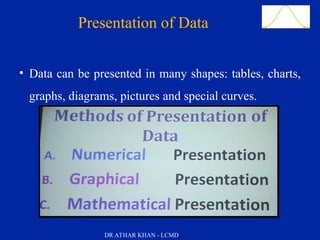
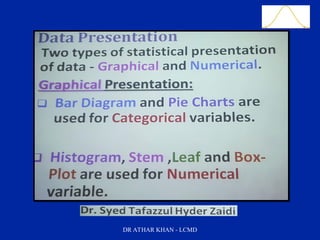
• Data can be presented in many shapes: tables, charts,
graphs, diagrams, pictures and special curves.
DR ATHAR KHAN - LCMD
Slide 7
DR ATHAR KHAN - LCMD
Slide 8Presentation of Data
1.TABULATION:
• Tables are devices that are used to present the data in
simple form and probably the first and most
commonly used method for presenting information,
DR ATHAR KHAN - LCMD
Slide 9TABULATION
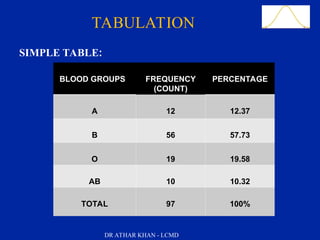
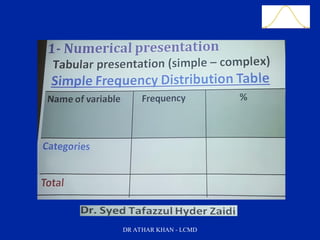
SIMPLE TABLE:
BLOOD GROUPS FREQUENCY
(COUNT)
PERCENTAGE
A 12 12.37
B 56 57.73
O 19 19.58
AB 10 10.32
TOTAL 97 100%
DR ATHAR KHAN - LCMD
Slide 10
DR ATHAR KHAN - LCMD
Slide 11
DR ATHAR KHAN - LCMD
✓
Slide 12
Slide 13
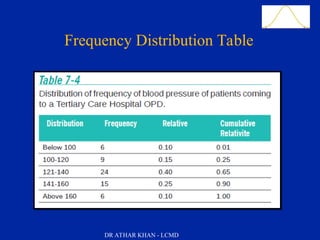
 Frequency Table
lists data values (either individually or by groups of
intervals), along with their corresponding
frequencies or counts
Frequency Distribution Table
DR ATHAR KHAN - LCMD
Slide 14
Frequency Distribution Table
DR ATHAR KHAN - LCMD
Slide 15
DR ATHAR KHAN - LCMD
Slide 16
Class Interval
Lower Class Limits
Upper Class Limit
Class Width
Class Boundaries
Class Midpoints
DR ATHAR KHAN - LCMD
Slide 17
Presentation of
Qualitative/Categorical Data
DR ATHAR KHAN - LCMD
Slide 18
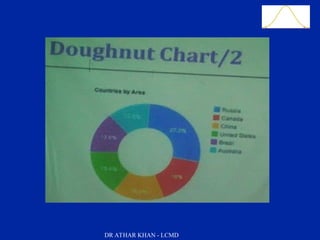
Pie Chart/Circle Graph
A pie chart is a circular chart in which the circle is
divided into sectors.  Each sector visually represents
an item in a data set to match the amount of the item
as a percentage or fraction of the total data set. It is
suitable for 4 or 5 categories.
DR ATHAR KHAN - LCMD
Slide 19
DR ATHAR KHAN - LCMD
Slide 20
DR ATHAR KHAN - LCMD
Slide 21
Pie Chart
DR ATHAR KHAN - LCMD
Slide 22
DR ATHAR KHAN - LCMD
Slide 23
DR ATHAR KHAN - LCMD
Slide 24
DR ATHAR KHAN - LCMD
Slide 25
SIMPLE BAR CHART
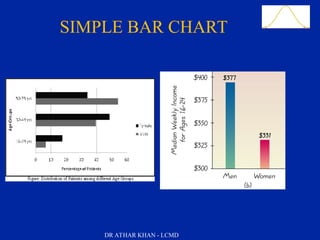
• A graph consisting of parallel, usually vertical bars or
rectangles with lengths proportional to the frequency
with which specified quantities occur in a set of data
• Suitable for more than 5 categories
• The bars are separated by appropriate spaces
• The height of rectangle represents the frequency or the
magnitude.
HORIZONTAL VERTICAL
Slide 26
SIMPLE BAR CHART
DR ATHAR KHAN - LCMD
Slide 27
DR ATHAR KHAN - LCMD
Slide 28
DR ATHAR KHAN - LCMD
Slide 29
DR ATHAR KHAN - LCMD
Slide 30
MULTIPLE BAR GRAPH
When each category of data is further subdivided into two
or more categories. Multiple bars are used to present the
ordinal data as well.
0
2
4
6
8
0 - 9 10 - 19 20 - 29 30 - 39 40 - 49 50 - 59 60 - 69 70 -
Age-group
Male
Female
Number of cases
DR ATHAR KHAN - LCMD
Slide 31COMPOSITE/COMPONENT BAR GRAPH
When there are more than 5 categories on X-axis
and they have further sub-categories
0 %
20 %
40 %
60 %
80 %
100 %
0 - 9 10 - 19 20 - 29 30 - 39 40 - 49 50 - 59 60 - 69 70 -
Age-group
Male FemaleProportional distribution by sex
DR ATHAR KHAN - LCMD
Slide 32
Presentation of
Quantitative/Numerical Data
DR ATHAR KHAN - LCMD
Slide 33
Histogram
A bar graph in which the horizontal scale represents
the class interval/boundaries and the vertical scale
represents the frequencies. The area of each block or
rectangle is proportional to the frequency.
Figure 2-1
DR ATHAR KHAN - LCMD
Slide 34
DR ATHAR KHAN - LCMD
Slide 35
DR ATHAR KHAN - LCMD
Slide 36Relative Frequency Histogram
Has the same shape and horizontal scale as a
histogram, but the vertical scale is marked with
relative frequencies.
Figure 2-2
DR ATHAR KHAN - LCMD
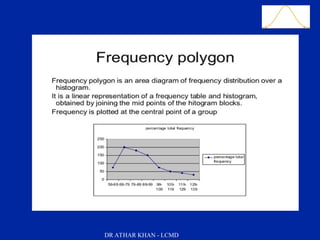
Slide 37Frequency Polygon
Uses line segments connected to points directly
above at the midpoint of the class interval
Figure 2-3
DR ATHAR KHAN - LCMD
Slide 38
DR ATHAR KHAN - LCMD
Slide 39Ogive/Cumulative Frequency Polygons
A line graph that depicts cumulative frequencies
Figure 2-4
DR ATHAR KHAN - LCMD
Slide 40Dot Plot
Consists of a graph in which each data value is
plotted as a point along a scale of values
Figure 2-5
DR ATHAR KHAN - LCMD
Slide 41Stem-and Leaf Plot
Represents data by separating each value into two
parts: the stem (such as the leftmost digit) and the
leaf (such as the rightmost digit)
DR ATHAR KHAN - LCMD
Slide 42
Scatter Diagram
Scatter diagram shows the relationship between two
quantitative variables .
A plot of paired ( x, y) data with a horizontal x-axis and a
vertical y-axis
DR ATHAR KHAN - LCMD
Slide 43
DR ATHAR KHAN - LCMD
Slide 44
Scatter Diagram
DR ATHAR KHAN - LCMD
Y
Dependent
X
Independent
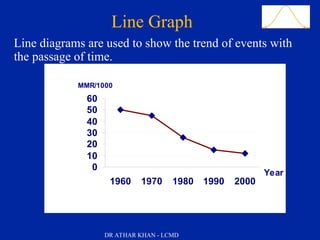
Slide 45Line Graph
0
10
20
30
40
50
60
1960 1970 1980 1990 2000
Year
MMR/1000
DR ATHAR KHAN - LCMD
Line diagrams are used to show the trend of events with
the passage of time.
Slide 46SPOT MAPS
8
6
7
1
2
3
4
5
9
10
DR ATHAR KHAN - LCMD
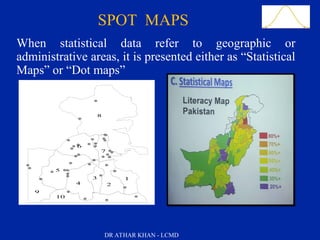
When statistical data refer to geographic or
administrative areas, it is presented either as “Statistical
Maps” or “Dot maps”
Slide 47PICTOGRAM
DR ATHAR KHAN - LCMD
Pictograms are a popular method of presenting data to
the “man in the street”.
Small pictures or symbols are used to present the data.
Pictograms are a form of bar charts.
Slide 48
DR ATHAR KHAN - LCMD
Slide 49
SUMMARY
DR ATHAR KHAN - LCMD
Slide 50
QUALITATIVE
VARIABLE
QUANTITATIVE
VARIABLE
Bar or Pie Chart Histogram, Frequency
Polygon, Ogive
DR ATHAR KHAN - LCMD
Slide 51
DR ATHAR KHAN - LCMD
Slide 52
DR ATHAR KHAN - LCMD
Slide 53
DR ATHAR KHAN - LCMD
HEADING
HEADING
Slide 54
THANK YOU
DR ATHAR KHAN - LCMD

Methods of data presentation