PRESENT BY
ANIL KUMAR SHARMA
M.S.W 3rd
SEMESTER
DIAGRAMS
(ONE DIMENSIONAL)
A diagram is a visual from for presentation of statistical
data, highlighting their basic facts and relationship. If
we draw diagrams on the basis of the data collected
they will easily be understood and appreciated by all. It
is readily intelligible and save a considerable amount of
time and energy.
Diagrams are extremely useful because of the following
reasons.
1. They are attractive and impressive.
2. They make data simple and intelligible.
3. They make comparison possible
4. They save time and labour.
5. They have universal utility.
6. They give more information.
7. They have a great memorizing effect.
TYPES OF DIAGRAMS
One-dimensional diagrams
Two-dimensional diagrams
Three-dimensional diagrams
Pictograms and Cartograms
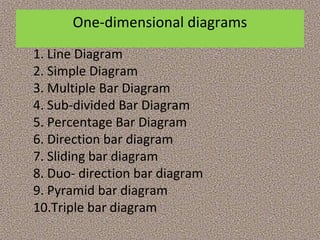
One-dimensional diagrams
1. Line Diagram
2. Simple Diagram
3. Multiple Bar Diagram
4. Sub-divided Bar Diagram
5. Percentage Bar Diagram
6. Direction bar diagram
7. Sliding bar diagram
8. Duo- direction bar diagram
9. Pyramid bar diagram
10.Triple bar diagram
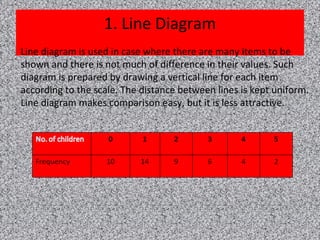
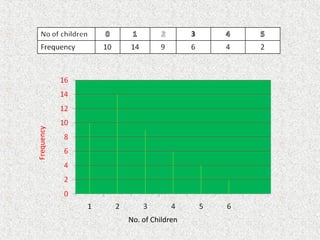
1. Line Diagram
Line diagram is used in case where there are many items to be
shown and there is not much of difference in their values. Such
diagram is prepared by drawing a vertical line for each item
according to the scale. The distance between lines is kept uniform.
Line diagram makes comparison easy, but it is less attractive.
No. of Children
Frequency
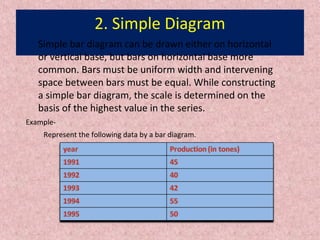
2. Simple Diagram
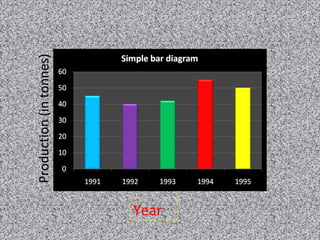
Simple bar diagram can be drawn either on horizontal
or vertical base, but bars on horizontal base more
common. Bars must be uniform width and intervening
space between bars must be equal. While constructing
a simple bar diagram, the scale is determined on the
basis of the highest value in the series.
Represent the following data by a bar diagram.
Example-
Year
Production(intonnes)
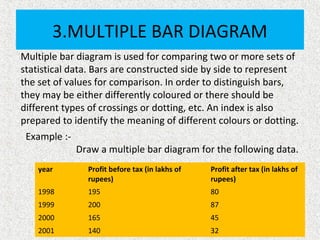
3.MULTIPLE BAR DIAGRAM
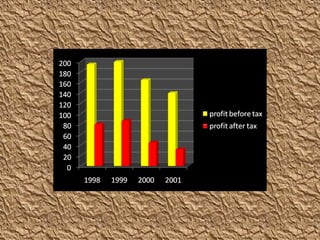
Multiple bar diagram is used for comparing two or more sets of
statistical data. Bars are constructed side by side to represent
the set of values for comparison. In order to distinguish bars,
they may be either differently coloured or there should be
different types of crossings or dotting, etc. An index is also
prepared to identify the meaning of different colours or dotting.
Example :-
Draw a multiple bar diagram for the following data.
year Profit before tax (in lakhs of
rupees)
Profit after tax (in lakhs of
rupees)
1998 195 80
1999 200 87
2000 165 45
2001 140 32
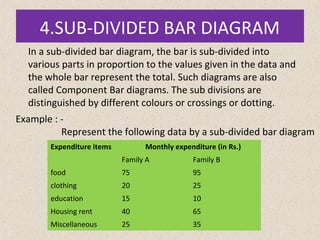
4.SUB-DIVIDED BAR DIAGRAM
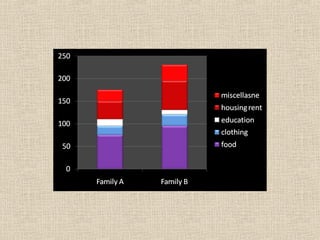
In a sub-divided bar diagram, the bar is sub-divided into
various parts in proportion to the values given in the data and
the whole bar represent the total. Such diagrams are also
called Component Bar diagrams. The sub divisions are
distinguished by different colours or crossings or dotting.
Example : -
Represent the following data by a sub-divided bar diagram
Expenditure items Monthly expenditure (in Rs.)
Family A Family B
food 75 95
clothing 20 25
education 15 10
Housing rent 40 65
Miscellaneous 25 35
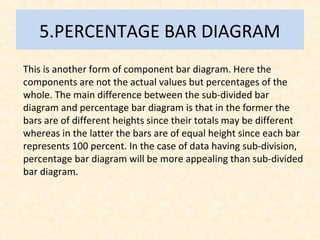
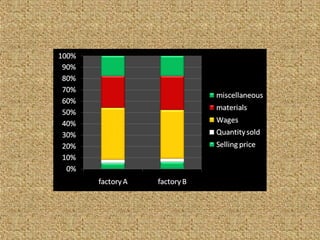
5.PERCENTAGE BAR DIAGRAM
This is another form of component bar diagram. Here the
components are not the actual values but percentages of the
whole. The main difference between the sub-divided bar
diagram and percentage bar diagram is that in the former the
bars are of different heights since their totals may be different
whereas in the latter the bars are of equal height since each bar
represents 100 percent. In the case of data having sub-division,
percentage bar diagram will be more appealing than sub-divided
bar diagram.
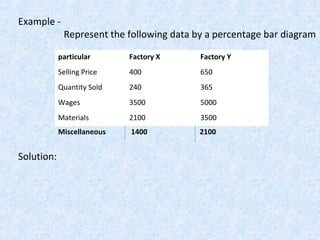
Example -
Represent the following data by a percentage bar diagram
particular Factory X Factory Y
Selling Price 400 650
Quantity Sold 240 365
Wages 3500 5000
Materials 2100 3500
Miscellaneous 1400 2100
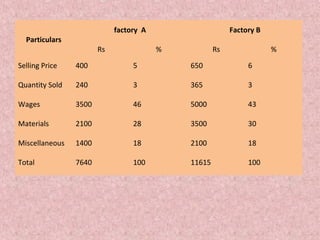
Solution:
Particulars
factory A Factory B
Rs % Rs %
Selling Price 400 5 650 6
Quantity Sold 240 3 365 3
Wages 3500 46 5000 43
Materials 2100 28 3500 30
Miscellaneous 1400 18 2100 18
Total 7640 100 11615 100
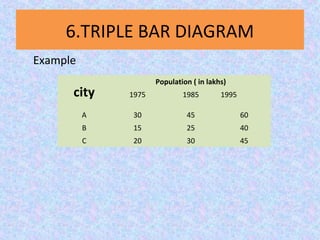
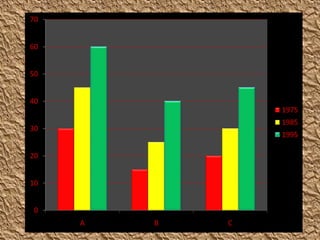
6.TRIPLE BAR DIAGRAM
Example
city
Population ( in lakhs)
1975 1985 1995
A 30 45 60
B 15 25 40
C 20 30 45
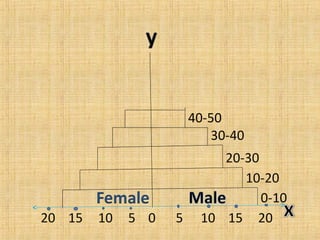
7.PYRAMID BAR DIAGRAM
Example-
Age [ in year]
Population [in crore]
Male Female
0-10 19 17
10-20 16 14.5
20-30 12.5 11
30-40 10 8
40-50 7 5.5
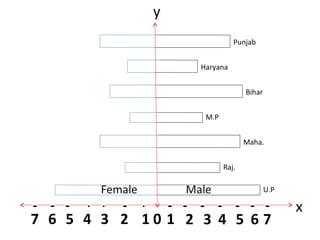
8.DIRECTIONAL BAR DIAGRAM
States
Persons [in lakhs]
Male Female
U.P 6.5 6
Raj. 4 2
Maha. 5 3.5
M.P 2.9 2.1
Bihar 5 3
Haryana 2.5 2
Punjab 4.5 3.5
U.P
Raj.
Maha.
M.P
Bihar
Haryana
Punjab
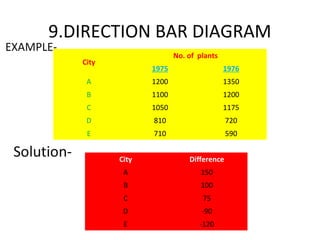
9.DIRECTION BAR DIAGRAM
City
No. of plants
1975 1976
A 1200 1350
B 1100 1200
C 1050 1175
D 810 720
E 710 590
City Difference
A 150
B 100
C 75
D -90
E -120
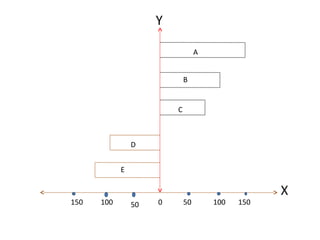
100100 150150 5050 0
A
B
C
D
E

statistics Diagrams

  • 1.
    PRESENT BY ANIL KUMARSHARMA M.S.W 3rd SEMESTER DIAGRAMS (ONE DIMENSIONAL)
  • 2.
    A diagram isa visual from for presentation of statistical data, highlighting their basic facts and relationship. If we draw diagrams on the basis of the data collected they will easily be understood and appreciated by all. It is readily intelligible and save a considerable amount of time and energy.
  • 3.
    Diagrams are extremelyuseful because of the following reasons. 1. They are attractive and impressive. 2. They make data simple and intelligible. 3. They make comparison possible 4. They save time and labour. 5. They have universal utility. 6. They give more information. 7. They have a great memorizing effect.
  • 4.
    TYPES OF DIAGRAMS One-dimensionaldiagrams Two-dimensional diagrams Three-dimensional diagrams Pictograms and Cartograms
  • 5.
    One-dimensional diagrams 1. LineDiagram 2. Simple Diagram 3. Multiple Bar Diagram 4. Sub-divided Bar Diagram 5. Percentage Bar Diagram 6. Direction bar diagram 7. Sliding bar diagram 8. Duo- direction bar diagram 9. Pyramid bar diagram 10.Triple bar diagram
  • 6.
    1. Line Diagram Linediagram is used in case where there are many items to be shown and there is not much of difference in their values. Such diagram is prepared by drawing a vertical line for each item according to the scale. The distance between lines is kept uniform. Line diagram makes comparison easy, but it is less attractive.
  • 7.
  • 8.
    2. Simple Diagram Simplebar diagram can be drawn either on horizontal or vertical base, but bars on horizontal base more common. Bars must be uniform width and intervening space between bars must be equal. While constructing a simple bar diagram, the scale is determined on the basis of the highest value in the series. Represent the following data by a bar diagram. Example-
  • 9.
  • 10.
    3.MULTIPLE BAR DIAGRAM Multiplebar diagram is used for comparing two or more sets of statistical data. Bars are constructed side by side to represent the set of values for comparison. In order to distinguish bars, they may be either differently coloured or there should be different types of crossings or dotting, etc. An index is also prepared to identify the meaning of different colours or dotting. Example :- Draw a multiple bar diagram for the following data. year Profit before tax (in lakhs of rupees) Profit after tax (in lakhs of rupees) 1998 195 80 1999 200 87 2000 165 45 2001 140 32
  • 12.
    4.SUB-DIVIDED BAR DIAGRAM Ina sub-divided bar diagram, the bar is sub-divided into various parts in proportion to the values given in the data and the whole bar represent the total. Such diagrams are also called Component Bar diagrams. The sub divisions are distinguished by different colours or crossings or dotting. Example : - Represent the following data by a sub-divided bar diagram Expenditure items Monthly expenditure (in Rs.) Family A Family B food 75 95 clothing 20 25 education 15 10 Housing rent 40 65 Miscellaneous 25 35
  • 14.
    5.PERCENTAGE BAR DIAGRAM Thisis another form of component bar diagram. Here the components are not the actual values but percentages of the whole. The main difference between the sub-divided bar diagram and percentage bar diagram is that in the former the bars are of different heights since their totals may be different whereas in the latter the bars are of equal height since each bar represents 100 percent. In the case of data having sub-division, percentage bar diagram will be more appealing than sub-divided bar diagram.
  • 15.
    Example - Represent thefollowing data by a percentage bar diagram particular Factory X Factory Y Selling Price 400 650 Quantity Sold 240 365 Wages 3500 5000 Materials 2100 3500 Miscellaneous 1400 2100 Solution:
  • 16.
    Particulars factory A FactoryB Rs % Rs % Selling Price 400 5 650 6 Quantity Sold 240 3 365 3 Wages 3500 46 5000 43 Materials 2100 28 3500 30 Miscellaneous 1400 18 2100 18 Total 7640 100 11615 100
  • 18.
    6.TRIPLE BAR DIAGRAM Example city Population( in lakhs) 1975 1985 1995 A 30 45 60 B 15 25 40 C 20 30 45
  • 20.
    7.PYRAMID BAR DIAGRAM Example- Age[ in year] Population [in crore] Male Female 0-10 19 17 10-20 16 14.5 20-30 12.5 11 30-40 10 8 40-50 7 5.5
  • 22.
    8.DIRECTIONAL BAR DIAGRAM States Persons[in lakhs] Male Female U.P 6.5 6 Raj. 4 2 Maha. 5 3.5 M.P 2.9 2.1 Bihar 5 3 Haryana 2.5 2 Punjab 4.5 3.5
  • 23.
  • 24.
    9.DIRECTION BAR DIAGRAM City No.of plants 1975 1976 A 1200 1350 B 1100 1200 C 1050 1175 D 810 720 E 710 590 City Difference A 150 B 100 C 75 D -90 E -120
  • 25.
    100100 150150 50500 A B C D E