BIOSTATISTICS
BIOSTATISTICS
Lecture 14
Dr. noorah murad
B.D.S. D.D.S.
Part 3
Data presentation
it is a way to summarize and analyze large
masses of data
 Various methods are seen in data presentation but
the most common are:
1. Tabular presentation of data.
2. graphical presentation of data.
DATA PRESENTATION
Tabular presentation of
data
 frequency distribution table
A table show data in
different classes or
categories and number of
cases that fall in each class
graphical presentation of
data
A. Histogram
B. Bar graph
1. Simple bar graph
2. Multiple bar graph
3. Sub divided bar
graph
C. Frequency polygon
D. Pie diagram
E. Line graphs
F. Scatter plots diagram
G. Statistical or dot map
H. pictogram
METHODS OF DATA PRESENTATION
%NumberGender
58.644female
41.431male
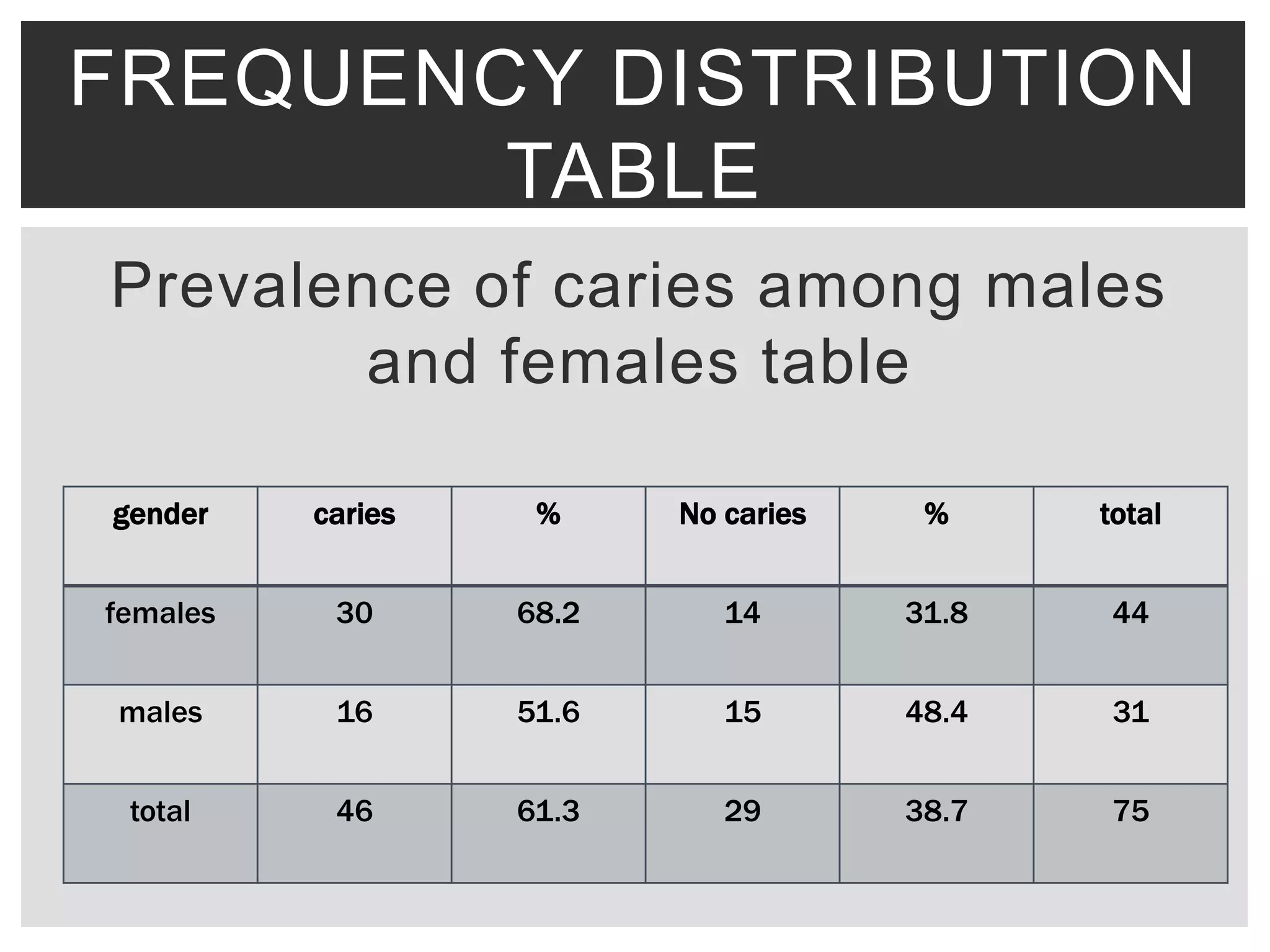
Prevalence of caries among males
and females table
FREQUENCY DISTRIBUTION
TABLE
total%No caries%cariesgender
4431.81468.230females
3148.41551.616males
7538.72961.346total
It is the visual display of data using plots
and diagrams or charts
Graphics are used to better understanding
of data and make a trend in data easy to
see
The type of graphic presentation depend
on:
1. Nature of data.
2. Nature of statistical results.
THE GRAPHICAL REPRESENTATION
OF DATA
HISTOGRAM
 a collection of rectangles whose height represents the class
frequency and whose extent represent class width
 Used with quantitative data & No gaps between bars
 The classes with greater frequency have taller bar
 The variable plotted in the form of bars
 Have two axes : one describe type of categories, the other
have number represent the data value
 It is used for qualitative type of data
 Bars can be plotted horizontal or vertical
1.Simple bar graph
One variable
BAR GRAPH
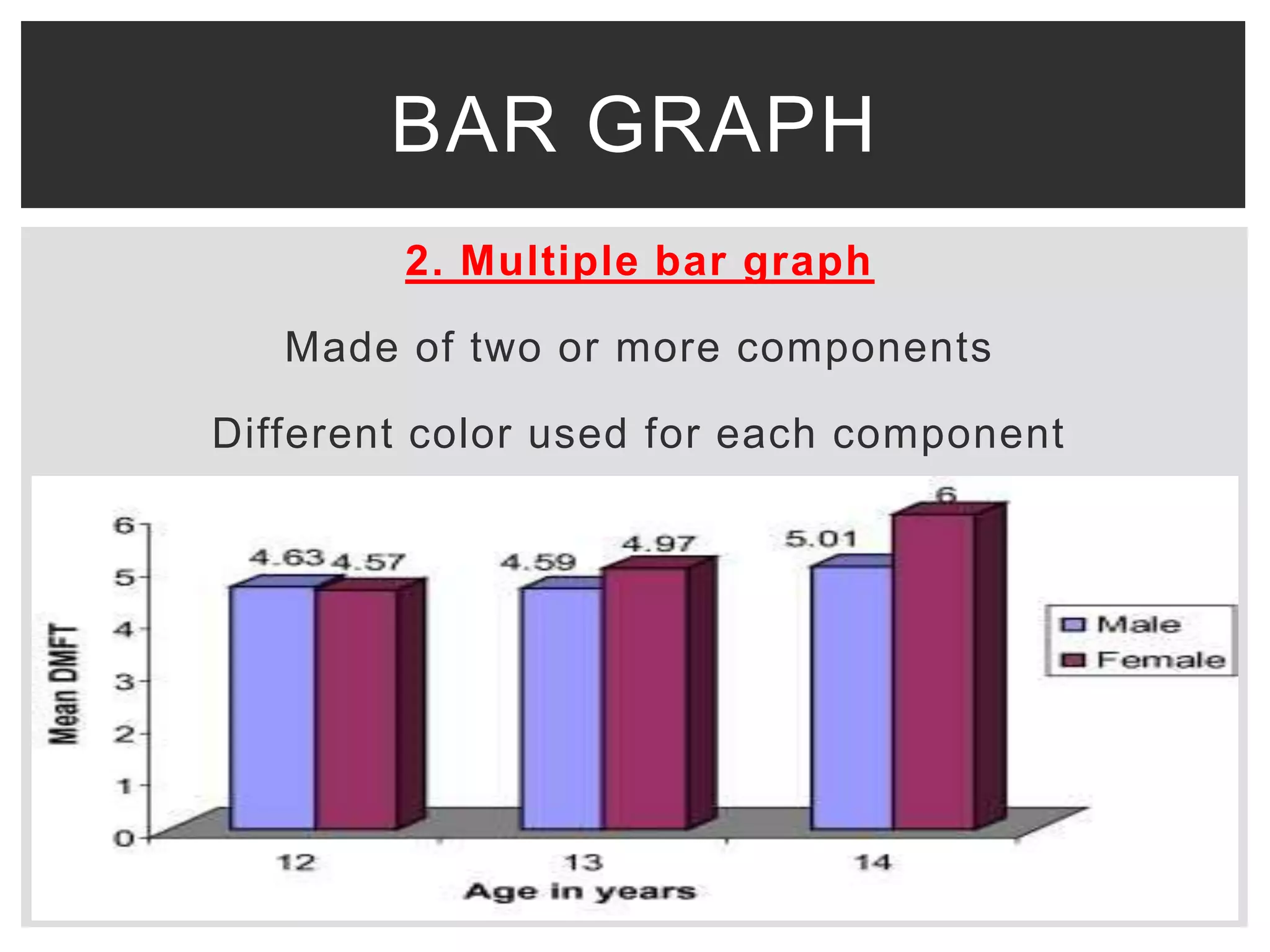
2. Multiple bar graph
Made of two or more components
Different color used for each component
BAR GRAPH
3. Sub divided bar graph (compound bar)
Used when there are many categories and they have further
sub categories
bar divided in to parts
various components should kept in the same order
Components are shown with different colors
BAR GRAPH
 Plot the class mid point against class frequency to obtain a
display of single points
It’s an area diagram distributed over a histogram
Obtained by joining the mid points of the histogram
blocks
THE FREQUENCY POLYGON
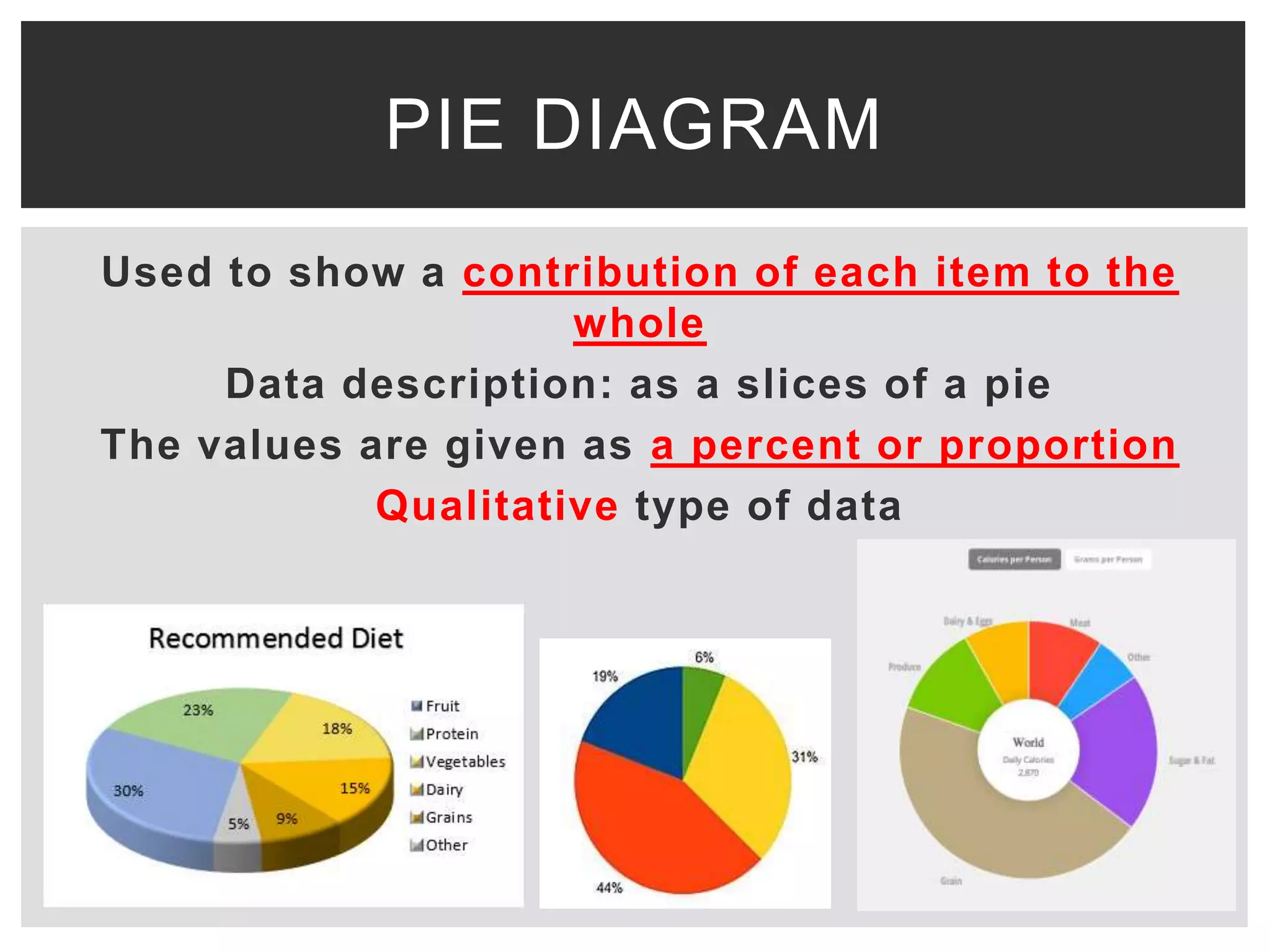
Used to show a contribution of each item to the
whole
Data description: as a slices of a pie
The values are given as a percent or proportion
Qualitative type of data
PIE DIAGRAM
Use line segments to connect data points and show
changes in data over time
Each quantitative data value becomes a dot or point
LINE GRAPHS
 Visualize a relation between two variables X & Y
both of them quantitative.
 If the dots cluster round a straight line, it shows
evidence of a relationship of a linear nature, if their
is no such cluster, it is probable that there is no
relationship between the variables.
SCATTER PLOTS DIAGRAM
 Used when statistical data refers to geographic or
regional distribution of a variable.
 The areas are shaded with different color.
STATISTICAL OR DOT MAP
 Popular method of presenting data to those who cannot
understand conventional charts .
 Small pictures or symbols are used to present the data.
 Fraction of the picture can be used to represent
numbers smaller than the value of whole symbol.
 E.g. : a picture of a doctor to represent the population
physician.
PICTOGRAM
Lec 14
Lec 14

Lec 14

  • 1.
    BIOSTATISTICS BIOSTATISTICS Lecture 14 Dr. noorahmurad B.D.S. D.D.S. Part 3 Data presentation
  • 2.
    it is away to summarize and analyze large masses of data  Various methods are seen in data presentation but the most common are: 1. Tabular presentation of data. 2. graphical presentation of data. DATA PRESENTATION
  • 3.
    Tabular presentation of data frequency distribution table A table show data in different classes or categories and number of cases that fall in each class graphical presentation of data A. Histogram B. Bar graph 1. Simple bar graph 2. Multiple bar graph 3. Sub divided bar graph C. Frequency polygon D. Pie diagram E. Line graphs F. Scatter plots diagram G. Statistical or dot map H. pictogram METHODS OF DATA PRESENTATION %NumberGender 58.644female 41.431male
  • 4.
    Prevalence of cariesamong males and females table FREQUENCY DISTRIBUTION TABLE total%No caries%cariesgender 4431.81468.230females 3148.41551.616males 7538.72961.346total
  • 5.
    It is thevisual display of data using plots and diagrams or charts Graphics are used to better understanding of data and make a trend in data easy to see The type of graphic presentation depend on: 1. Nature of data. 2. Nature of statistical results. THE GRAPHICAL REPRESENTATION OF DATA
  • 6.
    HISTOGRAM  a collectionof rectangles whose height represents the class frequency and whose extent represent class width  Used with quantitative data & No gaps between bars  The classes with greater frequency have taller bar
  • 7.
     The variableplotted in the form of bars  Have two axes : one describe type of categories, the other have number represent the data value  It is used for qualitative type of data  Bars can be plotted horizontal or vertical 1.Simple bar graph One variable BAR GRAPH
  • 8.
    2. Multiple bargraph Made of two or more components Different color used for each component BAR GRAPH
  • 9.
    3. Sub dividedbar graph (compound bar) Used when there are many categories and they have further sub categories bar divided in to parts various components should kept in the same order Components are shown with different colors BAR GRAPH
  • 10.
     Plot theclass mid point against class frequency to obtain a display of single points It’s an area diagram distributed over a histogram Obtained by joining the mid points of the histogram blocks THE FREQUENCY POLYGON
  • 11.
  • 12.
    Used to showa contribution of each item to the whole Data description: as a slices of a pie The values are given as a percent or proportion Qualitative type of data PIE DIAGRAM
  • 13.
    Use line segmentsto connect data points and show changes in data over time Each quantitative data value becomes a dot or point LINE GRAPHS
  • 14.
     Visualize arelation between two variables X & Y both of them quantitative.  If the dots cluster round a straight line, it shows evidence of a relationship of a linear nature, if their is no such cluster, it is probable that there is no relationship between the variables. SCATTER PLOTS DIAGRAM
  • 16.
     Used whenstatistical data refers to geographic or regional distribution of a variable.  The areas are shaded with different color. STATISTICAL OR DOT MAP
  • 17.
     Popular methodof presenting data to those who cannot understand conventional charts .  Small pictures or symbols are used to present the data.  Fraction of the picture can be used to represent numbers smaller than the value of whole symbol.  E.g. : a picture of a doctor to represent the population physician. PICTOGRAM