METHODS AND TECHNIQUES OF
GUIDANCE
SPECIFIC AREAS INCLUDE:
 GENERAL INFORMATION
 HEALTH

 ACHIEVEMENT
 APTITUDE
 PERSONAL ADJUSTMENT

 INTERESTS
 PLANS FOR THE FUTURE
 FAMILY BACKGROUND
Techniques for gathering
information about these areas
are:

 1. ADMINISTRATIVE RECORD/CUMULATIVE RECORD- contains facts
about each student background, health and
school history.
 2. INFORMAL TEACHER REPORTS- can
supply helpful guidance information
gathered from observation.
 3. INTERVIEWS WITH STUDENTS AND
PARENTS-enrich information gathered from
other sources.


4. AUTOBIOGRAPHIES- may be required of intermediate pupils and above.



5. USE OF STANDARDIZED TESTS- these are tools of measuring interests, intelligence, aptitudes and personality
traits.



TYPES OF TEST



ACHIEVEMENT TESTS-devised and administered to measure how well a person has learned as an outcome of
instruction.



INTELLIGENCE TESTS- measure general intelligence. Ex..IQ test



APTITUDE TESTS- measure the probable potentially for development prior to training or schooling as tests in
aptitude covered art, music, science, algebra, manual, and mechanical. Its value is the discovery of an individual’s
ability to succeed in a specific field.



INTEREST INVENTORY TEST- reveal the likes/dislikes of a person in appraising his occupational preferences in a
certain field of specialization.



PERSONALITY INVENTORY TESTS- measure the sum total of an individual’s overt behaviour and inner feelings. It
is the totality of what makes an individual different from one another



TRADE TESTS-designed to determine the skills, special abilities and techniques that make an individual fit for a
given occupation as test for engineers, plumbers, mechanics. They maybe oral and picture tests.



DIAGNOSTIC TEST.- aimed to uncover and focus attention on weakness of individuals for remedial purpose.



6. CONDUCTING SURVEY- through the use of questionnaire can cover a wide area of research and quite number
of respondents
 7. OBSERVATION- should be conducted by

the teacher and the counselor in and out of
the classroom.
 8. ANECDOTAL RECORD- should be
prepared by the teacher on significant
incident or event that happened to the
student in school.
 9. CASE STUDY- is the most comprehensive

and thorough technique of gathering
information about a person with a serious
problem
 10. CASE CONFERENCE- is a cooperative conference
 devoted to the intensive study of an individual.
 11. SOCIOMETRY- the mapping of interpersonal likes and

preferences within a classroom.

 THREE TYPES OF SOCIOMETRIC TECHNIQUES ARE:
 THE NOMINATION-the student is asked to select and name

his/her peers in terms of some criteria suggested by the
teacher

 THE SOCIAL ACCEPTANCE-levels of social relationship are

stated and the students asked to express his/her
sociometric choice

 THE WHO’S WHO OR GUESS WHO- brief description of

various types of students are provided and they are asked
to guess who in the class matches with the description.
 12. PROJECTIVE TECHNIQUES- these are

expressive techniques where a child has to
add meaning to a meaningless situation,
which are most useful with very young
children.
 These are indirect and unstructured methods

of investigation which have been developed
by psychologist and use projection of
respondents for inferring about underline
motives, urges and intentions which cannot
be secure through direct questioning as the
respondent either resist to reveal them or is
unable to figure out himself.
TOOLS USED IN PT

1. COMPLETION- the subject is given an
incomplete sentence, story, argument or
conversation, and asked to finish it. It may also

be in the means of showing the subject a
picture of an incomplete situation.

2. EXPRESSIVE- subject is asked to role- play, act,

draw or paint a specific concept or situation
(e.g. handwriting analysis, human figure
drawings, projective puppet play

3. CONSTRUCTION- the subject is asked to
construct a story or a picture from a stimulus
concept.
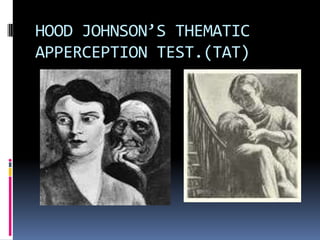
HOOD JOHNSON’S THEMATIC
APPERCEPTION TEST.(TAT)
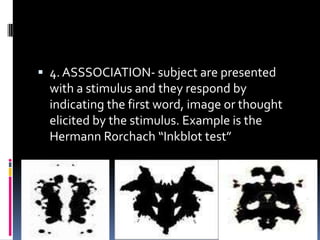
 4. ASSSOCIATION- subject are presented

with a stimulus and they respond by
indicating the first word, image or thought
elicited by the stimulus. Example is the
Hermann Rorchach “Inkblot test”
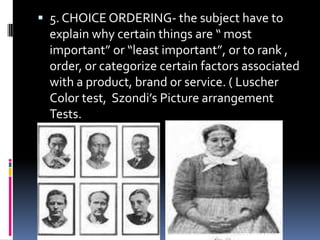
 5. CHOICE ORDERING- the subject have to

explain why certain things are “ most
important” or “least important”, or to rank ,
order, or categorize certain factors associated
with a product, brand or service. ( Luscher
Color test, Szondi’s Picture arrangement
Tests.


It is a projective personality test, the same category of the mostknown Rorschach test, but with the crucial difference of
being nonverbal. The test consists in showing the examinee a series
facial photographs,[11] displayed in six groups of eight each. All 48
subjects featured in the photogtaphs are mental patients, each group
containing a photo of a person whose personality had been classified
as homosexual, a sadist, an epileptic, an hysteric, a katatonic,
a paranoid, a depressive and a maniac. The subject is asked to choose
the two most appealing and the two most repulsive photos of each
group. The choices will supposedly reveal the subject satisfied and
unsatisfied instinctive drive needs, and the subject's dimensions of
personality.[12] Each photo is supposed to be a stimulus apt to detect the
pulsional drive tendencies of the examinee, from which the main
personality traits can surface.[13] Szondi said that for some disturbed
examinees the stimulus of seeing the photo of a mental patient with the
same pathology caused them to have crisis and convulsions during the
test examination.
 Szondi further broke down the results into four different vectors: a
homosexual/sadistic, epileptic/hysterical, catatonic/paranoid and
depressive/manic.
 Szondi believed that people are inherently attracted to people similar to
them[citation needed]. His theory of genotropism states that there are
specific genes that regulate mate selection, and that similarly-gened
individuals would seek each other out.
 13. RATING SCALE TECHNIQUE- a technique

whereby a behavior of the child may be
known by means of assigning degrees of
responses with corresponding scales or
values.
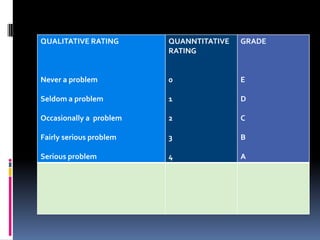
QUALITATIVE RATING

QUANNTITATIVE
RATING

GRADE

Never a problem

0

E

Seldom a problem

1

D

Occasionally a problem

2

C

Fairly serious problem

3

B

Serious problem

4

A
2 WAYS OF RATING SCALE
TECHNIQUE
 1. SELF RATING SCALE-the individual rate

himself. It provides useful information for
self-analysis which leads to better selfactualization or understanding.
 OPINIONATED RATING SCALE-someone is

to rate the individual
 14. THE QUESTIONNAIRE METHOD-

question are designed to get information
about conditions and practices about which
the respondent/s are presumed to have
knowledge
 TWO TYPES OF QUESTIONS IN A

QUESTIONNAIRE METHOD:
 1. CLOSE ENDED TYPES…answerable by yes
and no
 2. OPEN ENDED TYPES…the individual think
and write.
OTHER STRATEGIES USED IN
COUNSELLING
 PRESCRIPTIVE
 INFORMATIVE

 CONFRONTING
 CATHARTIC
 CATALYCTIC

 SUPPORTIVE

Methods and techniques of guidance

  • 1.
  • 2.
    SPECIFIC AREAS INCLUDE: GENERAL INFORMATION  HEALTH  ACHIEVEMENT  APTITUDE  PERSONAL ADJUSTMENT  INTERESTS  PLANS FOR THE FUTURE  FAMILY BACKGROUND
  • 3.
    Techniques for gathering informationabout these areas are:  1. ADMINISTRATIVE RECORD/CUMULATIVE RECORD- contains facts about each student background, health and school history.  2. INFORMAL TEACHER REPORTS- can supply helpful guidance information gathered from observation.  3. INTERVIEWS WITH STUDENTS AND PARENTS-enrich information gathered from other sources.
  • 4.
     4. AUTOBIOGRAPHIES- maybe required of intermediate pupils and above.  5. USE OF STANDARDIZED TESTS- these are tools of measuring interests, intelligence, aptitudes and personality traits.  TYPES OF TEST  ACHIEVEMENT TESTS-devised and administered to measure how well a person has learned as an outcome of instruction.  INTELLIGENCE TESTS- measure general intelligence. Ex..IQ test  APTITUDE TESTS- measure the probable potentially for development prior to training or schooling as tests in aptitude covered art, music, science, algebra, manual, and mechanical. Its value is the discovery of an individual’s ability to succeed in a specific field.  INTEREST INVENTORY TEST- reveal the likes/dislikes of a person in appraising his occupational preferences in a certain field of specialization.  PERSONALITY INVENTORY TESTS- measure the sum total of an individual’s overt behaviour and inner feelings. It is the totality of what makes an individual different from one another  TRADE TESTS-designed to determine the skills, special abilities and techniques that make an individual fit for a given occupation as test for engineers, plumbers, mechanics. They maybe oral and picture tests.  DIAGNOSTIC TEST.- aimed to uncover and focus attention on weakness of individuals for remedial purpose.  6. CONDUCTING SURVEY- through the use of questionnaire can cover a wide area of research and quite number of respondents
  • 5.
     7. OBSERVATION-should be conducted by the teacher and the counselor in and out of the classroom.  8. ANECDOTAL RECORD- should be prepared by the teacher on significant incident or event that happened to the student in school.  9. CASE STUDY- is the most comprehensive and thorough technique of gathering information about a person with a serious problem
  • 6.
     10. CASECONFERENCE- is a cooperative conference  devoted to the intensive study of an individual.  11. SOCIOMETRY- the mapping of interpersonal likes and preferences within a classroom.  THREE TYPES OF SOCIOMETRIC TECHNIQUES ARE:  THE NOMINATION-the student is asked to select and name his/her peers in terms of some criteria suggested by the teacher  THE SOCIAL ACCEPTANCE-levels of social relationship are stated and the students asked to express his/her sociometric choice  THE WHO’S WHO OR GUESS WHO- brief description of various types of students are provided and they are asked to guess who in the class matches with the description.
  • 7.
     12. PROJECTIVETECHNIQUES- these are expressive techniques where a child has to add meaning to a meaningless situation, which are most useful with very young children.  These are indirect and unstructured methods of investigation which have been developed by psychologist and use projection of respondents for inferring about underline motives, urges and intentions which cannot be secure through direct questioning as the respondent either resist to reveal them or is unable to figure out himself.
  • 8.
    TOOLS USED INPT 1. COMPLETION- the subject is given an incomplete sentence, story, argument or conversation, and asked to finish it. It may also be in the means of showing the subject a picture of an incomplete situation. 2. EXPRESSIVE- subject is asked to role- play, act, draw or paint a specific concept or situation (e.g. handwriting analysis, human figure drawings, projective puppet play 3. CONSTRUCTION- the subject is asked to construct a story or a picture from a stimulus concept.
  • 9.
  • 10.
     4. ASSSOCIATION-subject are presented with a stimulus and they respond by indicating the first word, image or thought elicited by the stimulus. Example is the Hermann Rorchach “Inkblot test”
  • 11.
     5. CHOICEORDERING- the subject have to explain why certain things are “ most important” or “least important”, or to rank , order, or categorize certain factors associated with a product, brand or service. ( Luscher Color test, Szondi’s Picture arrangement Tests.
  • 12.
     It is aprojective personality test, the same category of the mostknown Rorschach test, but with the crucial difference of being nonverbal. The test consists in showing the examinee a series facial photographs,[11] displayed in six groups of eight each. All 48 subjects featured in the photogtaphs are mental patients, each group containing a photo of a person whose personality had been classified as homosexual, a sadist, an epileptic, an hysteric, a katatonic, a paranoid, a depressive and a maniac. The subject is asked to choose the two most appealing and the two most repulsive photos of each group. The choices will supposedly reveal the subject satisfied and unsatisfied instinctive drive needs, and the subject's dimensions of personality.[12] Each photo is supposed to be a stimulus apt to detect the pulsional drive tendencies of the examinee, from which the main personality traits can surface.[13] Szondi said that for some disturbed examinees the stimulus of seeing the photo of a mental patient with the same pathology caused them to have crisis and convulsions during the test examination.  Szondi further broke down the results into four different vectors: a homosexual/sadistic, epileptic/hysterical, catatonic/paranoid and depressive/manic.  Szondi believed that people are inherently attracted to people similar to them[citation needed]. His theory of genotropism states that there are specific genes that regulate mate selection, and that similarly-gened individuals would seek each other out.
  • 13.
     13. RATINGSCALE TECHNIQUE- a technique whereby a behavior of the child may be known by means of assigning degrees of responses with corresponding scales or values.
  • 14.
    QUALITATIVE RATING QUANNTITATIVE RATING GRADE Never aproblem 0 E Seldom a problem 1 D Occasionally a problem 2 C Fairly serious problem 3 B Serious problem 4 A
  • 15.
    2 WAYS OFRATING SCALE TECHNIQUE  1. SELF RATING SCALE-the individual rate himself. It provides useful information for self-analysis which leads to better selfactualization or understanding.  OPINIONATED RATING SCALE-someone is to rate the individual
  • 16.
     14. THEQUESTIONNAIRE METHOD- question are designed to get information about conditions and practices about which the respondent/s are presumed to have knowledge  TWO TYPES OF QUESTIONS IN A QUESTIONNAIRE METHOD:  1. CLOSE ENDED TYPES…answerable by yes and no  2. OPEN ENDED TYPES…the individual think and write.
  • 17.
    OTHER STRATEGIES USEDIN COUNSELLING  PRESCRIPTIVE  INFORMATIVE  CONFRONTING  CATHARTIC  CATALYCTIC  SUPPORTIVE