PROJECTIVE
PERSONALITY
TESTS
PRESENTED BY:
JESABELL FE P. CAMODAG
HISTORY
• Francis Galton (1879)
-trials of word association for
measuring intelligence
• Kraepelin (1892)
- association method for studying
effects of fatigues, hunger etc
•Carl Jung
-first to formulate a
standardized word association
•Hermann Rorschach (1921)
-published Psychodiagnotik
DEFINITION
•Words
•Images
•Situations
Designed to let a person…
•respond to ambiguous
stimuli
•reveal hidden emotions
•internal conflicts
•also called as
indirect interview
test
TYPES
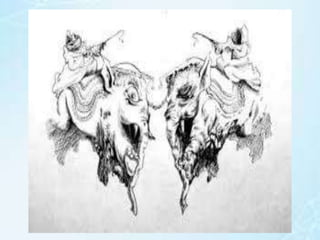
a. Rorschach inkblot
Hermann Rorschach
(1884 - 1922).
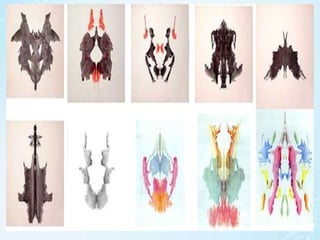
•consists of 10 cards having
prints of inkblot
• 5 black and white.
• 2 black, white, and red.
• 3 multicolor.
Administration
•What might this be?
Scoring Categories
• Location:
– Part of inkblot utilized:
• Entire blot, large or small
section, minute detail, white
space.
• Determinants:
– Qualities of the inkblot:
• Form, color, shading,
movement.
• Popularity of response
– Frequency of response.
• Content:
– Human figures, animal
figures, blood etc.
• Form:
– How accurately
examinee’s perception
matches the
corresponding part of
the inkblot.
Interpretation…
• Generate hypotheses based on patterns of
response, recurrent themes and
interrelationships among scoring
categories:
-Whole responses - conceptual thought
processes.
-Form - reality testing
-Human movement - imagination.
-Color - emotional reactivity.
RELIABILITY AND
VALIDITY
•Lack scoring reliability
•Can only be used
effectively with severely
maladjusted individuals
b. Thematic Apperception Test
(TAT)
• Morgan and Murray (1935).
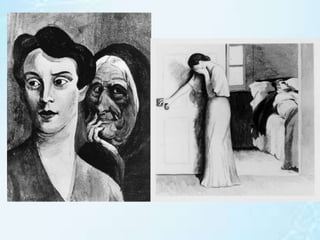
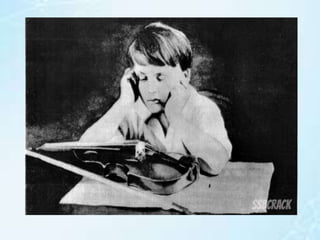
• Elicit fantasy material
• 31 cards:
-30 black & white with scenes:
• Describe story.
-1 blank:
• Imagine picture on card and tell related
story.
Administration
•A set of 20 cards is
recommended, but
the number may vary
based on length of
stories.
Interpretation…
• Murray’s concepts:
-Need - arising from within the
individual
-Press - behavior arising from
within the environment
-Thema - interaction between need
and press.
•Reliability:
-Split-half, test-retest, and
alternate-form reliability
measures are not appropriate.
•Inter-rater reliability is
acceptable.
• Situational factors:
-Examiner.
-Events just prior to administration.
-Delivery of instructions.
-Transient internal needs states.
-Stimulus pull.
-Desire to fake good or bad.
•Validity:
–Conflicting
opinions
c. House-Tree-Person test
(John Buck 1948)
•designed to measure aspects
of a person’s personality.
• can be used to assess brain
damage and general mental
functioning.
Interpretation…
House
>size
-small house represents renunciation of
family life
>walls
-weak lines: fragility
-strong lines: need to fortify boundaries
>roof
-more detail: concentrates on fantasies
-incomplete roof: evading formidable
ideas
>inclusion of windows, doors and
sidewalks
-openness to interaction
>inclusion of bushes , shades and shutters
-hesitation to open himself
As with other
subjectively scored
personality tests, there
is little support for its
reliability and validity.
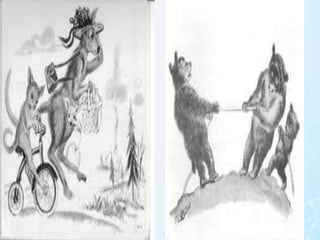
d. Children Apperception Test
(CAT)-Bellak 1949
-for acquiring
information about
children’s personality and
psychological processes
Administration
•20-45 minutes
Question asked:
•What went in the story
before and what will
happen later?
Scoring…
•No numerical
score or scale for
the test
RELIABILITYAND
VALIDITY
•Lack of
standardized
method and norms
for interpretation
e. Holtzman inkblot test
• for persons’ ages five and up.
• tool in assessing:
-schizophrenia
-depression
-addiction
-character disorders.
• stack of 47 cards with inkblots.
• Takes 50-80 minutes.
•The results that are given
should only be read and
interpreted by a licensed
professional psychologist/
psychiatrist.
APPLICATION
and
TECHNIQUES IN
PROJECTIVE
TESTS
ASSOCIATION
TECHNIQUE
•requires the client to
respond at the presentation
of stimulus (word) with the
first thing that comes to
mind.
COMPLETION
TECHNIQUES
• supply the subject with stimulus that is
incomplete and the subject is required to
complete it
• There two types:
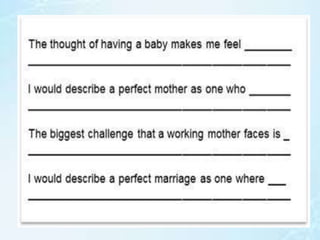
Sentence completion
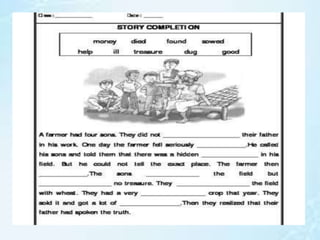
Story completion
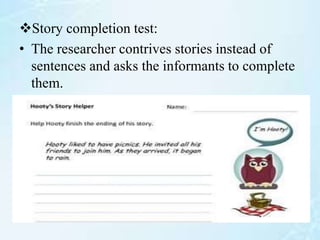
Story completion test:
• The researcher contrives stories instead of
sentences and asks the informants to complete
them.
CONSTRUCTION
TECHNIQUE
•produce or construct
something at
direction, usually a
story or a picture.
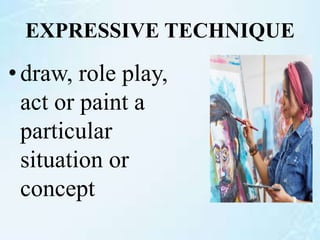
EXPRESSIVE TECHNIQUE
•draw, role play,
act or paint a
particular
situation or
concept
ORDERING CHOICE
• most frequently used in
quantitative researchers.
• explain why specific things are
‘most’ or ‘least’ important or to
order, rank or categorize some
factors related to topics under
research
STRENGHTS OF
PROJECTIVE
PERSONALITY
TEST
• Helpful when the issues to be addressed
are personal, sensitive, or subject to
strong social norms.
• Helpful when underlying motivations,
beliefs, and attitudes are operating at a
subconscious level.
• Projective test can be used in marketing:
• Projective test useful in business:
•The amount, richness and
accuracy of the
information collected is
reliable to an extent.
•give a view of the total
functioning of individual
• In qualitative research project,
projective techniques may be
employed as the basis of ‘breaking
the ice’ in a focus group.
• Rendering new energy in a group
discussion and to enlighten the
tone or mood of proceedings,
subjects enjoy projective test
• Wide range of ideas are
encouraged and there is no right
or wrong answer
WEAKNESSES
OF
PROJECTIVE
PERSONALITY
TEST
• It need highly qualified and
experienced professionals
• It is expensive
• Risk of interpretation bias
• Unstructured techniques
• Low psychometrics
characteristics
CONCLUSION
• put relatively low strain on participants.
• using a variety of test as opposed to direct
questioning boosts engagement and
increase participant enjoyment.
• When used correctly, they are useful tools
that can uncover true motivations behind
behaviours and subconscious attitudes.
BIBLIOGRAPHY
• Kothari CR, Garg G. Methods of data
collection. Research Methodology: methods
and techniques. New age international
publishers. 3rd edition. Pg.no: 104-07.
• Sharma SK. Tools and methods of data
collection. Nursing research and statistics.
Elsevier publishers. 2nd edition. Pg.no: 279-82

projective personality test.psychological testingpptx

Editor's Notes

  • #3 Projective tests have their origins in psychoanalysis, which argues that humans have conscious and unconscious attitudes and motivations that are beyond o hidden from conscious awareness.
  • #6 A psychological test in which words, images, or situations are presented to a person and the responses analyzed for unconscious expression of elements of personality that they reveal. a
  • #7 designed to let a person respond to ambiguous stimuli-result to the confusion of the clients presumably revealing hidden emotions and internal conflicts projected by the person into the test
  • #8 Projective test are used for collection of data which have been developed by psychologist to use projections of the respondents for inferring about the underlying motives, urges or intentions which are such that the respondents either resists them or is unable to figure out himself.
  • #10  The Rorschach test is a psychological test in which subjects' perceptions of inkblots are recorded and then analyzed using psychological interpretation. used for depression, schizophrenia , and anxiety disorders. This test consists of 10 cards having prints of inkblots, wherein the design happens to be symmetrical but meaningless. Respondents are asked to describe what they perceive in them.
  • #12 “What might this be?” Record response verbatim: Include time until first response. Position of card, spontaneous statements, nonverbal gestures or body movements. No discussion of examinee’s responses “What made it look like _____?” or “How do you see ____?” Clarify initial responses and determine which aspects of inkblot were most influential. Determine if examinee remembers initial responses and if original response is still seen. Ask about “any new perceptions?”
  • #15 Must be administered by trained pyschologist
  • #16 Elicit fantacy- bring out something about the material set of pictures normal everyday event respondents are asked to describe what they think the picture represent
  • #17 Some cards are suggested for use with adult males, adult females, or both. Some cards are best used with children; however, all cards may be administered to any subject. Based on: Stories told by examinee. Clinician’s notes: Examinee’s response to the cards. Extra-test behavior and verbalizations. Analysis of story requires special training.
  • #20 Murray’s concepts: -Need - determinants of behavior arising from within the individual. -Press - determinants of behavior arising from within the environment. -Thema - interaction between need and press.
  • #23 Conflicting opinions regarding the validity of the assumptions and the interpretations.
  • #24 HTP was designed by John Buck and was originally based on the Goodenough scale of intellectual functioning.  The HTP was developed in 1948.  Buck included both qualitative and quantitative measurements of intellectual ability in the HTP.  The House-Tree-Person test (HTP) is a projective test designed to measure aspects of a person’s personality.   The test can also be used to assess brain damage and general mental functioning. The test is a diagnostic tool for clinical psychologists, educators, and employers. 
  • #25 The subject receives a short, unclear instruction to draw a house, a tree, and the figure of a person. During the first phase, the test-taker is asked to draw the house, tree, and person and the test-giver asks questions about each picture. There are 60 questions originally designed by Buck . therapists and trained test givers can also design their own questions, or ask follow up questions This phase is done with a crayon. During the second phase of HTP, the test-taker draws the same pictures with a pencil or pen. HTP has been found to be an effective tool for classifying personality disorders, depression anxiety and other mental disorder. However there are shortcomings in the existing studies. One is that the scoring and interpretation are not standardized and lack consistency.
  • #27 tree interpretation: size of the trunk Small trunk represents weak ego while large trunk means a larger ego Observe whether the trunk is split in half means split personality Determine what kind of limbs were drawn, detached or small branches means difficulty in communicating with others, big trunk means connecting with others too much Pointy branches means hostility and dead branches represents desolation With leaves- success With out leave means emptiness. Person Open arms-inclination to connect with others Closed arms- hostility Disconnected arms- defenselessness
  • #28 HTP has been found to be an effective tool for classifying personality disorders, depression anxiety and other mental disorder. However there are shortcomings in the existing studies. One is that the scoring and interpretation are not standardized and lack consistency. As with other subjectively scored personality tests, there is little support for its reliability and validity. How ever, there is some evidence that the HTP can differentiate people with specific types of brain damage.
  • #29 It was devised by Bellak in 1949. -young children aged between 3 and 10 years. 10 pictures all these are of animals. What went in the story before and what will happen latter? The CAT is intended to measure the personality traits, attitudes, and psychodynamic processes evident in pre-pubertal children.
  • #33 Has been criticized for its lack of a standardized method of administration as well as lack of standard norms for interpretation.
  • #34 Developed by psychologist Wayne Holtzman and colleagues, was introduced in 1961. projective personality assessment test for persons ages five and up.  diagnostic tool in assessing schizophrenia, depression, addiction, and character disorders. stack of 47 cards with inkblots. 2 practice cards 45 test cards
  • #35 Developed by psychologist Wayne Holtzman and colleagues, was introduced in 1961. projective personality assessment test for persons ages five and up.  diagnostic tool in assessing schizophrenia, depression, addiction, and character disorders. stack of 47 cards with inkblots. 2 practice cards 45 test cards
  • #39 the respondent is asked to mention the first word that comes in the mind. E.g: Interviewer says COLD and the respondent may respond by saying HOT. This is mostly used in marketing research to find the quality that is mostly associated with the brand of a product.
  • #40 Completion projective techniques supply the subject with stimulus that is incomplete and the subject is required to complete it as he/she wishes. There two types: Sentence completion Sentence completion test: The subject is required to complete a sentence. It reveals his/her attitude towards the topic. The technique permits the testing not only to few words but of ideas as well and thus help in developing hypothesis and construction of questionnaires. This technique is quick and easy to use. E.g: Working with others all the time is ____________. Story completion
  • #44 Here the focus is on the product as it is related to the subject. The subject is required to produce or construct something at direction, usually a story or a picture. There are several pictorial techniques used in construction techniques. The important ones are:
  • #45 draw, role play, act or paint a particular situation or concept. Expressive techniques generally concentrate on the way in which something is constructed by the subject as against on what it represents.
  • #47 This type of projective technique is the most frequently used in quantitative researchers. This technique is generally used informally in qualitative researches when the subjects explain why specific things are ‘most’ or ‘least’ important or to order, rank or categorize some factors related to topics under research
  • #51 Reliable to an extent- partly true, but not entirely true
  • #52 Breaking the ice –relieve tension or get conversation going at the start
  • #55 The interpretative skills are required in the researcher to handle the complexity of interpretation of projective technique. Highly research staff have to employed hence it is expensive to administer. To project themselves into roles the researchers wants them to do, it may be difficult to get the subjects.