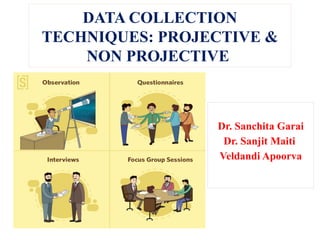
DATA COLLECTION
TECHNIQUES: PROJECTIVE &
NON PROJECTIVE
Dr. Sanchita Garai
Dr. Sanjit Maiti
Veldandi Apoorva
DATA COLLECTION
• Procedure of collecting, measuring and analyzing accurately insights for
research using standard validated techniques
Types of data
 Primary data: collected freshly for the first time and which is original in
character
 Secondary data: collected by some other person and passed through the
statistical process
TYPES OF RESEARCH DATA COLLECTION
TECHNIQUES
Research data
Secondary data Primary data
Quantitative Qualitative
Survey data
Observation
data
Experimental
Personal
Interview
Telephone
Interview
Focus Group
Interview
Depth
Interview
Projective
techniques
Projective Techniques
Projective Technique
is the method of exposing an
individual to a situation in which
the person in giving information
tends unconsciously to project a
part of his or her personality and in
the process reveals the inner mind.
 Projective technique is used to elicit information in situations
where people are unwilling or unable to respond to
questions, or might be unaware of their own thoughts,
opinions or feelings.
 In Projective technique, the stimuli (which may be verbal,
pictorial etc.) are capable of arousing many different kinds of
reactions of the respondents.
 There is no ‘right’ or ‘wrong’ answers, nor is the subject
faced with a limited number of alternatives.
 The emphasis is on respondents perception of the stimuli
and how these are interpreted.
Projective Techniques
Different projective techniques
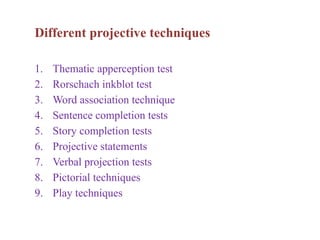
1. Thematic apperception test
2. Rorschach inkblot test
3. Word association technique
4. Sentence completion tests
5. Story completion tests
6. Projective statements
7. Verbal projection tests
8. Pictorial techniques
9. Play techniques
• This test was developed by Henry Murray(1935)
• TAT has been among the most widely used, researched, and
taught projective psychological tests.
• The TAT is popularly known as the picture interpretation
technique.
• This projective method consists of 20 pictures which are
black and white.
• The subject is informed that each card shows a scene that he
or she is to make up stories about the person or people in the
picture and there is no right or wrong response.
• The pictures are shown one at a time.
Thematic Apperception Test (TAT)
 The respondent is asked :
i. To tell how he/she thinks led up to the scene; how it came
about
ii. To give an account of what is happening and the feelings of
characters in the picture
iii. To tell what the outcome will be.
 The test is based on the principle that, when a person
interprets an ambiguous situation, the individual is apt to
reveal aspects of own personality, which the person
otherwise will not admit, or of which the individual is not
aware of.
Rorschach inkblot test
• Developed by Hermann Rorschach in 1921.
• Psychologists use this test to examine a person's
personality characteristics and emotional
functioning.
• Testing material consists of 10 Symmetrical
inkblots each printed on a separate white card.
• Seating side by side, the cards are presented to
subject one at a time in the same order
• The subject is asked questions such as :
i. What might this be?
ii. What does this look like or what does this
remind you?
• Examiner writes down as many answers as the
subject gives to each blot.
 Responses are scored by psychologists, using predetermined categories, on
key factors such as color and shape, movement, whether the whole or
part blot has been seen, and whether the response is given in content to
whole or peculiar details in the blot.
 It is a ‘multidimensional instrument’ that is intended to yield information
on the structure subject’s personality. Three major dimensions are
evaluated are :
I. Conscious intellectual activity
II. Externalised emotions and
III. Internalised emotions.
 The basic difference b/w Rorschach inkblot test and TAT is :
 Rorschach test is intended to reveal the structure and organization of an
individual’s personality .
 TAT is devised to bring out primarily the content of one’s personality :
the drives, needs, sentiments, conflicts etc.
What do you see?
What do you see?
What do you see?
Word association technique
• In word association, respondents are presented with a list of words, one at a
time, and asked to respond to each with the first word that comes to mind.
• The speed and content of response and emotional expressions while replying
provide valuable indicators of attitudes and interests of the subject.
The words of interest, called test words, are interspersed throughout the list
which also contains some neutral, or filler words to disguise the purpose of the
study. Responses are analyzed by calculating:
 the frequency with which any word is given as a response;
 the amount of time that elapses before a response is given; and
 the number of respondents who do not respond at all to a test word within a
reasonable period of time.
EXAMPLE
STIMULUS MRS. M MRS. C
washday everyday ironing
fresh and sweet clean
pure air soiled
scrub don't; husband does clean
filth this neighborhood dirt
bubbles bath soap and water
family squabbles children
towels dirty wash
Word association technique
Sentence completion tests
• This is an extension technique of word association tests.
• In sentence completion, respondents are given series of incomplete sentences
on a particular topic and asked to complete them.
• Analysis of replies from same person reveals the attitude of individuals
towards the topic.
• The combination of responses of all the sample members reflect the views of
the population.
 Panchayat pradhan is______
 Panchayat members are generally______
 Panchayat has done_____for the village
In sentence completion, respondents are given incomplete sentences and
asked to complete them. Generally, they are asked to use the first word or
phrase that comes to mind.
A person who shops at Sears is ______________________
A person who receives a gift certificate good for Sak's Fifth Avenue would be
__________________________________
J. C. Penney is most liked by _________________________
When I think of shopping in a department store, I ________
A variation of sentence completion is paragraph completion, in which the
respondent completes a paragraph beginning with the stimulus phrase.
Sentence completion tests
Story completion tests
• In story completion tests, the researcher may devise stories relevant to the
topic under investigation and ask the subjects to complete them.
• The respondents are given just enough of story to focus their attention on
the given topic and are asked to furnish conclusion to the story. The
conclusions are then interpreted.
Projective statements
• In Projective statements for measurement of attitude, instead of asking
direct questions, some indirect statements are placed before the subjects
so that while replying they can project their mind. The individuals are
asked to indicate their agreement or disagreement with set of statements
in a graded scale. The statements may be in positive or negative form.
• In a four point response category, the positive statements are given scores
for strongly agree-4, agree-3, disagree-2, and strongly disagree-1.
• Scoring was reversed for negative statements.
Verbal projection tests
The respondent is asked to comment on or to explain what other people
think or do. For example, why people vote in election? Reply to such
question may reveal inner feeling of the people towards democracy.
Pictorial techniques
In Pictorial technique the respondents are asked to describe a series of
pictures of ordinary as well as unusual events. The respondent's
interpretation of the pictures gives indications of that individual's personality.
Play techniques
It may take two forms.
In Role play technique, the subjects are asked to act out a situation in which
they have been assigned various roles. The researcher may observe such
traits as hostility, dominance, sympathy, prejudice or absence of such traits.
In Doll play test has been used for knowing the attitudes of younger ones
through manipulation of dolls. The manner in which children choose and
organize dolls, indicate their attitude towards other groups of people,
acceptance or rejection etc.
Advantages & Disadvantages of Projective
Techniques
Advantages :
 Helpful when the issues to be addressed are personal, sensitive, or
subject to strong social norms.
 Helpful when underlying motivations, beliefs, and attitudes are operating
at a subconscious level.
Disadvantages :
 Require highly-trained interviewers.
 Skilled interpreters are also required to analyze the responses.
 There is a serious risk of interpretation bias.
 They tend to be expensive.
 May require respondents to engage in unusual behavior.
Non Projective techniques
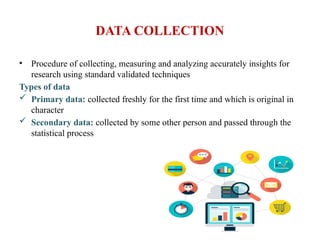
1. Observation method
2. Interview method
3. Schedule
4. Questionnaire
5. Check list
6. Rating scale
Observation Method
• Collected with the help of observation by the
observer or by going personally to the field
• Systematically planned and recorded and is
subjected to checks and controls for validity
and reliability
• Process of recording behaviour patterns of
people, objects and occurrences without
questioning or communicating with them
• Non experimental design
• Consists of Overt and Covert behaviours
• Main objective is to ensure that each
participant’s behaviour is systematically
recorded so that it will be possible to
aggregate the behaviour of all those in the
sample
Major types of Observation Methods
1. Participant observation
2. Non participant observation
3. Structured observation
4. Non structured observation
5. Controlled observation
6. Uncontrolled observation
7. Naturalistic observation
8. Direct observation
9. Indirect observation
Advantages of Observation Method
• Reliable & Objective
• Natural setting
• Useful for young & shy children
• No need of equipment or tool
• Useful for individuals & groups
• Immediate detection of problems
• Most direct measure of behaviour
• Provides direct information
• Easy to complete, saves time
• Can be used in natural or experimental settings
Disadvantages of Observation Method
• Less accuracy, Interference
• Objective recording is difficult
• Lack of competency
• Unnatural situation
• Expensive
• Slow and laborious
• Biased
• Lack of cooperation from people
• Favouritism
• May require training
• Observers presence may create artificial situation
• Potential to over look meaningful aspects
• Difficult to analyze
• In some cases, the use of observational methods may be unethical, as in
observing people without their knowledge or consent
Interview Method
• Verbal conversation between two people with the objective of collecting
relevant information for the purpose of the research
• Useful for getting the story behind a participant’s experiences
• Interviewer can pursue in-depth information around the topic
• May be useful as follow-up to certain respondents
Types of Interviews
1. Personal Interview
2. Telephone Interview
3. Focus Group Interview
4. Depth Interview
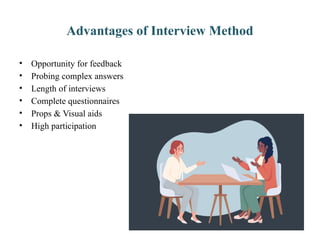
Advantages of Interview Method
• Opportunity for feedback
• Probing complex answers
• Length of interviews
• Complete questionnaires
• Props & Visual aids
• High participation
Disadvantages of Interview Method
• Cost
• Lack of anonymity
• Necessity for call backs
• Demographic characteristics of interviewer may influence answers of
respondents
• Dishonesty
• Interviewer’s individual questioning style, techniques and approaches may
influence the respondent’s answers
• Cultural aspects may influence people’s willingness to participate in
interviews
Schedule
• Structure of set of questions on a given topic which are asked by the
interviewer personally
• Includes open-ended and close-ended questions
Types of schedules
 Village or community schedule- used by census researchers who collect
general information on populations, occupations, etc.
 Family or household schedule- gives full demographic details of
households, status of individuals, data on education, age, family relations,
etc
 Opinion or attitude schedule
Questionnaire
• A set of pre-determined questions for all respondents that serves as a
primary research instrument in survey research
• Used to collect factual information
• Consists of a form containing a series of questions
• Provides description about age, sex, martial status, occupation, income,
political affiliations, religious affiliation, etc
• Measurement of individual or group variables like attitude, opinion, traits
and habits of persons
Checklist
 Consists of prepared list of items to record the presence or absence of
item under measurement
 Gather facts about an item
 Observe and record the behaviour
 Appraise the characteristics of an item
Rating scale
• Rating- expression of opinion or judgement regarding an object under
measurement
• Rating scale- measuring instrument for assigning the object under
measurement to categories
Types of rating scales:
 Graphic rating scales
 Numerical rating scales
 Descriptive rating scales
 Rank order rating scales
References
http://www.indiastudychannel.com/resources/143300-Measurement-pesonality
-non-projective.aspx
http://www.tutorialspoint.com/software_testing_dictionary/behaviour_testing.
htm
http://www.britannica.com/science/personality-assessment
http://adsabs.harvard.edu/abs/1946NYASA..46..625W
www.seemypersonality.com
http://www.ncbi.nlm.nih.gov/pubmed/20995687
http://onlinelibrary.wiley.com/doi/10.1111/j.1749-6632.1946.tb31694.x/abstra
ct
http://dictionary.reference.com/browse/non-projective
http://www.tandfonline.com/doi/abs/10.1080/08853126.1952.10380430?jo
urnalCode=hzpt20
http://www.tandfonline.com/doi/abs/10.1080/08853126.1952.10380430?jo
urnalCode=hzpt20#.VrAFBrJ95dg
http://www.indiastudychannel.com/resources/143300-Measurement-pesonality
-non-projective.aspx
http://onlinelibrary.wiley.com/doi/10.1111/j.2164-0947.1945.tb00193.x/abstra
ct
http://ajp.psychiatryonline.org/doi/abs/10.1176/ajp.103.6.847-a
http://psychologyforum.com/personality-psychology/598-what-difference-bet
ween-objective-projective-personality-tests.html
http://psycnet.apa.org/journals/apl/31/6/660/
http://www.scribd.com/doc/158158622/Advantages-and-Disadvantages-in-
Using-Projective-Techniques#scribd
http://www.enotes.com/homework-help/what-advantages-disadvantages-using
-objective-438939
http://www.managementparadise.com/forums/marketing-research/206774-adv
antages-projective-techniques.html
https://www.psychologytoday.com/blog/sideways-view/201403/projective-tec
hniques
http://psychology.about.com/od/psychologicaltesting/f/projective-tests.htm
http://psychology.jrank.org/pages/506/Projective-Techniques.html
https://www.google.co.in/#q=brook+test+ppt
http://www.tandfonline.com/doi/abs/10.1080/08853126.1952.10380430?journ
alCode=hzpt20

DATA COLLECTION TECHNIQUES-research methodology.pptx

  • 1.
    DATA COLLECTION TECHNIQUES: PROJECTIVE& NON PROJECTIVE Dr. Sanchita Garai Dr. Sanjit Maiti Veldandi Apoorva
  • 2.
    DATA COLLECTION • Procedureof collecting, measuring and analyzing accurately insights for research using standard validated techniques Types of data  Primary data: collected freshly for the first time and which is original in character  Secondary data: collected by some other person and passed through the statistical process
  • 3.
    TYPES OF RESEARCHDATA COLLECTION TECHNIQUES Research data Secondary data Primary data Quantitative Qualitative Survey data Observation data Experimental Personal Interview Telephone Interview Focus Group Interview Depth Interview Projective techniques
  • 4.
    Projective Techniques Projective Technique isthe method of exposing an individual to a situation in which the person in giving information tends unconsciously to project a part of his or her personality and in the process reveals the inner mind.
  • 5.
     Projective techniqueis used to elicit information in situations where people are unwilling or unable to respond to questions, or might be unaware of their own thoughts, opinions or feelings.  In Projective technique, the stimuli (which may be verbal, pictorial etc.) are capable of arousing many different kinds of reactions of the respondents.  There is no ‘right’ or ‘wrong’ answers, nor is the subject faced with a limited number of alternatives.  The emphasis is on respondents perception of the stimuli and how these are interpreted. Projective Techniques
  • 6.
    Different projective techniques 1.Thematic apperception test 2. Rorschach inkblot test 3. Word association technique 4. Sentence completion tests 5. Story completion tests 6. Projective statements 7. Verbal projection tests 8. Pictorial techniques 9. Play techniques
  • 7.
    • This testwas developed by Henry Murray(1935) • TAT has been among the most widely used, researched, and taught projective psychological tests. • The TAT is popularly known as the picture interpretation technique. • This projective method consists of 20 pictures which are black and white. • The subject is informed that each card shows a scene that he or she is to make up stories about the person or people in the picture and there is no right or wrong response. • The pictures are shown one at a time. Thematic Apperception Test (TAT)
  • 8.
     The respondentis asked : i. To tell how he/she thinks led up to the scene; how it came about ii. To give an account of what is happening and the feelings of characters in the picture iii. To tell what the outcome will be.  The test is based on the principle that, when a person interprets an ambiguous situation, the individual is apt to reveal aspects of own personality, which the person otherwise will not admit, or of which the individual is not aware of.
  • 12.
    Rorschach inkblot test •Developed by Hermann Rorschach in 1921. • Psychologists use this test to examine a person's personality characteristics and emotional functioning. • Testing material consists of 10 Symmetrical inkblots each printed on a separate white card. • Seating side by side, the cards are presented to subject one at a time in the same order • The subject is asked questions such as : i. What might this be? ii. What does this look like or what does this remind you? • Examiner writes down as many answers as the subject gives to each blot.
  • 13.
     Responses arescored by psychologists, using predetermined categories, on key factors such as color and shape, movement, whether the whole or part blot has been seen, and whether the response is given in content to whole or peculiar details in the blot.  It is a ‘multidimensional instrument’ that is intended to yield information on the structure subject’s personality. Three major dimensions are evaluated are : I. Conscious intellectual activity II. Externalised emotions and III. Internalised emotions.  The basic difference b/w Rorschach inkblot test and TAT is :  Rorschach test is intended to reveal the structure and organization of an individual’s personality .  TAT is devised to bring out primarily the content of one’s personality : the drives, needs, sentiments, conflicts etc.
  • 14.
  • 15.
  • 16.
  • 18.
    Word association technique •In word association, respondents are presented with a list of words, one at a time, and asked to respond to each with the first word that comes to mind. • The speed and content of response and emotional expressions while replying provide valuable indicators of attitudes and interests of the subject. The words of interest, called test words, are interspersed throughout the list which also contains some neutral, or filler words to disguise the purpose of the study. Responses are analyzed by calculating:  the frequency with which any word is given as a response;  the amount of time that elapses before a response is given; and  the number of respondents who do not respond at all to a test word within a reasonable period of time.
  • 19.
    EXAMPLE STIMULUS MRS. MMRS. C washday everyday ironing fresh and sweet clean pure air soiled scrub don't; husband does clean filth this neighborhood dirt bubbles bath soap and water family squabbles children towels dirty wash Word association technique
  • 20.
    Sentence completion tests •This is an extension technique of word association tests. • In sentence completion, respondents are given series of incomplete sentences on a particular topic and asked to complete them. • Analysis of replies from same person reveals the attitude of individuals towards the topic. • The combination of responses of all the sample members reflect the views of the population.  Panchayat pradhan is______  Panchayat members are generally______  Panchayat has done_____for the village
  • 21.
    In sentence completion,respondents are given incomplete sentences and asked to complete them. Generally, they are asked to use the first word or phrase that comes to mind. A person who shops at Sears is ______________________ A person who receives a gift certificate good for Sak's Fifth Avenue would be __________________________________ J. C. Penney is most liked by _________________________ When I think of shopping in a department store, I ________ A variation of sentence completion is paragraph completion, in which the respondent completes a paragraph beginning with the stimulus phrase. Sentence completion tests
  • 22.
    Story completion tests •In story completion tests, the researcher may devise stories relevant to the topic under investigation and ask the subjects to complete them. • The respondents are given just enough of story to focus their attention on the given topic and are asked to furnish conclusion to the story. The conclusions are then interpreted.
  • 23.
    Projective statements • InProjective statements for measurement of attitude, instead of asking direct questions, some indirect statements are placed before the subjects so that while replying they can project their mind. The individuals are asked to indicate their agreement or disagreement with set of statements in a graded scale. The statements may be in positive or negative form. • In a four point response category, the positive statements are given scores for strongly agree-4, agree-3, disagree-2, and strongly disagree-1. • Scoring was reversed for negative statements.
  • 24.
    Verbal projection tests Therespondent is asked to comment on or to explain what other people think or do. For example, why people vote in election? Reply to such question may reveal inner feeling of the people towards democracy. Pictorial techniques In Pictorial technique the respondents are asked to describe a series of pictures of ordinary as well as unusual events. The respondent's interpretation of the pictures gives indications of that individual's personality.
  • 25.
    Play techniques It maytake two forms. In Role play technique, the subjects are asked to act out a situation in which they have been assigned various roles. The researcher may observe such traits as hostility, dominance, sympathy, prejudice or absence of such traits. In Doll play test has been used for knowing the attitudes of younger ones through manipulation of dolls. The manner in which children choose and organize dolls, indicate their attitude towards other groups of people, acceptance or rejection etc.
  • 26.
    Advantages & Disadvantagesof Projective Techniques Advantages :  Helpful when the issues to be addressed are personal, sensitive, or subject to strong social norms.  Helpful when underlying motivations, beliefs, and attitudes are operating at a subconscious level. Disadvantages :  Require highly-trained interviewers.  Skilled interpreters are also required to analyze the responses.  There is a serious risk of interpretation bias.  They tend to be expensive.  May require respondents to engage in unusual behavior.
  • 27.
    Non Projective techniques 1.Observation method 2. Interview method 3. Schedule 4. Questionnaire 5. Check list 6. Rating scale
  • 28.
    Observation Method • Collectedwith the help of observation by the observer or by going personally to the field • Systematically planned and recorded and is subjected to checks and controls for validity and reliability • Process of recording behaviour patterns of people, objects and occurrences without questioning or communicating with them • Non experimental design • Consists of Overt and Covert behaviours • Main objective is to ensure that each participant’s behaviour is systematically recorded so that it will be possible to aggregate the behaviour of all those in the sample
  • 29.
    Major types ofObservation Methods 1. Participant observation 2. Non participant observation 3. Structured observation 4. Non structured observation 5. Controlled observation 6. Uncontrolled observation 7. Naturalistic observation 8. Direct observation 9. Indirect observation
  • 30.
    Advantages of ObservationMethod • Reliable & Objective • Natural setting • Useful for young & shy children • No need of equipment or tool • Useful for individuals & groups • Immediate detection of problems • Most direct measure of behaviour • Provides direct information • Easy to complete, saves time • Can be used in natural or experimental settings
  • 31.
    Disadvantages of ObservationMethod • Less accuracy, Interference • Objective recording is difficult • Lack of competency • Unnatural situation • Expensive • Slow and laborious • Biased • Lack of cooperation from people • Favouritism • May require training • Observers presence may create artificial situation • Potential to over look meaningful aspects • Difficult to analyze • In some cases, the use of observational methods may be unethical, as in observing people without their knowledge or consent
  • 32.
    Interview Method • Verbalconversation between two people with the objective of collecting relevant information for the purpose of the research • Useful for getting the story behind a participant’s experiences • Interviewer can pursue in-depth information around the topic • May be useful as follow-up to certain respondents
  • 33.
    Types of Interviews 1.Personal Interview 2. Telephone Interview 3. Focus Group Interview 4. Depth Interview
  • 34.
    Advantages of InterviewMethod • Opportunity for feedback • Probing complex answers • Length of interviews • Complete questionnaires • Props & Visual aids • High participation
  • 35.
    Disadvantages of InterviewMethod • Cost • Lack of anonymity • Necessity for call backs • Demographic characteristics of interviewer may influence answers of respondents • Dishonesty • Interviewer’s individual questioning style, techniques and approaches may influence the respondent’s answers • Cultural aspects may influence people’s willingness to participate in interviews
  • 36.
    Schedule • Structure ofset of questions on a given topic which are asked by the interviewer personally • Includes open-ended and close-ended questions Types of schedules  Village or community schedule- used by census researchers who collect general information on populations, occupations, etc.  Family or household schedule- gives full demographic details of households, status of individuals, data on education, age, family relations, etc  Opinion or attitude schedule
  • 37.
    Questionnaire • A setof pre-determined questions for all respondents that serves as a primary research instrument in survey research • Used to collect factual information • Consists of a form containing a series of questions • Provides description about age, sex, martial status, occupation, income, political affiliations, religious affiliation, etc • Measurement of individual or group variables like attitude, opinion, traits and habits of persons
  • 38.
    Checklist  Consists ofprepared list of items to record the presence or absence of item under measurement  Gather facts about an item  Observe and record the behaviour  Appraise the characteristics of an item
  • 39.
    Rating scale • Rating-expression of opinion or judgement regarding an object under measurement • Rating scale- measuring instrument for assigning the object under measurement to categories Types of rating scales:  Graphic rating scales  Numerical rating scales  Descriptive rating scales  Rank order rating scales
  • 41.
  • 42.
    http://www.indiastudychannel.com/resources/143300-Measurement-pesonality -non-projective.aspx http://onlinelibrary.wiley.com/doi/10.1111/j.2164-0947.1945.tb00193.x/abstra ct http://ajp.psychiatryonline.org/doi/abs/10.1176/ajp.103.6.847-a http://psychologyforum.com/personality-psychology/598-what-difference-bet ween-objective-projective-personality-tests.html http://psycnet.apa.org/journals/apl/31/6/660/ http://www.scribd.com/doc/158158622/Advantages-and-Disadvantages-in- Using-Projective-Techniques#scribd http://www.enotes.com/homework-help/what-advantages-disadvantages-using -objective-438939 http://www.managementparadise.com/forums/marketing-research/206774-adv antages-projective-techniques.html https://www.psychologytoday.com/blog/sideways-view/201403/projective-tec hniques http://psychology.about.com/od/psychologicaltesting/f/projective-tests.htm
  • 43.