Projective Techniques
Presented By
Group 3
REJO VARGHESE
AMENDA JOY
JITHIN CHAKO
DEENU ROSE
GAYATHRI P
MEGHA MOHAN
Projective Techniques
Projective techniques (or what are sometimes called as indirect
interviewing techniques) for the collection of data have been developed
by psychologists to use projections of respondents for inferring about
underlying motives, urges, or intentions which are such that the
respondent either resists to reveal them or is unable to figure out
himself. In projective techniques the respondent in supplying
information tends unconsciously to project his own attitudes or feelings
on the subject under study. Projective techniques play an important role
in motivational researches or in attitude surveys.
Projection
• Psychological technique to get answers without asking a
direct question
• Participants project their unconscious beliefs into other
people or objects
• Reduces threat of personal vulnerability
• Consists of a stimulus and a response
Projection Methods
Associations
Uncovers a brand’s identity or
product attributes
• Word association for a
product/brand
• Draw brands as people
Construction
Process allows participant to
construct meaning
• Participant constructs a story or
picture from a concept
• Collages are developed on a
topic
• Bubble drawings or cartoon tests
ask participant to construct a
dialog
Completion
For insight into participant’s
need-value system.
• Sentences, stories or
conversations are completed
• Ie “When I think of beer…..”
Expressive
For situations when participants
cannot describe their actions but
can demonstrate them.
• Participants role play or act out a
story
• Themes are developed based on
participants’ personal
interpretations of pictures
• House where brand lives (Bud vs
Guiness)
Types Of Projection Techniques
Pictorial Projective Technique
• Rorschach ink blot test
• Thematic appreciation test
Verbal Projective Technique
Association Technique
Word association Method
Completion Techniques
• Sentence Completion
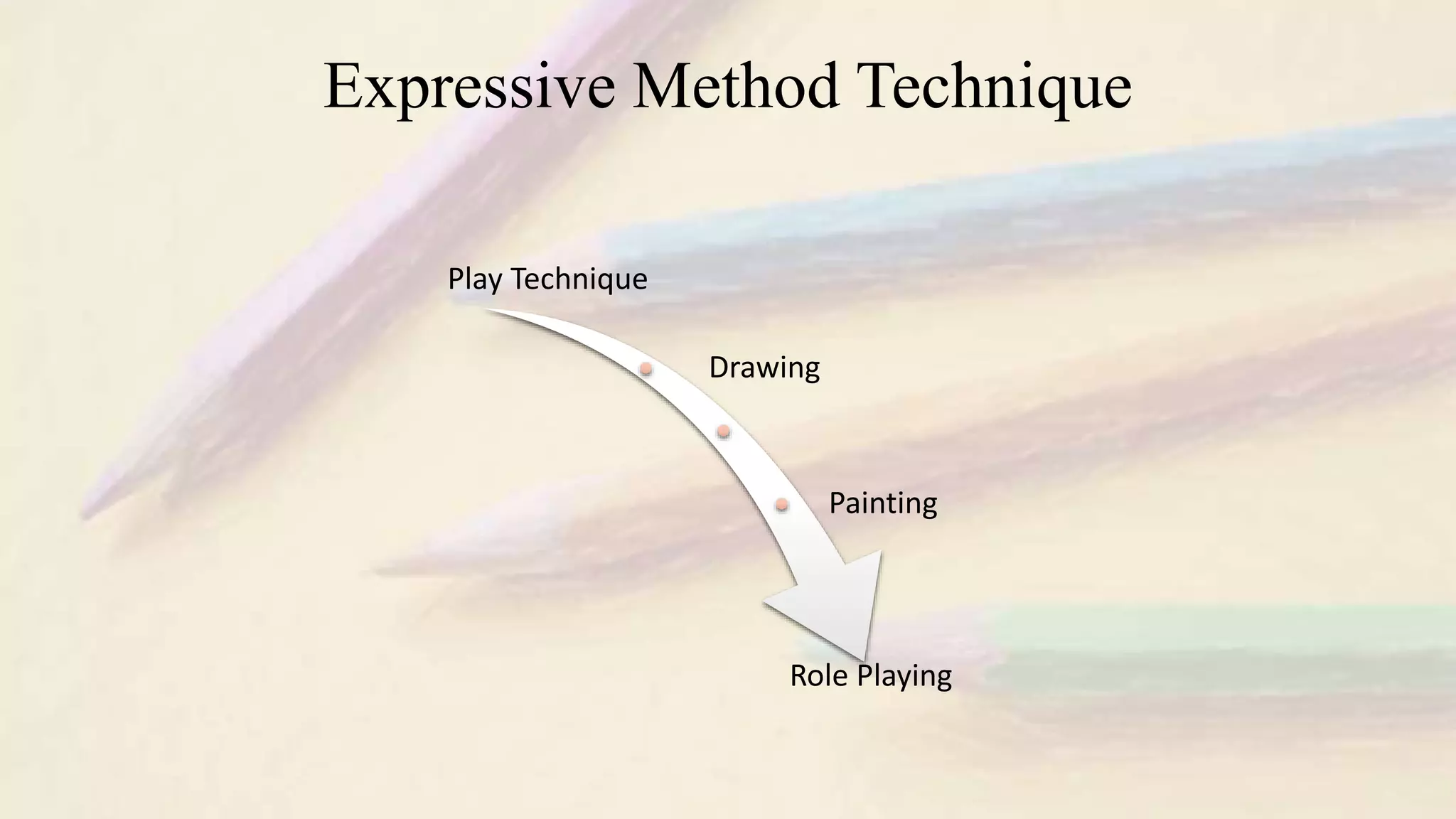
Expressive Method Technique
Play Technique
Drawing
Painting
Role Playing
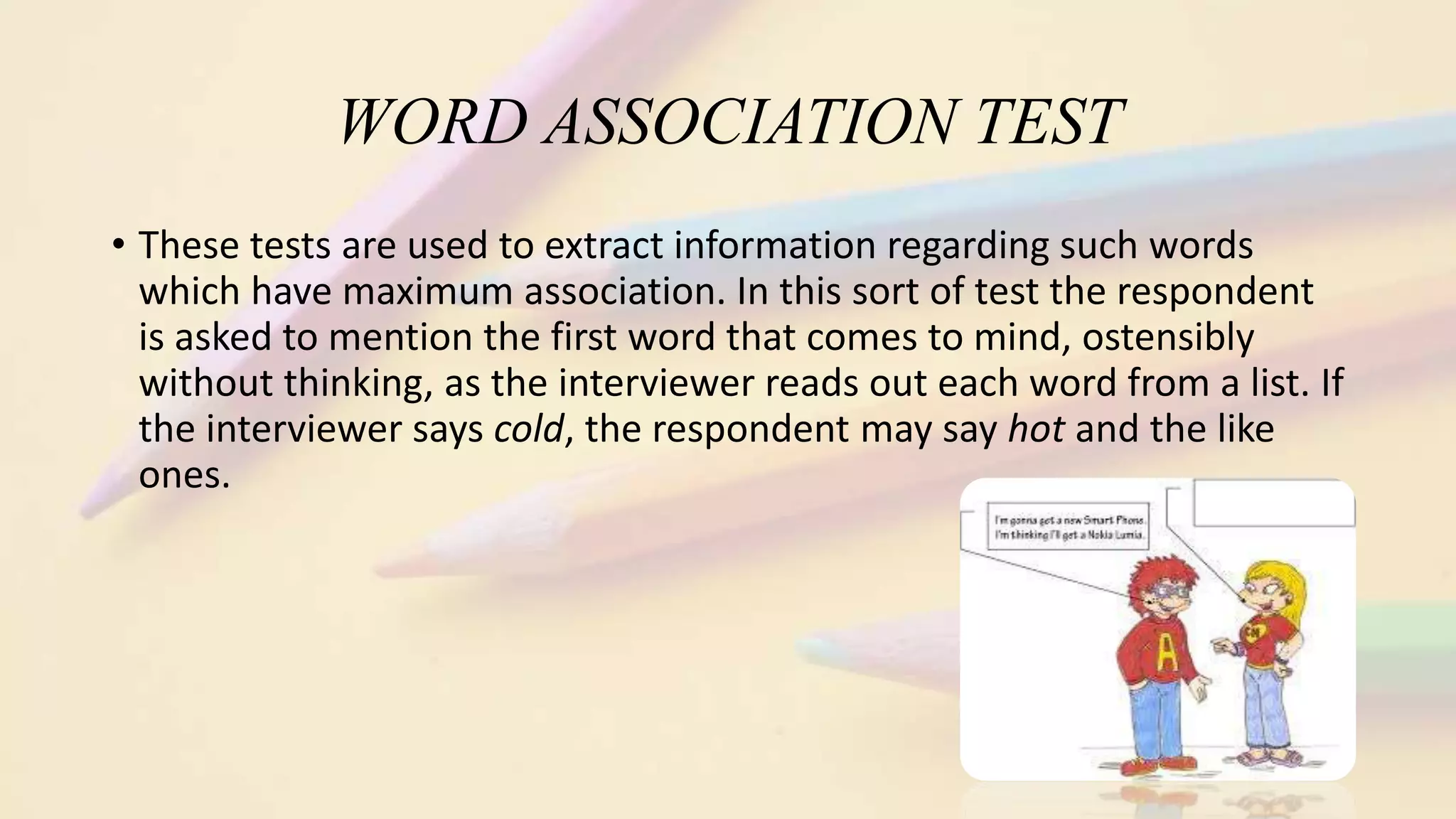
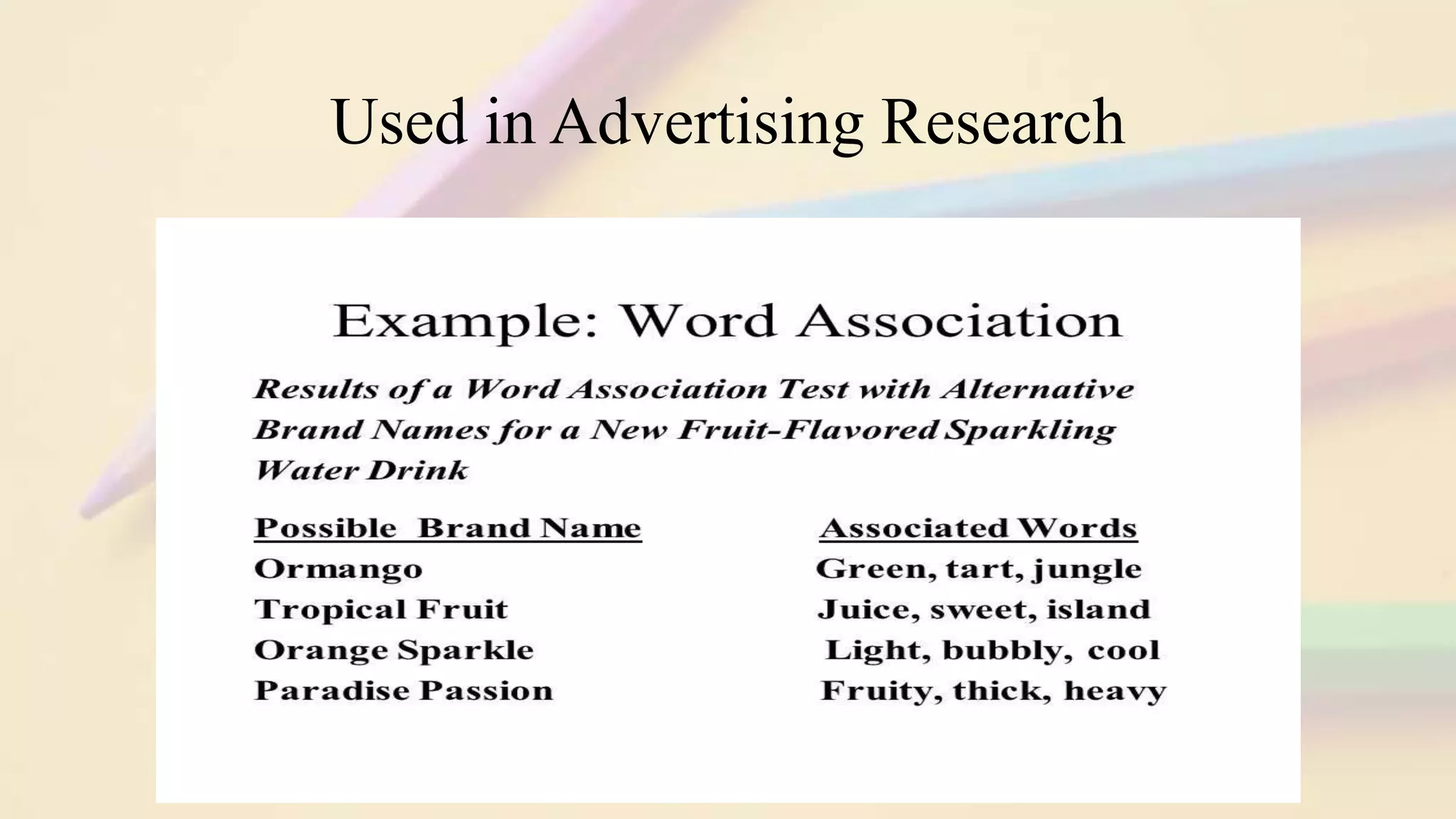
WORD ASSOCIATION TEST
• These tests are used to extract information regarding such words
which have maximum association. In this sort of test the respondent
is asked to mention the first word that comes to mind, ostensibly
without thinking, as the interviewer reads out each word from a list. If
the interviewer says cold, the respondent may say hot and the like
ones.
Used in Advertising Research
Sentence Completion test
• This text happens to be an extension of word association technique
• This technique is quick and easy to use. But it often leads to analytical
problems.
• When responses happens to multidimensional
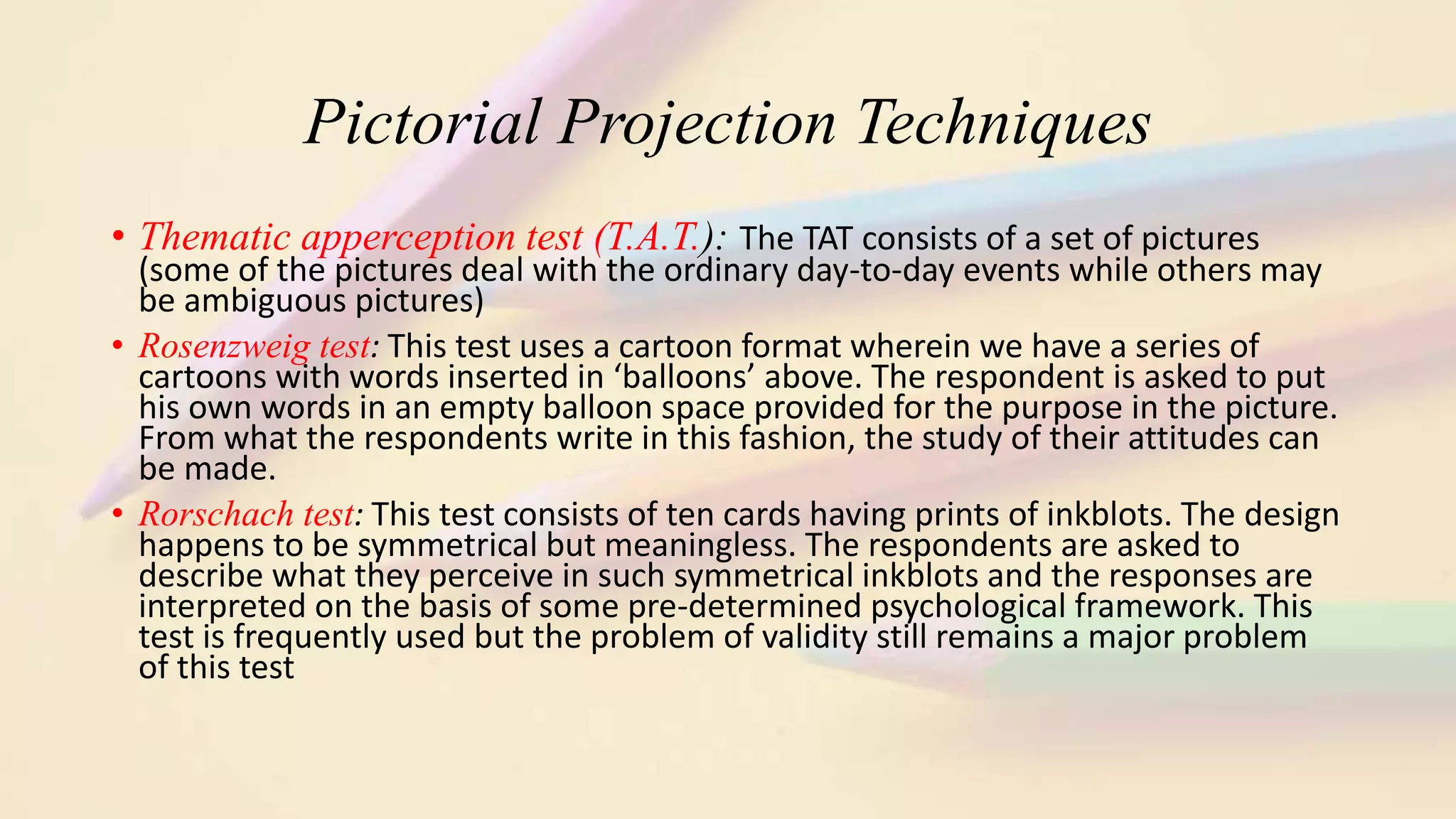
Pictorial Projection Techniques
• Thematic apperception test (T.A.T.): The TAT consists of a set of pictures
(some of the pictures deal with the ordinary day-to-day events while others may
be ambiguous pictures)
• Rosenzweig test: This test uses a cartoon format wherein we have a series of
cartoons with words inserted in ‘balloons’ above. The respondent is asked to put
his own words in an empty balloon space provided for the purpose in the picture.
From what the respondents write in this fashion, the study of their attitudes can
be made.
• Rorschach test: This test consists of ten cards having prints of inkblots. The design
happens to be symmetrical but meaningless. The respondents are asked to
describe what they perceive in such symmetrical inkblots and the responses are
interpreted on the basis of some pre-determined psychological framework. This
test is frequently used but the problem of validity still remains a major problem
of this test
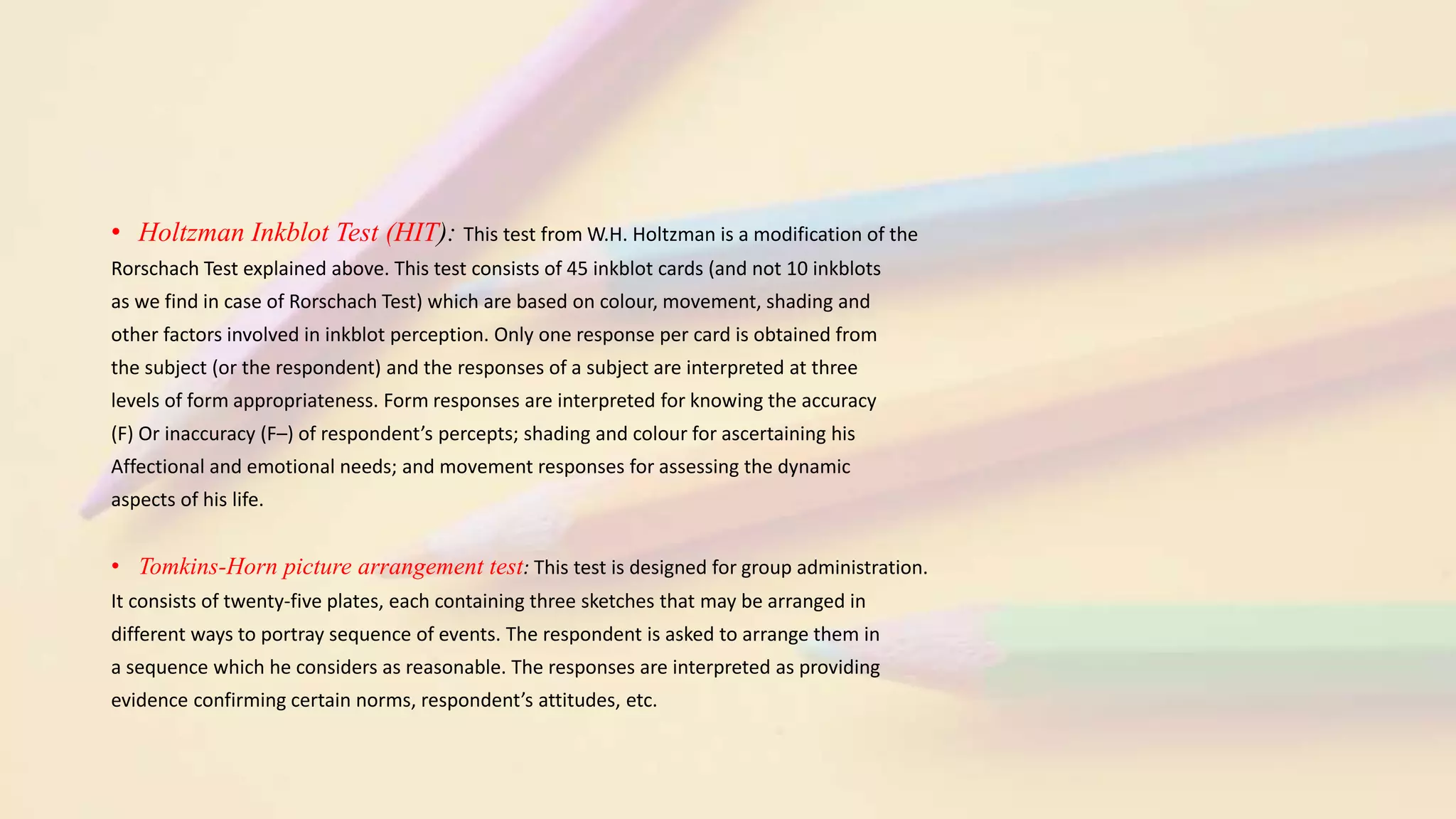
• Holtzman Inkblot Test (HIT): This test from W.H. Holtzman is a modification of the
Rorschach Test explained above. This test consists of 45 inkblot cards (and not 10 inkblots
as we find in case of Rorschach Test) which are based on colour, movement, shading and
other factors involved in inkblot perception. Only one response per card is obtained from
the subject (or the respondent) and the responses of a subject are interpreted at three
levels of form appropriateness. Form responses are interpreted for knowing the accuracy
(F) Or inaccuracy (F–) of respondent’s percepts; shading and colour for ascertaining his
Affectional and emotional needs; and movement responses for assessing the dynamic
aspects of his life.
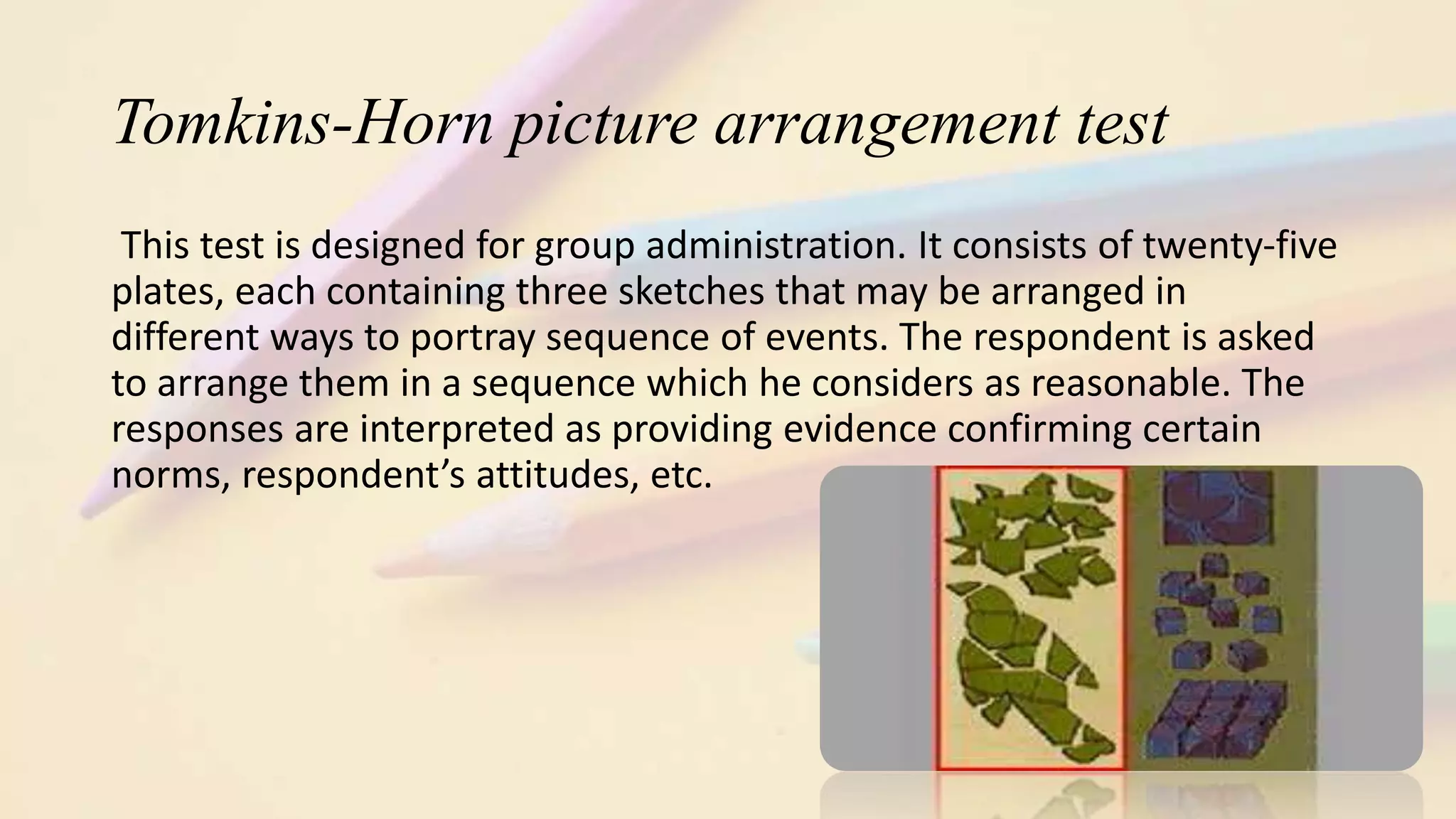
• Tomkins-Horn picture arrangement test: This test is designed for group administration.
It consists of twenty-five plates, each containing three sketches that may be arranged in
different ways to portray sequence of events. The respondent is asked to arrange them in
a sequence which he considers as reasonable. The responses are interpreted as providing
evidence confirming certain norms, respondent’s attitudes, etc.
Tomkins-Horn picture arrangement test
This test is designed for group administration. It consists of twenty-five
plates, each containing three sketches that may be arranged in
different ways to portray sequence of events. The respondent is asked
to arrange them in a sequence which he considers as reasonable. The
responses are interpreted as providing evidence confirming certain
norms, respondent’s attitudes, etc.
Play Techniques
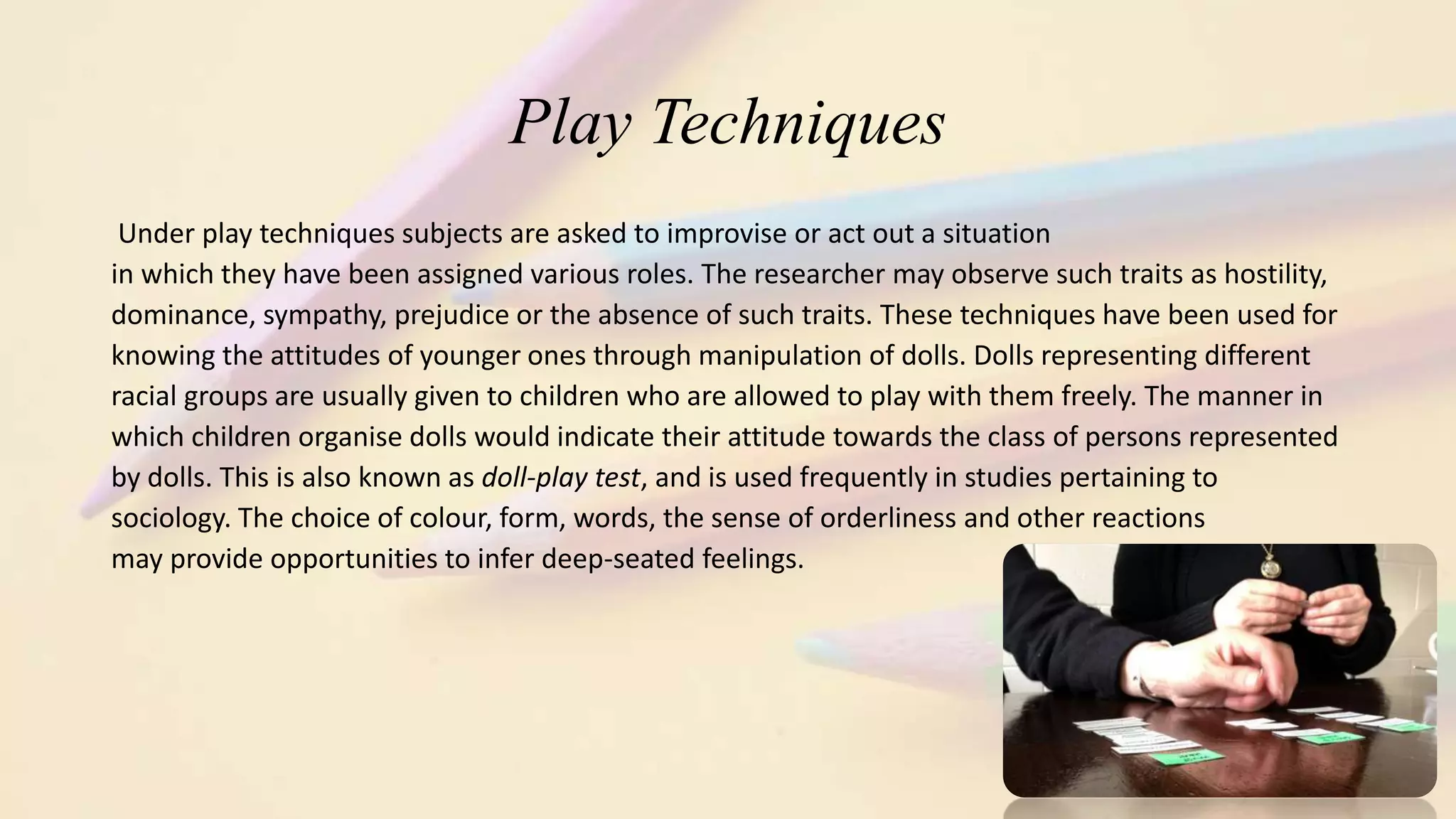
Under play techniques subjects are asked to improvise or act out a situation
in which they have been assigned various roles. The researcher may observe such traits as hostility,
dominance, sympathy, prejudice or the absence of such traits. These techniques have been used for
knowing the attitudes of younger ones through manipulation of dolls. Dolls representing different
racial groups are usually given to children who are allowed to play with them freely. The manner in
which children organise dolls would indicate their attitude towards the class of persons represented
by dolls. This is also known as doll-play test, and is used frequently in studies pertaining to
sociology. The choice of colour, form, words, the sense of orderliness and other reactions
may provide opportunities to infer deep-seated feelings.
Quizzes, tests and examinations
This is also a technique of extracting information regarding
specific ability of candidates indirectly. In this procedure both long and
short questions are framed to test through them the memorising and
analytical ability of candidates
Sociometry
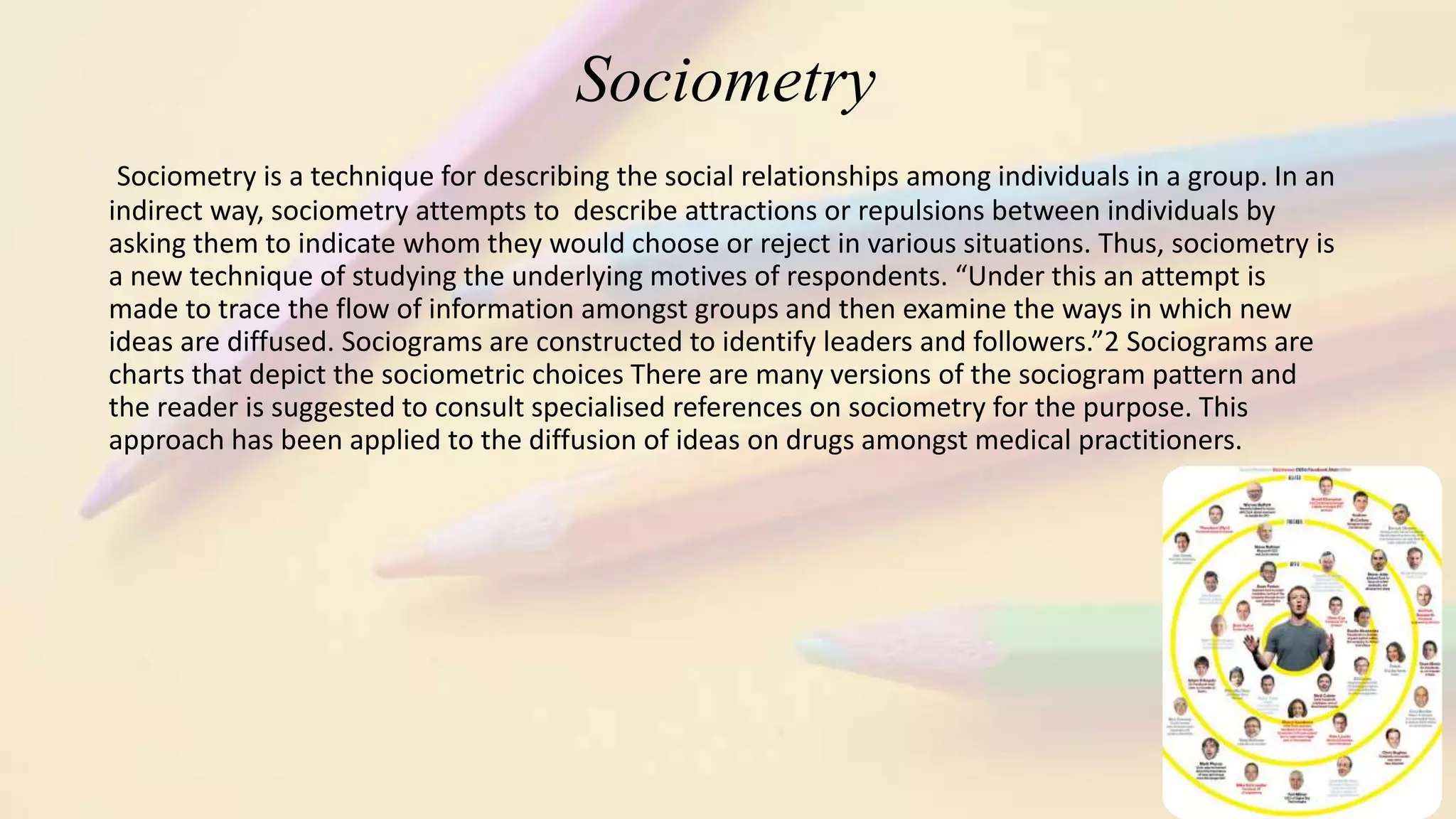
Sociometry is a technique for describing the social relationships among individuals in a group. In an
indirect way, sociometry attempts to describe attractions or repulsions between individuals by
asking them to indicate whom they would choose or reject in various situations. Thus, sociometry is
a new technique of studying the underlying motives of respondents. “Under this an attempt is
made to trace the flow of information amongst groups and then examine the ways in which new
ideas are diffused. Sociograms are constructed to identify leaders and followers.”2 Sociograms are
charts that depict the sociometric choices There are many versions of the sociogram pattern and
the reader is suggested to consult specialised references on sociometry for the purpose. This
approach has been applied to the diffusion of ideas on drugs amongst medical practitioners.
Projective techniques

Projective techniques

  • 1.
    Projective Techniques Presented By Group3 REJO VARGHESE AMENDA JOY JITHIN CHAKO DEENU ROSE GAYATHRI P MEGHA MOHAN
  • 2.
    Projective Techniques Projective techniques(or what are sometimes called as indirect interviewing techniques) for the collection of data have been developed by psychologists to use projections of respondents for inferring about underlying motives, urges, or intentions which are such that the respondent either resists to reveal them or is unable to figure out himself. In projective techniques the respondent in supplying information tends unconsciously to project his own attitudes or feelings on the subject under study. Projective techniques play an important role in motivational researches or in attitude surveys.
  • 3.
    Projection • Psychological techniqueto get answers without asking a direct question • Participants project their unconscious beliefs into other people or objects • Reduces threat of personal vulnerability • Consists of a stimulus and a response
  • 4.
    Projection Methods Associations Uncovers abrand’s identity or product attributes • Word association for a product/brand • Draw brands as people Construction Process allows participant to construct meaning • Participant constructs a story or picture from a concept • Collages are developed on a topic • Bubble drawings or cartoon tests ask participant to construct a dialog
  • 5.
    Completion For insight intoparticipant’s need-value system. • Sentences, stories or conversations are completed • Ie “When I think of beer…..” Expressive For situations when participants cannot describe their actions but can demonstrate them. • Participants role play or act out a story • Themes are developed based on participants’ personal interpretations of pictures • House where brand lives (Bud vs Guiness)
  • 6.
    Types Of ProjectionTechniques Pictorial Projective Technique • Rorschach ink blot test • Thematic appreciation test Verbal Projective Technique Association Technique Word association Method Completion Techniques • Sentence Completion
  • 7.
    Expressive Method Technique PlayTechnique Drawing Painting Role Playing
  • 8.
    WORD ASSOCIATION TEST •These tests are used to extract information regarding such words which have maximum association. In this sort of test the respondent is asked to mention the first word that comes to mind, ostensibly without thinking, as the interviewer reads out each word from a list. If the interviewer says cold, the respondent may say hot and the like ones.
  • 9.
  • 10.
    Sentence Completion test •This text happens to be an extension of word association technique • This technique is quick and easy to use. But it often leads to analytical problems. • When responses happens to multidimensional
  • 11.
    Pictorial Projection Techniques •Thematic apperception test (T.A.T.): The TAT consists of a set of pictures (some of the pictures deal with the ordinary day-to-day events while others may be ambiguous pictures) • Rosenzweig test: This test uses a cartoon format wherein we have a series of cartoons with words inserted in ‘balloons’ above. The respondent is asked to put his own words in an empty balloon space provided for the purpose in the picture. From what the respondents write in this fashion, the study of their attitudes can be made. • Rorschach test: This test consists of ten cards having prints of inkblots. The design happens to be symmetrical but meaningless. The respondents are asked to describe what they perceive in such symmetrical inkblots and the responses are interpreted on the basis of some pre-determined psychological framework. This test is frequently used but the problem of validity still remains a major problem of this test
  • 12.
    • Holtzman InkblotTest (HIT): This test from W.H. Holtzman is a modification of the Rorschach Test explained above. This test consists of 45 inkblot cards (and not 10 inkblots as we find in case of Rorschach Test) which are based on colour, movement, shading and other factors involved in inkblot perception. Only one response per card is obtained from the subject (or the respondent) and the responses of a subject are interpreted at three levels of form appropriateness. Form responses are interpreted for knowing the accuracy (F) Or inaccuracy (F–) of respondent’s percepts; shading and colour for ascertaining his Affectional and emotional needs; and movement responses for assessing the dynamic aspects of his life. • Tomkins-Horn picture arrangement test: This test is designed for group administration. It consists of twenty-five plates, each containing three sketches that may be arranged in different ways to portray sequence of events. The respondent is asked to arrange them in a sequence which he considers as reasonable. The responses are interpreted as providing evidence confirming certain norms, respondent’s attitudes, etc.
  • 13.
    Tomkins-Horn picture arrangementtest This test is designed for group administration. It consists of twenty-five plates, each containing three sketches that may be arranged in different ways to portray sequence of events. The respondent is asked to arrange them in a sequence which he considers as reasonable. The responses are interpreted as providing evidence confirming certain norms, respondent’s attitudes, etc.
  • 14.
    Play Techniques Under playtechniques subjects are asked to improvise or act out a situation in which they have been assigned various roles. The researcher may observe such traits as hostility, dominance, sympathy, prejudice or the absence of such traits. These techniques have been used for knowing the attitudes of younger ones through manipulation of dolls. Dolls representing different racial groups are usually given to children who are allowed to play with them freely. The manner in which children organise dolls would indicate their attitude towards the class of persons represented by dolls. This is also known as doll-play test, and is used frequently in studies pertaining to sociology. The choice of colour, form, words, the sense of orderliness and other reactions may provide opportunities to infer deep-seated feelings.
  • 15.
    Quizzes, tests andexaminations This is also a technique of extracting information regarding specific ability of candidates indirectly. In this procedure both long and short questions are framed to test through them the memorising and analytical ability of candidates
  • 16.
    Sociometry Sociometry is atechnique for describing the social relationships among individuals in a group. In an indirect way, sociometry attempts to describe attractions or repulsions between individuals by asking them to indicate whom they would choose or reject in various situations. Thus, sociometry is a new technique of studying the underlying motives of respondents. “Under this an attempt is made to trace the flow of information amongst groups and then examine the ways in which new ideas are diffused. Sociograms are constructed to identify leaders and followers.”2 Sociograms are charts that depict the sociometric choices There are many versions of the sociogram pattern and the reader is suggested to consult specialised references on sociometry for the purpose. This approach has been applied to the diffusion of ideas on drugs amongst medical practitioners.