METHODS AND
TECHNIQUES OF TEACHING
PRESENTED BY
BHAGYASHREE VYAWAHARE
Unit 2: Understanding Methods and
Approaches of Teaching
a) Traditional - Lecture-cum-
Discussion Method, Self – Learning
Method (SQ4R), Interactive
Techniques (questioning &
brainstorming)
MEANING
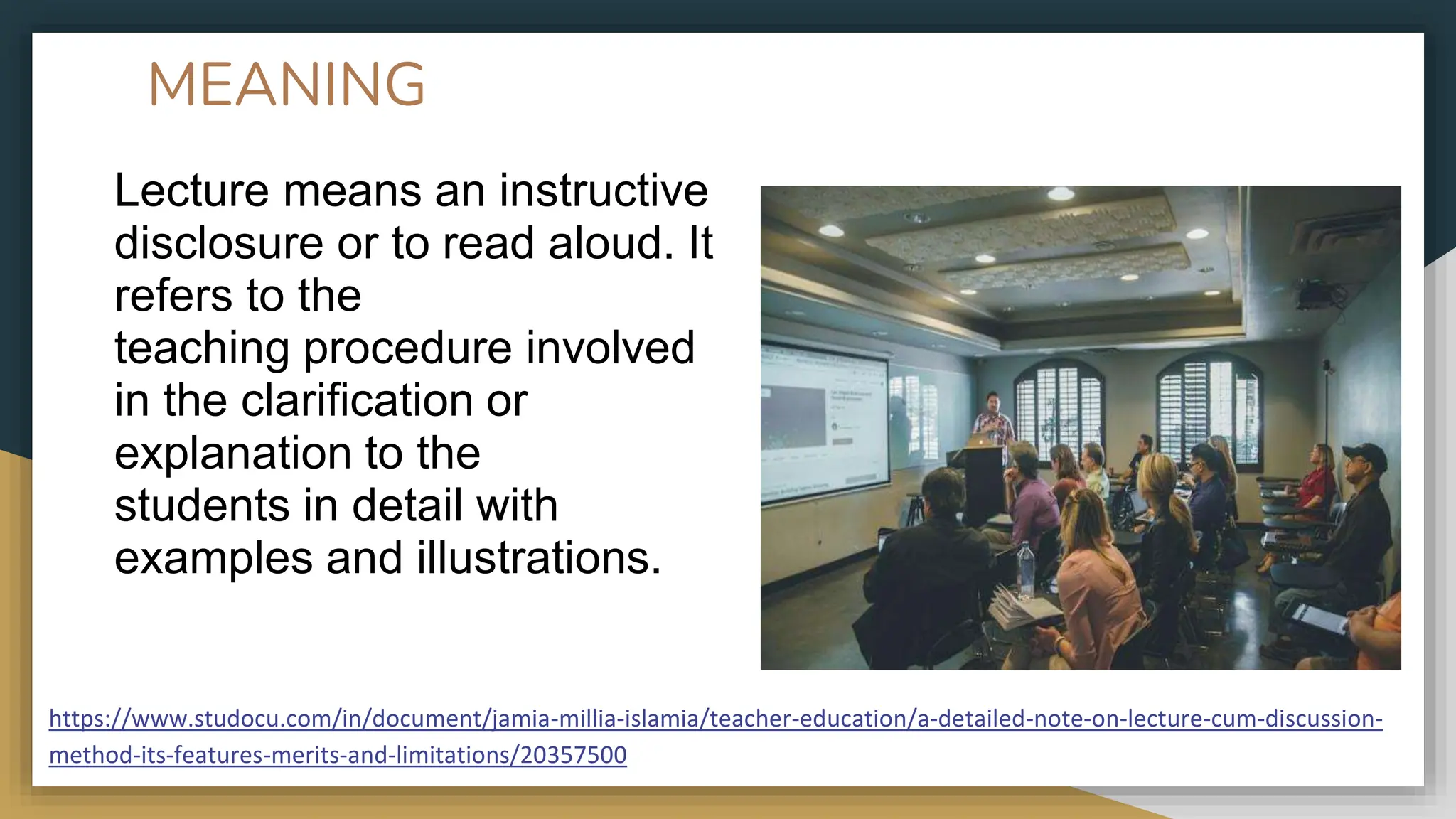
Lecture means an instructive
disclosure or to read aloud. It
refers to the
teaching procedure involved
in the clarification or
explanation to the
students in detail with
examples and illustrations.
https://www.studocu.com/in/document/jamia-millia-islamia/teacher-education/a-detailed-note-on-lecture-cum-discussion-
method-its-features-merits-and-limitations/20357500
DEFINITION
Good and Merkel (1959) suggest lecture as a method of
teaching by which the instructor gives an oral
presentation of facts or principles to learners and the
class usually being responsible for note taking, usually
implies little or no class participation by such means as
questioning or discussion during the class period.
https://www.ripublication.com/ijepa/ijepav1n1_001.pdf
DISCUSSION METHOD
According to Good's
Dictionary of Education,
"Discussion means an activity
characterised by
adherence to a topic, question
or problem about which the
participants
sincerely wish to arrive at a
decision or conclusion".
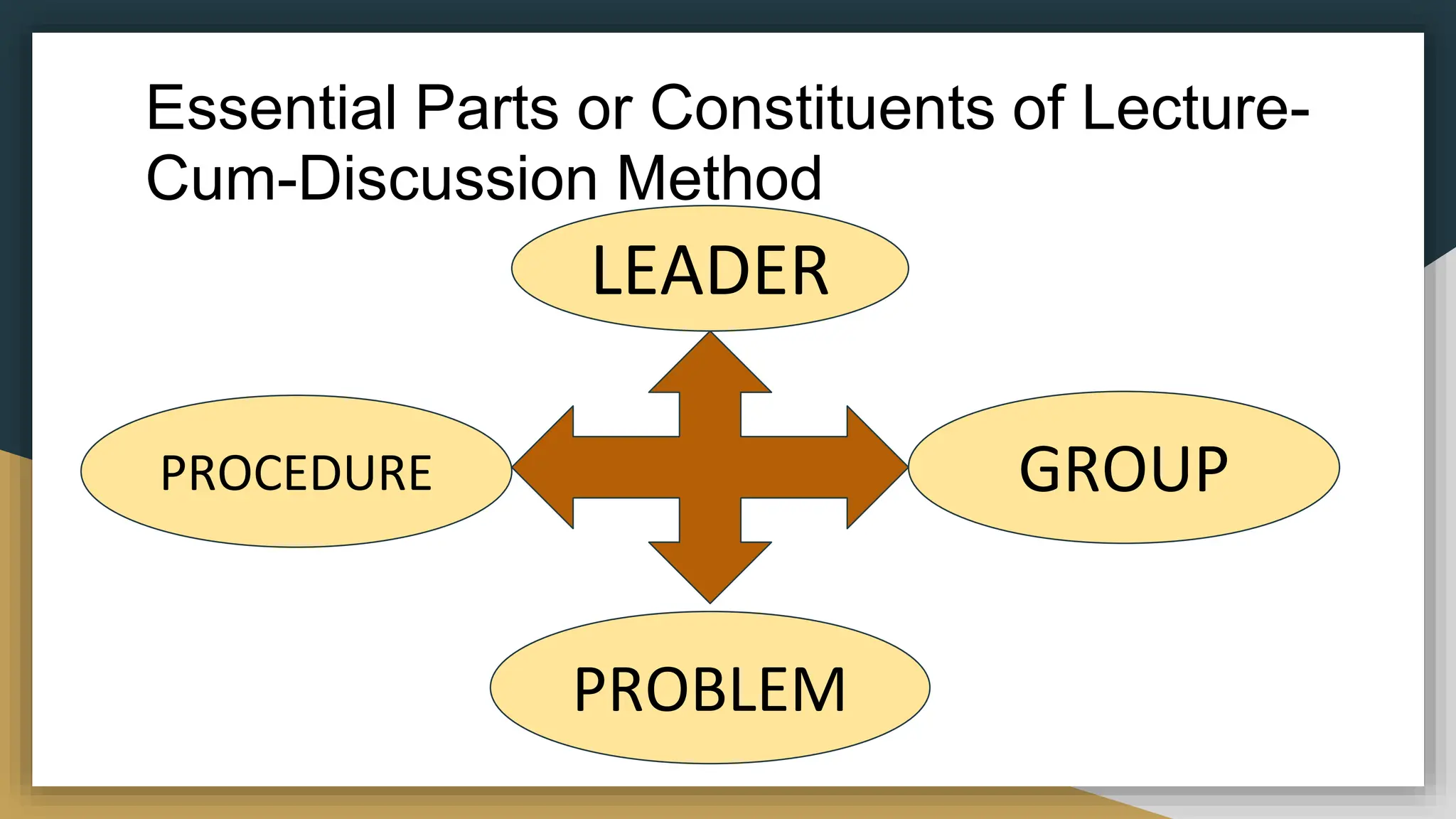
Essential Parts or Constituents of Lecture-
Cum-Discussion Method
GROUP
LEADER
PROCEDURE
PROBLEM
ROLE OF THE LEADER (TEACHER)
➢ being thorough with the content
➢ deciding the checkpoints of the discussion
➢ monitoring and facilitating the discussion
➢ explaining the basic ideas, thus laying a strong
foundation for discussion
➢ controlling the urge to dominate the discussion
THE GROUP
★ They differ in their interests, abilities, aptitudes,
temperaments and habits.
★ Every student should be encouraged to participate in
the discussion
★ Every member of the group should express his views.
THE PROBLEM
❖ The problem should be relevant
❖ It should be close to the students’ interest areas
❖ The problem should be made as precise and exact as
possible.
❖ The teacher should select the problem with the cooperation
of his students.
❖ It should be real and functional and within the capacity and
comprehension of the pupils.
THE CONTENT
❏ At the end of the discussion each participant
should evaluate whether discussion about the
particular problem has added to his
knowledge,changed his ideas, attitudes and
prejudice and increase the range of his
Interest.
❏ A good discussion would bring change in
ideas and attitudes and make the participant
more active than before.
PROCEDURE/ORGANISATION OF
DISCUSSION
1. Introduction of Topic/Problem
2. Collection and Presentation of Information
3. Outlines of Main Points
4. Student's Views
5. Teacher's Details and Discussion
6. Student's Details and Discussion
7.discussing them.
8. Audio-Visual Material
9. Evaluation
10. Recording
Merits of Lecture-Cum-Discussion Method
1. Helpful in Clarifying Main Issue
2.Development of Leadership Qualities
3.Inculcates Tolerance
4. Development of Ability to Select and Organise
5. Group Learning
6.Social Learning
7. Promotion of Self-Evaluation
Limitations of Lecture-Cum-Discussion
Method
1. Not suitable for all topics
2. Discussion has greater chances for
deviation from the main topic.
3. Not applicable to all the students
4. Groupism
5. Unpleasant feelings and tensions
6. Not very suitable for lower classes
REFERENCES
https://www.studocu.com/in/document/jamia-millia-islamia/teacher-education/a-detailed-note-on-lecture-
cum-discussion-method-its-features-merits-and-limitations/20357500
https://www.ripublication.com/ijepa/ijepav1n1_001.pdf
Method  of  lecture cum  discussion.pptx

Method of lecture cum discussion.pptx

  • 1.
    METHODS AND TECHNIQUES OFTEACHING PRESENTED BY BHAGYASHREE VYAWAHARE
  • 2.
    Unit 2: UnderstandingMethods and Approaches of Teaching a) Traditional - Lecture-cum- Discussion Method, Self – Learning Method (SQ4R), Interactive Techniques (questioning & brainstorming)
  • 3.
    MEANING Lecture means aninstructive disclosure or to read aloud. It refers to the teaching procedure involved in the clarification or explanation to the students in detail with examples and illustrations. https://www.studocu.com/in/document/jamia-millia-islamia/teacher-education/a-detailed-note-on-lecture-cum-discussion- method-its-features-merits-and-limitations/20357500
  • 4.
    DEFINITION Good and Merkel(1959) suggest lecture as a method of teaching by which the instructor gives an oral presentation of facts or principles to learners and the class usually being responsible for note taking, usually implies little or no class participation by such means as questioning or discussion during the class period. https://www.ripublication.com/ijepa/ijepav1n1_001.pdf
  • 5.
    DISCUSSION METHOD According toGood's Dictionary of Education, "Discussion means an activity characterised by adherence to a topic, question or problem about which the participants sincerely wish to arrive at a decision or conclusion".
  • 6.
    Essential Parts orConstituents of Lecture- Cum-Discussion Method GROUP LEADER PROCEDURE PROBLEM
  • 7.
    ROLE OF THELEADER (TEACHER) ➢ being thorough with the content ➢ deciding the checkpoints of the discussion ➢ monitoring and facilitating the discussion ➢ explaining the basic ideas, thus laying a strong foundation for discussion ➢ controlling the urge to dominate the discussion
  • 8.
    THE GROUP ★ Theydiffer in their interests, abilities, aptitudes, temperaments and habits. ★ Every student should be encouraged to participate in the discussion ★ Every member of the group should express his views.
  • 9.
    THE PROBLEM ❖ Theproblem should be relevant ❖ It should be close to the students’ interest areas ❖ The problem should be made as precise and exact as possible. ❖ The teacher should select the problem with the cooperation of his students. ❖ It should be real and functional and within the capacity and comprehension of the pupils.
  • 10.
    THE CONTENT ❏ Atthe end of the discussion each participant should evaluate whether discussion about the particular problem has added to his knowledge,changed his ideas, attitudes and prejudice and increase the range of his Interest. ❏ A good discussion would bring change in ideas and attitudes and make the participant more active than before.
  • 11.
    PROCEDURE/ORGANISATION OF DISCUSSION 1. Introductionof Topic/Problem 2. Collection and Presentation of Information 3. Outlines of Main Points 4. Student's Views 5. Teacher's Details and Discussion 6. Student's Details and Discussion
  • 12.
    7.discussing them. 8. Audio-VisualMaterial 9. Evaluation 10. Recording
  • 13.
    Merits of Lecture-Cum-DiscussionMethod 1. Helpful in Clarifying Main Issue 2.Development of Leadership Qualities 3.Inculcates Tolerance 4. Development of Ability to Select and Organise 5. Group Learning 6.Social Learning 7. Promotion of Self-Evaluation
  • 14.
    Limitations of Lecture-Cum-Discussion Method 1.Not suitable for all topics 2. Discussion has greater chances for deviation from the main topic. 3. Not applicable to all the students 4. Groupism 5. Unpleasant feelings and tensions 6. Not very suitable for lower classes
  • 15.

Editor's Notes

  • #11 The content is the body of knowledge, the needed material of study. It may include maps, charts, pictures, diagrams and other audio visual aids. In discussion what matters most is constant resort and generalisations without which a common bond of agreement cannot be established.