Choosing a method of Delivery Tips on how to give a speech correctly 2005  © Andree’s Attic Created by: Andree Swanson
The ways to give a speech  Speaking from a  manuscript Speaking from  memory Giving an  impromptu  speech Speaking  extemporaneously
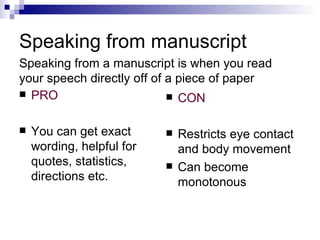
Speaking from manuscript PRO You can get exact wording, helpful for quotes, statistics, directions etc. CON Restricts eye contact and body movement Can become monotonous Speaking from a manuscript is when you read your speech directly off of a piece of paper
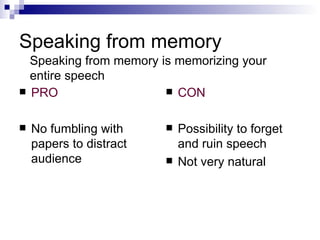
Speaking from memory PRO No fumbling with papers to distract audience CON Possibility to forget and ruin speech Not very natural Speaking from memory is memorizing your entire speech
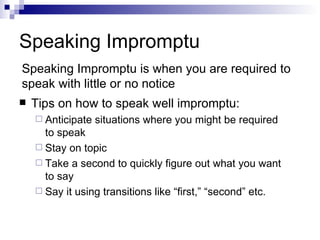
Speaking Impromptu Tips on how to speak well impromptu: Anticipate situations where you might be required to speak Stay on topic Take a second to quickly figure out what you want to say Say it using transitions like “first,” “second” etc.  Speaking Impromptu is when you are required to speak with little or no notice
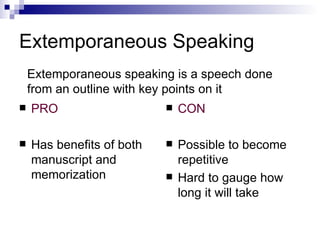
Extemporaneous Speaking PRO Has benefits of both manuscript and memorization CON Possible to become repetitive Hard to gauge how long it will take Extemporaneous speaking is a speech done from an outline with key points on it
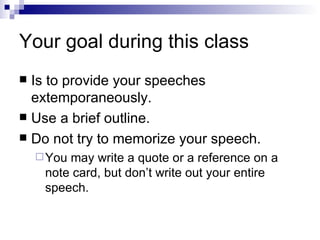
Your goal during this class Is to provide your speeches extemporaneously. Use a brief outline. Do not try to memorize your speech. You may write a quote or a reference on a note card, but don’t write out your entire speech.
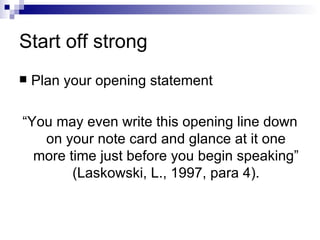
Start off strong Plan your opening statement “You may even write this opening line down on your note card and glance at it one more time just before you begin speaking” (Laskowski, L., 1997, para 4).
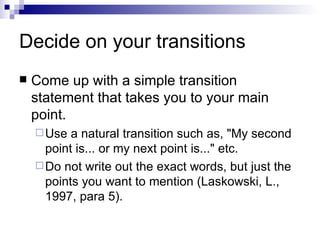
Decide on your transitions Come up with a simple transition statement that takes you to your main point.  Use a natural transition such as, "My second point is... or my next point is..." etc.  Do not write out the exact words, but just the points you want to mention (Laskowski, L., 1997, para 5).
Maintain Eye Contact  This is much easier to do when you don’t write your speech. In fact, if you type your speech, you will just lose your place…guaranteed! Keep those good ideas in your head.
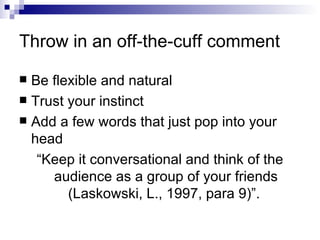
Throw in an off-the-cuff comment Be flexible and natural Trust your instinct Add a few words that just pop into your head “Keep it conversational and think of the audience as a group of your friends (Laskowski, L., 1997, para 9)”.
References Laskowski, L. (1997). Impromptu or extemporaneous speaking. Retrieved on September 3, 2005, from  http://www.ljlseminars.com/imprompt.htm .

Method of Delivery

  • 1.
    Choosing a methodof Delivery Tips on how to give a speech correctly 2005 © Andree’s Attic Created by: Andree Swanson
  • 2.
    The ways togive a speech Speaking from a manuscript Speaking from memory Giving an impromptu speech Speaking extemporaneously
  • 3.
    Speaking from manuscriptPRO You can get exact wording, helpful for quotes, statistics, directions etc. CON Restricts eye contact and body movement Can become monotonous Speaking from a manuscript is when you read your speech directly off of a piece of paper
  • 4.
    Speaking from memoryPRO No fumbling with papers to distract audience CON Possibility to forget and ruin speech Not very natural Speaking from memory is memorizing your entire speech
  • 5.
    Speaking Impromptu Tipson how to speak well impromptu: Anticipate situations where you might be required to speak Stay on topic Take a second to quickly figure out what you want to say Say it using transitions like “first,” “second” etc. Speaking Impromptu is when you are required to speak with little or no notice
  • 6.
    Extemporaneous Speaking PROHas benefits of both manuscript and memorization CON Possible to become repetitive Hard to gauge how long it will take Extemporaneous speaking is a speech done from an outline with key points on it
  • 7.
    Your goal duringthis class Is to provide your speeches extemporaneously. Use a brief outline. Do not try to memorize your speech. You may write a quote or a reference on a note card, but don’t write out your entire speech.
  • 8.
    Start off strongPlan your opening statement “You may even write this opening line down on your note card and glance at it one more time just before you begin speaking” (Laskowski, L., 1997, para 4).
  • 9.
    Decide on yourtransitions Come up with a simple transition statement that takes you to your main point. Use a natural transition such as, "My second point is... or my next point is..." etc. Do not write out the exact words, but just the points you want to mention (Laskowski, L., 1997, para 5).
  • 10.
    Maintain Eye Contact This is much easier to do when you don’t write your speech. In fact, if you type your speech, you will just lose your place…guaranteed! Keep those good ideas in your head.
  • 11.
    Throw in anoff-the-cuff comment Be flexible and natural Trust your instinct Add a few words that just pop into your head “Keep it conversational and think of the audience as a group of your friends (Laskowski, L., 1997, para 9)”.
  • 12.
    References Laskowski, L.(1997). Impromptu or extemporaneous speaking. Retrieved on September 3, 2005, from http://www.ljlseminars.com/imprompt.htm .