Public Speaking
Speech is power,
Speech is to persuade, to convert, to compel.

BY

•Harsh Gaur (B-41)
•Aamir Malik (B-43)
•Sudip Mazumdar (B-44)
•Satyam Maitrai (B-45)
•Zain Ul Abdeen (B-61)
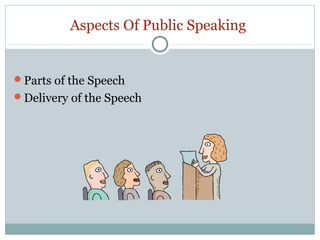
Aspects Of Public Speaking

Parts of the Speech
Delivery of the Speech
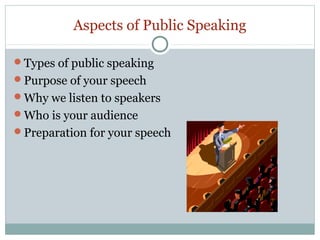
Aspects of Public Speaking
Types of public speaking
Purpose of your speech
Why we listen to speakers
Who is your audience
Preparation for your speech
Ways of Public Speaking





Extempore – without planning or preparation and on the
spot
Prepared – having time to think and develop your material
before you speak
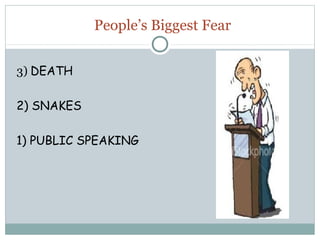
People’s Biggest Fear
3) DEATH
2) SNAKES
1) PUBLIC SPEAKING
 About 10 percent of the population

loves Public Speaking.
 Another

terrified.

10 percent are genuinely

 The rest of us- roughly 80 percent get

butterflies, get anxious, don’t sleep in
the night before- but we know we r
going to live through it. The fun part is
just lost in that case.
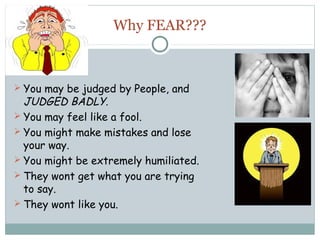
Why FEAR???

 You may be judged by People, and

JUDGED BADLY.
 You may feel like a fool.
 You might make mistakes and lose
your way.
 You might be extremely humiliated.
 They wont get what you are trying
to say.
 They wont like you.
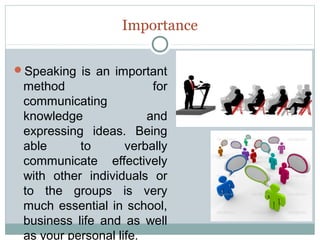
Importance
Speaking is an important

method
for
communicating
knowledge
and
expressing ideas. Being
able
to
verbally
communicate effectively
with other individuals or
to the groups is very
much essential in school,
business life and as well
as your personal life.
Three Types of Public Speaking
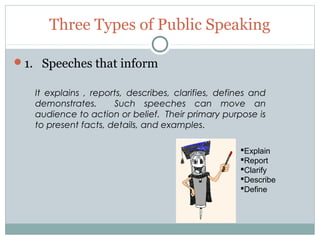
1. Speeches that inform
It explains , reports, describes, clarifies, defines and
demonstrates.
Such speeches can move an
audience to action or belief. Their primary purpose is
to present facts, details, and examples.
Explain
Report
Clarify
Describe
Define
2. Speeches that persuade
Speeches that persuade are designed to convince
and the goal is to influence the audience’s beliefs or
attitudes. This can be accomplished by using your
own credibility to strengthen your argument.
3. Speeches that entertain
Uses humor to influence an audience. Once the audience is
warmed up, one main idea is presented, still on a light note.
This is the most difficult of all presentations because it requires
great ease and elegance and depends to a large degree
on the charisma of the speaker.
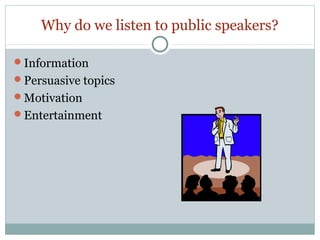
Why do we listen to public speakers?
Information
Persuasive topics
Motivation
Entertainment
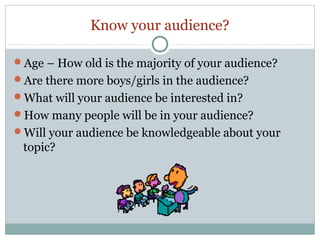
Know your audience?
Age – How old is the majority of your audience?
Are there more boys/girls in the audience?
What will your audience be interested in?
How many people will be in your audience?
Will your audience be knowledgeable about your

topic?
How to win the audience?
Keep your discussion
 Interesting





Use examples or stories
Provide interesting facts

To the point



Don’t go on and on and on and on and on
Keep your comments simple but informative
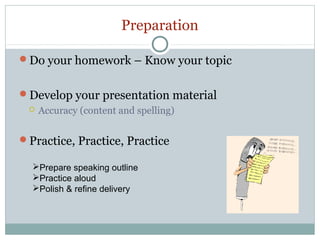
Preparation
Do your homework – Know your topic
Develop your presentation material


Accuracy (content and spelling)

Practice, Practice, Practice
Prepare speaking outline
Practice aloud
Polish & refine delivery
Parts of the Speech
Introduction
Body
Conclusion
Introduction of Speech
Get the audiences attention
Introduce yourself
State the purpose
Relate the importance to the audience
Preview the main points that will be covered
Body of the Speech
Conveys the message: Begin developing your speech by working
on the middle first, or the body. The body covers everything you want
to say during your speech. In other words, the body is the main content.

Discuss main points: The body should have three to five main
points. Next we present them from least important to the most
important, or vice versa. Each point needs to be backed up with
additional evidence such as quoting facts, statistics, or quoting experts .

Provide supporting details: Each point needs to be backed
up with additional evidence such as quoting facts, statistics, or quoting
experts.
Conclusion
Highlight the central theme of your speech
Briefly cover the main points
Provide the audience with a feeling of satisfaction

that you accomplished what you promised
Closing statement
Thank the audience for their attention
The first step
Be Prepared
Take a deep breath
Slow your breathing / pause between sentences
Get the audience engaged


Tell a joke, use a quote, use a poem to begin your speech

Walk around – use your energy
Find your own way to reduce nervousness
Face your fears
Delivery of your Speech
Appearance
Speech and Voice
Body Language
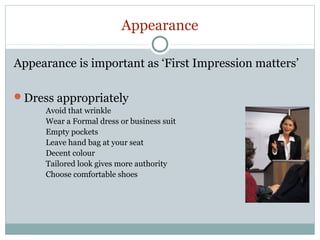
Appearance
Appearance is important as ‘First Impression matters’
Dress appropriately
Avoid that wrinkle
Wear a Formal dress or business suit
Empty pockets
Leave hand bag at your seat
Decent colour
Tailored look gives more authority
Choose comfortable shoes
Speech and Voice
Use variation in


Loudness




Pitch





Low and high pitch
Creates interest

Quality




Helps provide attention

Provides emotion and feeling

Rate


Holds the attention of the audience
Body Language
 Posture
 Shows confidence
 Not too rigid – locked knees = chance to meet the floor / Relax
 Facial Expressions
 Smile/ enjoy yourself and your audience will also enjoy themselves
 Be serious when necessary
 Eye Contact
 Helps establish a relationship with your audience
 Makes them feel included
 Too nervous – look directly above their heads
 Look for signals from your audience – do they look confused? bored? Excited?
 Keep head up – Don’t talk to the floor
 Gestures
 Use your head, hands and arms – helps to emphasize ideas and feelings
 Should come naturally
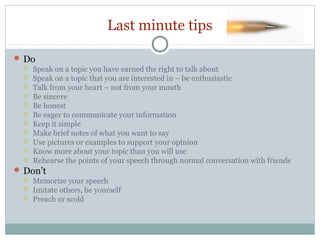
Last minute tips
 Do
 Speak on a topic you have earned the right to talk about
 Speak on a topic that you are interested in – be enthusiastic
 Talk from your heart – not from your mouth
 Be sincere
 Be honest
 Be eager to communicate your information
 Keep it simple
 Make brief notes of what you want to say
 Use pictures or examples to support your opinion
 Know more about your topic than you will use
 Rehearse the points of your speech through normal conversation with friends
 Don’t
 Memorize your speech
 Imitate others, be yourself
 Preach or scold
Thank You

QUESTIONS ???

Effective public speaking

  • 1.
    Public Speaking Speech ispower, Speech is to persuade, to convert, to compel. BY •Harsh Gaur (B-41) •Aamir Malik (B-43) •Sudip Mazumdar (B-44) •Satyam Maitrai (B-45) •Zain Ul Abdeen (B-61)
  • 2.
    Aspects Of PublicSpeaking Parts of the Speech Delivery of the Speech
  • 3.
    Aspects of PublicSpeaking Types of public speaking Purpose of your speech Why we listen to speakers Who is your audience Preparation for your speech
  • 4.
    Ways of PublicSpeaking   Extempore – without planning or preparation and on the spot Prepared – having time to think and develop your material before you speak
  • 5.
    People’s Biggest Fear 3)DEATH 2) SNAKES 1) PUBLIC SPEAKING
  • 6.
     About 10percent of the population loves Public Speaking.  Another terrified. 10 percent are genuinely  The rest of us- roughly 80 percent get butterflies, get anxious, don’t sleep in the night before- but we know we r going to live through it. The fun part is just lost in that case.
  • 7.
    Why FEAR???  Youmay be judged by People, and JUDGED BADLY.  You may feel like a fool.  You might make mistakes and lose your way.  You might be extremely humiliated.  They wont get what you are trying to say.  They wont like you.
  • 8.
    Importance Speaking is animportant method for communicating knowledge and expressing ideas. Being able to verbally communicate effectively with other individuals or to the groups is very much essential in school, business life and as well as your personal life.
  • 9.
    Three Types ofPublic Speaking 1. Speeches that inform It explains , reports, describes, clarifies, defines and demonstrates. Such speeches can move an audience to action or belief. Their primary purpose is to present facts, details, and examples. Explain Report Clarify Describe Define
  • 10.
    2. Speeches thatpersuade Speeches that persuade are designed to convince and the goal is to influence the audience’s beliefs or attitudes. This can be accomplished by using your own credibility to strengthen your argument.
  • 11.
    3. Speeches thatentertain Uses humor to influence an audience. Once the audience is warmed up, one main idea is presented, still on a light note. This is the most difficult of all presentations because it requires great ease and elegance and depends to a large degree on the charisma of the speaker.
  • 12.
    Why do welisten to public speakers? Information Persuasive topics Motivation Entertainment
  • 13.
    Know your audience? Age– How old is the majority of your audience? Are there more boys/girls in the audience? What will your audience be interested in? How many people will be in your audience? Will your audience be knowledgeable about your topic?
  • 14.
    How to winthe audience? Keep your discussion  Interesting    Use examples or stories Provide interesting facts To the point   Don’t go on and on and on and on and on Keep your comments simple but informative
  • 15.
    Preparation Do your homework– Know your topic Develop your presentation material  Accuracy (content and spelling) Practice, Practice, Practice Prepare speaking outline Practice aloud Polish & refine delivery
  • 16.
    Parts of theSpeech Introduction Body Conclusion
  • 17.
    Introduction of Speech Getthe audiences attention Introduce yourself State the purpose Relate the importance to the audience Preview the main points that will be covered
  • 18.
    Body of theSpeech Conveys the message: Begin developing your speech by working on the middle first, or the body. The body covers everything you want to say during your speech. In other words, the body is the main content. Discuss main points: The body should have three to five main points. Next we present them from least important to the most important, or vice versa. Each point needs to be backed up with additional evidence such as quoting facts, statistics, or quoting experts . Provide supporting details: Each point needs to be backed up with additional evidence such as quoting facts, statistics, or quoting experts.
  • 19.
    Conclusion Highlight the centraltheme of your speech Briefly cover the main points Provide the audience with a feeling of satisfaction that you accomplished what you promised Closing statement Thank the audience for their attention
  • 20.
    The first step BePrepared Take a deep breath Slow your breathing / pause between sentences Get the audience engaged  Tell a joke, use a quote, use a poem to begin your speech Walk around – use your energy Find your own way to reduce nervousness Face your fears
  • 21.
    Delivery of yourSpeech Appearance Speech and Voice Body Language
  • 22.
    Appearance Appearance is importantas ‘First Impression matters’ Dress appropriately Avoid that wrinkle Wear a Formal dress or business suit Empty pockets Leave hand bag at your seat Decent colour Tailored look gives more authority Choose comfortable shoes
  • 23.
    Speech and Voice Usevariation in  Loudness   Pitch    Low and high pitch Creates interest Quality   Helps provide attention Provides emotion and feeling Rate  Holds the attention of the audience
  • 24.
    Body Language  Posture Shows confidence  Not too rigid – locked knees = chance to meet the floor / Relax  Facial Expressions  Smile/ enjoy yourself and your audience will also enjoy themselves  Be serious when necessary  Eye Contact  Helps establish a relationship with your audience  Makes them feel included  Too nervous – look directly above their heads  Look for signals from your audience – do they look confused? bored? Excited?  Keep head up – Don’t talk to the floor  Gestures  Use your head, hands and arms – helps to emphasize ideas and feelings  Should come naturally
  • 25.
    Last minute tips Do  Speak on a topic you have earned the right to talk about  Speak on a topic that you are interested in – be enthusiastic  Talk from your heart – not from your mouth  Be sincere  Be honest  Be eager to communicate your information  Keep it simple  Make brief notes of what you want to say  Use pictures or examples to support your opinion  Know more about your topic than you will use  Rehearse the points of your speech through normal conversation with friends  Don’t  Memorize your speech  Imitate others, be yourself  Preach or scold
  • 26.

Editor's Notes