MGT 425
Week 3
MGT 425
Leadership & Motivation
As we embark on
the heart of our
class, please take
advantage of
saving your
research from
previous weeks, as
you may likely be
able to find another
way to use it in this
week’s work (or
future
weeks/classes)
Don’t forget to
avoid non-credible
sources. We only
use scholarly, peer-
reviewed sources in
academic writing
MGT 425: Leadership & Motivation
Introduction to Week 3
We are officially mid-way through class and chances
are you are well-versed in the basic principles of
motivation improvement processes
As we move into Week 3, we will explore connection
points between action to results and results to
evaluation
As with any endeavor, planning generally allots for up
to 80% of our time. The same is true for motivation
improvement processes and proper leadership
practices
As such, our people rely on our leadership. It’s up to
us to lead our organizations to continued and/or
heightened success. It’s also up to us to train our
managers to properly motivate their staff
Overview & Requirements
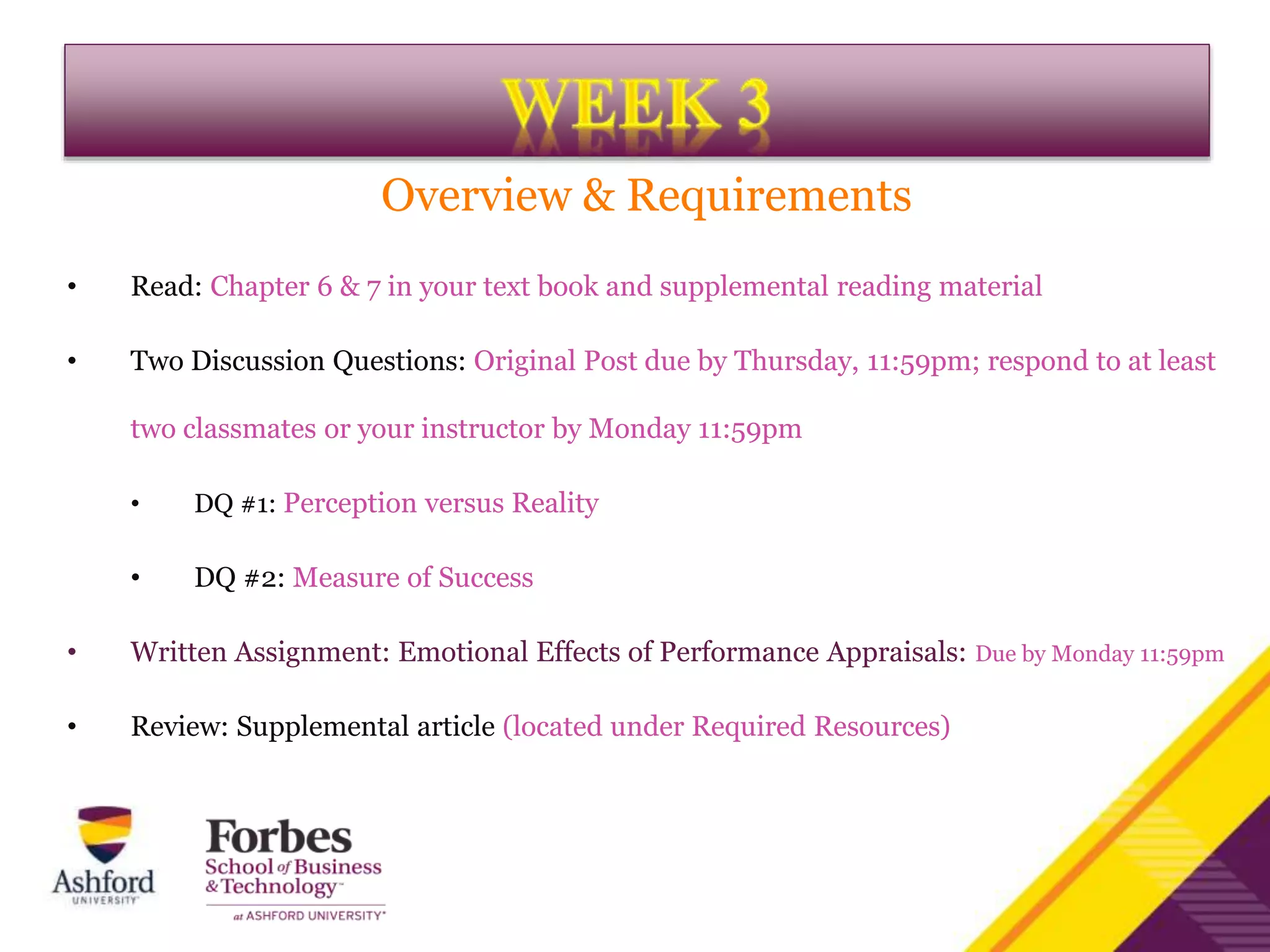
• Read: Chapter 6 & 7 in your text book and supplemental reading material
• Two Discussion Questions: Original Post due by Thursday, 11:59pm; respond to at least
two classmates or your instructor by Monday 11:59pm
• DQ #1: Perception versus Reality
• DQ #2: Measure of Success
• Written Assignment: Emotional Effects of Performance Appraisals: Due by Monday 11:59pm
• Review: Supplemental article (located under Required Resources)
 Chapter 6: Diagnosing Action-to-Results Connections
 Chapter 7: Diagnosing Results-to-Evaluation Connections
 Mitchell, L. D. (2010). Emotional responses to performance appraisal
feedback: Implications for organizations. The Journal of Applied Business
and Economics, 11(4), 82-108.
Required Text Reading
Pritchard, R. D., & Ashwood, E. L. (2008). Managing motivation: A manager's guide
to diagnosing and improving motivation.
This week we will:
 Assess (analyze) data to predict results
 Evaluate how changing perceptions of success can impact our
workforce
 Discuss how our leadership influences all of this
Objectives for Week 3
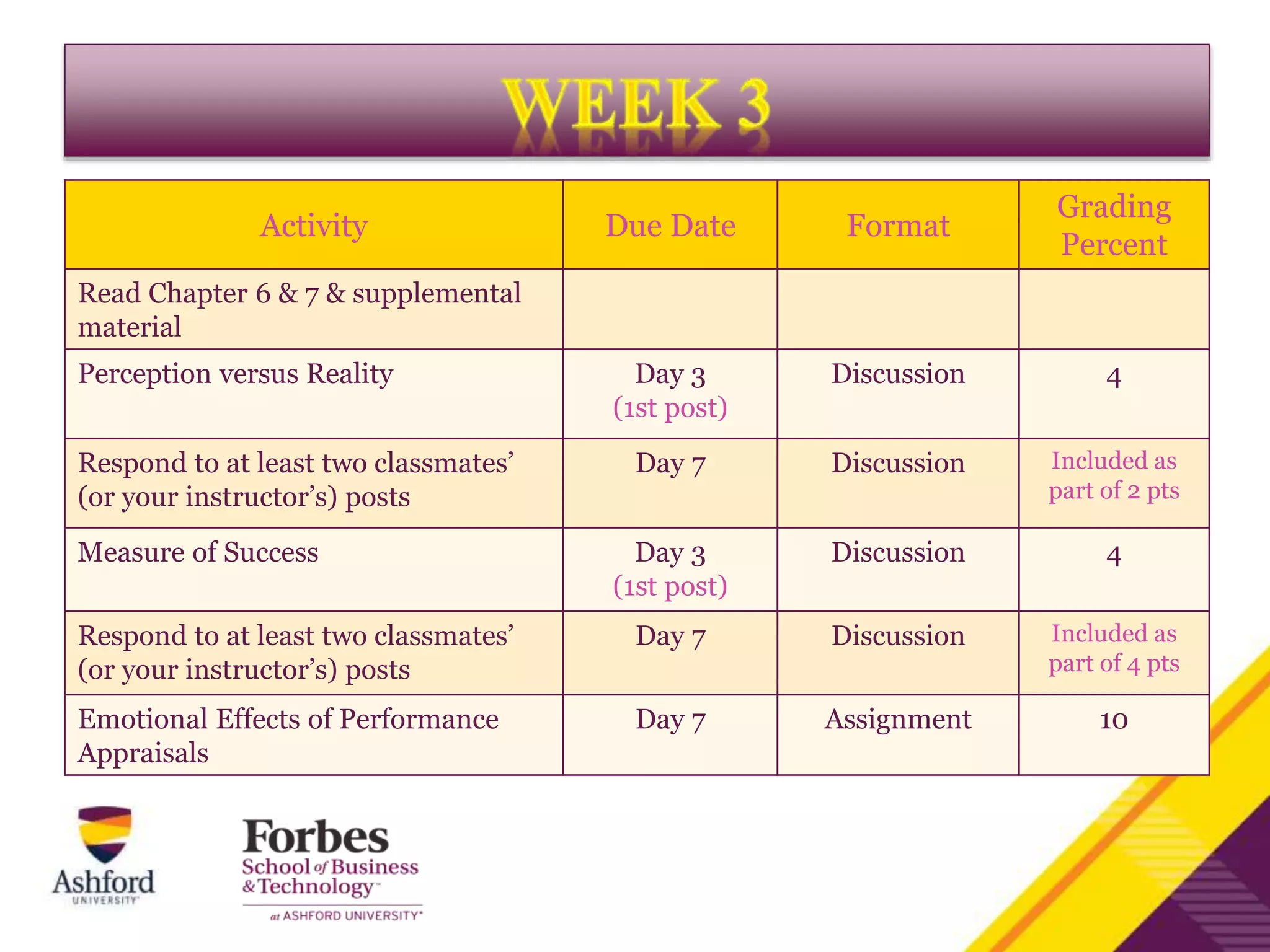
Activity Due Date Format
Grading
Percent
Read Chapter 6 & 7 & supplemental
material
Perception versus Reality Day 3
(1st post)
Discussion 4
Respond to at least two classmates’
(or your instructor’s) posts
Day 7 Discussion Included as
part of 2 pts
Measure of Success Day 3
(1st post)
Discussion 4
Respond to at least two classmates’
(or your instructor’s) posts
Day 7 Discussion Included as
part of 4 pts
Emotional Effects of Performance
Appraisals
Day 7 Assignment 10
LEADERSHIP & MOTIVATION: THE CORRELATION
Teams, departments, and organizations success rates are a direct
correlation to our leadership
Leadership is the lifeblood of every organization and while all
organizations operate under a universal set of systems, the
strength of leadership is the driving force behind how well the
organization’s lifecycle plays out
As leaders, motivation is one of the most foundational and critical tools we
have available in our toolbox
The power of motivation is amazing and when we recognize its value as being such a
strong force in an organizational system, understanding how to improve motivation
also becomes a critical skill
Reference: Pritchard, R. D., & Ashwood, E. L. (2008). Managing motivation: A manager's guide to diagnosing and
improving motivation. New York: Routledge/Taylor & Francis Group.
Leader’s Responsibility: Properly Diagnosing
To properly diagnose, we need:
1) An understanding of the connection
2) An understanding of the determinants of the connection
3) A roadmap for how we will gather data by observing and listening for the
connections
FOUNDATIONAL ASPECTS
“It is the degree to which we believe we can control our results by changing the
amount of energy we apply to the actions that produce those results”
(Pritchard & Ashwood, 2008, p. 53)
 Please review Examples 1, 2, and 3 on pages 54 – 56 of our text and consider
applying what you’ve garnered to your responses to this week’s discussion
questions
 These two chapters contain wonderful graphs, examples, and illustrations to
drive home the critical nature of how our leadership and what we practice
influences our results
Reference: Pritchard, R. D., & Ashwood, E. L. (2008). Managing
motivation: A manager's guide to diagnosing and improving
motivation. New York: Routledge/Taylor & Francis Group.
DIAGNOSING
Interesting Facts
 The results-to-evaluation stage is oftentimes where connections are the weakest when
there is a motivation problem
 It’s also the two connections that a leader or manager can most easily correct
 Since every human being is unique, no two motivation improvement plans are going to
result in the same success if consideration is not given to the idiosyncrasies of those
people involved
 Determinants of action-to-results connections involve capabilities, resources,
authority, and work strategies. Neglect to any given factor will likely result in less-
than-effective success
 It is necessary to pinpoint the issue, so efforts don’t become so grandeur that they
loose effectiveness
 All results need a measurements and evaluation system
ACTION-TO-RESULTS CONNECTIONS & RESULTS-TO-EVALUATION CONNECTIONS
Reference: Pritchard, R. D., & Ashwood, E. L. (2008). Managing
motivation: A manager's guide to diagnosing and improving motivation.
New York: Routledge/Taylor & Francis Group.
INVESTIGATION PROCESS
 It becomes critical that we are measuring accurately. Otherwise, we will gather results that
are inaccurate and to try to replicate this process will run the risk of loosing credibility with
our staff
 Results-to-evaluation strength is determined by:
 Knowing what results are valued
 Consistency with the broader organization
 Agreement among evaluators
 An effective feedback system
 Take heed when inconsistencies arise during the diagnosis. The role of conflict is a sign that
something is off-kilter
Reference: Pritchard, R. D., & Ashwood, E. L. (2008). Managing motivation: A manager's guide to
diagnosing and improving motivation. New York: Routledge/Taylor & Francis Group.
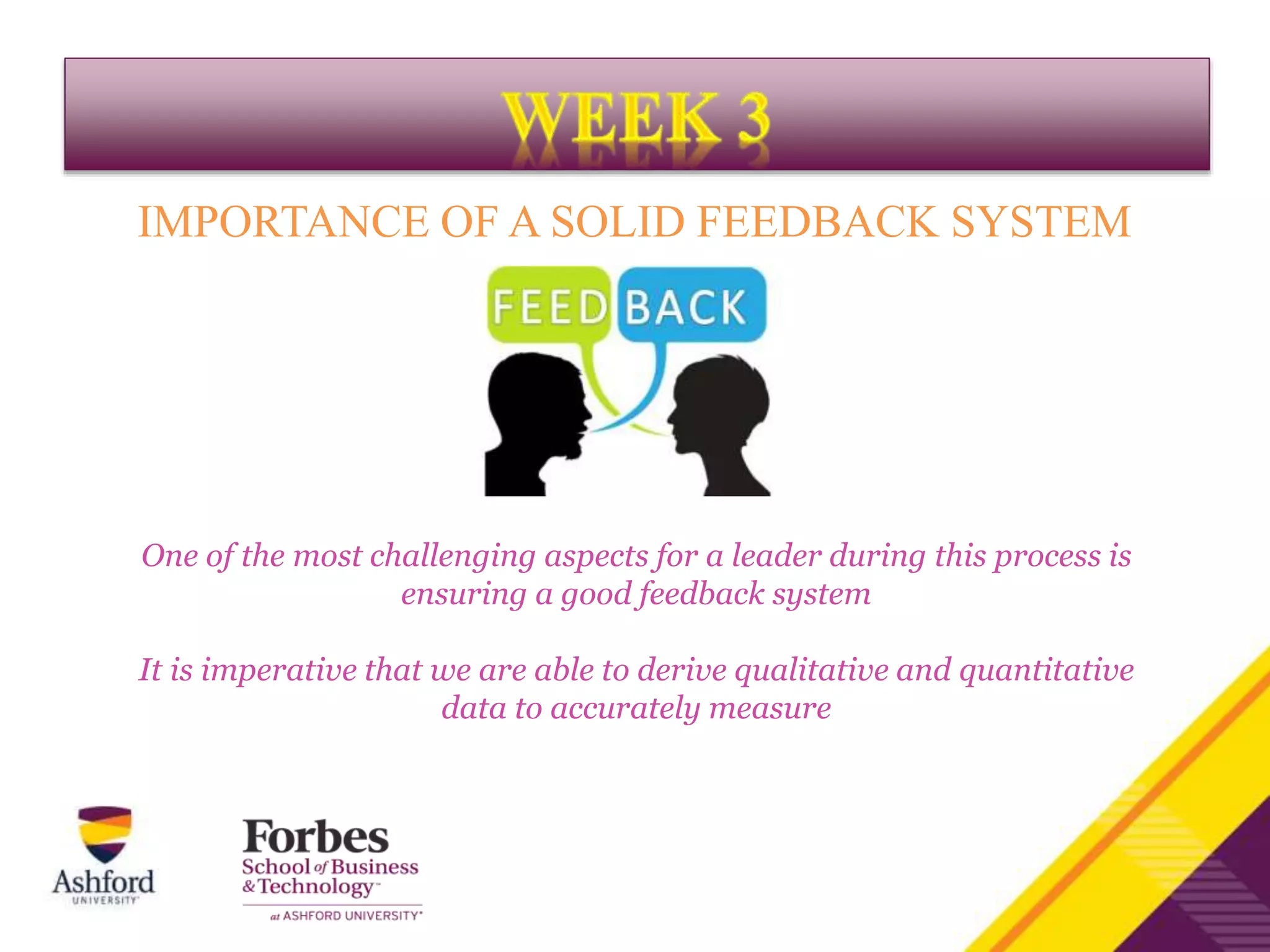
IMPORTANCE OF A SOLID FEEDBACK SYSTEM
One of the most challenging aspects for a leader during this process is
ensuring a good feedback system
It is imperative that we are able to derive qualitative and quantitative
data to accurately measure
A good feedback system needs to address, at the minimum, the following:
 Individual versus group feedback
 Results-based feedback
 Measurement of all important results
 Quantitative information
 Qualitative information
 Appropriate level of specificity
 Understanding of the feedback system
 Relative importance of results
 Both descriptive and evaluative information
For a full list, please see pages 77-80
NEEDS TO ADDRESS ALL OF THE ISSUES
Reference: Pritchard, R. D., & Ashwood, E. L. (2008). Managing motivation: A manager's guide to diagnosing
and improving motivation. New York: Routledge/Taylor & Francis Group.
TIPS FOR UNEXPECTED AMBIGUITY
 Discovering unclear connections may occur. The role of ambiguity is to be expected, but with solid
planning and good leadership, this should be controlled immediately
 If our people don’t understand what is going to be the next step in the process, further motivation
issues may arise. It is critical to keep our staff appraised of all that is taking place so they feel
confident that the results will benefit them, too
 Discovering frequently changing connections may happen. This may occur in industries or
organizations with rapidly changing environments. The best defense is a very strong plan prior to
the onset of the motivation improvement process
 It is human nature to want to be involved and to be part of the solution. Keeping everyone involved
will not only garner the most accurate results, but will appeal to a natural sense of intrinsic
motivation - an extra win/win during the process (Northouse, 2013)
Reference: Northouse, P. G. (2013). Introduction to
leadership: Concepts and practice. Thousand Oaks,
CA: Sage Publications, Inc.
TIPS FOR WEEK 3’S WRITTEN ASSIGNMENT
 I highly recommend first familiarizing yourself with the aforementioned tables in our
texts, as the information contained within provides a nice overview of how to proceed
 Be sure to tailor your paper around the Mitchell article and refer to the conclusions
found on page 22 and 23 of the article
 I highly recommend starting out with an outline. This is the best measure of
protection in ensuring that each main point of the assignment’s requirements are
addressed
 Don’t forget to avoid fluff and stay within 10% of the word/page count requirement.
Part of what you are being graded on is your ability to write in clear, concise language.
Higher order thinking and critical thought should be evident
REQUIRED READING
Pritchard, R. D., & Ashwood, E. L. (2008). Managing motivation: A manager's
guide to diagnosing and improving motivation. New York: Routledge/Taylor &
Francis Group.
 Chapter 6: Diagnosing Action-to-Results Connections
 Chapter 7: Diagnosing Results-to-Evaluation Connections
 Mitchell, L. D. (2010). Emotional responses to performance appraisal feedback:
Implications for organizations. The Journal of Applied Business and Economics, 11(4),
82-108.
MISCELLENAEOUS TIPS
 Please note that as instructors, we must adhere to the late policy. If you have an
emergency, the burden of responsibility falls on your shoulders to contact your
instructor prior to any given due date. In most cases you will be offered an
extension
 Keep in contact with your academic advisor. He or she is also committed to
your success and we work closely with academic advisors on behalf of our
students
 Unless an assignment specifically states that using first person is acceptable, we
only use third person in academic writing. Learn how to reword your sentences
to remove the use of first and second person. This will also force a more formal
writing tone
 Keep your APA Manual (6th ed) your best buddy throughout your entire degree
program. While it’s impossible to learn and memorize everything, it’s extremely
helpful as a resource guide
GREATEST TIPS FOR WEEK 3
& WILL SERVE YOU WELL THROUGHOUT YOUR EDUCATIONAL JOURNEY
 If you aren’t already watching the Announcements, I highly recommend checking
those daily. Anytime your professor posts an Announcement, it contains information
that is either pertinent to the any given week, the class topic in general, or to benefit
you throughout your educational journey
 If you are noticing a gradual decline in your grades, but aren’t checking your
feedback, you are likely missing extremely useful information. Information that can
and will help correct the problem(s) that are causing a continuous decline in your
grade
 Make your education a priority. Your employer will be expecting a higher level of
knowledge and critical thinking abilities when you graduate. Show him or her how
much you’ve gained through your degree program!
AMAZING SUPPORT SYSTEM
 Listed under ‘Writing Center & Library’ are links to the following:
TAKE ADVANTAGE OF AVAILABLE RESOURCES
 Listed under the email tab on the left hand menu is an icon similar to this. Click here
for access to tech supports phone number, email, and chat options
THE WRITING CENTER
https://awc.ashford.edu/Index.html
 Any questions about the content you’ve developed?
 Formatting concerns?
 APA questions?
I highly recommend getting into the habit of submitting all work to the Writing Center prior to
submitting for a grade. They will help you catch errors that will help you avoid running the risk of
submitting erroneous errors in your written assignments
ANY
QUESTIONS?
Please post
your questions
in the Ask Your
Instructor
thread
For question
that are
private, be sure
to reserve those
for email
correspondence
REFERENCES
Pritchard, R. D., & Ashwood, E. L. (2008). Managing motivation: A manager’s
guide to diagnosing and improving motivation. New York: Routledge/Taylor &
Francis Group.
Northouse, P. G. (2013). Introduction to leadership: Concepts and practice.
Thousand Oaks, CA: Sage Publications, Inc.

Standardized Guidance for MGT 425 Week 3

  • 1.
  • 2.
  • 3.
    As we embarkon the heart of our class, please take advantage of saving your research from previous weeks, as you may likely be able to find another way to use it in this week’s work (or future weeks/classes) Don’t forget to avoid non-credible sources. We only use scholarly, peer- reviewed sources in academic writing MGT 425: Leadership & Motivation Introduction to Week 3 We are officially mid-way through class and chances are you are well-versed in the basic principles of motivation improvement processes As we move into Week 3, we will explore connection points between action to results and results to evaluation As with any endeavor, planning generally allots for up to 80% of our time. The same is true for motivation improvement processes and proper leadership practices As such, our people rely on our leadership. It’s up to us to lead our organizations to continued and/or heightened success. It’s also up to us to train our managers to properly motivate their staff
  • 4.
    Overview & Requirements •Read: Chapter 6 & 7 in your text book and supplemental reading material • Two Discussion Questions: Original Post due by Thursday, 11:59pm; respond to at least two classmates or your instructor by Monday 11:59pm • DQ #1: Perception versus Reality • DQ #2: Measure of Success • Written Assignment: Emotional Effects of Performance Appraisals: Due by Monday 11:59pm • Review: Supplemental article (located under Required Resources)
  • 5.
     Chapter 6:Diagnosing Action-to-Results Connections  Chapter 7: Diagnosing Results-to-Evaluation Connections  Mitchell, L. D. (2010). Emotional responses to performance appraisal feedback: Implications for organizations. The Journal of Applied Business and Economics, 11(4), 82-108. Required Text Reading Pritchard, R. D., & Ashwood, E. L. (2008). Managing motivation: A manager's guide to diagnosing and improving motivation.
  • 6.
    This week wewill:  Assess (analyze) data to predict results  Evaluate how changing perceptions of success can impact our workforce  Discuss how our leadership influences all of this Objectives for Week 3
  • 7.
    Activity Due DateFormat Grading Percent Read Chapter 6 & 7 & supplemental material Perception versus Reality Day 3 (1st post) Discussion 4 Respond to at least two classmates’ (or your instructor’s) posts Day 7 Discussion Included as part of 2 pts Measure of Success Day 3 (1st post) Discussion 4 Respond to at least two classmates’ (or your instructor’s) posts Day 7 Discussion Included as part of 4 pts Emotional Effects of Performance Appraisals Day 7 Assignment 10
  • 8.
    LEADERSHIP & MOTIVATION:THE CORRELATION Teams, departments, and organizations success rates are a direct correlation to our leadership Leadership is the lifeblood of every organization and while all organizations operate under a universal set of systems, the strength of leadership is the driving force behind how well the organization’s lifecycle plays out As leaders, motivation is one of the most foundational and critical tools we have available in our toolbox
  • 9.
    The power ofmotivation is amazing and when we recognize its value as being such a strong force in an organizational system, understanding how to improve motivation also becomes a critical skill Reference: Pritchard, R. D., & Ashwood, E. L. (2008). Managing motivation: A manager's guide to diagnosing and improving motivation. New York: Routledge/Taylor & Francis Group. Leader’s Responsibility: Properly Diagnosing To properly diagnose, we need: 1) An understanding of the connection 2) An understanding of the determinants of the connection 3) A roadmap for how we will gather data by observing and listening for the connections
  • 10.
    FOUNDATIONAL ASPECTS “It isthe degree to which we believe we can control our results by changing the amount of energy we apply to the actions that produce those results” (Pritchard & Ashwood, 2008, p. 53)  Please review Examples 1, 2, and 3 on pages 54 – 56 of our text and consider applying what you’ve garnered to your responses to this week’s discussion questions  These two chapters contain wonderful graphs, examples, and illustrations to drive home the critical nature of how our leadership and what we practice influences our results Reference: Pritchard, R. D., & Ashwood, E. L. (2008). Managing motivation: A manager's guide to diagnosing and improving motivation. New York: Routledge/Taylor & Francis Group.
  • 11.
    DIAGNOSING Interesting Facts  Theresults-to-evaluation stage is oftentimes where connections are the weakest when there is a motivation problem  It’s also the two connections that a leader or manager can most easily correct  Since every human being is unique, no two motivation improvement plans are going to result in the same success if consideration is not given to the idiosyncrasies of those people involved  Determinants of action-to-results connections involve capabilities, resources, authority, and work strategies. Neglect to any given factor will likely result in less- than-effective success  It is necessary to pinpoint the issue, so efforts don’t become so grandeur that they loose effectiveness  All results need a measurements and evaluation system ACTION-TO-RESULTS CONNECTIONS & RESULTS-TO-EVALUATION CONNECTIONS Reference: Pritchard, R. D., & Ashwood, E. L. (2008). Managing motivation: A manager's guide to diagnosing and improving motivation. New York: Routledge/Taylor & Francis Group.
  • 12.
    INVESTIGATION PROCESS  Itbecomes critical that we are measuring accurately. Otherwise, we will gather results that are inaccurate and to try to replicate this process will run the risk of loosing credibility with our staff  Results-to-evaluation strength is determined by:  Knowing what results are valued  Consistency with the broader organization  Agreement among evaluators  An effective feedback system  Take heed when inconsistencies arise during the diagnosis. The role of conflict is a sign that something is off-kilter Reference: Pritchard, R. D., & Ashwood, E. L. (2008). Managing motivation: A manager's guide to diagnosing and improving motivation. New York: Routledge/Taylor & Francis Group.
  • 13.
    IMPORTANCE OF ASOLID FEEDBACK SYSTEM One of the most challenging aspects for a leader during this process is ensuring a good feedback system It is imperative that we are able to derive qualitative and quantitative data to accurately measure
  • 14.
    A good feedbacksystem needs to address, at the minimum, the following:  Individual versus group feedback  Results-based feedback  Measurement of all important results  Quantitative information  Qualitative information  Appropriate level of specificity  Understanding of the feedback system  Relative importance of results  Both descriptive and evaluative information For a full list, please see pages 77-80 NEEDS TO ADDRESS ALL OF THE ISSUES Reference: Pritchard, R. D., & Ashwood, E. L. (2008). Managing motivation: A manager's guide to diagnosing and improving motivation. New York: Routledge/Taylor & Francis Group.
  • 15.
    TIPS FOR UNEXPECTEDAMBIGUITY  Discovering unclear connections may occur. The role of ambiguity is to be expected, but with solid planning and good leadership, this should be controlled immediately  If our people don’t understand what is going to be the next step in the process, further motivation issues may arise. It is critical to keep our staff appraised of all that is taking place so they feel confident that the results will benefit them, too  Discovering frequently changing connections may happen. This may occur in industries or organizations with rapidly changing environments. The best defense is a very strong plan prior to the onset of the motivation improvement process  It is human nature to want to be involved and to be part of the solution. Keeping everyone involved will not only garner the most accurate results, but will appeal to a natural sense of intrinsic motivation - an extra win/win during the process (Northouse, 2013) Reference: Northouse, P. G. (2013). Introduction to leadership: Concepts and practice. Thousand Oaks, CA: Sage Publications, Inc.
  • 16.
    TIPS FOR WEEK3’S WRITTEN ASSIGNMENT  I highly recommend first familiarizing yourself with the aforementioned tables in our texts, as the information contained within provides a nice overview of how to proceed  Be sure to tailor your paper around the Mitchell article and refer to the conclusions found on page 22 and 23 of the article  I highly recommend starting out with an outline. This is the best measure of protection in ensuring that each main point of the assignment’s requirements are addressed  Don’t forget to avoid fluff and stay within 10% of the word/page count requirement. Part of what you are being graded on is your ability to write in clear, concise language. Higher order thinking and critical thought should be evident
  • 17.
    REQUIRED READING Pritchard, R.D., & Ashwood, E. L. (2008). Managing motivation: A manager's guide to diagnosing and improving motivation. New York: Routledge/Taylor & Francis Group.  Chapter 6: Diagnosing Action-to-Results Connections  Chapter 7: Diagnosing Results-to-Evaluation Connections  Mitchell, L. D. (2010). Emotional responses to performance appraisal feedback: Implications for organizations. The Journal of Applied Business and Economics, 11(4), 82-108.
  • 18.
    MISCELLENAEOUS TIPS  Pleasenote that as instructors, we must adhere to the late policy. If you have an emergency, the burden of responsibility falls on your shoulders to contact your instructor prior to any given due date. In most cases you will be offered an extension  Keep in contact with your academic advisor. He or she is also committed to your success and we work closely with academic advisors on behalf of our students  Unless an assignment specifically states that using first person is acceptable, we only use third person in academic writing. Learn how to reword your sentences to remove the use of first and second person. This will also force a more formal writing tone  Keep your APA Manual (6th ed) your best buddy throughout your entire degree program. While it’s impossible to learn and memorize everything, it’s extremely helpful as a resource guide
  • 19.
    GREATEST TIPS FORWEEK 3 & WILL SERVE YOU WELL THROUGHOUT YOUR EDUCATIONAL JOURNEY  If you aren’t already watching the Announcements, I highly recommend checking those daily. Anytime your professor posts an Announcement, it contains information that is either pertinent to the any given week, the class topic in general, or to benefit you throughout your educational journey  If you are noticing a gradual decline in your grades, but aren’t checking your feedback, you are likely missing extremely useful information. Information that can and will help correct the problem(s) that are causing a continuous decline in your grade  Make your education a priority. Your employer will be expecting a higher level of knowledge and critical thinking abilities when you graduate. Show him or her how much you’ve gained through your degree program!
  • 20.
    AMAZING SUPPORT SYSTEM Listed under ‘Writing Center & Library’ are links to the following: TAKE ADVANTAGE OF AVAILABLE RESOURCES  Listed under the email tab on the left hand menu is an icon similar to this. Click here for access to tech supports phone number, email, and chat options
  • 21.
    THE WRITING CENTER https://awc.ashford.edu/Index.html Any questions about the content you’ve developed?  Formatting concerns?  APA questions? I highly recommend getting into the habit of submitting all work to the Writing Center prior to submitting for a grade. They will help you catch errors that will help you avoid running the risk of submitting erroneous errors in your written assignments
  • 22.
    ANY QUESTIONS? Please post your questions inthe Ask Your Instructor thread For question that are private, be sure to reserve those for email correspondence
  • 23.
    REFERENCES Pritchard, R. D.,& Ashwood, E. L. (2008). Managing motivation: A manager’s guide to diagnosing and improving motivation. New York: Routledge/Taylor & Francis Group. Northouse, P. G. (2013). Introduction to leadership: Concepts and practice. Thousand Oaks, CA: Sage Publications, Inc.