MGT 425
Week 1
MGT 425
Leadership & Motivation
Take advantage of
the opportunity to
reflect on your own
professional
experiences
We all come from a
lifetime of unique
experiences and
together we may
create some
amazing
discussions
MGT 425: Leadership & Motivation
Introduction to Week 1
Our class will examine various approaches to
motivation and discover how to transform theory into
practice
Through the study of motivation, we will discover
appropriate motivational strategies that promote
effective personal and organizational performance
Our class focuses on what drives motivation and how it
can be fostered and nurtured optimal use in our
contemporary workplace
Northouse, P. G. (2013). Introduction to leadership: Concepts and practice. Thousand Oaks,
CA: Sage Publications, Inc.
Overview & Requirements
• Post your introduction: Help us get to know you
• Read: Chapters 1 -4 in your text book
• Two Discussion Questions: Original Post due by Thursday, 11:59pm
• Respond to at least two classmates (or your instructor) for each discussion question:
Due by Monday 11:59 pm
• Week 1 Assignment: What’s in it for Me (WIIFM)? Due by Monday 11:59 pm
• Review: Cohan’s article and Anne’s multi-media (located under Required Resources)
Pritchard, R. D., & Ashwood, E. L. (2008). Managing motivation: A
manager's guide to diagnosing and improving motivation. New
York: Routledge/Taylor & Francis Group.
Required Text
This is a
Constellation
textbook
This week we will:
 Evaluate individual sources of motivation
 Apply the basic theories of motivation to a current or
former workplace
Objectives for Week 1
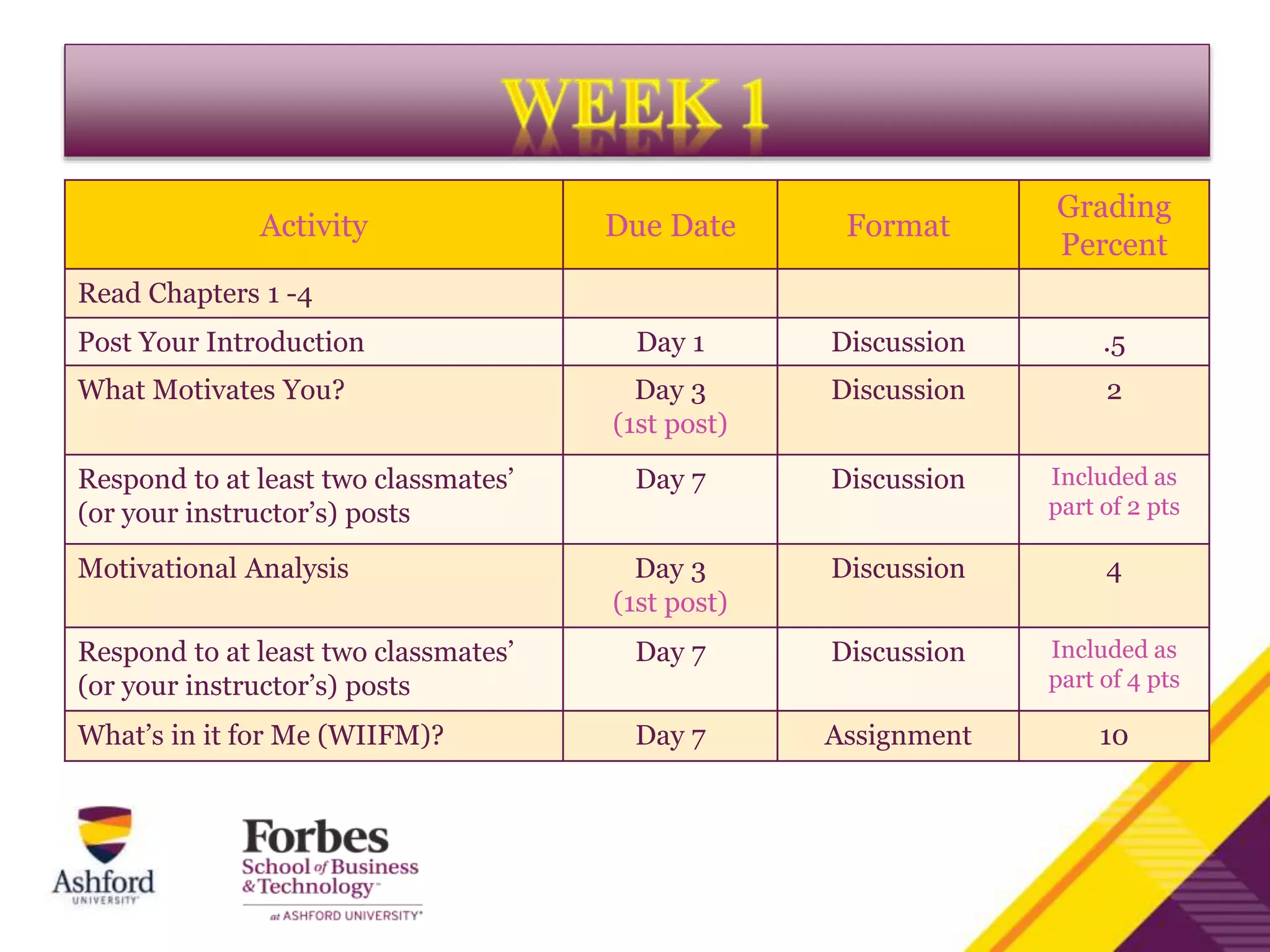
Activity Due Date Format
Grading
Percent
Read Chapters 1 -4
Post Your Introduction Day 1 Discussion .5
What Motivates You? Day 3
(1st post)
Discussion 2
Respond to at least two classmates’
(or your instructor’s) posts
Day 7 Discussion Included as
part of 2 pts
Motivational Analysis Day 3
(1st post)
Discussion 4
Respond to at least two classmates’
(or your instructor’s) posts
Day 7 Discussion Included as
part of 4 pts
What’s in it for Me (WIIFM)? Day 7 Assignment 10
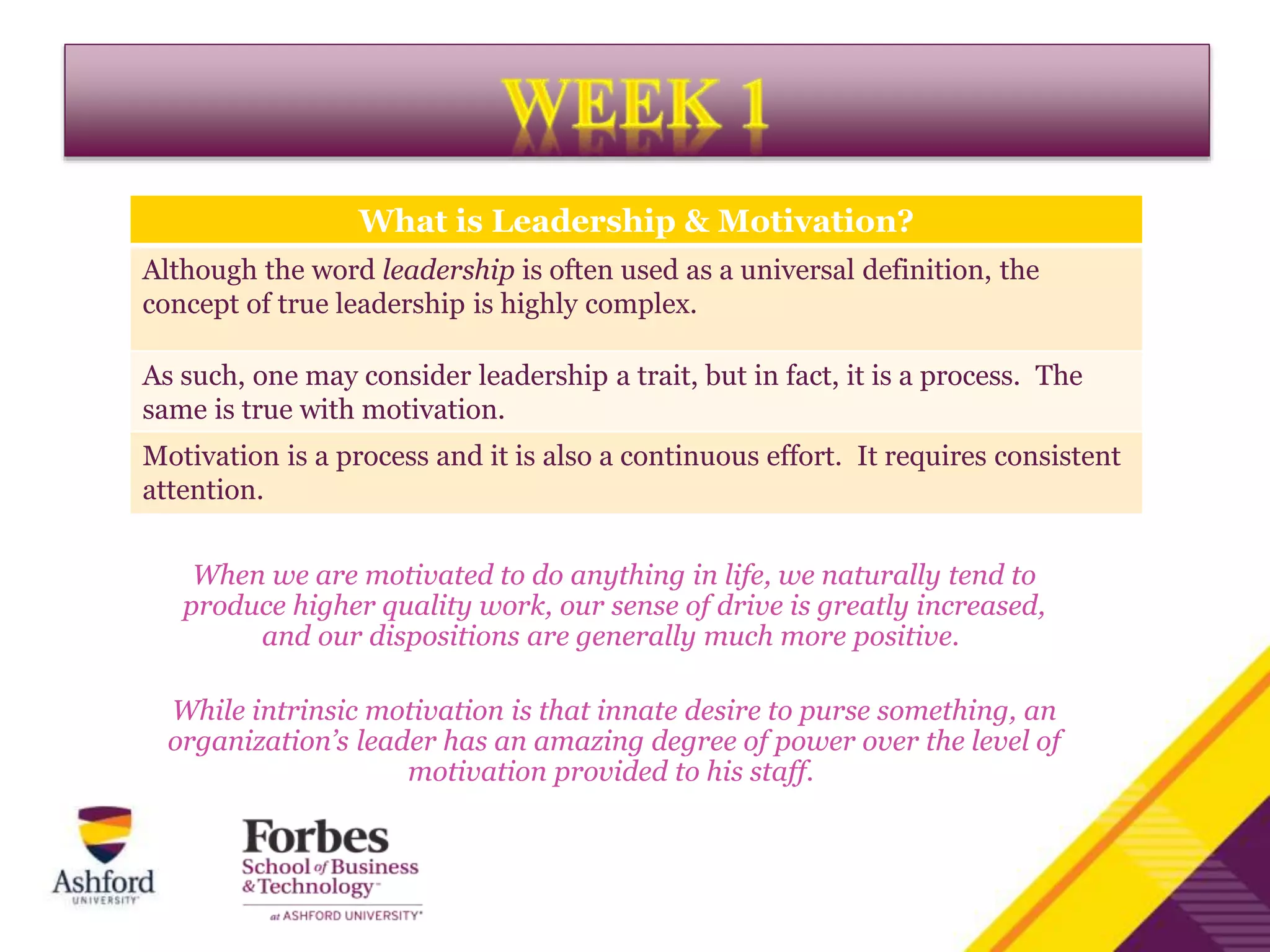
When we are motivated to do anything in life, we naturally tend to
produce higher quality work, our sense of drive is greatly increased,
and our dispositions are generally much more positive.
While intrinsic motivation is that innate desire to purse something, an
organization’s leader has an amazing degree of power over the level of
motivation provided to his staff.
What is Leadership & Motivation?
Although the word leadership is often used as a universal definition, the
concept of true leadership is highly complex.
As such, one may consider leadership a trait, but in fact, it is a process. The
same is true with motivation.
Motivation is a process and it is also a continuous effort. It requires consistent
attention.
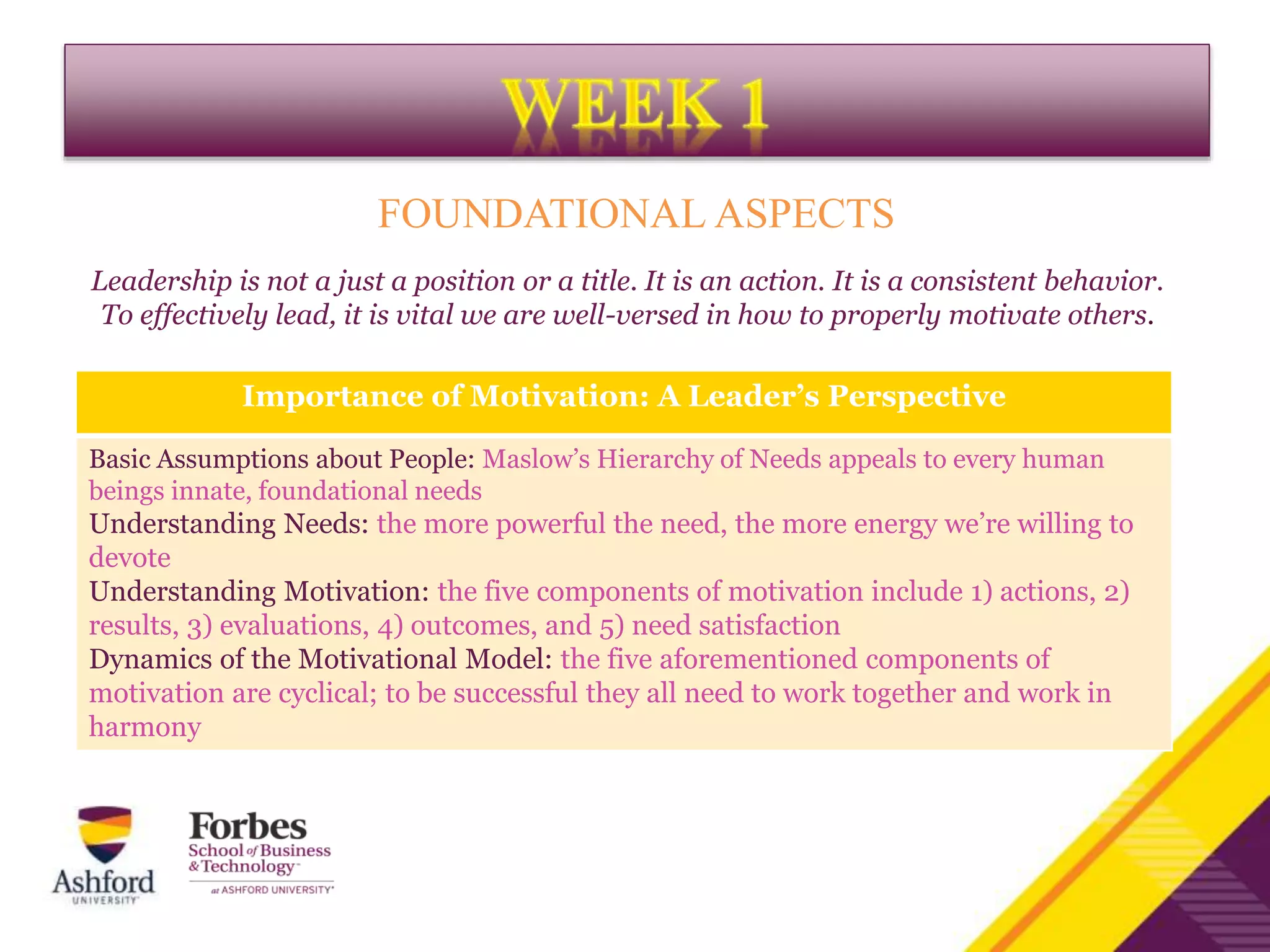
FOUNDATIONAL ASPECTS
Leadership is not a just a position or a title. It is an action. It is a consistent behavior.
To effectively lead, it is vital we are well-versed in how to properly motivate others.
Importance of Motivation: A Leader’s Perspective
Basic Assumptions about People: Maslow’s Hierarchy of Needs appeals to every human
beings innate, foundational needs
Understanding Needs: the more powerful the need, the more energy we’re willing to
devote
Understanding Motivation: the five components of motivation include 1) actions, 2)
results, 3) evaluations, 4) outcomes, and 5) need satisfaction
Dynamics of the Motivational Model: the five aforementioned components of
motivation are cyclical; to be successful they all need to work together and work in
harmony
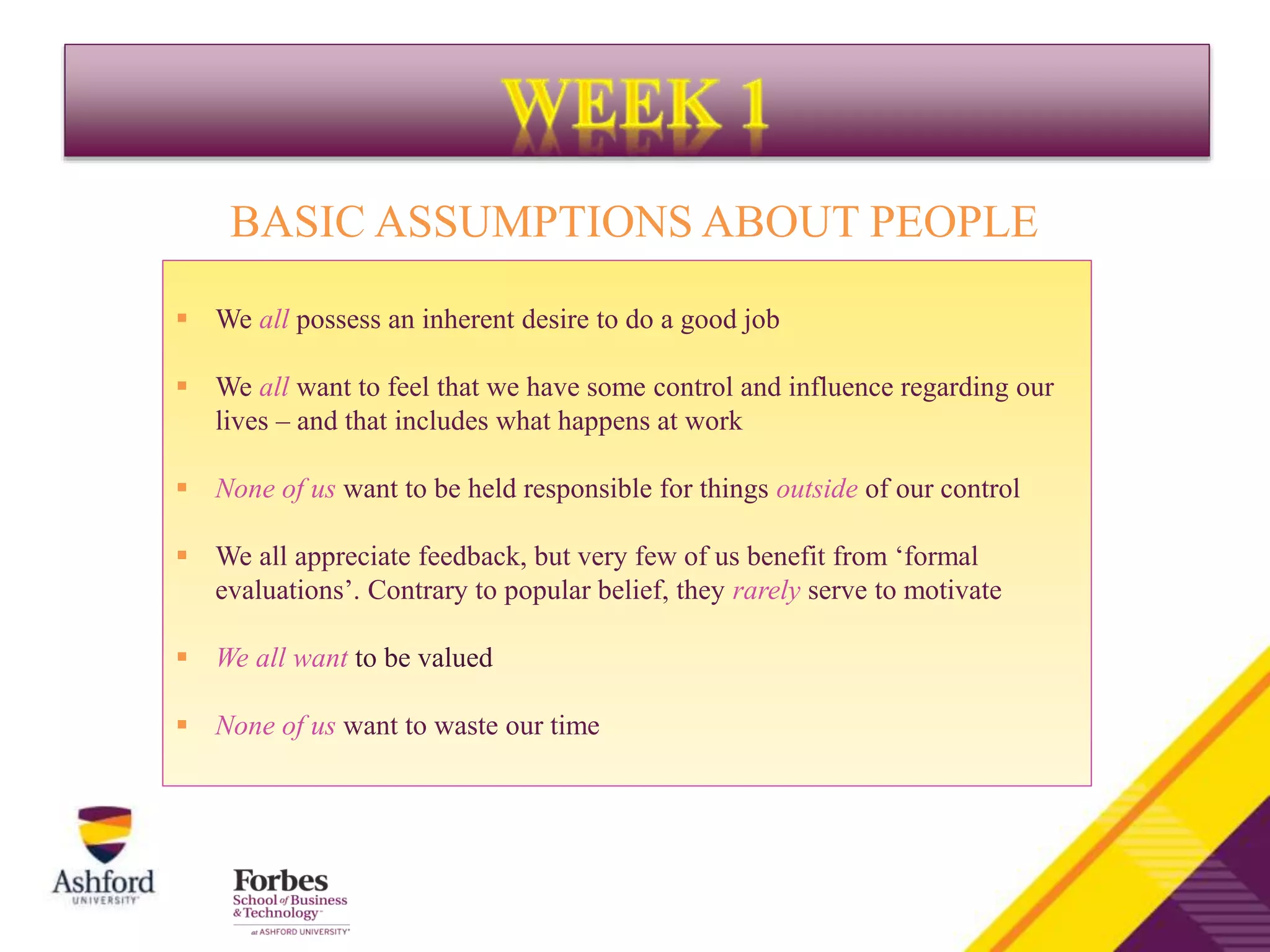
BASIC ASSUMPTIONS ABOUT PEOPLE
 We all possess an inherent desire to do a good job
 We all want to feel that we have some control and influence regarding our
lives – and that includes what happens at work
 None of us want to be held responsible for things outside of our control
 We all appreciate feedback, but very few of us benefit from ‘formal
evaluations’. Contrary to popular belief, they rarely serve to motivate
 We all want to be valued
 None of us want to waste our time
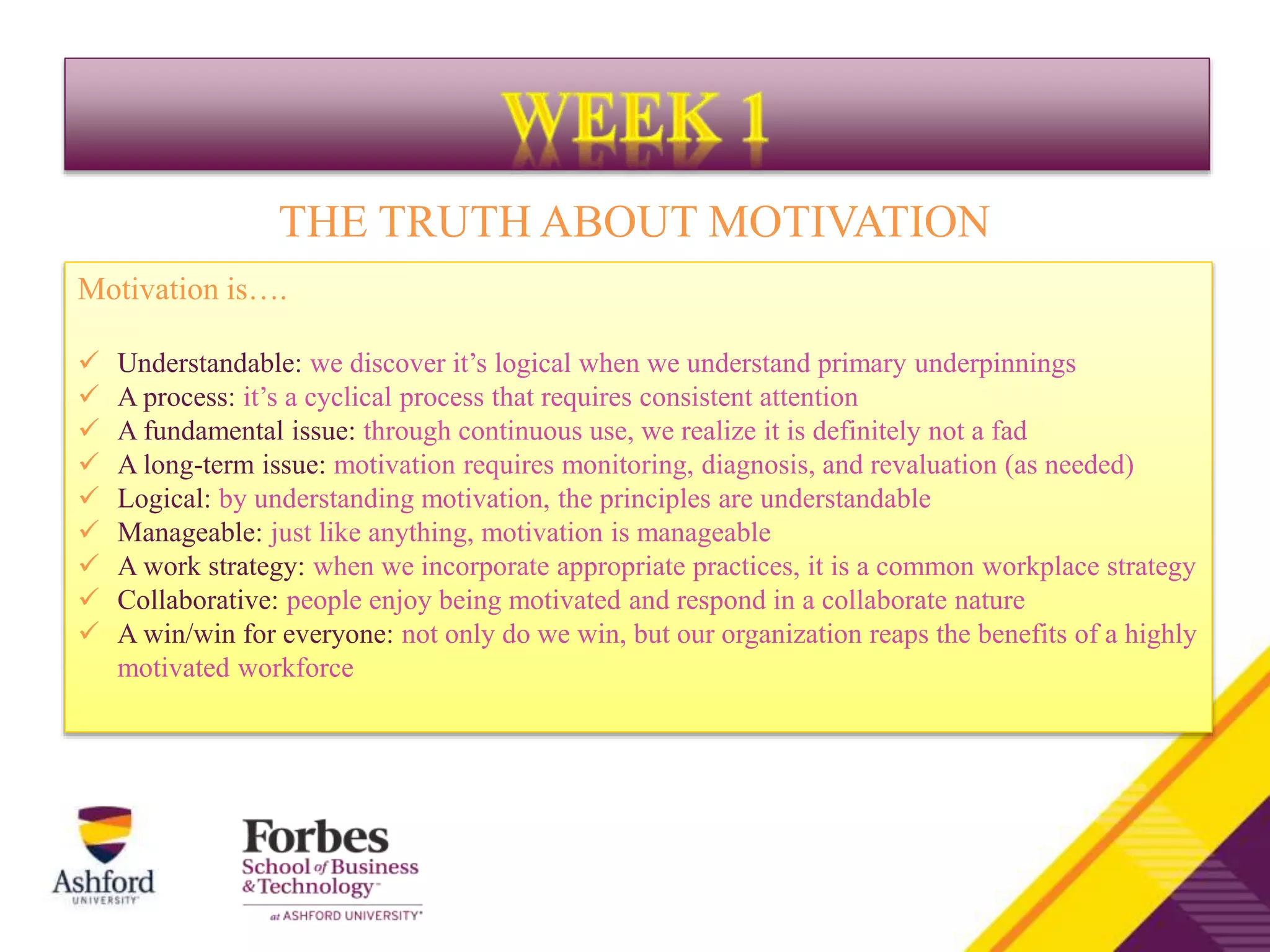
Motivation is….
 Understandable: we discover it’s logical when we understand primary underpinnings
 A process: it’s a cyclical process that requires consistent attention
 A fundamental issue: through continuous use, we realize it is definitely not a fad
 A long-term issue: motivation requires monitoring, diagnosis, and revaluation (as needed)
 Logical: by understanding motivation, the principles are understandable
 Manageable: just like anything, motivation is manageable
 A work strategy: when we incorporate appropriate practices, it is a common workplace strategy
 Collaborative: people enjoy being motivated and respond in a collaborate nature
 A win/win for everyone: not only do we win, but our organization reaps the benefits of a highly
motivated workforce
THE TRUTH ABOUT MOTIVATION
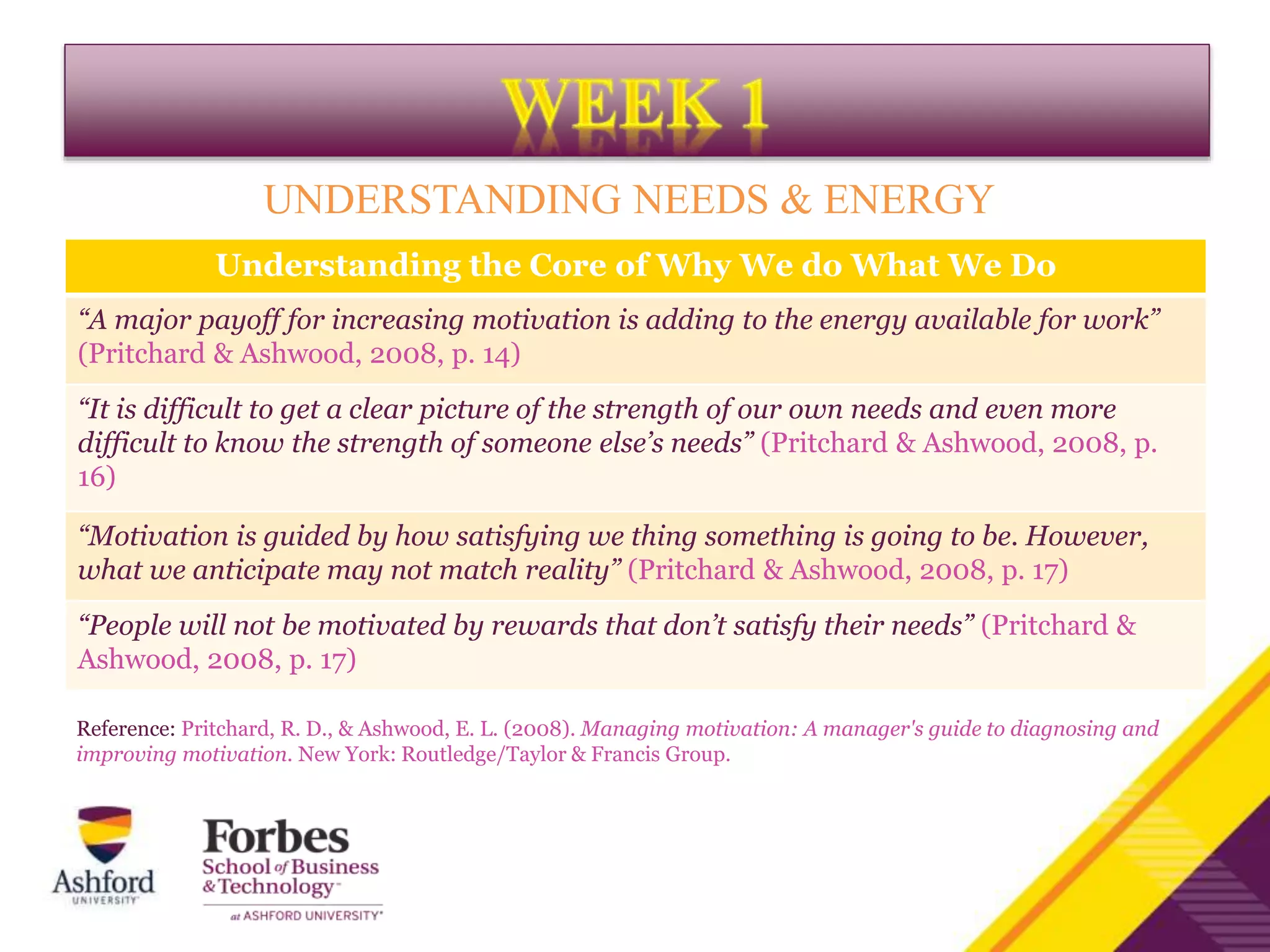
UNDERSTANDING NEEDS & ENERGY
Understanding the Core of Why We do What We Do
“A major payoff for increasing motivation is adding to the energy available for work”
(Pritchard & Ashwood, 2008, p. 14)
“It is difficult to get a clear picture of the strength of our own needs and even more
difficult to know the strength of someone else’s needs” (Pritchard & Ashwood, 2008, p.
16)
“Motivation is guided by how satisfying we thing something is going to be. However,
what we anticipate may not match reality” (Pritchard & Ashwood, 2008, p. 17)
“People will not be motivated by rewards that don’t satisfy their needs” (Pritchard &
Ashwood, 2008, p. 17)
Reference: Pritchard, R. D., & Ashwood, E. L. (2008). Managing motivation: A manager's guide to diagnosing and
improving motivation. New York: Routledge/Taylor & Francis Group.
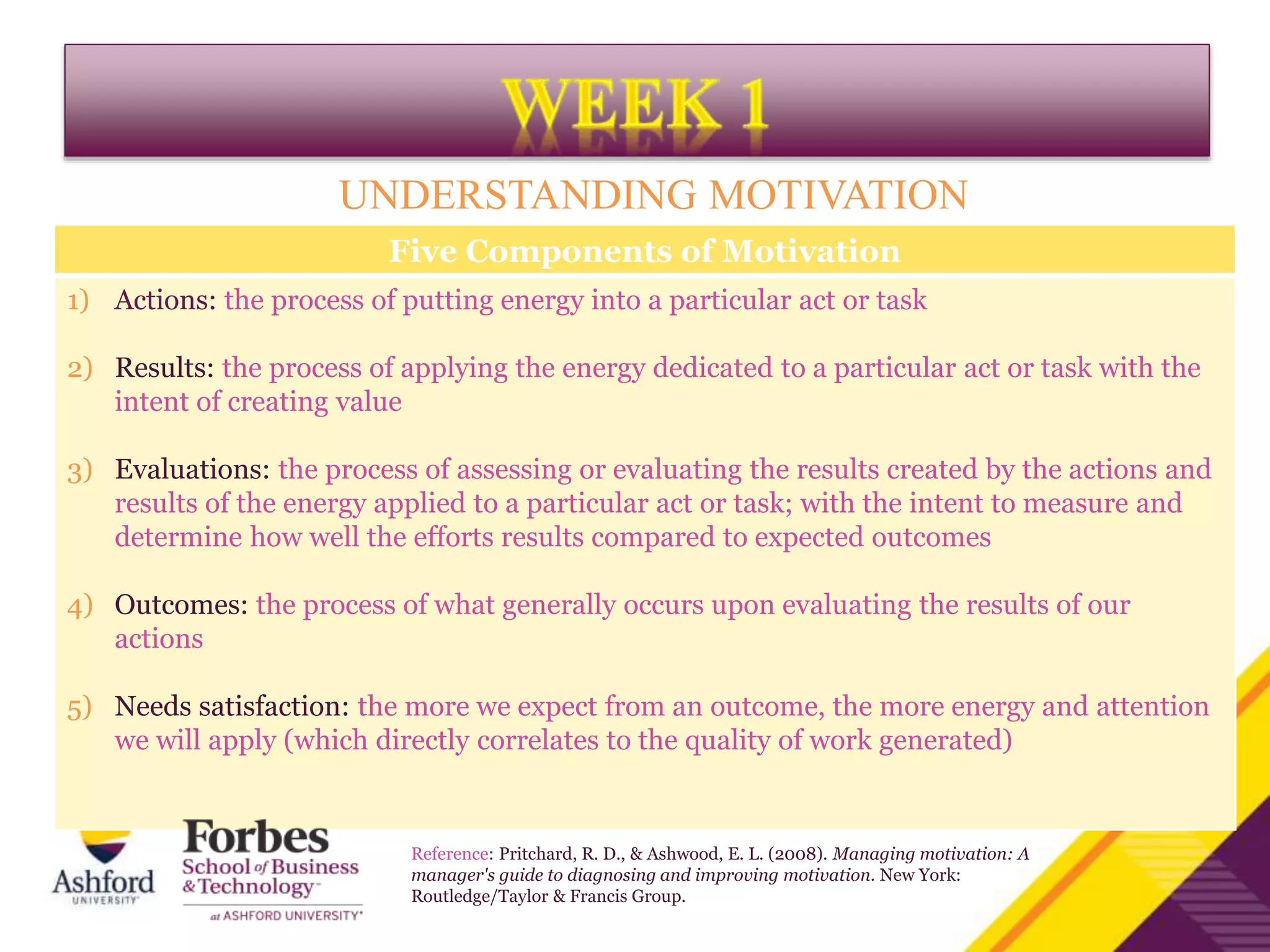
UNDERSTANDING MOTIVATION
Five Components of Motivation
1) Actions: the process of putting energy into a particular act or task
2) Results: the process of applying the energy dedicated to a particular act or task with the
intent of creating value
3) Evaluations: the process of assessing or evaluating the results created by the actions and
results of the energy applied to a particular act or task; with the intent to measure and
determine how well the efforts results compared to expected outcomes
4) Outcomes: the process of what generally occurs upon evaluating the results of our
actions
5) Needs satisfaction: the more we expect from an outcome, the more energy and attention
we will apply (which directly correlates to the quality of work generated)
Reference: Pritchard, R. D., & Ashwood, E. L. (2008). Managing motivation: A
manager's guide to diagnosing and improving motivation. New York:
Routledge/Taylor & Francis Group.
Actions & Connections
 When actions-to-results connections are low, we have little control over the results produced
 We can’t expect people be highly motivated when they cannot control their results
 We all must know how different results are valued for motivation to be high
 Outcomes that are not tied to performance will have little or no effect on the motivation to do a better
job
 One of the challenges of managing motivation is learning what outcomes are effective for different
people
 Although we usually don’t think about the details of the model, but they still influence us
 We do think about the motivation components when something unexcepted happens
 For motivation to be high, all the components of the model must be high
THE MOTIVATION MODEL
Reference: Pritchard, R. D., & Ashwood, E. L. (2008). Managing motivation: A
manager's guide to diagnosing and improving motivation. New York:
Routledge/Taylor & Francis Group.
REQUIRED READING
Pritchard, R. D., & Ashwood, E. L. (2008). Managing motivation: A manager's guide to
diagnosing and improving motivation. New York: Routledge/Taylor & Francis Group.
 Chapter 1: Motivation and Management
 Chapter 2: Understanding Needs and Energy
 Chapter 3: Understanding Motivation
 Chapter 4: Dynamics of the Motivation Model
SUPPLEMENTAL REQUIRED READING & REVIEW
 Cohan, P. (2012, ). TemboSocial makes employee motivation
everyone's business. Forbes.
http://www.forbes.com/sites/petercohan/2012/09/26/temboso
cial-makes-employee-motivation-everyones-business/.
 Anne, L. (n.d.). Anne Loehr Explains WIIFM: What's In It For
Me
http://www.youtube.com/watch?v=qhxjDcjsODQ
MISCELLENAEOUS TIPS
 To be eligible to earn full credit, discussion question posts and replies should be
substantial in nature.
 I highly recommend striving to exceed minimum requirements. It’s a far safer bet than
trying to simply meet the minimum requirements.
 Be sure to clearly and concisely follow the assignments requirements.
 Create an outline based on the details contained in the assignments requirements. It will
serve you well. I promise.
GREATEST TIPS
WILL SERVE YOU WELL THROUGHOUT YOUR EDUCATIONAL JOURNEY
 All professor are committed to adhering to the universities policies and procedures, but we all have
certain areas expectations that may be more dominate than others. Adhere to your instructor’s specific
requirements. In time, you will notice that all are providing invaluable information to add to you
toolbox of knowledge
 Follow directions specifically. Avoid being creative. Academic writing leaves little room for creativity.
Strive to use formal language and adhere to APA guidelines. It is the best insurance buffer available
 Use templates and sample APA papers until you become accustomed to APA’s requirements. Rather
than trying to memorize it all now, focus on learning and use the resources we offer to your advantage,
but avoid ignoring the vital importance of APA guidelines
***I’ve seen far too many students continue to loose points because they choose to
ignore feedback; resulting in the difference between a final grade of a B, instead of
an A (for example)
AMAZING SUPPORT SYSTEM
 Listed under ‘Writing Center & Library’ are links to the following:
TAKE ADVANTAGE OF AVAILABLE RESOURCES
 Listed under the email tab on the left hand menu is an icon similar to this. Click here
for access to tech supports phone number, email, and chat options
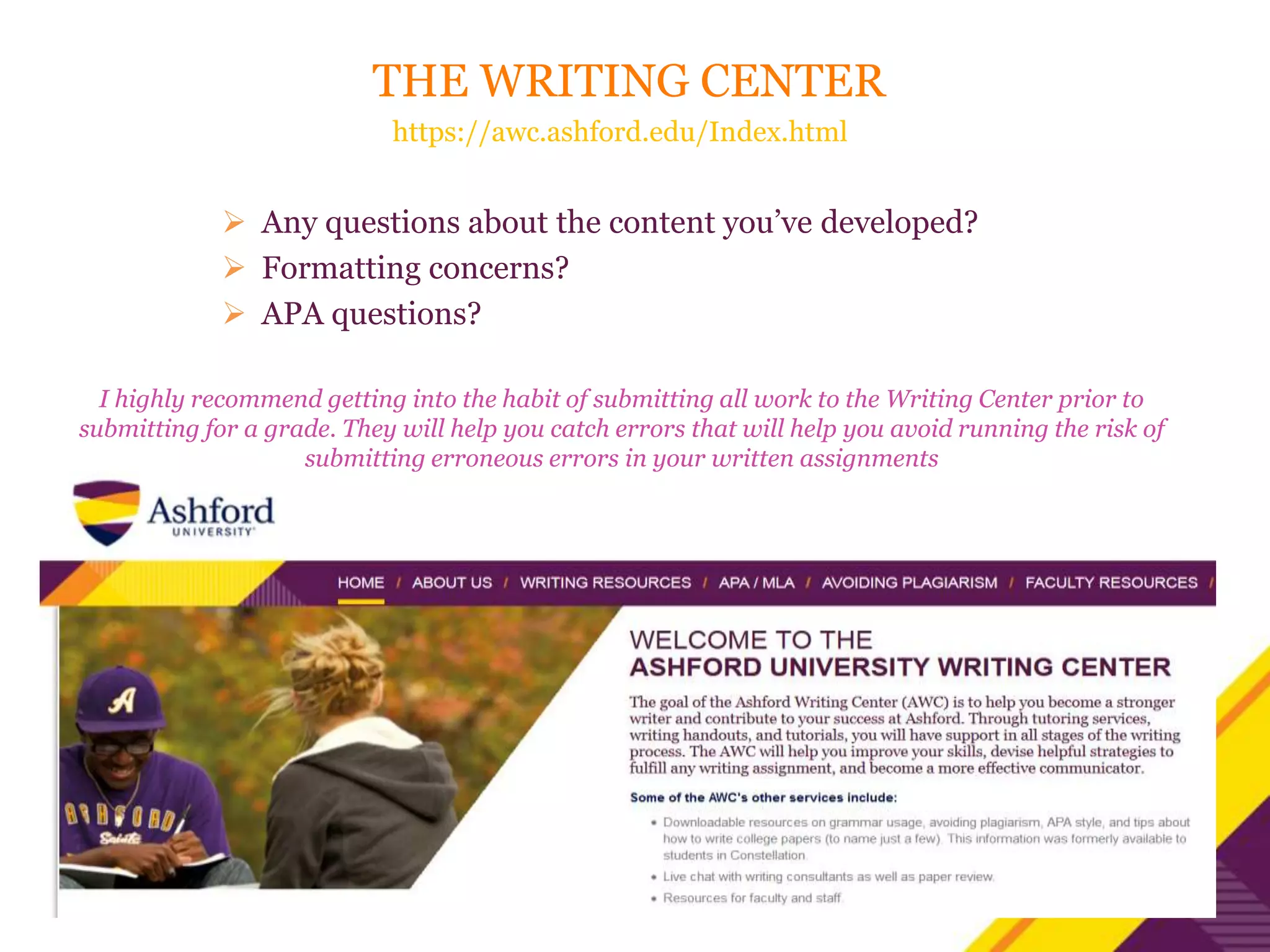
THE WRITING CENTER
https://awc.ashford.edu/Index.html
 Any questions about the content you’ve developed?
 Formatting concerns?
 APA questions?
I highly recommend getting into the habit of submitting all work to the Writing Center prior to
submitting for a grade. They will help you catch errors that will help you avoid running the risk of
submitting erroneous errors in your written assignments
ANY
QUESTIONS?
Please post
your questions
in the Ask Your
Instructor
thread. For
question that
are private, be
sure to reserve
those for email
correspondence
REFERENCES
Pritchard, R. D., & Ashwood, E. L. (2008). Managing motivation: A manager’s
guide to diagnosing and improving motivation. New York: Routledge/Taylor &
Francis Group.
Northouse, P. G. (2013). Introduction to leadership: Concepts and practice.
Thousand Oaks, CA: Sage Publications, Inc.

Standardized guidance for MGT425 Week 1

  • 1.
  • 2.
  • 3.
    Take advantage of theopportunity to reflect on your own professional experiences We all come from a lifetime of unique experiences and together we may create some amazing discussions MGT 425: Leadership & Motivation Introduction to Week 1 Our class will examine various approaches to motivation and discover how to transform theory into practice Through the study of motivation, we will discover appropriate motivational strategies that promote effective personal and organizational performance Our class focuses on what drives motivation and how it can be fostered and nurtured optimal use in our contemporary workplace Northouse, P. G. (2013). Introduction to leadership: Concepts and practice. Thousand Oaks, CA: Sage Publications, Inc.
  • 4.
    Overview & Requirements •Post your introduction: Help us get to know you • Read: Chapters 1 -4 in your text book • Two Discussion Questions: Original Post due by Thursday, 11:59pm • Respond to at least two classmates (or your instructor) for each discussion question: Due by Monday 11:59 pm • Week 1 Assignment: What’s in it for Me (WIIFM)? Due by Monday 11:59 pm • Review: Cohan’s article and Anne’s multi-media (located under Required Resources)
  • 5.
    Pritchard, R. D.,& Ashwood, E. L. (2008). Managing motivation: A manager's guide to diagnosing and improving motivation. New York: Routledge/Taylor & Francis Group. Required Text This is a Constellation textbook
  • 6.
    This week wewill:  Evaluate individual sources of motivation  Apply the basic theories of motivation to a current or former workplace Objectives for Week 1
  • 7.
    Activity Due DateFormat Grading Percent Read Chapters 1 -4 Post Your Introduction Day 1 Discussion .5 What Motivates You? Day 3 (1st post) Discussion 2 Respond to at least two classmates’ (or your instructor’s) posts Day 7 Discussion Included as part of 2 pts Motivational Analysis Day 3 (1st post) Discussion 4 Respond to at least two classmates’ (or your instructor’s) posts Day 7 Discussion Included as part of 4 pts What’s in it for Me (WIIFM)? Day 7 Assignment 10
  • 8.
    When we aremotivated to do anything in life, we naturally tend to produce higher quality work, our sense of drive is greatly increased, and our dispositions are generally much more positive. While intrinsic motivation is that innate desire to purse something, an organization’s leader has an amazing degree of power over the level of motivation provided to his staff. What is Leadership & Motivation? Although the word leadership is often used as a universal definition, the concept of true leadership is highly complex. As such, one may consider leadership a trait, but in fact, it is a process. The same is true with motivation. Motivation is a process and it is also a continuous effort. It requires consistent attention.
  • 9.
    FOUNDATIONAL ASPECTS Leadership isnot a just a position or a title. It is an action. It is a consistent behavior. To effectively lead, it is vital we are well-versed in how to properly motivate others. Importance of Motivation: A Leader’s Perspective Basic Assumptions about People: Maslow’s Hierarchy of Needs appeals to every human beings innate, foundational needs Understanding Needs: the more powerful the need, the more energy we’re willing to devote Understanding Motivation: the five components of motivation include 1) actions, 2) results, 3) evaluations, 4) outcomes, and 5) need satisfaction Dynamics of the Motivational Model: the five aforementioned components of motivation are cyclical; to be successful they all need to work together and work in harmony
  • 10.
    BASIC ASSUMPTIONS ABOUTPEOPLE  We all possess an inherent desire to do a good job  We all want to feel that we have some control and influence regarding our lives – and that includes what happens at work  None of us want to be held responsible for things outside of our control  We all appreciate feedback, but very few of us benefit from ‘formal evaluations’. Contrary to popular belief, they rarely serve to motivate  We all want to be valued  None of us want to waste our time
  • 11.
    Motivation is….  Understandable:we discover it’s logical when we understand primary underpinnings  A process: it’s a cyclical process that requires consistent attention  A fundamental issue: through continuous use, we realize it is definitely not a fad  A long-term issue: motivation requires monitoring, diagnosis, and revaluation (as needed)  Logical: by understanding motivation, the principles are understandable  Manageable: just like anything, motivation is manageable  A work strategy: when we incorporate appropriate practices, it is a common workplace strategy  Collaborative: people enjoy being motivated and respond in a collaborate nature  A win/win for everyone: not only do we win, but our organization reaps the benefits of a highly motivated workforce THE TRUTH ABOUT MOTIVATION
  • 12.
    UNDERSTANDING NEEDS &ENERGY Understanding the Core of Why We do What We Do “A major payoff for increasing motivation is adding to the energy available for work” (Pritchard & Ashwood, 2008, p. 14) “It is difficult to get a clear picture of the strength of our own needs and even more difficult to know the strength of someone else’s needs” (Pritchard & Ashwood, 2008, p. 16) “Motivation is guided by how satisfying we thing something is going to be. However, what we anticipate may not match reality” (Pritchard & Ashwood, 2008, p. 17) “People will not be motivated by rewards that don’t satisfy their needs” (Pritchard & Ashwood, 2008, p. 17) Reference: Pritchard, R. D., & Ashwood, E. L. (2008). Managing motivation: A manager's guide to diagnosing and improving motivation. New York: Routledge/Taylor & Francis Group.
  • 13.
    UNDERSTANDING MOTIVATION Five Componentsof Motivation 1) Actions: the process of putting energy into a particular act or task 2) Results: the process of applying the energy dedicated to a particular act or task with the intent of creating value 3) Evaluations: the process of assessing or evaluating the results created by the actions and results of the energy applied to a particular act or task; with the intent to measure and determine how well the efforts results compared to expected outcomes 4) Outcomes: the process of what generally occurs upon evaluating the results of our actions 5) Needs satisfaction: the more we expect from an outcome, the more energy and attention we will apply (which directly correlates to the quality of work generated) Reference: Pritchard, R. D., & Ashwood, E. L. (2008). Managing motivation: A manager's guide to diagnosing and improving motivation. New York: Routledge/Taylor & Francis Group.
  • 14.
    Actions & Connections When actions-to-results connections are low, we have little control over the results produced  We can’t expect people be highly motivated when they cannot control their results  We all must know how different results are valued for motivation to be high  Outcomes that are not tied to performance will have little or no effect on the motivation to do a better job  One of the challenges of managing motivation is learning what outcomes are effective for different people  Although we usually don’t think about the details of the model, but they still influence us  We do think about the motivation components when something unexcepted happens  For motivation to be high, all the components of the model must be high THE MOTIVATION MODEL Reference: Pritchard, R. D., & Ashwood, E. L. (2008). Managing motivation: A manager's guide to diagnosing and improving motivation. New York: Routledge/Taylor & Francis Group.
  • 15.
    REQUIRED READING Pritchard, R.D., & Ashwood, E. L. (2008). Managing motivation: A manager's guide to diagnosing and improving motivation. New York: Routledge/Taylor & Francis Group.  Chapter 1: Motivation and Management  Chapter 2: Understanding Needs and Energy  Chapter 3: Understanding Motivation  Chapter 4: Dynamics of the Motivation Model
  • 16.
    SUPPLEMENTAL REQUIRED READING& REVIEW  Cohan, P. (2012, ). TemboSocial makes employee motivation everyone's business. Forbes. http://www.forbes.com/sites/petercohan/2012/09/26/temboso cial-makes-employee-motivation-everyones-business/.  Anne, L. (n.d.). Anne Loehr Explains WIIFM: What's In It For Me http://www.youtube.com/watch?v=qhxjDcjsODQ
  • 17.
    MISCELLENAEOUS TIPS  Tobe eligible to earn full credit, discussion question posts and replies should be substantial in nature.  I highly recommend striving to exceed minimum requirements. It’s a far safer bet than trying to simply meet the minimum requirements.  Be sure to clearly and concisely follow the assignments requirements.  Create an outline based on the details contained in the assignments requirements. It will serve you well. I promise.
  • 18.
    GREATEST TIPS WILL SERVEYOU WELL THROUGHOUT YOUR EDUCATIONAL JOURNEY  All professor are committed to adhering to the universities policies and procedures, but we all have certain areas expectations that may be more dominate than others. Adhere to your instructor’s specific requirements. In time, you will notice that all are providing invaluable information to add to you toolbox of knowledge  Follow directions specifically. Avoid being creative. Academic writing leaves little room for creativity. Strive to use formal language and adhere to APA guidelines. It is the best insurance buffer available  Use templates and sample APA papers until you become accustomed to APA’s requirements. Rather than trying to memorize it all now, focus on learning and use the resources we offer to your advantage, but avoid ignoring the vital importance of APA guidelines ***I’ve seen far too many students continue to loose points because they choose to ignore feedback; resulting in the difference between a final grade of a B, instead of an A (for example)
  • 19.
    AMAZING SUPPORT SYSTEM Listed under ‘Writing Center & Library’ are links to the following: TAKE ADVANTAGE OF AVAILABLE RESOURCES  Listed under the email tab on the left hand menu is an icon similar to this. Click here for access to tech supports phone number, email, and chat options
  • 20.
    THE WRITING CENTER https://awc.ashford.edu/Index.html Any questions about the content you’ve developed?  Formatting concerns?  APA questions? I highly recommend getting into the habit of submitting all work to the Writing Center prior to submitting for a grade. They will help you catch errors that will help you avoid running the risk of submitting erroneous errors in your written assignments
  • 21.
    ANY QUESTIONS? Please post your questions inthe Ask Your Instructor thread. For question that are private, be sure to reserve those for email correspondence
  • 22.
    REFERENCES Pritchard, R. D.,& Ashwood, E. L. (2008). Managing motivation: A manager’s guide to diagnosing and improving motivation. New York: Routledge/Taylor & Francis Group. Northouse, P. G. (2013). Introduction to leadership: Concepts and practice. Thousand Oaks, CA: Sage Publications, Inc.