Listening means thinking and acting in ways that  connect you with the speaker.  Listening is an art and a gift.   It is a  tool that is essential to your success as a student, an employee, and a friend, yet most of us have never been taught how to listen. As the listener, you should then be able to repeat back in your own words what they have said to their satisfaction.
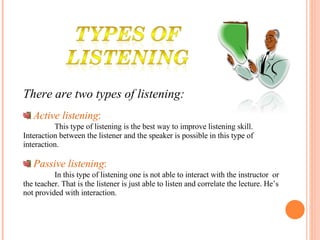
There are two types of listening: Active listening : This type of listening is the best way to improve listening skill. Interaction between the listener and the speaker is possible in this type of interaction. Passive listening : In this type of listening one is not able to interact with the instructor  or the teacher. That is the listener is just able to listen and correlate the lecture. He’s not provided with interaction.
 
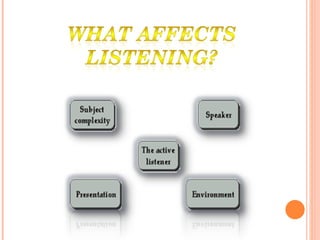
One has to look after the following  strategies before preparing themselves to listen: What do you think of the  subject  matter? Is it new or have you a lot of experience with it? Will it be difficult to understand, or simple? Is it important to you, or just fun? Is the  speaker  experienced or nervous? What are the  non-verbal cues of the speaker? What frame of mind is he or she? How personable, threatening, intelligent, etc.? Is the  message  illustrated with visuals or examples? Is technology used effectively? Are concepts introduced incrementally, or with examples? Is the  space  conducive to listening?  Or to interaction or exchange with the speaker? Are there avoidable distractions?
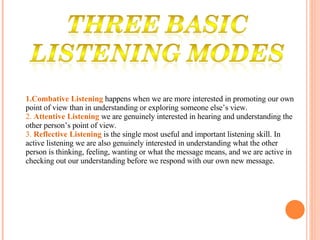
1.Combative Listening   happens when we are more interested in promoting our own point of view than in understanding or exploring someone else’s view.  2.  Attentive Listening   we are genuinely interested in hearing and understanding the other person’s point of view. 3.  Reflective Listening  is the single most useful and important listening skill. In active listening we are also genuinely interested in understanding what the other person is thinking, feeling, wanting or what the message means, and we are active in checking out our understanding before we respond with our own new message.
The average college student spends about  14 hours  per week in class listening (or perhaps I should say " hearing"-- there is a difference!) to lectures. See if you can improve your listening skills by following some of the strategies below: Maintain eye contact with the instructor.   An eye contact with the speaker is very essential to improve listening efficiency  Focus on content, not delivery.   Have you ever counted the number of times a teacher clears his/her throat in a fifteen minute period? If so, you weren't focusing on content. Avoid emotional involvement.   Try to remain objective and open-minded. Avoid distractions .  Don't let your mind wander or be distracted by the person shuffling papers near you.  Treat listening as a challenging mental task .   Listening to an academic lecture is not a passive act--at least it shouldn't be.  Stay active by asking mental questions.   Active listening keeps you on your toes. You can ask yourself ask a few questions as you listen.  Use the gap between the rate of speech and your rate of thought .   You can think faster than the lecturer can talk. That's one reason your mind may tend to wander.
     The one skill you'll use most in college is the skill to listen .  Yet how many of us have ever taken a "course" in listening? There are strategies to consider that can improve your ability to "hear" a lecture and interact with communicated instructional material.  Listen and Learn  - Modern research has revealed that although we spend a large percentage of our time listening; only a small amount of what we have heard actually registers in our brain. The development of active listening skills has become an increasingly recognized part of study and communication skills Attentive and Critical Listening In the Classroom - Listening and Note-taking Listening Skill- H ere's a great quote  -  "We were given two ears but only one mouth. This is because God knew that listening was twice as hard as talking."
Listening is not the same as hearing. Your skill as a listener can make or break your success in leadership, teams, customer relationships, and negotiation. Listening is a communication skill  that takes practice. By becoming a better listener in class, you will become a better note taker and a successful student.  After reading this information about listening skills and after doing the other assignments about listening, you should be able to:  identify six problems that result from poor listening skills; apply four positive steps to become a better listener; understand strategies to improve listening skills; explain why the difference between speaking and listening speeds can be a potential listening problem.
Check your listening behavior often. Here are some positive steps to take to help improve your listening skills: Prepare to listen.    Your attitude in attending class is important. If you feel that a particular class is generally a waste of your time, you obviously won't be in a good mood to listen Watch the speaker.    Don't take your eyes off the speaker! Eye contact is a very important part of the active listening process. You have to listen with your eyes and your ears! Note questions.    If you listen with a questioning attitude, learning will be easier for you. When the instructor asks a question, pay close attention.  Listen creatively.    You should not be listening and thinking about other things at the same time, but you should be evaluating and organizing the speaker's words by taking notes.  Listening is a prime source of information in college .
There are many mixed reasons for poor listening. Here's a list of problems that result from weak listening skills. Daydreaming   is probably the most common listening problem because it affects everyone.  Closed-mindedness   is a fault that happens more outside the classroom, especially when we are arguing.  False attention   is a protection technique that everyone uses from time to time to fake out the speaker.  Intellectual despair   means giving up before you even get started. Listening can be hard to do sometimes. In college you have to sit through many lectures that are hard to understand.  Memorizing   is a problem that happens when listeners try to memorize every word the instructor says.  Personality listening   is something we all do. It's natural for listeners to evaluate a speaker, but our impressions should not interfere with our listening.
There are several simple steps you can take to overcome these listening problems and improve our listening efficiency. The quality of information exchanged, your own experience as a listener, the experience of the person you are listening to, and your relationship with the listener will all benefit. The steps are: Get Over Yourself, Give Them A Solo. Stop Multi-tasking. Recap regularly. Use Connecting Words. Use Body Language.
The way the poor listeners behave are as follows: Just Keep Talking . When you're not talking, think about what you're going to say next . Interrupt Frequently . Look Away. Never, ever, ask clarifying questions
Your tutees may give several reasons for why they don't take notes.  Perhaps their instructor talks too fast or lectures directly from the book.  Don't accept these excuses.  The advantages of taking notes always outweigh the disadvantages. Advantages : Requires organization on the part of the student. Requires critical thinking. Develops active listening skills. Requires concentration. Solidifies understanding. Provides a record of what was discussed. Aids student in determining what the instructor thinks is important. Strengthens some learning styles.  
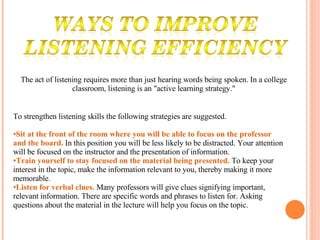
The act of listening requires more than just hearing words being spoken. In a college classroom, listening is an "active learning strategy." To strengthen listening skills the following strategies are suggested.  Sit at the front of the room where you will be able to focus on the professor and the board.   In this position you will be less likely to be distracted. Your attention will be focused on the instructor and the presentation of information.  Train yourself to stay focused on the material being presented.   To keep your interest in the topic, make the information relevant to you, thereby making it more memorable .  Listen for verbal clues.   Many professors will give clues signifying important, relevant information. There are specific words and phrases to listen for. Asking questions about the material in the lecture will help you focus on the topic.
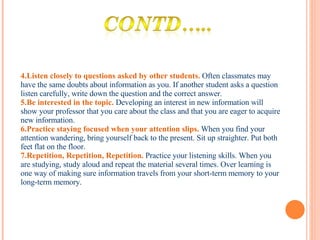
4.Listen closely to questions asked by other students.   Often classmates may have the same doubts about information as you. If another student asks a question listen carefully, write down the question and the correct answer.  5.Be interested in the topic.   Developing an interest in new information will show your professor that you care about the class and that you are eager to acquire new information.  6.Practice staying focused when your attention slips.   When you find your attention wandering, bring yourself back to the present. Sit up straighter. Put both feet flat on the floor.  7.Repetition, Repetition, Repetition.   Practice your listening skills. When you are studying, study aloud and repeat the material several times. Over learning is one way of making sure information travels from your short-term memory to your long-term memory.
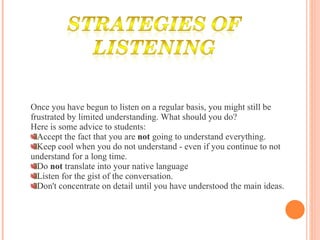
Once you have begun to listen on a regular basis, you might still be frustrated by limited understanding. What should you do?  Here is some advice to students:  Accept the fact that you are  not  going to understand everything.  Keep cool when you do not understand - even if you continue to not understand for a long time.  Do  not  translate into your native language  Listen for the gist of the conversation.  Don't concentrate on detail until you have understood the main ideas.
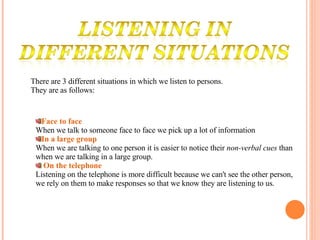
There are 3 different situations in which we listen to persons. They are as follows: Face to face   When we talk to someone face to face we pick up a lot of information In a large group   When we are talking to one person it is easier to notice their  non-verbal cues  than when we are talking in a large group. On the telephone   Listening on the telephone is more difficult because we can't see the other person, we rely on them to make responses so that we know they are listening to us.
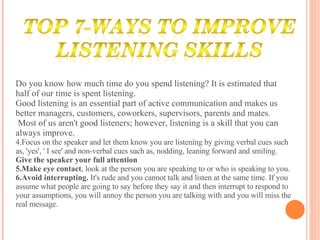
Do you know how much time do you spend listening? It is estimated that half of our time is spent listening.  Good listening is an essential part of active communication and makes us better managers, customers, coworkers, supervisors, parents and mates. Most of us aren't good listeners; however, listening is a skill that you can always improve. Focus on the speaker and let them know you are listening by giving verbal cues such as, 'yes', ' I see' and non-verbal cues such as, nodding, leaning forward and smiling.  Give the speaker your full attention Make eye contact , look at the person you are speaking to or who is speaking to you.  Avoid interrupting.  It's rude and you cannot talk and listen at the same time. If you assume what people are going to say before they say it and then interrupt to respond to your assumptions, you will annoy the person you are talking with and you will miss the real message.
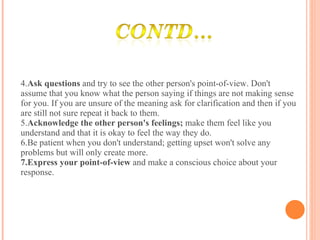
4. Ask questions  and try to see the other person's point-of-view. Don't assume that you know what the person saying if things are not making sense for you. If you are unsure of the meaning ask for clarification and then if you are still not sure repeat it back to them. 5. Acknowledge the other person's feelings;  make them feel like you understand and that it is okay to feel the way they do. 6.Be patient when you don't understand; getting upset won't solve any problems but will only create more. 7.Express your point-of-view  and make a conscious choice about your response.
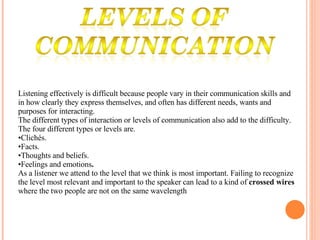
Listening effectively is difficult because people vary in their communication skills and in how clearly they express themselves, and often has different needs, wants and purposes for interacting.  The different types of interaction or levels of communication also add to the difficulty.  The four different types or levels are. Clichés.  Facts.    Thoughts and beliefs.  Feelings and emotions .  As a listener we attend to the level that we think is most important. Failing to recognize the level most relevant and important to the speaker can lead to a kind of  crossed wires  where the two people are not on the same wavelength
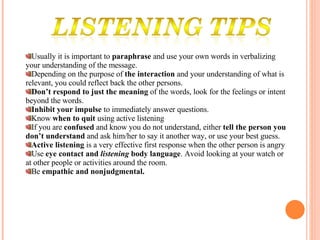
Usually it is important to  paraphrase  and use your own words in verbalizing your understanding of the message. Depending on the purpose of  the interaction  and your understanding of what is relevant, you could reflect back the other persons. Don’t respond to just the meaning  of the words, look for the feelings or intent beyond the words. Inhibit your impulse  to immediately answer questions.  Know  when to quit  using active listening If you are  confused  and know you do not understand, either  tell the person you don’t understand  and ask him/her to say it another way, or use your best guess. Active listening  is a very effective first response when the other person is angry Use  eye contact and  listening  body language . Avoid looking at your watch or at other people or activities around the room. Be  empathic and nonjudgmental.
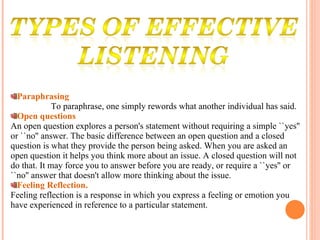
Paraphrasing To paraphrase, one simply rewords what another individual has said.  Open questions An open question explores a person's statement without requiring a simple ``yes'' or ``no'' answer. The basic difference between an open question and a closed question is what they provide the person being asked. When you are asked an open question it helps you think more about an issue. A closed question will not do that. It may force you to answer before you are ready, or require a ``yes'' or ``no'' answer that doesn't allow more thinking about the issue. Feeling Reflection. Feeling reflection is a response in which you express a feeling or emotion you have experienced in reference to a particular statement.
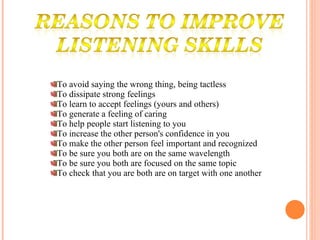
To avoid saying the wrong thing, being tactless  To dissipate strong feelings  To learn to accept feelings (yours and others)  To generate a feeling of caring  To help people start listening to you  To increase the other person's confidence in you  To make the other person feel important and recognized  To be sure you both are on the same wavelength  To be sure you both are focused on the same topic  To check that you are both are on target with one another
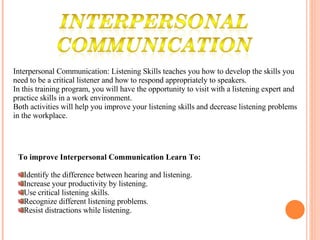
Interpersonal Communication: Listening Skills teaches you how to develop the skills you need to be a critical listener and how to respond appropriately to speakers.  In this training program, you will have the opportunity to visit with a listening expert and practice skills in a work environment.  Both activities will help you improve your listening skills and decrease listening problems in the workplace. To improve Interpersonal Communication Learn To: Identify the difference between hearing and listening.  Increase your productivity by listening.  Use critical listening skills.  Recognize different listening problems.  Resist distractions while listening.
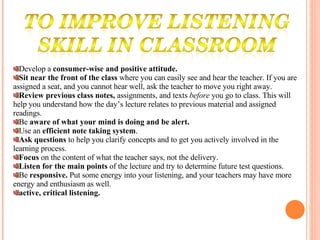
Develop a  consumer-wise and positive attitude.  Sit near the front of the class  where you can easily see and hear the teacher. If you are assigned a seat, and you cannot hear well, ask the teacher to move you right away.  Review previous class notes,  assignments, and texts  before  you go to class. This will help you understand how the day’s lecture relates to previous material and assigned readings.  Be  aware of what your mind is doing and be alert.  Use an  efficient note taking system .  Ask questions  to help you clarify concepts and to get you actively involved in the learning process.  Focus  on the content of what the teacher says, not the delivery.  Listen for the main points  of the lecture and try to determine future test questions.  Be  responsive.  Put some energy into your listening, and your teachers may have more energy and enthusiasm as well.  active, critical listening.
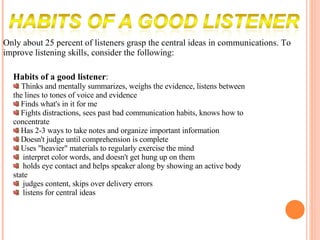
Only about 25 percent of listeners grasp the central ideas in communications. To improve listening skills, consider the following: Habits of a good listener : Thinks and mentally summarizes, weighs the evidence, listens between the lines to tones of voice and evidence Finds what's in it for me Fights distractions, sees past bad communication habits, knows how to concentrate Has 2-3 ways to take notes and organize important information Doesn't judge until comprehension is complete Uses "heavier" materials to regularly exercise the mind interpret color words, and doesn't get hung up on them holds eye contact and helps speaker along by showing an active body state judges content, skips over delivery errors listens for central ideas
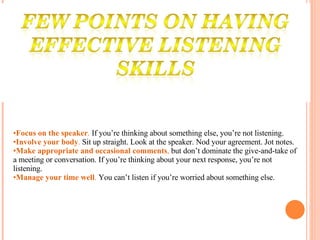
Focus on the speaker .  If you’re thinking about something else, you’re not listening.  Involve your body .  Sit up straight. Look at the speaker. Nod your agreement. Jot notes.  Make appropriate and occasional comments ,  but don’t dominate the give-and-take of a meeting or conversation. If you’re thinking about your next response, you’re not listening.  Manage your time well .  You can’t listen if you’re worried about something else.
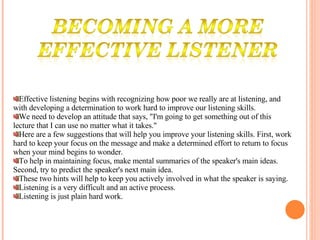
Effective listening begins with recognizing how poor we really are at listening, and with developing a determination to work hard to improve our listening skills.  We need to develop an attitude that says, "I'm going to get something out of this lecture that I can use no matter what it takes."  Here are a few suggestions that will help you improve your listening skills. First, work hard to keep your focus on the message and make a determined effort to return to focus when your mind begins to wonder.  To help in maintaining focus, make mental summaries of the speaker's main ideas. Second, try to predict the speaker's next main idea.  These two hints will help to keep you actively involved in what the speaker is saying.  Listening is a very difficult and an active process.  Listening is just plain hard work.
1.Kirthiga 2.Lavanya 3.Priyasree  4.Icewarya 5.Janani 6.Jeevithra 7.Rajasekar Presented by

English (Improving Listening Efficency)

  • 1.
  • 2.
    Listening means thinkingand acting in ways that connect you with the speaker. Listening is an art and a gift.  It is a  tool that is essential to your success as a student, an employee, and a friend, yet most of us have never been taught how to listen. As the listener, you should then be able to repeat back in your own words what they have said to their satisfaction.
  • 3.
    There are twotypes of listening: Active listening : This type of listening is the best way to improve listening skill. Interaction between the listener and the speaker is possible in this type of interaction. Passive listening : In this type of listening one is not able to interact with the instructor or the teacher. That is the listener is just able to listen and correlate the lecture. He’s not provided with interaction.
  • 4.
  • 5.
    One has tolook after the following strategies before preparing themselves to listen: What do you think of the subject matter? Is it new or have you a lot of experience with it? Will it be difficult to understand, or simple? Is it important to you, or just fun? Is the speaker experienced or nervous? What are the  non-verbal cues of the speaker? What frame of mind is he or she? How personable, threatening, intelligent, etc.? Is the message illustrated with visuals or examples? Is technology used effectively? Are concepts introduced incrementally, or with examples? Is the space conducive to listening? Or to interaction or exchange with the speaker? Are there avoidable distractions?
  • 6.
    1.Combative Listening happens when we are more interested in promoting our own point of view than in understanding or exploring someone else’s view. 2. Attentive Listening we are genuinely interested in hearing and understanding the other person’s point of view. 3. Reflective Listening is the single most useful and important listening skill. In active listening we are also genuinely interested in understanding what the other person is thinking, feeling, wanting or what the message means, and we are active in checking out our understanding before we respond with our own new message.
  • 7.
    The average collegestudent spends about 14 hours per week in class listening (or perhaps I should say " hearing"-- there is a difference!) to lectures. See if you can improve your listening skills by following some of the strategies below: Maintain eye contact with the instructor. An eye contact with the speaker is very essential to improve listening efficiency Focus on content, not delivery. Have you ever counted the number of times a teacher clears his/her throat in a fifteen minute period? If so, you weren't focusing on content. Avoid emotional involvement. Try to remain objective and open-minded. Avoid distractions . Don't let your mind wander or be distracted by the person shuffling papers near you. Treat listening as a challenging mental task . Listening to an academic lecture is not a passive act--at least it shouldn't be. Stay active by asking mental questions. Active listening keeps you on your toes. You can ask yourself ask a few questions as you listen. Use the gap between the rate of speech and your rate of thought . You can think faster than the lecturer can talk. That's one reason your mind may tend to wander.
  • 8.
       The one skill you'll use most in college is the skill to listen . Yet how many of us have ever taken a "course" in listening? There are strategies to consider that can improve your ability to "hear" a lecture and interact with communicated instructional material. Listen and Learn - Modern research has revealed that although we spend a large percentage of our time listening; only a small amount of what we have heard actually registers in our brain. The development of active listening skills has become an increasingly recognized part of study and communication skills Attentive and Critical Listening In the Classroom - Listening and Note-taking Listening Skill- H ere's a great quote - "We were given two ears but only one mouth. This is because God knew that listening was twice as hard as talking."
  • 9.
    Listening is notthe same as hearing. Your skill as a listener can make or break your success in leadership, teams, customer relationships, and negotiation. Listening is a communication skill  that takes practice. By becoming a better listener in class, you will become a better note taker and a successful student. After reading this information about listening skills and after doing the other assignments about listening, you should be able to: identify six problems that result from poor listening skills; apply four positive steps to become a better listener; understand strategies to improve listening skills; explain why the difference between speaking and listening speeds can be a potential listening problem.
  • 10.
    Check your listeningbehavior often. Here are some positive steps to take to help improve your listening skills: Prepare to listen.   Your attitude in attending class is important. If you feel that a particular class is generally a waste of your time, you obviously won't be in a good mood to listen Watch the speaker.   Don't take your eyes off the speaker! Eye contact is a very important part of the active listening process. You have to listen with your eyes and your ears! Note questions.  If you listen with a questioning attitude, learning will be easier for you. When the instructor asks a question, pay close attention. Listen creatively.  You should not be listening and thinking about other things at the same time, but you should be evaluating and organizing the speaker's words by taking notes. Listening is a prime source of information in college .
  • 11.
    There are manymixed reasons for poor listening. Here's a list of problems that result from weak listening skills. Daydreaming is probably the most common listening problem because it affects everyone. Closed-mindedness is a fault that happens more outside the classroom, especially when we are arguing. False attention is a protection technique that everyone uses from time to time to fake out the speaker. Intellectual despair means giving up before you even get started. Listening can be hard to do sometimes. In college you have to sit through many lectures that are hard to understand. Memorizing is a problem that happens when listeners try to memorize every word the instructor says. Personality listening is something we all do. It's natural for listeners to evaluate a speaker, but our impressions should not interfere with our listening.
  • 12.
    There are severalsimple steps you can take to overcome these listening problems and improve our listening efficiency. The quality of information exchanged, your own experience as a listener, the experience of the person you are listening to, and your relationship with the listener will all benefit. The steps are: Get Over Yourself, Give Them A Solo. Stop Multi-tasking. Recap regularly. Use Connecting Words. Use Body Language.
  • 13.
    The way thepoor listeners behave are as follows: Just Keep Talking . When you're not talking, think about what you're going to say next . Interrupt Frequently . Look Away. Never, ever, ask clarifying questions
  • 14.
    Your tutees maygive several reasons for why they don't take notes.  Perhaps their instructor talks too fast or lectures directly from the book. Don't accept these excuses. The advantages of taking notes always outweigh the disadvantages. Advantages : Requires organization on the part of the student. Requires critical thinking. Develops active listening skills. Requires concentration. Solidifies understanding. Provides a record of what was discussed. Aids student in determining what the instructor thinks is important. Strengthens some learning styles.  
  • 15.
    The act oflistening requires more than just hearing words being spoken. In a college classroom, listening is an "active learning strategy." To strengthen listening skills the following strategies are suggested. Sit at the front of the room where you will be able to focus on the professor and the board. In this position you will be less likely to be distracted. Your attention will be focused on the instructor and the presentation of information. Train yourself to stay focused on the material being presented. To keep your interest in the topic, make the information relevant to you, thereby making it more memorable . Listen for verbal clues. Many professors will give clues signifying important, relevant information. There are specific words and phrases to listen for. Asking questions about the material in the lecture will help you focus on the topic.
  • 16.
    4.Listen closely toquestions asked by other students. Often classmates may have the same doubts about information as you. If another student asks a question listen carefully, write down the question and the correct answer. 5.Be interested in the topic. Developing an interest in new information will show your professor that you care about the class and that you are eager to acquire new information. 6.Practice staying focused when your attention slips. When you find your attention wandering, bring yourself back to the present. Sit up straighter. Put both feet flat on the floor. 7.Repetition, Repetition, Repetition. Practice your listening skills. When you are studying, study aloud and repeat the material several times. Over learning is one way of making sure information travels from your short-term memory to your long-term memory.
  • 17.
    Once you havebegun to listen on a regular basis, you might still be frustrated by limited understanding. What should you do? Here is some advice to students: Accept the fact that you are not going to understand everything. Keep cool when you do not understand - even if you continue to not understand for a long time. Do not translate into your native language Listen for the gist of the conversation. Don't concentrate on detail until you have understood the main ideas.
  • 18.
    There are 3different situations in which we listen to persons. They are as follows: Face to face When we talk to someone face to face we pick up a lot of information In a large group When we are talking to one person it is easier to notice their non-verbal cues than when we are talking in a large group. On the telephone Listening on the telephone is more difficult because we can't see the other person, we rely on them to make responses so that we know they are listening to us.
  • 19.
    Do you knowhow much time do you spend listening? It is estimated that half of our time is spent listening. Good listening is an essential part of active communication and makes us better managers, customers, coworkers, supervisors, parents and mates. Most of us aren't good listeners; however, listening is a skill that you can always improve. Focus on the speaker and let them know you are listening by giving verbal cues such as, 'yes', ' I see' and non-verbal cues such as, nodding, leaning forward and smiling. Give the speaker your full attention Make eye contact , look at the person you are speaking to or who is speaking to you. Avoid interrupting. It's rude and you cannot talk and listen at the same time. If you assume what people are going to say before they say it and then interrupt to respond to your assumptions, you will annoy the person you are talking with and you will miss the real message.
  • 20.
    4. Ask questions and try to see the other person's point-of-view. Don't assume that you know what the person saying if things are not making sense for you. If you are unsure of the meaning ask for clarification and then if you are still not sure repeat it back to them. 5. Acknowledge the other person's feelings; make them feel like you understand and that it is okay to feel the way they do. 6.Be patient when you don't understand; getting upset won't solve any problems but will only create more. 7.Express your point-of-view and make a conscious choice about your response.
  • 21.
    Listening effectively isdifficult because people vary in their communication skills and in how clearly they express themselves, and often has different needs, wants and purposes for interacting. The different types of interaction or levels of communication also add to the difficulty. The four different types or levels are. Clichés. Facts.   Thoughts and beliefs. Feelings and emotions . As a listener we attend to the level that we think is most important. Failing to recognize the level most relevant and important to the speaker can lead to a kind of crossed wires where the two people are not on the same wavelength
  • 22.
    Usually it isimportant to paraphrase and use your own words in verbalizing your understanding of the message. Depending on the purpose of the interaction and your understanding of what is relevant, you could reflect back the other persons. Don’t respond to just the meaning of the words, look for the feelings or intent beyond the words. Inhibit your impulse to immediately answer questions.  Know when to quit using active listening If you are confused and know you do not understand, either tell the person you don’t understand and ask him/her to say it another way, or use your best guess. Active listening is a very effective first response when the other person is angry Use eye contact and listening body language . Avoid looking at your watch or at other people or activities around the room. Be empathic and nonjudgmental.
  • 23.
    Paraphrasing To paraphrase,one simply rewords what another individual has said. Open questions An open question explores a person's statement without requiring a simple ``yes'' or ``no'' answer. The basic difference between an open question and a closed question is what they provide the person being asked. When you are asked an open question it helps you think more about an issue. A closed question will not do that. It may force you to answer before you are ready, or require a ``yes'' or ``no'' answer that doesn't allow more thinking about the issue. Feeling Reflection. Feeling reflection is a response in which you express a feeling or emotion you have experienced in reference to a particular statement.
  • 24.
    To avoid sayingthe wrong thing, being tactless To dissipate strong feelings To learn to accept feelings (yours and others) To generate a feeling of caring To help people start listening to you To increase the other person's confidence in you To make the other person feel important and recognized To be sure you both are on the same wavelength To be sure you both are focused on the same topic To check that you are both are on target with one another
  • 25.
    Interpersonal Communication: ListeningSkills teaches you how to develop the skills you need to be a critical listener and how to respond appropriately to speakers. In this training program, you will have the opportunity to visit with a listening expert and practice skills in a work environment. Both activities will help you improve your listening skills and decrease listening problems in the workplace. To improve Interpersonal Communication Learn To: Identify the difference between hearing and listening. Increase your productivity by listening. Use critical listening skills. Recognize different listening problems. Resist distractions while listening.
  • 26.
    Develop a consumer-wise and positive attitude. Sit near the front of the class where you can easily see and hear the teacher. If you are assigned a seat, and you cannot hear well, ask the teacher to move you right away. Review previous class notes, assignments, and texts before you go to class. This will help you understand how the day’s lecture relates to previous material and assigned readings. Be aware of what your mind is doing and be alert. Use an efficient note taking system . Ask questions to help you clarify concepts and to get you actively involved in the learning process. Focus on the content of what the teacher says, not the delivery. Listen for the main points of the lecture and try to determine future test questions. Be responsive. Put some energy into your listening, and your teachers may have more energy and enthusiasm as well. active, critical listening.
  • 27.
    Only about 25percent of listeners grasp the central ideas in communications. To improve listening skills, consider the following: Habits of a good listener : Thinks and mentally summarizes, weighs the evidence, listens between the lines to tones of voice and evidence Finds what's in it for me Fights distractions, sees past bad communication habits, knows how to concentrate Has 2-3 ways to take notes and organize important information Doesn't judge until comprehension is complete Uses "heavier" materials to regularly exercise the mind interpret color words, and doesn't get hung up on them holds eye contact and helps speaker along by showing an active body state judges content, skips over delivery errors listens for central ideas
  • 28.
    Focus on thespeaker . If you’re thinking about something else, you’re not listening. Involve your body . Sit up straight. Look at the speaker. Nod your agreement. Jot notes. Make appropriate and occasional comments , but don’t dominate the give-and-take of a meeting or conversation. If you’re thinking about your next response, you’re not listening. Manage your time well . You can’t listen if you’re worried about something else.
  • 29.
    Effective listening beginswith recognizing how poor we really are at listening, and with developing a determination to work hard to improve our listening skills. We need to develop an attitude that says, "I'm going to get something out of this lecture that I can use no matter what it takes." Here are a few suggestions that will help you improve your listening skills. First, work hard to keep your focus on the message and make a determined effort to return to focus when your mind begins to wonder. To help in maintaining focus, make mental summaries of the speaker's main ideas. Second, try to predict the speaker's next main idea. These two hints will help to keep you actively involved in what the speaker is saying. Listening is a very difficult and an active process. Listening is just plain hard work.
  • 30.
    1.Kirthiga 2.Lavanya 3.Priyasree 4.Icewarya 5.Janani 6.Jeevithra 7.Rajasekar Presented by