MGT380: Leadership
for Organizations
Week 4
MGT380: LEADERSHIP
FOR ORGANIZATIONS
MGT380: Leadership
for Organizations
Week 4
WEEK FOUR OVERVIEW
Week 4 reviews the leader-follower relationship. Also, the
leadership role will be explained as it relates to an organization’s
vision, mission, and strategy.
MGT380: Leadership
for Organizations
Week 4
WEEK FOUR LEARNING
OBJECTIVES
• Assess dynamics and outcomes of the leader-follower
relationship.
• Explain how the leadership role relates to an
organization’s vision, mission, and strategy.
MGT380: Leadership
for Organizations
Week 4
READINGS, REQUIRED
ARTICLE, AND WEBSITE
Readings
Read the following chapter in An Introduction to Leadership:
1. Chapter 9: Leadership, Strategy
2. Chapter 11: Power, Politics, and Conflict
MGT380: Leadership
for Organizations
Week 4
FRAME OF REFERENCE
FRAME OF REFERENCE
A frame of reference guides employees and leaders in the decision
making process. It is also influenced by the employee’s or leader’s goals,
resources and ethics.
Your text introduces and discusses four frames of reference.
• Structural
• Human Resource
• Political
• Symbolic (Bolman and Deal as cited in Weiss, 2015)
STRUCTURAL
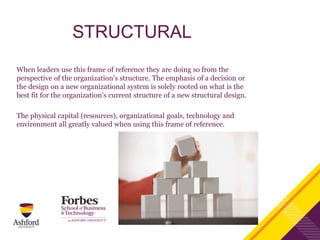
When leaders use this frame of reference they are doing so from the
perspective of the organization’s structure. The emphasis of a decision or
the design on a new organizational system is solely rooted on what is the
best fit for the organization’s current structure of a new structural design.
The physical capital (resources), organizational goals, technology and
environment all greatly valued when using this frame of reference.
HUMAN RESOURCE
The human resource frame focuses on the people by designing systems
that benefit and motivate them the most. The goal of the human resource
frame is to ensure that the organization’s culture and climate is
conducive to the employees.
POLITICAL
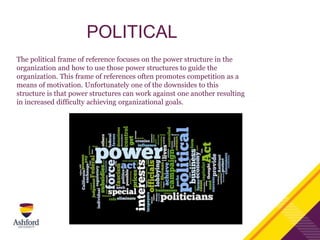
The political frame of reference focuses on the power structure in the
organization and how to use those power structures to guide the
organization. This frame of references often promotes competition as a
means of motivation. Unfortunately one of the downsides to this
structure is that power structures can work against one another resulting
in increased difficulty achieving organizational goals.
SYMBOLIC
The symbolic frame focuses on the meaning of the organizational
systems and their uniqueness. For example, if an organization required
it’s workers to work four days a week and the fifth day was reserved for
innovation.
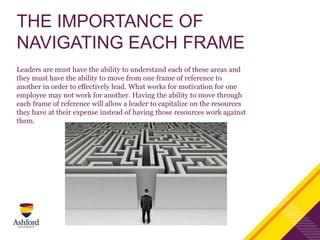
THE IMPORTANCE OF
NAVIGATING EACH FRAME
Leaders are must have the ability to understand each of these areas and
they must have the ability to move from one frame of reference to
another in order to effectively lead. What works for motivation for one
employee may not work for another. Having the ability to move through
each frame of reference will allow a leader to capitalize on the resources
they have at their expense instead of having those resources work against
them.
VISION, MISSION, STRATEGY
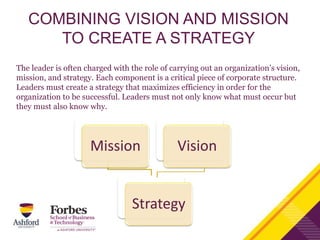
COMBINING VISION AND MISSION
TO CREATE A STRATEGY
The leader is often charged with the role of carrying out an organization’s vision,
mission, and strategy. Each component is a critical piece of corporate structure.
Leaders must create a strategy that maximizes efficiency in order for the
organization to be successful. Leaders must not only know what must occur but
they must also know why.
VisionMission
Strategy
THE VISION
The Vision creates clarity when there is uncertainty. The vision should provide a
desired endpoint. The endpoint provides a context to the situation being addressed
and in turn that context is used to build a strategy. Sometimes you will hear vision
described as “the what” meaning “what does one want to accomplish?”
Here are some questions a vision statement should answer:
• What is the focus?
• What is the goal?
• What resources does the organization need for the future?
• What metrics should be in place to measure progress?
THE MISSION
The mission statement delineates the purpose and objectives of the
organization. The mission statement is more about current operations,
quality, and methods of operation. A good mission statement provides a
standard by which to align current procedures can be measured. The
mission statement then is "the how" that the leader must know as well.
The leader uses the mission statement to align processes and techniques
to keep the course to the vision as straight as possible.
Mission statements should:
• Clearly define what the organization sets out to do.
• Assist leaders is developing a strategy.
• Answers the “why” question when developing organizational
processes.
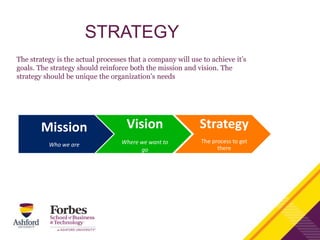
STRATEGY
The strategy is the actual processes that a company will use to achieve it’s
goals. The strategy should reinforce both the mission and vision. The
strategy should be unique the organization’s needs
Mission
Who we are
Vision
Where we want to
go
Strategy
The process to get
there
WEEK 4 QUIZ
• Ensure that you complete your Week 4 you Quiz by Day 7.
STILL HAVE QUESTIONS
ON ACADEMIC WRITING
OR APA FORMATTING?
https://awc.ashford.edu/Index.html
ANY
QUESTIONS?
Please post your
questions in the Ask
the Instructor thread
or e-mail your
instructor directly.

MGT380 Week 4 Instructor Guidance

  • 1.
  • 2.
    MGT380: LEADERSHIP FOR ORGANIZATIONS MGT380:Leadership for Organizations Week 4
  • 3.
    WEEK FOUR OVERVIEW Week4 reviews the leader-follower relationship. Also, the leadership role will be explained as it relates to an organization’s vision, mission, and strategy. MGT380: Leadership for Organizations Week 4
  • 4.
    WEEK FOUR LEARNING OBJECTIVES •Assess dynamics and outcomes of the leader-follower relationship. • Explain how the leadership role relates to an organization’s vision, mission, and strategy. MGT380: Leadership for Organizations Week 4
  • 5.
    READINGS, REQUIRED ARTICLE, ANDWEBSITE Readings Read the following chapter in An Introduction to Leadership: 1. Chapter 9: Leadership, Strategy 2. Chapter 11: Power, Politics, and Conflict MGT380: Leadership for Organizations Week 4
  • 6.
  • 7.
    FRAME OF REFERENCE Aframe of reference guides employees and leaders in the decision making process. It is also influenced by the employee’s or leader’s goals, resources and ethics. Your text introduces and discusses four frames of reference. • Structural • Human Resource • Political • Symbolic (Bolman and Deal as cited in Weiss, 2015)
  • 8.
    STRUCTURAL When leaders usethis frame of reference they are doing so from the perspective of the organization’s structure. The emphasis of a decision or the design on a new organizational system is solely rooted on what is the best fit for the organization’s current structure of a new structural design. The physical capital (resources), organizational goals, technology and environment all greatly valued when using this frame of reference.
  • 9.
    HUMAN RESOURCE The humanresource frame focuses on the people by designing systems that benefit and motivate them the most. The goal of the human resource frame is to ensure that the organization’s culture and climate is conducive to the employees.
  • 10.
    POLITICAL The political frameof reference focuses on the power structure in the organization and how to use those power structures to guide the organization. This frame of references often promotes competition as a means of motivation. Unfortunately one of the downsides to this structure is that power structures can work against one another resulting in increased difficulty achieving organizational goals.
  • 11.
    SYMBOLIC The symbolic framefocuses on the meaning of the organizational systems and their uniqueness. For example, if an organization required it’s workers to work four days a week and the fifth day was reserved for innovation.
  • 12.
    THE IMPORTANCE OF NAVIGATINGEACH FRAME Leaders are must have the ability to understand each of these areas and they must have the ability to move from one frame of reference to another in order to effectively lead. What works for motivation for one employee may not work for another. Having the ability to move through each frame of reference will allow a leader to capitalize on the resources they have at their expense instead of having those resources work against them.
  • 13.
  • 14.
    COMBINING VISION ANDMISSION TO CREATE A STRATEGY The leader is often charged with the role of carrying out an organization’s vision, mission, and strategy. Each component is a critical piece of corporate structure. Leaders must create a strategy that maximizes efficiency in order for the organization to be successful. Leaders must not only know what must occur but they must also know why. VisionMission Strategy
  • 15.
    THE VISION The Visioncreates clarity when there is uncertainty. The vision should provide a desired endpoint. The endpoint provides a context to the situation being addressed and in turn that context is used to build a strategy. Sometimes you will hear vision described as “the what” meaning “what does one want to accomplish?” Here are some questions a vision statement should answer: • What is the focus? • What is the goal? • What resources does the organization need for the future? • What metrics should be in place to measure progress?
  • 16.
    THE MISSION The missionstatement delineates the purpose and objectives of the organization. The mission statement is more about current operations, quality, and methods of operation. A good mission statement provides a standard by which to align current procedures can be measured. The mission statement then is "the how" that the leader must know as well. The leader uses the mission statement to align processes and techniques to keep the course to the vision as straight as possible. Mission statements should: • Clearly define what the organization sets out to do. • Assist leaders is developing a strategy. • Answers the “why” question when developing organizational processes.
  • 17.
    STRATEGY The strategy isthe actual processes that a company will use to achieve it’s goals. The strategy should reinforce both the mission and vision. The strategy should be unique the organization’s needs Mission Who we are Vision Where we want to go Strategy The process to get there
  • 18.
    WEEK 4 QUIZ •Ensure that you complete your Week 4 you Quiz by Day 7.
  • 19.
    STILL HAVE QUESTIONS ONACADEMIC WRITING OR APA FORMATTING? https://awc.ashford.edu/Index.html
  • 20.
    ANY QUESTIONS? Please post your questionsin the Ask the Instructor thread or e-mail your instructor directly.