BUS 119
Week 3
BUS 119 – Principles of
Personal &
Organizational
Leadership
Overview – Suggested and Required Actions for this week
• Read Chapters 6, 7, & 8 in your text book
• 2 Discussion Questions – Original Posts – Due by Thursday, 11:59 pm
• Quiz – Due by Sunday, 11:59 pm
• Respond to at least 2 classmates for each question – Due by Monday, 11:59 pm
• Read requirements for final assignment due week 5 and
begin research.
Northouse, P. G. (2018). Introduction to leadership:
Concepts and practice. Thousand Oaks, CA: Sage
Publications, Inc.
This textbook
is a
Constellation
textbook
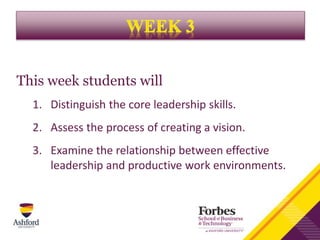
This week students will
1. Distinguish the core leadership skills.
2. Assess the process of creating a vision.
3. Examine the relationship between effective
leadership and productive work environments.
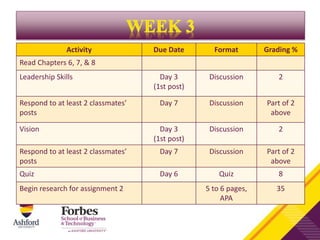
Activity Due Date Format Grading %
Read Chapters 6, 7, & 8
Leadership Skills Day 3
(1st post)
Discussion 2
Respond to at least 2 classmates’
posts
Day 7 Discussion Part of 2
above
Vision Day 3
(1st post)
Discussion 2
Respond to at least 2 classmates’
posts
Day 7 Discussion Part of 2
above
Quiz Day 6 Quiz 8
Begin research for assignment 2 5 to 6 pages,
APA
35
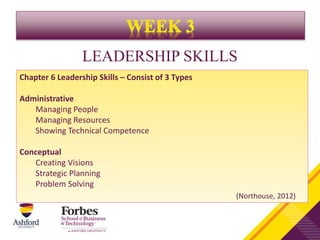
LEADERSHIP SKILLS
Chapter 6 Leadership Skills – Consist of 3 Types
Administrative
Managing People
Managing Resources
Showing Technical Competence
Conceptual
Creating Visions
Strategic Planning
Problem Solving
(Northouse, 2012)
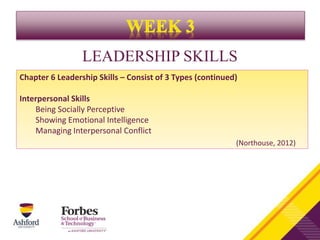
LEADERSHIP SKILLS
Chapter 6 Leadership Skills – Consist of 3 Types (continued)
Interpersonal Skills
Being Socially Perceptive
Showing Emotional Intelligence
Managing Interpersonal Conflict
(Northouse, 2012)
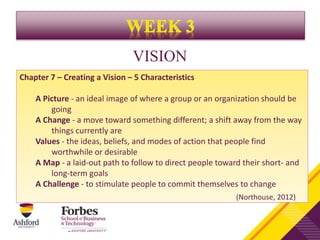
VISION
Chapter 7 – Creating a Vision – 5 Characteristics
A Picture - an ideal image of where a group or an organization should be
going
A Change - a move toward something different; a shift away from the way
things currently are
Values - the ideas, beliefs, and modes of action that people find
worthwhile or desirable
A Map - a laid-out path to follow to direct people toward their short- and
long-term goals
A Challenge - to stimulate people to commit themselves to change
(Northouse, 2012)
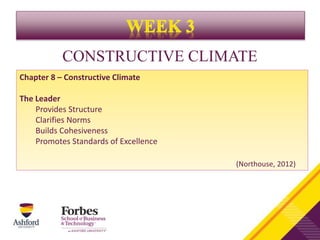
CONSTRUCTIVE CLIMATE
Chapter 8 – Constructive Climate
The Leader
Provides Structure
Clarifies Norms
Builds Cohesiveness
Promotes Standards of Excellence
(Northouse, 2012)
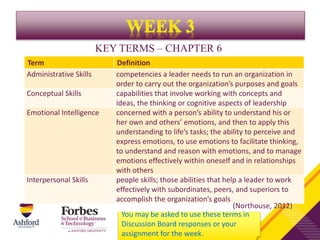
KEY TERMS – CHAPTER 6
You may be asked to use these terms in
Discussion Board responses or your
assignment for the week.
Term Definition
Administrative Skills competencies a leader needs to run an organization in
order to carry out the organization’s purposes and goals
Conceptual Skills capabilities that involve working with concepts and
ideas, the thinking or cognitive aspects of leadership
Emotional Intelligence concerned with a person’s ability to understand his or
her own and others’ emotions, and then to apply this
understanding to life’s tasks; the ability to perceive and
express emotions, to use emotions to facilitate thinking,
to understand and reason with emotions, and to manage
emotions effectively within oneself and in relationships
with others
Interpersonal Skills people skills; those abilities that help a leader to work
effectively with subordinates, peers, and superiors to
accomplish the organization’s goals
(Northouse, 2012)
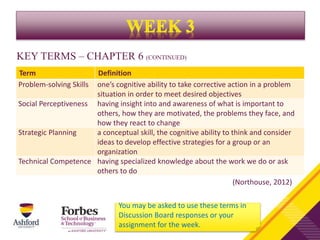
KEY TERMS – CHAPTER 6 (CONTINUED)
Term Definition
Problem-solving Skills one’s cognitive ability to take corrective action in a problem
situation in order to meet desired objectives
Social Perceptiveness having insight into and awareness of what is important to
others, how they are motivated, the problems they face, and
how they react to change
Strategic Planning a conceptual skill, the cognitive ability to think and consider
ideas to develop effective strategies for a group or an
organization
Technical Competence having specialized knowledge about the work we do or ask
others to do
You may be asked to use these terms in
Discussion Board responses or your
assignment for the week.
(Northouse, 2012)
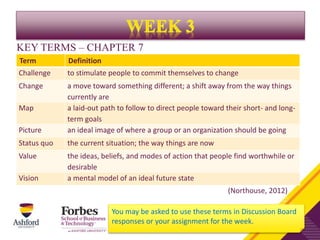
Term Definition
Challenge to stimulate people to commit themselves to change
Change a move toward something different; a shift away from the way things
currently are
Map a laid-out path to follow to direct people toward their short- and long-
term goals
Picture an ideal image of where a group or an organization should be going
Status quo the current situation; the way things are now
Value the ideas, beliefs, and modes of action that people find worthwhile or
desirable
Vision a mental model of an ideal future state
KEY TERMS – CHAPTER 7
You may be asked to use these terms in Discussion Board
responses or your assignment for the week.
(Northouse, 2012)
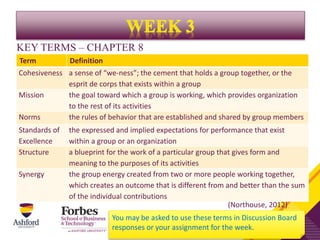
KEY TERMS – CHAPTER 8
You may be asked to use these terms in Discussion Board
responses or your assignment for the week.
Term Definition
Cohesiveness a sense of “we-ness”; the cement that holds a group together, or the
esprit de corps that exists within a group
Mission the goal toward which a group is working, which provides organization
to the rest of its activities
Norms the rules of behavior that are established and shared by group members
Standards of
Excellence
the expressed and implied expectations for performance that exist
within a group or an organization
Structure a blueprint for the work of a particular group that gives form and
meaning to the purposes of its activities
Synergy the group energy created from two or more people working together,
which creates an outcome that is different from and better than the sum
of the individual contributions
(Northouse, 2012)
REFERENCES
Northouse, P. G. (2018). Introduction to leadership: Concepts and practice.
Thousand Oaks, CA: Sage Publications, Inc.
RECOMMENDED READINGS
Chapter 6
Developing Leadership Skills
Valuable Resources
Motivating People
Technical Competence
How to Manage Conflict
Problem-Solving Story
RECOMMENDED READINGS
Chapter 7
Creating an Inspiring Vision
Understanding the Vision Challenge
Vision in Leadership
Inspiring Staff
Chapter 8
Positive Work Climate
Norms
Giving Great Feedback
RECOMMENDED VIEWINGS
Chapter 6
Recruiting and Retaining Employees
Strategic Planning
Coquese Washington
Chapter 7
How Great Leaders Inspire Action
Values-Based Leadership
Vision to Results
JFK Inaugural Speech
RECOMMENDED VIEWINGS (CONTINUED)
Chapter 8
Group Cohesion
Successful Groups
Performance Reviews
Meg Whitman
STILL HAVE QUESTIONS
ON ACADEMIC WRITING
OR APA FORMATTING?
https://awc.ashford.edu/Index.html
ANY
QUESTIONS?
Please
post your
questions
in the Ask
the
instructor
thread or
email me

Bus119 guidance wk 3

  • 1.
  • 2.
    BUS 119 –Principles of Personal & Organizational Leadership
  • 3.
    Overview – Suggestedand Required Actions for this week • Read Chapters 6, 7, & 8 in your text book • 2 Discussion Questions – Original Posts – Due by Thursday, 11:59 pm • Quiz – Due by Sunday, 11:59 pm • Respond to at least 2 classmates for each question – Due by Monday, 11:59 pm • Read requirements for final assignment due week 5 and begin research.
  • 4.
    Northouse, P. G.(2018). Introduction to leadership: Concepts and practice. Thousand Oaks, CA: Sage Publications, Inc. This textbook is a Constellation textbook
  • 5.
    This week studentswill 1. Distinguish the core leadership skills. 2. Assess the process of creating a vision. 3. Examine the relationship between effective leadership and productive work environments.
  • 6.
    Activity Due DateFormat Grading % Read Chapters 6, 7, & 8 Leadership Skills Day 3 (1st post) Discussion 2 Respond to at least 2 classmates’ posts Day 7 Discussion Part of 2 above Vision Day 3 (1st post) Discussion 2 Respond to at least 2 classmates’ posts Day 7 Discussion Part of 2 above Quiz Day 6 Quiz 8 Begin research for assignment 2 5 to 6 pages, APA 35
  • 7.
    LEADERSHIP SKILLS Chapter 6Leadership Skills – Consist of 3 Types Administrative Managing People Managing Resources Showing Technical Competence Conceptual Creating Visions Strategic Planning Problem Solving (Northouse, 2012)
  • 8.
    LEADERSHIP SKILLS Chapter 6Leadership Skills – Consist of 3 Types (continued) Interpersonal Skills Being Socially Perceptive Showing Emotional Intelligence Managing Interpersonal Conflict (Northouse, 2012)
  • 9.
    VISION Chapter 7 –Creating a Vision – 5 Characteristics A Picture - an ideal image of where a group or an organization should be going A Change - a move toward something different; a shift away from the way things currently are Values - the ideas, beliefs, and modes of action that people find worthwhile or desirable A Map - a laid-out path to follow to direct people toward their short- and long-term goals A Challenge - to stimulate people to commit themselves to change (Northouse, 2012)
  • 10.
    CONSTRUCTIVE CLIMATE Chapter 8– Constructive Climate The Leader Provides Structure Clarifies Norms Builds Cohesiveness Promotes Standards of Excellence (Northouse, 2012)
  • 11.
    KEY TERMS –CHAPTER 6 You may be asked to use these terms in Discussion Board responses or your assignment for the week. Term Definition Administrative Skills competencies a leader needs to run an organization in order to carry out the organization’s purposes and goals Conceptual Skills capabilities that involve working with concepts and ideas, the thinking or cognitive aspects of leadership Emotional Intelligence concerned with a person’s ability to understand his or her own and others’ emotions, and then to apply this understanding to life’s tasks; the ability to perceive and express emotions, to use emotions to facilitate thinking, to understand and reason with emotions, and to manage emotions effectively within oneself and in relationships with others Interpersonal Skills people skills; those abilities that help a leader to work effectively with subordinates, peers, and superiors to accomplish the organization’s goals (Northouse, 2012)
  • 12.
    KEY TERMS –CHAPTER 6 (CONTINUED) Term Definition Problem-solving Skills one’s cognitive ability to take corrective action in a problem situation in order to meet desired objectives Social Perceptiveness having insight into and awareness of what is important to others, how they are motivated, the problems they face, and how they react to change Strategic Planning a conceptual skill, the cognitive ability to think and consider ideas to develop effective strategies for a group or an organization Technical Competence having specialized knowledge about the work we do or ask others to do You may be asked to use these terms in Discussion Board responses or your assignment for the week. (Northouse, 2012)
  • 13.
    Term Definition Challenge tostimulate people to commit themselves to change Change a move toward something different; a shift away from the way things currently are Map a laid-out path to follow to direct people toward their short- and long- term goals Picture an ideal image of where a group or an organization should be going Status quo the current situation; the way things are now Value the ideas, beliefs, and modes of action that people find worthwhile or desirable Vision a mental model of an ideal future state KEY TERMS – CHAPTER 7 You may be asked to use these terms in Discussion Board responses or your assignment for the week. (Northouse, 2012)
  • 14.
    KEY TERMS –CHAPTER 8 You may be asked to use these terms in Discussion Board responses or your assignment for the week. Term Definition Cohesiveness a sense of “we-ness”; the cement that holds a group together, or the esprit de corps that exists within a group Mission the goal toward which a group is working, which provides organization to the rest of its activities Norms the rules of behavior that are established and shared by group members Standards of Excellence the expressed and implied expectations for performance that exist within a group or an organization Structure a blueprint for the work of a particular group that gives form and meaning to the purposes of its activities Synergy the group energy created from two or more people working together, which creates an outcome that is different from and better than the sum of the individual contributions (Northouse, 2012)
  • 15.
    REFERENCES Northouse, P. G.(2018). Introduction to leadership: Concepts and practice. Thousand Oaks, CA: Sage Publications, Inc.
  • 16.
    RECOMMENDED READINGS Chapter 6 DevelopingLeadership Skills Valuable Resources Motivating People Technical Competence How to Manage Conflict Problem-Solving Story
  • 17.
    RECOMMENDED READINGS Chapter 7 Creatingan Inspiring Vision Understanding the Vision Challenge Vision in Leadership Inspiring Staff Chapter 8 Positive Work Climate Norms Giving Great Feedback
  • 18.
    RECOMMENDED VIEWINGS Chapter 6 Recruitingand Retaining Employees Strategic Planning Coquese Washington Chapter 7 How Great Leaders Inspire Action Values-Based Leadership Vision to Results JFK Inaugural Speech
  • 19.
    RECOMMENDED VIEWINGS (CONTINUED) Chapter8 Group Cohesion Successful Groups Performance Reviews Meg Whitman
  • 20.
    STILL HAVE QUESTIONS ONACADEMIC WRITING OR APA FORMATTING? https://awc.ashford.edu/Index.html
  • 21.
    ANY QUESTIONS? Please post your questions in theAsk the instructor thread or email me