
METHOD AND MANNER 
OF LOG SAWING
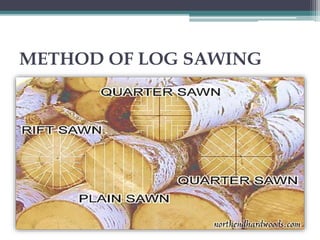
METHOD OF LOG SAWING
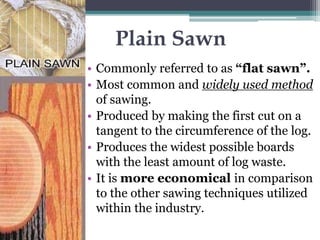
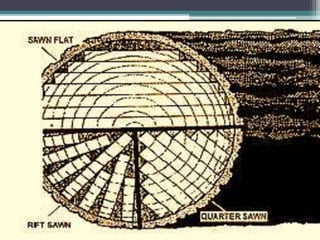
Plain Sawn 
• Commonly referred to as “flat sawn”. 
• Most common and widely used method 
of sawing. 
• Produced by making the first cut on a 
tangent to the circumference of the log. 
• Produces the widest possible boards 
with the least amount of log waste. 
• It is more economical in comparison 
to the other sawing techniques utilized 
within the industry.
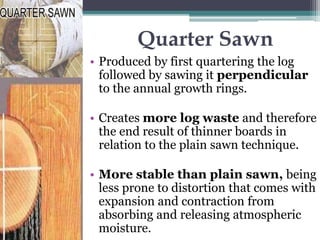
Quarter Sawn 
• Produced by first quartering the log 
followed by sawing it perpendicular 
to the annual growth rings. 
• Creates more log waste and therefore 
the end result of thinner boards in 
relation to the plain sawn technique. 
• More stable than plain sawn, being 
less prone to distortion that comes with 
expansion and contraction from 
absorbing and releasing atmospheric 
moisture.
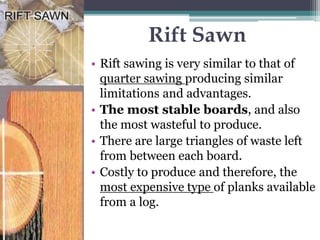
Rift Sawn 
• Rift sawing is very similar to that of 
quarter sawing producing similar 
limitations and advantages. 
• The most stable boards, and also 
the most wasteful to produce. 
• There are large triangles of waste left 
from between each board. 
• Costly to produce and therefore, the 
most expensive type of planks available 
from a log.
THE END

Method and manner

  • 1.
    METHOD AND MANNER OF LOG SAWING
  • 2.
  • 3.
    Plain Sawn •Commonly referred to as “flat sawn”. • Most common and widely used method of sawing. • Produced by making the first cut on a tangent to the circumference of the log. • Produces the widest possible boards with the least amount of log waste. • It is more economical in comparison to the other sawing techniques utilized within the industry.
  • 4.
    Quarter Sawn •Produced by first quartering the log followed by sawing it perpendicular to the annual growth rings. • Creates more log waste and therefore the end result of thinner boards in relation to the plain sawn technique. • More stable than plain sawn, being less prone to distortion that comes with expansion and contraction from absorbing and releasing atmospheric moisture.
  • 5.
    Rift Sawn •Rift sawing is very similar to that of quarter sawing producing similar limitations and advantages. • The most stable boards, and also the most wasteful to produce. • There are large triangles of waste left from between each board. • Costly to produce and therefore, the most expensive type of planks available from a log.
  • 7.