DEFINITION 
 The mechanical properties of wood are its 
fitness and ability to resist applied or 
external forces 
 The mechanical properties of wood 
considered are 
 (1) stiffness and elasticity, (2) tensile 
strength, (3) compressive or crushing 
strength, (4) shearing strength, (5) 
transverse or bending strength, (6) 
toughness, (7) hardness, (8) 
cleavability, (9) resilience.
STIFFNESS 
 
 The property by means of which a body acted upon by 
external forces tends to retain its natural size and shape, or 
resists deformation. 
 Thus a material that is difficult to bend or otherwise 
deform is stiff; one that is easily bent or otherwise 
deformed is flexible. Flexibility is not the exact counterpart 
of stiffness, as it also involves toughness and pliability.
TENSILE STRENGTH 
 
The tensile strength of wood parallel to the 
grain depends upon the strength of the fibers 
and is affected not only by the nature and 
dimensions of the wood elements but also by 
their arrangement.
COMPRESSIVE OR 
CRUSHING STRENGTH 
 
 Is very closely related to hardness and 
transverse shear. 
 There are two ways in which wood is 
subjected to stress of this kind, namely, (1) 
with the load acting over the entire area of 
the specimen, and (2) with a load 
concentrated over a portion of the area.
SHEARING STRENGTH 
 
 Whenever forces act upon a body in such a way that 
one portion tends to slide upon another adjacent to it 
the action is called a shear. In wood this shearing 
action may be (1) along the grain, or (2) across the 
grain.
TRANSVERSE OR BENDING 
STRENGTH: BEAMS 
 
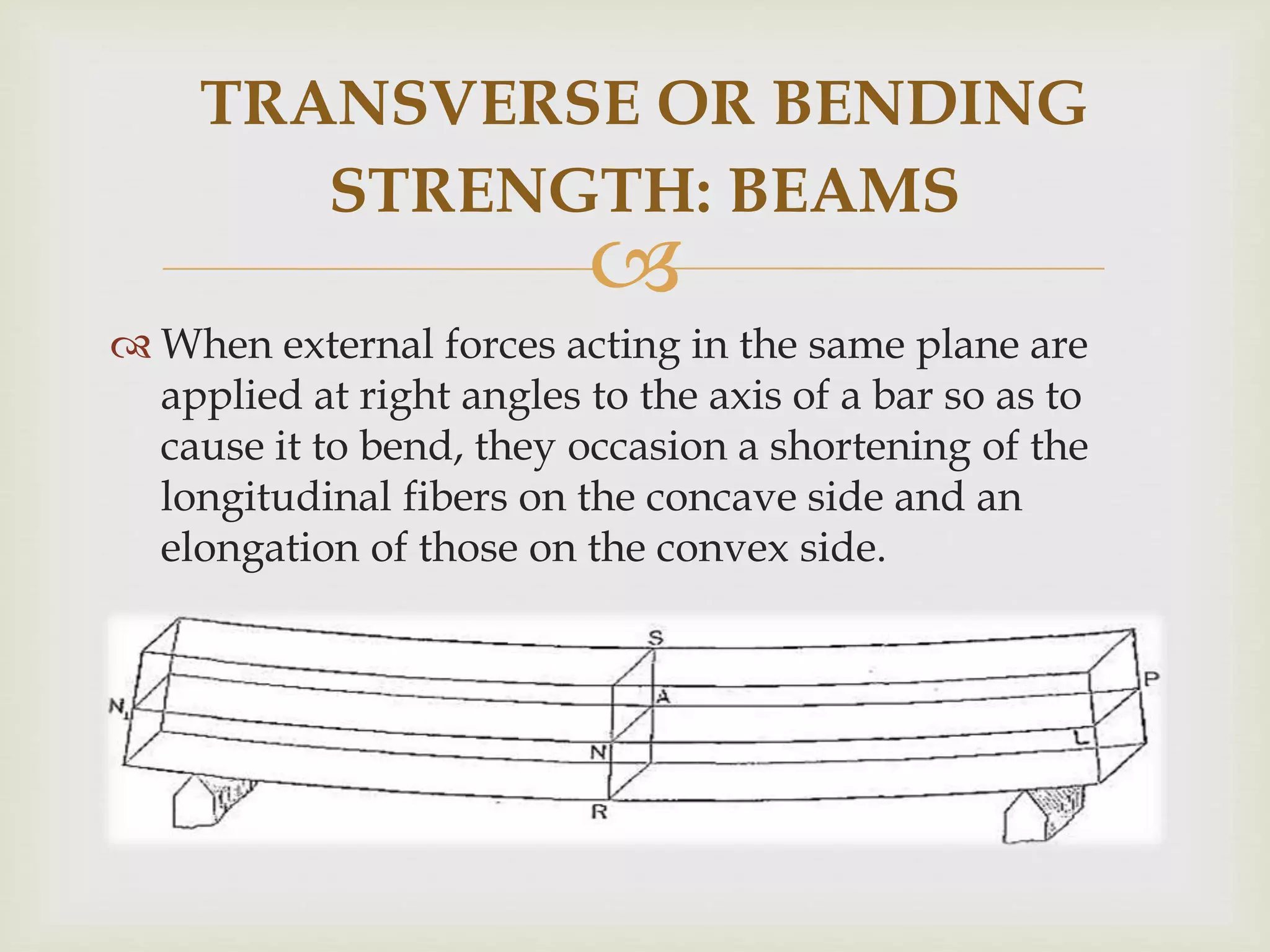
 When external forces acting in the same plane are 
applied at right angles to the axis of a bar so as to 
cause it to bend, they occasion a shortening of the 
longitudinal fibers on the concave side and an 
elongation of those on the convex side.
FAILURES IN BEAMS 
 (1) Simple tension, in which there is a direct pulling in two 
of the wood on the underside of the beam due to a tensile 
stress parallel to the grain 
 (2) Cross-grained tension, in which the fracture is caused 
by a tensile force acting oblique to the grain. This is a common 
form of failure where the beam has diagonal, spiral or other 
form of cross grain on its lower side. 
 (3) Splintering tension, in which the failure consists of a 
considerable number of slight tension failures, producing a 
ragged or splintery break on the under surface of the beam. 
This is common in tough woods.
 (4) Brittle tension, in which the beam fails by a clean break extending 
entirely through it. It is characteristic of a brittle wood which gives way 
suddenly without warning, like a piece of chalk. 
 (5) Compression failure has few variations except that it appears at 
various distances from the neutral plane of the beam. It is very common 
in green timbers. The compressive stress parallel to the fibers causes 
them to buckle or bend as in an endwise compressive test. 
 (6) Horizontal shear failure, in which the upper and lower portions of 
the beam slide along each other for a portion of their length either at one 
or at both ends is fairly common in air-dry material and in green material 
when the ratio of the height of the beam to the span is relatively large.
TOUGHNESS: 
TORSION 
 
 Wood that is difficult to split is said to be tough 
 Toughness includes flexibility and is the reverse of 
brittleness, in that tough woods break gradually and give 
warning of failure. 
 Toughness is dependent upon the strength, cohesion, 
quality, length, and arrangement of fiber, and the 
pliability of the wood
HARDNESS 
 
The term hardness is used in two senses, namely: 
(1) resistance to indentation, and (2) resistance to 
abrasion or scratching 
In the latter sense hardness combined with 
toughness is a measure of the wearing ability of 
wood and is an important consideration in the 
use of wood for floors, paving blocks, bearings, 
and rollers.
CLEAVABILITY 
 
 Cleavability is the term 
used to denote the facility 
with which wood is split. 
A splitting stress is one in 
which the forces act 
normally like a wedge.
RESILIENCE 
 
 Is the amount of work done upon a body in 
deforming it. Within the elastic limit it is also a 
measure of the potential energy stored in the 
material and represents the amount of work the 
material would do upon being released from a 
state of stress
Mechanical properties of wood

Mechanical properties of wood

  • 2.
    DEFINITION  Themechanical properties of wood are its fitness and ability to resist applied or external forces  The mechanical properties of wood considered are  (1) stiffness and elasticity, (2) tensile strength, (3) compressive or crushing strength, (4) shearing strength, (5) transverse or bending strength, (6) toughness, (7) hardness, (8) cleavability, (9) resilience.
  • 3.
    STIFFNESS  The property by means of which a body acted upon by external forces tends to retain its natural size and shape, or resists deformation.  Thus a material that is difficult to bend or otherwise deform is stiff; one that is easily bent or otherwise deformed is flexible. Flexibility is not the exact counterpart of stiffness, as it also involves toughness and pliability.
  • 4.
    TENSILE STRENGTH  The tensile strength of wood parallel to the grain depends upon the strength of the fibers and is affected not only by the nature and dimensions of the wood elements but also by their arrangement.
  • 5.
    COMPRESSIVE OR CRUSHINGSTRENGTH   Is very closely related to hardness and transverse shear.  There are two ways in which wood is subjected to stress of this kind, namely, (1) with the load acting over the entire area of the specimen, and (2) with a load concentrated over a portion of the area.
  • 6.
    SHEARING STRENGTH   Whenever forces act upon a body in such a way that one portion tends to slide upon another adjacent to it the action is called a shear. In wood this shearing action may be (1) along the grain, or (2) across the grain.
  • 7.
    TRANSVERSE OR BENDING STRENGTH: BEAMS   When external forces acting in the same plane are applied at right angles to the axis of a bar so as to cause it to bend, they occasion a shortening of the longitudinal fibers on the concave side and an elongation of those on the convex side.
  • 8.
    FAILURES IN BEAMS  (1) Simple tension, in which there is a direct pulling in two of the wood on the underside of the beam due to a tensile stress parallel to the grain  (2) Cross-grained tension, in which the fracture is caused by a tensile force acting oblique to the grain. This is a common form of failure where the beam has diagonal, spiral or other form of cross grain on its lower side.  (3) Splintering tension, in which the failure consists of a considerable number of slight tension failures, producing a ragged or splintery break on the under surface of the beam. This is common in tough woods.
  • 9.
     (4) Brittletension, in which the beam fails by a clean break extending entirely through it. It is characteristic of a brittle wood which gives way suddenly without warning, like a piece of chalk.  (5) Compression failure has few variations except that it appears at various distances from the neutral plane of the beam. It is very common in green timbers. The compressive stress parallel to the fibers causes them to buckle or bend as in an endwise compressive test.  (6) Horizontal shear failure, in which the upper and lower portions of the beam slide along each other for a portion of their length either at one or at both ends is fairly common in air-dry material and in green material when the ratio of the height of the beam to the span is relatively large.
  • 11.
    TOUGHNESS: TORSION   Wood that is difficult to split is said to be tough  Toughness includes flexibility and is the reverse of brittleness, in that tough woods break gradually and give warning of failure.  Toughness is dependent upon the strength, cohesion, quality, length, and arrangement of fiber, and the pliability of the wood
  • 12.
    HARDNESS  Theterm hardness is used in two senses, namely: (1) resistance to indentation, and (2) resistance to abrasion or scratching In the latter sense hardness combined with toughness is a measure of the wearing ability of wood and is an important consideration in the use of wood for floors, paving blocks, bearings, and rollers.
  • 13.
    CLEAVABILITY  Cleavability is the term used to denote the facility with which wood is split. A splitting stress is one in which the forces act normally like a wedge.
  • 14.
    RESILIENCE  Is the amount of work done upon a body in deforming it. Within the elastic limit it is also a measure of the potential energy stored in the material and represents the amount of work the material would do upon being released from a state of stress