AMPHIBIAN:
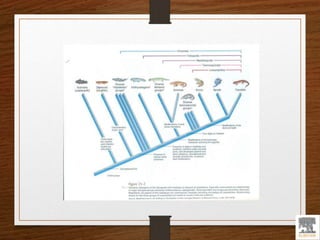
 Evolved from ancient sarcopterygians------great variety of
forms
 No knowledge about exact origin
 Structure of limbs, skulls, teeth suggest lchthyostega
 2- lineages
Amniotic Lineage:
 Late Devonian and early carboniferous. Roof and posterior portion of
the skull are attached to each other
 One lineage became extinct in the late carboniferous period
 Amniotic egg that resisted drying evolved in this group
 Descendants are reptiles birds + mammals
Nonamniotic lineage:
 Started into the Jurassic period
 Most become extinct after giving rise to three living orders caudate,
Anura and Gymnophiona
Order Caudata:
 Both pairs of legs, relatively un specialized
 115 of 350 sp. Of salamanders live in north America
 Live in moist forest floor bitter and have aquatic larval, caves, some
are fully terrestrial
 Some spend most of life in water and retain their cauded fins
 Few cm-----1.5m
 Japanese joint salamander (1.5m) Andras japonicas
 The largest north American salamander is hellbender crypto branches
alleganiexesis 65cn
 Most have internal fertilization, Male -----produces gelatinous pyramidal
spermatophore deposited on the substrate ---- picked by ------cap with
cloaca ----store in special pouch (speramatheca)
 Lays eggs ---pass cloaca ---- fertilization ---- larvae similar to adults but
smaller in size, either single clumps, strings,
 Larvae possess external gills, a tail fin, larval dentition, and a
rudimentary tongue.
 Aquatic larva metamorphosis ---- terrestrial adult
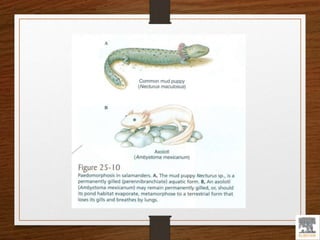
 Many salamanders --- incomplete metamorphosis --- paedomorphic
(Becoming sexually mature at larval)
Order Gymnophiona---Apoda: Caecilians 160sp
 Wormlike burrowers feed on worms and other invert in soil
 Look like segmented due to folds in skin
 Retractile tentacle between eyes and nostrils may transport chemicals from
environment to olfactory cells in the roof of the mouth
 Skin covers the eyes making them blind
 Internal fertilization
 Larval stages occur within the oviducts and they scrape the inner lining of
the oviducts with fetal teeth to feed miniature adults some lay eggs aquatic
larvae or embryos
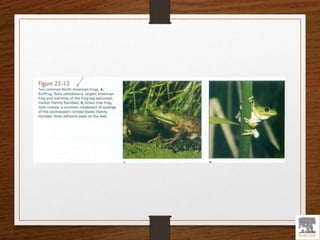
Order Anuara: or Salientia . Frog, toods without tail.
 3500 sp, moist environment, some at dry deserts adults lack tail, - caudal
vertebral fuse into a road like structure called urostyle
 Long hind limbs with muscles ending into web bed foot
 External fertilization
 Eggs and larvae are aquatic
 Larval stage is tadpole with tail, herbivorous having beaklike structure--
- metamorphoses adult toad dry worthy skin. Family bufonidae
Evolutionary Pressure:
Most divide their life between terrestrial and freshwater
External structure and locomotion:
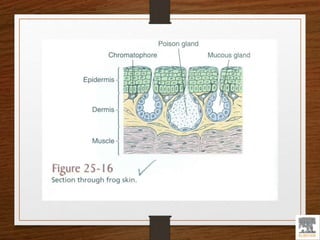
 Skin: protects against infective microorganisms, UV light, desiccation and
mechanical injury
 Functions in gas exchange, temperature regulations, absorption and water
storage
 Lacks scales, feathers or hair
 Highly glandular, secretions help in protection secretes sticky secretions
to help to cling O+ during mating
 Produces toxic chemicals against predators
 May be smooth or has warts, claws as a result of keratin deposits or
formation of hard bowery areas
 Chromatophores are specialized cells in the epidermis and dermis of skin
that are responsible for skin color and color changes
 Cryptic, aposematic coloration and mimicry are common in amphibians.
Support and Movement: (Modifications)
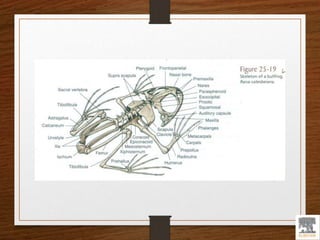
 Skeleton is modified to support against gravity and is strong to support
powerful muscles to propel across land
 Skull is flattened, smaller with few bony elements support then in water
 Changes in jaw structure and musculature help terrestrials to crush prey
 Vertebral column gives support and flexibility on land
Zygapophyses are supportive processes on each vertebra prevent
twisting
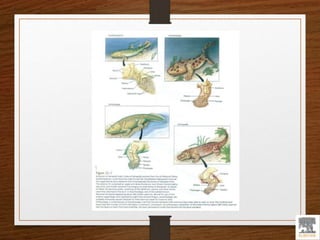
Cervical:
1st vertebra moves against back of skull
Sacral:
(Last) anchors pelvic girdle to vertebral column to provide increased
support
Sternum:
Sternum is ventral plate of bone present at anterior ventral trunk
region and supports forelimbs and internal organs reduced or absent
in anurans
 Joints at shoulder, hip, elbow, knee, wrist and ankle albow face
movement and better contact with substrate
 Pelvic gridle 3 bones ilium, ischium, pubis important for support on
land, absent in fishes
 Locomotion is through appendages than body wall which is reduced while
appendicular musculature predominates
 Salamanders more through undulatory wares passing along the body.
 Terrestrial salamanders move through limb + body movements (alternate
movement)
 Anurans jump with long hind limb
 Ilium extends anteriorly and attaches to pelvis
 These modifications make the posterior half strong and help them in
jumping.
Nutritive and Digestive System:
 Mostly carinivores, invert small mammals, birds and other anurans
 Lasvac are herbivorous, algae, plant Mather
 Use jaw and tongue to capture prey (Elip and Grabs)
 Tongue is attached at anterior margin of jaw and folds back over floor of
mouth
 Tongue has buckle and mucous glands secrete sticky secretions
 0.05 – 0.15 second – push to esophagus
 Eyes sink downward during swallowing and help force food towards
esophagus
Circulation and Gas Exchange:
 A remarkable adaption in circulatory system for 2 kinds of life
 Separation of pulmonary and systemic circuits is less efficient then long fish
 Atrium partially divided in uredines and completely in anurams
 Ventricle has no septum
 Spiral valve in consu arterious or ventral aorta second blood into pulmonary
and systemic circuits
 Blood entering heart’s right side is nearly as well oxygenated as blood
entering the heart from lungs
 When submerged, all gas exchange occurs across the skin and moist surface
making the blood with higher concentration of O2 entering into R-atrium
them blood retuning into left atrium after oxygenation from lungs
 Under these condtions, blood flow is reduced to lungs and conserve energy
 This adaptions is very advantageous for frogs and salamander for
overwintering in mud or blatom of pond
 Adult’s amphibians have fewer aortic arches then fishes.
Lymphatic system
 Returns fluids, proteins, ions filtered from capillaries in tissue space, back
to circulatory system,
 It transport H2O absorbed through skin
 Unlike others only amphibians have lymphatic hearts or contractile
vesicles which pump – fluid thought the lymphatic system.
Gas Exchange
 Terrestrials use less energy is gas exchange be air has 20times more O2
/ unit volume than H2O
 Skin is richly supplied with capillary beds and is mount helping
together in efficient gas exchange
Cutaneous respiration
 Gas exchange acros the skin may occur on land or in water
 This quality enables frog to spend winter in mud bottom
 In salamanders 30-90 % of gas exchange occurs across skin
Buecopharyneal Respiration
 Gas exchange also occurs across the moist surfaces of mouth and pharynx
1-7%
Pulmonary Ventilation
 Most possess lungs. Lungs of salamander are relatively simple sacs
 Lungs of anurans are subdivided increasing surface area for gas exchange
 Buccal pumps mechanism
 Muscles of mouth and pharynx create +ve foressure to force air into the
lungs
 1+2 = disadvantages = constant amount of gas exchanged and cant be
increased during metabolism
 Lungs compensate this foroblem and contribute to more gas exchange when
Temperature and activity is
 At 5ºc = ~ 70% by mouth + skin
 At 25 ºc = ~ 30% of the total by mouth + skin rest by lungs
External Gills
 Amphibian larvae and some adults respire using external gills
 Cartilaginous reds between pharyngeal slits support pair of gills during
embryonic stages
 During metamorphosis gills are reabsorbed pharyngeal slits are closed and
lungs become functional
Temperature Regulation
 Ectothermic (need external heat source to maintain body Temperature)
 Water absorbs heat as it is produced by amphibians
in H2O – body Temp = water temp
on land - = may different from environment
 Temperature regulation behavioral
 Coaling occurs after evaporative heat loss many are nocturnal – live in coal
burrows, under leaf bitter during hot day
 Basking: warming up by increasing body temperature 10 ºc above their body
temperature
 Common after having meal to increase metabolic reactions
 Fluctuation: Occurs in daily and seasonal environmental temperature show
wide range of temperature tolerance .e.g
Some salamanders = between – 2 to 27 ºc
Some anurans = between 3-41 ºc
Nervous and sensory functions:
 Similar to those of other vert
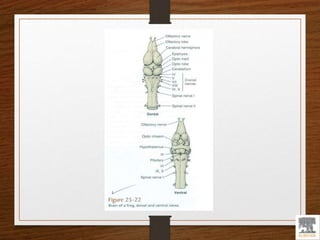
 Brain develops from 3 embryological subdivisions
1. Forbrain:-
Contain olfactory centers and regions to regulate 1 color change and II
visceral funtions
1. Midbrain:-
Contains a region called optic tectum that I assimilate sensory
information and II initiate motor responses
1. Hind Brain:-
Motor coordination – Regulation of heart rate Mechanism of
respiration
Sensory Receptors
 Many receptors are widely distributed over the skin
 Some are simple nerve endings to respond to heat, cold + pain
 The lateral line system is similar in structure to that of fishes and is present
in all aquatic larvae, aquatic adult salamanders and some adult anurans
 Lateral line receptors are distributed along lateral + dorsolateral side and
respond to low frequency vibrations in water and movement of water
relative to the animal
 In cures trials these receptors are less important
Chemoreception
 Important sense present in nasal epithelium and living of mouth , on
tongue and over skin
 Olfaction is used for mate recognition, detects chemicals and locating
food
Vision
 Modification in eyes in terrestrials
 In anurans, salamanders eyes are present on front of head providing
binocular vision and well developed perception necessary for capturing
prey
 Some salamanders have small lateral eyes and lack binocular vision
 Lower eyelid is movable and cleans and protects eyes
 Transparent part is nictitating membrane
 When eyeball ---- Retracts into orbit of skull ___ N.M cover corn and a
fold of epithelium It is surrounds it
 Iris can dilate or constrict to the size of pupil
 Focusing involves bending (Refracting) light rays to a focal point on the
retina
 Light waves moving form air across the cornea are refract because of change
in density between 2 media
 Lens provides further refrection.
 At rest eye focuses on distant objects
 Protractor Lentismuscles move lens forward to focus on the near objects
 Reds and cones are in retina
 Cones Colorvision, distinguish how different wavelengthsof light with
unknown extent
 Complex interconnection b/w Neurons and Retina- and Can distinguish b/w
flying Prey and shadow
Auditory System:
 This system is a clear adaptation to life on land
 Transmit sulestrate borne vibrations and airline vibration
 Tympanic membrane, Middle ear, Inner ear
 -TM is or piece of integument stretched over a cartilaginous ring that
receives airborne vibrations and transmit them to middle ear which is a
chamber under T.M.
 TM is Middle ear ossicle (Bone) called stapes (columella)
 which transmits vibrations of T.M into inner ear
 High frequency airborne vibrations are transmitted to inner ear through T.M.
 Low frequency substrate borne vibrations are transmitted to through front
appendages and Pectoral Girdle to the inner ear through a second ossicle
called operculum
 Muscles attached to operculum and Stapes can lock either or both of these
ossicles allowing to screen out the (in or out) frequency sounds to use
them according to need.
 Mating calls are frequency sounds warn about predator
 Salamander Lack T.M and Middle ear they have mating calls and can hear
only frequency Sounds.
 Inner ear has semicircular canals to detect Rotational movements, respond
gravity. etc
Excretion and Osmoregulation:
 Kidneys lie on either side dorsal aorta on dorsal wall the body cavity. → Duct
Cloaca, Urinary bladder
 Either Ammonia or Urea.
 Freshwater - Ammonia & No energy is used in →→ converting Other
Products
 Toxic effects → → b/c of immediate diffusion in mater
 Terrestrials → Urea Less toxic than Ammonia. Can be stored urine bladder
 Some com excrete mm. when in H₂0 and Urea on land." Osmoregulation is
the main problem. They must release
 excess of water and conserve essential cons
 Large amount of Hypotonic Urine
 Limit water loss by behavior that reduce exposure to dessicating conditions
 Many are nocturnal. During day they move to humid areas
 Diurnals live in high humid, and rehydrate by entering water
 Many reduce water loss by reducing amount of body surface exposed to air e.g
curling of closely packed aggregations.
 Some have protective coverings
 Hardened regions of skin are resistant to water loss and are used to play
entrances to burrows or other openings to maintain high humidity
 Some form Cocoons that encase body during long periods of dormancy, formed
from outer layer of skin having opening near mouth, can reduce water loss up to
20-50%
 Skin is the most important source water loss and Rehydration
 On moist surface Flatter body Ventral Pelvic Region →→ absorbs
 Skin's Permeability + Vascularization + Epidermal sculpturing
 Amphibians can store water Urinary bladder and Lymph sacs can be reabsorbed
to replace evaporative
 Amphibians living in dry environments can store water white 35% of the total
body weight
Reproduction, Development and Metamorphosis:
 Dioecious Ovaries, Testes located near body wall
 Ext. Fertilization, life of absence of protective covering around egg
development occurs et moist habitats
 Some develop & terrestrial Nests Kept moist
 In come, larval stages are passed in egg membranes and the mature hatch
into adult like body except Salamander.
 Only 10% of all salamander have ext. fertility rest produce
spermatophors for internal fertilization and eggs are deposited in soil
water & retain in oviduct during development
 All Caecilians have internal fertilization and among them only 75% have
internal development:b
 Tadpole Larva different mode of respiration, form of locomotion and diet
from adult Reduce competetion life them
 Interactions life internal control + Extrinsic factors determine the timing of
reproductive activities.
 In Temperate regions Temp. breeding, breeding periods. seasonal occurring
in spring & Summer
 Iu Tropical Regions Rainy season are breeding potential +
Courtship Behavior
 locate breeding sites + identify mates +foreparation for reproduction and
fertilization and deposition of fertilized eggs for successful development
Salamanders and mating.
 rely on olfactory + visual cues in courtship and mating
 Anurans vocalization by + Tactile cues
 Many sp. + in one location during breeding activity
 Vocalizations are species specific and function in initial attraction and contact
b/w mates Tactile cues become more strong important. Amplexus Positioning
of or dorsal to Grasping with his for climbs arount her west for 1-24 hrs sperms
+ eggs.
 Caecilians A little knowledge about breeding behavin -Internal fortilization.
Compulatory organ (modification of cloacal wall)
 Vocalization Sound production is reproductive function of of ancirans
 Advertisement calls species specific rattrad & to breeding area & announce
other of that the given area is occupied
 respond by reciprocation calls to give consant
 Release calls by or means indication of by dicapability "
 Distress calls in response to Pain, beny seized predator. Loud calls Predator
release the frog
Sound Production Apparatus
 Larynx + Vocal Cords
 Larynx swell developed in 8, also possess vocal sac developed from
lining luccal cavity as diverticulum.
 Lungs → Force air over vocal cords and cartilages of → Vilration
 Muscles-control vituration of vocal cords + regulate frequency
 Vocal & sacs act as resonating structures and increase the volume of
sound
 Use of sound to attract mates is useful in organisms living in dispersed
habitats.
 Vocalizations help to reduce Chaos Parental Care:
Parental care
 ↑ chances of development. Energy expenditure,
 Energy expenditure Clutch cored by any one Parent
 External Fest aeration of eggs, cleaning & moistening of eggs protection
from Predators removal of dead and infected
Transportation of Eggs
 May be transported on back
 Some brood tadpoles in their stomach and young’s emerge from mouth
(either young’s developed or swallowed)
 During brooding Q's stomach expanded to fill most of her body cavity and
stomach stops producing digestive secretions
 viviparity and ovoviviparity occurs in Salamanders and caecilians.
Metamorphosis
 Crowding & Food availability determine the duration
 Neurosecretions of hypothalamus, hormones of anterior love of pituitary
gland (Adeno hypophysis), and thyroid gland Control metamorphosis
 Morphological changes in Caecilians Salamander Miner Gills + Candal Fin
lost, Reproductive structures develop.
 From Tadpole - Frog are more dramatic - lost, Limbs + Longs Develop
Skin Thickens Hand + Digestive tract occurs.
Paedomorphosis
 Salamanders fail to respond to thyroid hormones + Fact to produce
hormones associated with metamor, In some sala it is a rule, while in some
it is variable and dependent on environ.

Amphibians.ppt lecture.ppt

  • 4.
    AMPHIBIAN:  Evolved fromancient sarcopterygians------great variety of forms  No knowledge about exact origin  Structure of limbs, skulls, teeth suggest lchthyostega  2- lineages
  • 5.
    Amniotic Lineage:  LateDevonian and early carboniferous. Roof and posterior portion of the skull are attached to each other  One lineage became extinct in the late carboniferous period  Amniotic egg that resisted drying evolved in this group  Descendants are reptiles birds + mammals
  • 6.
    Nonamniotic lineage:  Startedinto the Jurassic period  Most become extinct after giving rise to three living orders caudate, Anura and Gymnophiona
  • 7.
    Order Caudata:  Bothpairs of legs, relatively un specialized  115 of 350 sp. Of salamanders live in north America  Live in moist forest floor bitter and have aquatic larval, caves, some are fully terrestrial  Some spend most of life in water and retain their cauded fins  Few cm-----1.5m  Japanese joint salamander (1.5m) Andras japonicas  The largest north American salamander is hellbender crypto branches alleganiexesis 65cn
  • 8.
     Most haveinternal fertilization, Male -----produces gelatinous pyramidal spermatophore deposited on the substrate ---- picked by ------cap with cloaca ----store in special pouch (speramatheca)  Lays eggs ---pass cloaca ---- fertilization ---- larvae similar to adults but smaller in size, either single clumps, strings,  Larvae possess external gills, a tail fin, larval dentition, and a rudimentary tongue.  Aquatic larva metamorphosis ---- terrestrial adult  Many salamanders --- incomplete metamorphosis --- paedomorphic (Becoming sexually mature at larval)
  • 9.
    Order Gymnophiona---Apoda: Caecilians160sp  Wormlike burrowers feed on worms and other invert in soil  Look like segmented due to folds in skin  Retractile tentacle between eyes and nostrils may transport chemicals from environment to olfactory cells in the roof of the mouth  Skin covers the eyes making them blind  Internal fertilization  Larval stages occur within the oviducts and they scrape the inner lining of the oviducts with fetal teeth to feed miniature adults some lay eggs aquatic larvae or embryos
  • 10.
    Order Anuara: orSalientia . Frog, toods without tail.  3500 sp, moist environment, some at dry deserts adults lack tail, - caudal vertebral fuse into a road like structure called urostyle  Long hind limbs with muscles ending into web bed foot  External fertilization  Eggs and larvae are aquatic  Larval stage is tadpole with tail, herbivorous having beaklike structure-- - metamorphoses adult toad dry worthy skin. Family bufonidae Evolutionary Pressure: Most divide their life between terrestrial and freshwater
  • 11.
    External structure andlocomotion:  Skin: protects against infective microorganisms, UV light, desiccation and mechanical injury  Functions in gas exchange, temperature regulations, absorption and water storage  Lacks scales, feathers or hair  Highly glandular, secretions help in protection secretes sticky secretions to help to cling O+ during mating
  • 12.
     Produces toxicchemicals against predators  May be smooth or has warts, claws as a result of keratin deposits or formation of hard bowery areas  Chromatophores are specialized cells in the epidermis and dermis of skin that are responsible for skin color and color changes  Cryptic, aposematic coloration and mimicry are common in amphibians.
  • 13.
    Support and Movement:(Modifications)  Skeleton is modified to support against gravity and is strong to support powerful muscles to propel across land  Skull is flattened, smaller with few bony elements support then in water  Changes in jaw structure and musculature help terrestrials to crush prey  Vertebral column gives support and flexibility on land Zygapophyses are supportive processes on each vertebra prevent twisting
  • 14.
    Cervical: 1st vertebra movesagainst back of skull Sacral: (Last) anchors pelvic girdle to vertebral column to provide increased support Sternum: Sternum is ventral plate of bone present at anterior ventral trunk region and supports forelimbs and internal organs reduced or absent in anurans  Joints at shoulder, hip, elbow, knee, wrist and ankle albow face movement and better contact with substrate  Pelvic gridle 3 bones ilium, ischium, pubis important for support on land, absent in fishes
  • 15.
     Locomotion isthrough appendages than body wall which is reduced while appendicular musculature predominates  Salamanders more through undulatory wares passing along the body.  Terrestrial salamanders move through limb + body movements (alternate movement)  Anurans jump with long hind limb  Ilium extends anteriorly and attaches to pelvis  These modifications make the posterior half strong and help them in jumping.
  • 16.
    Nutritive and DigestiveSystem:  Mostly carinivores, invert small mammals, birds and other anurans  Lasvac are herbivorous, algae, plant Mather  Use jaw and tongue to capture prey (Elip and Grabs)  Tongue is attached at anterior margin of jaw and folds back over floor of mouth  Tongue has buckle and mucous glands secrete sticky secretions  0.05 – 0.15 second – push to esophagus  Eyes sink downward during swallowing and help force food towards esophagus
  • 17.
    Circulation and GasExchange:  A remarkable adaption in circulatory system for 2 kinds of life  Separation of pulmonary and systemic circuits is less efficient then long fish  Atrium partially divided in uredines and completely in anurams  Ventricle has no septum  Spiral valve in consu arterious or ventral aorta second blood into pulmonary and systemic circuits  Blood entering heart’s right side is nearly as well oxygenated as blood entering the heart from lungs  When submerged, all gas exchange occurs across the skin and moist surface making the blood with higher concentration of O2 entering into R-atrium them blood retuning into left atrium after oxygenation from lungs  Under these condtions, blood flow is reduced to lungs and conserve energy  This adaptions is very advantageous for frogs and salamander for overwintering in mud or blatom of pond  Adult’s amphibians have fewer aortic arches then fishes.
  • 18.
    Lymphatic system  Returnsfluids, proteins, ions filtered from capillaries in tissue space, back to circulatory system,  It transport H2O absorbed through skin  Unlike others only amphibians have lymphatic hearts or contractile vesicles which pump – fluid thought the lymphatic system.
  • 36.
    Gas Exchange  Terrestrialsuse less energy is gas exchange be air has 20times more O2 / unit volume than H2O  Skin is richly supplied with capillary beds and is mount helping together in efficient gas exchange
  • 37.
    Cutaneous respiration  Gasexchange acros the skin may occur on land or in water  This quality enables frog to spend winter in mud bottom  In salamanders 30-90 % of gas exchange occurs across skin Buecopharyneal Respiration  Gas exchange also occurs across the moist surfaces of mouth and pharynx 1-7%
  • 38.
    Pulmonary Ventilation  Mostpossess lungs. Lungs of salamander are relatively simple sacs  Lungs of anurans are subdivided increasing surface area for gas exchange  Buccal pumps mechanism  Muscles of mouth and pharynx create +ve foressure to force air into the lungs  1+2 = disadvantages = constant amount of gas exchanged and cant be increased during metabolism  Lungs compensate this foroblem and contribute to more gas exchange when Temperature and activity is  At 5ºc = ~ 70% by mouth + skin  At 25 ºc = ~ 30% of the total by mouth + skin rest by lungs
  • 39.
    External Gills  Amphibianlarvae and some adults respire using external gills  Cartilaginous reds between pharyngeal slits support pair of gills during embryonic stages  During metamorphosis gills are reabsorbed pharyngeal slits are closed and lungs become functional
  • 40.
    Temperature Regulation  Ectothermic(need external heat source to maintain body Temperature)  Water absorbs heat as it is produced by amphibians in H2O – body Temp = water temp on land - = may different from environment  Temperature regulation behavioral  Coaling occurs after evaporative heat loss many are nocturnal – live in coal burrows, under leaf bitter during hot day  Basking: warming up by increasing body temperature 10 ºc above their body temperature  Common after having meal to increase metabolic reactions  Fluctuation: Occurs in daily and seasonal environmental temperature show wide range of temperature tolerance .e.g Some salamanders = between – 2 to 27 ºc Some anurans = between 3-41 ºc
  • 41.
    Nervous and sensoryfunctions:  Similar to those of other vert  Brain develops from 3 embryological subdivisions 1. Forbrain:- Contain olfactory centers and regions to regulate 1 color change and II visceral funtions 1. Midbrain:- Contains a region called optic tectum that I assimilate sensory information and II initiate motor responses 1. Hind Brain:- Motor coordination – Regulation of heart rate Mechanism of respiration
  • 42.
    Sensory Receptors  Manyreceptors are widely distributed over the skin  Some are simple nerve endings to respond to heat, cold + pain  The lateral line system is similar in structure to that of fishes and is present in all aquatic larvae, aquatic adult salamanders and some adult anurans  Lateral line receptors are distributed along lateral + dorsolateral side and respond to low frequency vibrations in water and movement of water relative to the animal  In cures trials these receptors are less important
  • 43.
    Chemoreception  Important sensepresent in nasal epithelium and living of mouth , on tongue and over skin  Olfaction is used for mate recognition, detects chemicals and locating food
  • 44.
    Vision  Modification ineyes in terrestrials  In anurans, salamanders eyes are present on front of head providing binocular vision and well developed perception necessary for capturing prey  Some salamanders have small lateral eyes and lack binocular vision  Lower eyelid is movable and cleans and protects eyes  Transparent part is nictitating membrane  When eyeball ---- Retracts into orbit of skull ___ N.M cover corn and a fold of epithelium It is surrounds it
  • 45.
     Iris candilate or constrict to the size of pupil  Focusing involves bending (Refracting) light rays to a focal point on the retina  Light waves moving form air across the cornea are refract because of change in density between 2 media  Lens provides further refrection.  At rest eye focuses on distant objects  Protractor Lentismuscles move lens forward to focus on the near objects  Reds and cones are in retina  Cones Colorvision, distinguish how different wavelengthsof light with unknown extent  Complex interconnection b/w Neurons and Retina- and Can distinguish b/w flying Prey and shadow
  • 46.
    Auditory System:  Thissystem is a clear adaptation to life on land  Transmit sulestrate borne vibrations and airline vibration  Tympanic membrane, Middle ear, Inner ear  -TM is or piece of integument stretched over a cartilaginous ring that receives airborne vibrations and transmit them to middle ear which is a chamber under T.M.  TM is Middle ear ossicle (Bone) called stapes (columella)  which transmits vibrations of T.M into inner ear  High frequency airborne vibrations are transmitted to inner ear through T.M.  Low frequency substrate borne vibrations are transmitted to through front appendages and Pectoral Girdle to the inner ear through a second ossicle called operculum
  • 47.
     Muscles attachedto operculum and Stapes can lock either or both of these ossicles allowing to screen out the (in or out) frequency sounds to use them according to need.  Mating calls are frequency sounds warn about predator  Salamander Lack T.M and Middle ear they have mating calls and can hear only frequency Sounds.  Inner ear has semicircular canals to detect Rotational movements, respond gravity. etc
  • 48.
    Excretion and Osmoregulation: Kidneys lie on either side dorsal aorta on dorsal wall the body cavity. → Duct Cloaca, Urinary bladder  Either Ammonia or Urea.  Freshwater - Ammonia & No energy is used in →→ converting Other Products  Toxic effects → → b/c of immediate diffusion in mater  Terrestrials → Urea Less toxic than Ammonia. Can be stored urine bladder  Some com excrete mm. when in H₂0 and Urea on land." Osmoregulation is the main problem. They must release  excess of water and conserve essential cons  Large amount of Hypotonic Urine  Limit water loss by behavior that reduce exposure to dessicating conditions  Many are nocturnal. During day they move to humid areas  Diurnals live in high humid, and rehydrate by entering water
  • 49.
     Many reducewater loss by reducing amount of body surface exposed to air e.g curling of closely packed aggregations.  Some have protective coverings  Hardened regions of skin are resistant to water loss and are used to play entrances to burrows or other openings to maintain high humidity  Some form Cocoons that encase body during long periods of dormancy, formed from outer layer of skin having opening near mouth, can reduce water loss up to 20-50%  Skin is the most important source water loss and Rehydration  On moist surface Flatter body Ventral Pelvic Region →→ absorbs  Skin's Permeability + Vascularization + Epidermal sculpturing  Amphibians can store water Urinary bladder and Lymph sacs can be reabsorbed to replace evaporative  Amphibians living in dry environments can store water white 35% of the total body weight
  • 50.
    Reproduction, Development andMetamorphosis:  Dioecious Ovaries, Testes located near body wall  Ext. Fertilization, life of absence of protective covering around egg development occurs et moist habitats  Some develop & terrestrial Nests Kept moist  In come, larval stages are passed in egg membranes and the mature hatch into adult like body except Salamander.  Only 10% of all salamander have ext. fertility rest produce spermatophors for internal fertilization and eggs are deposited in soil water & retain in oviduct during development
  • 51.
     All Caecilianshave internal fertilization and among them only 75% have internal development:b  Tadpole Larva different mode of respiration, form of locomotion and diet from adult Reduce competetion life them  Interactions life internal control + Extrinsic factors determine the timing of reproductive activities.  In Temperate regions Temp. breeding, breeding periods. seasonal occurring in spring & Summer  Iu Tropical Regions Rainy season are breeding potential +
  • 52.
    Courtship Behavior  locatebreeding sites + identify mates +foreparation for reproduction and fertilization and deposition of fertilized eggs for successful development Salamanders and mating.  rely on olfactory + visual cues in courtship and mating  Anurans vocalization by + Tactile cues  Many sp. + in one location during breeding activity  Vocalizations are species specific and function in initial attraction and contact b/w mates Tactile cues become more strong important. Amplexus Positioning of or dorsal to Grasping with his for climbs arount her west for 1-24 hrs sperms + eggs.  Caecilians A little knowledge about breeding behavin -Internal fortilization. Compulatory organ (modification of cloacal wall)  Vocalization Sound production is reproductive function of of ancirans  Advertisement calls species specific rattrad & to breeding area & announce other of that the given area is occupied  respond by reciprocation calls to give consant  Release calls by or means indication of by dicapability "  Distress calls in response to Pain, beny seized predator. Loud calls Predator release the frog
  • 53.
    Sound Production Apparatus Larynx + Vocal Cords  Larynx swell developed in 8, also possess vocal sac developed from lining luccal cavity as diverticulum.  Lungs → Force air over vocal cords and cartilages of → Vilration  Muscles-control vituration of vocal cords + regulate frequency  Vocal & sacs act as resonating structures and increase the volume of sound  Use of sound to attract mates is useful in organisms living in dispersed habitats.  Vocalizations help to reduce Chaos Parental Care:
  • 54.
    Parental care  ↑chances of development. Energy expenditure,  Energy expenditure Clutch cored by any one Parent  External Fest aeration of eggs, cleaning & moistening of eggs protection from Predators removal of dead and infected
  • 55.
    Transportation of Eggs May be transported on back  Some brood tadpoles in their stomach and young’s emerge from mouth (either young’s developed or swallowed)  During brooding Q's stomach expanded to fill most of her body cavity and stomach stops producing digestive secretions  viviparity and ovoviviparity occurs in Salamanders and caecilians.
  • 56.
    Metamorphosis  Crowding &Food availability determine the duration  Neurosecretions of hypothalamus, hormones of anterior love of pituitary gland (Adeno hypophysis), and thyroid gland Control metamorphosis  Morphological changes in Caecilians Salamander Miner Gills + Candal Fin lost, Reproductive structures develop.  From Tadpole - Frog are more dramatic - lost, Limbs + Longs Develop Skin Thickens Hand + Digestive tract occurs. Paedomorphosis  Salamanders fail to respond to thyroid hormones + Fact to produce hormones associated with metamor, In some sala it is a rule, while in some it is variable and dependent on environ.