Embryonic Induction
Induction is the process by which one group
of cells produces a signal that determines the
fate of a second group of cells.
This implies both the capacity to produce a
signal by the inducing cells and the
competence of the responding cells to receive
and interpret the signal via a signal
transduction pathway.
Amphibians are the most extensively studied
vertebrates for investigations into embryonic
induction.
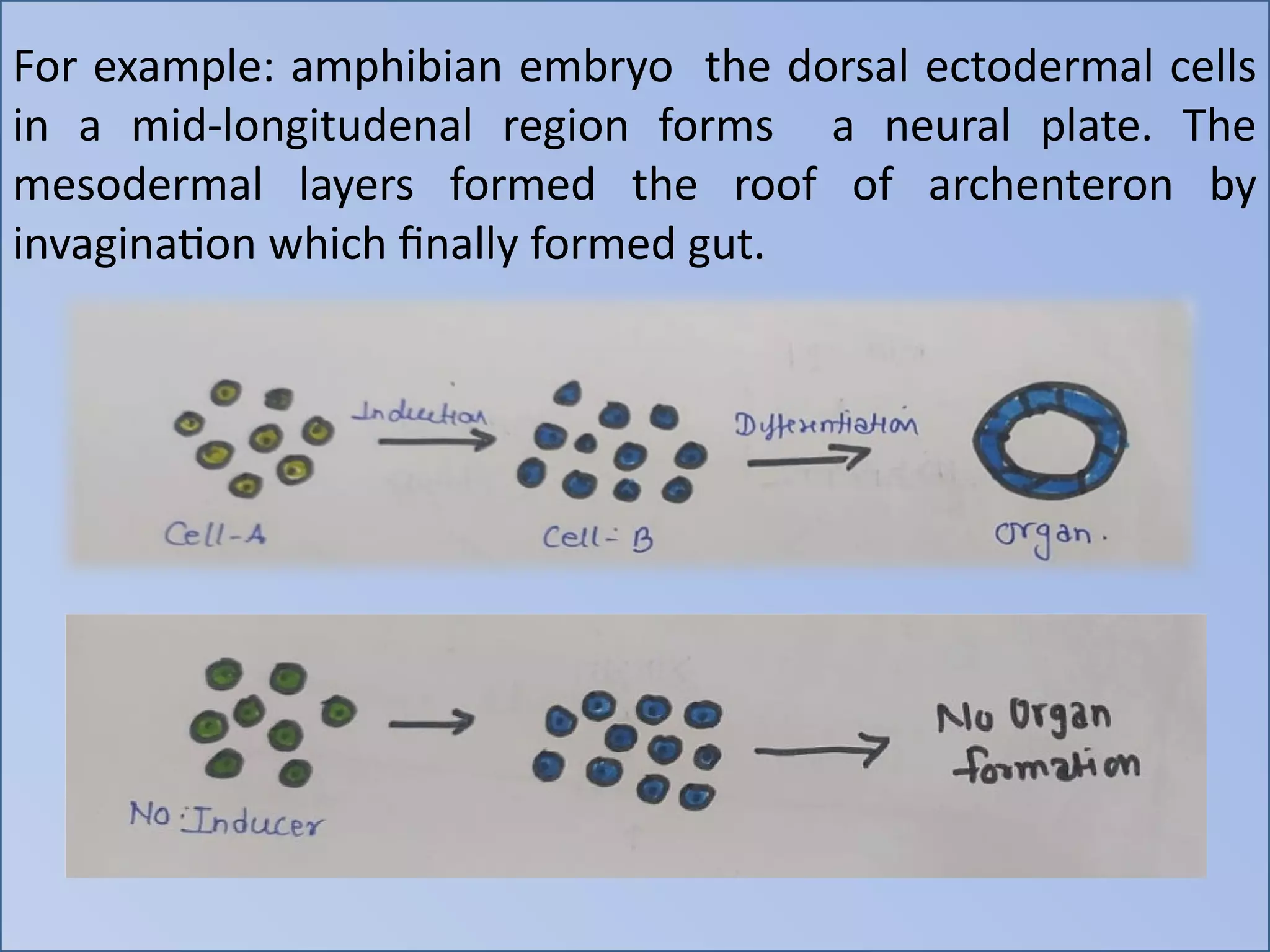
For example: amphibian embryo the dorsal ectodermal cells
in a mid-longitudenal region forms a neural plate. The
mesodermal layers formed the roof of archenteron by
invagination which finally formed gut.
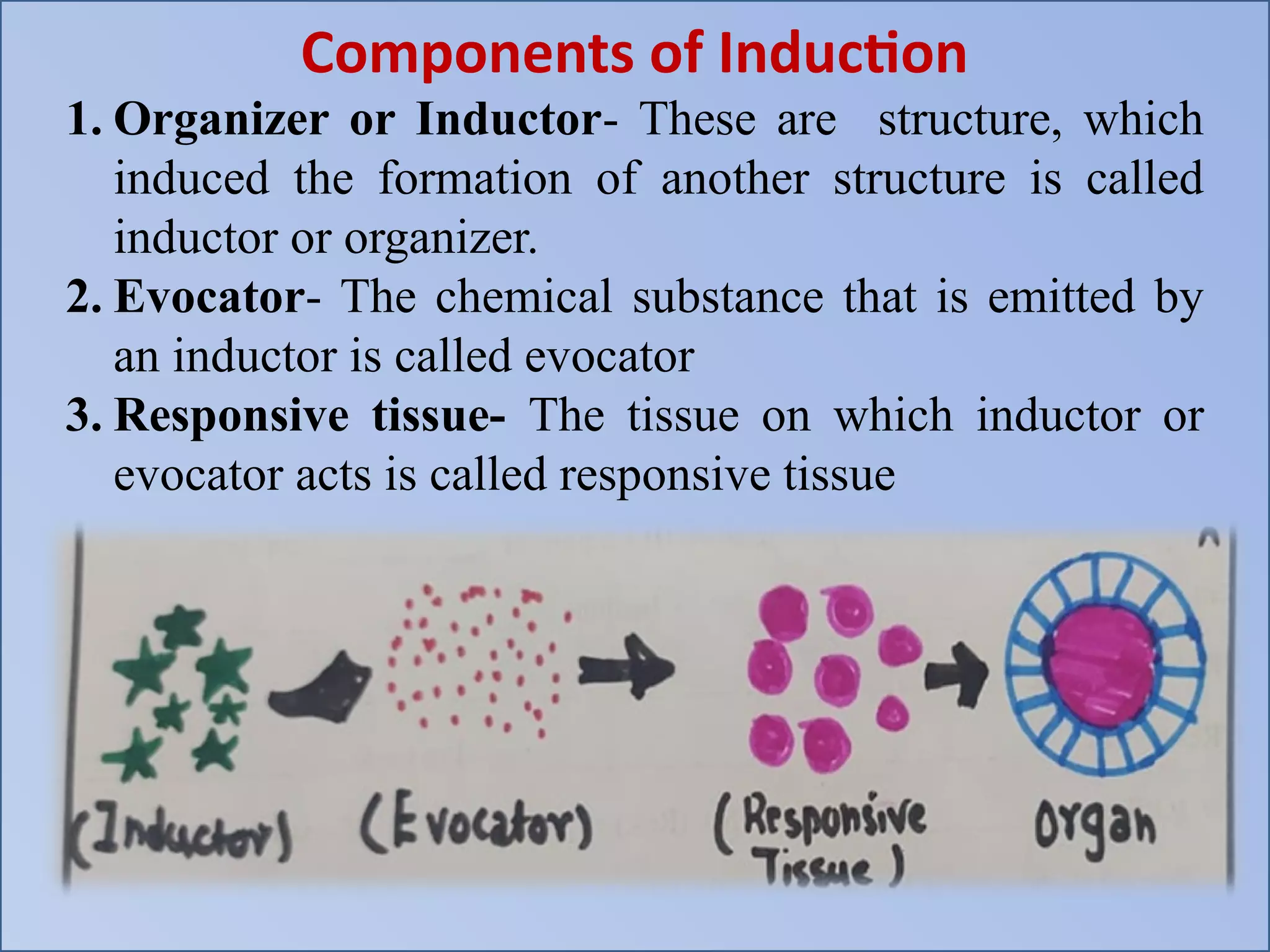
Components of Induction
1. Organizer or Inductor- These are structure, which
induced the formation of another structure is called
inductor or organizer.
2. Evocator- The chemical substance that is emitted by
an inductor is called evocator
3. Responsive tissue- The tissue on which inductor or
evocator acts is called responsive tissue
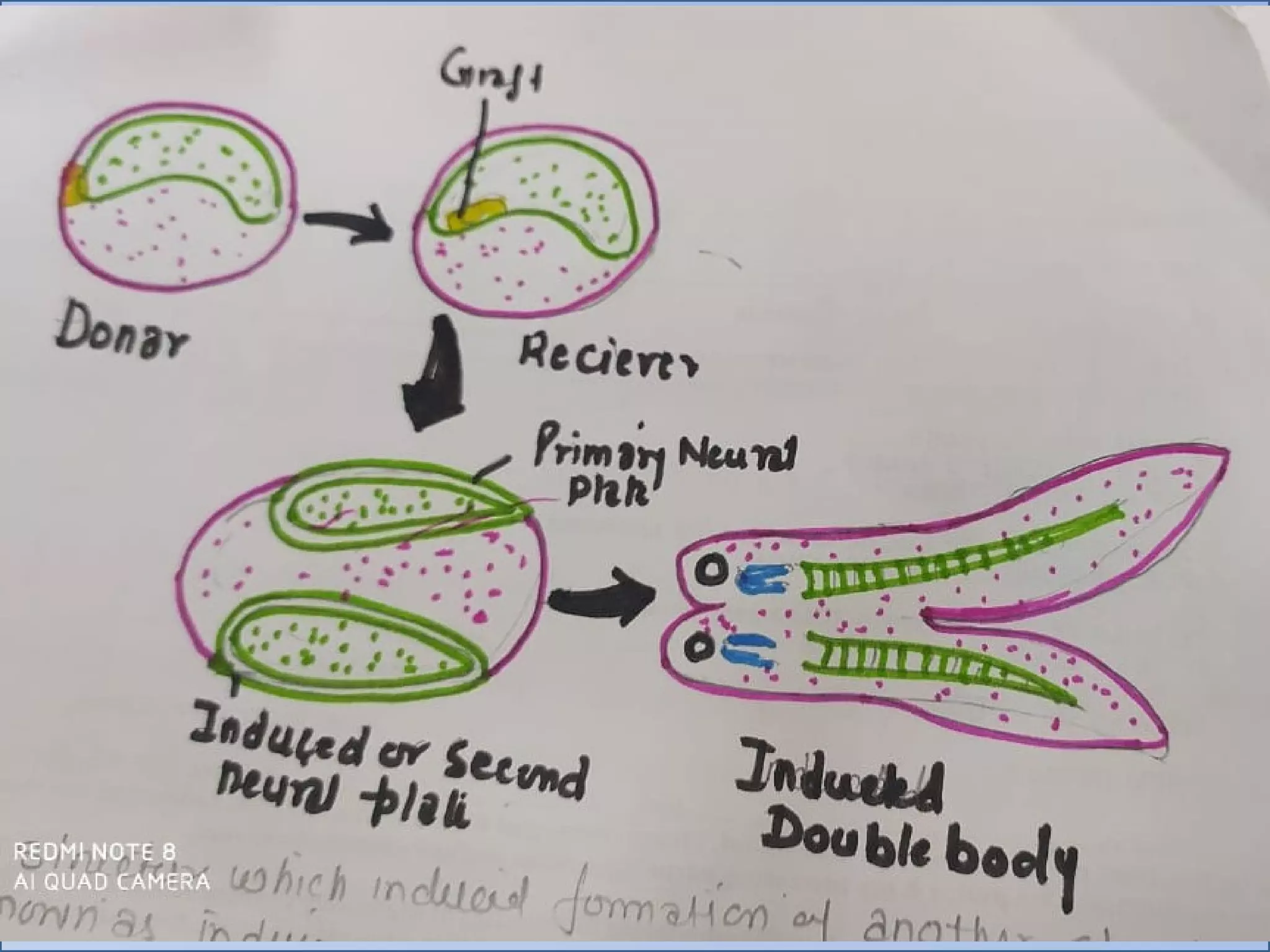
Mangold(1927). Organization of a secondary axis by dorsal
blastopore lip tissue.
(A) Dorsal lip tissue from an early gastrula is transplanted into
another early gastrula in the region that normally becomes
ventral epidermis.
(B) The donor tissue invaginates and forms a second
archenteron, and then a second embryonic axis.
(C)Both donor and host tissues are seen in the new neural tube,
notochord, and somites.
(D) Eventually, a second embryo forms that is joined to the host.
(E) Structure of the dorsal blastopore lip region in an
early Xenopus gastrula.
•One of the embryo was regular
•Another was the induced one
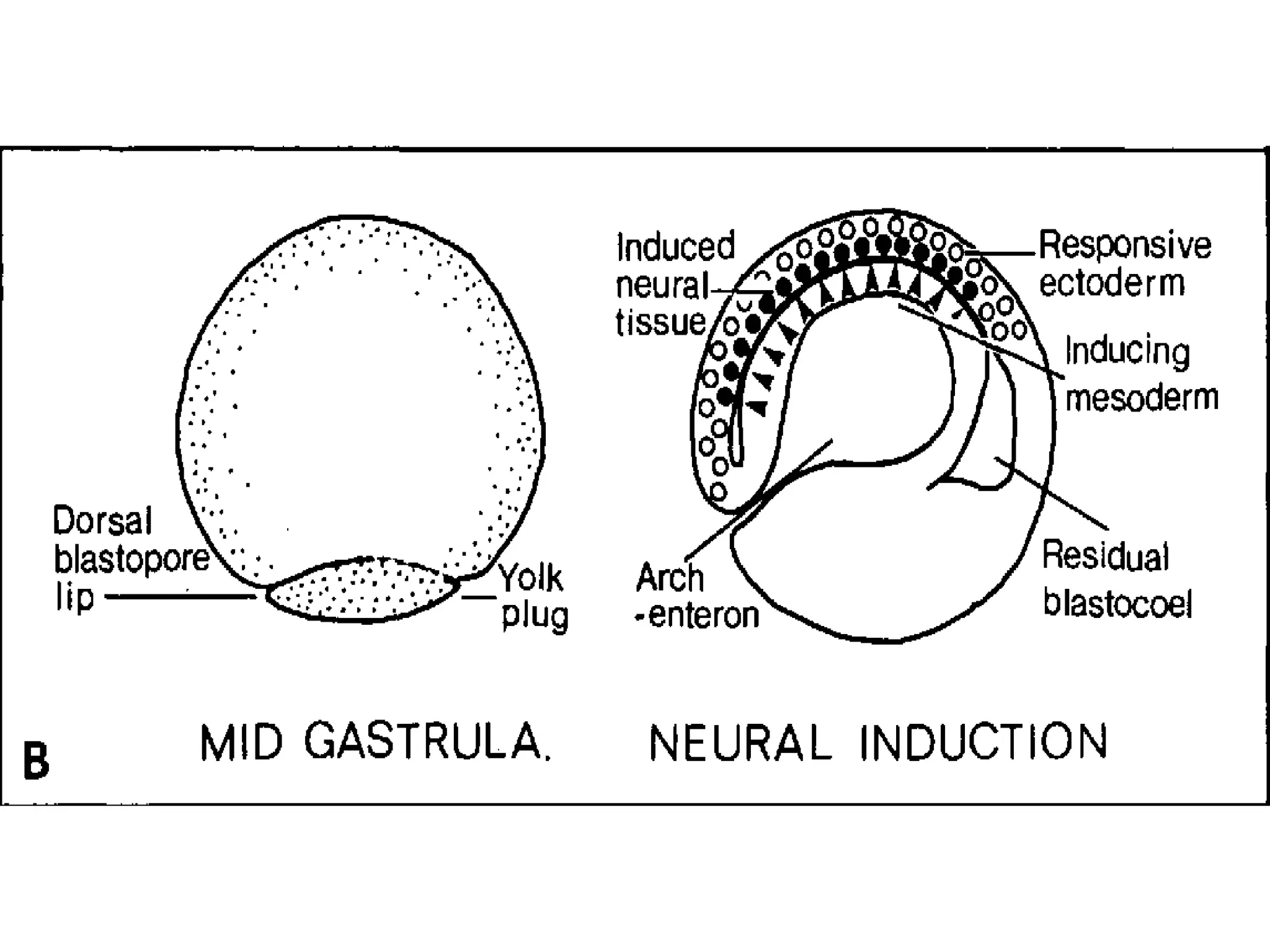
Neural induction- This experiment clearly
showed that dorsal blastopore or lip of the
blastrula have the ability to induced the
formation of neural plate in the ectodermal
cells of the host. This phenomena is known as
neural induction.
Embryonic Induction – Other part of
embryo can induced the formation of another
structures. This influence of one structure in
the formation of another structure is in
embryo is called embryonic induction
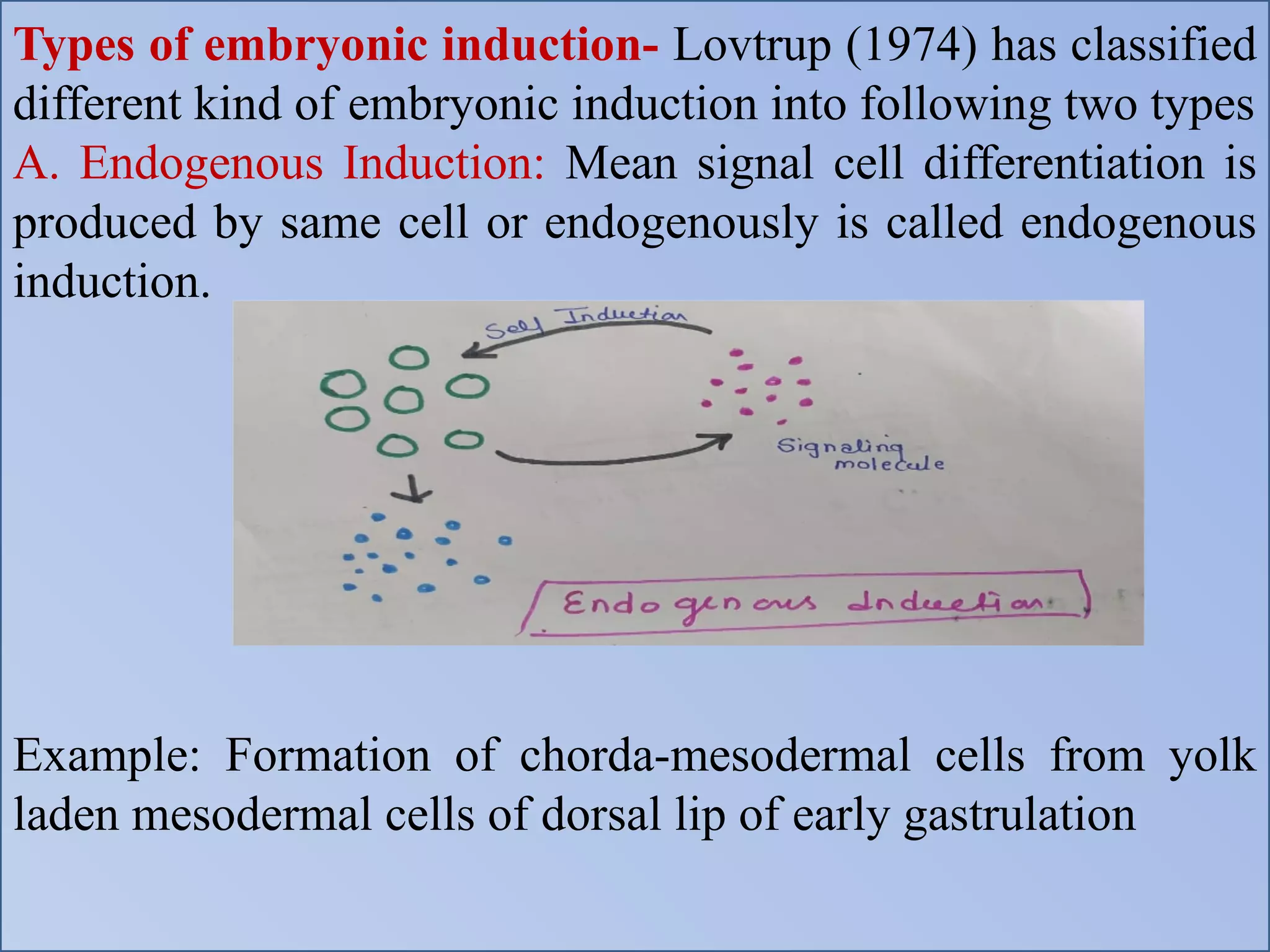
Types of embryonic induction- Lovtrup (1974) has classified
different kind of embryonic induction into following two types
A. Endogenous Induction: Mean signal cell differentiation is
produced by same cell or endogenously is called endogenous
induction.
Example: Formation of chorda-mesodermal cells from yolk
laden mesodermal cells of dorsal lip of early gastrulation
Exogenous Induction- Signal received by the other cell is
called exogenous induction, when external agent or a cell or a
tissue introduced into an embryo they exert their influence by
a process of diversification pattern through contact induction
this phenomena is known as exogenous induction
Grobstien (1964) reported that a differentiate cell produce an
inductor. The inductor not only serve maintain the state of cell
also induced the adjacent cell to differentiate according to it.
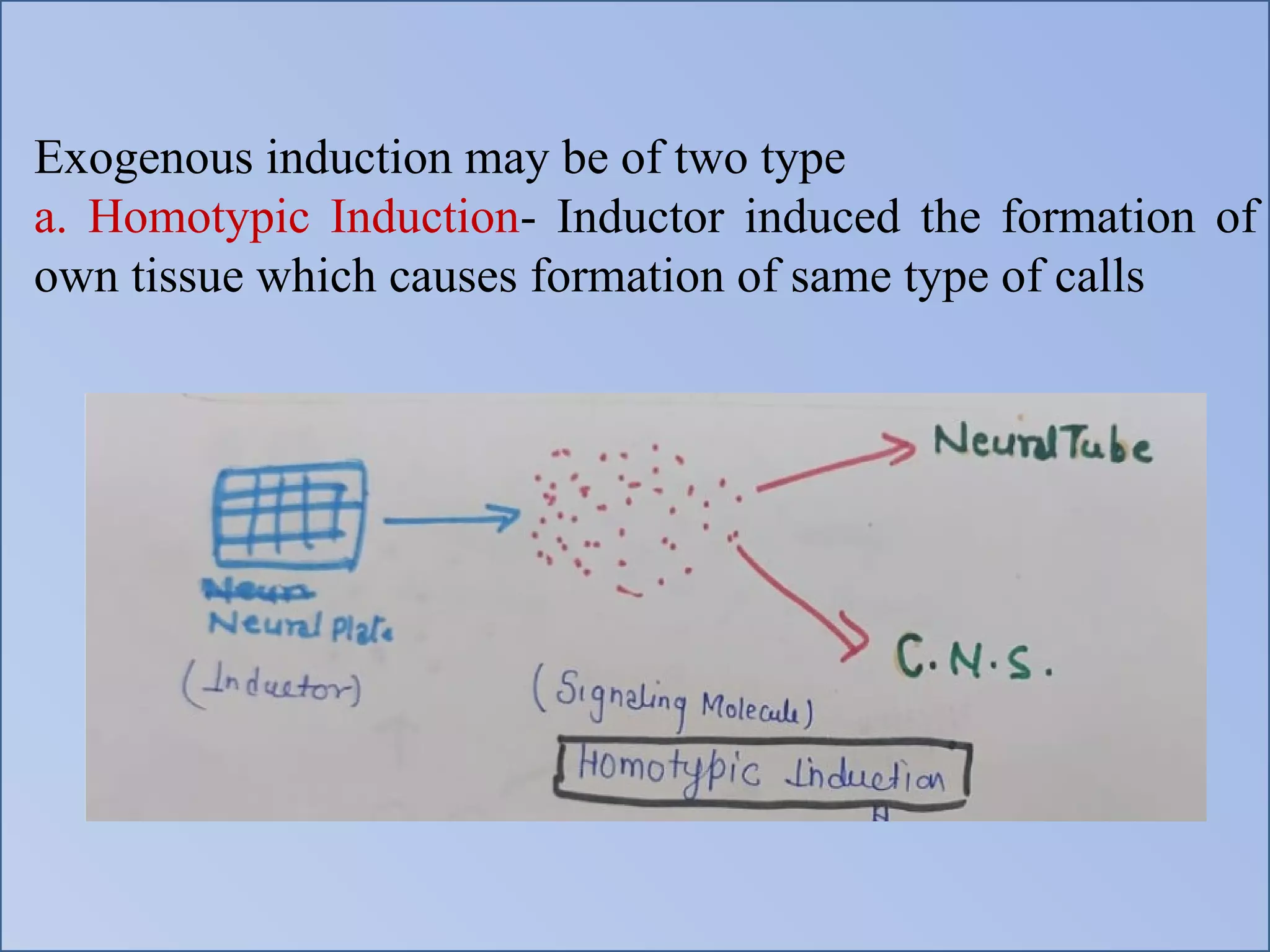
Exogenous induction may be of two type
a. Homotypic Induction- Inductor induced the formation of
own tissue which causes formation of same type of calls
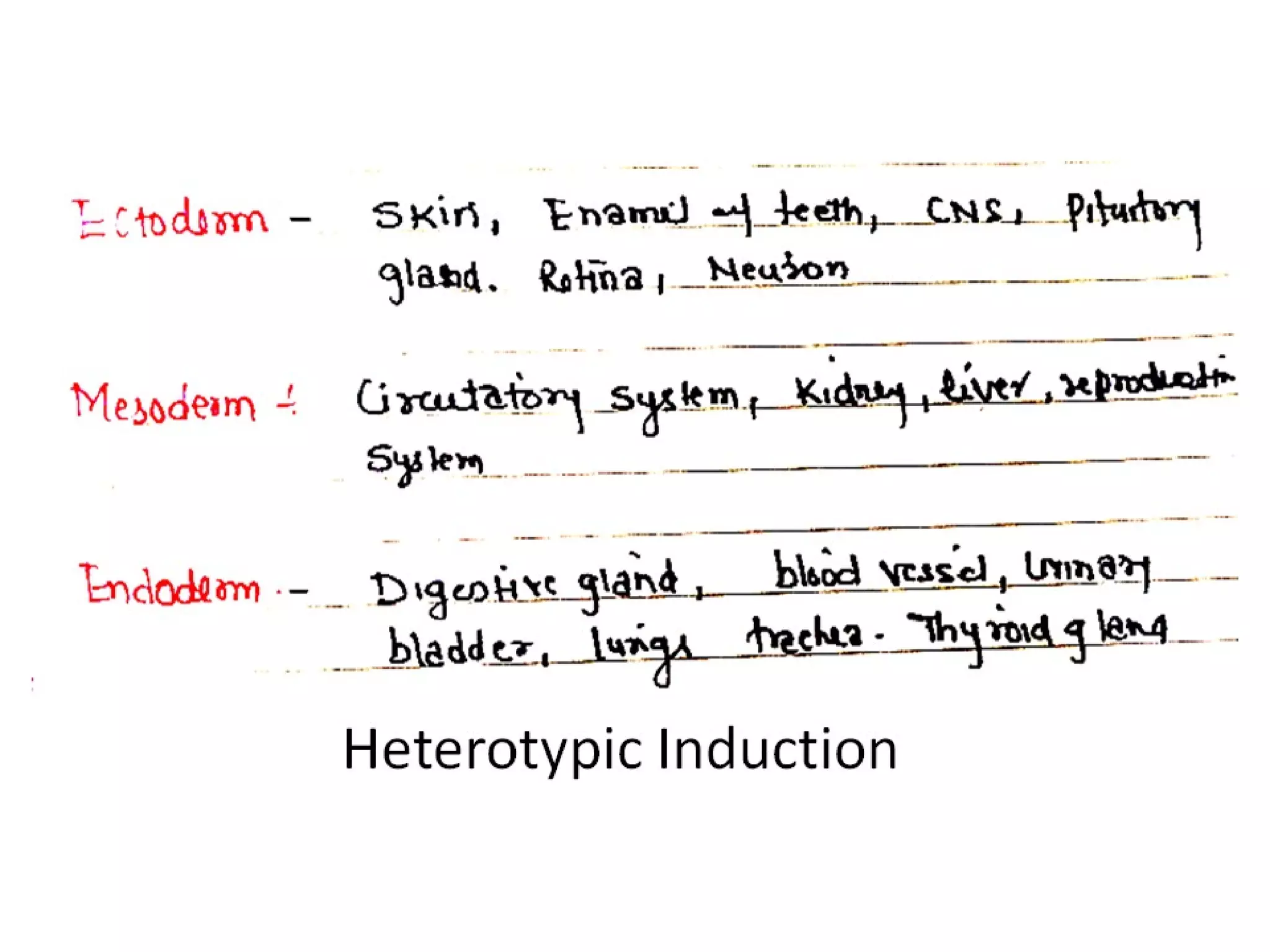
Heterotypic Induction- In this organizer
induct the formation of different types of
cells or tissues or organ from different cell
group
Example – Gastrula, three ger layer
formation takes place
Instructive Induction: In this type of induction organizer
instruct the responding cell to follow specific development
pathway. The responding cell adapted a different fate in the
presence or absence of inductor.
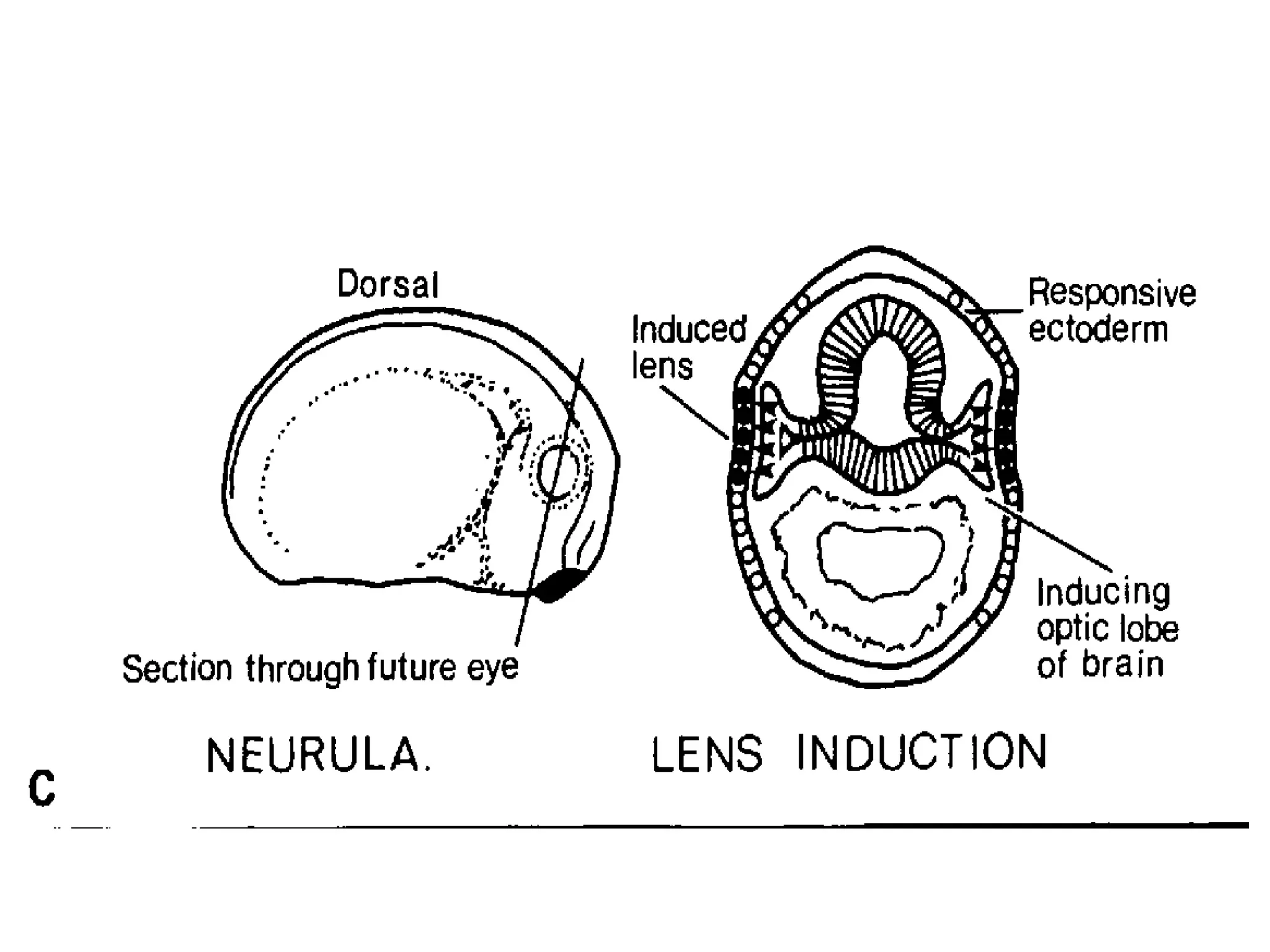
Example: Optic vesicle is the secondary organizer and it is
responsible or induced the ectodermal cells to develop the
lens. In an experiment this optic vesicle implant in different
area of ectodermal region but here it will not form to lens
while the ectodermal cells of this area form the lens but due
to instructive instruction
Permissible induction
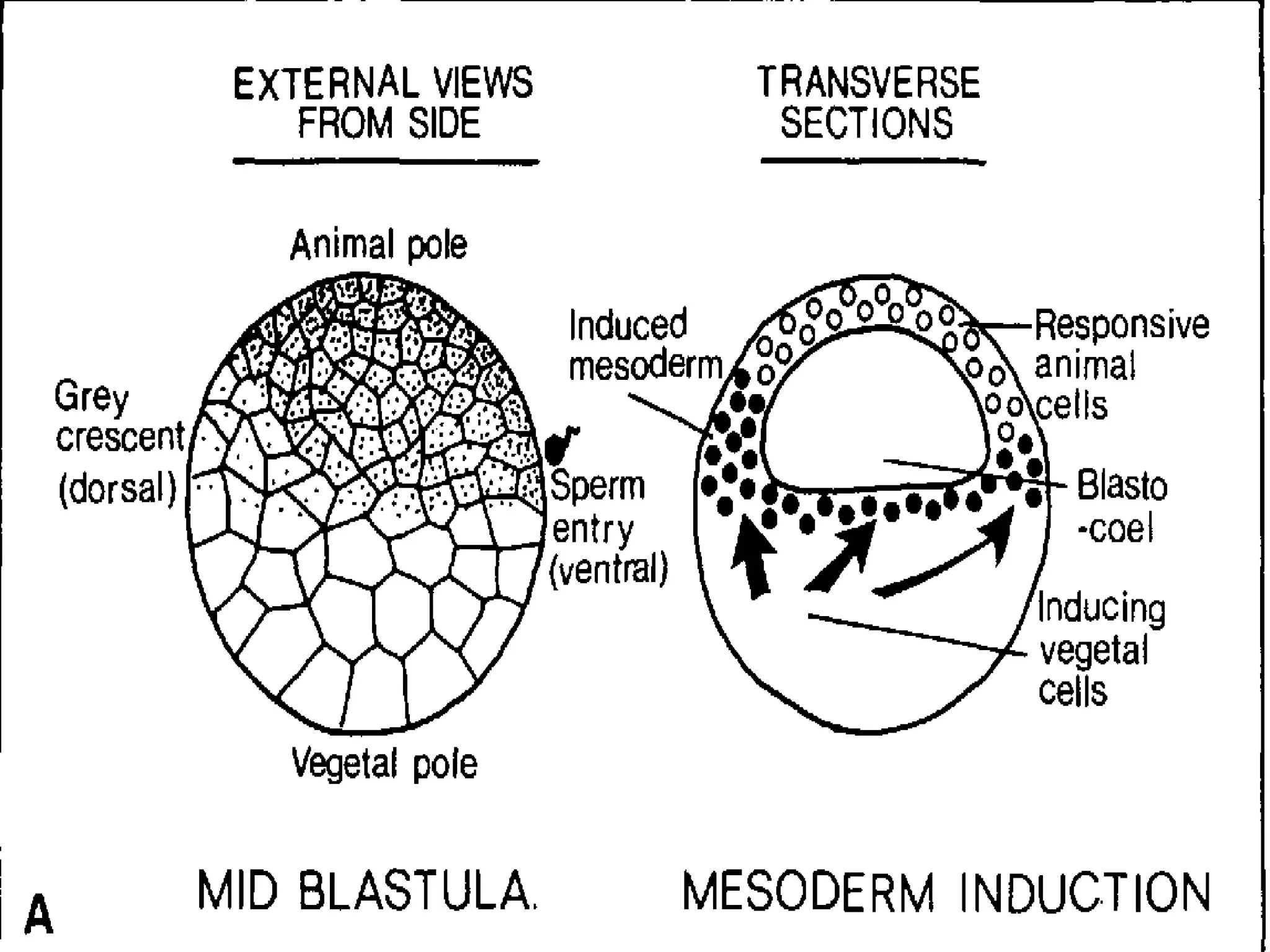
Embryonic induction describes the embryonic
process in which one group of cells, or tissues,
directs the development of another group of
cells, the responding tissue. Induction directs the
development of various tissues and organs in most
animal embryos; for example, the eye lens and the
heart..
Permissible induction
In this type of induction the responding cells already
commit to certain fate but need a signal to continue or
permission.
For example many tissue need a solid substance
containing fibronectin or laminin which help in the
expression of trait. During embryogenesis fibronectin
pathway guide cell to their movement.
Regional Specification-
Regional specification is also referred to
as pattern formation or spatial organization.
During early embryogenesis, regional
specification is possibly operant following
blastula, and is (Appear)apparent during
gastrulation and thereafter during embryonic
and fetal stages of development .
Spemann (1931) One of the most fascinating
phenomena in neural induction is the
regional specificity of the neural structures
that are produced.
1. Forebrain, hindbrain, and spinocaudal
regions of the neural tube must all be
properly organized in an anterior-to-
posterior direction.
Neural Development= Anterior to Posterior
2. The organizer tissue not only
induces the neural tube, but also
specifies the regions of the neural tube
Mangold Experiment
This region-specific induction was
demonstrated by Hilde Mangold, he
transplanted four successive regions of the
archenteron roof of late-gastrula newt
embryos into the blastocoels of early-
gastrula embryos .
1. The most anterior portion of the
archenteron roof induced portions of
the oral apparatus.
2. The next most anterior section
induced the formation of various
structures, including head, nose,
eyes, balancers, and optic vesicles.
3. The third section induced the hindbrain
structure a
4. Most posterior section induced the
formation of dorsal trunk and tail mesoderm
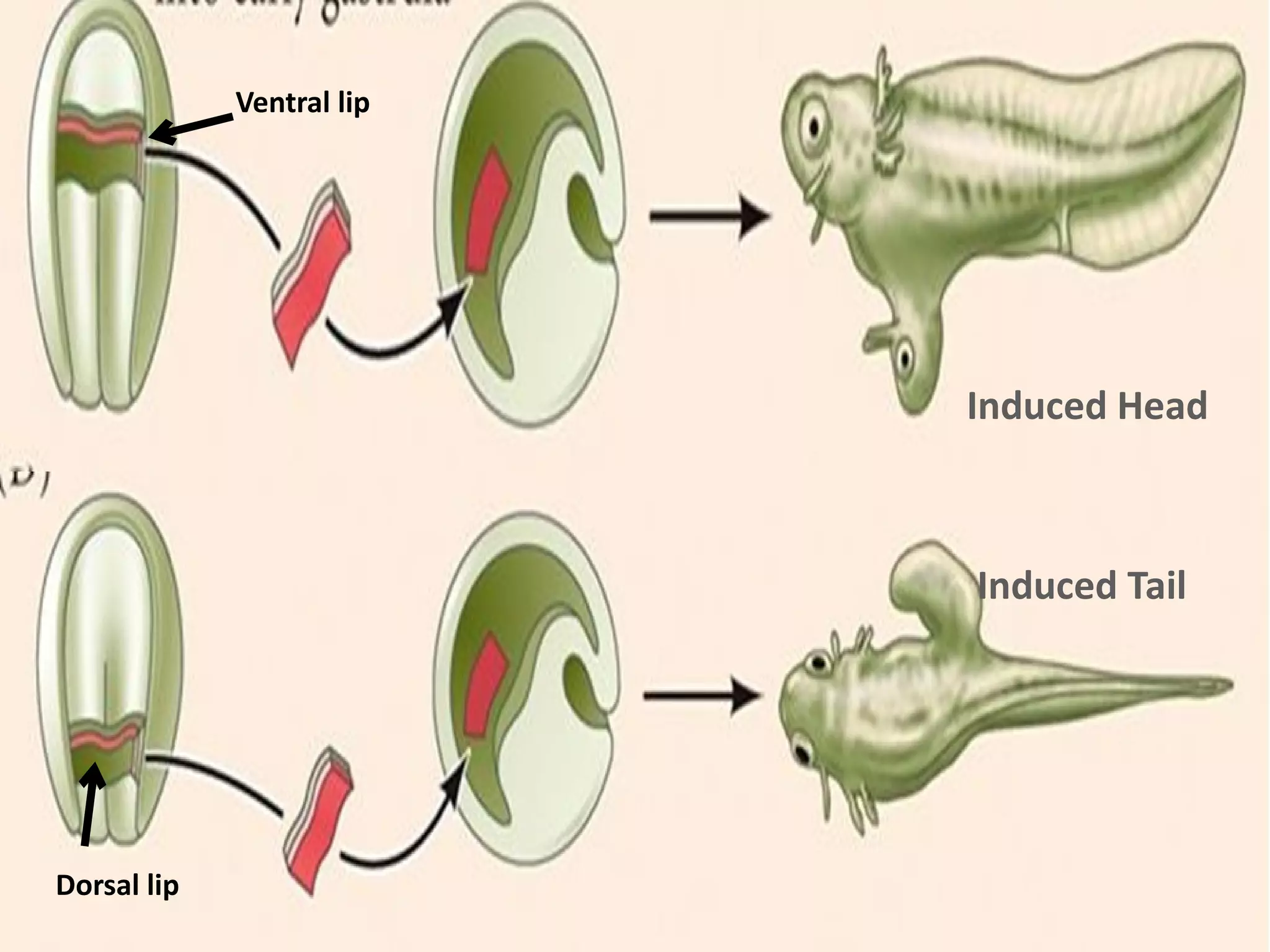
A. Moreover, when dorsal blastopore lips
from early salamander gastrula were
transplanted into other early salamander
gastrulae, they formed secondary heads.
B. When dorsal lips from later gastrulas were
transplanted into early salamander gastrulae,
however, they induced the formation of
secondary tails.
These results show that the first cells of the
organizer to enter the embryo induce the
formation of brains and heads, while those cells
that form the dorsal lip of later-stage embryos
induce the cells above them to become spinal
cords and tails.
Induced Head
Induced Tail
Dorsal lip
Ventral lip
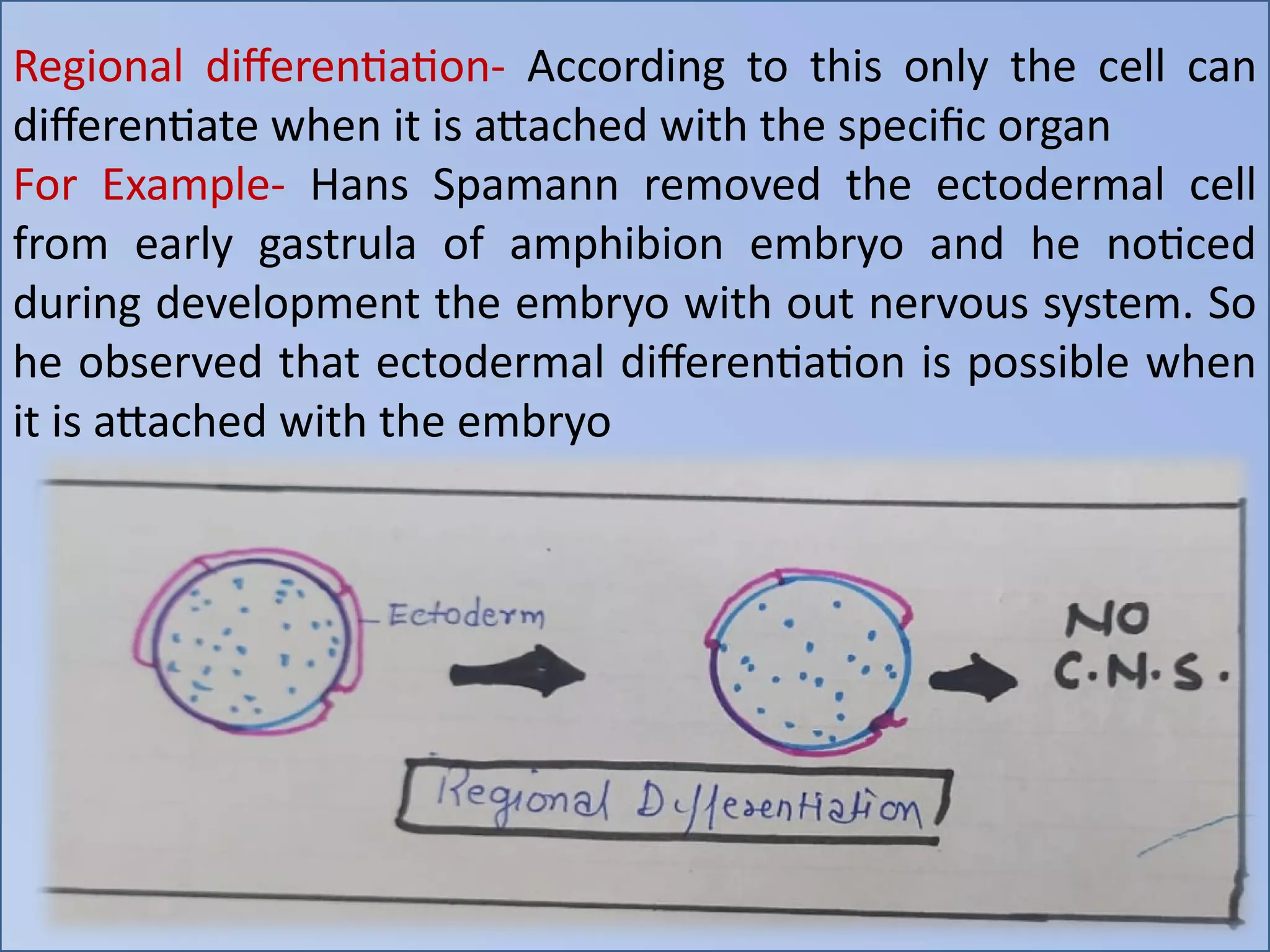
Regional differentiation- According to this only the cell can
differentiate when it is attached with the specific organ
For Example- Hans Spamann removed the ectodermal cell
from early gastrula of amphibion embryo and he noticed
during development the embryo with out nervous system. So
he observed that ectodermal differentiation is possible when
it is attached with the embryo
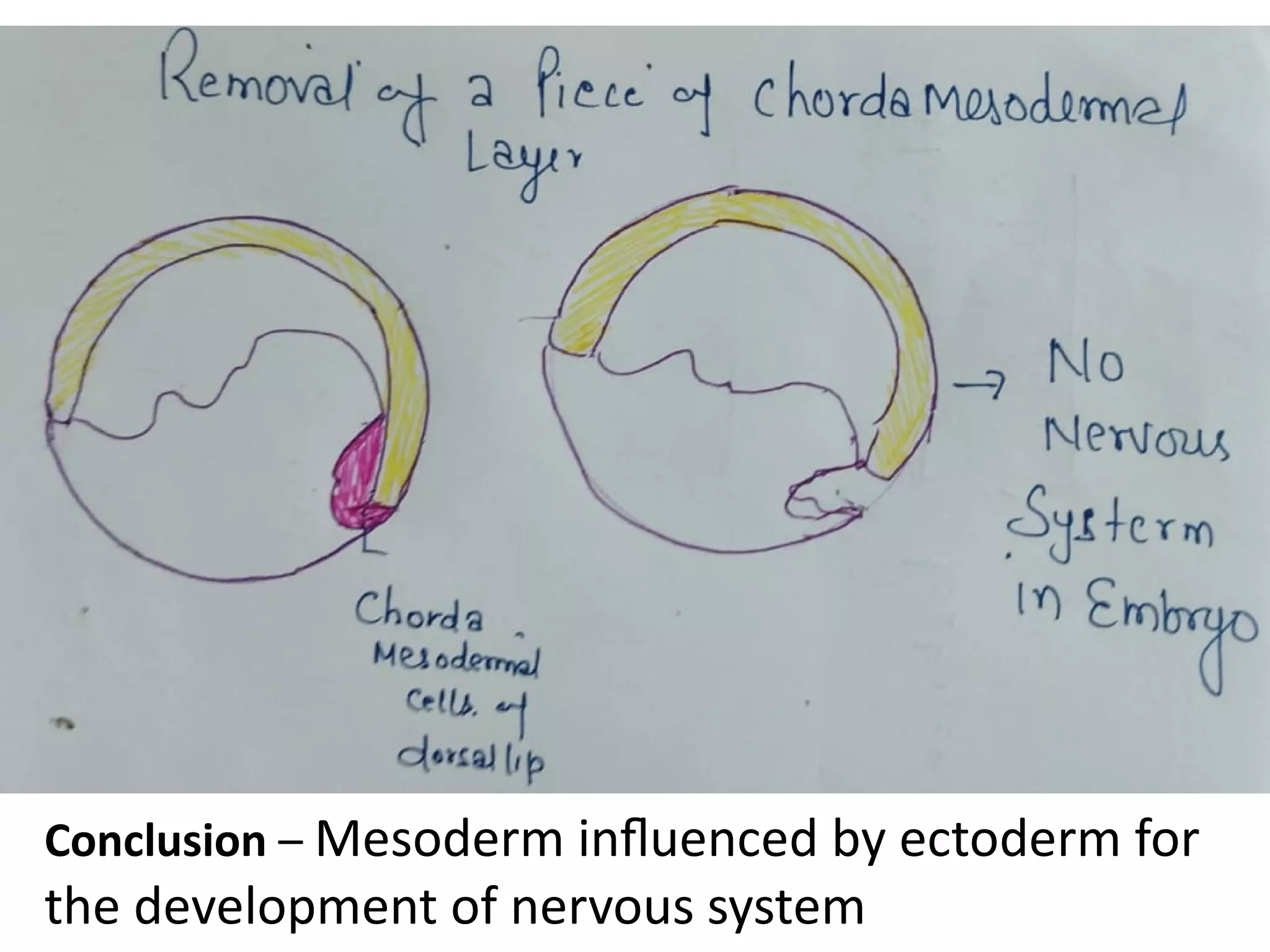
Conclusion – Mesoderm influenced by ectoderm for
the development of nervous system
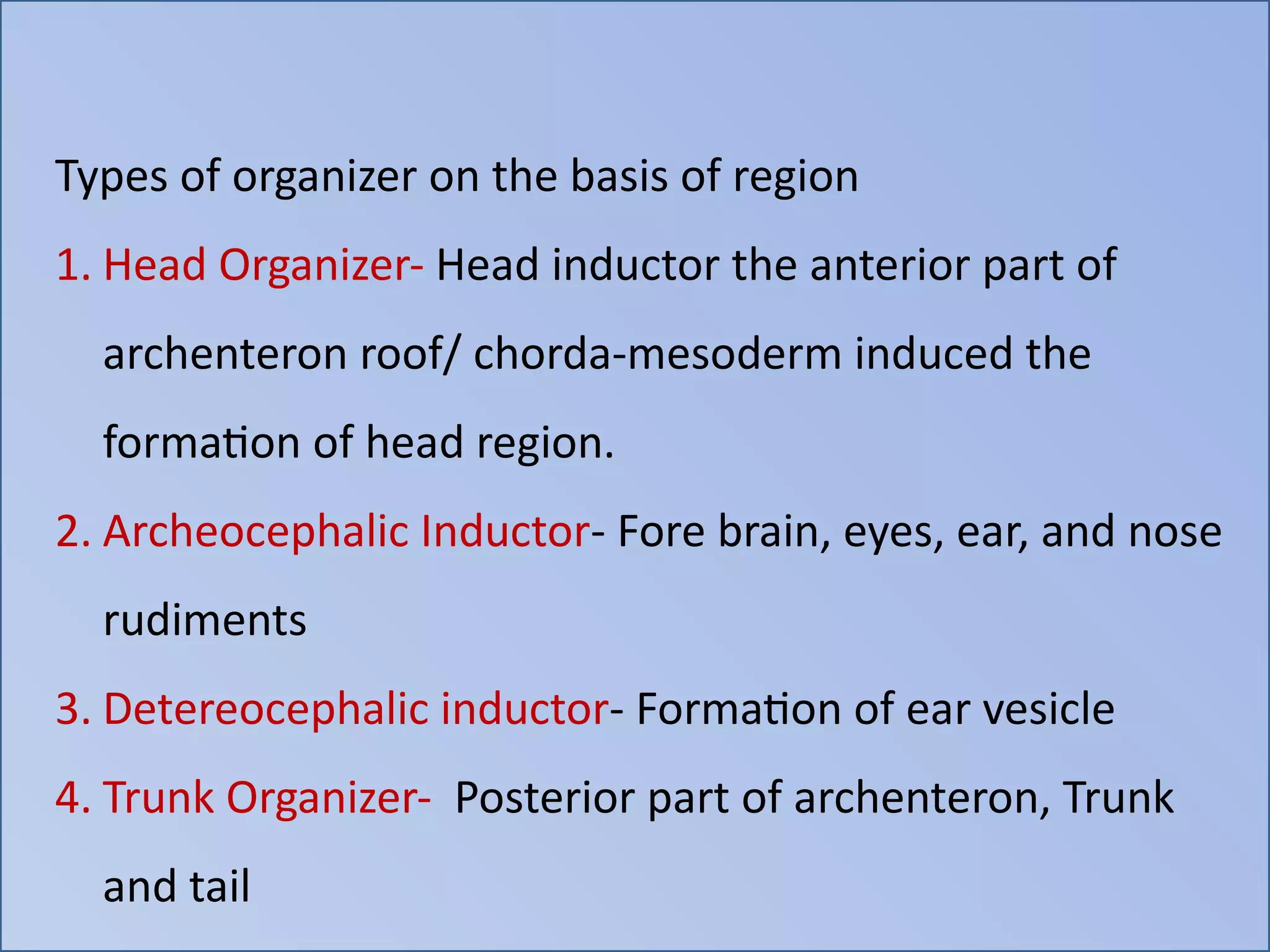
Types of organizer on the basis of region
1. Head Organizer- Head inductor the anterior part of
archenteron roof/ chorda-mesoderm induced the
formation of head region.
2. Archeocephalic Inductor- Fore brain, eyes, ear, and nose
rudiments
3. Detereocephalic inductor- Formation of ear vesicle
4. Trunk Organizer- Posterior part of archenteron, Trunk
and tail
On the basis of differentiation organizer are of
following types
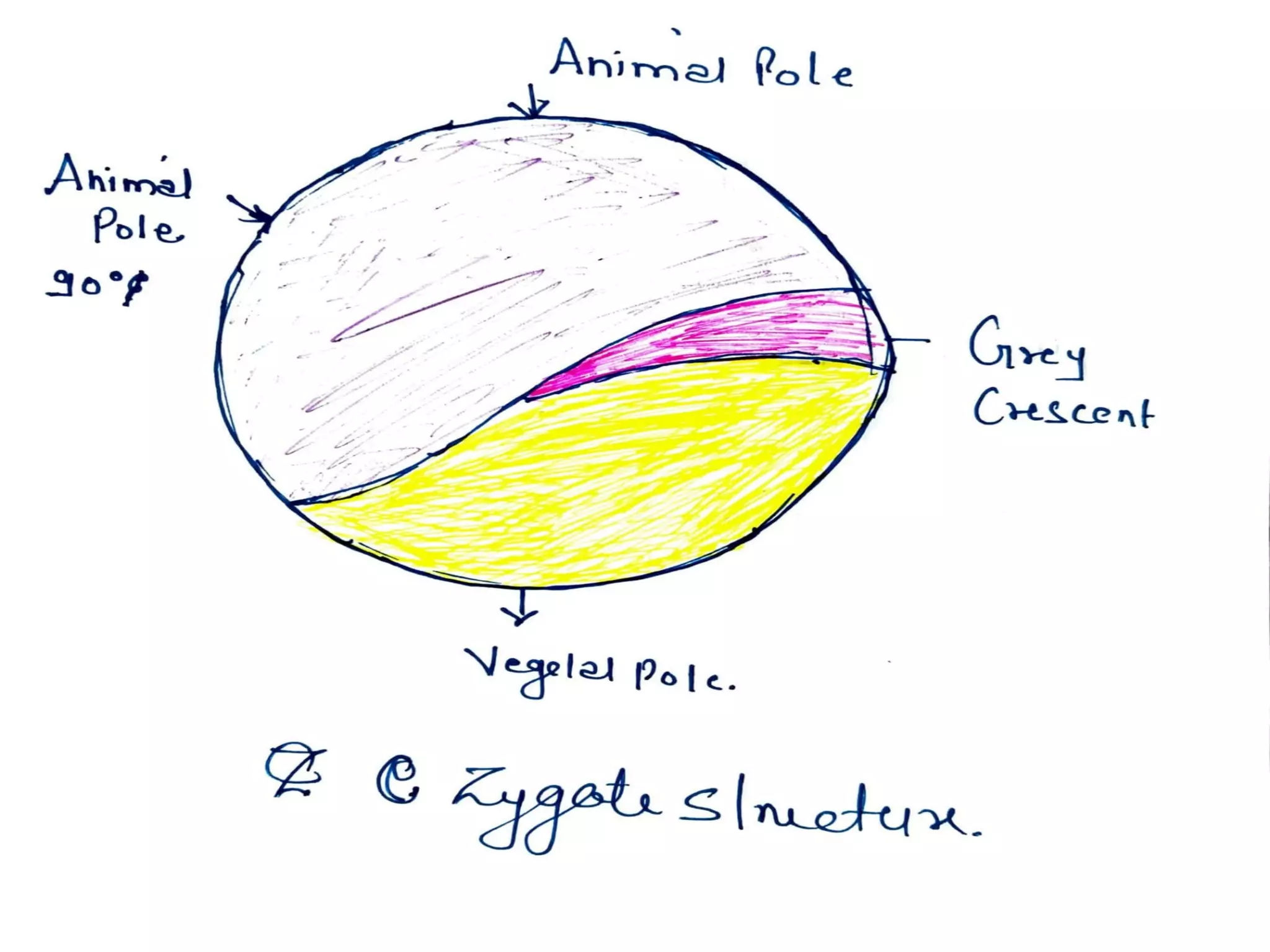
1. Primary Organizer- Grey crescent area, dorsal lip of
blastopore, chorda-mesodermal cells.
2. Secondary organizer- Forms through primary organizer
3. Tertiary organizer- Forms through Secondary organizer
4. Quarterly Organizer- Forms through tertiary organizer
Characteristics of Organizer
1. They initiate the process of cellular development
and differentiation in the cells, tissues and
organs.
2. Time limitation for induction
3. Primary organizer has ability to change blastula
to gastrula
4. Normally the organizer does not interfere with
the work of another organizer
Progressive Determination
Amphibian axis formation is an example of regulative development
Regulative development generally occurs in early gastrulation when
cells are induced to form different structures according to the cell-
cell signaling interactions in a specific area of the embryo that lead
to the conditional specification of a cell's fate). In regulative
development that an isolated blastomere has a potency to greater than
it normal embryonic fate and cell fate determined by interaction with
neighboring cells such interaction is known as induction. That such
inductive interaction were responsible for amphibian axis were
demonstrated by Hans Spemann at university Frieburg, He got nobel
prize in 1935.
Spemann demonstrated that early newt blastomere have
identical nuclei that each nuclei capable to producing a
entire larva.
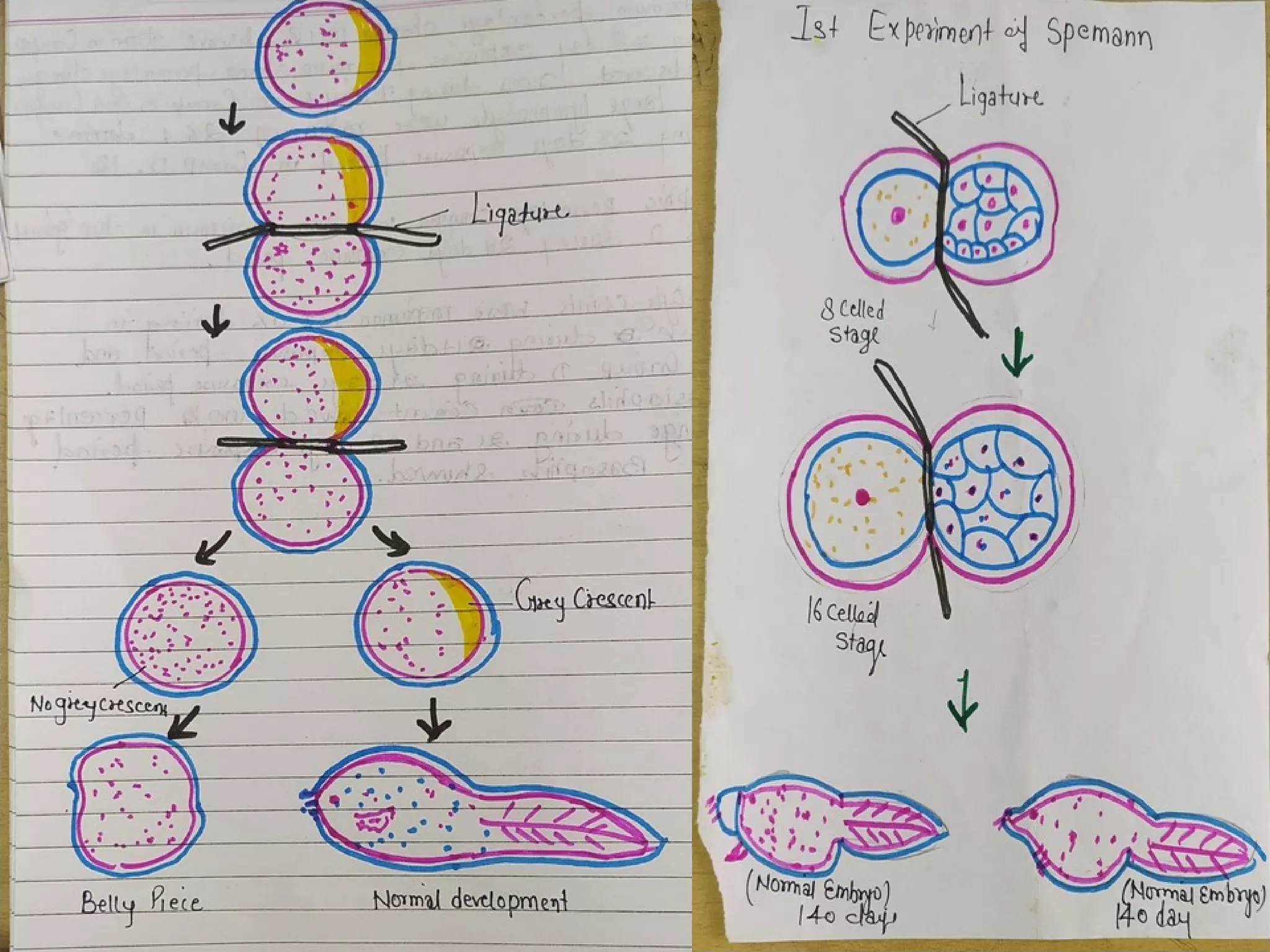
A. Spemann taken baby hair to lasso the zygote in the plane of its
cleavage. He partially constricted the egg by a ligature, The
cleavage was on one it reached at 8 celled stage and remained
undivided.
(B) At 16 celled stage a single nucleus. Observed at undivided part and the
ligature was constricted to complete the separation of two halves
(C) After 140 days each side developed into a normal embryo.
However Spemann performed a similar experiment with the constrication
longitudenal and divided to two halves same as Ist experiment.
(A) Egg divided in two blastomere.
(B) One half get greycrescent and remaining without grey crescent.
(C) The halve having greycrescent developed in normal embryo
(D) Other half produce mass of un organized tissue.
Why should these two practical given different result be gray crescent shaped area
of cytoplasm in the region directly opposite the point of sperm entry. I have area a
has been called grey crescent.
In Ist experiment the greycrescent divided into tow equal half to complete two
larva.
However in IInd experiment cleavage was segment in one part so or one blastomer.
Spemann found the blastomere containing gray crescent develop normal
which greycrescent develop abnormally
embryonic-induction.pdf

embryonic-induction.pdf

  • 1.
  • 2.
    Induction is theprocess by which one group of cells produces a signal that determines the fate of a second group of cells. This implies both the capacity to produce a signal by the inducing cells and the competence of the responding cells to receive and interpret the signal via a signal transduction pathway. Amphibians are the most extensively studied vertebrates for investigations into embryonic induction.
  • 3.
    For example: amphibianembryo the dorsal ectodermal cells in a mid-longitudenal region forms a neural plate. The mesodermal layers formed the roof of archenteron by invagination which finally formed gut.
  • 5.
    Components of Induction 1.Organizer or Inductor- These are structure, which induced the formation of another structure is called inductor or organizer. 2. Evocator- The chemical substance that is emitted by an inductor is called evocator 3. Responsive tissue- The tissue on which inductor or evocator acts is called responsive tissue
  • 6.
    Mangold(1927). Organization ofa secondary axis by dorsal blastopore lip tissue. (A) Dorsal lip tissue from an early gastrula is transplanted into another early gastrula in the region that normally becomes ventral epidermis. (B) The donor tissue invaginates and forms a second archenteron, and then a second embryonic axis. (C)Both donor and host tissues are seen in the new neural tube, notochord, and somites. (D) Eventually, a second embryo forms that is joined to the host. (E) Structure of the dorsal blastopore lip region in an early Xenopus gastrula. •One of the embryo was regular •Another was the induced one
  • 8.
    Neural induction- Thisexperiment clearly showed that dorsal blastopore or lip of the blastrula have the ability to induced the formation of neural plate in the ectodermal cells of the host. This phenomena is known as neural induction.
  • 9.
    Embryonic Induction –Other part of embryo can induced the formation of another structures. This influence of one structure in the formation of another structure is in embryo is called embryonic induction
  • 11.
    Types of embryonicinduction- Lovtrup (1974) has classified different kind of embryonic induction into following two types A. Endogenous Induction: Mean signal cell differentiation is produced by same cell or endogenously is called endogenous induction. Example: Formation of chorda-mesodermal cells from yolk laden mesodermal cells of dorsal lip of early gastrulation
  • 12.
    Exogenous Induction- Signalreceived by the other cell is called exogenous induction, when external agent or a cell or a tissue introduced into an embryo they exert their influence by a process of diversification pattern through contact induction this phenomena is known as exogenous induction Grobstien (1964) reported that a differentiate cell produce an inductor. The inductor not only serve maintain the state of cell also induced the adjacent cell to differentiate according to it.
  • 13.
    Exogenous induction maybe of two type a. Homotypic Induction- Inductor induced the formation of own tissue which causes formation of same type of calls
  • 14.
    Heterotypic Induction- Inthis organizer induct the formation of different types of cells or tissues or organ from different cell group Example – Gastrula, three ger layer formation takes place
  • 16.
    Instructive Induction: Inthis type of induction organizer instruct the responding cell to follow specific development pathway. The responding cell adapted a different fate in the presence or absence of inductor. Example: Optic vesicle is the secondary organizer and it is responsible or induced the ectodermal cells to develop the lens. In an experiment this optic vesicle implant in different area of ectodermal region but here it will not form to lens while the ectodermal cells of this area form the lens but due to instructive instruction
  • 18.
    Permissible induction Embryonic inductiondescribes the embryonic process in which one group of cells, or tissues, directs the development of another group of cells, the responding tissue. Induction directs the development of various tissues and organs in most animal embryos; for example, the eye lens and the heart..
  • 19.
    Permissible induction In thistype of induction the responding cells already commit to certain fate but need a signal to continue or permission. For example many tissue need a solid substance containing fibronectin or laminin which help in the expression of trait. During embryogenesis fibronectin pathway guide cell to their movement.
  • 20.
    Regional Specification- Regional specificationis also referred to as pattern formation or spatial organization. During early embryogenesis, regional specification is possibly operant following blastula, and is (Appear)apparent during gastrulation and thereafter during embryonic and fetal stages of development .
  • 22.
    Spemann (1931) Oneof the most fascinating phenomena in neural induction is the regional specificity of the neural structures that are produced. 1. Forebrain, hindbrain, and spinocaudal regions of the neural tube must all be properly organized in an anterior-to- posterior direction. Neural Development= Anterior to Posterior
  • 23.
    2. The organizertissue not only induces the neural tube, but also specifies the regions of the neural tube
  • 24.
    Mangold Experiment This region-specificinduction was demonstrated by Hilde Mangold, he transplanted four successive regions of the archenteron roof of late-gastrula newt embryos into the blastocoels of early- gastrula embryos .
  • 25.
    1. The mostanterior portion of the archenteron roof induced portions of the oral apparatus. 2. The next most anterior section induced the formation of various structures, including head, nose, eyes, balancers, and optic vesicles.
  • 26.
    3. The thirdsection induced the hindbrain structure a 4. Most posterior section induced the formation of dorsal trunk and tail mesoderm A. Moreover, when dorsal blastopore lips from early salamander gastrula were transplanted into other early salamander gastrulae, they formed secondary heads. B. When dorsal lips from later gastrulas were transplanted into early salamander gastrulae, however, they induced the formation of secondary tails.
  • 27.
    These results showthat the first cells of the organizer to enter the embryo induce the formation of brains and heads, while those cells that form the dorsal lip of later-stage embryos induce the cells above them to become spinal cords and tails.
  • 28.
  • 29.
    Regional differentiation- Accordingto this only the cell can differentiate when it is attached with the specific organ For Example- Hans Spamann removed the ectodermal cell from early gastrula of amphibion embryo and he noticed during development the embryo with out nervous system. So he observed that ectodermal differentiation is possible when it is attached with the embryo
  • 30.
    Conclusion – Mesoderminfluenced by ectoderm for the development of nervous system
  • 31.
    Types of organizeron the basis of region 1. Head Organizer- Head inductor the anterior part of archenteron roof/ chorda-mesoderm induced the formation of head region. 2. Archeocephalic Inductor- Fore brain, eyes, ear, and nose rudiments 3. Detereocephalic inductor- Formation of ear vesicle 4. Trunk Organizer- Posterior part of archenteron, Trunk and tail
  • 32.
    On the basisof differentiation organizer are of following types 1. Primary Organizer- Grey crescent area, dorsal lip of blastopore, chorda-mesodermal cells. 2. Secondary organizer- Forms through primary organizer 3. Tertiary organizer- Forms through Secondary organizer 4. Quarterly Organizer- Forms through tertiary organizer
  • 33.
    Characteristics of Organizer 1.They initiate the process of cellular development and differentiation in the cells, tissues and organs. 2. Time limitation for induction 3. Primary organizer has ability to change blastula to gastrula 4. Normally the organizer does not interfere with the work of another organizer
  • 34.
    Progressive Determination Amphibian axisformation is an example of regulative development Regulative development generally occurs in early gastrulation when cells are induced to form different structures according to the cell- cell signaling interactions in a specific area of the embryo that lead to the conditional specification of a cell's fate). In regulative development that an isolated blastomere has a potency to greater than it normal embryonic fate and cell fate determined by interaction with neighboring cells such interaction is known as induction. That such inductive interaction were responsible for amphibian axis were demonstrated by Hans Spemann at university Frieburg, He got nobel prize in 1935.
  • 35.
    Spemann demonstrated thatearly newt blastomere have identical nuclei that each nuclei capable to producing a entire larva. A. Spemann taken baby hair to lasso the zygote in the plane of its cleavage. He partially constricted the egg by a ligature, The cleavage was on one it reached at 8 celled stage and remained undivided. (B) At 16 celled stage a single nucleus. Observed at undivided part and the ligature was constricted to complete the separation of two halves (C) After 140 days each side developed into a normal embryo.
  • 36.
    However Spemann performeda similar experiment with the constrication longitudenal and divided to two halves same as Ist experiment. (A) Egg divided in two blastomere. (B) One half get greycrescent and remaining without grey crescent. (C) The halve having greycrescent developed in normal embryo (D) Other half produce mass of un organized tissue. Why should these two practical given different result be gray crescent shaped area of cytoplasm in the region directly opposite the point of sperm entry. I have area a has been called grey crescent. In Ist experiment the greycrescent divided into tow equal half to complete two larva. However in IInd experiment cleavage was segment in one part so or one blastomer. Spemann found the blastomere containing gray crescent develop normal which greycrescent develop abnormally