METALSProperties, Processes and Types & Uses.
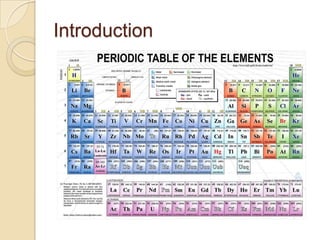
IntroductionAmong the 109 elements, 85 are classified as metallic, 7 as metalloids and 17 as nonmetallic. Metal Classificationsimple metalsmetallic alloys – purposeful mixture
Introduction
Metallic PropertiesHardnessBrittlenessMalleabilityDuctilityElasticityToughnessDensityFusibilityConductionContraction and ExpansionStrengthCorrosiveness
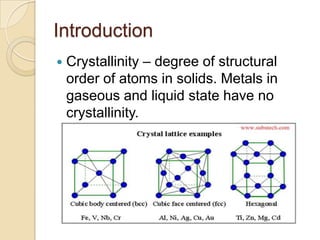
IntroductionCrystallinity – degree of structural order of atoms in solids. Metals in gaseous and liquid state have no crystallinity.
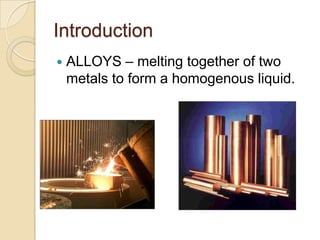
IntroductionALLOYS – melting together of two metals to form a homogenous liquid.
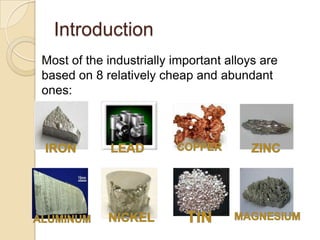
Introduction	Most of the industrially important alloys are  based on 8 relatively cheap and abundant ones:IRONLEADCOPPERZINCTINNICKELMAGNESIUMALUMINUM
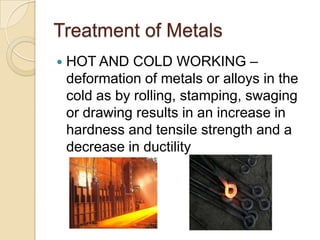
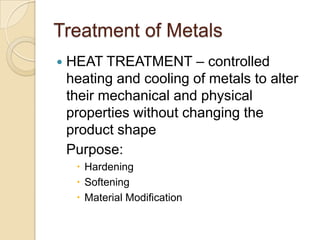
Treatment of MetalsHOT AND COLD WORKING – deformation of metals or alloys in the cold as by rolling, stamping, swaging or drawing results in an increase in hardness and tensile strength and a decrease in ductility
Treatment of MetalsHEAT TREATMENT– controlled heating and cooling of metals to alter their mechanical and physical properties without changing the product shape 	Purpose:Hardening SofteningMaterial Modification
Treatment of MetalsHardening – increase in strength and wearDirect hardeningQuench hardeningSoftening – reduce strength and hardness, restore ductilityAnnealing and recrystallization  (50° C or 122°F)Normalizing  (60°C or 140°F)Tempering (40°C or 104°F after quenching)Material modification– modify properties of materialsStress Relief
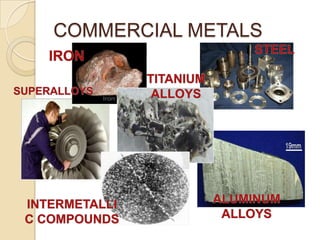
COMMERCIAL METALSSTEELIRONTITANIUM ALLOYSSUPERALLOYSALUMINUM ALLOYSINTERMETALLIC COMPOUNDS
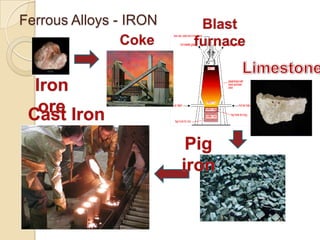
Ferrous Alloys - IRONBlast furnaceCoke ovenLimestoneIron oreCast IronPig iron
Ferrous Alloys - IronCast iron - is roughly, the pouring of melted iron grades to patterns which would produce fine metal forms. Ordinarily, it is produced with Carbon to Iron ratio of more than 2% up to 4.5%.										Cast Steel - is ordinarily, much lower in carbon than iron running from 0.2% to 0.35%
Ferrous Alloys - Steel	STEEL - is primarily made from pig iron plus scrap melted into open-hearth furnace with flux and generally contains 0.05% to 2.0% Carbon.Plain Carbon Steels – iron and carbon steelAlloying Steels – with 5% non-carbon additions such as Mn, Cr, Ni, Cu, Si, Mo and VStainless steel – more resistant to rusting due to Chromium addition (4%-30%)Tool steels – used for cutting, forming or shaping another material
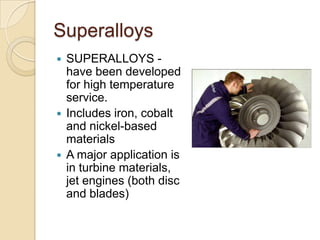
SuperalloysSUPERALLOYS - have been developed for high temperature service.Includes iron, cobalt and nickel-based materialsA major application is in turbine materials, jet engines (both disc and blades)
Titanium AlloysTITANIUM - emerged as “wonder metal” in 1950Relies on high strength/weight ratio, good resistance to corrosion, combined low thermal conductivity and thermal expansionAttractive for aerospace applications in both engine and airframe
Intermetallic Compoundsare generally regarded as a class of materials between metals and ceramicsIntrinsically strong with high elastic modulusIntermetallics containing Al or Si exhibit resistance to oxidation and corrosionThose made of light elements give rise to low density for weight-saving applicationsGreatest disadvantage is low ductility
Intermetallic CompoundsExamples:Nickel AluminidesTitanium AluminidesIron AluminideNickel SilicatePdInZirconium Aluminide
Aluminum AlloysALUMINUM - has an attractive combination of properties such as low density, strong and easy to fabricate.Its two most important properties are density and thermal conductivityIn engines, they are used as pistons, cylinder heads and sumps However, modulus of aluminum is only one third that of steelSuper plastic forming is a cost-effective manufacturing process for producing both simple and complex shapes from aluminum alloy sheets

Metals

  • 1.
  • 2.
    IntroductionAmong the 109elements, 85 are classified as metallic, 7 as metalloids and 17 as nonmetallic. Metal Classificationsimple metalsmetallic alloys – purposeful mixture
  • 3.
  • 4.
  • 5.
    IntroductionCrystallinity – degreeof structural order of atoms in solids. Metals in gaseous and liquid state have no crystallinity.
  • 6.
    IntroductionALLOYS – meltingtogether of two metals to form a homogenous liquid.
  • 7.
    Introduction Most of theindustrially important alloys are based on 8 relatively cheap and abundant ones:IRONLEADCOPPERZINCTINNICKELMAGNESIUMALUMINUM
  • 8.
    Treatment of MetalsHOTAND COLD WORKING – deformation of metals or alloys in the cold as by rolling, stamping, swaging or drawing results in an increase in hardness and tensile strength and a decrease in ductility
  • 9.
    Treatment of MetalsHEATTREATMENT– controlled heating and cooling of metals to alter their mechanical and physical properties without changing the product shape Purpose:Hardening SofteningMaterial Modification
  • 10.
    Treatment of MetalsHardening– increase in strength and wearDirect hardeningQuench hardeningSoftening – reduce strength and hardness, restore ductilityAnnealing and recrystallization (50° C or 122°F)Normalizing (60°C or 140°F)Tempering (40°C or 104°F after quenching)Material modification– modify properties of materialsStress Relief
  • 11.
  • 12.
    Ferrous Alloys -IRONBlast furnaceCoke ovenLimestoneIron oreCast IronPig iron
  • 13.
    Ferrous Alloys -IronCast iron - is roughly, the pouring of melted iron grades to patterns which would produce fine metal forms. Ordinarily, it is produced with Carbon to Iron ratio of more than 2% up to 4.5%. Cast Steel - is ordinarily, much lower in carbon than iron running from 0.2% to 0.35%
  • 14.
    Ferrous Alloys -Steel STEEL - is primarily made from pig iron plus scrap melted into open-hearth furnace with flux and generally contains 0.05% to 2.0% Carbon.Plain Carbon Steels – iron and carbon steelAlloying Steels – with 5% non-carbon additions such as Mn, Cr, Ni, Cu, Si, Mo and VStainless steel – more resistant to rusting due to Chromium addition (4%-30%)Tool steels – used for cutting, forming or shaping another material
  • 15.
    SuperalloysSUPERALLOYS - havebeen developed for high temperature service.Includes iron, cobalt and nickel-based materialsA major application is in turbine materials, jet engines (both disc and blades)
  • 16.
    Titanium AlloysTITANIUM -emerged as “wonder metal” in 1950Relies on high strength/weight ratio, good resistance to corrosion, combined low thermal conductivity and thermal expansionAttractive for aerospace applications in both engine and airframe
  • 17.
    Intermetallic Compoundsare generallyregarded as a class of materials between metals and ceramicsIntrinsically strong with high elastic modulusIntermetallics containing Al or Si exhibit resistance to oxidation and corrosionThose made of light elements give rise to low density for weight-saving applicationsGreatest disadvantage is low ductility
  • 18.
    Intermetallic CompoundsExamples:Nickel AluminidesTitaniumAluminidesIron AluminideNickel SilicatePdInZirconium Aluminide
  • 19.
    Aluminum AlloysALUMINUM -has an attractive combination of properties such as low density, strong and easy to fabricate.Its two most important properties are density and thermal conductivityIn engines, they are used as pistons, cylinder heads and sumps However, modulus of aluminum is only one third that of steelSuper plastic forming is a cost-effective manufacturing process for producing both simple and complex shapes from aluminum alloy sheets