Metals
Properties and
Techniques
By:Mel Fàbregas, Yeray
Freire, Lara Hosking and
Ara Forcadell.
Description:
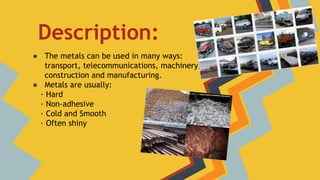
● The metals can be used in many ways:
transport, telecommunications, machinery,
construction and manufacturing.
● Metals are usually:
· Hard
· Non-adhesive
· Cold and Smooth
· Often shiny
Properties
There are 3 types of properties:
· Physical: A physical property is any property that is measurable
whose value describes a state of a physical system.

· Chemical: A chemical property is any of a material's properties that
becomes evident during a chemical reaction.

· Ecological: A ecological property is any material that can be
recyclable and reusable, however it also can be toxic.
Where and how metals are obtained
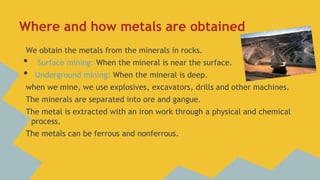
We obtain the metals from the minerals in rocks.

•
•

Surface mining: When the mineral is near the surface.
Underground mining: When the mineral is deep.

when we mine, we use explosives, excavators, drills and other machines.
The minerals are separated into ore and gangue.
The metal is extracted with an iron work through a physical and chemical
process.
The metals can be ferrous and nonferrous.
Ferrous materials
Caracteristics:
·Common
·inexpensive to extract
·need processing to produce pure iron
·used to make alloys

·Pure iron:
The concentration of carbon is between 0.008% and 0.03%.

·Steel:
The concentration is between 0.03% and 1.76%.

·Cast iron:
The concentration is between 1.76% and 6.67%.
Ferrous Materials: Pure iron and cast
iron
· PURE IRON: It’s a greyish white metal with good magnetic properties.
DISADVANTAGES

USES

Corrodes easily

Only melts in a very high temperature

Electrical and electronic components

It’s difficult to machine

·CAST IRON: It’s extremely hard and resistant
Uses: machinery parts, pistons, street lamps, drain covers,...
Ferrous materials: steel
Steel is an alloy of iron containing a small quantity of carbon. It is very hard
and strong, and because of this it has better mechanical properties than
iron.

Up next there is a Alloy steel group and then the steel making process.
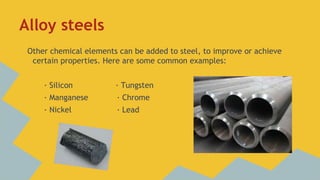
Alloy steels
Other chemical elements can be added to steel, to improve or achieve
certain properties. Here are some common examples:
· Silicon

· Tungsten

· Manganese

· Chrome

· Nickel

· Lead
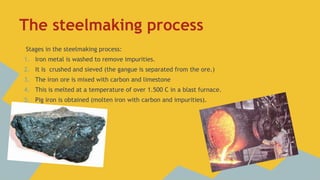
The steelmaking process
Stages in the steelmaking process:
1. Iron metal is washed to remove impurities.
2. It is crushed and sieved (the gangue is separated from the ore.)

3. The iron ore is mixed with carbon and limestone
4. This is melted at a temperature of over 1.500 C in a blast furnace.
5. Pig iron is obtained (molten iron with carbon and impurities).
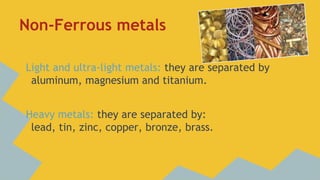
Non-Ferrous metals
Light and ultra-light metals: they are separated by
aluminum, magnesium and titanium.

Heavy metals: they are separated by:
lead, tin, zinc, copper, bronze, brass.
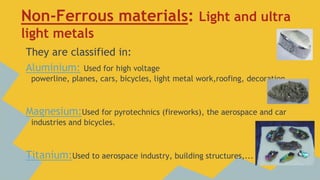
Non-Ferrous materials: Light and ultra
light metals
They are classified in:
Aluminium: Used for high voltage
powerline, planes, cars, bicycles, light metal work,roofing, decoration,...

Magnesium:Used for pyrotechnics (fireworks), the aerospace and car
industries and bicycles.

Titanium:Used to aerospace industry, building structures,...
Shaping techniques
There are different processes and techniques to shape
metals depending on the type of metal and object we
want to make.
They are classified in:
Shaping
Powder metallurgy
Casting

•
•
•
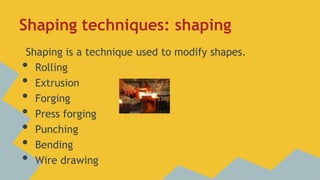
Shaping techniques: shaping
Shaping is a technique used to modify shapes.
Rolling
Extrusion
Forging
Press forging
Punching
Bending
Wire drawing

•
•
•
•
•
•
•
Shaping techniques: Powder
Metallurgy
This process has five stages:
1st: The metal is ground into powder.
2nd: It is pressed into steel dies.
3rd: It is heated to a temperature close to 70% of the
metal's melting point.
4th: Pressure is applied to produce the required
dimensions.
5th: The object is left to cool (it loses heat)
Shaping techniques: Casting
The mould can be made from sand, steel or cast iron.
The casting process:
1. The metal is heated to melting point.
2. The liquid metal is poured into the mould.
3. The mould and metal are left to cool until the
material has solidified.
4. The solidified piece is extracted from the mould.
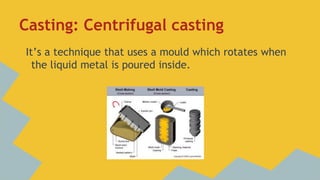
Casting: Centrifugal casting
It’s a technique that uses a mould which rotates when
the liquid metal is poured inside.
Cutting, joining and finishing
techiniques:
Hand tools or power tools are used to cut prefabricated
materials.
They also, are classificated by:
· Marking
· Rough finishing
· Cutting
· Permanent joints
· Drilling
· Temporary joints
· Shaping
· Finishes
THE END

Metals

  • 1.
    Metals Properties and Techniques By:Mel Fàbregas,Yeray Freire, Lara Hosking and Ara Forcadell.
  • 2.
    Description: ● The metalscan be used in many ways: transport, telecommunications, machinery, construction and manufacturing. ● Metals are usually: · Hard · Non-adhesive · Cold and Smooth · Often shiny
  • 3.
    Properties There are 3types of properties: · Physical: A physical property is any property that is measurable whose value describes a state of a physical system. · Chemical: A chemical property is any of a material's properties that becomes evident during a chemical reaction. · Ecological: A ecological property is any material that can be recyclable and reusable, however it also can be toxic.
  • 5.
    Where and howmetals are obtained We obtain the metals from the minerals in rocks. • • Surface mining: When the mineral is near the surface. Underground mining: When the mineral is deep. when we mine, we use explosives, excavators, drills and other machines. The minerals are separated into ore and gangue. The metal is extracted with an iron work through a physical and chemical process. The metals can be ferrous and nonferrous.
  • 6.
    Ferrous materials Caracteristics: ·Common ·inexpensive toextract ·need processing to produce pure iron ·used to make alloys ·Pure iron: The concentration of carbon is between 0.008% and 0.03%. ·Steel: The concentration is between 0.03% and 1.76%. ·Cast iron: The concentration is between 1.76% and 6.67%.
  • 7.
    Ferrous Materials: Pureiron and cast iron · PURE IRON: It’s a greyish white metal with good magnetic properties. DISADVANTAGES USES Corrodes easily Only melts in a very high temperature Electrical and electronic components It’s difficult to machine ·CAST IRON: It’s extremely hard and resistant Uses: machinery parts, pistons, street lamps, drain covers,...
  • 8.
    Ferrous materials: steel Steelis an alloy of iron containing a small quantity of carbon. It is very hard and strong, and because of this it has better mechanical properties than iron. Up next there is a Alloy steel group and then the steel making process.
  • 9.
    Alloy steels Other chemicalelements can be added to steel, to improve or achieve certain properties. Here are some common examples: · Silicon · Tungsten · Manganese · Chrome · Nickel · Lead
  • 10.
    The steelmaking process Stagesin the steelmaking process: 1. Iron metal is washed to remove impurities. 2. It is crushed and sieved (the gangue is separated from the ore.) 3. The iron ore is mixed with carbon and limestone 4. This is melted at a temperature of over 1.500 C in a blast furnace. 5. Pig iron is obtained (molten iron with carbon and impurities).
  • 11.
    Non-Ferrous metals Light andultra-light metals: they are separated by aluminum, magnesium and titanium. Heavy metals: they are separated by: lead, tin, zinc, copper, bronze, brass.
  • 12.
    Non-Ferrous materials: Lightand ultra light metals They are classified in: Aluminium: Used for high voltage powerline, planes, cars, bicycles, light metal work,roofing, decoration,... Magnesium:Used for pyrotechnics (fireworks), the aerospace and car industries and bicycles. Titanium:Used to aerospace industry, building structures,...
  • 14.
    Shaping techniques There aredifferent processes and techniques to shape metals depending on the type of metal and object we want to make. They are classified in: Shaping Powder metallurgy Casting • • •
  • 15.
    Shaping techniques: shaping Shapingis a technique used to modify shapes. Rolling Extrusion Forging Press forging Punching Bending Wire drawing • • • • • • •
  • 16.
    Shaping techniques: Powder Metallurgy Thisprocess has five stages: 1st: The metal is ground into powder. 2nd: It is pressed into steel dies. 3rd: It is heated to a temperature close to 70% of the metal's melting point. 4th: Pressure is applied to produce the required dimensions. 5th: The object is left to cool (it loses heat)
  • 17.
    Shaping techniques: Casting Themould can be made from sand, steel or cast iron. The casting process: 1. The metal is heated to melting point. 2. The liquid metal is poured into the mould. 3. The mould and metal are left to cool until the material has solidified. 4. The solidified piece is extracted from the mould.
  • 18.
    Casting: Centrifugal casting It’sa technique that uses a mould which rotates when the liquid metal is poured inside.
  • 19.
    Cutting, joining andfinishing techiniques: Hand tools or power tools are used to cut prefabricated materials. They also, are classificated by: · Marking · Rough finishing · Cutting · Permanent joints · Drilling · Temporary joints · Shaping · Finishes
  • 20.