4630 CR 209 S.
Green Cove Springs, FL 32043
904-284-5611
www.rollerdie.com
Roll Forming – Stamping – Press Brake – Powder Coating – Polishing – Welding - Assembly
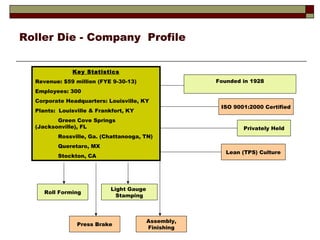
Roller Die - Company Profile
Key Statistics
Revenue: $59 million (FYE 9-30-13)
Employees: 300
Corporate Headquarters: Louisville, KY
Plants: Louisville & Frankfort, KY
Green Cove Springs
(Jacksonville), FL
Rossville, Ga. (Chattanooga, TN)
Queretaro, MX
Stockton, CA
Founded in 1928
ISO 9001:2000 Certified
Privately Held
Lean (TPS) Culture
Press Brake
Light Gauge
Stamping
Assembly,
Finishing
Roll Forming
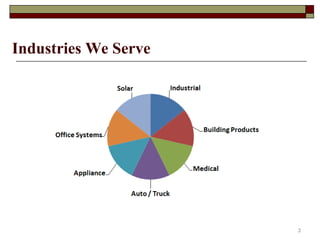
Industries We Serve
3
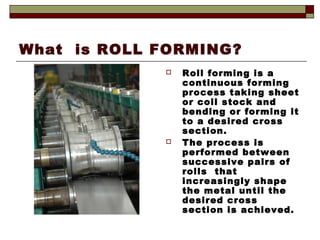
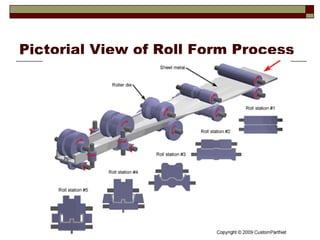
What is ROLL FORMING?
 Roll forming is a
continuous forming
process taking sheet
or coil stock and
bending or forming it
to a desired cross
section.
 The process is
performed between
successive pairs of
rolls that
increasingly shape
the metal until the
desired cross
section is achieved.
Pictorial View of Roll Form Process
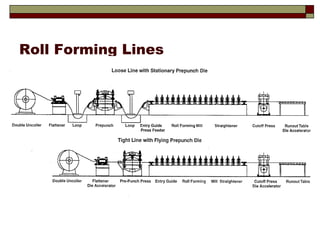
Roll Forming Lines
Materials
 Almost any material that can tolerate
bending to a desired radius can be roll
formed.
 The more ductile a material is, the
better it will roll form.
 The roll forming process can handle
ferrous, nonferrous, hot rolled, cold
rolled, polished, plated, or pre-painted
metals producing excellent results.
Materials
 Materials as thin as 0.005" and as
thick as 0.750" can be roll formed,
depending upon the size of the roll
form machine spindles.
 Material pieces as narrow as 1/8" and
as wide as 72", or more, can be roll
formed, depending on machine size.
Design Considerations
 Bend Radii:
 Best practice is a one-metal-
thickness inside radius.
 May need slightly larger in high-
strength steels
 Sharper corners CAN be obtained at
the expense of tool life
 Scoring the inside of the strip can
help make sharper corners in some
cases.
Design Considerations
 Deep sections:
 Require more passes, larger
machines, larger rolls and dies
 Risk overstressing the edges of the
material
 Typical machines – 100 mm max.
height of part
 Short Legs:
 Three times metal thickness is a
good minimum leg length
Design Considerations
 Wide sections
 Apply ribs or offsets to wide panels
 Helps prevent wrinkles, “oil-
canning”
 Often wide material has appearance
issues
Design Considerations
 Cross Section Tolerances
 Typically +/- .25 mm to +/- .75 mm
 Tighter tolerances are achievable:
 Different approach to tooling
 Special quality materials
 Angular Tolerances
 Typically +/- 1º
Design Considerations
 Length Tolerance
 Influenced by many factors:
 Length of part
 Speed of rollformer
 Measuring system
 Cutoff system
 Material properties
 Commonly available: +/- 0.8 mm
 Special equipment and tooling: +/-
0.25 mm
 Long parts (3 M or more): +/- 3.0 mm
and up
Design Considerations
 Straightness:
 Bow (up or down) or Curve (side to side) –
1.0 mm per Meter
 Twist - 1 degree per Meter
 Flare:
 Typically avoid measuring the cross
section within 50 mm of ends.
 Flare can be controlled with special
attention
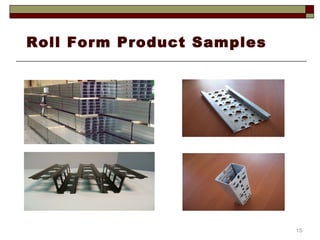
Roll Form Product Samples
15
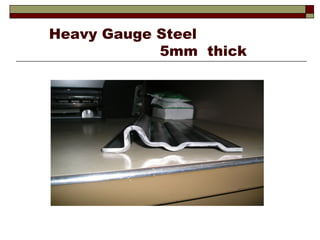
Heavy Gauge Steel
5mm thick
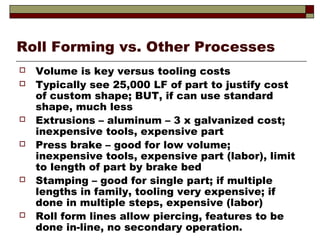
Roll Forming vs. Other Processes
 Volume is key versus tooling costs
 Typically see 25,000 LF of part to justify cost
of custom shape; BUT, if can use standard
shape, much less
 Extrusions – aluminum – 3 x galvanized cost;
inexpensive tools, expensive part
 Press brake – good for low volume;
inexpensive tools, expensive part (labor), limit
to length of part by brake bed
 Stamping – good for single part; if multiple
lengths in family, tooling very expensive; if
done in multiple steps, expensive (labor)
 Roll form lines allow piercing, features to be
done in-line, no secondary operation.
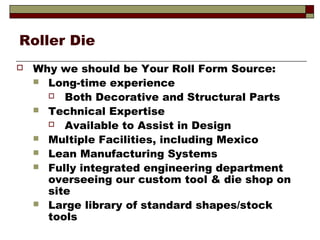
Roller Die
 Why we should be Your Roll Form Source:
 Long-time experience
 Both Decorative and Structural Parts
 Technical Expertise
 Available to Assist in Design
 Multiple Facilities, including Mexico
 Lean Manufacturing Systems
 Fully integrated engineering department
overseeing our custom tool & die shop on
site
 Large library of standard shapes/stock
tools

Roll Forming Presentation

  • 1.
    4630 CR 209S. Green Cove Springs, FL 32043 904-284-5611 www.rollerdie.com Roll Forming – Stamping – Press Brake – Powder Coating – Polishing – Welding - Assembly
  • 2.
    Roller Die -Company Profile Key Statistics Revenue: $59 million (FYE 9-30-13) Employees: 300 Corporate Headquarters: Louisville, KY Plants: Louisville & Frankfort, KY Green Cove Springs (Jacksonville), FL Rossville, Ga. (Chattanooga, TN) Queretaro, MX Stockton, CA Founded in 1928 ISO 9001:2000 Certified Privately Held Lean (TPS) Culture Press Brake Light Gauge Stamping Assembly, Finishing Roll Forming
  • 3.
  • 4.
    What is ROLLFORMING?  Roll forming is a continuous forming process taking sheet or coil stock and bending or forming it to a desired cross section.  The process is performed between successive pairs of rolls that increasingly shape the metal until the desired cross section is achieved.
  • 5.
    Pictorial View ofRoll Form Process
  • 6.
  • 7.
    Materials  Almost anymaterial that can tolerate bending to a desired radius can be roll formed.  The more ductile a material is, the better it will roll form.  The roll forming process can handle ferrous, nonferrous, hot rolled, cold rolled, polished, plated, or pre-painted metals producing excellent results.
  • 8.
    Materials  Materials asthin as 0.005" and as thick as 0.750" can be roll formed, depending upon the size of the roll form machine spindles.  Material pieces as narrow as 1/8" and as wide as 72", or more, can be roll formed, depending on machine size.
  • 9.
    Design Considerations  BendRadii:  Best practice is a one-metal- thickness inside radius.  May need slightly larger in high- strength steels  Sharper corners CAN be obtained at the expense of tool life  Scoring the inside of the strip can help make sharper corners in some cases.
  • 10.
    Design Considerations  Deepsections:  Require more passes, larger machines, larger rolls and dies  Risk overstressing the edges of the material  Typical machines – 100 mm max. height of part  Short Legs:  Three times metal thickness is a good minimum leg length
  • 11.
    Design Considerations  Widesections  Apply ribs or offsets to wide panels  Helps prevent wrinkles, “oil- canning”  Often wide material has appearance issues
  • 12.
    Design Considerations  CrossSection Tolerances  Typically +/- .25 mm to +/- .75 mm  Tighter tolerances are achievable:  Different approach to tooling  Special quality materials  Angular Tolerances  Typically +/- 1º
  • 13.
    Design Considerations  LengthTolerance  Influenced by many factors:  Length of part  Speed of rollformer  Measuring system  Cutoff system  Material properties  Commonly available: +/- 0.8 mm  Special equipment and tooling: +/- 0.25 mm  Long parts (3 M or more): +/- 3.0 mm and up
  • 14.
    Design Considerations  Straightness: Bow (up or down) or Curve (side to side) – 1.0 mm per Meter  Twist - 1 degree per Meter  Flare:  Typically avoid measuring the cross section within 50 mm of ends.  Flare can be controlled with special attention
  • 15.
  • 16.
  • 17.
    Roll Forming vs.Other Processes  Volume is key versus tooling costs  Typically see 25,000 LF of part to justify cost of custom shape; BUT, if can use standard shape, much less  Extrusions – aluminum – 3 x galvanized cost; inexpensive tools, expensive part  Press brake – good for low volume; inexpensive tools, expensive part (labor), limit to length of part by brake bed  Stamping – good for single part; if multiple lengths in family, tooling very expensive; if done in multiple steps, expensive (labor)  Roll form lines allow piercing, features to be done in-line, no secondary operation.
  • 18.
    Roller Die  Whywe should be Your Roll Form Source:  Long-time experience  Both Decorative and Structural Parts  Technical Expertise  Available to Assist in Design  Multiple Facilities, including Mexico  Lean Manufacturing Systems  Fully integrated engineering department overseeing our custom tool & die shop on site  Large library of standard shapes/stock tools