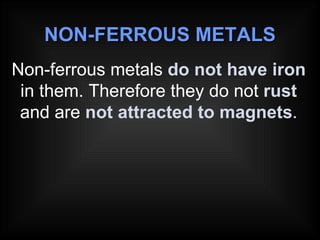
NON-FERROUS METALS Non-ferrous metals  do not have iron  in them. Therefore they do not  rust  and are  not attracted to magnets .
NON-FERROUS METALS Most non-ferrous metals are  soft . By ‘ alloying ’ with other materials, they form new materials and become stronger for further applications. These are known also as ‘ non-ferrous alloys ’.
NON-FERROUS METALS Name Properties Uses ALUMINIUM (Pure metal) Greyish-white colour The second most widely used metal after steel Lightweight Good conductor of electricity and heat Easy to cut and machine. Engine parts Cooking foil Drink cans Overhead power cables Road signs COPPER (Pure metal) Reddish-brown colour Ductile Malleable Excellent conductor of heat and electricity Electrical fitting and wires Tips of soldering iron Domestic water pipes Cooking utensils
NON-FERROUS METALS Core of some batteries Can be mixed with other protection against x-rays and radiation Weights Solder Bluish-grey colour when cut but surface changes quickly to a dull grey Heavy but soft Resistant to corrosion Toxic LEAD (Pure metal) Name Properties Uses TIN (Pure metal) Silvery-white colour Non-toxic Soft Tinplate from which food cans are made Coating or printed circuit boards ZINC (Pure metal) Silvery-blue colour Ductile but rather weak Good corrosion resistance Manufacture of galvanised iron Batteries Rust-proof paints Roof
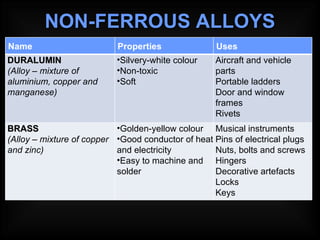
NON-FERROUS ALLOYS Name Properties Uses DURALUMIN (Alloy – mixture of  aluminium, copper and manganese ) Silvery-white colour Non-toxic Soft Aircraft and vehicle parts Portable ladders Door and window frames Rivets BRASS (Alloy – mixture of  copper and zinc ) Golden-yellow colour Good conductor of heat and electricity Easy to machine and solder Musical instruments Pins of electrical plugs Nuts, bolts and screws Hingers Decorative artefacts Locks Keys
NON-FERROUS ALLOYS Name Properties Uses BRONZE (Alloy – mixture  of copper and tin ) Reddish-yellow colour Corrosion resistant Easily machined ship propellers Bells Gears Bearings Statues PEWTER (Alloy – mixture of  copper, tin and antimony ) Silvery colour Soft and malleable Ornaments such as plaques, vases, mugs and souvenirs

Metal non ferrous

  • 1.
    NON-FERROUS METALS Non-ferrousmetals do not have iron in them. Therefore they do not rust and are not attracted to magnets .
  • 2.
    NON-FERROUS METALS Mostnon-ferrous metals are soft . By ‘ alloying ’ with other materials, they form new materials and become stronger for further applications. These are known also as ‘ non-ferrous alloys ’.
  • 3.
    NON-FERROUS METALS NameProperties Uses ALUMINIUM (Pure metal) Greyish-white colour The second most widely used metal after steel Lightweight Good conductor of electricity and heat Easy to cut and machine. Engine parts Cooking foil Drink cans Overhead power cables Road signs COPPER (Pure metal) Reddish-brown colour Ductile Malleable Excellent conductor of heat and electricity Electrical fitting and wires Tips of soldering iron Domestic water pipes Cooking utensils
  • 4.
    NON-FERROUS METALS Coreof some batteries Can be mixed with other protection against x-rays and radiation Weights Solder Bluish-grey colour when cut but surface changes quickly to a dull grey Heavy but soft Resistant to corrosion Toxic LEAD (Pure metal) Name Properties Uses TIN (Pure metal) Silvery-white colour Non-toxic Soft Tinplate from which food cans are made Coating or printed circuit boards ZINC (Pure metal) Silvery-blue colour Ductile but rather weak Good corrosion resistance Manufacture of galvanised iron Batteries Rust-proof paints Roof
  • 5.
    NON-FERROUS ALLOYS NameProperties Uses DURALUMIN (Alloy – mixture of aluminium, copper and manganese ) Silvery-white colour Non-toxic Soft Aircraft and vehicle parts Portable ladders Door and window frames Rivets BRASS (Alloy – mixture of copper and zinc ) Golden-yellow colour Good conductor of heat and electricity Easy to machine and solder Musical instruments Pins of electrical plugs Nuts, bolts and screws Hingers Decorative artefacts Locks Keys
  • 6.
    NON-FERROUS ALLOYS NameProperties Uses BRONZE (Alloy – mixture of copper and tin ) Reddish-yellow colour Corrosion resistant Easily machined ship propellers Bells Gears Bearings Statues PEWTER (Alloy – mixture of copper, tin and antimony ) Silvery colour Soft and malleable Ornaments such as plaques, vases, mugs and souvenirs