Metadata for  Terminology / KOS Resources Marcia Lei Zeng NKOS Workshop 2008
Registry Types Metadata Schemas Registries  Elements and refinements, application profiles, schemas in different bindings …  e,g., UKOLN  CORES Registry   Terminology Registries / Repositories Registries for schemes (metadata) only Registries of the entries of vocabularies (usually accompanied by scheme’s metadata)  e.g.,  OCLC Terminologies Service ;  BioPortal  ontology repository Service Registries  Terminology services may be listed in a terminology registry or separately hosted in a service registry Data Standards Registries (integrated) Registries/repositories of data standards (e.g., data dictionaries, data models, schemas, and code sets)
1. Why do we need metadata for terminology resources? 2. What do we need to know about a terminology resource? 3. Is there a standardized set of metadata elements for terminology resources?
1. Why do we need metadata for  terminology  resources?
Basically, metadata for terminology resources will … record specific characteristics of terminology resources facilitate the  discovery  of terminology resources facilitate the  evaluation  of the terminology resource for a particular application or use facilitate  sharing, reusing, and collaboration
Types of terminology registries 1)  Registries  providing  metadata  for  each vocabulary  and linking to vocabulary owner/provider  2)  Registries  providing  metadata  on (and linking to) any available  terminology services 3)  Registries  providing  access  to the  vocabulary content   by downloading the complete vocabulary via access to a vocabulary’s concepts, terms and relationships -  Golub & Tudhope , TRSS Report, 2008
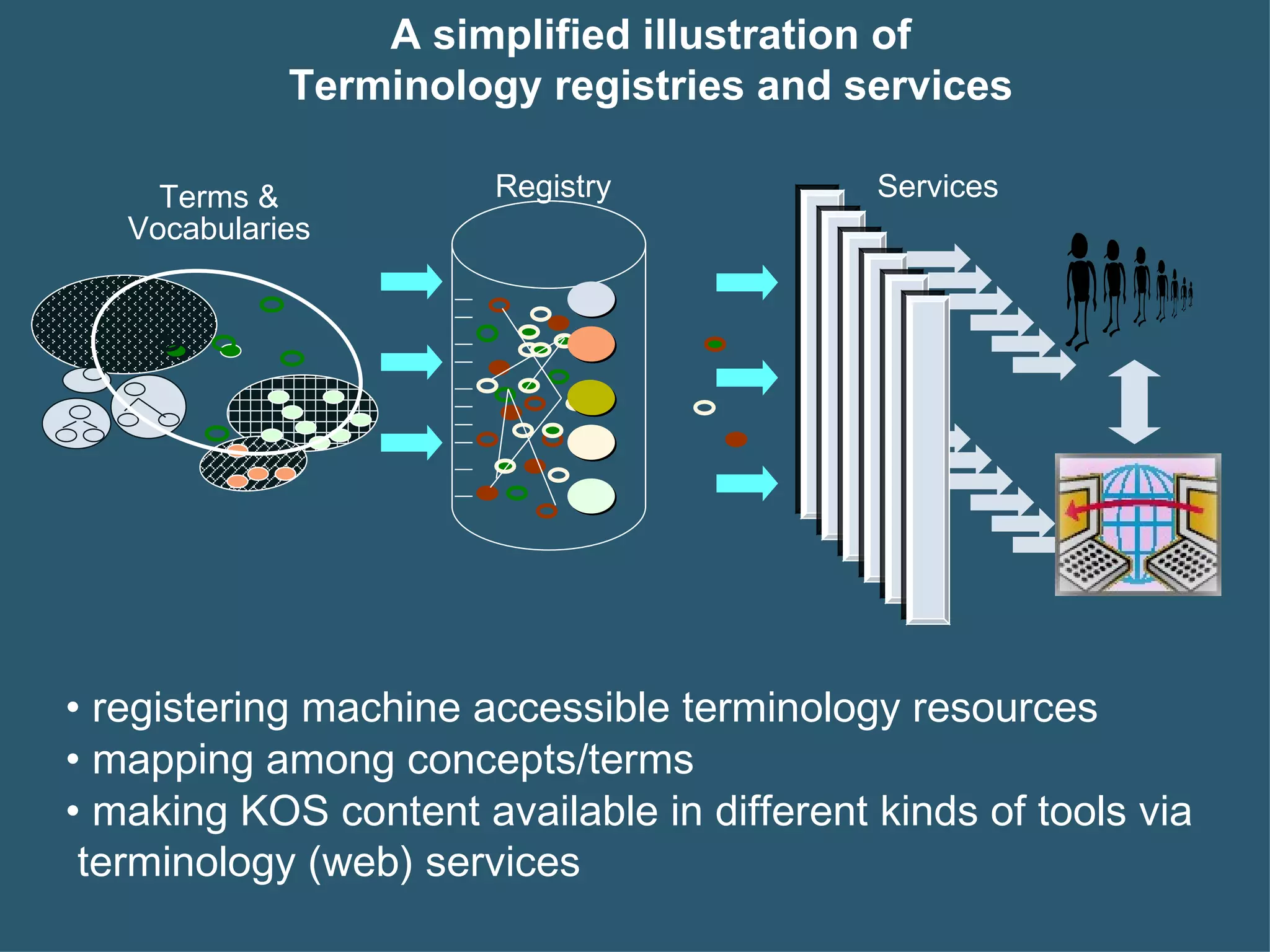
registering machine accessible terminology resources mapping among concepts/terms making KOS content available in different kinds of tools via  terminology (web) services A simplified illustration of Terminology registries and services Registry Terms & Vocabularies Services
Related to the terminology registries are services, which may also be listed in a terminology registry or separately hosted in a  service registry .  These services, based on terminology, are used for automatic classification, term expansion, disambiguation, translation, and semantic reasoning. Terminology-based Services
Terminology registries need to provide information about:   sources used creation and revision dates  provenance  trustworthiness of sources  quality assessment metrics for the vocabulary & source materials licensing, IP limitations flexibility for integration with other KOS specific requirements such as  performance security maintainability The need of metadata (1)  --  terminology registries   -- based on Elisa Kendall, 2008
Service registries need to understand and provide information on: Data models Tool interoperability Protocol Querying and accessibility Affectivity – at what time, location, and/or use is the content applicable or valid Available formats  The need of metadata (2) --  service registries
Different agents, services, and applications need to  communicate  about KOS data in the form of: transferring exchange transformation mediation migration  integration The need of metadata (3) --  vocabulary users
2. What do we need to know about a terminology resource? Descriptive metadata Administrative metadata Structural metadata
Creator? Domain or subject area? Copyright? … …  ??? Need more  descriptive  metadata See Glossary at:  http:// swoogle.umbc.edu/index.php?option = com_swoogle_manual&manual =glossary [ Swoogle’s Metadata Scheenshots ]
Domain / subject area? Number of triples? Number of classes? [Useful? Useable?] [ Images of :  SchemaWeb  Kissology scheme details  kissology: classes and properties]
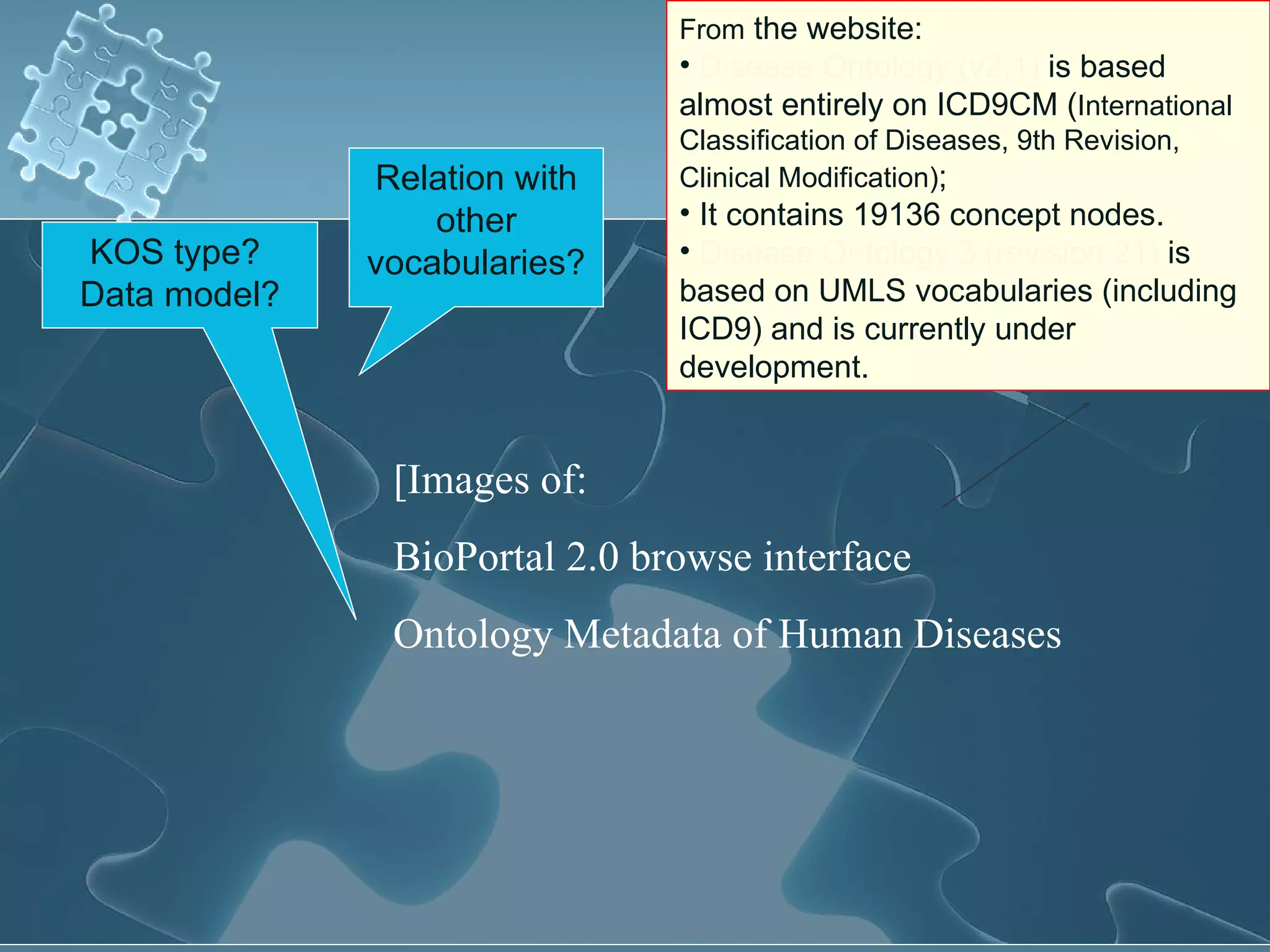
Relation with other vocabularies? From  the website: Disease Ontology (v2.1)  is based almost entirely on ICD9CM ( International Classification of Diseases, 9th Revision, Clinical Modification) ;  It contains 19136 concept nodes.  Disease Ontology 3 (revision 21)  is based on UMLS vocabularies (including ICD9) and is currently under development.  KOS type?  Data model? [Images of:  BioPortal 2.0 browse interface  Ontology Metadata of Human Diseases
3. Is there a standardized set of metadata elements for terminology resources?
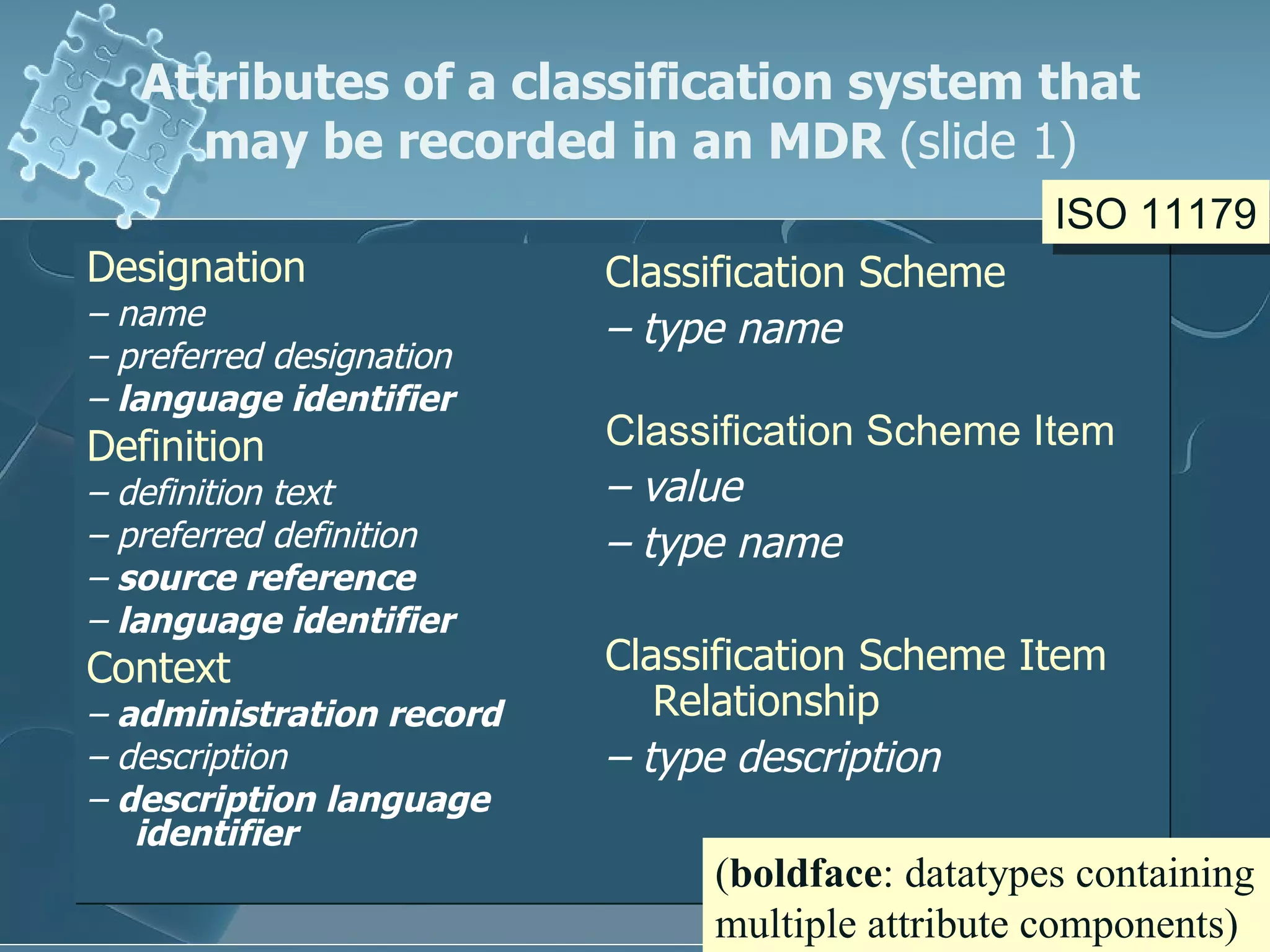
International Standard  -- ISO 11179  ISO 11179-2 Information Technology --  Metadata registries (MDR) - Part 2 Classification* (*CLASSIFICATION schemes include: key words, thesauri, taxonomies, and ontologies.) http://metadata-standards.org/11179/
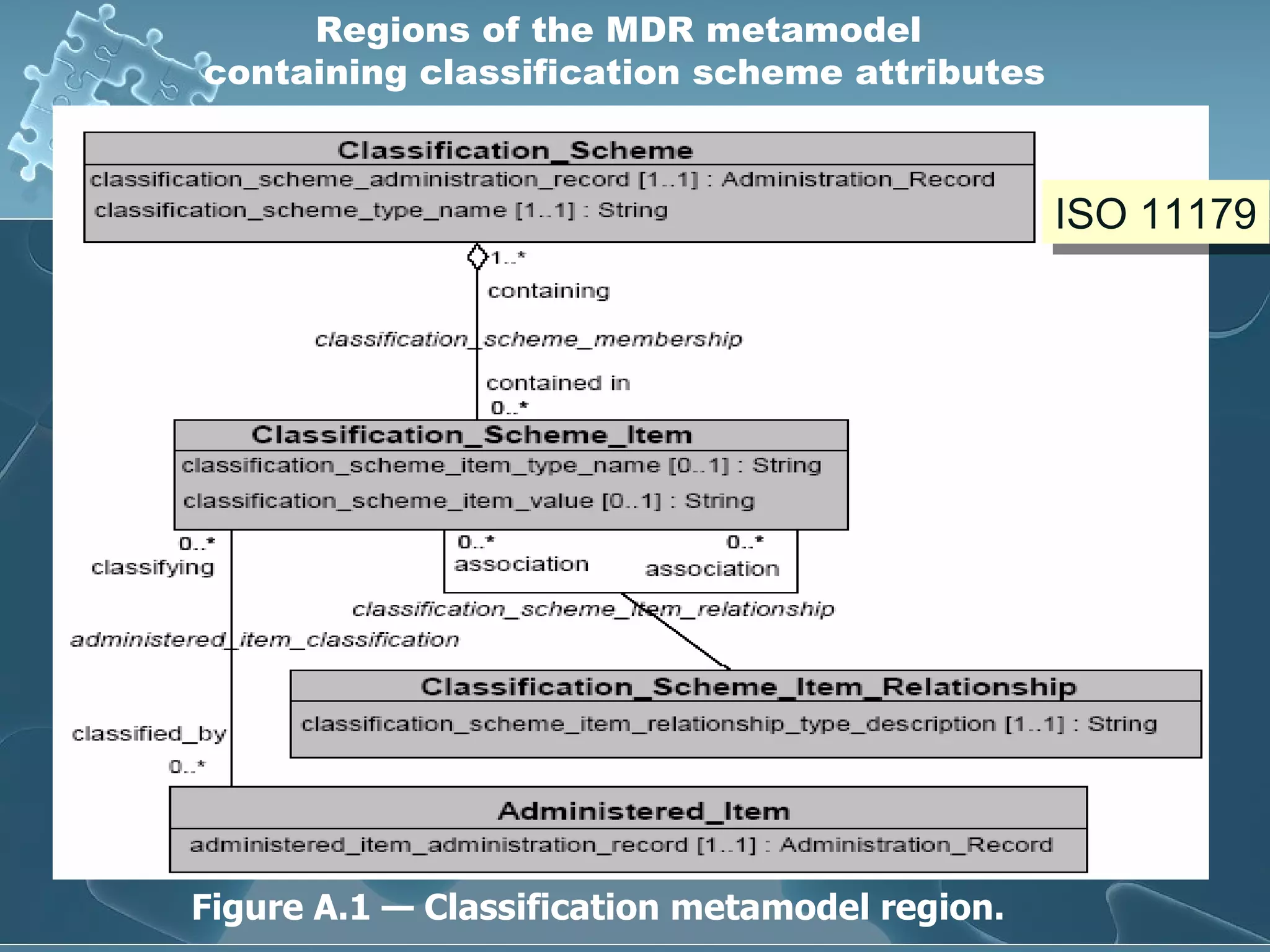
Figure A.1 — Classification metamodel region. Regions of the MDR metamodel  containing classification scheme attributes ISO 11179
Attributes of a classification system that may be recorded in an MDR  (slide 1) Designation –  name  –  preferred designation  –   language identifier  Definition –  definition text  –  preferred definition  –  source reference  –  language identifier  Context  –  administration record  –  description  –  description language identifier   Classification Scheme   –  type name  Classification Scheme Item –  value  –  type name  Classification Scheme Item Relationship   –  type description ( boldface : datatypes containing  multiple attribute components) ISO 11179
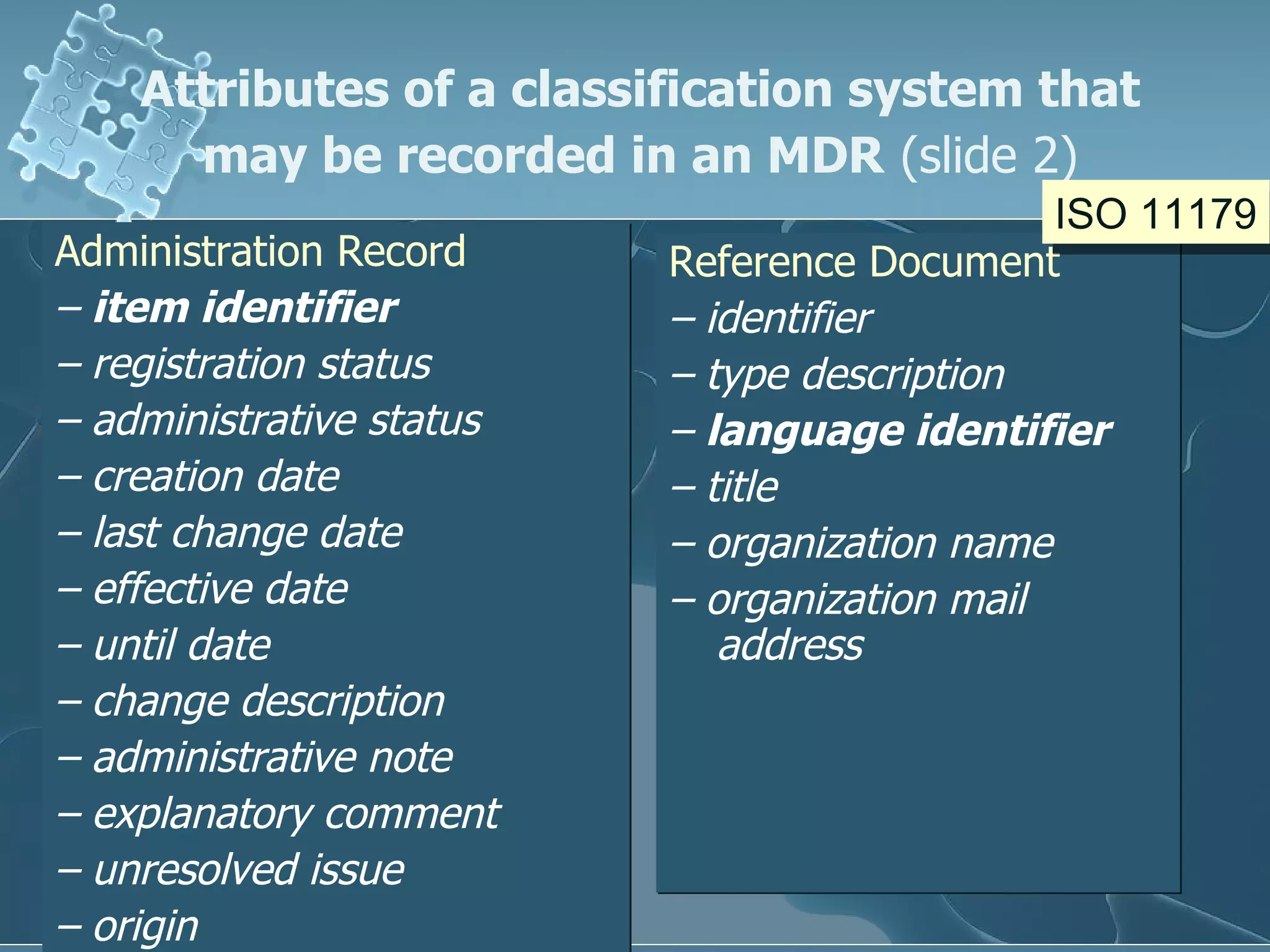
Administration Record   –  item identifier –  registration status  –  administrative status  –  creation date  –  last change date  –  effective date  –  until date  –  change description –  administrative note  –  explanatory comment  –  unresolved issue  –  origin   Reference Document –  identifier  –  type description  –  language identifier  –  title  –  organization name  –  organization mail address Attributes of a classification system that may be recorded in an MDR   (slide 2) ISO 11179
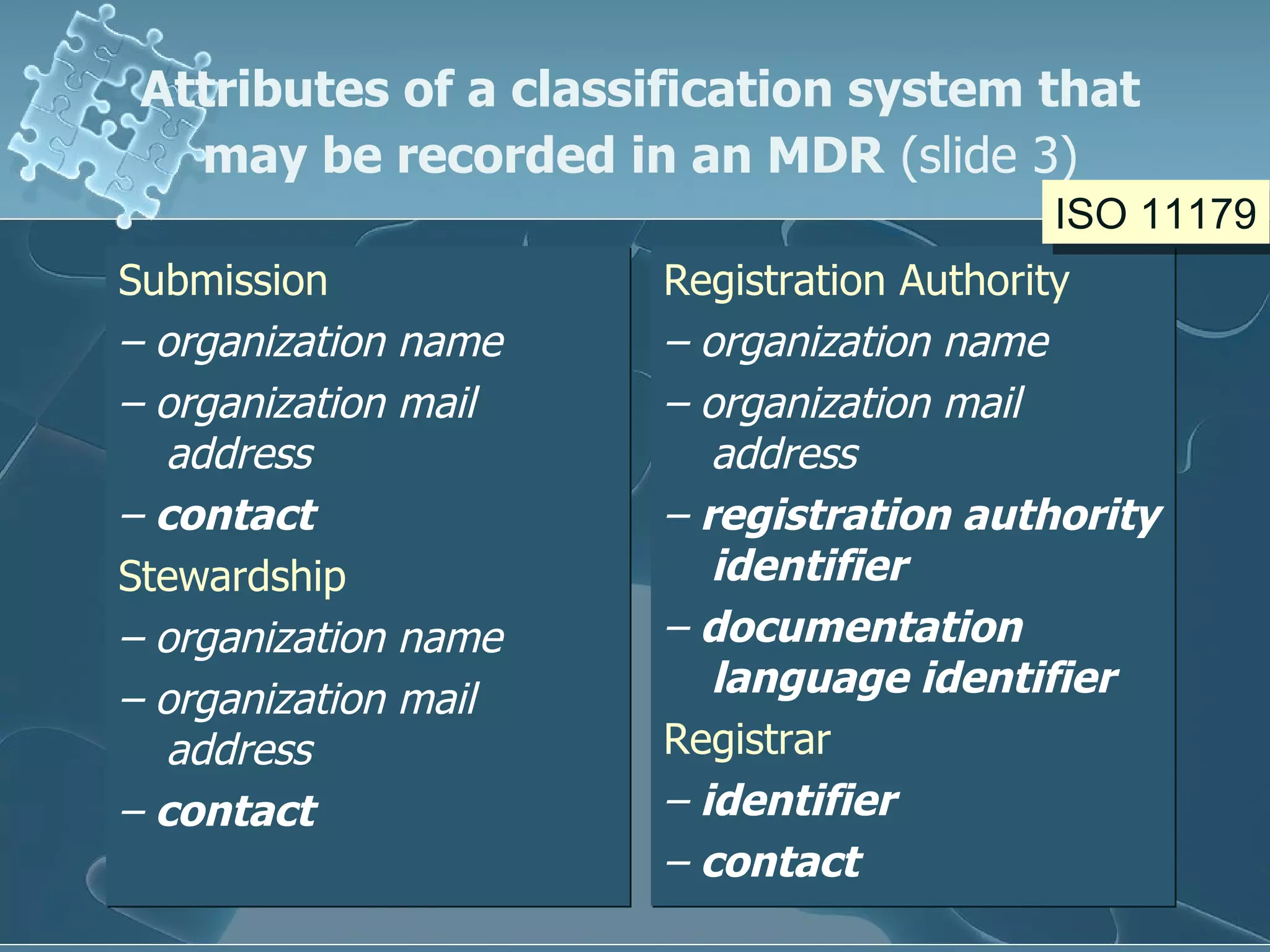
Submission –  organization name  –  organization mail address  –  contact  Stewardship   –  organization name –  organization mail address  –  contact   Registration Authority –  organization name  –  organization mail address –  registration authority identifier –  documentation language identifier Registrar   –  identifier  –  contact   Attributes of a classification system that may be recorded in an MDR   (slide 3) ISO 11179
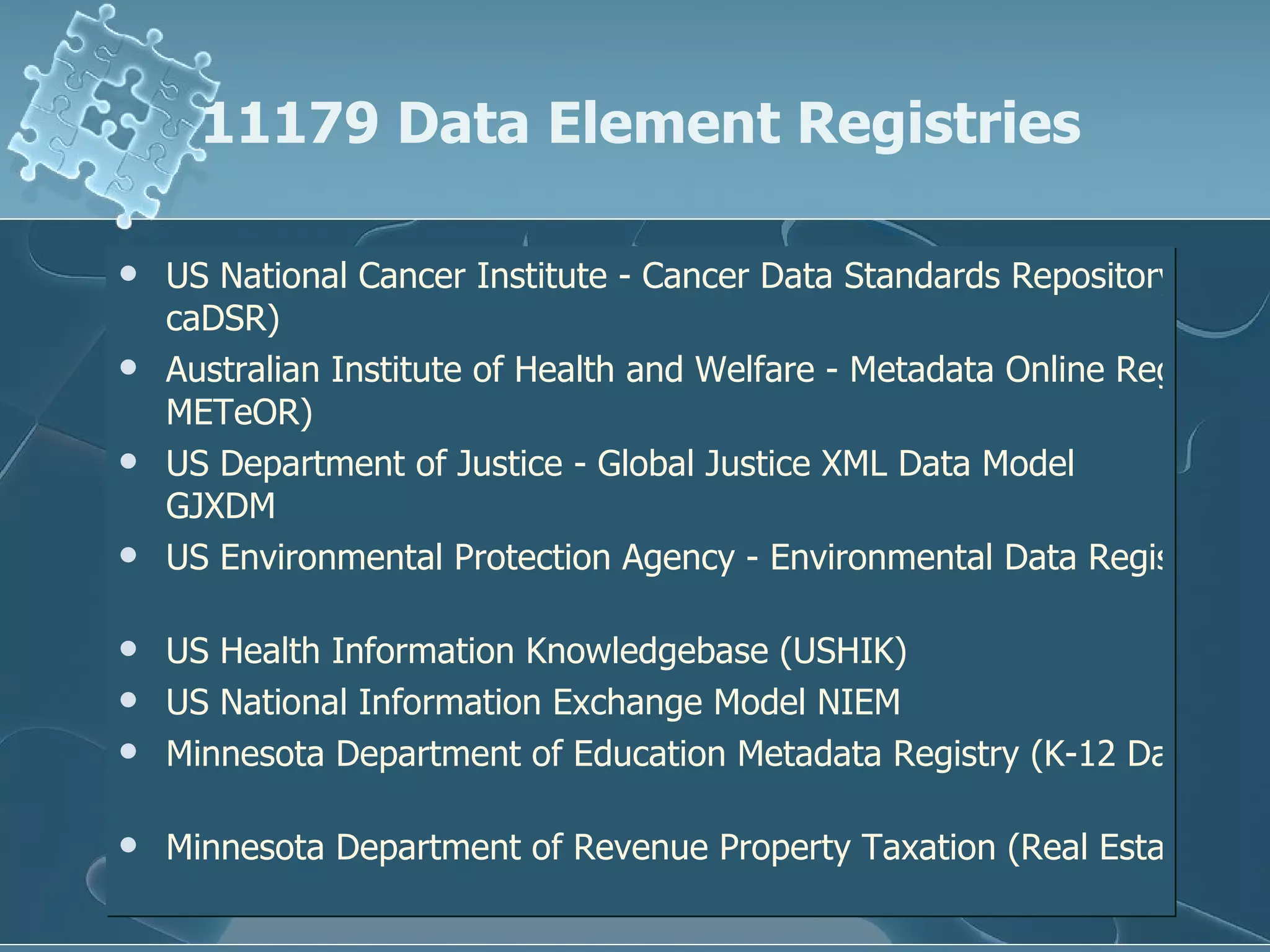
11179 Data Element Registries US National Cancer Institute - Cancer Data Standards Repository ( caDSR )  Australian Institute of Health and Welfare - Metadata Online Registry ( METeOR )   US Department of Justice - Global Justice XML Data Model   GJXDM   US Environmental Protection Agency - Environmental Data Registry   US Health Information Knowledgebase (USHIK)   US National Information Exchange Model   NIEM   Minnesota Department of Education Metadata Registry (K-12 Data)   Minnesota Department of Revenue Property Taxation (Real Estate Transactions)
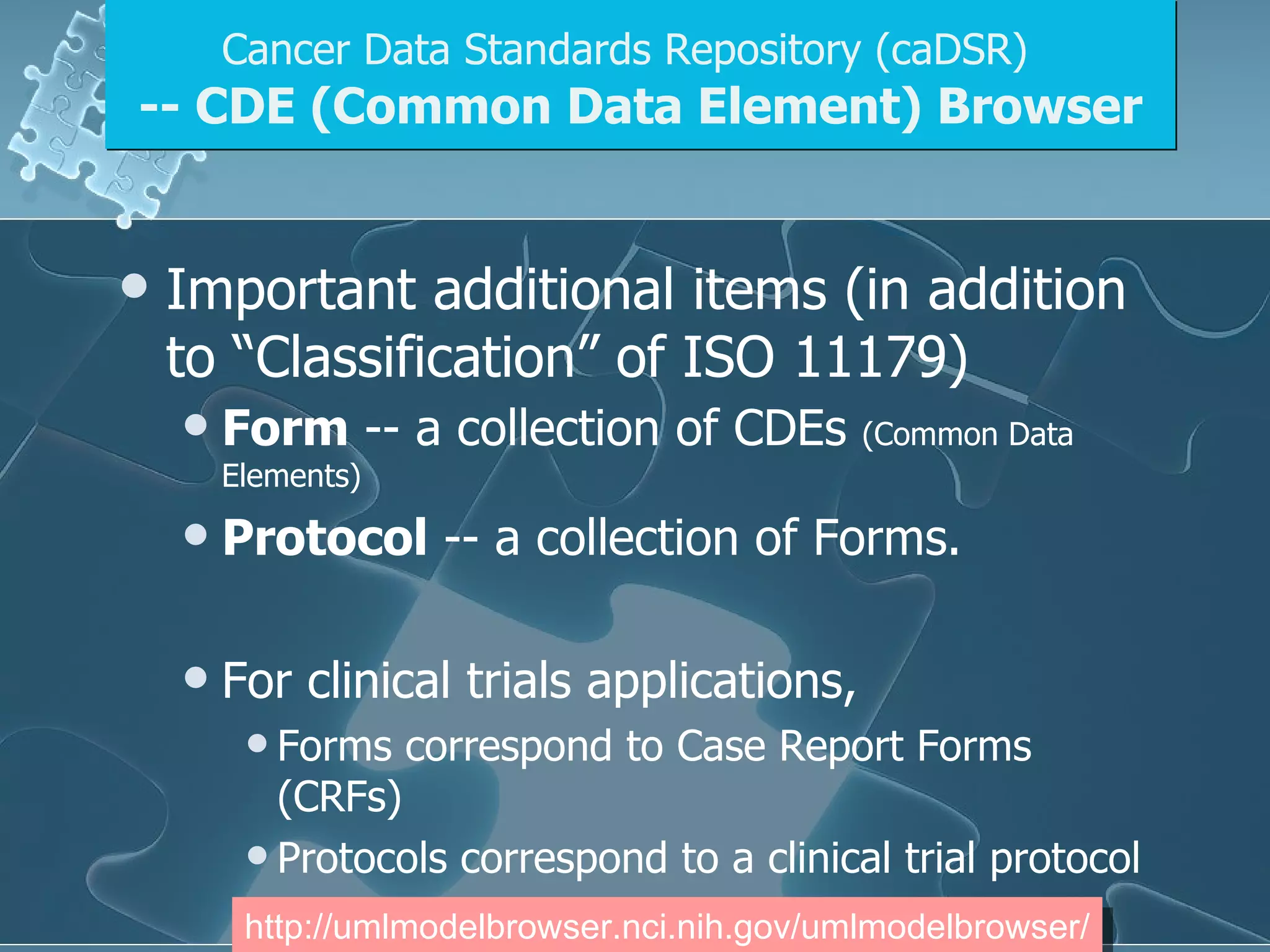
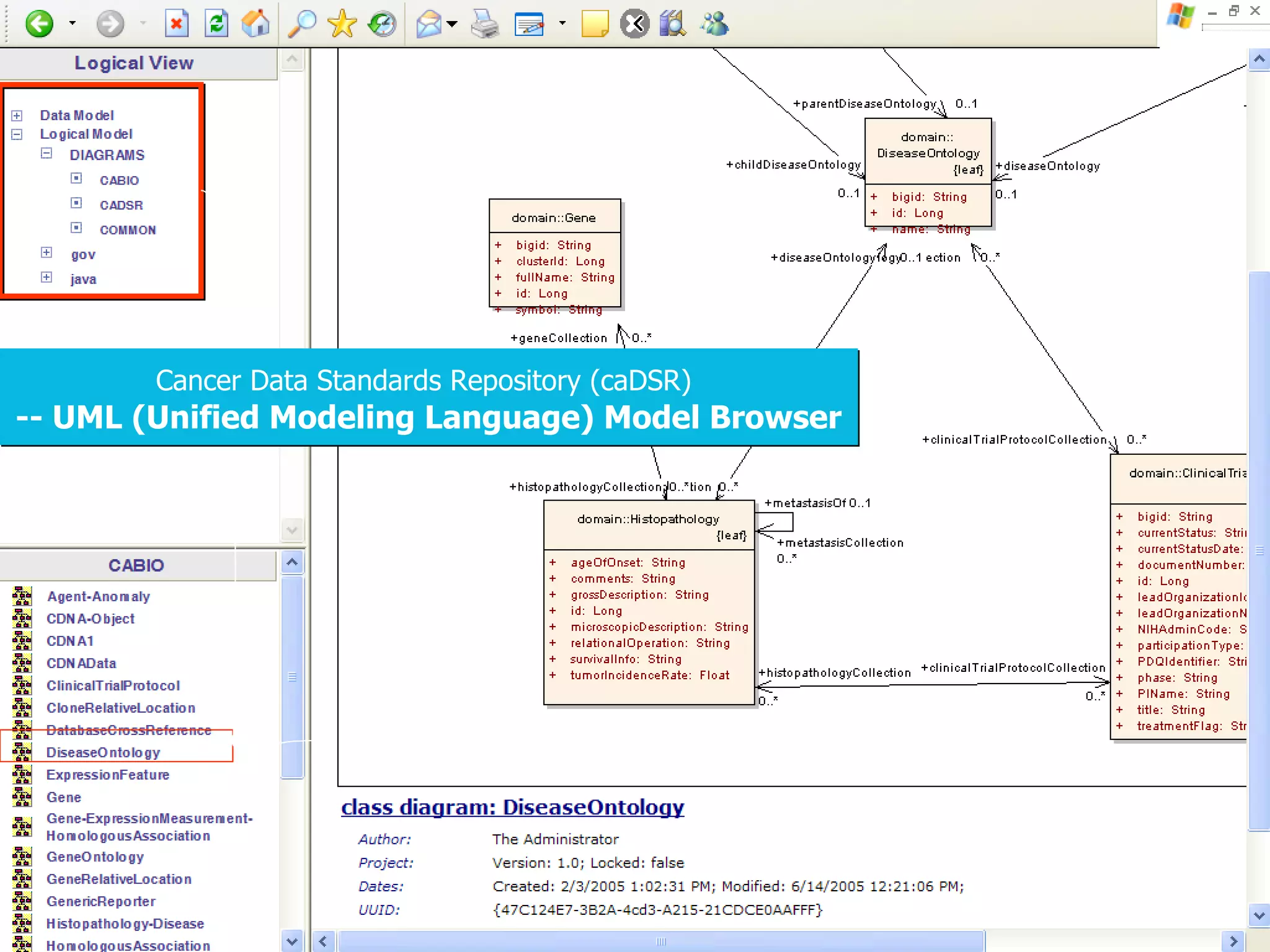
Important additional items (in addition to ā€œClassificationā€ of ISO 11179) Form  -- a collection of CDEs  (Common Data Elements) Protocol  -- a collection of Forms.  For clinical trials applications, Forms correspond to Case Report Forms (CRFs) Protocols correspond to a clinical trial protocol Cancer Data Standards Repository (caDSR)   -- CDE (Common Data Element) Browser http://umlmodelbrowser.nci.nih.gov/umlmodelbrowser/
Cancer Data Standards Repository (caDSR)   -- UML (Unified Modeling Language) Model Browser
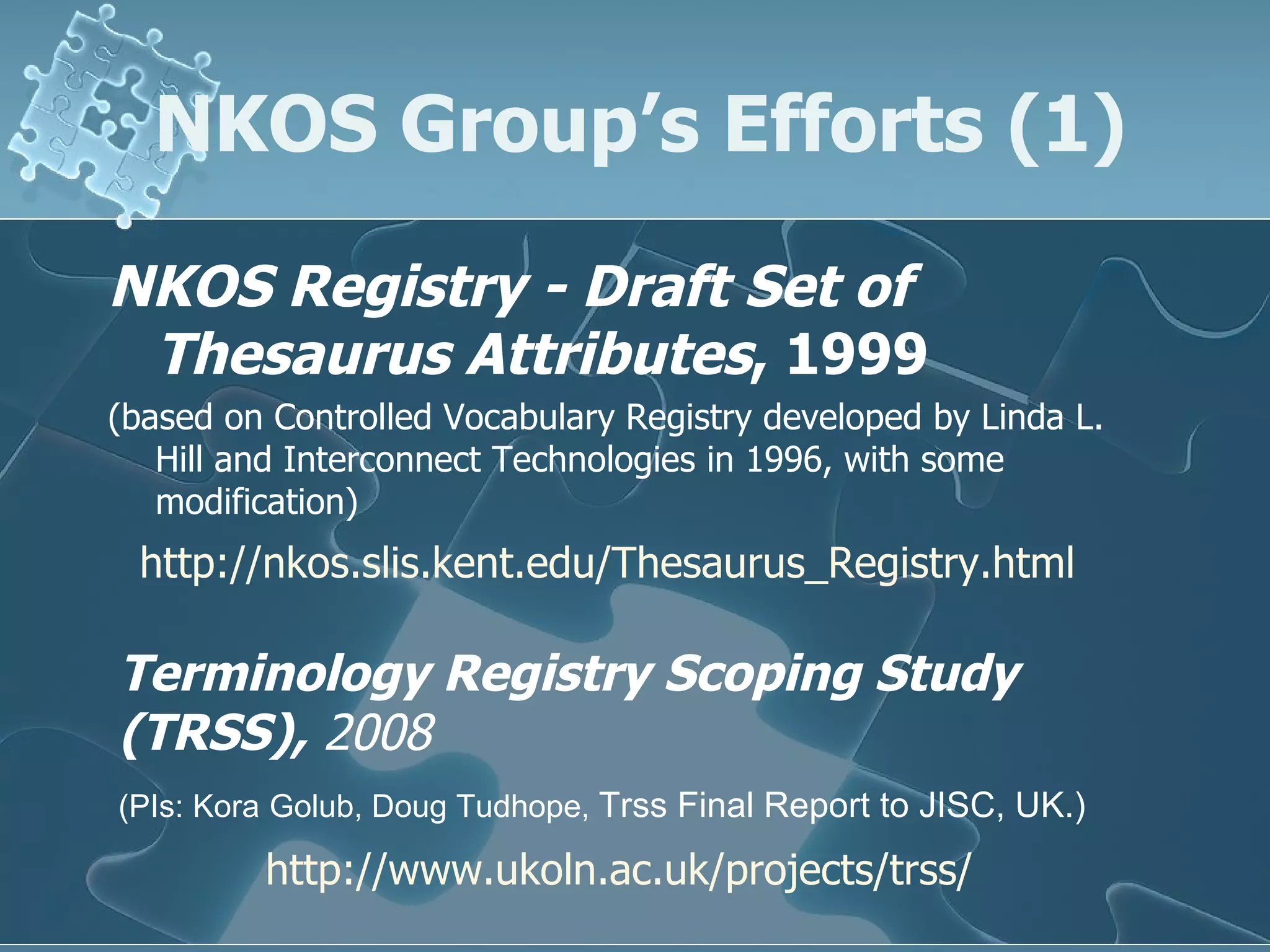
NKOS Group’s Efforts (1) NKOS Registry - Draft Set of Thesaurus Attributes , 1999   (based on Controlled Vocabulary Registry developed by Linda L. Hill and Interconnect Technologies in 1996, with some modification)  Terminology Registry Scoping Study (TRSS),  2008 (PIs:  Kora   Golub, Doug Tudhope,  Trss Final Report to JISC , UK.)   http:// www.ukoln.ac.uk/projects/trss / http:// nkos.slis.kent.edu/Thesaurus_Registry.html
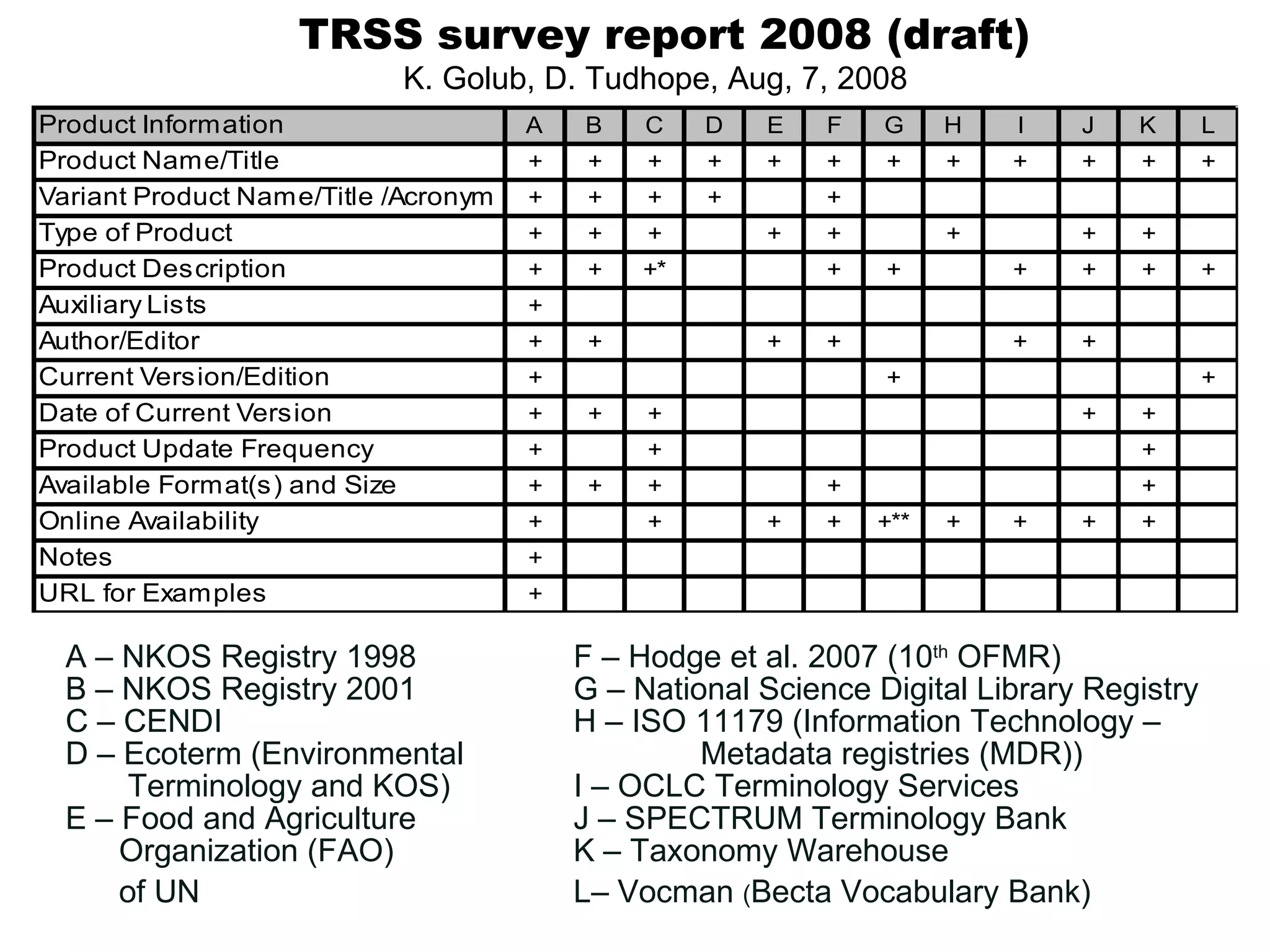
A – NKOS Registry 1998 F – Hodge et al. 2007 (10 th  OFMR) B – NKOS Registry 2001 G – National Science Digital Library Registry C – CENDI H – ISO 11179 (Information Technology –  D – Ecoterm ( Environmental  Metadata registries (MDR)) Terminology and KOS)   I – OCLC Terminology Services   E – Food and Agriculture  J – SPECTRUM Terminology Bank    Organization (FAO)  K – Taxonomy Warehouse of UN   L– Vocman  ( Becta Vocabulary Bank ) TRSS survey report 2008 (draft)  K. Golub, D. Tudhope , Aug, 7, 2008
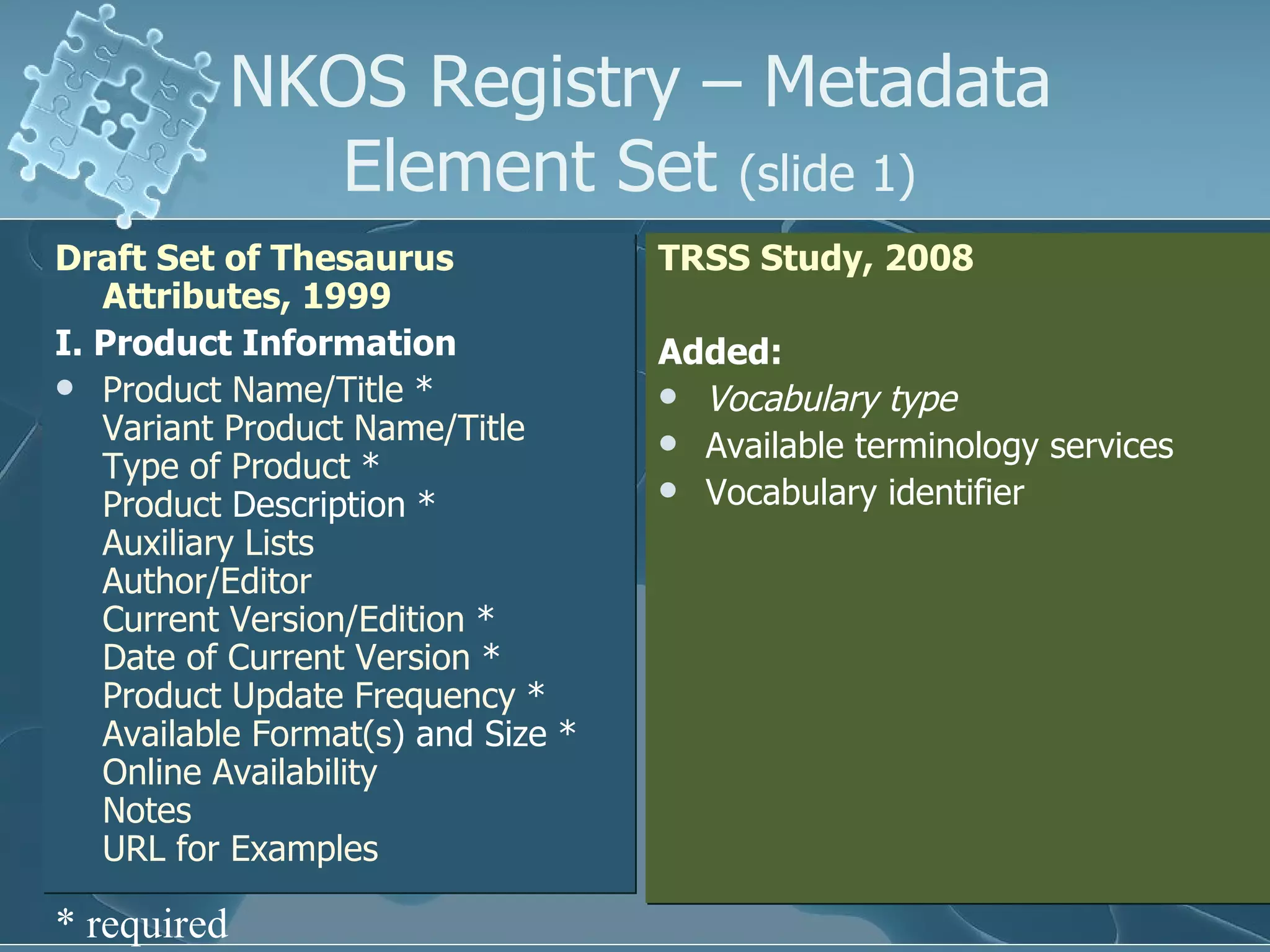
NKOS Registry – Metadata Element Set  (slide 1)   Draft Set of Thesaurus Attributes, 1999 I. Product Information   Product Name/Title  *  Variant Product Name/Title   Type of Product  *  Product  Description  *  Auxiliary Lists   Author/Editor   Current Version/Edition  *  Date of Current Version  *  Product Update Frequency  *  Available  Format(s ) and Size  *  Online Availability   Notes   URL for Examples   TRSS Study, 2008 Added: Vocabulary type   Available terminology services Vocabulary identifier * required
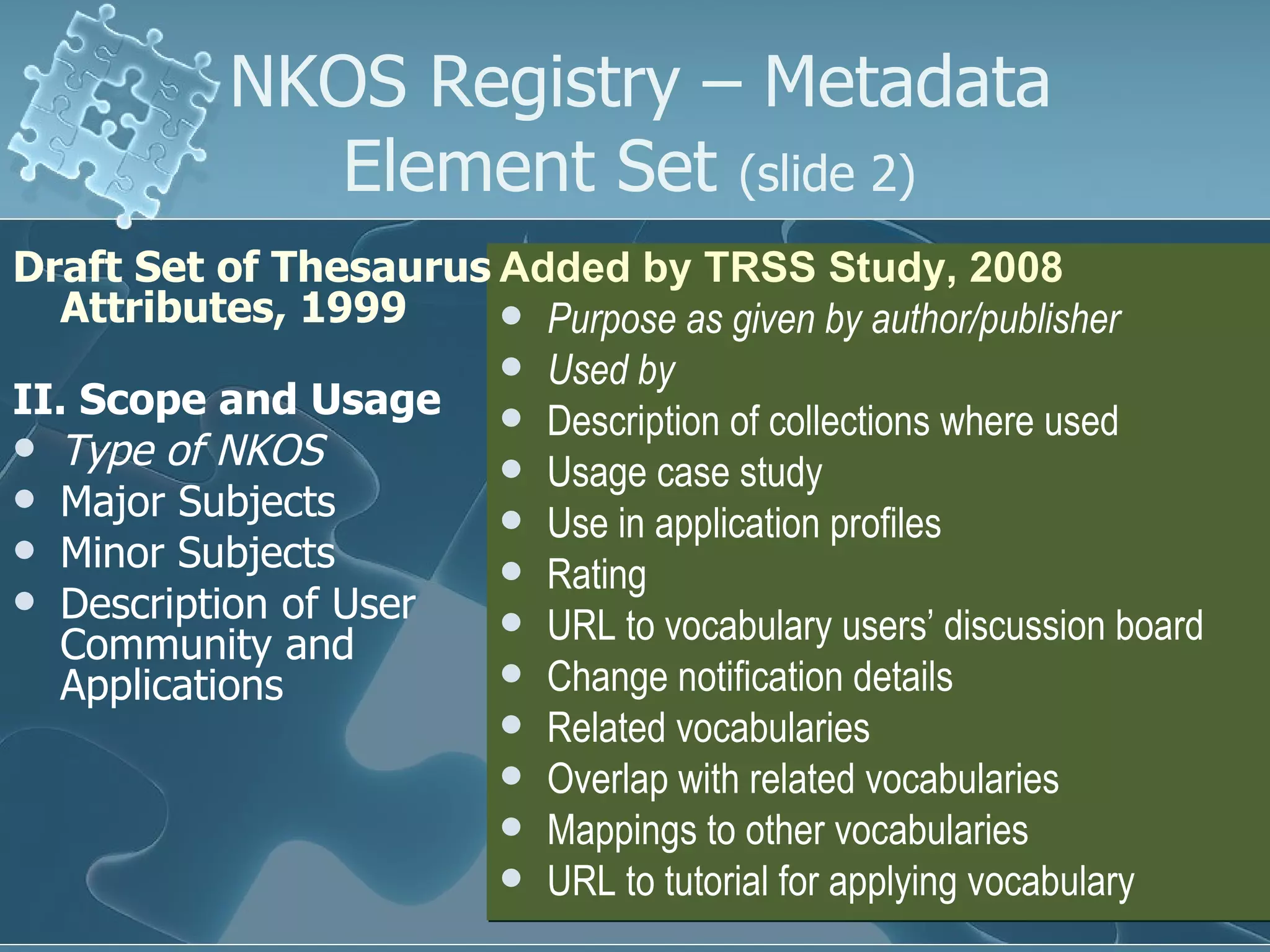
NKOS Registry – Metadata Element Set  (slide 2)   Added by TRSS Study, 2008 Purpose as given by author/publisher Used by  Description of collections where used Usage case study Use in application profiles  Rating URL to vocabulary users’ discussion board Change notification details Related vocabularies Overlap with related vocabularies Mappings to other vocabularies URL to tutorial for applying vocabulary   Draft Set of Thesaurus Attributes, 1999 II. Scope and Usage   Type of NKOS   Major Subjects  Minor Subjects  Description of User Community and Applications
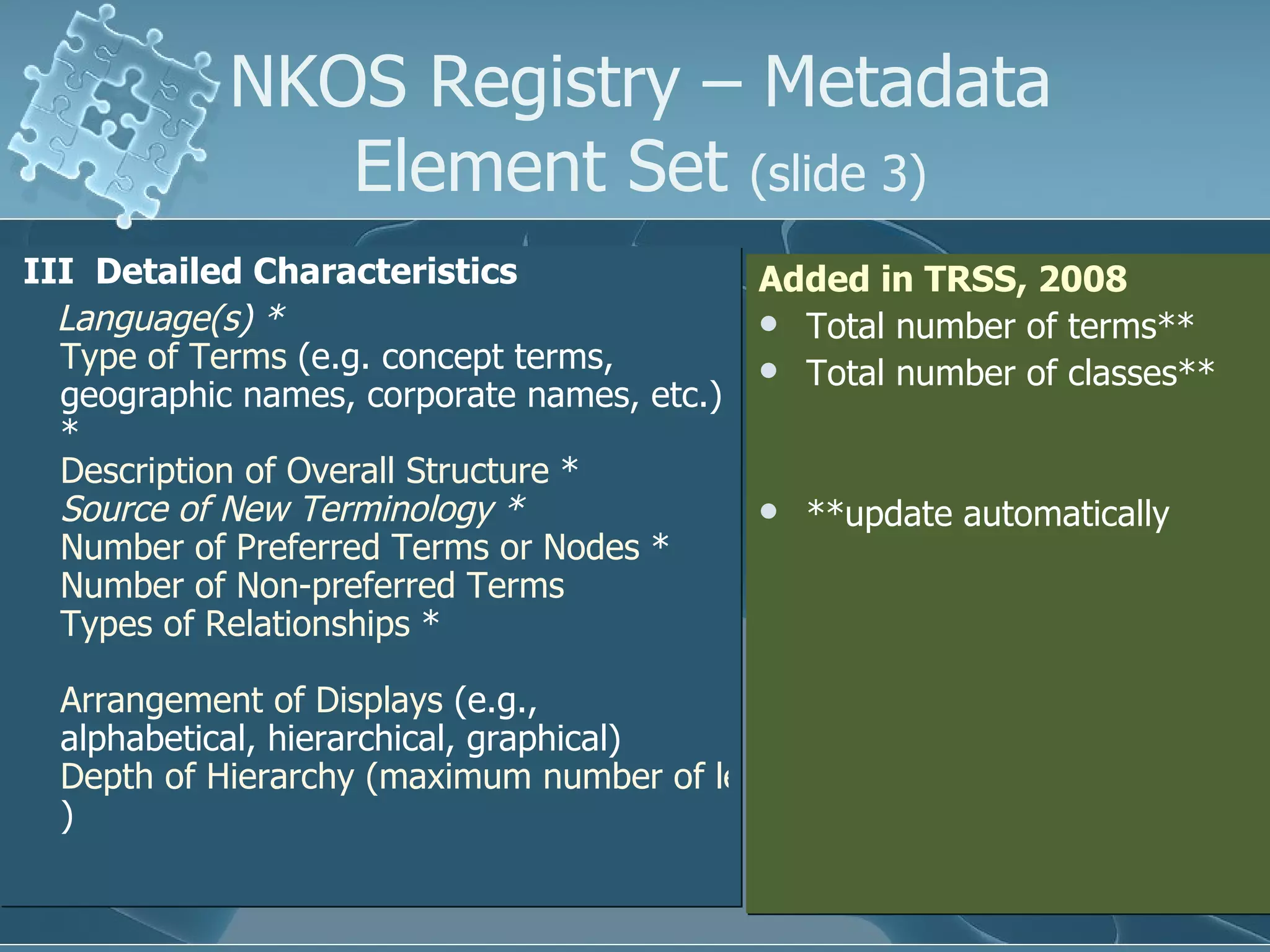
Ā  III  Detailed Characteristics  Language(s )  *   Type of Terms  (e.g. concept terms, geographic names, corporate names, etc.) *  Description of Overall Structure  *  Source of New Terminology  *   Number of Preferred Terms or Nodes  *  Number of Non-preferred Terms   Types of Relationships  *  Arrangement of Displays  (e.g., alphabetical, hierarchical, graphical)  Depth of Hierarchy (maximum number of levels ) NKOS Registry – Metadata Element Set  (slide 3) Added in TRSS, 2008 Total number of terms**  Total number of classes** **update automatically
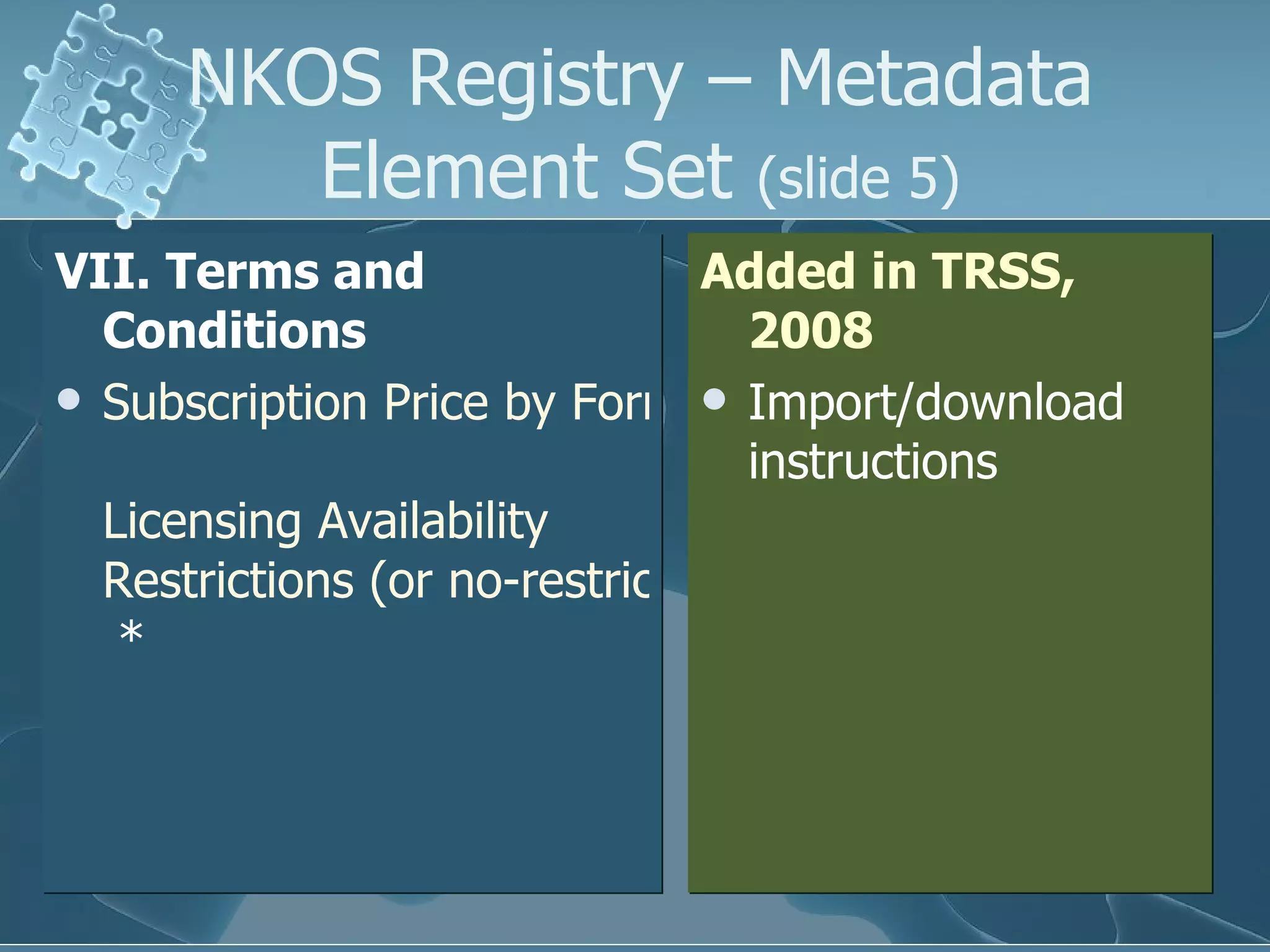
VII. Terms and Conditions   Subscription Price by Format   Licensing Availability   Restrictions (or no-restrictions statement)  *  NKOS Registry – Metadata Element Set  (slide 5) Added in TRSS, 2008 Import/download instructions
Simplified in TRSS, 2008 6  Vocabulary provider   Vocabulary provider name Vocabulary provider URL Vocabulary provider contact details NKOS Registry – Metadata Element Set  (slide 6)   VIII. Vendor/Provider Information   … …  [14 elements] IX. Contact Information … …  [5 elements] X.  Additional Information   General Note  Comments to Registry Maintainer
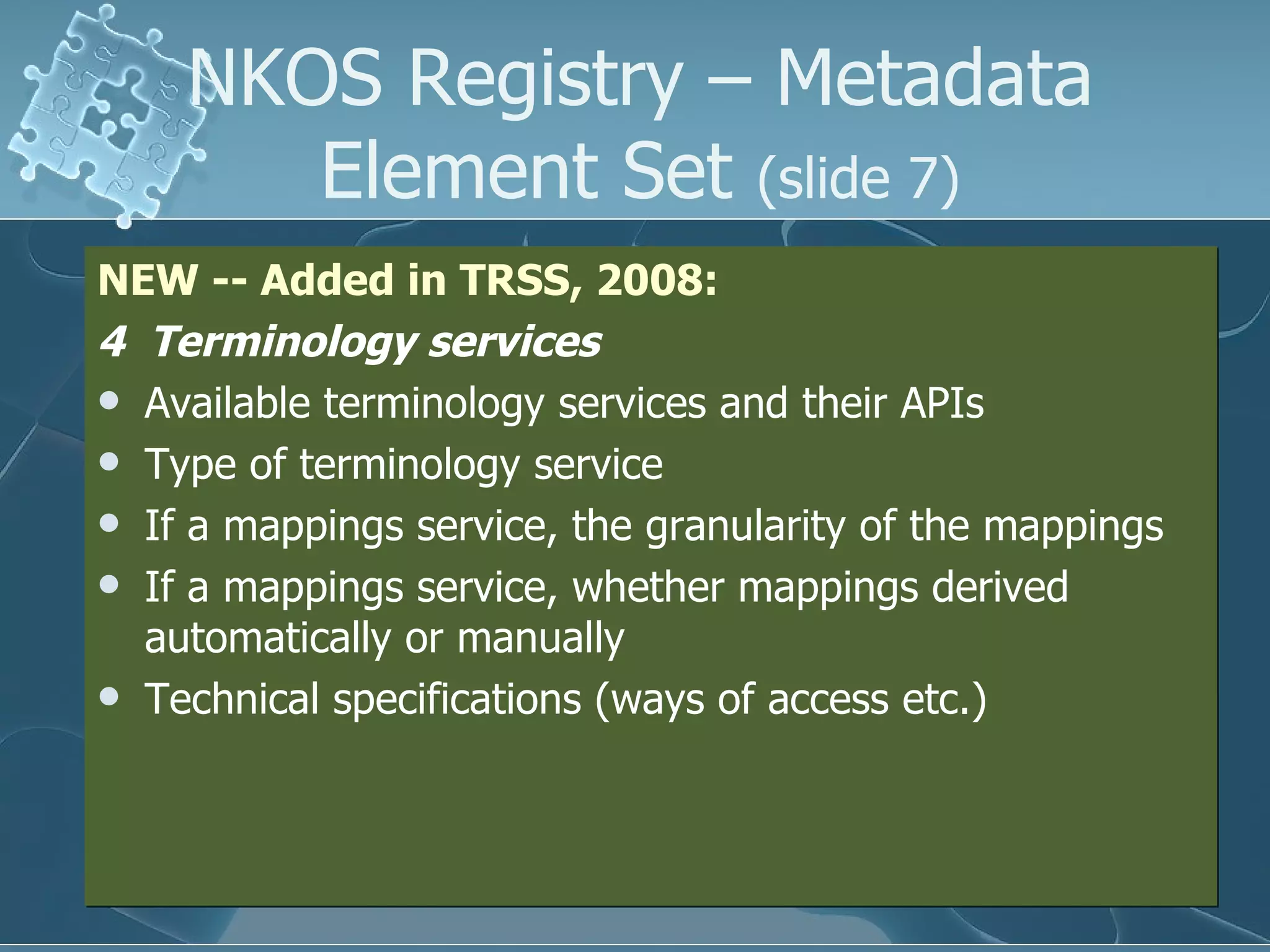
NEW -- Added in TRSS, 2008: 4  Terminology services Available terminology services and their APIs  Type of terminology service  If a mappings service, the granularity of the mappings If a mappings service, whether mappings derived automatically or manually Technical specifications (ways of access etc.) NKOS Registry – Metadata Element Set  (slide 7)
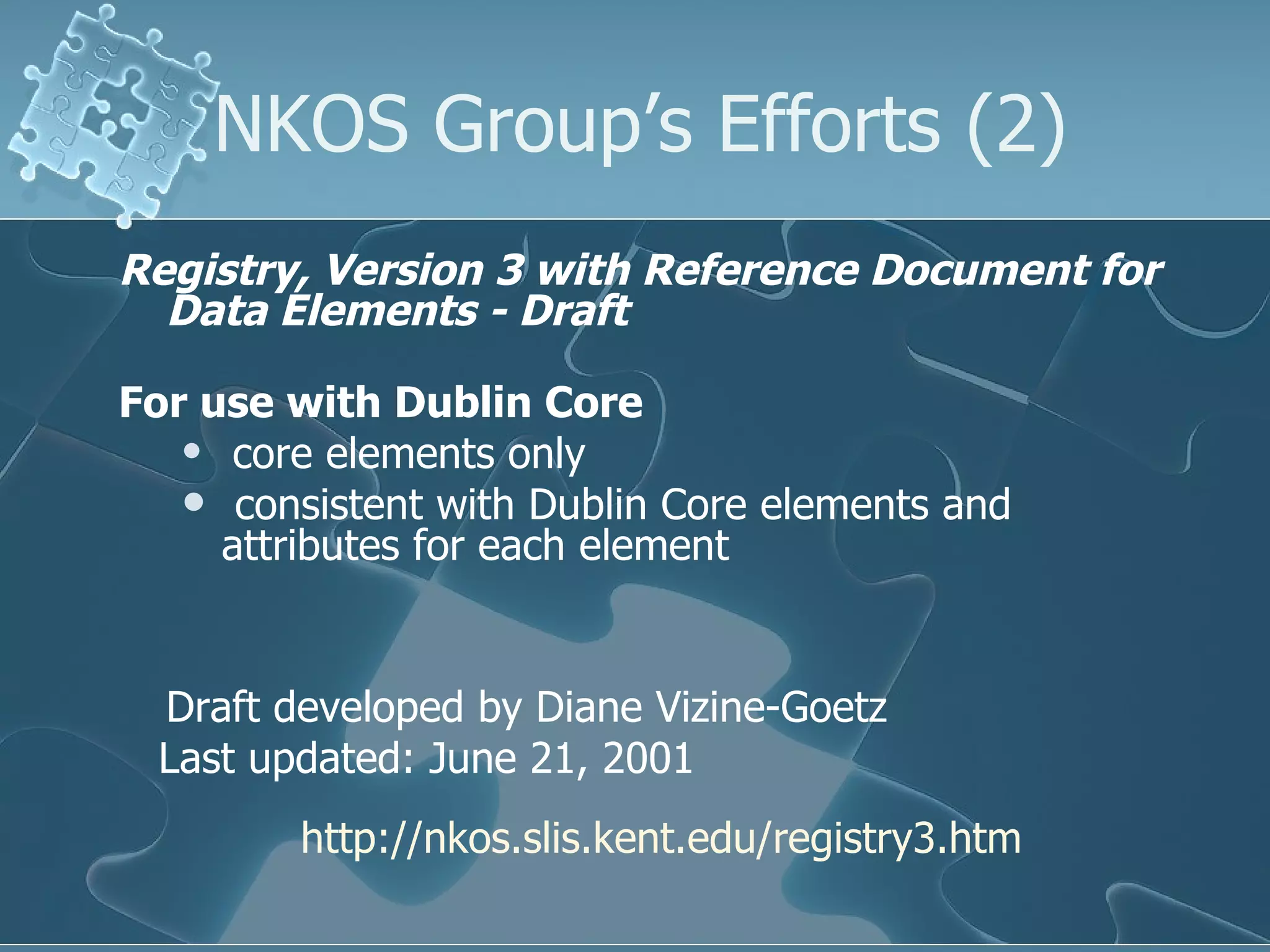
Registry, Version 3 with Reference Document for Data Elements - Draft   For use with Dublin Core core elements only consistent with Dublin Core elements and attributes for each element Draft developed by Diane Vizine-Goetz  Last updated: June 21, 2001  NKOS Group’s Efforts (2) http://nkos.slis.kent.edu/registry3.htm
KOS Title (R) Alternative Title (O) Creator (O) KOS  Subject (R) Description (O) Publisher (O) Date (R) KOS  Type (R) Format (R) Identifier (O) Language (R) KOS  Relation (R) Rights (O) Entity Type (R) Entity Value (O) Relationships (R) Information Given (O) Arrangement (R) Application (O) Minor Subject (O)  [Should this be a  qualifier of KOS  Subject?] for facilitating the discovery of KOS resources,  (DC-based) : for recording specific characteristics, to facilitate the evaluation of the resource for a  particular application or use:  http://nkos.slis.kent.edu/registry3.htm
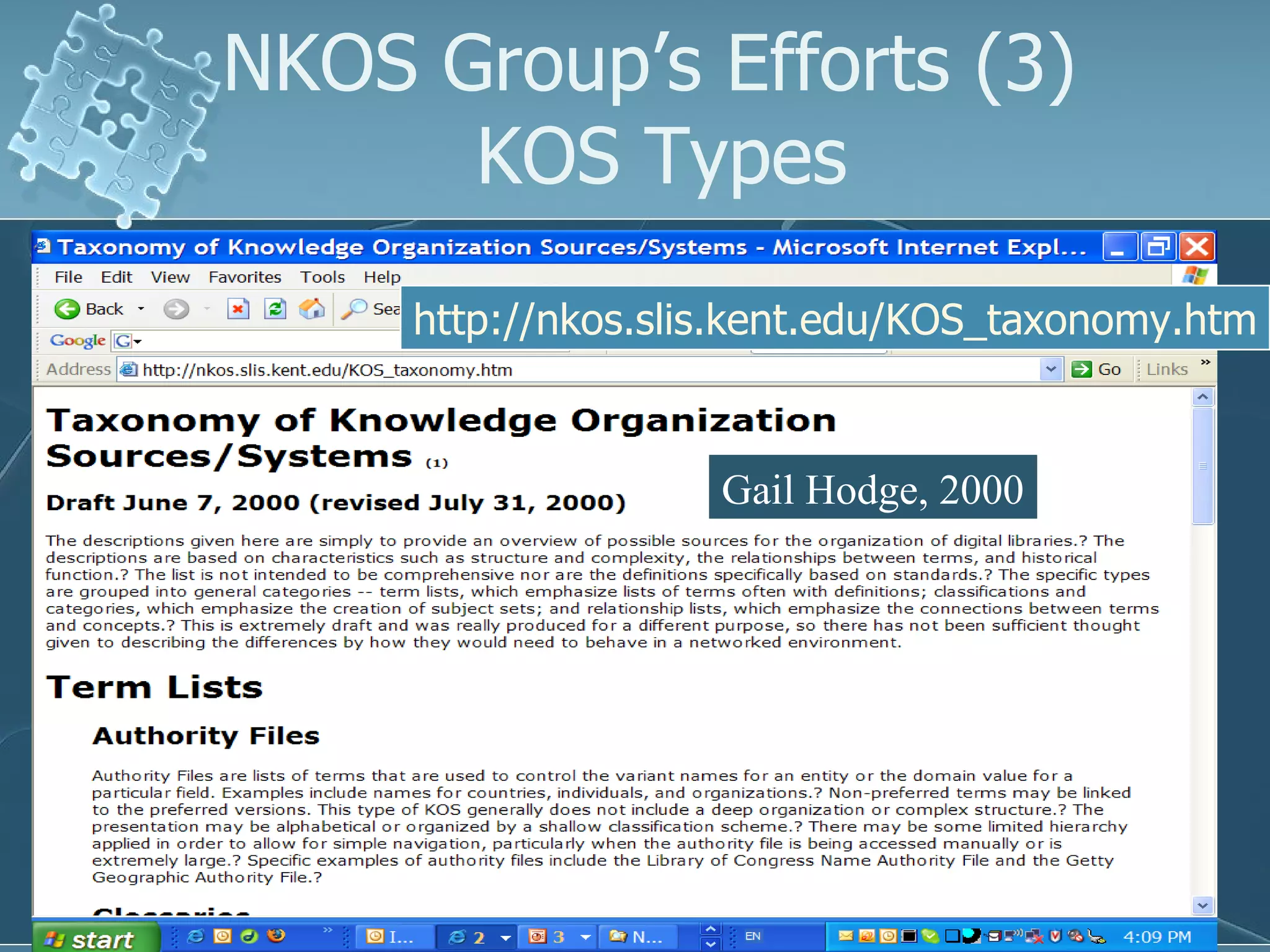
http:// nkos.slis.kent.edu/KOS_taxonomy.htm NKOS Group’s Efforts (3)  KOS Types Gail Hodge, 2000
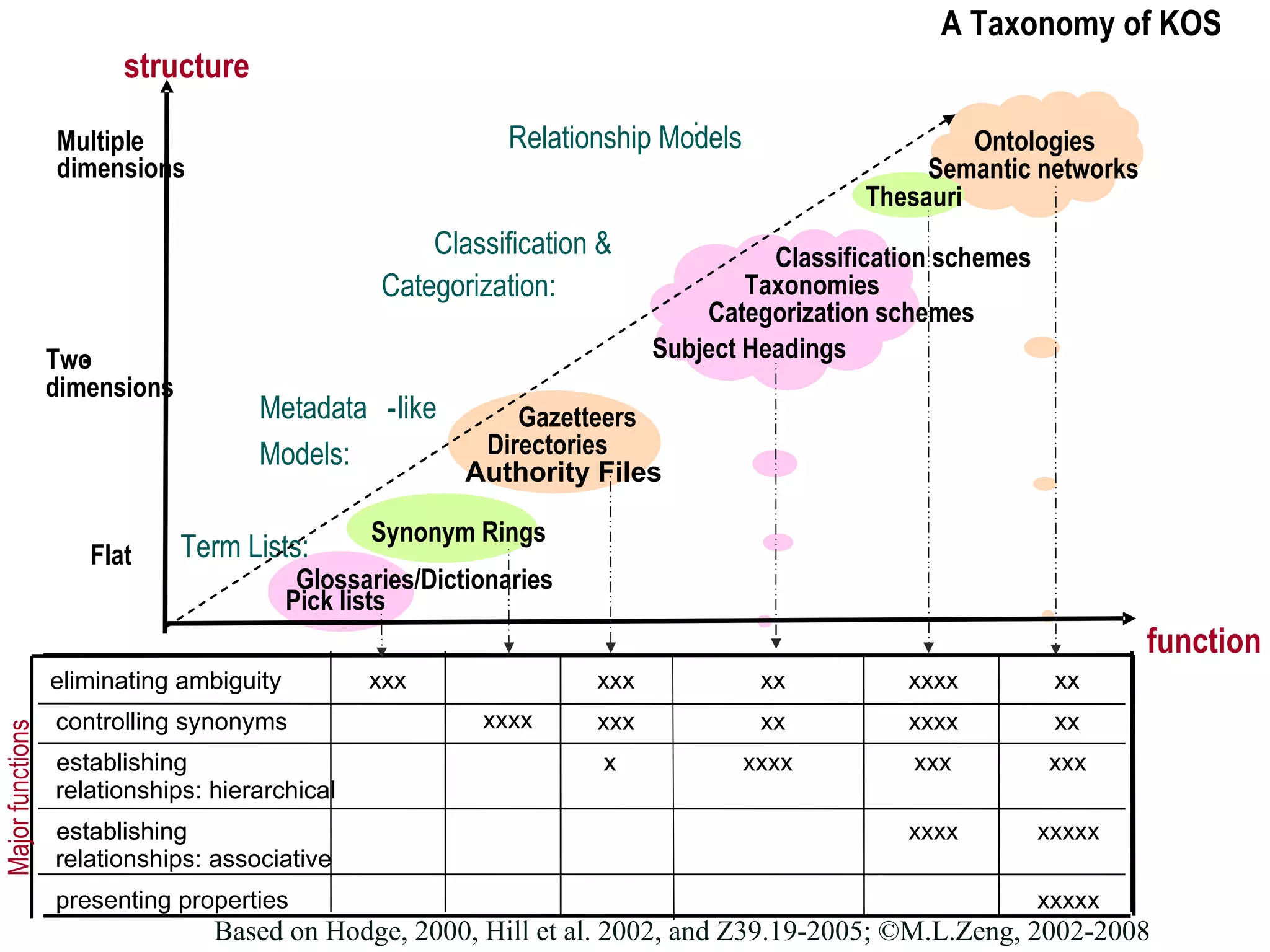
A Taxonomy of KOS  Ontologies  Semantic networks Thesauri Glossaries/Dictionaries  Pick lists xxxxx presenting properties xxxxx xxxx establishing  relationships: associative xxx xxx x  xxxx establishing  relationships: hierarchical  xx xxxx xxx  xx xxxx controlling synonyms xx xxxx xxx  xx xxx eliminating ambiguity establishing  x  establishing  xx xx function Two - dimensions Term Lists: Synonym Rings Flat  structure Classification & Categorization: Subject Headings Classification schemes Taxonomies Categorization schemes Relationship Models : Gazetteers Directories Authority Files Metadata - like  Models: Multiple  dimensions Major functions Based on Hodge, 2000, Hill et al. 2002, and Z39.19-2005; ©M.L.Zeng, 200 2 -2008
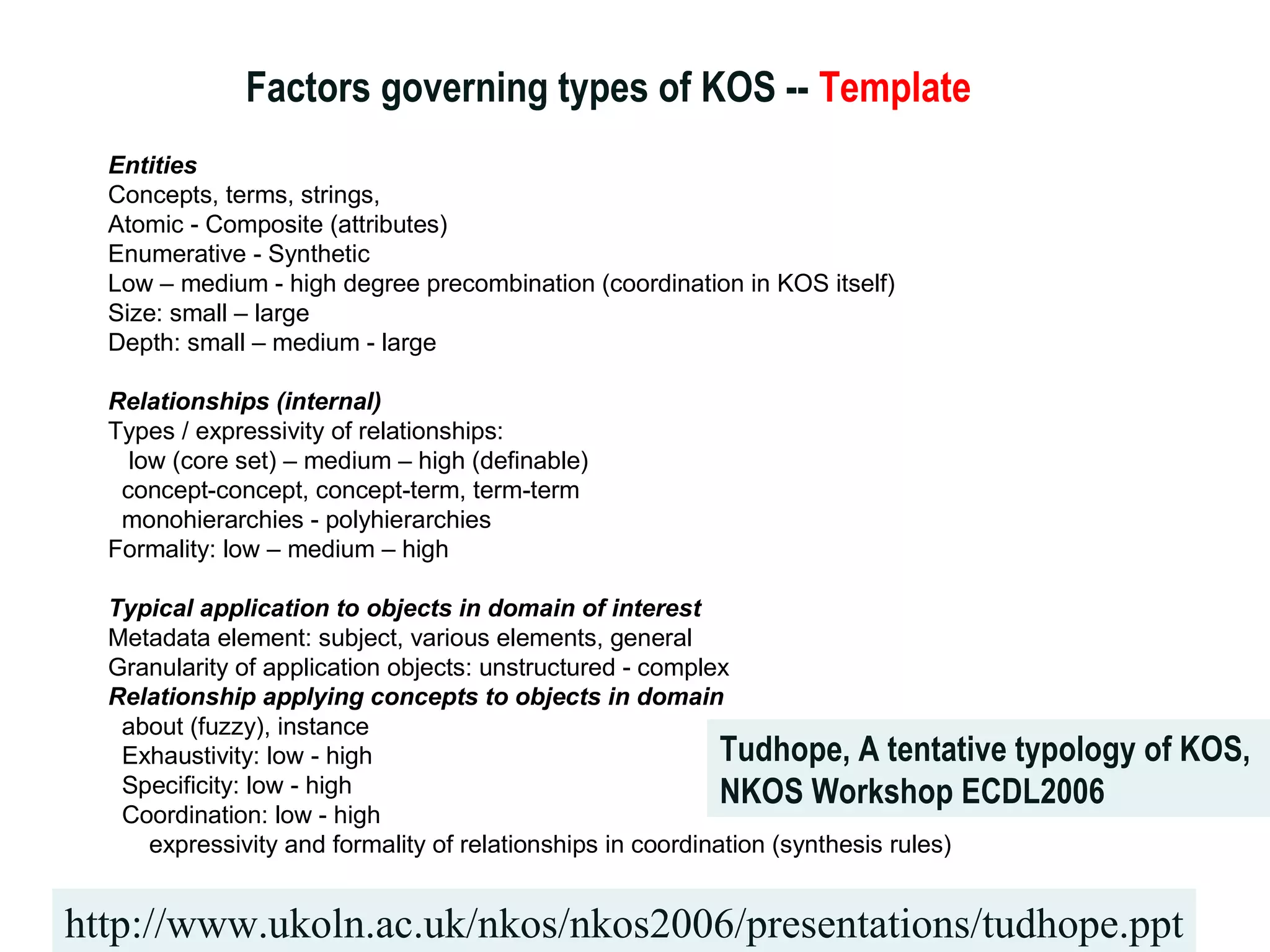
Factors governing types of KOS --  Template http://www.ukoln.ac.uk/nkos/nkos2006/presentations/tudhope.ppt Tudhope,  A tentative typology of KOS ,  NKOS Workshop ECDL2006
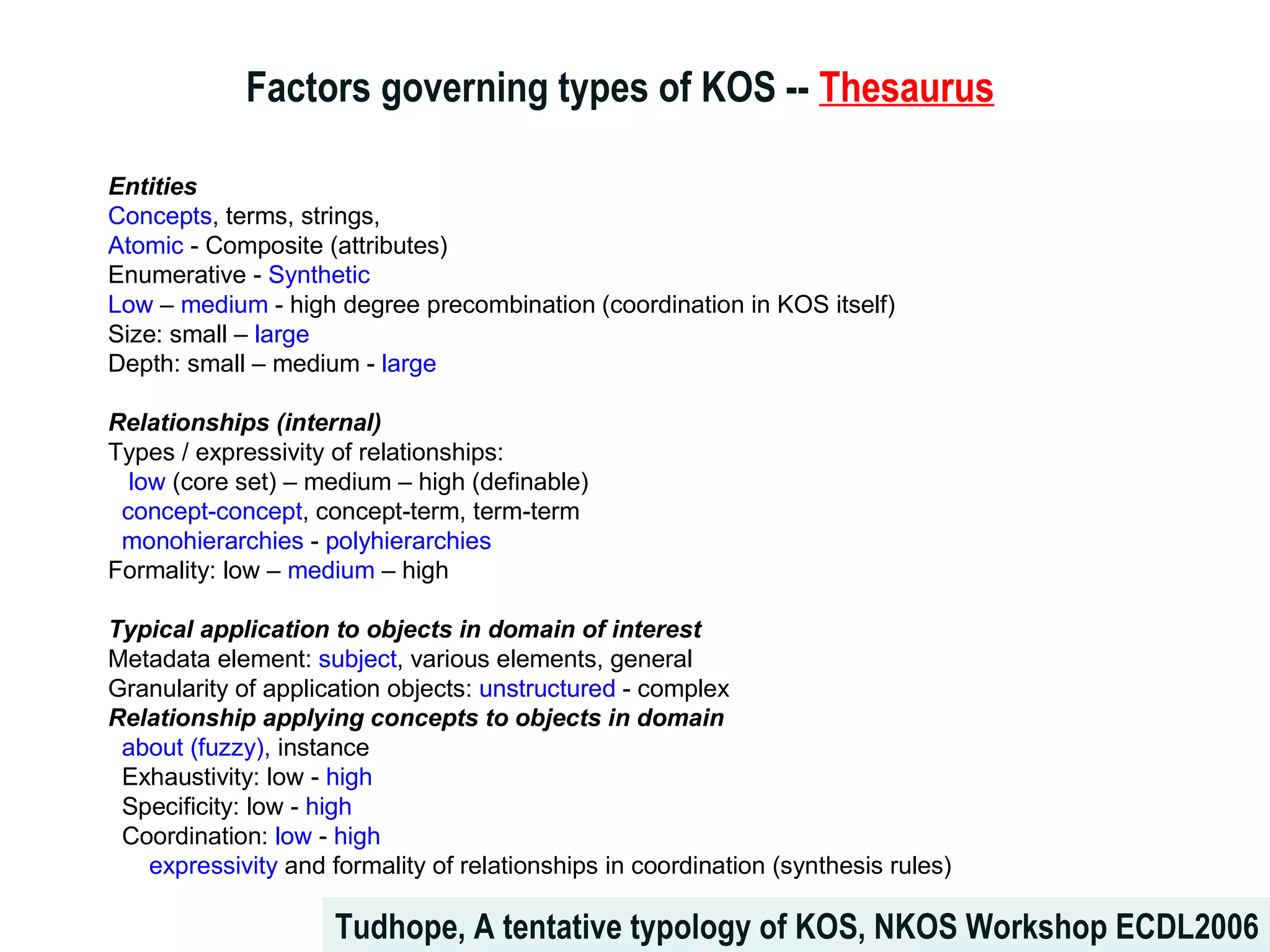
Factors governing types of KOS --  Thesaurus Tudhope,  A tentative typology of KOS , NKOS Workshop ECDL2006
Factors governing types of KOS –  [AI] Ontology Tudhope,  A tentative typology of KOS , NKOS Workshop ECDL2006
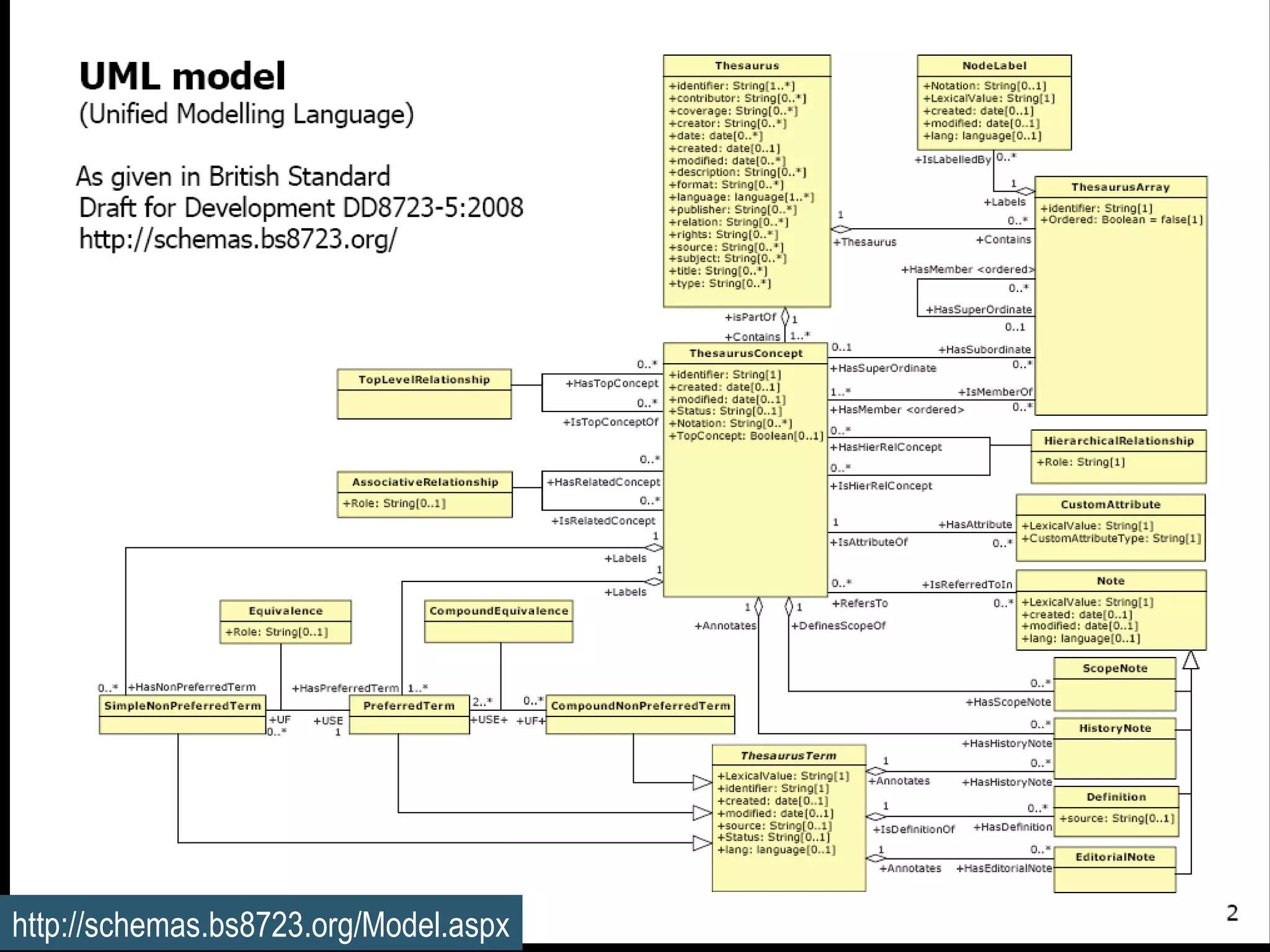
Are there data models defined for KOS types?
http://schemas.bs8723.org/Model.aspx
Summary Metadata for KOS resources are important to  Terminology registries Service registries Vocabulary users Currently there are no standardized metadata element sets A KOS typology needs to be implemented KOS data models need to be developed and tested
References Hodge, G.; Salokhe, G.; Zolly, L.; Anderson, N. (2007). Terminology Resource Registry: Descriptions for Humans and Computers. Presentation at  Integrating Standards in Practice, 10th Open Forum on Metadata Registries, New York City, NY  USA, July 9-11, 2007.  http://www.metadataopenforum.org/index.php?id=21,74,0,0,1,0   ISO/IEC 11179, Information Technology -- Metadata registries (MDR)  http://metadata-standards.org/11179/ Kendall. E. Metadata Support for OMG's Emerging Ontology & Vocabulary Management Initiative.  Joint OOR-OntologySummit2008 Panel Discussion: "Developing an Ontology of Ontologies for OOR"  http://ontolog.cim3.net/cgi-bin/wiki.pl?ConferenceCall_2008_04_10 Golub, K.; Tudhope, D. TRSS survey report 2008 (draft) Aug, 7, 2008
http://nkos.slis.kent.edu (NKOS Website, announcements, listserv, workshop materials, etc.) Thank you!

Metadata for Terminology / KOS Resources

  • 1.
    Metadata for Terminology / KOS Resources Marcia Lei Zeng NKOS Workshop 2008
  • 2.
    Registry Types MetadataSchemas Registries Elements and refinements, application profiles, schemas in different bindings … e,g., UKOLN CORES Registry Terminology Registries / Repositories Registries for schemes (metadata) only Registries of the entries of vocabularies (usually accompanied by scheme’s metadata) e.g., OCLC Terminologies Service ; BioPortal ontology repository Service Registries Terminology services may be listed in a terminology registry or separately hosted in a service registry Data Standards Registries (integrated) Registries/repositories of data standards (e.g., data dictionaries, data models, schemas, and code sets)
  • 3.
    1. Why dowe need metadata for terminology resources? 2. What do we need to know about a terminology resource? 3. Is there a standardized set of metadata elements for terminology resources?
  • 4.
    1. Why dowe need metadata for terminology resources?
  • 5.
    Basically, metadata forterminology resources will … record specific characteristics of terminology resources facilitate the discovery of terminology resources facilitate the evaluation of the terminology resource for a particular application or use facilitate sharing, reusing, and collaboration
  • 6.
    Types of terminologyregistries 1) Registries providing metadata for each vocabulary and linking to vocabulary owner/provider 2) Registries providing metadata on (and linking to) any available terminology services 3) Registries providing access to the vocabulary content by downloading the complete vocabulary via access to a vocabulary’s concepts, terms and relationships - Golub & Tudhope , TRSS Report, 2008
  • 7.
    registering machine accessibleterminology resources mapping among concepts/terms making KOS content available in different kinds of tools via terminology (web) services A simplified illustration of Terminology registries and services Registry Terms & Vocabularies Services
  • 8.
    Related to theterminology registries are services, which may also be listed in a terminology registry or separately hosted in a service registry . These services, based on terminology, are used for automatic classification, term expansion, disambiguation, translation, and semantic reasoning. Terminology-based Services
  • 9.
    Terminology registries needto provide information about: sources used creation and revision dates provenance trustworthiness of sources quality assessment metrics for the vocabulary & source materials licensing, IP limitations flexibility for integration with other KOS specific requirements such as performance security maintainability The need of metadata (1) -- terminology registries -- based on Elisa Kendall, 2008
  • 10.
    Service registries needto understand and provide information on: Data models Tool interoperability Protocol Querying and accessibility Affectivity – at what time, location, and/or use is the content applicable or valid Available formats The need of metadata (2) -- service registries
  • 11.
    Different agents, services,and applications need to communicate about KOS data in the form of: transferring exchange transformation mediation migration integration The need of metadata (3) -- vocabulary users
  • 12.
    2. What dowe need to know about a terminology resource? Descriptive metadata Administrative metadata Structural metadata
  • 13.
    Creator? Domain orsubject area? Copyright? … … ??? Need more descriptive metadata See Glossary at: http:// swoogle.umbc.edu/index.php?option = com_swoogle_manual&manual =glossary [ Swoogle’s Metadata Scheenshots ]
  • 14.
    Domain / subjectarea? Number of triples? Number of classes? [Useful? Useable?] [ Images of : SchemaWeb Kissology scheme details kissology: classes and properties]
  • 15.
    Relation with othervocabularies? From the website: Disease Ontology (v2.1) is based almost entirely on ICD9CM ( International Classification of Diseases, 9th Revision, Clinical Modification) ; It contains 19136 concept nodes. Disease Ontology 3 (revision 21) is based on UMLS vocabularies (including ICD9) and is currently under development. KOS type? Data model? [Images of: BioPortal 2.0 browse interface Ontology Metadata of Human Diseases
  • 16.
    3. Is therea standardized set of metadata elements for terminology resources?
  • 17.
    International Standard -- ISO 11179 ISO 11179-2 Information Technology -- Metadata registries (MDR) - Part 2 Classification* (*CLASSIFICATION schemes include: key words, thesauri, taxonomies, and ontologies.) http://metadata-standards.org/11179/
  • 18.
    Figure A.1 —Classification metamodel region. Regions of the MDR metamodel containing classification scheme attributes ISO 11179
  • 19.
    Attributes of aclassification system that may be recorded in an MDR (slide 1) Designation – name – preferred designation – language identifier Definition – definition text – preferred definition – source reference – language identifier Context – administration record – description – description language identifier Classification Scheme – type name Classification Scheme Item – value – type name Classification Scheme Item Relationship – type description ( boldface : datatypes containing multiple attribute components) ISO 11179
  • 20.
    Administration Record – item identifier – registration status – administrative status – creation date – last change date – effective date – until date – change description – administrative note – explanatory comment – unresolved issue – origin Reference Document – identifier – type description – language identifier – title – organization name – organization mail address Attributes of a classification system that may be recorded in an MDR (slide 2) ISO 11179
  • 21.
    Submission – organization name – organization mail address – contact Stewardship – organization name – organization mail address – contact Registration Authority – organization name – organization mail address – registration authority identifier – documentation language identifier Registrar – identifier – contact Attributes of a classification system that may be recorded in an MDR (slide 3) ISO 11179
  • 22.
    11179 Data ElementRegistries US National Cancer Institute - Cancer Data Standards Repository ( caDSR ) Australian Institute of Health and Welfare - Metadata Online Registry ( METeOR ) US Department of Justice - Global Justice XML Data Model GJXDM US Environmental Protection Agency - Environmental Data Registry US Health Information Knowledgebase (USHIK) US National Information Exchange Model NIEM Minnesota Department of Education Metadata Registry (K-12 Data) Minnesota Department of Revenue Property Taxation (Real Estate Transactions)
  • 23.
    Important additional items(in addition to ā€œClassificationā€ of ISO 11179) Form -- a collection of CDEs (Common Data Elements) Protocol -- a collection of Forms. For clinical trials applications, Forms correspond to Case Report Forms (CRFs) Protocols correspond to a clinical trial protocol Cancer Data Standards Repository (caDSR) -- CDE (Common Data Element) Browser http://umlmodelbrowser.nci.nih.gov/umlmodelbrowser/
  • 24.
    Cancer Data StandardsRepository (caDSR) -- UML (Unified Modeling Language) Model Browser
  • 25.
    NKOS Group’s Efforts(1) NKOS Registry - Draft Set of Thesaurus Attributes , 1999 (based on Controlled Vocabulary Registry developed by Linda L. Hill and Interconnect Technologies in 1996, with some modification) Terminology Registry Scoping Study (TRSS), 2008 (PIs: Kora Golub, Doug Tudhope, Trss Final Report to JISC , UK.) http:// www.ukoln.ac.uk/projects/trss / http:// nkos.slis.kent.edu/Thesaurus_Registry.html
  • 26.
    A – NKOSRegistry 1998 F – Hodge et al. 2007 (10 th OFMR) B – NKOS Registry 2001 G – National Science Digital Library Registry C – CENDI H – ISO 11179 (Information Technology – D – Ecoterm ( Environmental Metadata registries (MDR)) Terminology and KOS) I – OCLC Terminology Services E – Food and Agriculture J – SPECTRUM Terminology Bank Organization (FAO) K – Taxonomy Warehouse of UN L– Vocman ( Becta Vocabulary Bank ) TRSS survey report 2008 (draft) K. Golub, D. Tudhope , Aug, 7, 2008
  • 27.
    NKOS Registry –Metadata Element Set (slide 1) Draft Set of Thesaurus Attributes, 1999 I. Product Information Product Name/Title * Variant Product Name/Title Type of Product * Product Description * Auxiliary Lists Author/Editor Current Version/Edition * Date of Current Version * Product Update Frequency * Available Format(s ) and Size * Online Availability Notes URL for Examples TRSS Study, 2008 Added: Vocabulary type Available terminology services Vocabulary identifier * required
  • 28.
    NKOS Registry –Metadata Element Set (slide 2) Added by TRSS Study, 2008 Purpose as given by author/publisher Used by Description of collections where used Usage case study Use in application profiles Rating URL to vocabulary users’ discussion board Change notification details Related vocabularies Overlap with related vocabularies Mappings to other vocabularies URL to tutorial for applying vocabulary Draft Set of Thesaurus Attributes, 1999 II. Scope and Usage Type of NKOS Major Subjects Minor Subjects Description of User Community and Applications
  • 29.
    Ā  III Detailed Characteristics Language(s ) * Type of Terms (e.g. concept terms, geographic names, corporate names, etc.) * Description of Overall Structure * Source of New Terminology * Number of Preferred Terms or Nodes * Number of Non-preferred Terms Types of Relationships * Arrangement of Displays (e.g., alphabetical, hierarchical, graphical) Depth of Hierarchy (maximum number of levels ) NKOS Registry – Metadata Element Set (slide 3) Added in TRSS, 2008 Total number of terms** Total number of classes** **update automatically
  • 30.
    VII. Terms andConditions Subscription Price by Format Licensing Availability Restrictions (or no-restrictions statement) * NKOS Registry – Metadata Element Set (slide 5) Added in TRSS, 2008 Import/download instructions
  • 31.
    Simplified in TRSS,2008 6 Vocabulary provider Vocabulary provider name Vocabulary provider URL Vocabulary provider contact details NKOS Registry – Metadata Element Set (slide 6) VIII. Vendor/Provider Information … … [14 elements] IX. Contact Information … … [5 elements] X. Additional Information General Note Comments to Registry Maintainer
  • 32.
    NEW -- Addedin TRSS, 2008: 4 Terminology services Available terminology services and their APIs Type of terminology service If a mappings service, the granularity of the mappings If a mappings service, whether mappings derived automatically or manually Technical specifications (ways of access etc.) NKOS Registry – Metadata Element Set (slide 7)
  • 33.
    Registry, Version 3with Reference Document for Data Elements - Draft For use with Dublin Core core elements only consistent with Dublin Core elements and attributes for each element Draft developed by Diane Vizine-Goetz Last updated: June 21, 2001 NKOS Group’s Efforts (2) http://nkos.slis.kent.edu/registry3.htm
  • 34.
    KOS Title (R)Alternative Title (O) Creator (O) KOS Subject (R) Description (O) Publisher (O) Date (R) KOS Type (R) Format (R) Identifier (O) Language (R) KOS Relation (R) Rights (O) Entity Type (R) Entity Value (O) Relationships (R) Information Given (O) Arrangement (R) Application (O) Minor Subject (O) [Should this be a qualifier of KOS Subject?] for facilitating the discovery of KOS resources, (DC-based) : for recording specific characteristics, to facilitate the evaluation of the resource for a particular application or use: http://nkos.slis.kent.edu/registry3.htm
  • 35.
    http:// nkos.slis.kent.edu/KOS_taxonomy.htm NKOSGroup’s Efforts (3) KOS Types Gail Hodge, 2000
  • 36.
    A Taxonomy ofKOS Ontologies Semantic networks Thesauri Glossaries/Dictionaries Pick lists xxxxx presenting properties xxxxx xxxx establishing relationships: associative xxx xxx x xxxx establishing relationships: hierarchical xx xxxx xxx xx xxxx controlling synonyms xx xxxx xxx xx xxx eliminating ambiguity establishing x establishing xx xx function Two - dimensions Term Lists: Synonym Rings Flat structure Classification & Categorization: Subject Headings Classification schemes Taxonomies Categorization schemes Relationship Models : Gazetteers Directories Authority Files Metadata - like Models: Multiple dimensions Major functions Based on Hodge, 2000, Hill et al. 2002, and Z39.19-2005; ©M.L.Zeng, 200 2 -2008
  • 37.
    Factors governing typesof KOS -- Template http://www.ukoln.ac.uk/nkos/nkos2006/presentations/tudhope.ppt Tudhope, A tentative typology of KOS , NKOS Workshop ECDL2006
  • 38.
    Factors governing typesof KOS -- Thesaurus Tudhope, A tentative typology of KOS , NKOS Workshop ECDL2006
  • 39.
    Factors governing typesof KOS – [AI] Ontology Tudhope, A tentative typology of KOS , NKOS Workshop ECDL2006
  • 40.
    Are there datamodels defined for KOS types?
  • 41.
  • 42.
    Summary Metadata forKOS resources are important to Terminology registries Service registries Vocabulary users Currently there are no standardized metadata element sets A KOS typology needs to be implemented KOS data models need to be developed and tested
  • 43.
    References Hodge, G.;Salokhe, G.; Zolly, L.; Anderson, N. (2007). Terminology Resource Registry: Descriptions for Humans and Computers. Presentation at Integrating Standards in Practice, 10th Open Forum on Metadata Registries, New York City, NY USA, July 9-11, 2007. http://www.metadataopenforum.org/index.php?id=21,74,0,0,1,0 ISO/IEC 11179, Information Technology -- Metadata registries (MDR) http://metadata-standards.org/11179/ Kendall. E. Metadata Support for OMG's Emerging Ontology & Vocabulary Management Initiative. Joint OOR-OntologySummit2008 Panel Discussion: "Developing an Ontology of Ontologies for OOR" http://ontolog.cim3.net/cgi-bin/wiki.pl?ConferenceCall_2008_04_10 Golub, K.; Tudhope, D. TRSS survey report 2008 (draft) Aug, 7, 2008
  • 44.
    http://nkos.slis.kent.edu (NKOS Website,announcements, listserv, workshop materials, etc.) Thank you!

Editor's Notes

  • #2Ā 10:45 - 11:15 am 2:15-2:45 pm. Three terms may be used interchangeably. Controlled vocabularies, used as encoding values in metadata records and indexes, for the purpose of effective information retrieval. Knowledge organization systems (KOS) – mostly include controlled vocabularies, but has a broader range to include schemes for organizing information and promoting knowledge management (e.g., classification systems, ontologies). Terminology -- often used similarly as KOS vocabulary. Often used in connection to registries.