An Introduction to IMS LODE (Learning Object Discovery & Exchange)http://imsglobal.org/lode/Dr. David Massart and Dr. Elena ShulmanEuropean SchoolnetJuly 21, 2010
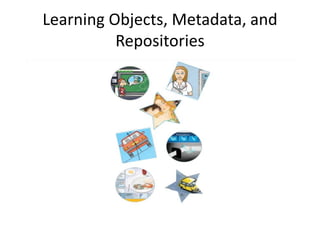
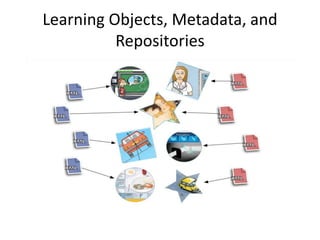
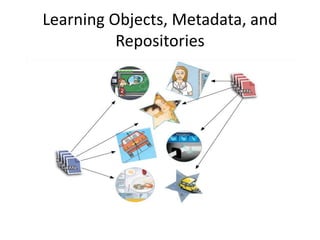
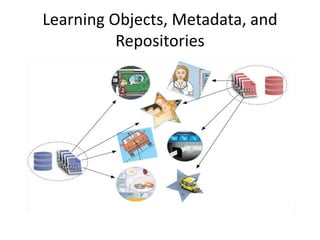
Learning Objects, Metadata, and Repositories
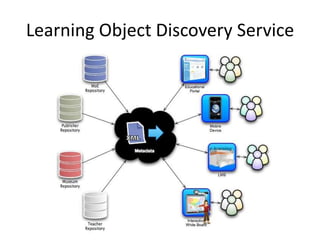
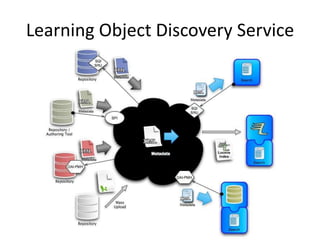
Learning Object Discovery Service
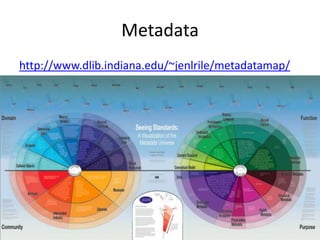
Metadatahttp://www.dlib.indiana.edu/~jenlrile/metadatamap/
Issues Addressed by LODEHow to automatically find and connect to repositories?How do you express a meaningful learning object queries? How do you deal with versions and formats?How do you manage metadata from different  sources and of different standards?
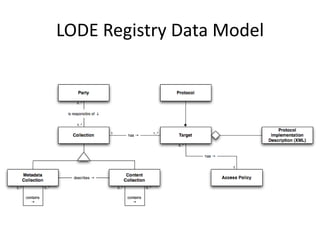
Learning Object Discovery & Exchange (LODE) specification Aims to facilitate the discovery and retrieval of learning objects stored across more than one collectionIs a glue specification that profiles existing general-purpose protocols to take into account requirements specific to the educational domain, rather than creating new protocolsProposes three main data modelsLearning Object Repository Registry Data ModelInformation for Learning Object eXchange (ILOX)LODE Context Set for the Contextual Query Language (CQL)
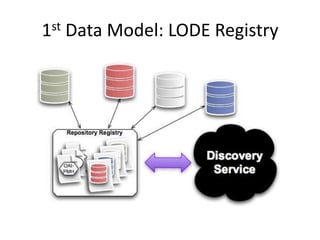
1st Data Model: LODE Registry
LODE Registry Data Model
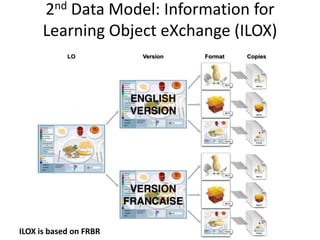
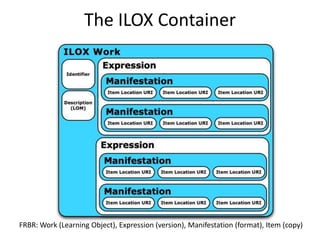
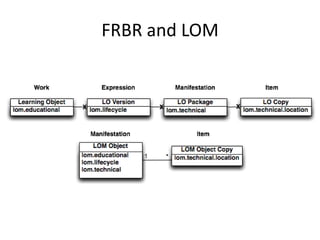
2nd Data Model: Information for Learning Object eXchange (ILOX)ILOX is based on FRBR
The ILOX ContainerFRBR: Work (Learning Object), Expression (version), Manifestation (format), Item (copy)
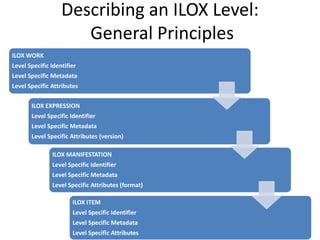
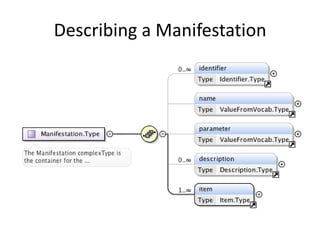
Describing an ILOX Level: General Principles
Describing a Manifestation
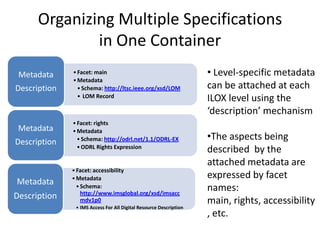
Organizing Multiple Specifications in One Container Level-specific metadata can be attached at each ILOX level using the ‘description’ mechanism
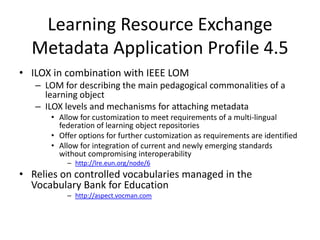
The aspects being described  by the attached metadata are expressed by facet names: main, rights, accessibility, etc.Learning Resource Exchange Metadata Application Profile 4.5ILOX in combination with IEEE LOM LOM for describing the main pedagogical commonalities of a learning objectILOX levels and mechanisms for attaching metadataAllow for customization to meet requirements of a multi-lingual federation of learning object repositoriesOffer options for further customization as requirements are identifiedAllow for integration of current and newly emerging standards without compromising interoperabilityhttp://lre.eun.org/node/6Relies on controlled vocabularies managed in the Vocabulary Bank for Educationhttp://aspect.vocman.com
Customization for Level Specific Information: Expression DimensionExpression(version)LanguagesThe same Learning Object is often available in multiple languagesCoverageThe same Learning Object may be available in versions tailored to meet different regional or educational systemsAccessibilityVersions of a Learning Object differ because they are  tailored to meet specific accessibility needs of different user groups
Description Facets for MetadataMandatory at top level and optional lower:MainRights/licenseOptional and attached at any level when appropriate ReputationParadataTransactionAccessibility (only at Expression level)
Reputation FacetRefers to any type of user-generated assessments of a LO (ratings, annotations, bookmarks) Aids in the object’s retrieval and rankingsCan work with recommendation systems and/or support social navigation tools. No schema is specified for this facet Schema development is in progresshttps://sites.google.com/site/censocialdata/home
Paradata FacetAny data that records meaningful actions and processes users initiate to locate and access learning objects (e.g., web server logs).  Such data includes number of visits, number of downloads, etc. This data is initially collected at the item level and then can be aggregated at different upper ILOX levels using the ‘paradata’ facet. Such aggregation will track the number of times different formats of different versions of an object were accessed starting from the number of downloads of individual copies at the item level. No schema is specified for this facet
Vocabulary Bank for EducationProvides Identifiers for vocabularies and termsTranslations for vocabulary termsCrosswalks between vocabulariesBrowsable and searchable web application for users to locate, view and download terminologyStandards-based, machine-to-machine interfacesREST Can be used by validation servicesStores vocabularies from other organizations
3rd Data Model: LODE Context SetUses certain attributes of the objects as search terms (e.g., competency, learning resource type)Defines modifiers that allow more specific queries (e.g., language)Defines sort criteria that can be used to indicate how to sort the result set generated by the search (e.g., rating, relevance)
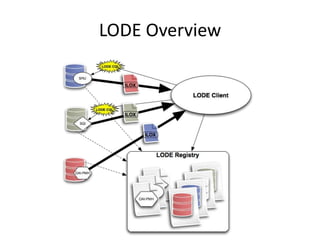
LODE Overview
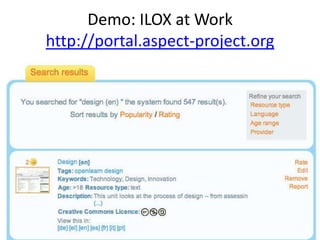
Demo: ILOX at Workhttp://portal.aspect-project.org
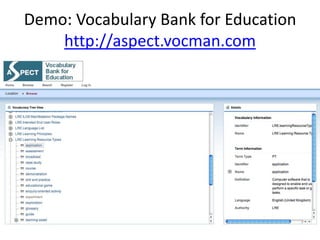
Demo: Vocabulary Bank for Educationhttp://aspect.vocman.com
AppendixFRBR and LOMILOX
FRBR and LOM
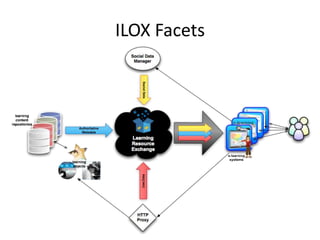
ILOX Facets

An Introduction to the IMS Learning Object Discovery and Exchange (LODE) Specification

  • 1.
    An Introduction toIMS LODE (Learning Object Discovery & Exchange)http://imsglobal.org/lode/Dr. David Massart and Dr. Elena ShulmanEuropean SchoolnetJuly 21, 2010
  • 2.
  • 3.
  • 4.
  • 5.
  • 6.
  • 7.
  • 8.
  • 9.
    Issues Addressed byLODEHow to automatically find and connect to repositories?How do you express a meaningful learning object queries? How do you deal with versions and formats?How do you manage metadata from different sources and of different standards?
  • 10.
    Learning Object Discovery& Exchange (LODE) specification Aims to facilitate the discovery and retrieval of learning objects stored across more than one collectionIs a glue specification that profiles existing general-purpose protocols to take into account requirements specific to the educational domain, rather than creating new protocolsProposes three main data modelsLearning Object Repository Registry Data ModelInformation for Learning Object eXchange (ILOX)LODE Context Set for the Contextual Query Language (CQL)
  • 11.
    1st Data Model:LODE Registry
  • 12.
  • 13.
    2nd Data Model:Information for Learning Object eXchange (ILOX)ILOX is based on FRBR
  • 14.
    The ILOX ContainerFRBR:Work (Learning Object), Expression (version), Manifestation (format), Item (copy)
  • 15.
    Describing an ILOXLevel: General Principles
  • 16.
  • 17.
    Organizing Multiple Specificationsin One Container Level-specific metadata can be attached at each ILOX level using the ‘description’ mechanism
  • 18.
    The aspects beingdescribed by the attached metadata are expressed by facet names: main, rights, accessibility, etc.Learning Resource Exchange Metadata Application Profile 4.5ILOX in combination with IEEE LOM LOM for describing the main pedagogical commonalities of a learning objectILOX levels and mechanisms for attaching metadataAllow for customization to meet requirements of a multi-lingual federation of learning object repositoriesOffer options for further customization as requirements are identifiedAllow for integration of current and newly emerging standards without compromising interoperabilityhttp://lre.eun.org/node/6Relies on controlled vocabularies managed in the Vocabulary Bank for Educationhttp://aspect.vocman.com
  • 19.
    Customization for LevelSpecific Information: Expression DimensionExpression(version)LanguagesThe same Learning Object is often available in multiple languagesCoverageThe same Learning Object may be available in versions tailored to meet different regional or educational systemsAccessibilityVersions of a Learning Object differ because they are tailored to meet specific accessibility needs of different user groups
  • 20.
    Description Facets forMetadataMandatory at top level and optional lower:MainRights/licenseOptional and attached at any level when appropriate ReputationParadataTransactionAccessibility (only at Expression level)
  • 21.
    Reputation FacetRefers toany type of user-generated assessments of a LO (ratings, annotations, bookmarks) Aids in the object’s retrieval and rankingsCan work with recommendation systems and/or support social navigation tools. No schema is specified for this facet Schema development is in progresshttps://sites.google.com/site/censocialdata/home
  • 22.
    Paradata FacetAny datathat records meaningful actions and processes users initiate to locate and access learning objects (e.g., web server logs). Such data includes number of visits, number of downloads, etc. This data is initially collected at the item level and then can be aggregated at different upper ILOX levels using the ‘paradata’ facet. Such aggregation will track the number of times different formats of different versions of an object were accessed starting from the number of downloads of individual copies at the item level. No schema is specified for this facet
  • 23.
    Vocabulary Bank forEducationProvides Identifiers for vocabularies and termsTranslations for vocabulary termsCrosswalks between vocabulariesBrowsable and searchable web application for users to locate, view and download terminologyStandards-based, machine-to-machine interfacesREST Can be used by validation servicesStores vocabularies from other organizations
  • 24.
    3rd Data Model:LODE Context SetUses certain attributes of the objects as search terms (e.g., competency, learning resource type)Defines modifiers that allow more specific queries (e.g., language)Defines sort criteria that can be used to indicate how to sort the result set generated by the search (e.g., rating, relevance)
  • 25.
  • 26.
    Demo: ILOX atWorkhttp://portal.aspect-project.org
  • 27.
    Demo: Vocabulary Bankfor Educationhttp://aspect.vocman.com
  • 28.
  • 29.
  • 30.

Editor's Notes

  • #3 Learning Object:Anything digital used for learning and/or teachingLearning Object Metadata:Machine-readable description of learning resources Learning Object Repository:Software system for managing learning resources and their metadata
  • #4 Learning Object:Anything digital used for learning and/or teachingLearning Object Metadata:Machine-readable description of learning resources Learning Object Repository:Software system for managing learning resources and their metadata
  • #5 Learning Object:Anything digital used for learning and/or teachingLearning Object Metadata:Machine-readable description of learning resources Learning Object Repository:Software system for managing learning resources and their metadata
  • #6 Learning Object:Anything digital used for learning and/or teachingLearning Object Metadata:Machine-readable description of learning resources Learning Object Repository:Software system for managing learning resources and their metadata
  • #13 Ask for questions
  • #14 ILOX is based on FRBR
  • #15 Describe the FRBR terminology
  • #17 Give example of names and parameter – package in and thumbnail
  • #18 Ask for questions
  • #23 Ask for questions
  • #24 Ask for questions
  • #25 Ask for questions
  • #26 Ask for questions
  • #28 Managing controlled vocabularies (vocabulary and term
  • #30 A LOM Object = A Learning Object as envisioned in a LOM description
  • #31 IMS ILOX as a framework to manage and exchange “authoritative” and “non-authoritative” metadata of different natures and origins in a conceptually clean way.