Dublin Core  in  Practice   Tutorial 4 Marcia L. Zeng [email_address] International Conference on Dublin Core and Metadata Applications, Berlin, 2008-09-22
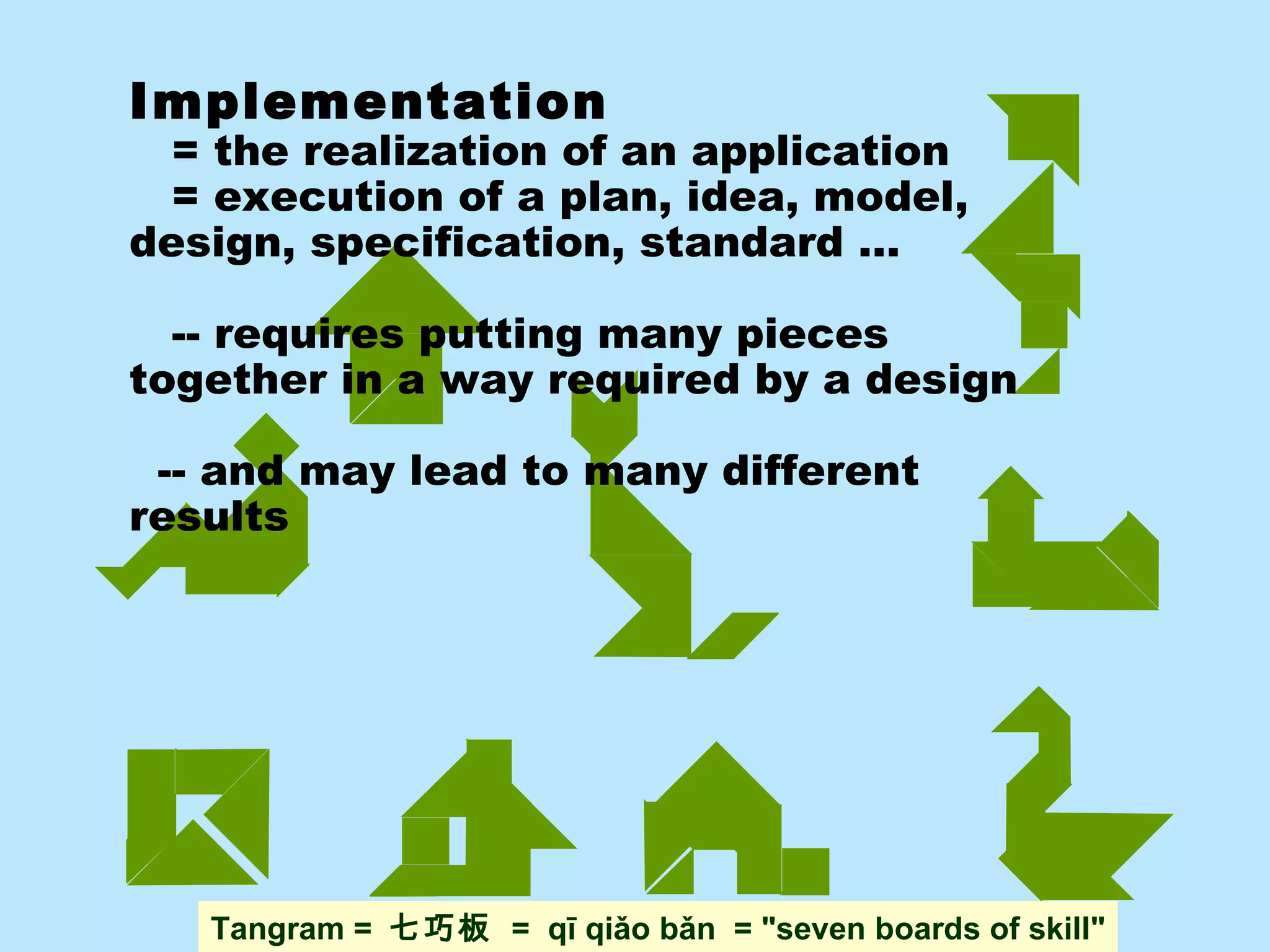
Implementation    = the realization of an application   = execution of a plan, idea, model, design, specification, standard …   -- requires putting many pieces together in a way required by a design   -- and may lead to many different results Tangram =  七巧板  =  qī qiǎo bǎn  = "seven boards of skill"
Understanding the  Pieces of the Puzzle Outline 1. Standards 2. Metadata types and functions 3. Crosswalking and mapping 4. Sources of metadata 5. Quality control 6. Workflows 7. Reference sources
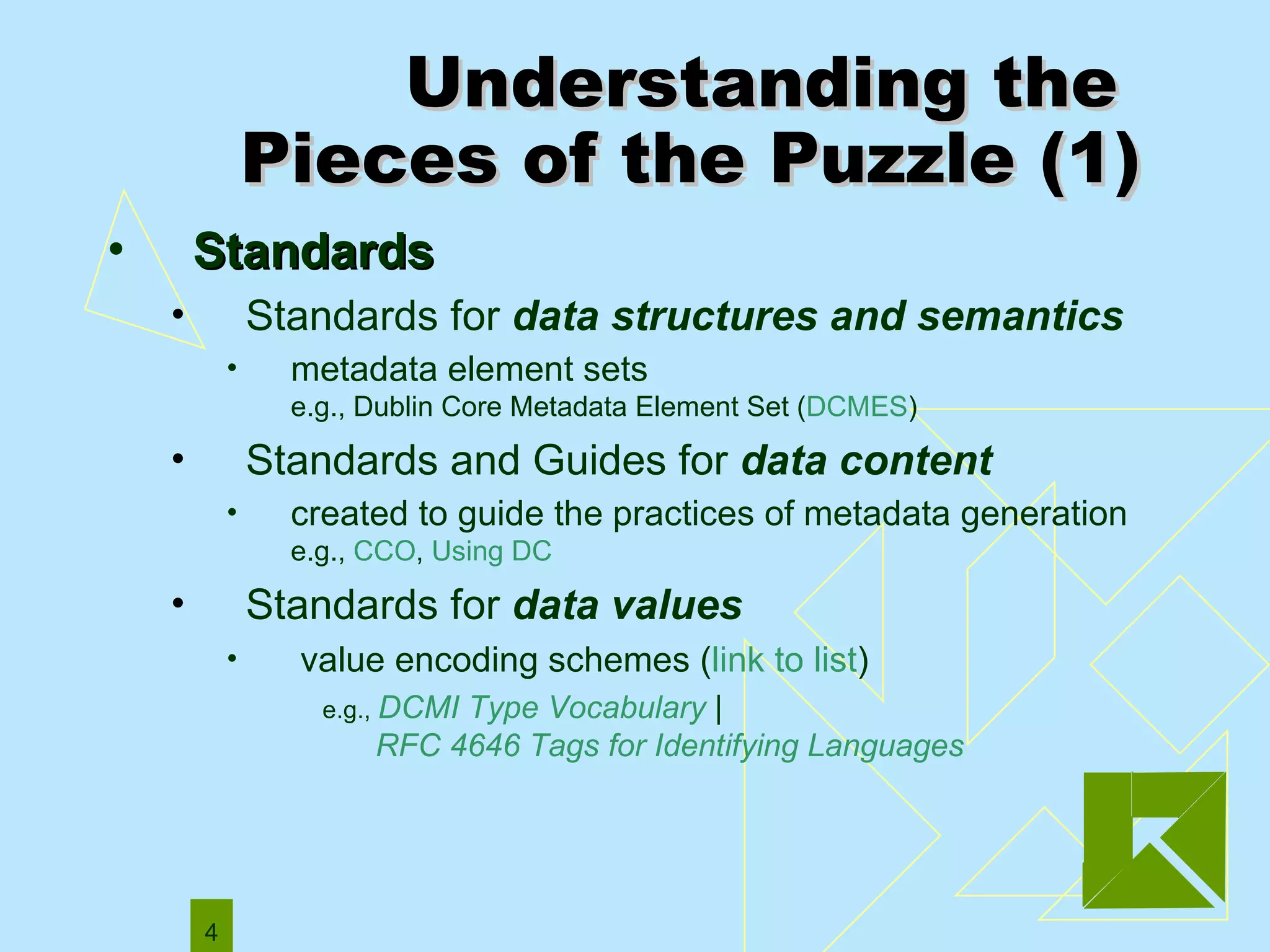
Standards   Standards for  data structures and   semantics   metadata element sets  e.g., Dublin Core Metadata Element Set ( DCMES )  Standards and Guides for  data   content   created to guide the practices of metadata generation  e.g.,  CCO ,  Using DC Standards for  data values   value encoding schemes ( link to list )  e.g.,  DCMI Type Vocabulary   |  RFC 4646 Tags for Identifying Languages   Understanding the  Pieces of the Puzzle (1)
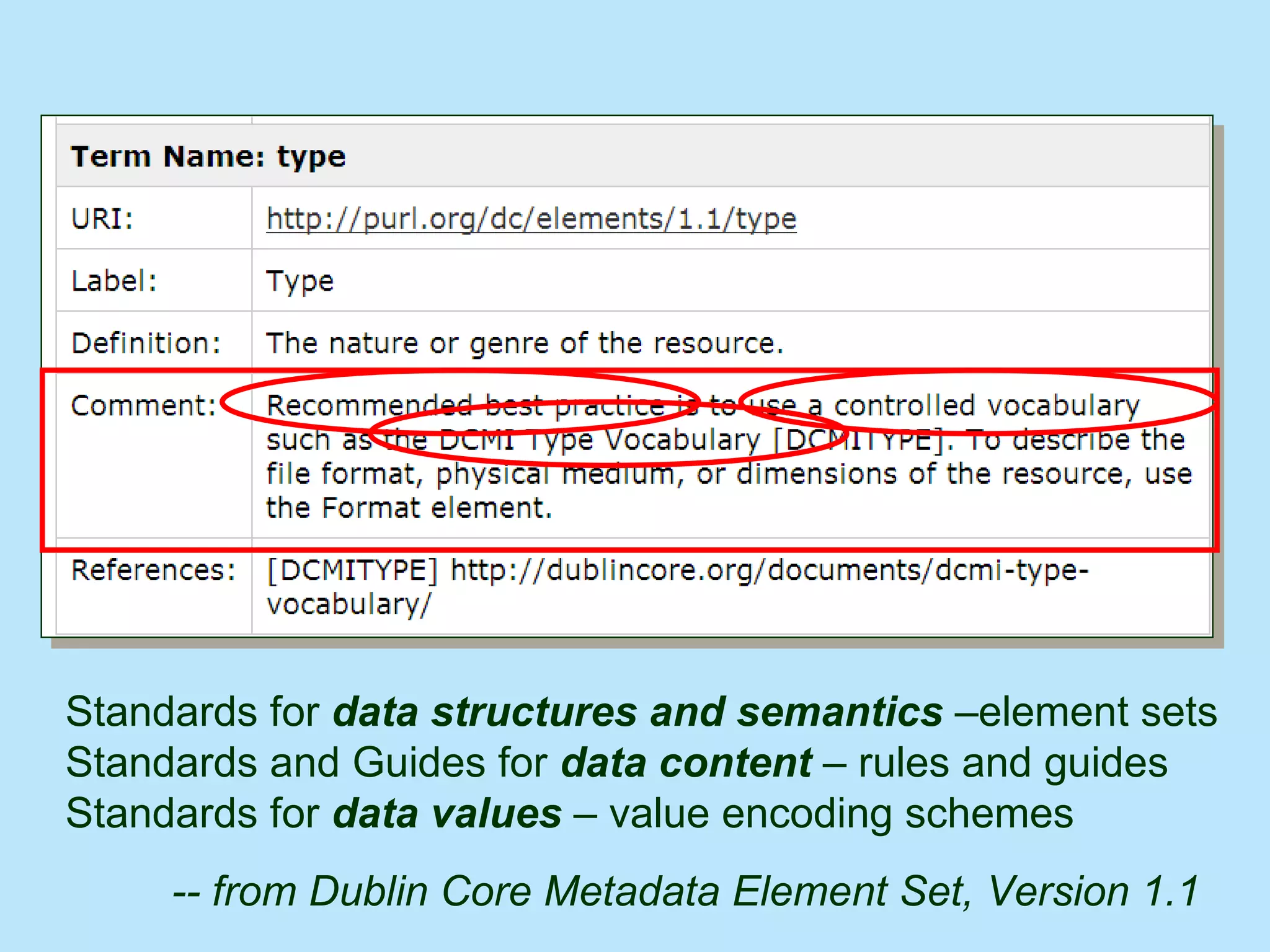
-- from Dublin Core Metadata Element Set, Version 1.1   Standards for  data structures and   semantics  –element sets Standards and Guides for  data   content   – rules and guides Standards for  data values  – value encoding schemes
Value space that should follow  syntax encoding schemes   Examples from values associated with  DATE  element 1979 2000-03 2000-03-01 2001-01-02T21:48.00Z 200003 C1999, 2000 January, 1919 May, 1919 1987, c2000 ?1999 1952 (issued) (1982) 1930?] 1823-1845 Between 1680 and 1896?
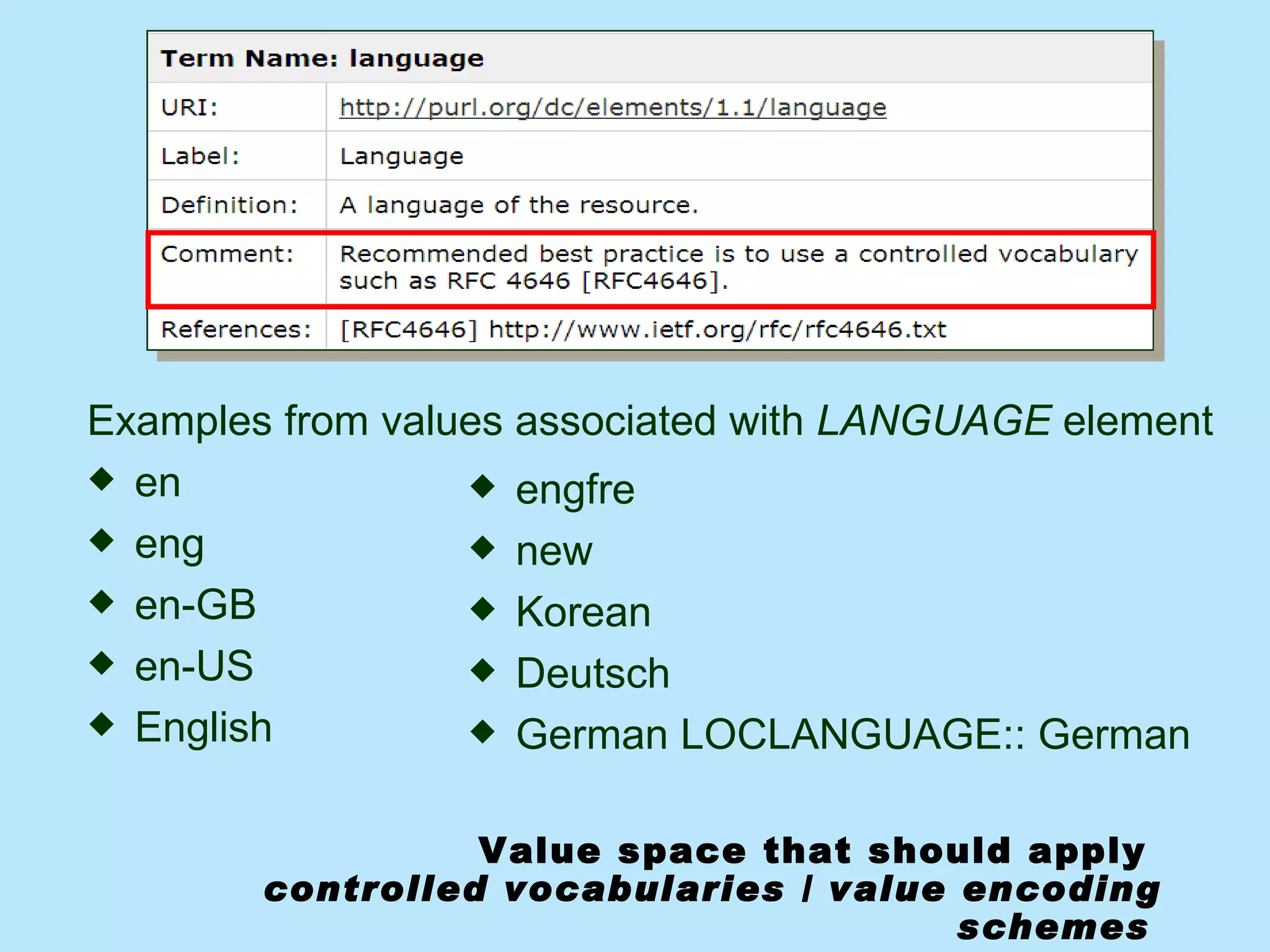
Value space that should apply  controlled vocabularies / value encoding schemes   Examples from values associated with  LANGUAGE  element en eng en-GB en-US English engfre new Korean Deutsch German LOCLANGUAGE:: German
Examples:  values associated with FORMAT element found in the research samples :   text text/html text/plain plain digital TIFF image/tiff other http://......../../../postscript.pdf application/msword application/Flash (animation) ascii http:// ….../../../sample.txt pdf http:// ….../../../sample.pdf ps http:// ….../../../sample.ps 3.6 megabytes 1000149 bytes language/java Application/JAVA applet Java  CLASS Model/VRML AVI, MOV, QTM 1 v. (various pagings) 10 p., [6] p. of plates p.461-470 viii, 82 p. MPEG-4 Value space that should apply  controlled vocabularies / value encoding schemes
Implement standards and follow best practices  to ensure consistency In shared repositories, consistency may be an issue in the following areas: Data Recording   Source Links   Identification and Identifiers   Description of Sources Metadata Representation ( in the search results display)  Data Syntax
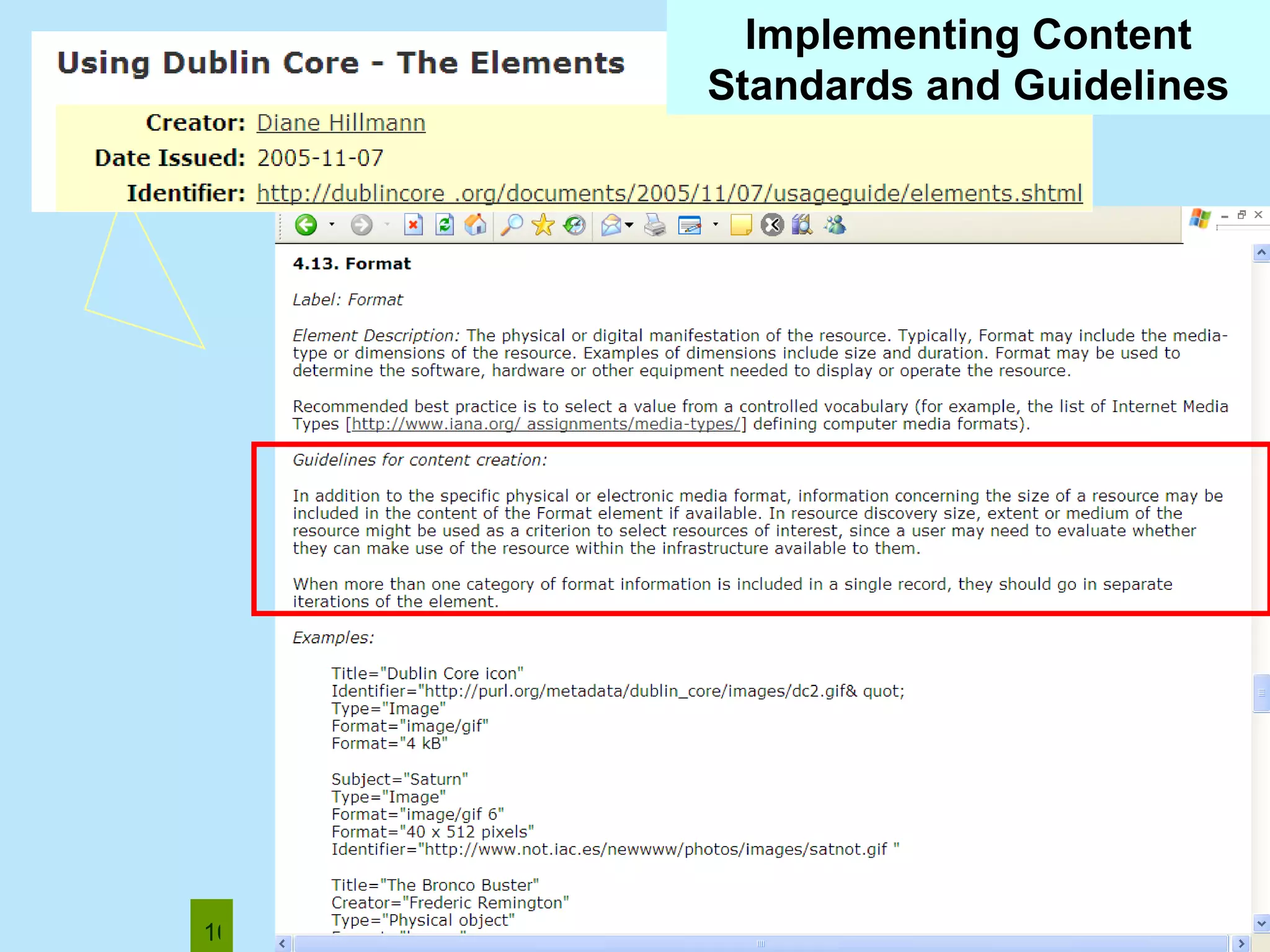
Implementing Content Standards and Guidelines
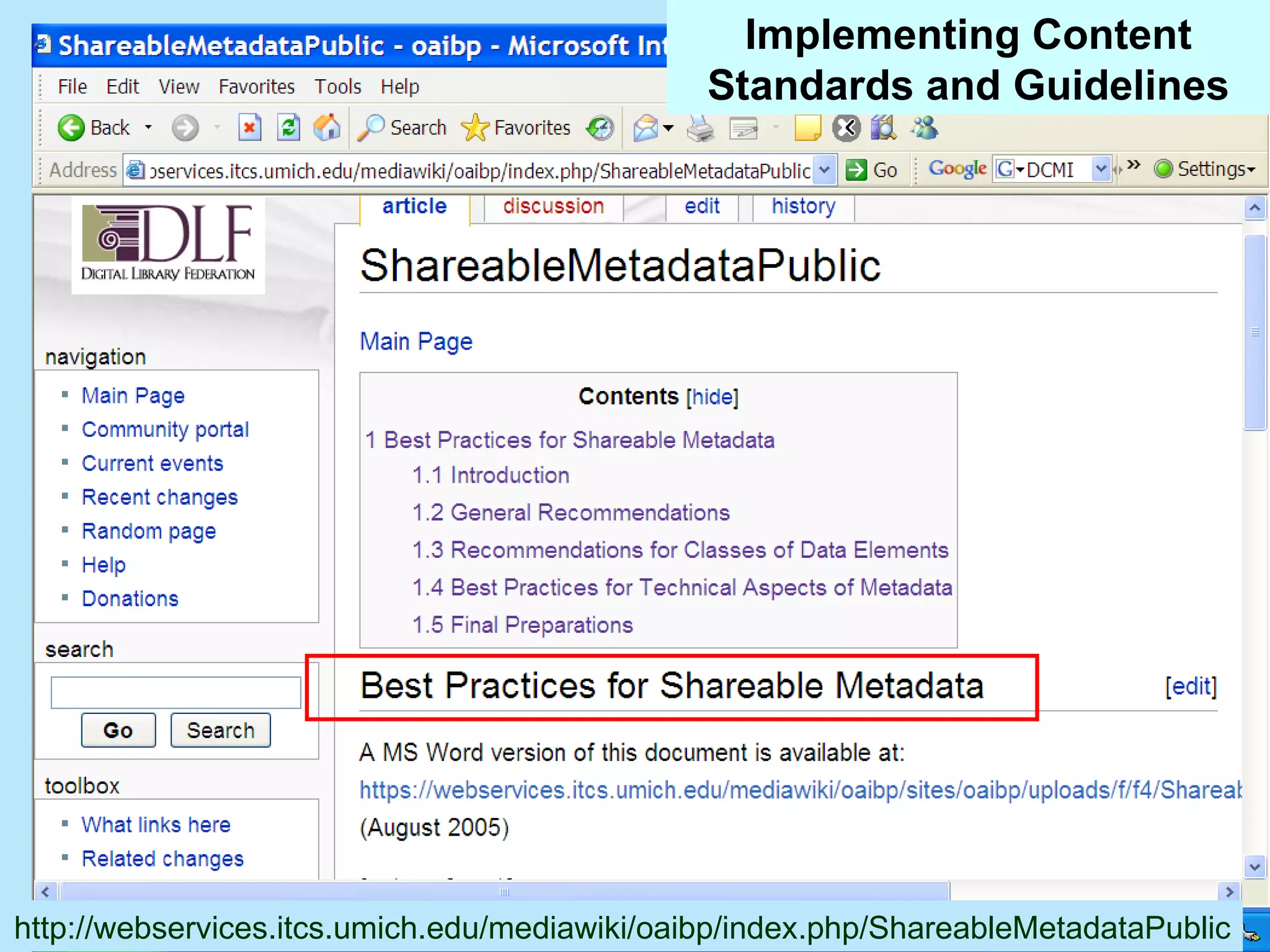
http://webservices.itcs.umich.edu/mediawiki/oaibp/index.php/ShareableMetadataPublic Implementing Content Standards and Guidelines
Understanding the  Pieces of the Puzzle (2) 2 . Metadata   Types and Functions
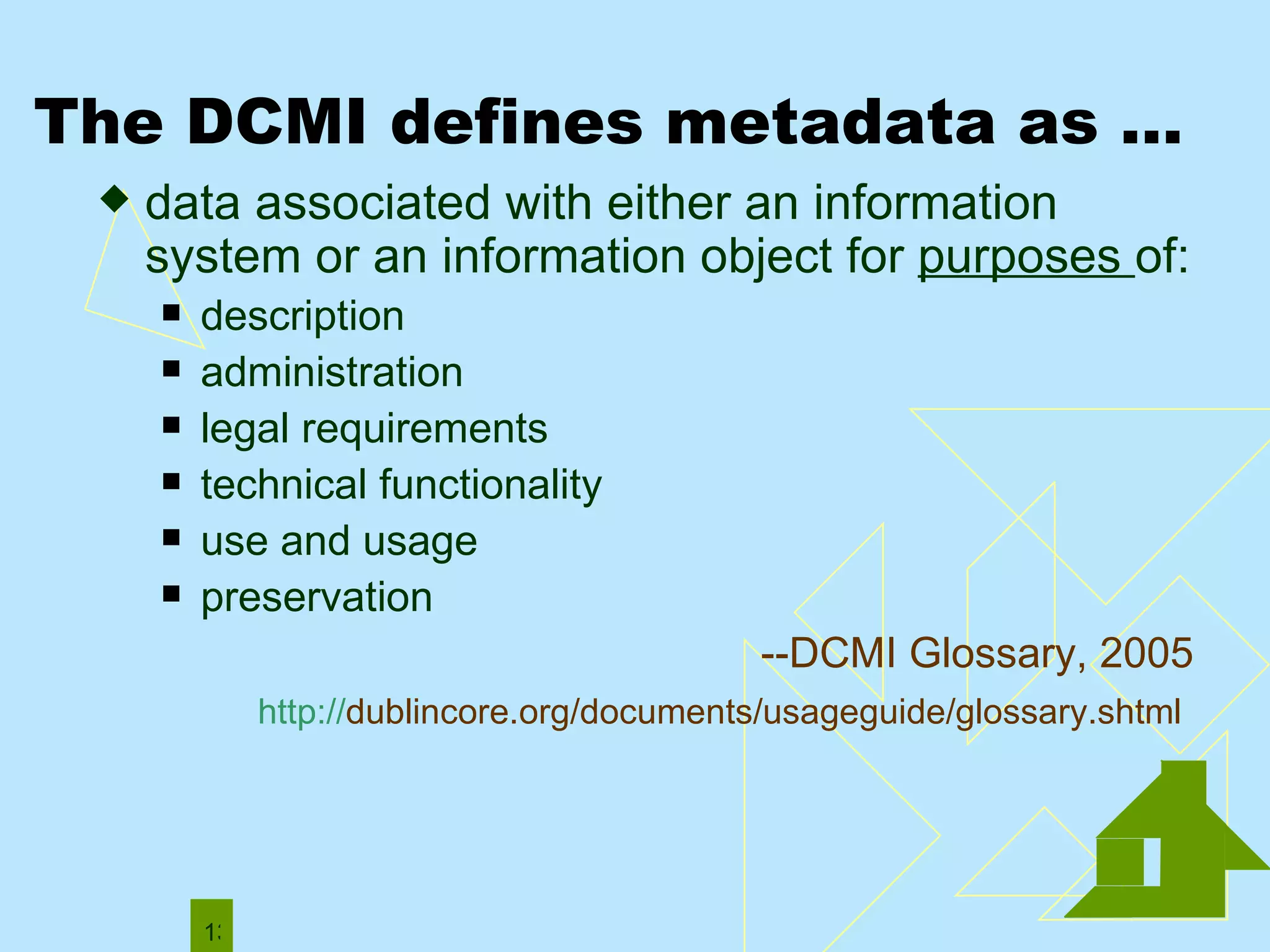
The DCMI defines metadata as … data associated with either an information system or an information object for  purposes  of: description administration  legal requirements technical functionality use and usage preservation --DCMI Glossary, 2005 http:// dublincore.org/documents/usageguide/glossary.shtml
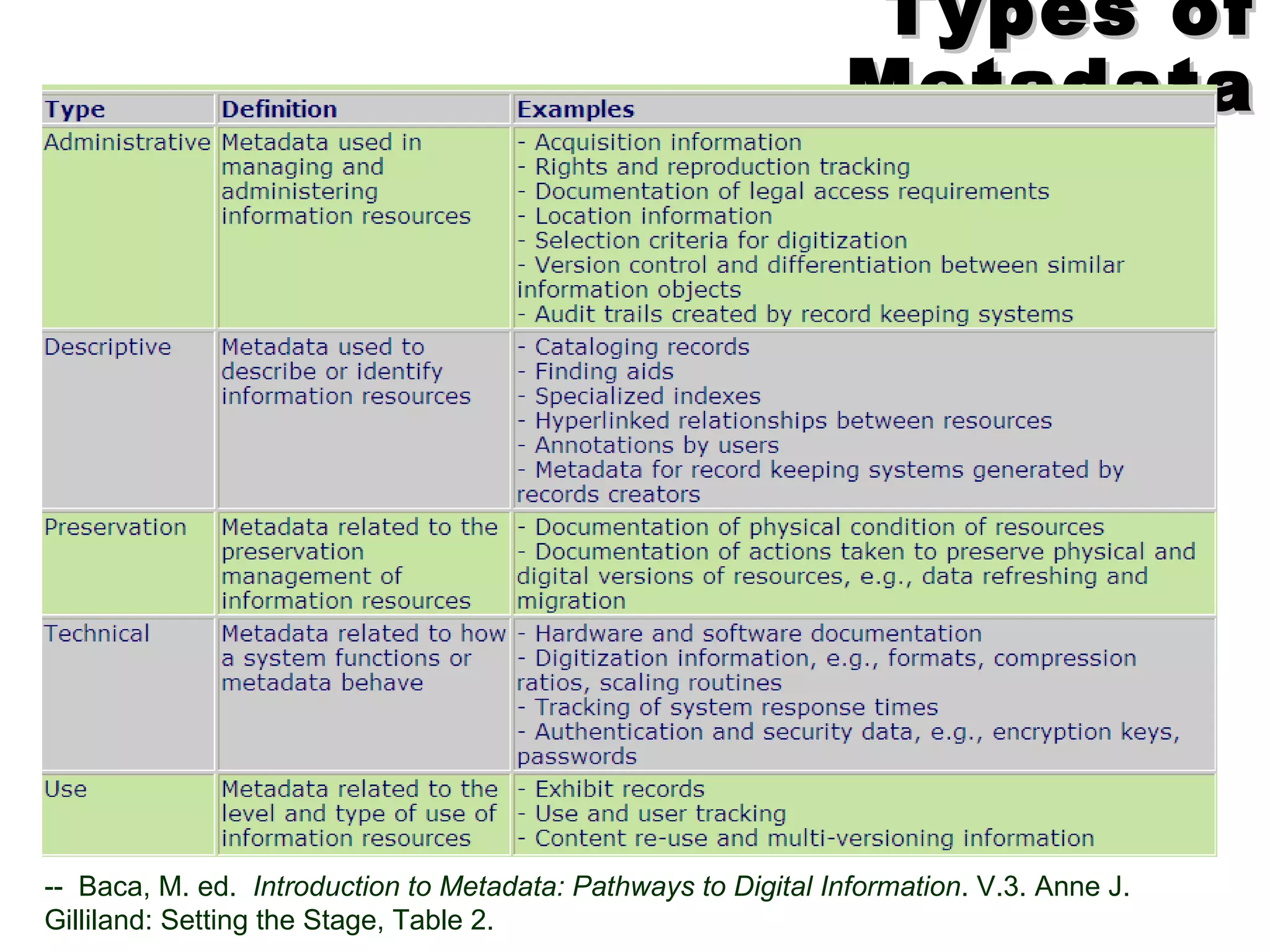
Types of Metadata --  Baca, M. ed.  Introduction to Metadata: Pathways to Digital Information . V.3. Anne J. Gilliland: Setting the Stage, Table 2.
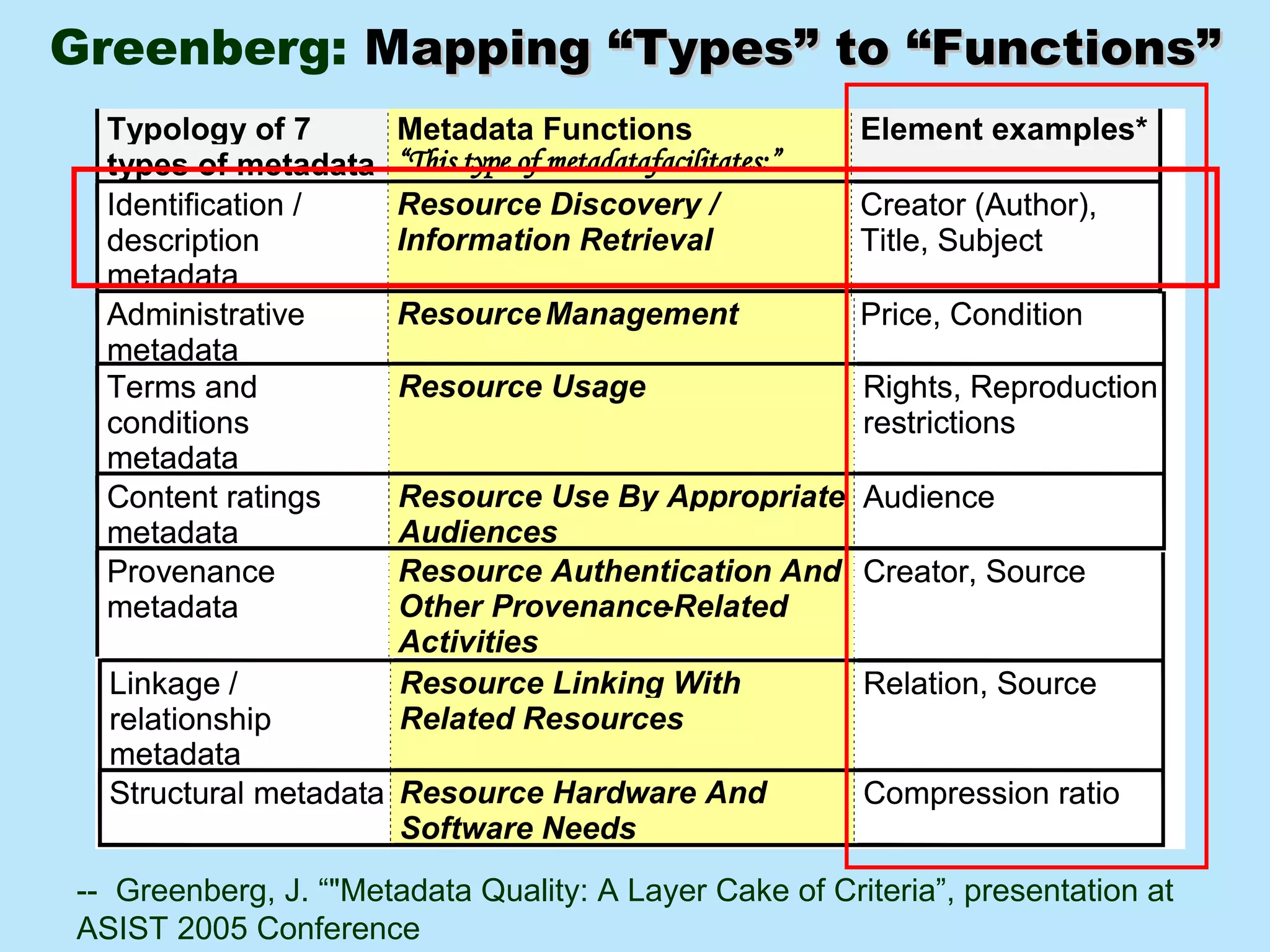
Greenberg:  M apping “Types” to “Functions” --  Greenberg, J. “ "Metadata Quality: A Layer Cake of Criteria ”, presentation at  ASIST 2005 Conference
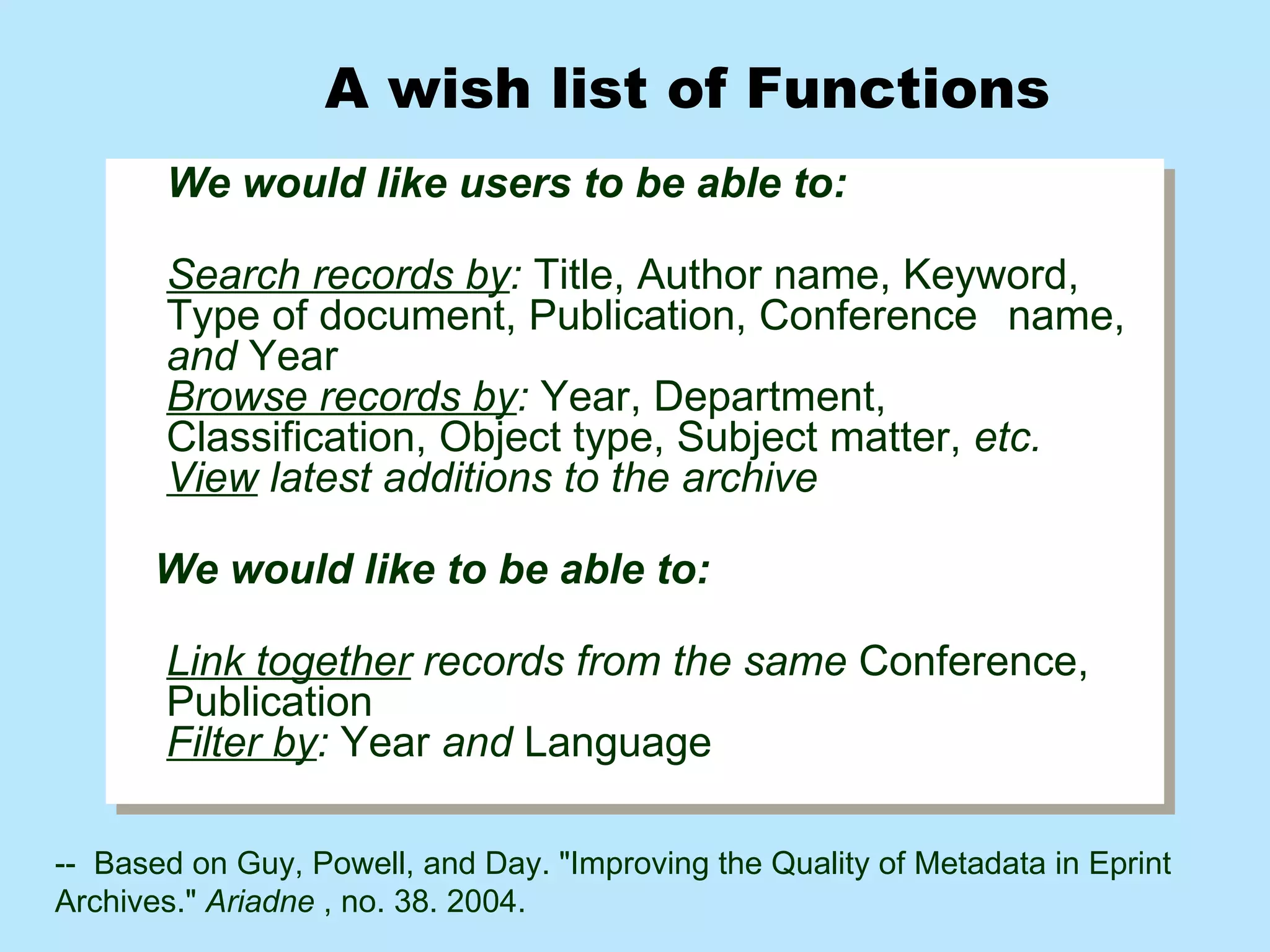
We would like users to be able to: Search records by :  Title, Author name, Keyword,  Type of document, Publication, Conference  name,  and  Year  Browse records by :  Year, Department,  Classification, Object type, Subject matter,  etc.   View  latest additions to the archive We would like to be able to: Link together  records from the same  Conference,  Publication  Filter by :  Year  and  Language A wish list of Functions  --  Based on Guy, Powell, and Day.  "Improving the Quality of Metadata in Eprint Archives."  Ariadne  , no. 38.  2004.
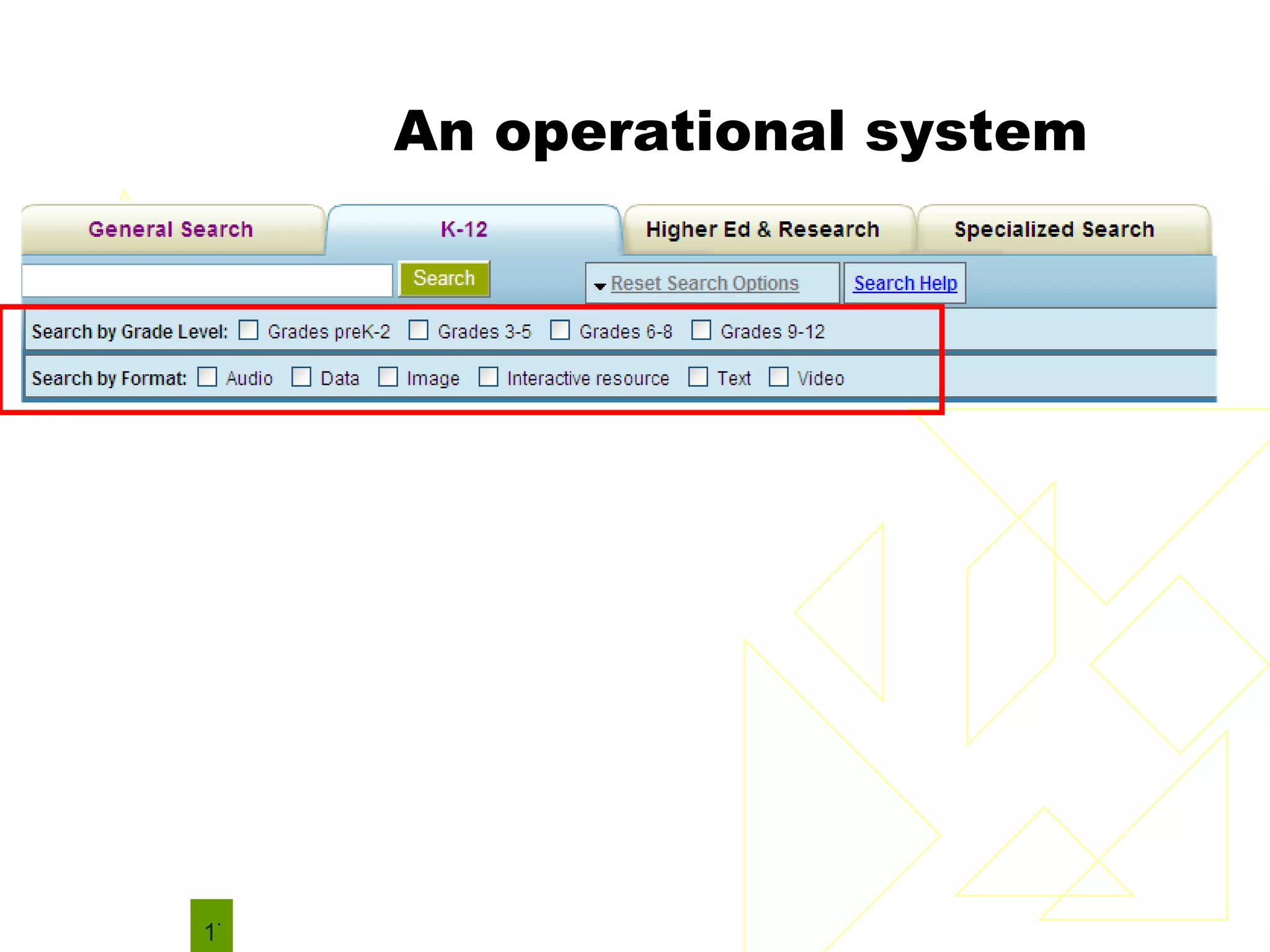
An operational system
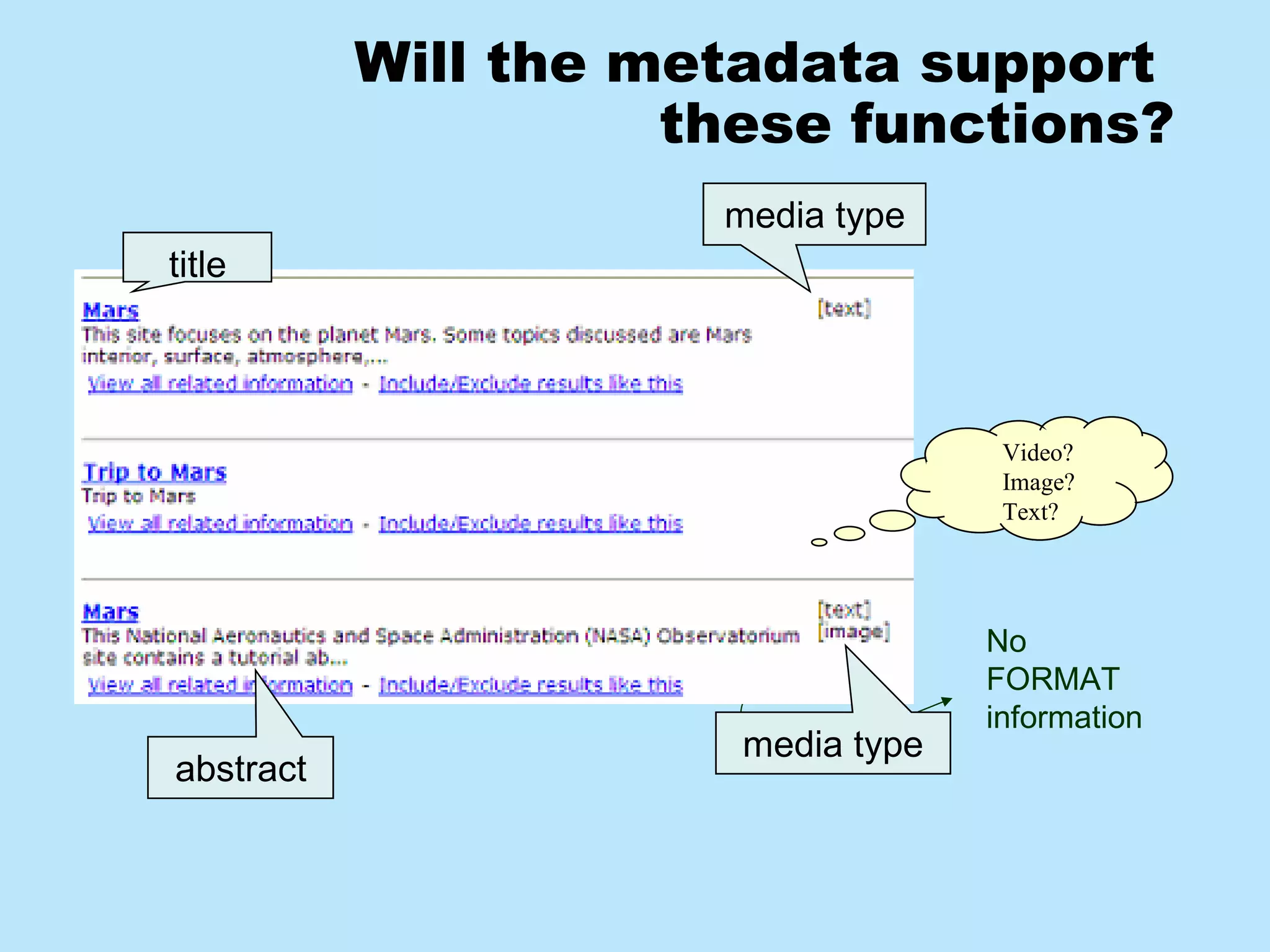
Will the metadata support  these functions? No FORMAT information
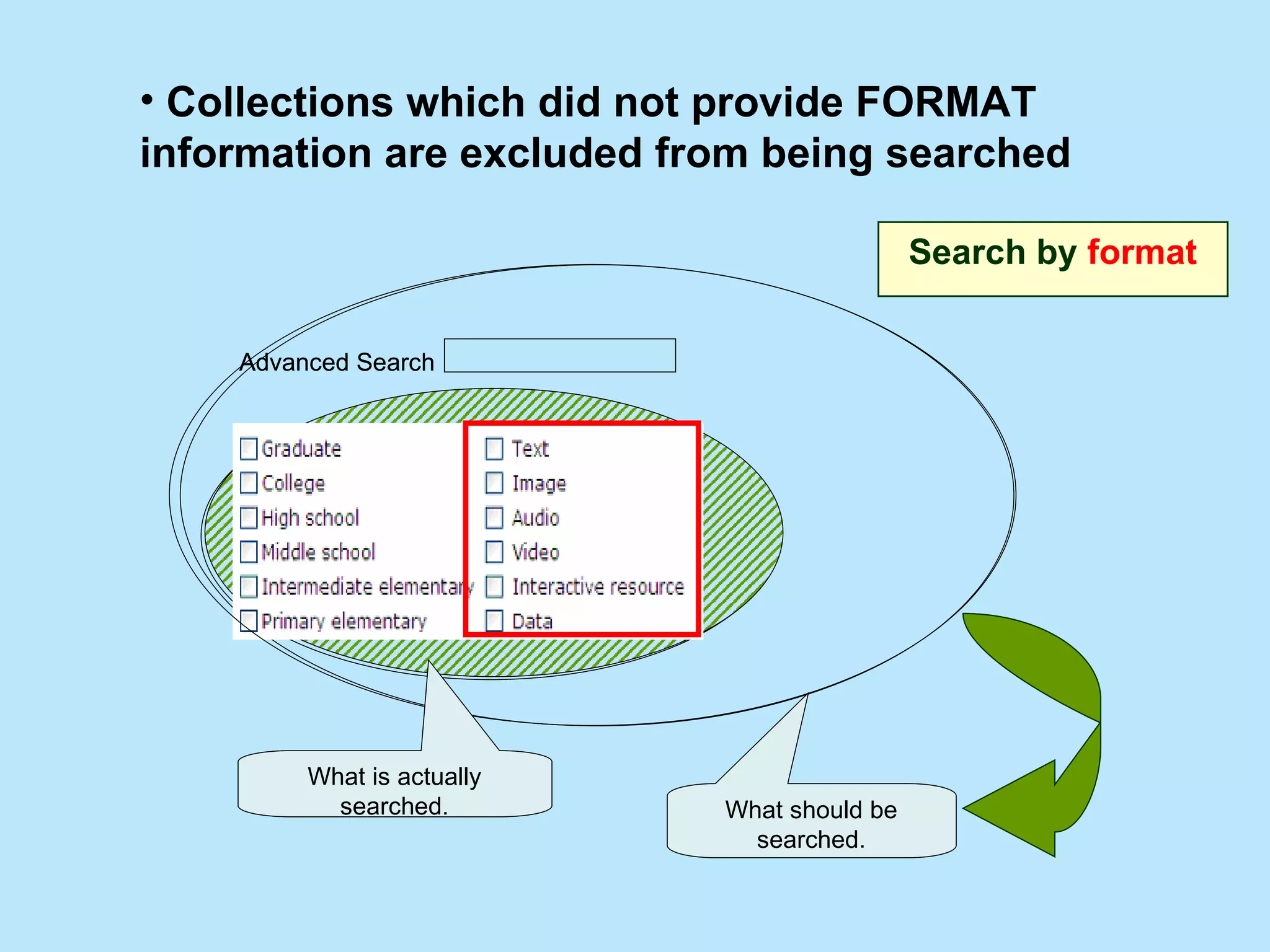
Search by  format Collections which did not provide FORMAT information are excluded from being searched  Advanced Search  What is actually  searched. What should be  searched. Advanced Search  What is actually  searched. What should be  searched.
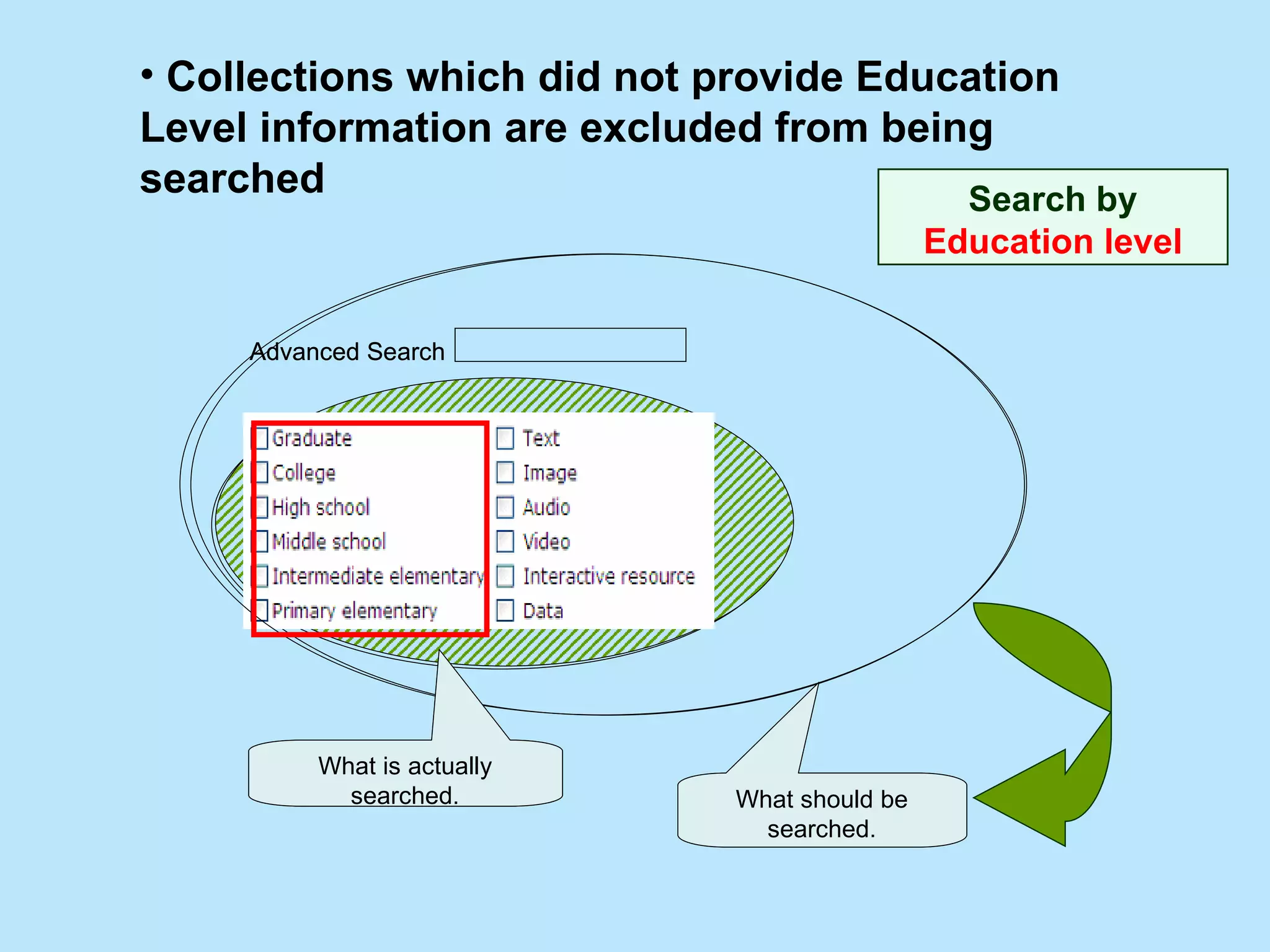
Search by  Education level Collections which did not provide Education Level information are excluded from being searched  Advanced Search  What is actually  searched. What should be  searched. Advanced Search  What is actually  searched. What should be  searched.
1) The metadata element set might not include such an element.  e.g., the legacy DC 15 elements does not include EDUCATION LEVEL The causes of  missing information (1)
The causes of  missing information (2) 2)  Although the metadata element set does include such an element, --  there is no authority or set of guidelines that enforce the use of this element  -- therefore, all or part of the records do not include a particular group of data.
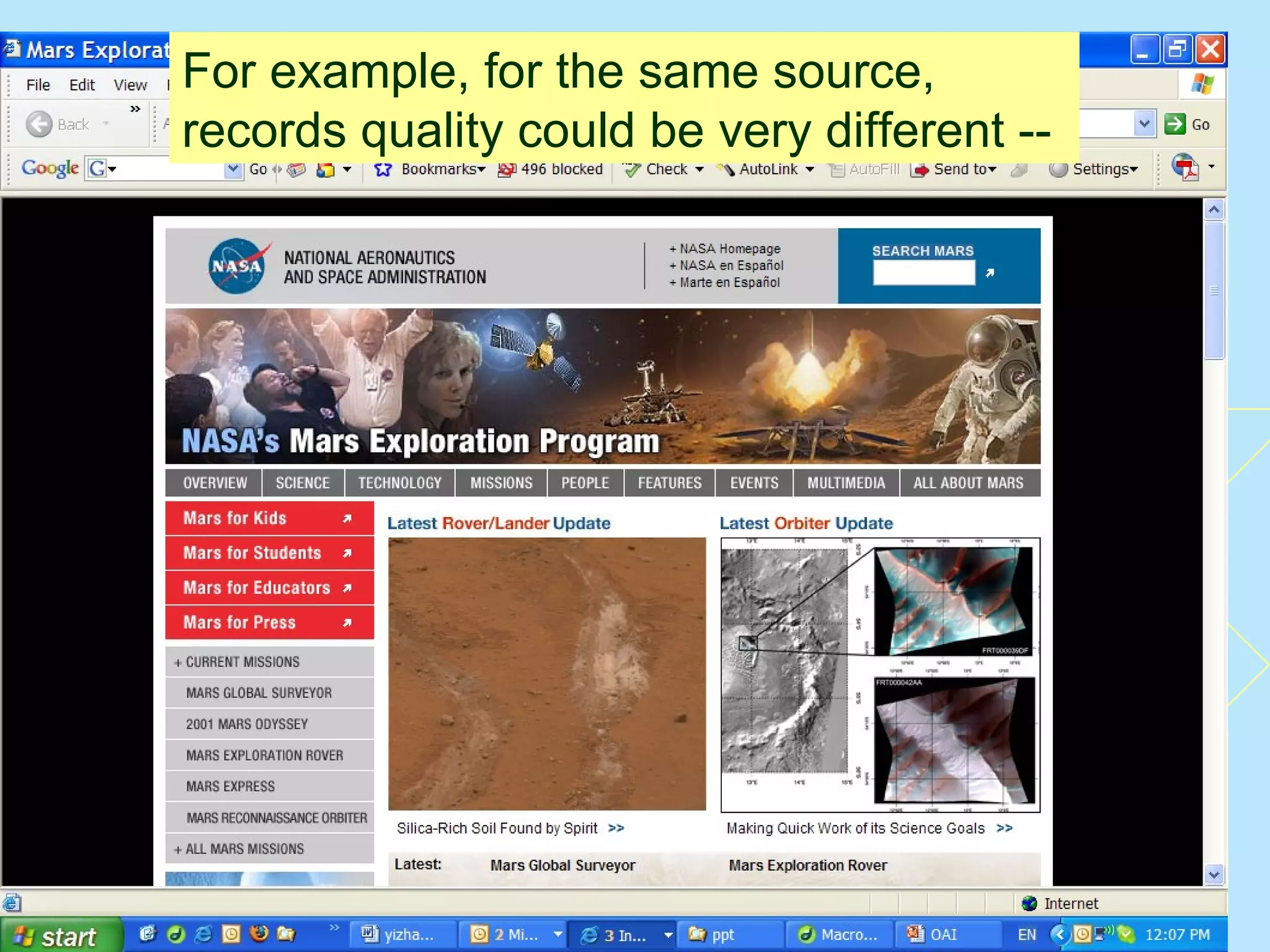
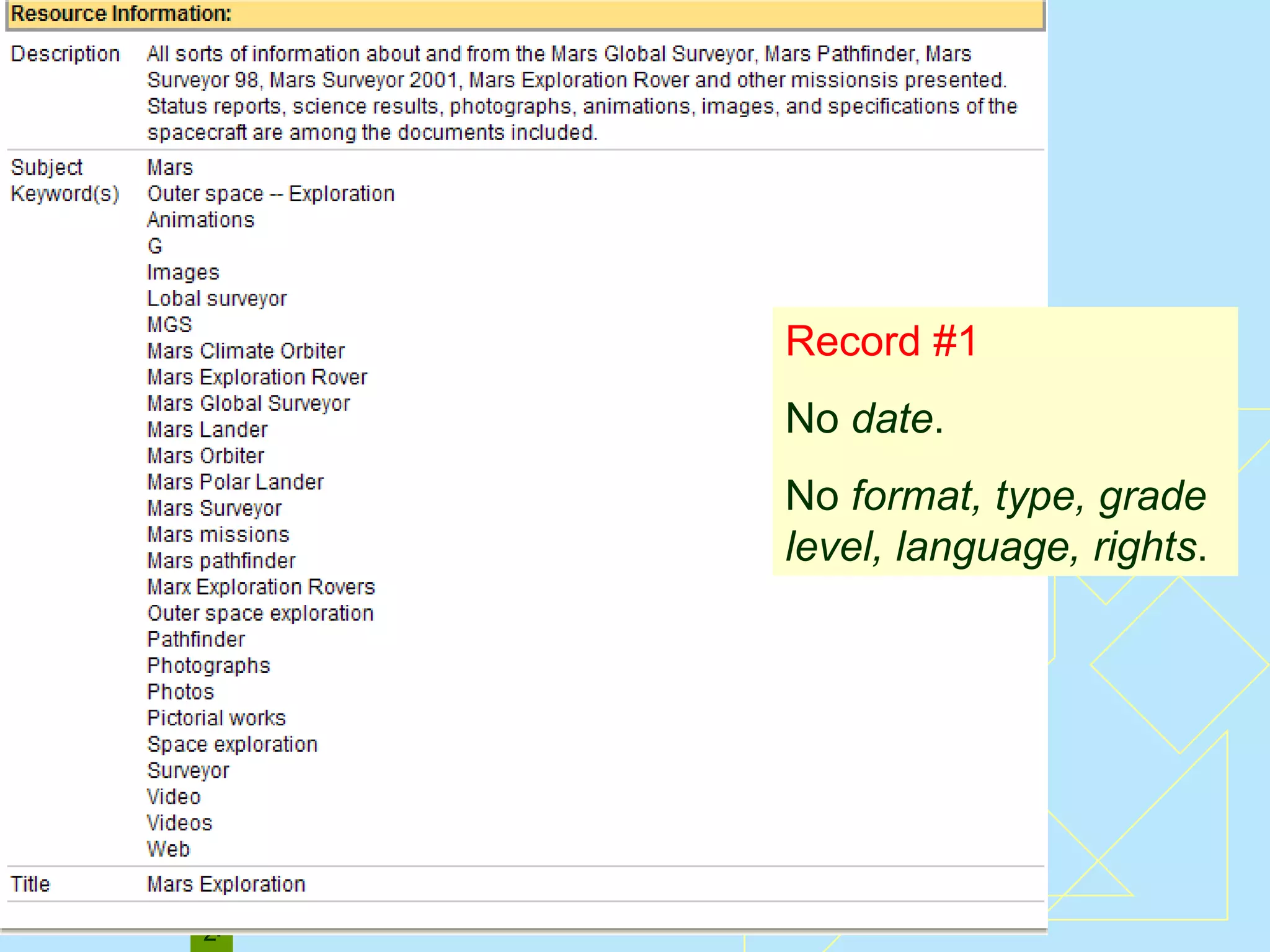
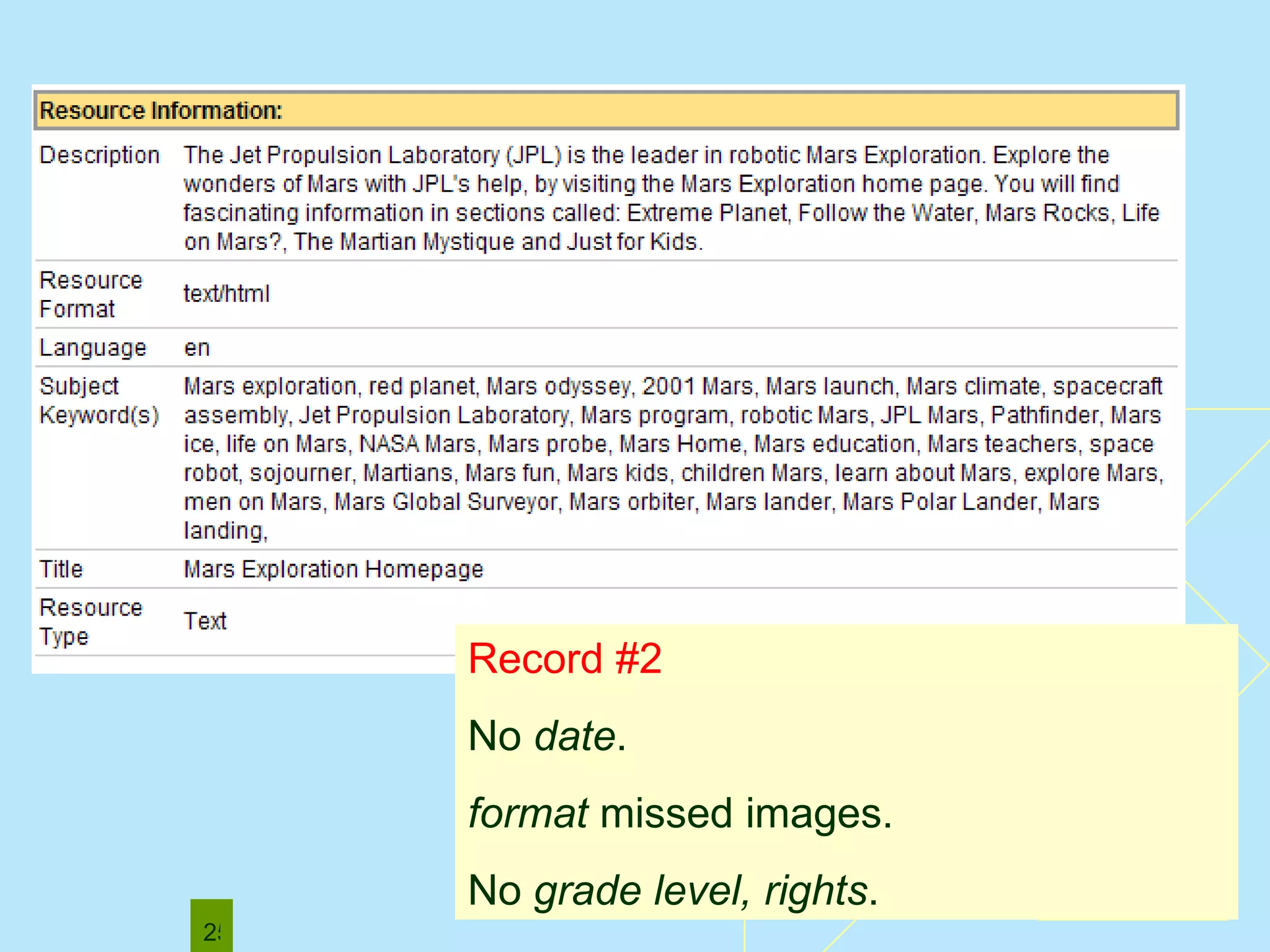
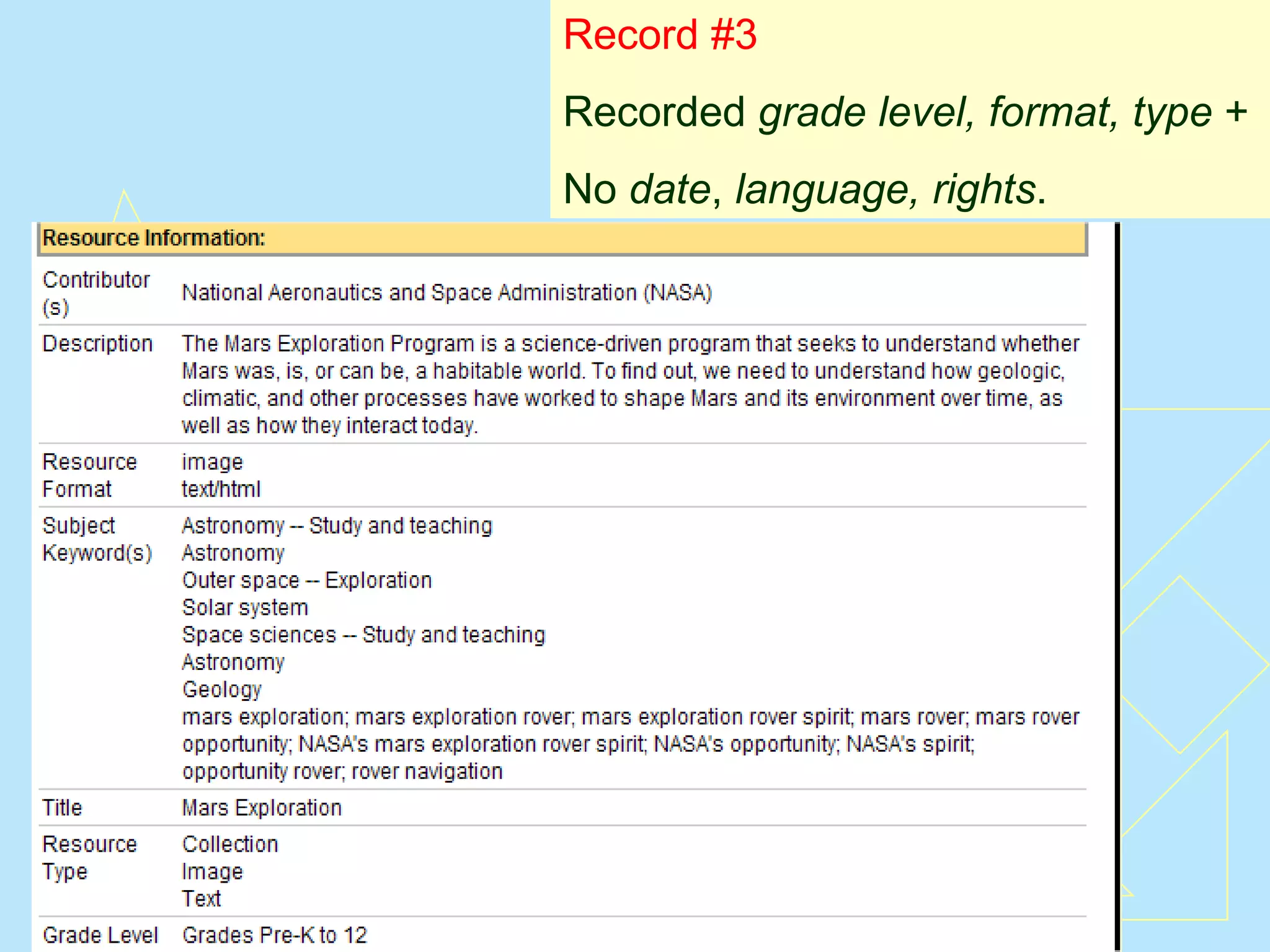
For example, for the same source, records quality could be very different --
Record #1 No  date .  No  format, type, grade level, language, rights .
Record #2 No  date .  format  missed images. No  grade level, rights .
Record #3 Recorded  grade level, format, type  + No  date ,  language, rights .
The causes of  missing information (3) 3) The information about  format  is put under a wrong element, e.g.  type , so that the values in this field will not be correctly indexed for  format .
4) The values are lost when the metadata records are converted from one database to another (due to incorrect mapping).  The causes of  missing information (4)
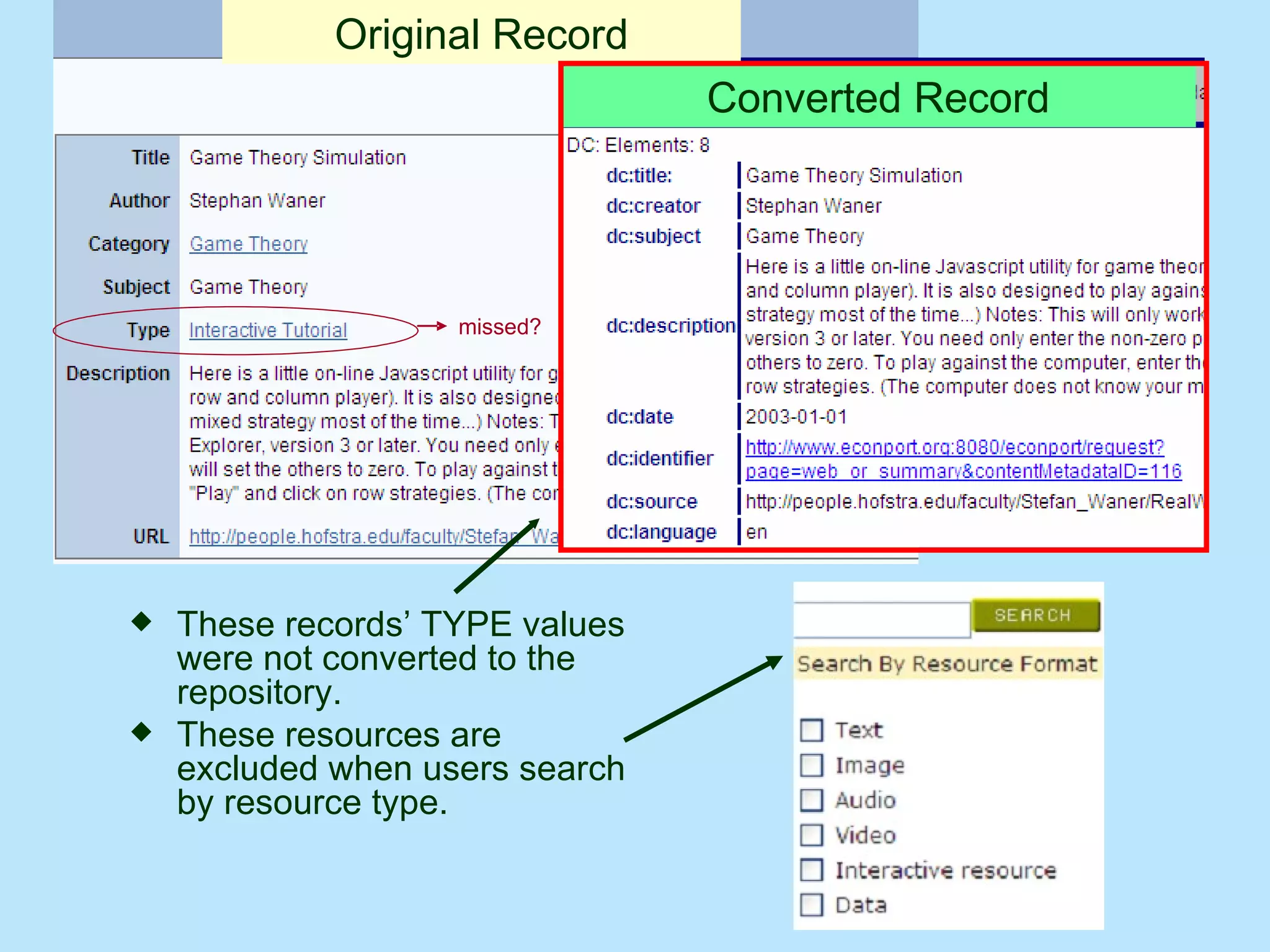
These records’ TYPE values were not converted to the repository.  These resources are excluded when users search by resource type. Original Record Converted Record
Understanding the  Pieces of the Puzzle (3) 3. Crosswalking and Mapping
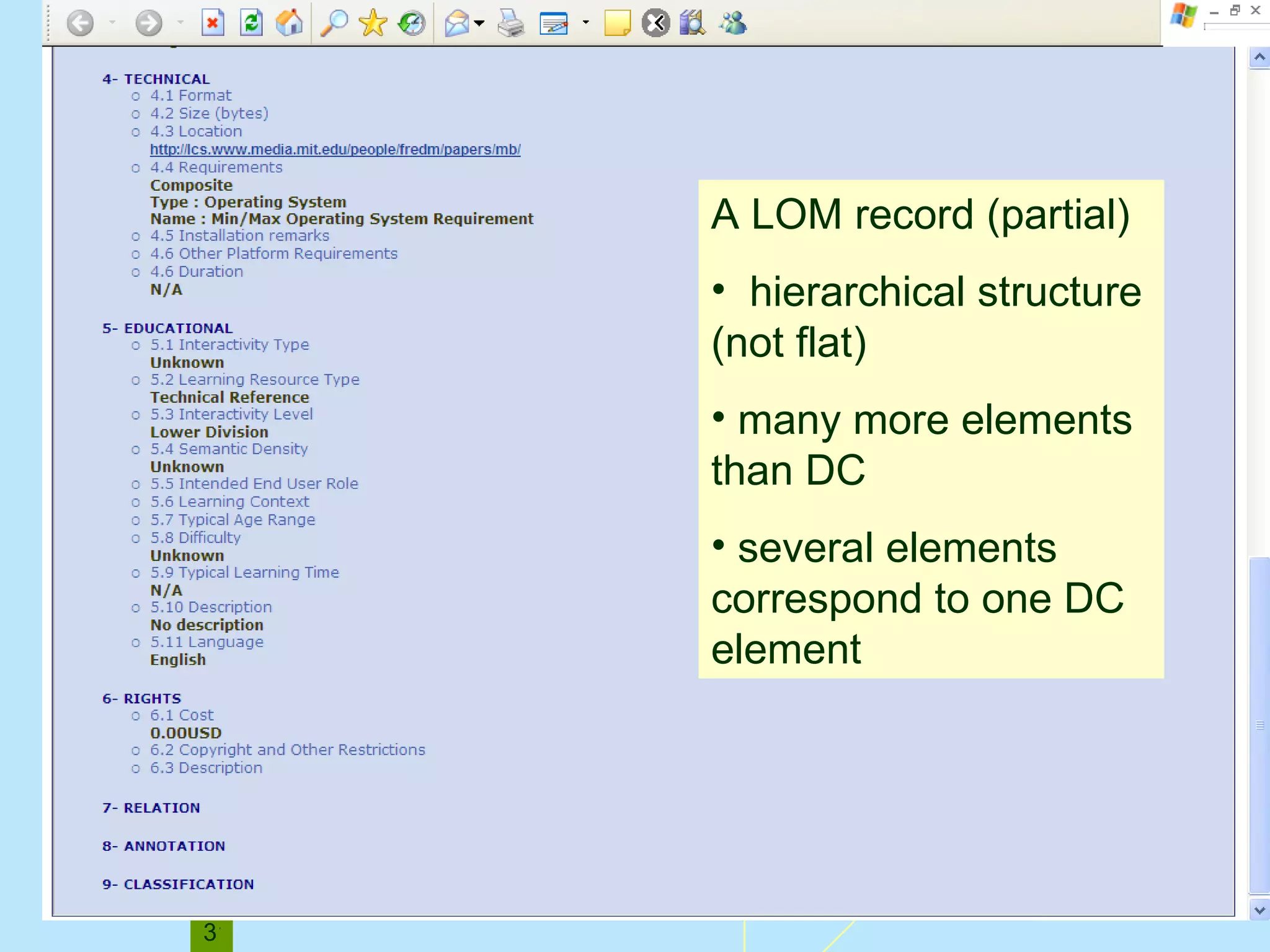
A LOM record (partial)  hierarchical structure (not flat) many more elements than DC several elements correspond to one DC element
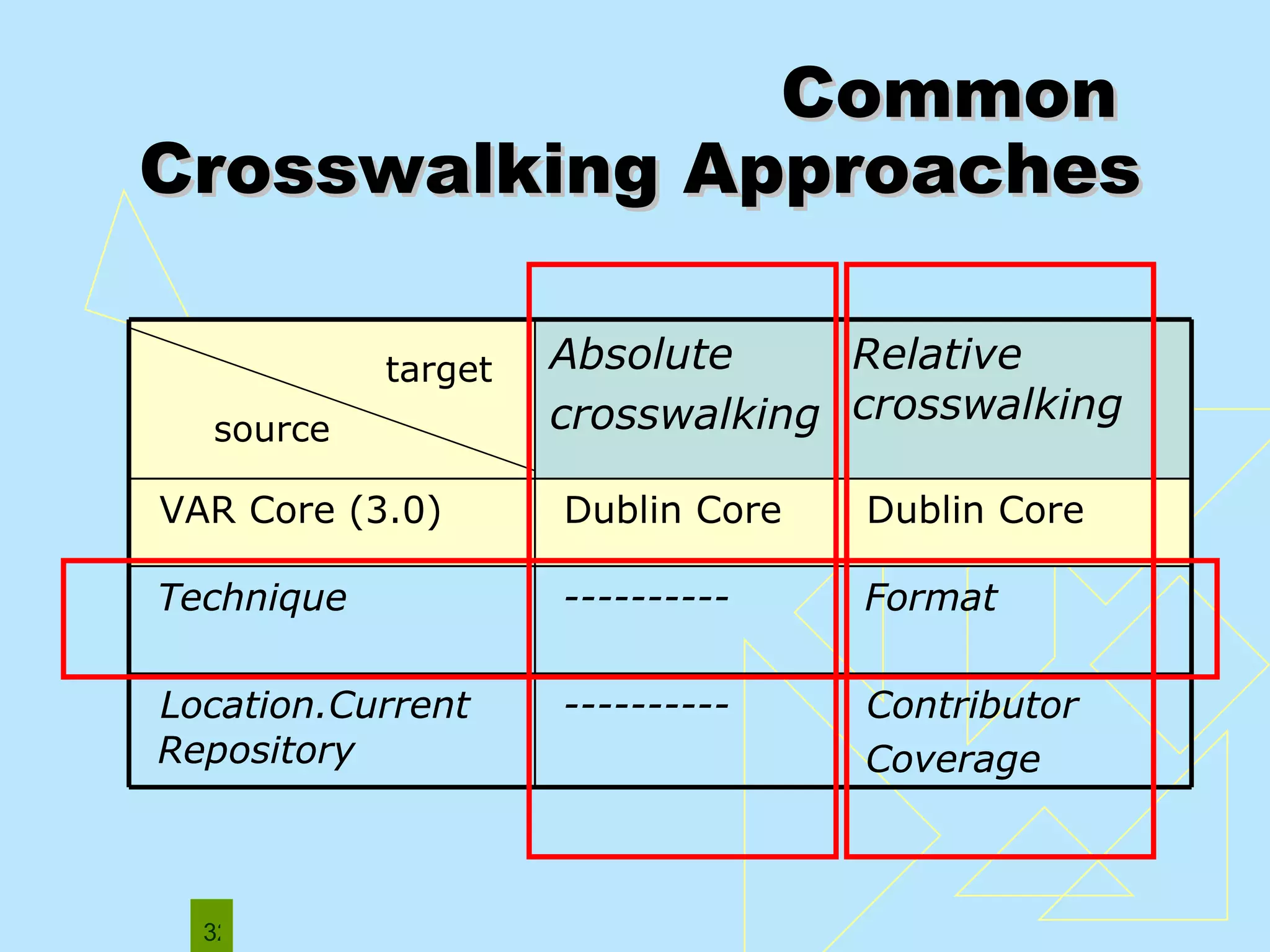
Common  Crosswalking Approaches Contributor Coverage ---------- Location.Current Repository Format ---------- Technique Dublin Core Dublin Core VAR Core (3.0) Relative  crosswalking Absolute crosswalking Contributor Coverage ---------- Location.Current Repository Format ---------- Technique Dublin Core Dublin Core VAR Core (3.0) Relative  crosswalking Absolute crosswalking target source
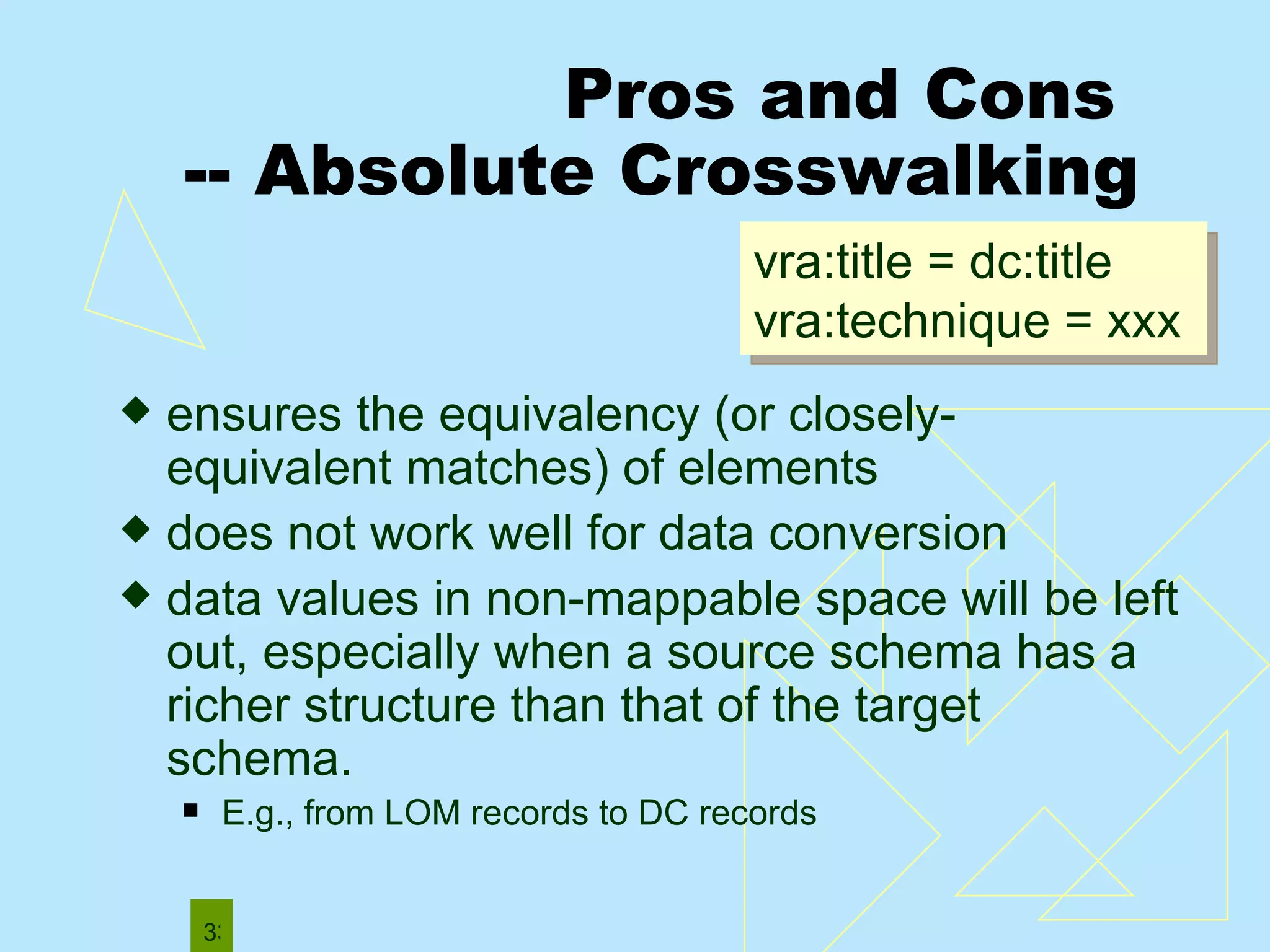
Pros and Cons  -- Absolute Crosswalking ensures the equivalency (or closely-equivalent matches) of elements does not work well for data conversion  data values in non-mappable space will be left out, especially when a source schema has a richer structure than that of the target schema.  E.g., from LOM records to DC records vra:title = dc:title vra:technique = xxx
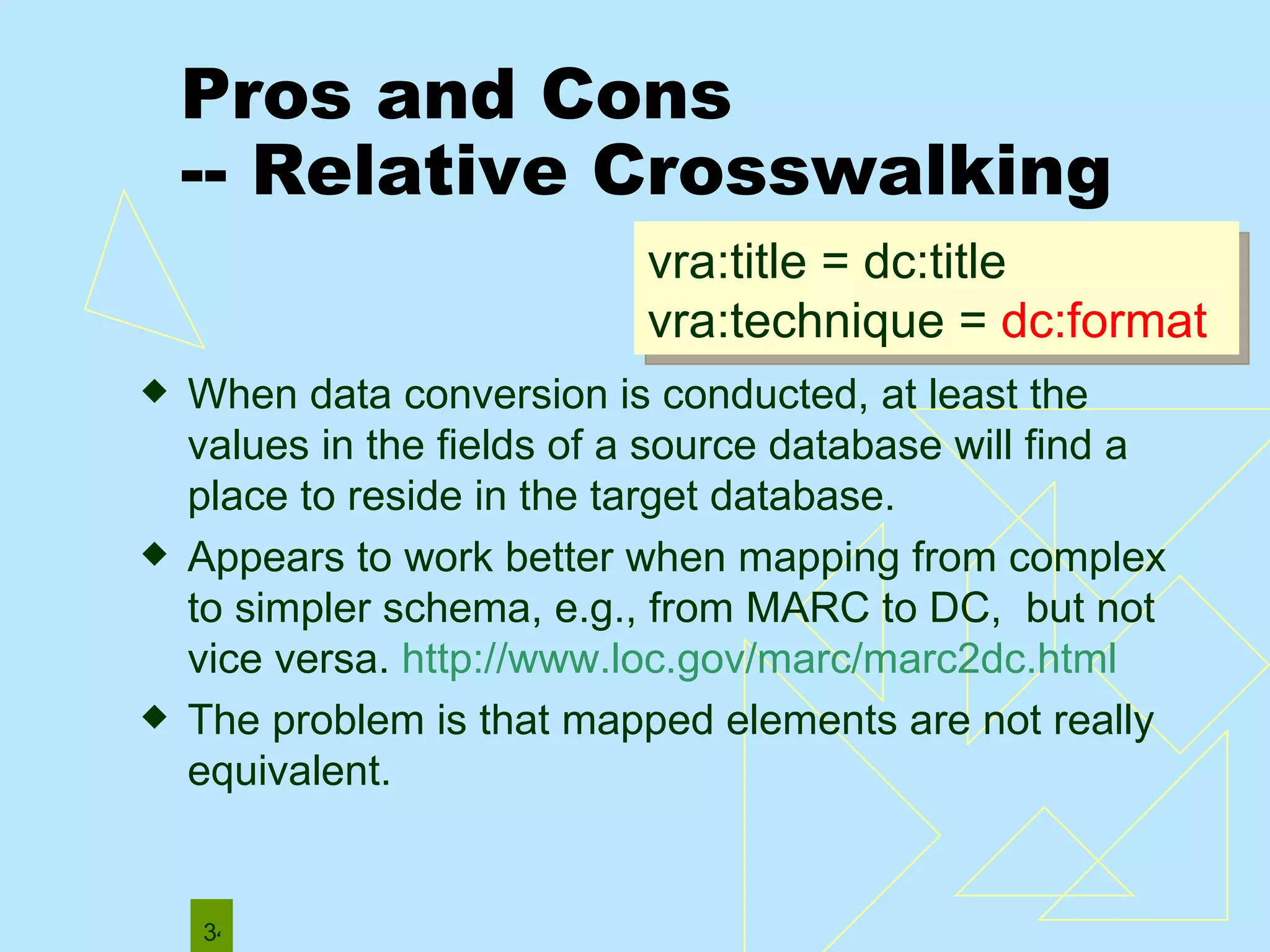
Pros and Cons  -- Relative Crosswalking When data conversion is conducted, at least the values in the fields of a source database will find a place to reside in the target database.  Appears to work better when mapping from complex to simpler schema, e.g., from MARC to DC,  but not vice versa.  http://www.loc.gov/marc/marc2dc.html The problem is that mapped elements are not really equivalent. vra:title = dc:title vra:technique =  dc:format
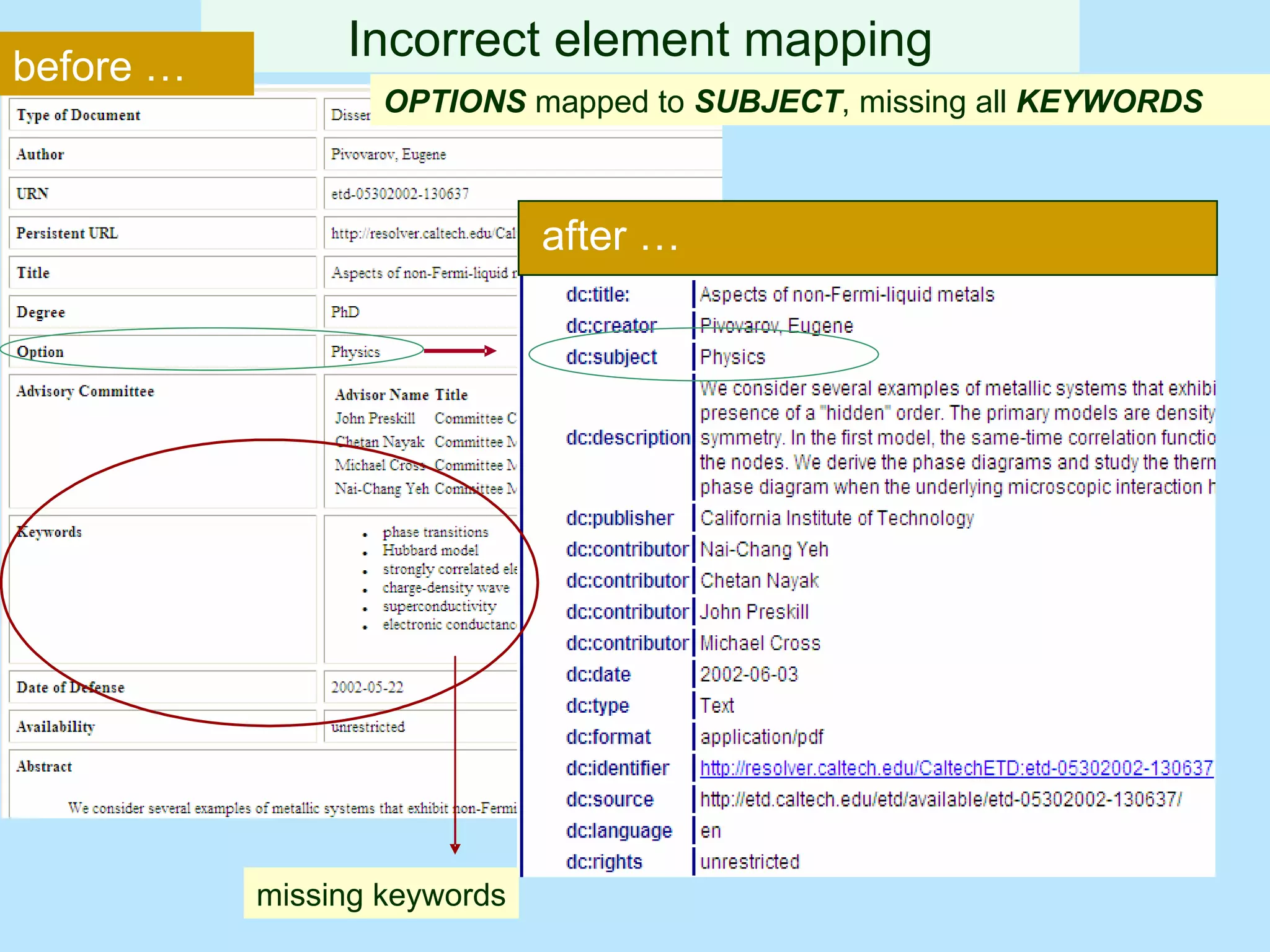
missing keywords OPTIONS  mapped to  SUBJECT , missing all  KEYWORDS Incorrect element mapping after … before … missed?!  missed?!
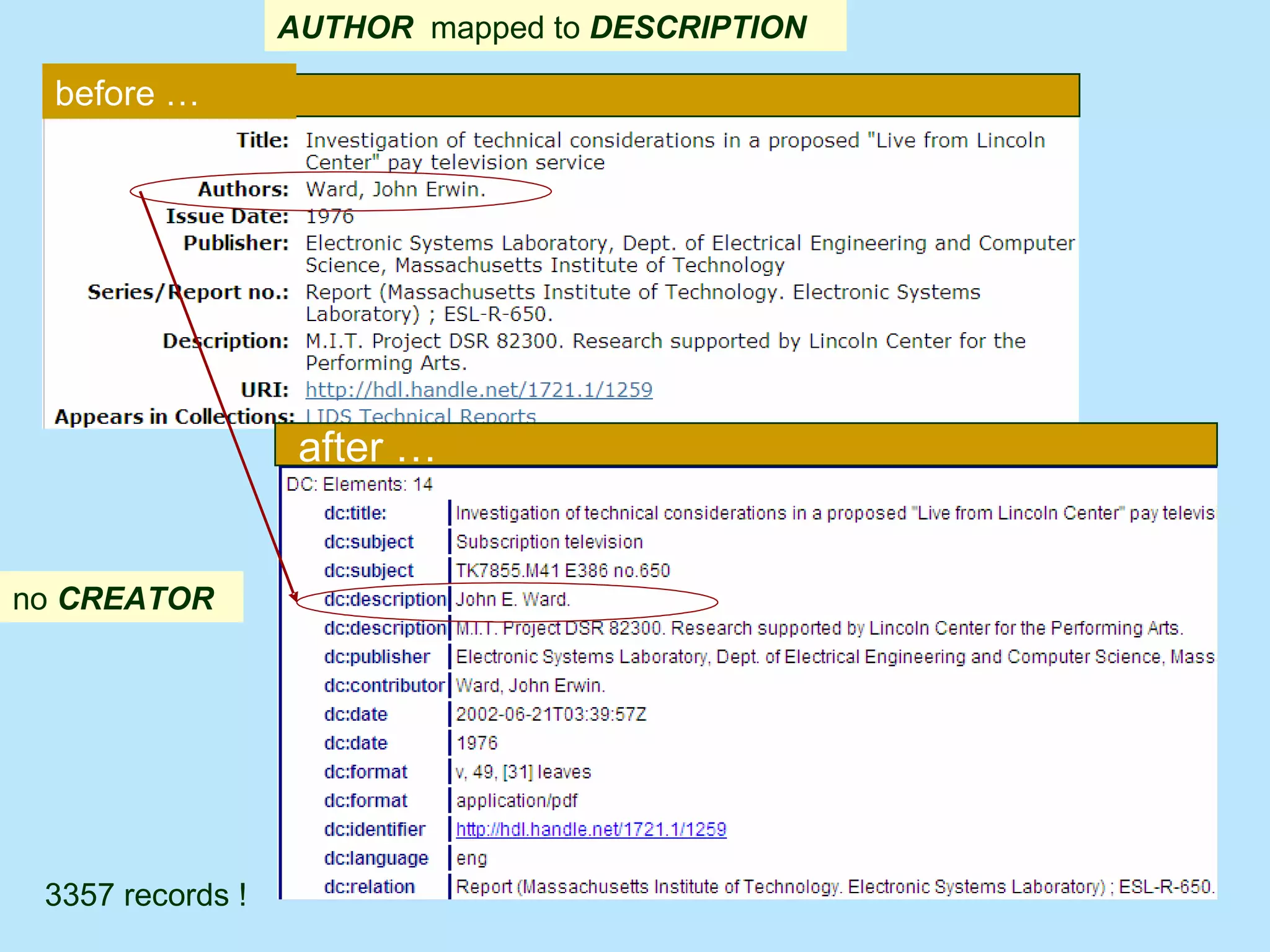
AUTHOR  mapped to  DESCRIPTION 3357 records ! no   CREATOR before … after …
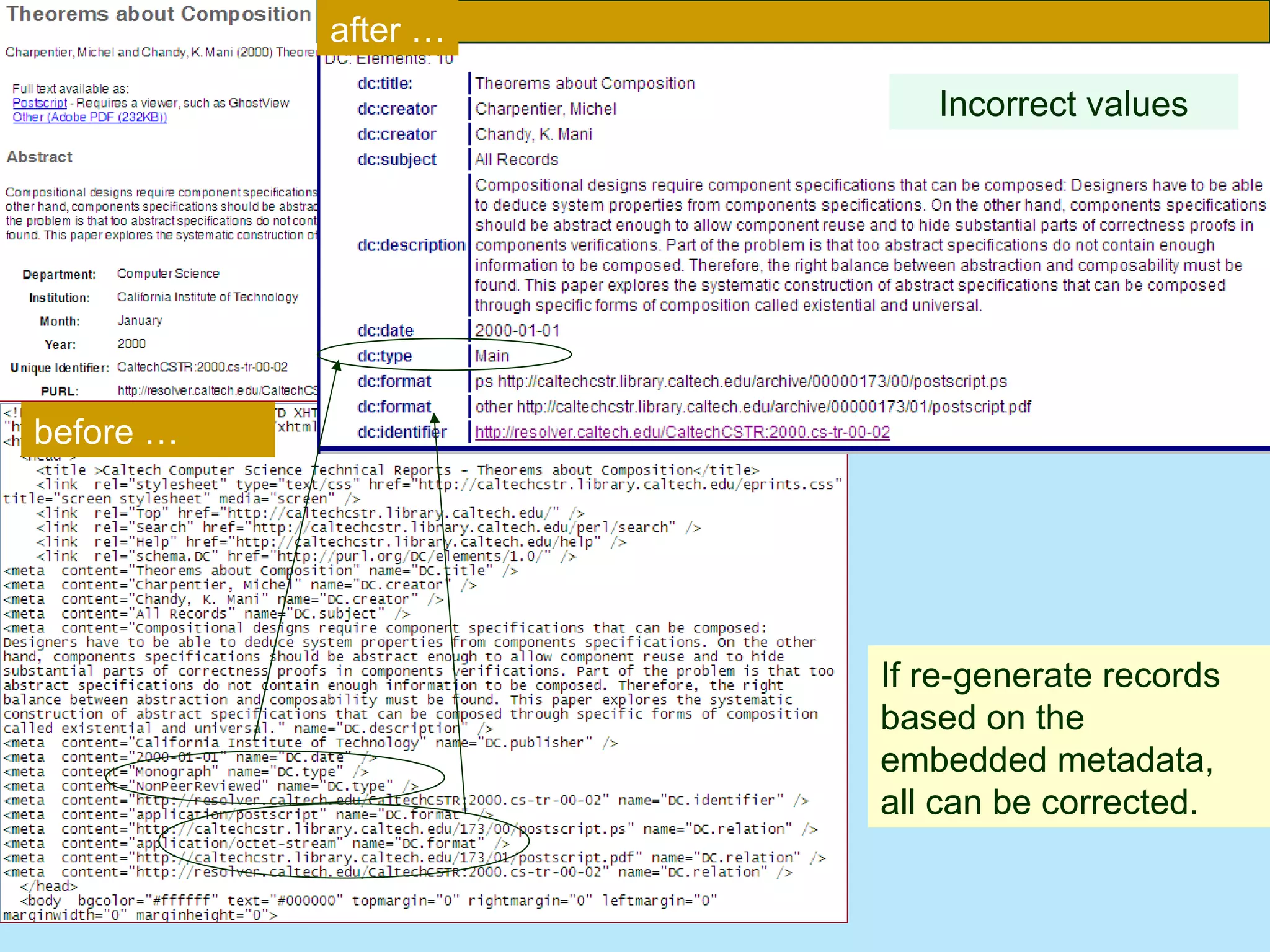
If re-generate records based on the embedded metadata, all can be corrected. Incorrect values after … before …
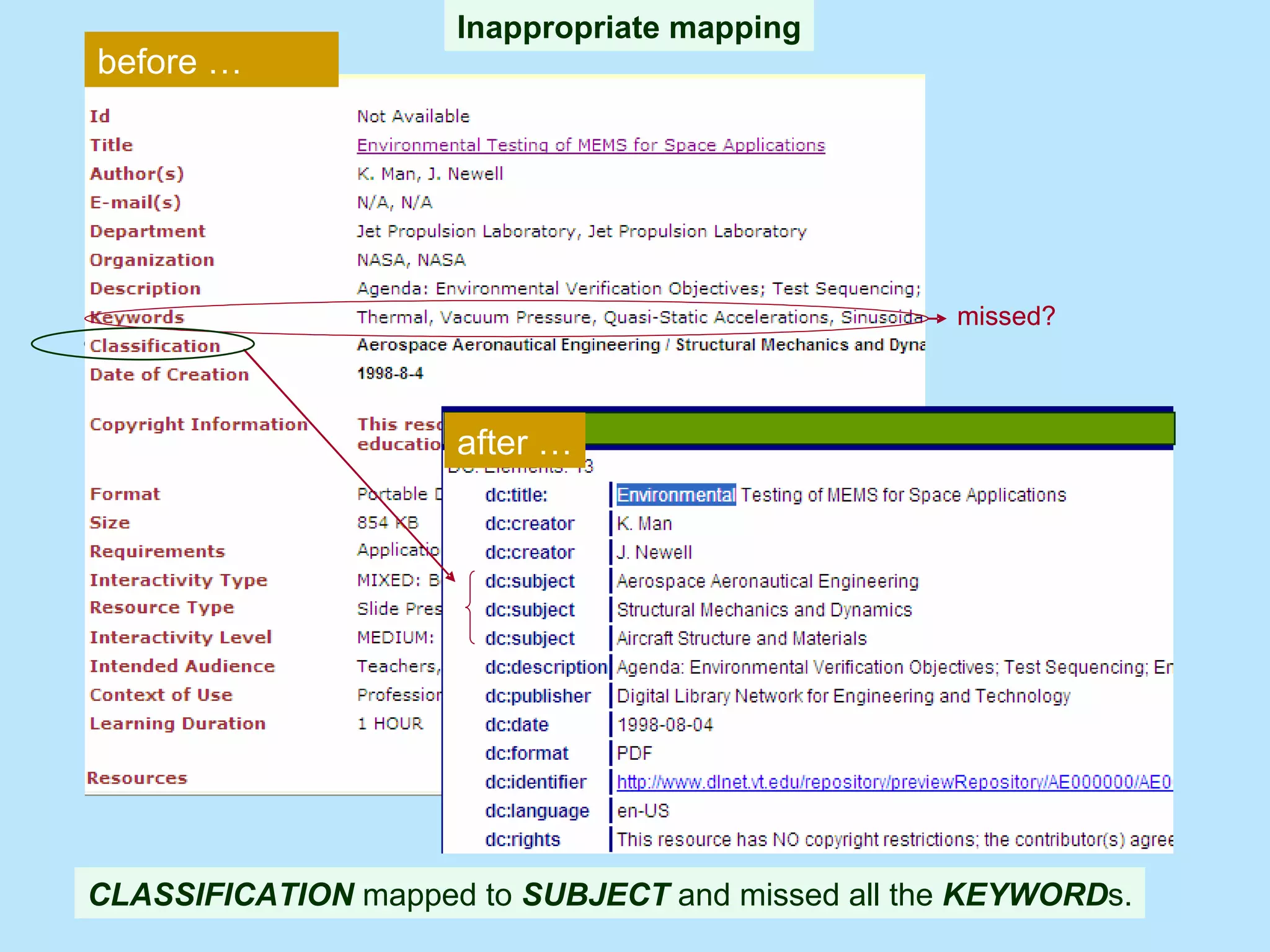
CLASSIFICATION  mapped to  SUBJECT  and missed all the  KEYWORD s. Inappropriate mapping missed? missed? before … after …
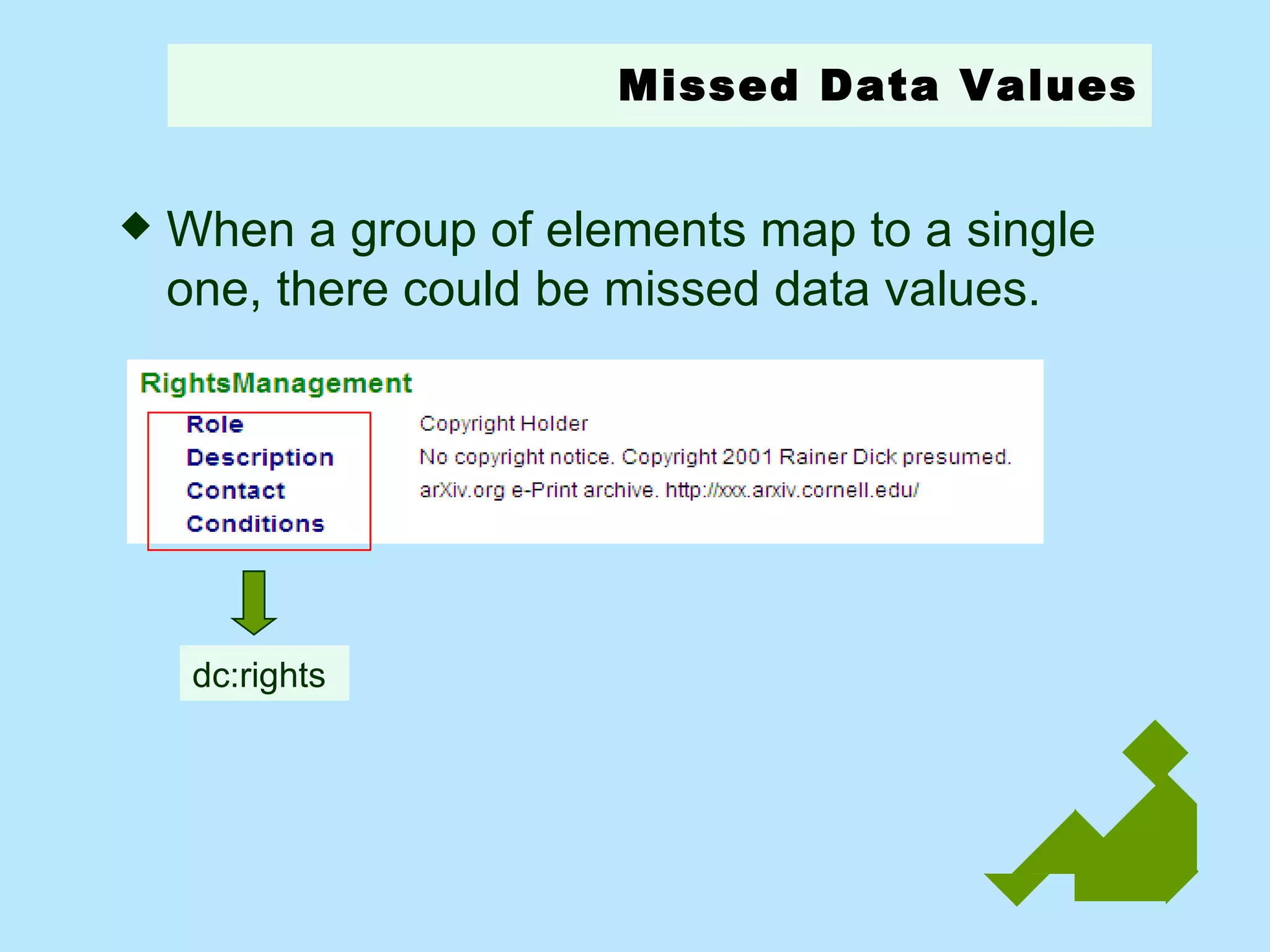
Missed Data Values When a group of elements map to a single one, there could be missed data values. dc:rights
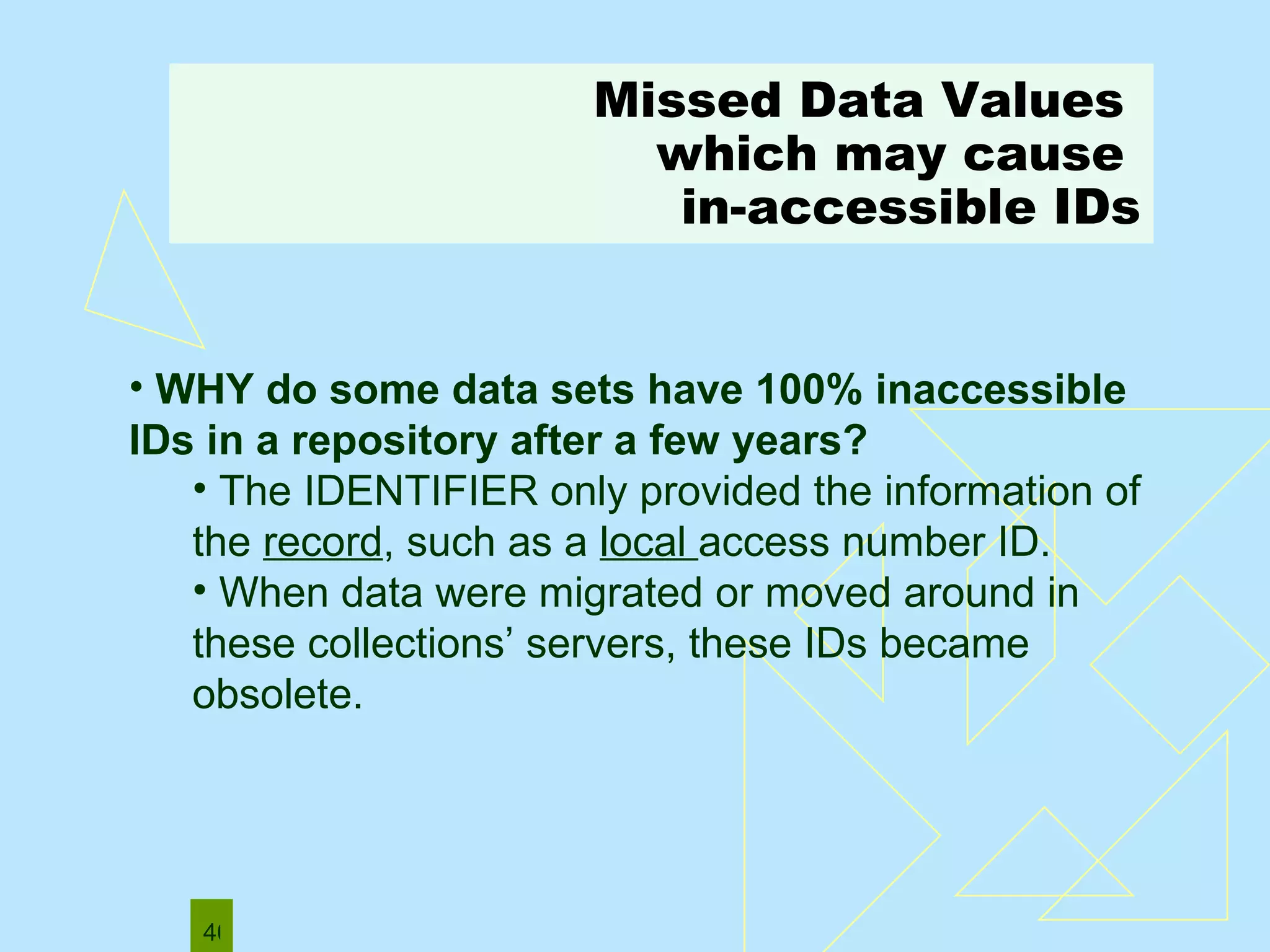
Missed Data Values   which may cause  in-accessible IDs WHY do some data sets have 100% inaccessible IDs in a repository after a few years? The IDENTIFIER only provided the information of the  record , such as a  local  access number ID.  When data were migrated or moved around in these collections’ servers, these IDs became obsolete.
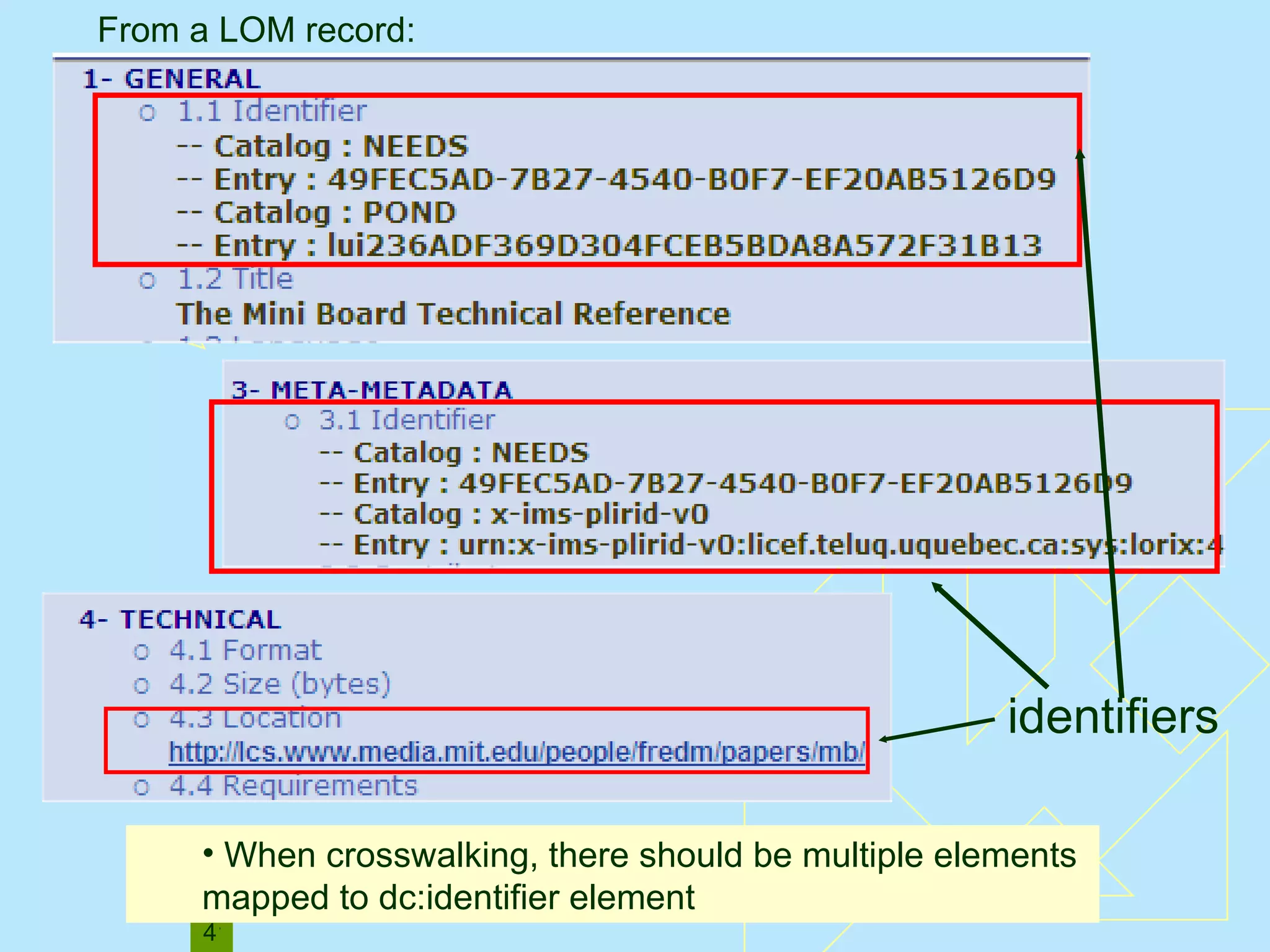
When crosswalking, there should be multiple elements  mapped to dc:identifier element identifiers From a LOM record:
Common properties in crosswalks definition  of each metadata element mandatory , optional, or mandatory based on certain conditions may occur  multiple  times constraints due to the structure e.g., hierarchical parent-child relationships constraints imposed on the  value   e.g., free text, numeric range, date, or a controlled vocabulary  locally defined  metadata element (s) - Based on St. Pierre and Jr. William. 1998.  Issues in Crosswalking Content Metadata Standards . Bethesda,  MD: NISO Press.
Understanding the  Pieces of the Puzzle (4) 4. Sources of Metadata 1) Manual creation Professional-created Authors-contributed User-tagged 2)  Automatic metadata generation   extraction  harvesting
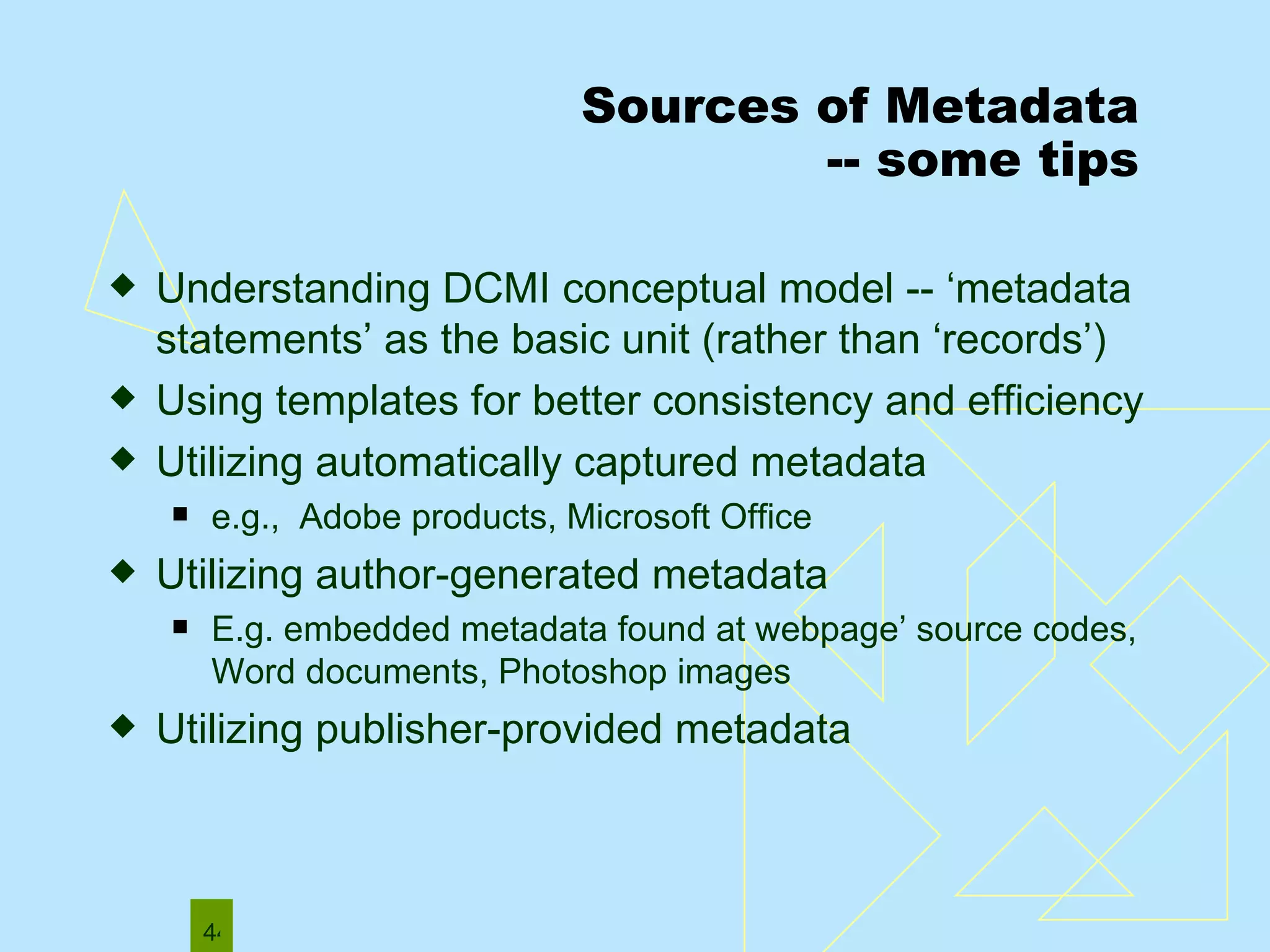
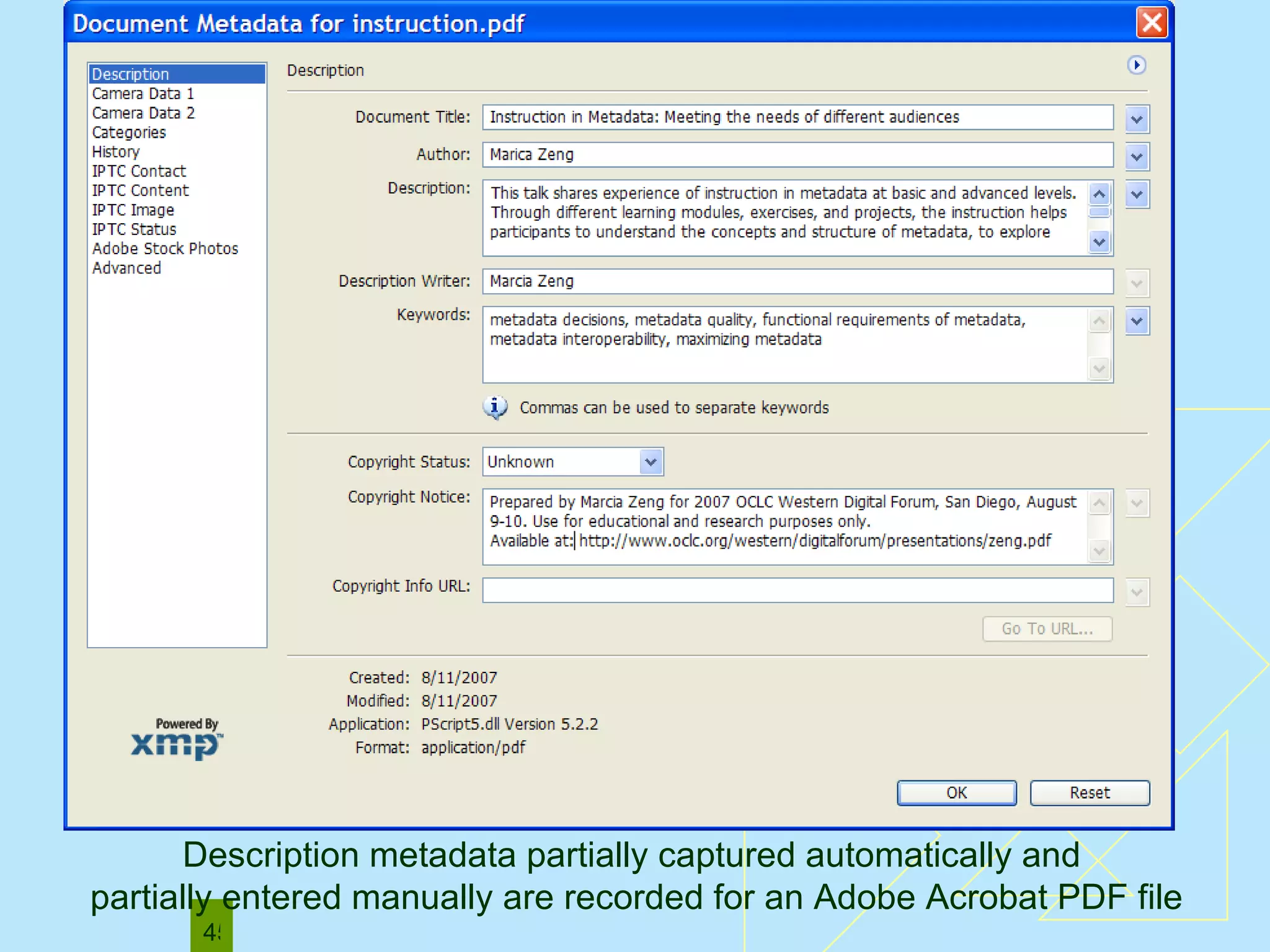
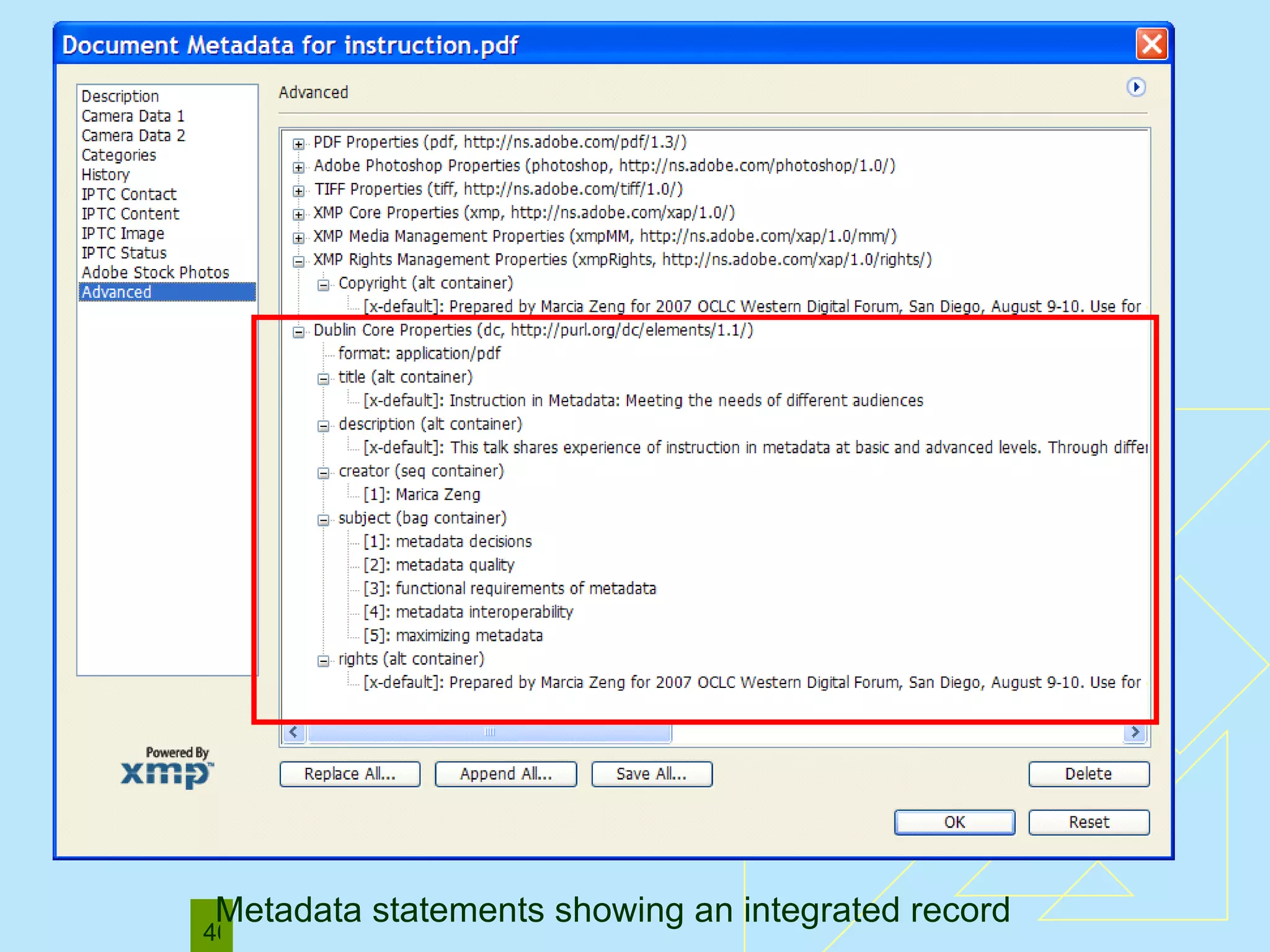
Sources of Metadata -- some tips Understanding DCMI conceptual model -- ‘metadata statements’ as the basic unit (rather than ‘records’) Using templates for better consistency and efficiency Utilizing automatically captured metadata  e.g.,  Adobe products, Microsoft Office  Utilizing author-generated metadata E.g. embedded metadata found at webpage’ source codes, Word documents, Photoshop images Utilizing publisher-provided metadata
Description metadata partially captured automatically and  partially entered manually are recorded for an Adobe Acrobat PDF file
Metadata statements showing an integrated record
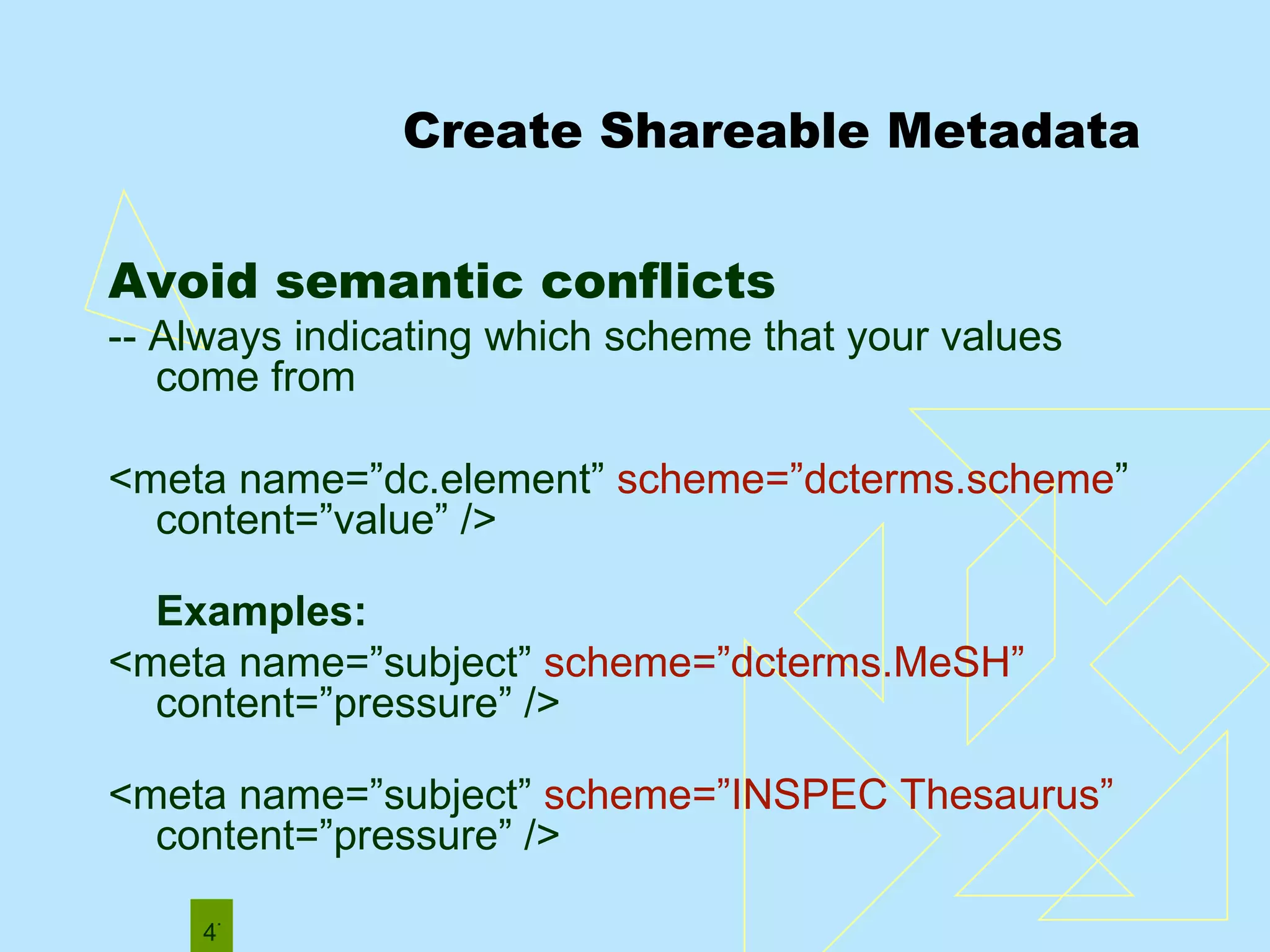
Create Shareable Metadata Avoid semantic conflicts  -- Always indicating which scheme that your values come from  <meta name=”dc.element”  scheme=”dcterms.scheme ” content=”value” /> Examples: <meta name=”subject”  scheme=”dcterms.MeSH”  content=”pressure” />  <meta name=”subject”  scheme=”INSPEC Thesaurus”  content=”pressure” />
Reuse Metadata  Combining  and  recombining  (the twin aspects of reuse) metadata descriptions   1) Creating basic metadata descriptions can be a combined effort of machine and human processing 2) Existing metadata descriptions can be reused for any appropriate projects 3) Quality of metadata can be enhanced through recombinant metadata 4) Integrated records can be generated for better access and sharing.
Understanding the  Pieces of the Puzzle (5) 5. Quality Control
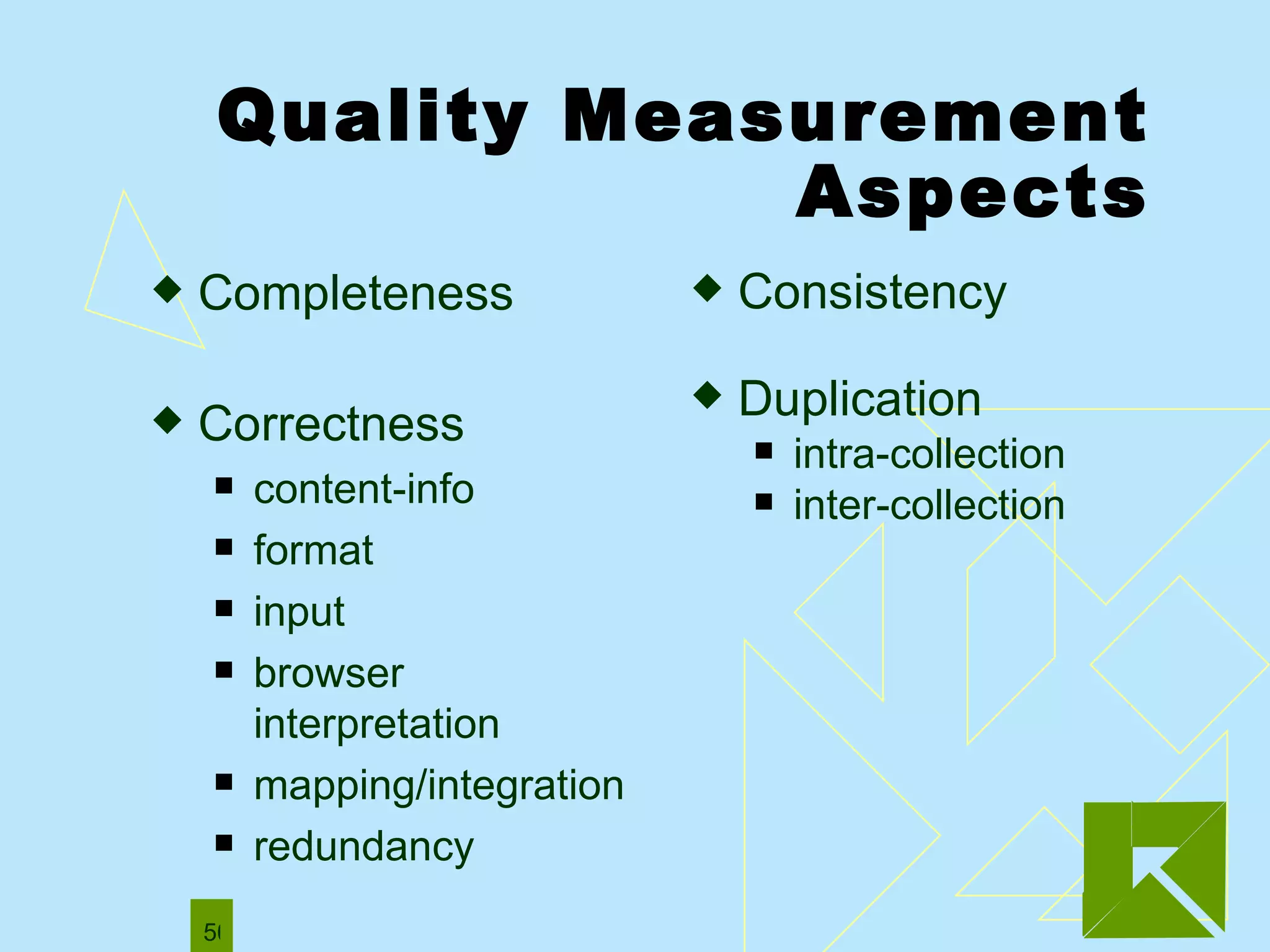
Quality Measurement Aspects Completeness  Correctness content-info format input browser interpretation mapping/integration redundancy  Consistency  Duplication intra-collection inter-collection
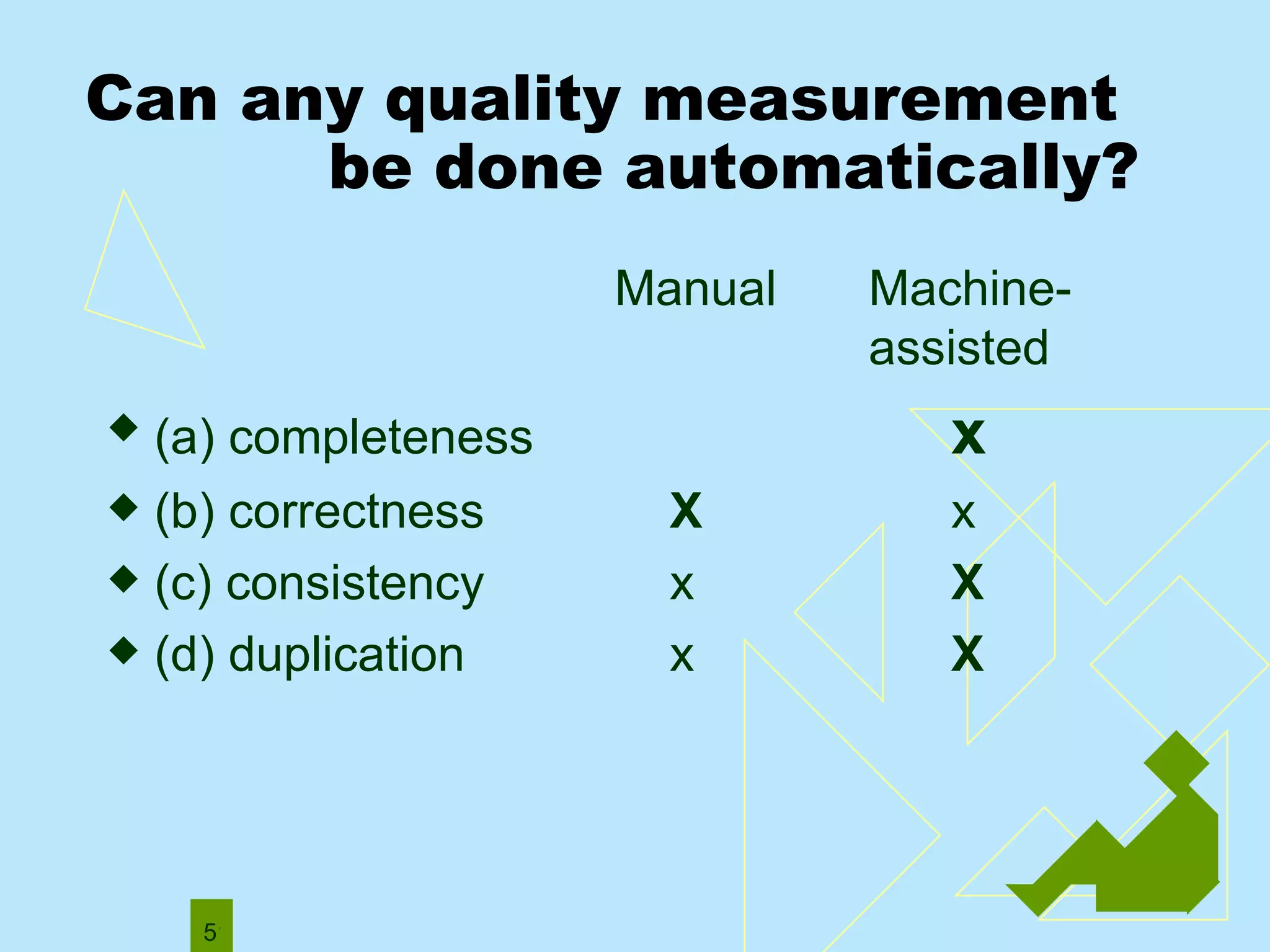
Can any quality measurement  be done automatically? Manual Machine- assisted (a) completeness    x (b) correctness    X   x (c) consistency   x   X (d) duplication    x   X
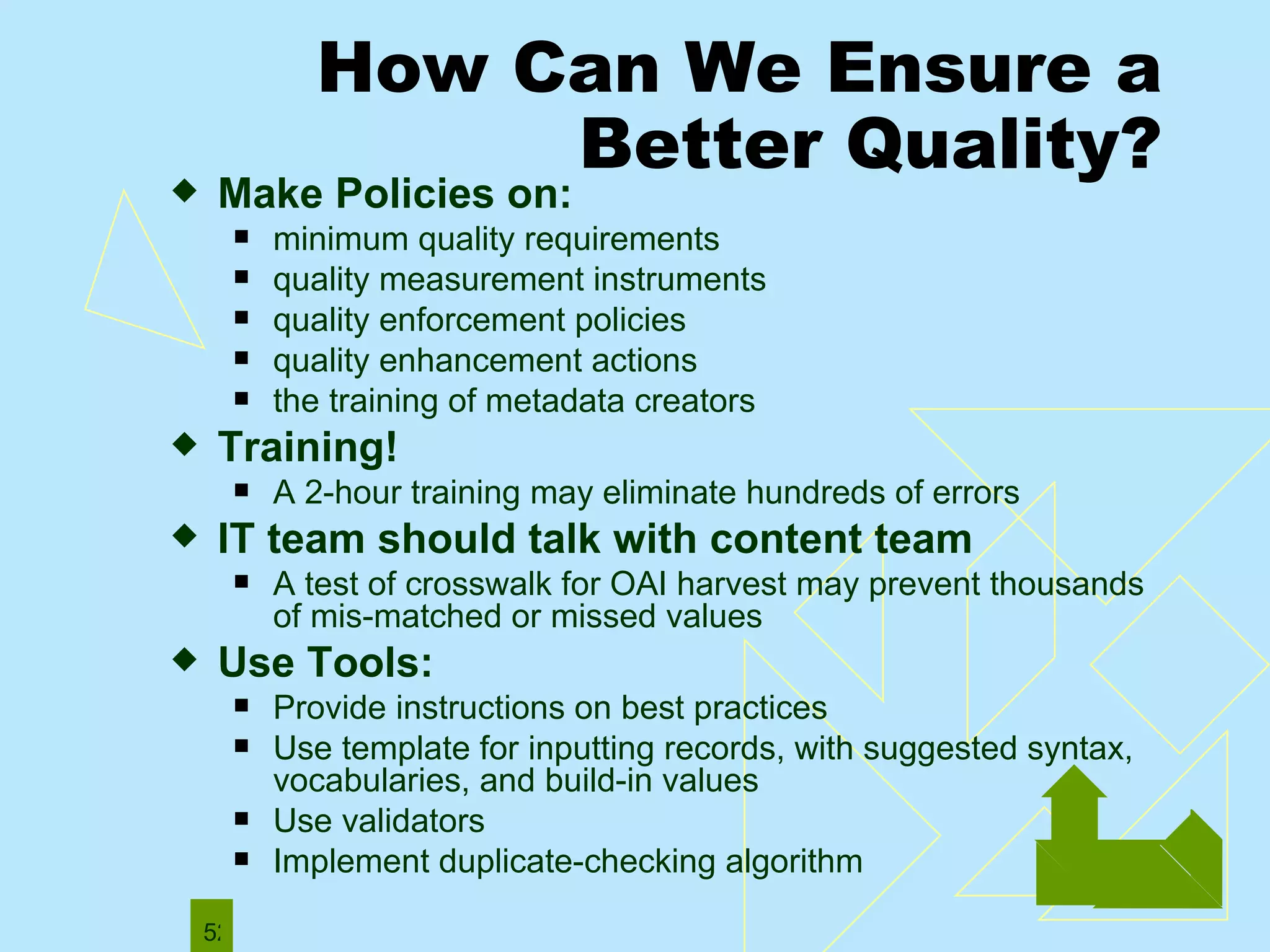
How Can We Ensure a Better Quality? Make Policies on: minimum quality requirements quality measurement instruments quality enforcement policies quality enhancement actions the training of metadata creators Training!  A   2-hour training may eliminate hundreds of errors IT team should talk with content team A test of crosswalk for OAI harvest may prevent thousands of mis-matched or missed values Use Tools: Provide instructions on best practices Use template for inputting records, with suggested syntax, vocabularies, and build-in values Use validators Implement duplicate-checking algorithm
Understanding the  Pieces of the Puzzle (6) 6. Workflows
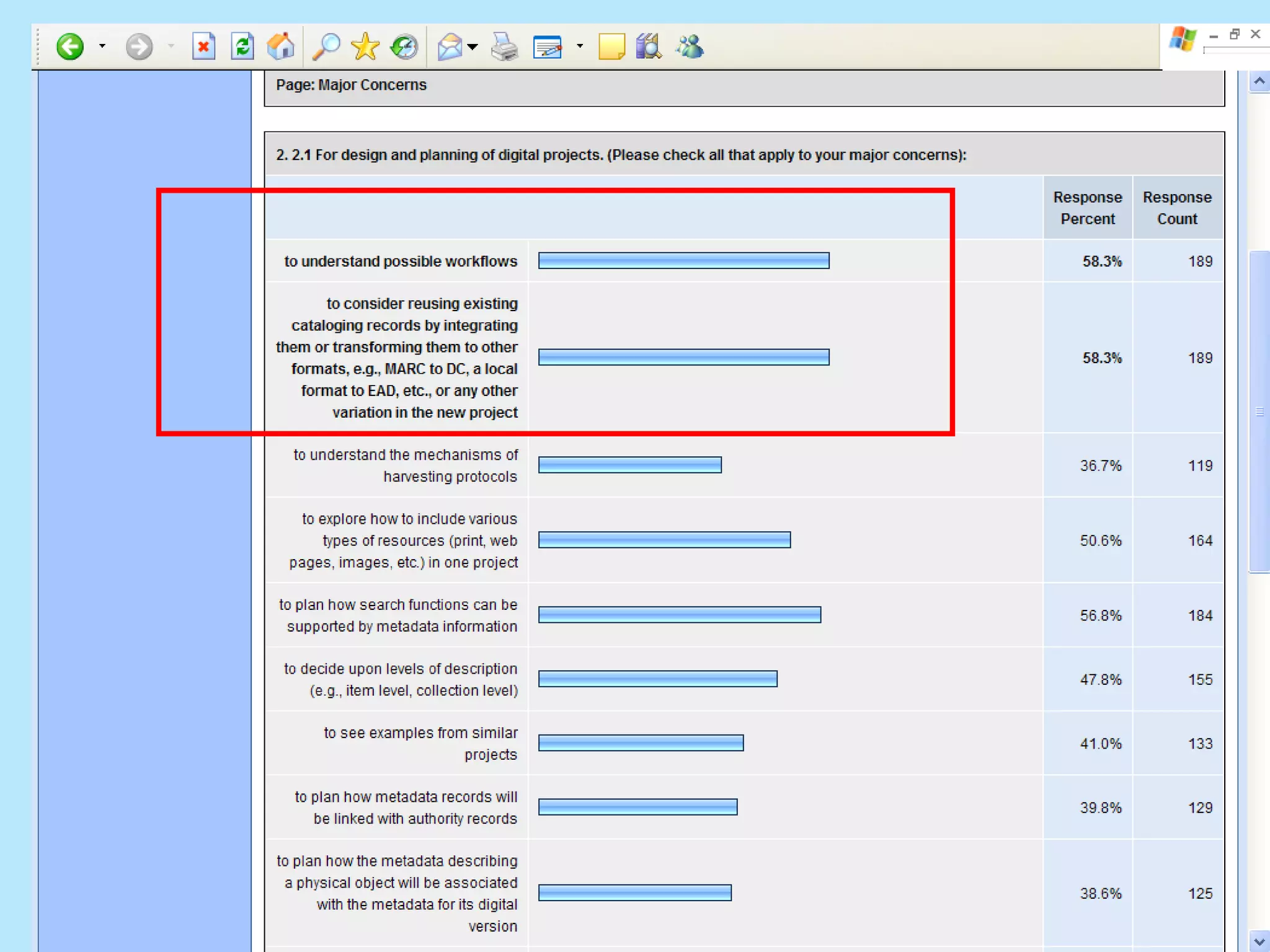
Metadata Decisions    Major concerns  in DL projects that relate to metadata include making decisions about: design and planning of digital projects element set standards (data structure decision)  data contents in a record (data content decision) authority files and controlled vocabularies (data value decision) metadata encoding (data format/technical interchange decision)  A survey on Metadata Decisions for Digital Libraries  – 426 responses from all over the world, Zeng, Lee, Hayes
 
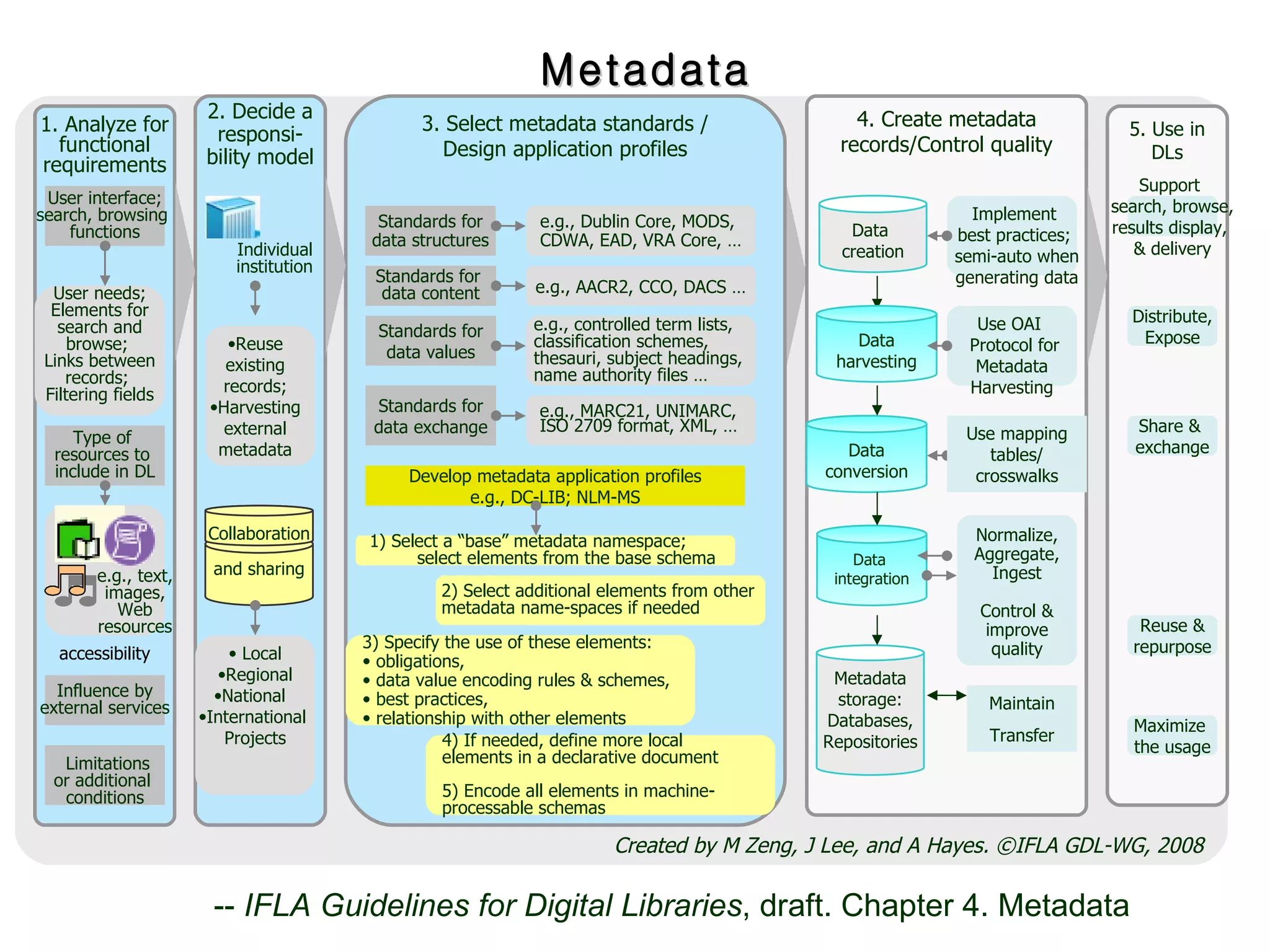
1. Analyze for functional requirements  2. Decide a responsi-bility model Metadata Workflows 3. Select metadata standards / Design application profiles and sharing Standards for data structures Develop metadata application profiles e.g., DC-LIB; NLM-MS Standards for  data content Individual institution Collaboration e.g., Dublin Core, MODS,  CDWA, EAD, VRA Core, … e.g., AACR2, CCO, DACS … Standards for data values e.g., controlled term lists,  classification schemes,  thesauri, subject headings,  name authority files … Standards for data exchange e.g., MARC21, UNIMARC,  ISO 2709 format, XML, … 1) Select a “base”   metadata   namespace;  select elements from the base schema 2)  Select additional elements from othe r  metadata name - spaces if needed 3) Specify the use of these   elements: obligations,  data value encoding  rules &  schemes,  best practices,   relationship with other elements 4) If needed, define more local elements in  a declarative document 5) Encode all elements in machine- processable schemas 4. Create metadata records/Control quality Data  creation Data harvesting Data  integration Data  conversion 5. Use in DLs Normalize, Aggregate, Ingest Control & improve quality Metadata storage: Databases, Repositories Type of  resources to  include in DL e.g., text, images, Web resources User interface; search, browsing  functions User needs; Elements for search and browse;  Links between records;  Filtering fields Influence by external services Limitations or additional  conditions Local Regional National  International  Projects Maintain Transfer Reuse existing records; Harvesting external metadata Implement  best practices;  semi-auto when generating data Use OAI   Protocol for  Metadata  Harvesting Use mapping tables/ crosswalks Support  search, browse, results display,  & delivery Distribute, Expose Share &  exchange Reuse & repurpose Maximize  the usage accessibility Created by M Zeng, J Lee, and A Hayes. ©IFLA GDL-WG, 2008 --  IFLA Guidelines for Digital Libraries , draft. Chapter 4. Metadata
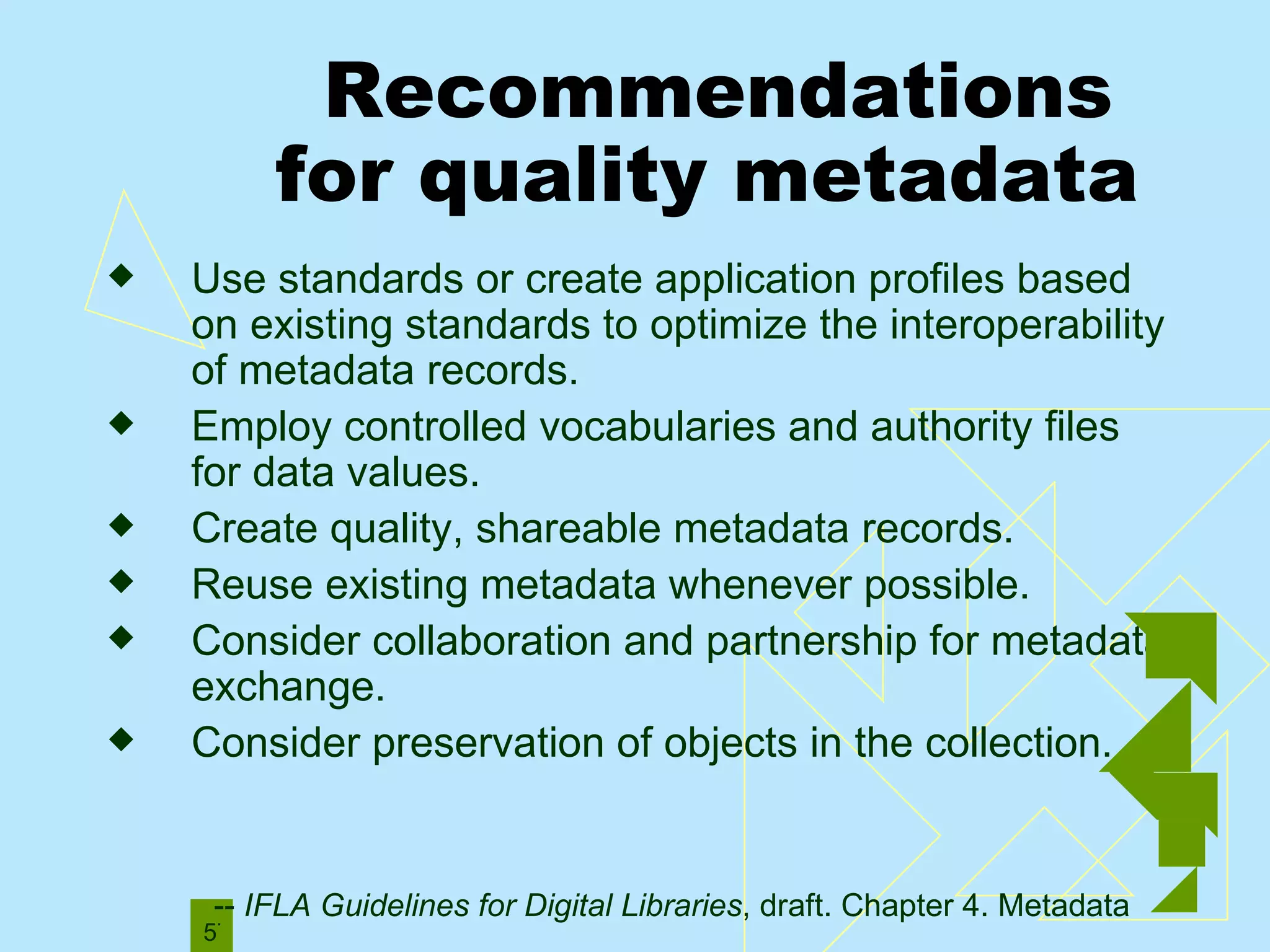
Recommendations  for quality metadata Use standards or create application profiles based on existing standards to optimize the interoperability of metadata records. Employ controlled vocabularies and authority files for data values. Create quality, shareable metadata records. Reuse existing metadata whenever possible. Consider collaboration and partnership for metadata exchange.  Consider preservation of objects in the collection. --  IFLA Guidelines for Digital Libraries , draft. Chapter 4. Metadata
7. Reference sources   NISO Framework Advisory Group. 2007.  A Framework of Guidance for Building Good Digital Collections .  3rd ed.  http://www.niso.org/publications/rp/framework3.pdf   Using Dublin Core . Hillmann, Diane. 2005.  http://dublincore.org/documents/2005/11/07/usageguide/ Best Practices for Shareable Metadata . NSDL. 2005- http://webservices.itcs.umich.edu/mediawiki/oaibp/index.php/ShareableMetadataPublic Lists of standards and best practices can be found at  http://www.metadataetc.org/book-website/index.html Understanding the  Pieces of the Puzzle (7)

Dublin Core In Practice

  • 1.
    Dublin Core in Practice Tutorial 4 Marcia L. Zeng [email_address] International Conference on Dublin Core and Metadata Applications, Berlin, 2008-09-22
  • 2.
    Implementation = the realization of an application = execution of a plan, idea, model, design, specification, standard … -- requires putting many pieces together in a way required by a design -- and may lead to many different results Tangram = 七巧板 = qī qiǎo bǎn = &quot;seven boards of skill&quot;
  • 3.
    Understanding the Pieces of the Puzzle Outline 1. Standards 2. Metadata types and functions 3. Crosswalking and mapping 4. Sources of metadata 5. Quality control 6. Workflows 7. Reference sources
  • 4.
    Standards Standards for data structures and semantics metadata element sets e.g., Dublin Core Metadata Element Set ( DCMES ) Standards and Guides for data content created to guide the practices of metadata generation e.g., CCO , Using DC Standards for data values value encoding schemes ( link to list ) e.g., DCMI Type Vocabulary | RFC 4646 Tags for Identifying Languages Understanding the Pieces of the Puzzle (1)
  • 5.
    -- from DublinCore Metadata Element Set, Version 1.1 Standards for data structures and semantics –element sets Standards and Guides for data content – rules and guides Standards for data values – value encoding schemes
  • 6.
    Value space thatshould follow syntax encoding schemes Examples from values associated with DATE element 1979 2000-03 2000-03-01 2001-01-02T21:48.00Z 200003 C1999, 2000 January, 1919 May, 1919 1987, c2000 ?1999 1952 (issued) (1982) 1930?] 1823-1845 Between 1680 and 1896?
  • 7.
    Value space thatshould apply controlled vocabularies / value encoding schemes Examples from values associated with LANGUAGE element en eng en-GB en-US English engfre new Korean Deutsch German LOCLANGUAGE:: German
  • 8.
    Examples: valuesassociated with FORMAT element found in the research samples : text text/html text/plain plain digital TIFF image/tiff other http://......../../../postscript.pdf application/msword application/Flash (animation) ascii http:// ….../../../sample.txt pdf http:// ….../../../sample.pdf ps http:// ….../../../sample.ps 3.6 megabytes 1000149 bytes language/java Application/JAVA applet Java CLASS Model/VRML AVI, MOV, QTM 1 v. (various pagings) 10 p., [6] p. of plates p.461-470 viii, 82 p. MPEG-4 Value space that should apply controlled vocabularies / value encoding schemes
  • 9.
    Implement standards andfollow best practices to ensure consistency In shared repositories, consistency may be an issue in the following areas: Data Recording Source Links Identification and Identifiers Description of Sources Metadata Representation ( in the search results display) Data Syntax
  • 10.
  • 11.
  • 12.
    Understanding the Pieces of the Puzzle (2) 2 . Metadata Types and Functions
  • 13.
    The DCMI definesmetadata as … data associated with either an information system or an information object for purposes of: description administration legal requirements technical functionality use and usage preservation --DCMI Glossary, 2005 http:// dublincore.org/documents/usageguide/glossary.shtml
  • 14.
    Types of Metadata-- Baca, M. ed. Introduction to Metadata: Pathways to Digital Information . V.3. Anne J. Gilliland: Setting the Stage, Table 2.
  • 15.
    Greenberg: Mapping “Types” to “Functions” -- Greenberg, J. “ &quot;Metadata Quality: A Layer Cake of Criteria ”, presentation at ASIST 2005 Conference
  • 16.
    We would likeusers to be able to: Search records by : Title, Author name, Keyword, Type of document, Publication, Conference name, and Year Browse records by : Year, Department, Classification, Object type, Subject matter, etc. View latest additions to the archive We would like to be able to: Link together records from the same Conference, Publication Filter by : Year and Language A wish list of Functions -- Based on Guy, Powell, and Day. &quot;Improving the Quality of Metadata in Eprint Archives.&quot; Ariadne , no. 38. 2004.
  • 17.
  • 18.
    Will the metadatasupport these functions? No FORMAT information
  • 19.
    Search by format Collections which did not provide FORMAT information are excluded from being searched Advanced Search What is actually searched. What should be searched. Advanced Search What is actually searched. What should be searched.
  • 20.
    Search by Education level Collections which did not provide Education Level information are excluded from being searched Advanced Search What is actually searched. What should be searched. Advanced Search What is actually searched. What should be searched.
  • 21.
    1) The metadataelement set might not include such an element. e.g., the legacy DC 15 elements does not include EDUCATION LEVEL The causes of missing information (1)
  • 22.
    The causes of missing information (2) 2) Although the metadata element set does include such an element, -- there is no authority or set of guidelines that enforce the use of this element -- therefore, all or part of the records do not include a particular group of data.
  • 23.
    For example, forthe same source, records quality could be very different --
  • 24.
    Record #1 No date . No format, type, grade level, language, rights .
  • 25.
    Record #2 No date . format missed images. No grade level, rights .
  • 26.
    Record #3 Recorded grade level, format, type + No date , language, rights .
  • 27.
    The causes of missing information (3) 3) The information about format is put under a wrong element, e.g. type , so that the values in this field will not be correctly indexed for format .
  • 28.
    4) The valuesare lost when the metadata records are converted from one database to another (due to incorrect mapping). The causes of missing information (4)
  • 29.
    These records’ TYPEvalues were not converted to the repository. These resources are excluded when users search by resource type. Original Record Converted Record
  • 30.
    Understanding the Pieces of the Puzzle (3) 3. Crosswalking and Mapping
  • 31.
    A LOM record(partial) hierarchical structure (not flat) many more elements than DC several elements correspond to one DC element
  • 32.
    Common CrosswalkingApproaches Contributor Coverage ---------- Location.Current Repository Format ---------- Technique Dublin Core Dublin Core VAR Core (3.0) Relative crosswalking Absolute crosswalking Contributor Coverage ---------- Location.Current Repository Format ---------- Technique Dublin Core Dublin Core VAR Core (3.0) Relative crosswalking Absolute crosswalking target source
  • 33.
    Pros and Cons -- Absolute Crosswalking ensures the equivalency (or closely-equivalent matches) of elements does not work well for data conversion data values in non-mappable space will be left out, especially when a source schema has a richer structure than that of the target schema. E.g., from LOM records to DC records vra:title = dc:title vra:technique = xxx
  • 34.
    Pros and Cons -- Relative Crosswalking When data conversion is conducted, at least the values in the fields of a source database will find a place to reside in the target database. Appears to work better when mapping from complex to simpler schema, e.g., from MARC to DC, but not vice versa. http://www.loc.gov/marc/marc2dc.html The problem is that mapped elements are not really equivalent. vra:title = dc:title vra:technique = dc:format
  • 35.
    missing keywords OPTIONS mapped to SUBJECT , missing all KEYWORDS Incorrect element mapping after … before … missed?! missed?!
  • 36.
    AUTHOR mappedto DESCRIPTION 3357 records ! no CREATOR before … after …
  • 37.
    If re-generate recordsbased on the embedded metadata, all can be corrected. Incorrect values after … before …
  • 38.
    CLASSIFICATION mappedto SUBJECT and missed all the KEYWORD s. Inappropriate mapping missed? missed? before … after …
  • 39.
    Missed Data ValuesWhen a group of elements map to a single one, there could be missed data values. dc:rights
  • 40.
    Missed Data Values which may cause in-accessible IDs WHY do some data sets have 100% inaccessible IDs in a repository after a few years? The IDENTIFIER only provided the information of the record , such as a local access number ID. When data were migrated or moved around in these collections’ servers, these IDs became obsolete.
  • 41.
    When crosswalking, thereshould be multiple elements mapped to dc:identifier element identifiers From a LOM record:
  • 42.
    Common properties incrosswalks definition of each metadata element mandatory , optional, or mandatory based on certain conditions may occur multiple times constraints due to the structure e.g., hierarchical parent-child relationships constraints imposed on the value e.g., free text, numeric range, date, or a controlled vocabulary locally defined metadata element (s) - Based on St. Pierre and Jr. William. 1998. Issues in Crosswalking Content Metadata Standards . Bethesda, MD: NISO Press.
  • 43.
    Understanding the Pieces of the Puzzle (4) 4. Sources of Metadata 1) Manual creation Professional-created Authors-contributed User-tagged 2) Automatic metadata generation extraction harvesting
  • 44.
    Sources of Metadata-- some tips Understanding DCMI conceptual model -- ‘metadata statements’ as the basic unit (rather than ‘records’) Using templates for better consistency and efficiency Utilizing automatically captured metadata e.g., Adobe products, Microsoft Office Utilizing author-generated metadata E.g. embedded metadata found at webpage’ source codes, Word documents, Photoshop images Utilizing publisher-provided metadata
  • 45.
    Description metadata partiallycaptured automatically and partially entered manually are recorded for an Adobe Acrobat PDF file
  • 46.
    Metadata statements showingan integrated record
  • 47.
    Create Shareable MetadataAvoid semantic conflicts -- Always indicating which scheme that your values come from <meta name=”dc.element” scheme=”dcterms.scheme ” content=”value” /> Examples: <meta name=”subject” scheme=”dcterms.MeSH” content=”pressure” /> <meta name=”subject” scheme=”INSPEC Thesaurus” content=”pressure” />
  • 48.
    Reuse Metadata Combining and recombining (the twin aspects of reuse) metadata descriptions 1) Creating basic metadata descriptions can be a combined effort of machine and human processing 2) Existing metadata descriptions can be reused for any appropriate projects 3) Quality of metadata can be enhanced through recombinant metadata 4) Integrated records can be generated for better access and sharing.
  • 49.
    Understanding the Pieces of the Puzzle (5) 5. Quality Control
  • 50.
    Quality Measurement AspectsCompleteness Correctness content-info format input browser interpretation mapping/integration redundancy Consistency Duplication intra-collection inter-collection
  • 51.
    Can any qualitymeasurement be done automatically? Manual Machine- assisted (a) completeness x (b) correctness X x (c) consistency x X (d) duplication x X
  • 52.
    How Can WeEnsure a Better Quality? Make Policies on: minimum quality requirements quality measurement instruments quality enforcement policies quality enhancement actions the training of metadata creators Training! A 2-hour training may eliminate hundreds of errors IT team should talk with content team A test of crosswalk for OAI harvest may prevent thousands of mis-matched or missed values Use Tools: Provide instructions on best practices Use template for inputting records, with suggested syntax, vocabularies, and build-in values Use validators Implement duplicate-checking algorithm
  • 53.
    Understanding the Pieces of the Puzzle (6) 6. Workflows
  • 54.
    Metadata Decisions Major concerns in DL projects that relate to metadata include making decisions about: design and planning of digital projects element set standards (data structure decision) data contents in a record (data content decision) authority files and controlled vocabularies (data value decision) metadata encoding (data format/technical interchange decision) A survey on Metadata Decisions for Digital Libraries – 426 responses from all over the world, Zeng, Lee, Hayes
  • 55.
  • 56.
    1. Analyze forfunctional requirements 2. Decide a responsi-bility model Metadata Workflows 3. Select metadata standards / Design application profiles and sharing Standards for data structures Develop metadata application profiles e.g., DC-LIB; NLM-MS Standards for data content Individual institution Collaboration e.g., Dublin Core, MODS, CDWA, EAD, VRA Core, … e.g., AACR2, CCO, DACS … Standards for data values e.g., controlled term lists, classification schemes, thesauri, subject headings, name authority files … Standards for data exchange e.g., MARC21, UNIMARC, ISO 2709 format, XML, … 1) Select a “base” metadata namespace; select elements from the base schema 2) Select additional elements from othe r metadata name - spaces if needed 3) Specify the use of these elements: obligations, data value encoding rules & schemes, best practices, relationship with other elements 4) If needed, define more local elements in a declarative document 5) Encode all elements in machine- processable schemas 4. Create metadata records/Control quality Data creation Data harvesting Data integration Data conversion 5. Use in DLs Normalize, Aggregate, Ingest Control & improve quality Metadata storage: Databases, Repositories Type of resources to include in DL e.g., text, images, Web resources User interface; search, browsing functions User needs; Elements for search and browse; Links between records; Filtering fields Influence by external services Limitations or additional conditions Local Regional National International Projects Maintain Transfer Reuse existing records; Harvesting external metadata Implement best practices; semi-auto when generating data Use OAI Protocol for Metadata Harvesting Use mapping tables/ crosswalks Support search, browse, results display, & delivery Distribute, Expose Share & exchange Reuse & repurpose Maximize the usage accessibility Created by M Zeng, J Lee, and A Hayes. ©IFLA GDL-WG, 2008 -- IFLA Guidelines for Digital Libraries , draft. Chapter 4. Metadata
  • 57.
    Recommendations forquality metadata Use standards or create application profiles based on existing standards to optimize the interoperability of metadata records. Employ controlled vocabularies and authority files for data values. Create quality, shareable metadata records. Reuse existing metadata whenever possible. Consider collaboration and partnership for metadata exchange. Consider preservation of objects in the collection. -- IFLA Guidelines for Digital Libraries , draft. Chapter 4. Metadata
  • 58.
    7. Reference sources NISO Framework Advisory Group. 2007. A Framework of Guidance for Building Good Digital Collections . 3rd ed. http://www.niso.org/publications/rp/framework3.pdf Using Dublin Core . Hillmann, Diane. 2005. http://dublincore.org/documents/2005/11/07/usageguide/ Best Practices for Shareable Metadata . NSDL. 2005- http://webservices.itcs.umich.edu/mediawiki/oaibp/index.php/ShareableMetadataPublic Lists of standards and best practices can be found at http://www.metadataetc.org/book-website/index.html Understanding the Pieces of the Puzzle (7)

Editor's Notes

  • #2 Metadata is an essential component required for success in description, administration, preservation, access and service of digital content s . I t is , however, easy to misunderstand that metadata is simply a technical issue. This session will draw on case studies to explore practical issues in the use of Dublin Core. These considerations include quality, consistency, cost and other factors.