Metadata: An Introduction By  Wendy Duff October 13, 2001 ECURE
Metadata The term "meta" comes from a Greek word that denotes  something of a higher or more fundamental nature. Metadata, then, is data about other data.  The term refers to any data used to aid the identification, description and location of networked electronic resources
Defining Metadata Does data about data mean anything?  Librarians equate it with a complete bibliographic record Information technologists equate it to database schema or definitions of the data elements Archivists include context information, restrictions and access terms, index terms, etc.
Bibliographic Metadata Providing a description of the information package along with other information necessary for management and preservation Encoding Providing access to this description Predominantly discovery and retrieval
Encoding Surrogate records are encoded by assigning tags, letter, or words Why encode? For display Provide access Integration of surrogate Management
Beyond Discovery and Retrieval Gilliland-Swetland (1998) explains “metadata also documents how that objects behaves, its functions and use, relationship to other objects and how it should be managed”.
Definition proposed by Cunningham   Structured information that describes and/or allows us to find, manage, control, understand or preserve other information over time.
Different Communities ….Different Metadata Developers of the Interoperabilty of Data in E-Commerce Systems (indecs) ideintified metadata for protecting intellectual property rights of creators and publishers.  The Research Library Group’s Working Group on Preservation Issues of Metadata identified metadata for  “digital master files that have preservation-based intent”.
Metadata to Information Technologists The data that defines the data elements in a table Data that controls or explains other data Something that is not part of the bit stream of a record but needed to understand the data in the record One systems metadata is another systems data
Source of Metadata Automatically generated Supplied by creator of electronic resource Supplied by 3rd party
Dublin Core Metadata to improve information retrieval of internet resources Developed predominantly by the bibliographic community.  Elements similar to bibliographic surrogate
Characteristics of Dublin Core Simplicity Semantic Interoperability   International Consensus   Extensibility   Metadata Modularity on the Web
Dublin Core Elements Content Coverage Description Type Relation  Source  Subject  Title  Intellectual Property   Contributor  Creator  Publisher  Rights
Dublin Core Element Instantiation Date Format Identifier Language
Law Suits Over Metatags Playboy!
Resource Description Framework(RDF)  RDF  provides interoperability between applications that exchange machine-understandable information on the Web
Metadata and XML Provides a means of encoding and exchanging metadata EAD, TEI, VERS
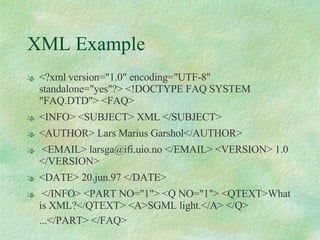
XML Example <?xml version=&quot;1.0&quot; encoding=&quot;UTF-8&quot; standalone=&quot;yes&quot;?> <!DOCTYPE FAQ SYSTEM &quot;FAQ.DTD&quot;> <FAQ>  <INFO> <SUBJECT> XML </SUBJECT>  <AUTHOR> Lars Marius Garshol</AUTHOR> <EMAIL> larsga@ifi.uio.no </EMAIL> <VERSION> 1.0 </VERSION>  <DATE> 20.jun.97 </DATE> </INFO> <PART NO=&quot;1&quot;> <Q NO=&quot;1&quot;> <QTEXT>What is XML?</QTEXT> <A>SGML light.</A> </Q> ...</PART> </FAQ>
Electronic Records Metadata Project Functional Requirements for Evidence in Recordkeeping The SPIRT Metadata Project  VERS GILS - and the AGLS OAIS InterPares
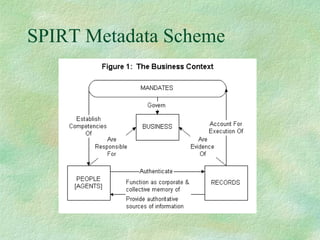
SPIRT Metadata Scheme
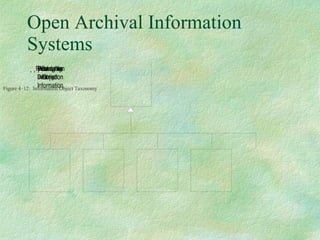
Open Archival Information Systems Figure 4‑12:  Information Object Taxonomy
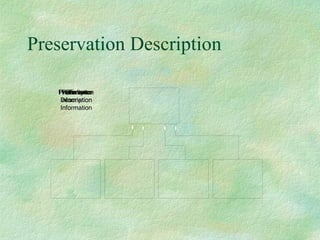
Preservation Description
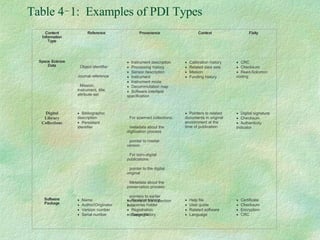
Table 4‑1:  Examples of PDI Types   Content Information Type Reference Provenance  Context Fixity Space Science Data      Object identifier  Journal reference      Mission, instrument, title, attribute set        Instrument description      Processing history      Sensor description      Instrument      Instrument mode      Decommutation map      Software interface specification      Calibration history      Related data sets      Mission      Funding history      CRC      Checksum      Reed-Solomon coding   Digital Library Collections      Bibliographic description      Persistent  identifier      For scanned collections:       metadata about the digitisation process      pointer to master version      For born-digital publications:       pointer to the digital original      Metadata about the preservation process:      pointers to earlier versions of the collection item      change history      Pointers to related documents in original environment at the time of publication      Digital signature      Checksum      Authenticity indicator Software Package        Name      Author/Originator      Version number      Serial number      Revision history      License holder      Registration      Copyright      Help file      User guide      Related software      Language      Certificate      Checksum      Encryption      CRC
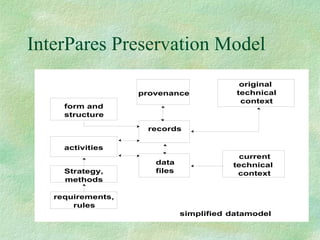
InterPares Preservation Model
Metadata Facts to Remember  Metadata does not have to be digital Metadata relates to more than the description of an object .  Metadata can come from a variety of sources Metadata continue to accrue during the life of an information object or system .  One information object's metadata can simultaneously be another information object's data .   (Anne Gilliland-Swetland, Setting the Stage)
Developing Metadata Schemes Identify the purpose of the metadata model Level of specificity of the elements Identify resources Infrastructure - who will supply it? What type of information package is it? Who will use the metadata? Existing metadata models
Other Sources Introduction to Metadata:  Pathways to Digital Information.   http://www.getty.edu/gri/standard/intrometadata/index.htm CLIR Reports  http://www.clir.org/pubs/reports/reports.html Digital Libraries: Metadata Resources http://www.ifla.org/II/metadata.htm Australian Government Locator Service (AGLS) Metadata Standard. http://www.naa.gov.au/recordkeeping/gov_online/agls/summary.html
More Sources SPIRT Recordkeeping Metadata Project http://www.sims.monash.edu.au/rcrg/research/spirt/index.html www.archiefschool.nl/metadata

香港六合彩

  • 1.
    Metadata: An IntroductionBy Wendy Duff October 13, 2001 ECURE
  • 2.
    Metadata The term&quot;meta&quot; comes from a Greek word that denotes something of a higher or more fundamental nature. Metadata, then, is data about other data. The term refers to any data used to aid the identification, description and location of networked electronic resources
  • 3.
    Defining Metadata Doesdata about data mean anything? Librarians equate it with a complete bibliographic record Information technologists equate it to database schema or definitions of the data elements Archivists include context information, restrictions and access terms, index terms, etc.
  • 4.
    Bibliographic Metadata Providinga description of the information package along with other information necessary for management and preservation Encoding Providing access to this description Predominantly discovery and retrieval
  • 5.
    Encoding Surrogate recordsare encoded by assigning tags, letter, or words Why encode? For display Provide access Integration of surrogate Management
  • 6.
    Beyond Discovery andRetrieval Gilliland-Swetland (1998) explains “metadata also documents how that objects behaves, its functions and use, relationship to other objects and how it should be managed”.
  • 7.
    Definition proposed byCunningham   Structured information that describes and/or allows us to find, manage, control, understand or preserve other information over time.
  • 8.
    Different Communities ….DifferentMetadata Developers of the Interoperabilty of Data in E-Commerce Systems (indecs) ideintified metadata for protecting intellectual property rights of creators and publishers. The Research Library Group’s Working Group on Preservation Issues of Metadata identified metadata for “digital master files that have preservation-based intent”.
  • 9.
    Metadata to InformationTechnologists The data that defines the data elements in a table Data that controls or explains other data Something that is not part of the bit stream of a record but needed to understand the data in the record One systems metadata is another systems data
  • 10.
    Source of MetadataAutomatically generated Supplied by creator of electronic resource Supplied by 3rd party
  • 11.
    Dublin Core Metadatato improve information retrieval of internet resources Developed predominantly by the bibliographic community. Elements similar to bibliographic surrogate
  • 12.
    Characteristics of DublinCore Simplicity Semantic Interoperability International Consensus Extensibility Metadata Modularity on the Web
  • 13.
    Dublin Core ElementsContent Coverage Description Type Relation Source Subject Title Intellectual Property Contributor Creator Publisher Rights
  • 14.
    Dublin Core ElementInstantiation Date Format Identifier Language
  • 15.
    Law Suits OverMetatags Playboy!
  • 16.
    Resource Description Framework(RDF) RDF provides interoperability between applications that exchange machine-understandable information on the Web
  • 17.
    Metadata and XMLProvides a means of encoding and exchanging metadata EAD, TEI, VERS
  • 18.
    XML Example <?xmlversion=&quot;1.0&quot; encoding=&quot;UTF-8&quot; standalone=&quot;yes&quot;?> <!DOCTYPE FAQ SYSTEM &quot;FAQ.DTD&quot;> <FAQ> <INFO> <SUBJECT> XML </SUBJECT> <AUTHOR> Lars Marius Garshol</AUTHOR> <EMAIL> larsga@ifi.uio.no </EMAIL> <VERSION> 1.0 </VERSION> <DATE> 20.jun.97 </DATE> </INFO> <PART NO=&quot;1&quot;> <Q NO=&quot;1&quot;> <QTEXT>What is XML?</QTEXT> <A>SGML light.</A> </Q> ...</PART> </FAQ>
  • 19.
    Electronic Records MetadataProject Functional Requirements for Evidence in Recordkeeping The SPIRT Metadata Project VERS GILS - and the AGLS OAIS InterPares
  • 20.
  • 21.
    Open Archival InformationSystems Figure 4‑12: Information Object Taxonomy
  • 22.
  • 23.
    Table 4‑1: Examples of PDI Types Content Information Type Reference Provenance Context Fixity Space Science Data     Object identifier  Journal reference     Mission, instrument, title, attribute set       Instrument description     Processing history     Sensor description     Instrument     Instrument mode     Decommutation map     Software interface specification     Calibration history     Related data sets     Mission     Funding history     CRC     Checksum     Reed-Solomon coding   Digital Library Collections     Bibliographic description     Persistent identifier     For scanned collections:     metadata about the digitisation process     pointer to master version     For born-digital publications:     pointer to the digital original     Metadata about the preservation process:     pointers to earlier versions of the collection item     change history     Pointers to related documents in original environment at the time of publication     Digital signature     Checksum     Authenticity indicator Software Package       Name     Author/Originator     Version number     Serial number     Revision history     License holder     Registration     Copyright     Help file     User guide     Related software     Language     Certificate     Checksum     Encryption     CRC
  • 24.
  • 25.
    Metadata Facts toRemember Metadata does not have to be digital Metadata relates to more than the description of an object . Metadata can come from a variety of sources Metadata continue to accrue during the life of an information object or system . One information object's metadata can simultaneously be another information object's data . (Anne Gilliland-Swetland, Setting the Stage)
  • 26.
    Developing Metadata SchemesIdentify the purpose of the metadata model Level of specificity of the elements Identify resources Infrastructure - who will supply it? What type of information package is it? Who will use the metadata? Existing metadata models
  • 27.
    Other Sources Introductionto Metadata: Pathways to Digital Information. http://www.getty.edu/gri/standard/intrometadata/index.htm CLIR Reports http://www.clir.org/pubs/reports/reports.html Digital Libraries: Metadata Resources http://www.ifla.org/II/metadata.htm Australian Government Locator Service (AGLS) Metadata Standard. http://www.naa.gov.au/recordkeeping/gov_online/agls/summary.html
  • 28.
    More Sources SPIRTRecordkeeping Metadata Project http://www.sims.monash.edu.au/rcrg/research/spirt/index.html www.archiefschool.nl/metadata