Alexander Haffner RDA and the Semantic Web
Internationalisation and Interoperability interoperability of  information and library systems  internationalisation in descriptive cataloguing and subject cataloguing  join all kinds of catalogues understanding user needs find, identify, select, obtain, explore cost-effectiveness
Functional Requirements for Bibliographic Records (FRBR) A model for cataloguing has to identify and clearly define  entities of interest to users by bibliographic records  the attributes of each entity  and the types of relationships that operate between entities Entities of the FRBR Model: group 1: work, expression, manifestation, item  group 2: person, corporate body group 3: concept, object, event, and place
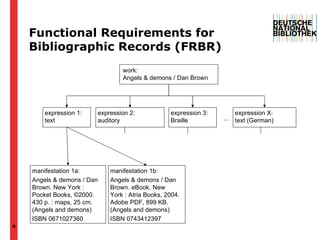
Functional Requirements for Bibliographic Records (FRBR) work: Angels & demons / Dan Brown expression 1: text … expression X: text (German) expression 2: auditory expression 3: Braille manifestation 1a: Angels & demons / Dan Brown. New York : Pocket Books, ©2000. 430 p. : maps, 25 cm. (Angels and demons) ISBN 0671027360 manifestation 1b: Angels & demons / Dan Brown. eBook. New York : Atria Books, 2004. Adobe PDF, 899 KB. (Angels and demons) ISBN 0743412397
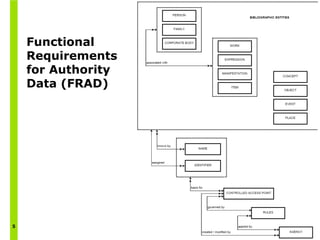
Functional Requirements for Authority Data (FRAD)
Resource Description and Access  upcoming user-focused content standard  changes perspectives of cataloguing  guiding librarians and non-librarians in how to describe entities and their relationships  re-use of FRBR, FRAD, and FRSAD RDA is intended to replace AACR2  cover all types of media (non-digital and digital; textual, visual, auditory, tactile etc.) first release of RDA is announced for November 2009 RDA will be published as an online product independent of technical metadata formats but definitely upcoming metadata records in MARC 21 and RDF  RDA has been developed explicitly to take advantage of the Semantic Web
Linked Data and the Semantic Web linking associate resources and related data in the web linked data as prerequisite for the semantic web key technologies URIs as generic means to identify entities and concepts RDF as a data model to describe things as instances  (subject-predicate-object expressions) subsequent use of data public data network of structured information  avoidance of redundant information and efforts How do you know that a dataset is reliable and trustworthy?  semantic networking and the library scene bibliographies and authority data in libraries will receive the status of reliable and trustworthy data re-use by a variety of service providers
Linked Data and the Semantic Web RDF Schema (RDFS) expresses the structure of metadata classes and properties lightweight ontology representation Simple Knowledge Organization System (SKOS) expresses the basic structure and content of concept schemes such as thesauri and other types of controlled vocabularies Web Ontology Language (OWL) explicitly represents the meaning of terms in vocabularies and the relationships between them complex ontology representation: optimized for reasoning
DCMI/RDA Task Group define vocabularies in Semantic Web formats using NSDL Metadata Registry tools two types of vocabularies: 1.  metadata entities (elements, attributes) e.g. “Title”, “Content type”; represented as RDF-Schema 2. metadata content (controlled terms) e.g. “spoken word” (instance of Content type); represented in SKOS FRBR Review Group re-affirmed its desire to liaise with DCMI/RDA Task Group  register RDFS representations of FRBR entities and relationships  element registration approaches RDA Element Analysis
FRBR entities [resource URIref] [resource URIref] [resource URIref] [resource URIref] http://RDVocab.info/uri/schema/FRBRentitiesRDA/Work http://RDVocab.info/uri/schema/FRBRentitiesRDA/Expression http://RDVocab.info/uri/schema/FRBRentitiesRDA/Manifestation http://RDVocab.info/uri/schema/FRBRentitiesRDA/Item rdf:type rdf:type rdf:type rdf:type
FRBR relationships [resource URIref] [resource URIref] [resource URIref] [resource URIref] ifla:isRealizedThrough ifla:isEmbodiedIn ifla:isExemplifiedBy  FRBR Relationships (Sandbox version) http://sandbox.metadataregistry.org/vocabulary/show/id/90.html
FRBR relationships [resource URIref] [resource URIref] [resource URIref] [resource URIref] ifla:isRealizedThrough ifla:isEmbodiedIn ifla:isExemplifiedBy  ifla:isCreatedBy ifla:isProducedBy [resource URIref] [resource URIref]
RDA roles to concretize relationships a part played or function fulfilled by an entity in relation to another entity or entities  [resource URIref] [resource URIref] [resource URIref] [resource URIref] rda:publisher [resource URIref] rda:printer rda:distributer [resource URIref] [resource URIref]
RDA label  literal value surrogate literal values using plain or typed value [resource URIref] [resource URIref] [resource URIref] [resource URIref] [plain value string] rda:titleOfTheWork  [plain value string] [plain value string] rda:preferredTitleForTheWork  rda:variantTitleForTheWork  element sub-types element
RDA label  for any RDA  element  or  element sub-type , one or more  sub-elements  may be defined  composite string blank node to represent the aggregation blank node links to literal value surrogates [resource URIref] [resource URIref] [resource URIref] [resource URIref] rda:publicationStatementManifestation  [plain value string] [typed value string] ^^ [syntax encoding scheme] rda:dateOfPublicationManifestation  rda:publishersNameManifestation  element sub-element
RDA types  represented by a non-literal value surrogate using a value URI reference value encoding scheme allows re-use of controlled vocabulary [resource URIref] [resource URIref] [resource URIref] [resource URIref] rda:carrierTypeManifestation  [value URIref]  [plain value string] [vocabulary encoding scheme URIref]
NSDL Registry  definition of RDF-Schemas to represent RDA elements, sub-elements, and element sub-types in an ontology environment to assign URIs to RDA elements and vocabularies  DCMI/RDA Task Group finalizes the registration of the  RDA Element Sets and RDA Vocabularies   completion date aimed soon   sustainability of the registry by use of elements and vocabularies in RDA online tools registry is open for contribution non-RDA elements and vocabulary are also welcome
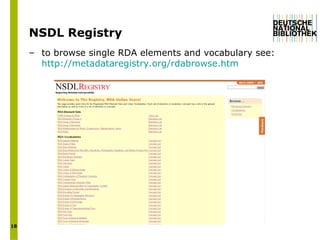
NSDL Registry to browse single RDA elements and vocabulary see:  http://metadataregistry.org/rdabrowse.htm
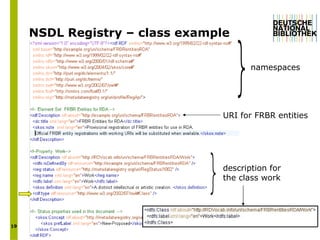
NSDL Registry – class  example description for the class work namespaces URI for FRBR entities
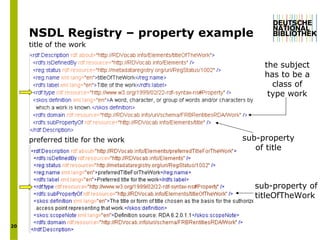
NSDL Registry – property  example title of the work preferred title for the work sub-property of title sub-property of titleOfTheWork the subject has to be a class of type work
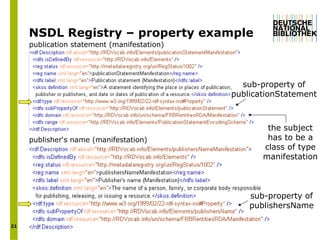
NSDL Registry – property  example publication statement (manifestation) publisher‘s name (manifestation) sub-property of publicationStatement the subject has to be a class of type manifestation sub-property of publishersName
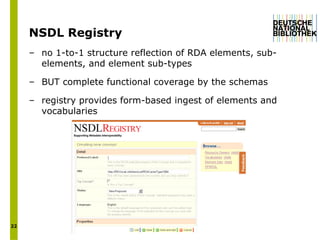
NSDL Registry  no 1-to-1 structure reflection of RDA elements, sub-elements, and element sub-types BUT complete functional coverage by the schemas  registry provides form-based ingest of elements and vocabularies
Conclusion raising awareness in librarians for the next era in information distribution minimizing cataloguing efforts in each library National Libraries as forerunner approaching workflows resulting from the application of the RDA online tools proof of concept transferring bibliographic records and authority data held in country specific form into proper RDA records non-librarian world web community benefits of our comprehensive reliable and dependable metadata new business models for metadata providers and service providers
Thank you! discussion is welcome…

RDA and the Semantic Web

  • 1.
    Alexander Haffner RDAand the Semantic Web
  • 2.
    Internationalisation and Interoperabilityinteroperability of information and library systems internationalisation in descriptive cataloguing and subject cataloguing join all kinds of catalogues understanding user needs find, identify, select, obtain, explore cost-effectiveness
  • 3.
    Functional Requirements forBibliographic Records (FRBR) A model for cataloguing has to identify and clearly define entities of interest to users by bibliographic records the attributes of each entity and the types of relationships that operate between entities Entities of the FRBR Model: group 1: work, expression, manifestation, item group 2: person, corporate body group 3: concept, object, event, and place
  • 4.
    Functional Requirements forBibliographic Records (FRBR) work: Angels & demons / Dan Brown expression 1: text … expression X: text (German) expression 2: auditory expression 3: Braille manifestation 1a: Angels & demons / Dan Brown. New York : Pocket Books, ©2000. 430 p. : maps, 25 cm. (Angels and demons) ISBN 0671027360 manifestation 1b: Angels & demons / Dan Brown. eBook. New York : Atria Books, 2004. Adobe PDF, 899 KB. (Angels and demons) ISBN 0743412397
  • 5.
    Functional Requirements forAuthority Data (FRAD)
  • 6.
    Resource Description andAccess upcoming user-focused content standard changes perspectives of cataloguing guiding librarians and non-librarians in how to describe entities and their relationships re-use of FRBR, FRAD, and FRSAD RDA is intended to replace AACR2 cover all types of media (non-digital and digital; textual, visual, auditory, tactile etc.) first release of RDA is announced for November 2009 RDA will be published as an online product independent of technical metadata formats but definitely upcoming metadata records in MARC 21 and RDF RDA has been developed explicitly to take advantage of the Semantic Web
  • 7.
    Linked Data andthe Semantic Web linking associate resources and related data in the web linked data as prerequisite for the semantic web key technologies URIs as generic means to identify entities and concepts RDF as a data model to describe things as instances (subject-predicate-object expressions) subsequent use of data public data network of structured information avoidance of redundant information and efforts How do you know that a dataset is reliable and trustworthy? semantic networking and the library scene bibliographies and authority data in libraries will receive the status of reliable and trustworthy data re-use by a variety of service providers
  • 8.
    Linked Data andthe Semantic Web RDF Schema (RDFS) expresses the structure of metadata classes and properties lightweight ontology representation Simple Knowledge Organization System (SKOS) expresses the basic structure and content of concept schemes such as thesauri and other types of controlled vocabularies Web Ontology Language (OWL) explicitly represents the meaning of terms in vocabularies and the relationships between them complex ontology representation: optimized for reasoning
  • 9.
    DCMI/RDA Task Groupdefine vocabularies in Semantic Web formats using NSDL Metadata Registry tools two types of vocabularies: 1. metadata entities (elements, attributes) e.g. “Title”, “Content type”; represented as RDF-Schema 2. metadata content (controlled terms) e.g. “spoken word” (instance of Content type); represented in SKOS FRBR Review Group re-affirmed its desire to liaise with DCMI/RDA Task Group register RDFS representations of FRBR entities and relationships element registration approaches RDA Element Analysis
  • 10.
    FRBR entities [resourceURIref] [resource URIref] [resource URIref] [resource URIref] http://RDVocab.info/uri/schema/FRBRentitiesRDA/Work http://RDVocab.info/uri/schema/FRBRentitiesRDA/Expression http://RDVocab.info/uri/schema/FRBRentitiesRDA/Manifestation http://RDVocab.info/uri/schema/FRBRentitiesRDA/Item rdf:type rdf:type rdf:type rdf:type
  • 11.
    FRBR relationships [resourceURIref] [resource URIref] [resource URIref] [resource URIref] ifla:isRealizedThrough ifla:isEmbodiedIn ifla:isExemplifiedBy FRBR Relationships (Sandbox version) http://sandbox.metadataregistry.org/vocabulary/show/id/90.html
  • 12.
    FRBR relationships [resourceURIref] [resource URIref] [resource URIref] [resource URIref] ifla:isRealizedThrough ifla:isEmbodiedIn ifla:isExemplifiedBy ifla:isCreatedBy ifla:isProducedBy [resource URIref] [resource URIref]
  • 13.
    RDA roles toconcretize relationships a part played or function fulfilled by an entity in relation to another entity or entities [resource URIref] [resource URIref] [resource URIref] [resource URIref] rda:publisher [resource URIref] rda:printer rda:distributer [resource URIref] [resource URIref]
  • 14.
    RDA label literal value surrogate literal values using plain or typed value [resource URIref] [resource URIref] [resource URIref] [resource URIref] [plain value string] rda:titleOfTheWork [plain value string] [plain value string] rda:preferredTitleForTheWork rda:variantTitleForTheWork element sub-types element
  • 15.
    RDA label for any RDA element or element sub-type , one or more sub-elements may be defined composite string blank node to represent the aggregation blank node links to literal value surrogates [resource URIref] [resource URIref] [resource URIref] [resource URIref] rda:publicationStatementManifestation [plain value string] [typed value string] ^^ [syntax encoding scheme] rda:dateOfPublicationManifestation rda:publishersNameManifestation element sub-element
  • 16.
    RDA types represented by a non-literal value surrogate using a value URI reference value encoding scheme allows re-use of controlled vocabulary [resource URIref] [resource URIref] [resource URIref] [resource URIref] rda:carrierTypeManifestation [value URIref] [plain value string] [vocabulary encoding scheme URIref]
  • 17.
    NSDL Registry definition of RDF-Schemas to represent RDA elements, sub-elements, and element sub-types in an ontology environment to assign URIs to RDA elements and vocabularies DCMI/RDA Task Group finalizes the registration of the RDA Element Sets and RDA Vocabularies completion date aimed soon sustainability of the registry by use of elements and vocabularies in RDA online tools registry is open for contribution non-RDA elements and vocabulary are also welcome
  • 18.
    NSDL Registry tobrowse single RDA elements and vocabulary see: http://metadataregistry.org/rdabrowse.htm
  • 19.
    NSDL Registry –class example description for the class work namespaces URI for FRBR entities
  • 20.
    NSDL Registry –property example title of the work preferred title for the work sub-property of title sub-property of titleOfTheWork the subject has to be a class of type work
  • 21.
    NSDL Registry –property example publication statement (manifestation) publisher‘s name (manifestation) sub-property of publicationStatement the subject has to be a class of type manifestation sub-property of publishersName
  • 22.
    NSDL Registry no 1-to-1 structure reflection of RDA elements, sub-elements, and element sub-types BUT complete functional coverage by the schemas registry provides form-based ingest of elements and vocabularies
  • 23.
    Conclusion raising awarenessin librarians for the next era in information distribution minimizing cataloguing efforts in each library National Libraries as forerunner approaching workflows resulting from the application of the RDA online tools proof of concept transferring bibliographic records and authority data held in country specific form into proper RDA records non-librarian world web community benefits of our comprehensive reliable and dependable metadata new business models for metadata providers and service providers
  • 24.
    Thank you! discussionis welcome…