
Modelling Knowledge Organization Systems and Structures -A discussion in the context of conceptual and data models Maja Žumer University of Ljubljana Slovenia Marcia Lei Zeng  Kent State University USA ISKO-UK Biennial Conference, July 4-5, 2011, London
I. Background  Zumer & Zeng, ISKO-UK, 2011, London
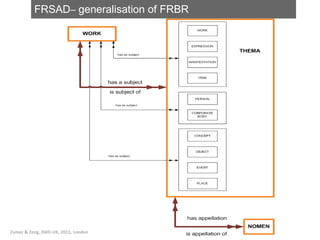
FRSAD –  generalisation of FRBR Zumer & Zeng, ISKO-UK, 2011, London
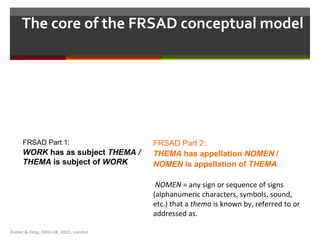
The core of the FRSAD conceptual model  Zumer & Zeng, ISKO-UK, 2011, London FRSAD Part 1:   WORK  has as subject  THEMA /  THEMA  is subject of  WORK FRSAD Part 2:   THEMA  has appellation  NOMEN  /  NOMEN  is appellation of  THEMA .   NOMEN  =  any sign or sequence of signs (alphanumeric characters, symbols, sound, etc.) that a  thema  is known by, referred to or addressed  as .
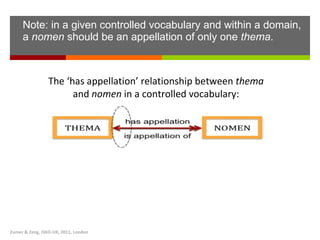
Note: in a given controlled vocabulary and within a domain, a  nomen  should be an appellation of only one  thema . Zumer & Zeng, ISKO-UK, 2011, London The ‘has appellation’ relationship between  thema  and  nomen  in a controlled vocabulary:
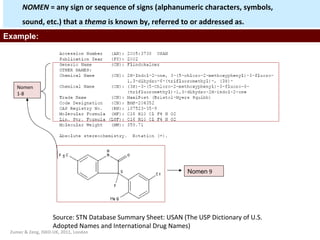
NOMEN  =  any sign or sequence of signs (alphanumeric characters, symbols,  sound, etc.) that a  thema  is known by, referred to or addressed  as .  Source: STN Database Summary Sheet: USAN (The USP Dictionary of U.S.  Adopted Names and International Drug Names) Example: Zumer & Zeng, ISKO-UK, 2011, London Nomen 1-8 Nomen  9
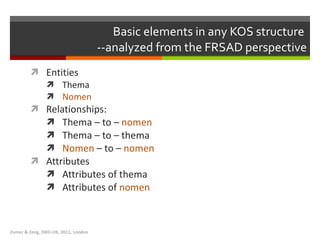
Basic elements in any KOS structure  --analyzed from the FRSAD perspective Entities Thema Nomen Relationships: Thema – to –  nomen Thema – to – thema Nomen  – to –  nomen   Attributes  Attributes of thema Attributes of  nomen Zumer & Zeng, ISKO-UK, 2011, London
The FRSAD conceptual model and its implementation in data models for subject authority data II. FRSAD  conceptual model    implementation in  data models  for subject authority data Zumer & Zeng, ISKO-UK, 2011, London
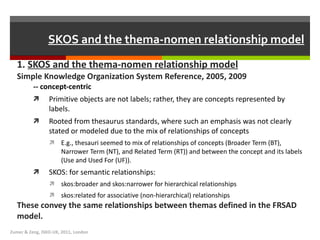
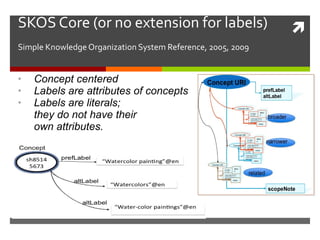
SKOS and the thema-nomen relationship model   1.  SKOS and the thema-nomen relationship model   Simple Knowledge Organization System Reference, 2005, 2009  -- concept-centric  Primitive objects are not labels; rather, they are concepts represented by labels.  Rooted from thesaurus standards, where such an emphasis was not clearly stated or modeled due to the mix of relationships of concepts  E.g., thesauri seemed to mix of relationships of concepts (Broader Term (BT), Narrower Term (NT), and Related Term (RT)) and between the concept and its labels (Use and Used For (UF)). SKOS: for semantic relationships:  skos:broader and skos:narrower for hierarchical relationships  skos:related for associative (non-hierarchical) relationships These convey the same relationships between themas defined in the FRSAD model. Zumer & Zeng, ISKO-UK, 2011, London
Concept centered Labels are attributes of concepts Labels are literals; they do not have their  own attributes . SKOS Core (or no extension for labels) Simple Knowledge Organization System Reference, 2005, 2009
SKOS Core (or no extension for labels) KOS vocabularies that have implemented this SKOS core (or no extension for labels) model  Library of Congress Subject Headings (LCSH)  at  http://id.loc.gov/authorities/ Zumer & Zeng, ISKO-UK, 2011, London
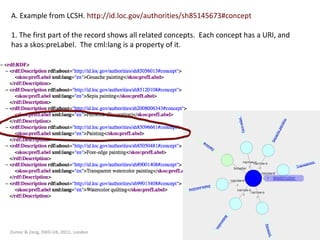
A. Example  from LCSH.  http://id.loc.gov/authorities/sh85145673#concept 1. The first part of the record shows all related concepts.  Each concept has a URI, and has a skos:preLabel.  The cml:lang is a property of it. Zumer & Zeng, ISKO-UK, 2011, London
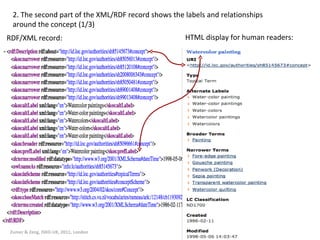
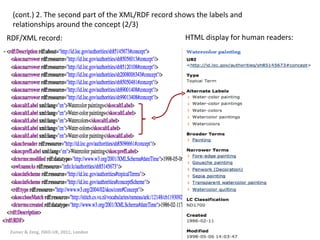
2. The second part of the XML/RDF record shows the labels and relationships around the concept (1/3) HTML display for human readers: RDF/XML record: Zumer & Zeng, ISKO-UK, 2011, London
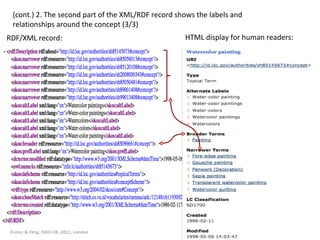
(cont.) 2. The second part of the XML/RDF record shows the labels and relationships around the concept (2/3) HTML display for human readers: RDF/XML record: Zumer & Zeng, ISKO-UK, 2011, London
(cont.) 2. The second part of the XML/RDF record shows the labels and relationships around the concept (3/3) HTML display for human readers: RDF/XML record: Zumer & Zeng, ISKO-UK, 2011, London
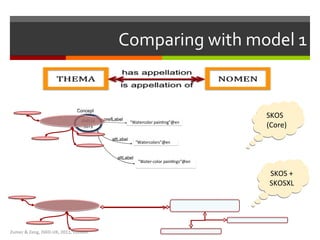
2.  SKOS eXtension for Labels (SKOS-XL) and relationships of nomens   --  thema  corresponds to skos:Concept class  -- nomen  corresponds to skosxl:Label  (cont.) SKOS and the thema-nomen relationship model   Zumer & Zeng, ISKO-UK, 2011, London Ref: eXtension for Labels (SKOS-XL) , in:  SKOS Simple Knowledge Organization System Reference , 2009, Appendix B
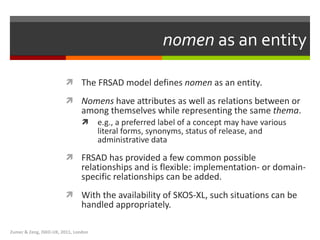
nomen  as an entity The FRSAD model defines  nomen  as an entity .  Nomens  have attributes as well as relations between or among themselves while representing the same  thema .  e.g., a preferred label of a concept may have various literal forms, synonyms, status of release, and administrative data FRSAD has provided a few common possible relationships and is flexible: implementation- or domain-specific relationships can be added.  With the availability of SKOS-XL, such situations can be handled appropriately.  Zumer & Zeng, ISKO-UK, 2011, London
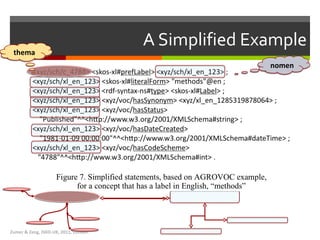
A Simplified Example Zumer & Zeng, ISKO-UK, 2011, London nomen thema
Comparing with model 1 SKOS  (Core) Zumer & Zeng, ISKO-UK, 2011, London SKOS + SKOSXL
[… continue for other language labels] THEMA Zumer & Zeng, ISKO-UK, 2011, London NOMEN “ methods”@en xl_en_345 “ published” “ 1981-01-09” “ 4788” literalForm hasSynonym hasStatus hasDateCreated hasCode Scheme C_4788 xl_en_123 xl_de_789 “ METHODE”@ de xl_de_345 “ published” “ 1996-12-24” “ 4788” literalForm hasSynonym hasStatus hasDateCreated  hasCode Scheme
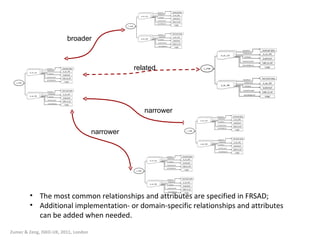
broader related narrower narrower The most common relationships and attributes are specified in FRSAD;  Additional implementation- or domain-specific relationships and attributes can be added when needed.  Zumer & Zeng, ISKO-UK, 2011, London
Summary The two data models presented above demonstrate how the FRSAD model can be implemented 。   T he power of the FRSAD conceptual model wields to meet the needs of both the conventional LIS environment and the emerging Linked Data environment.  Zumer & Zeng, ISKO-UK, 2011, London
References AGROVOC Thesaurus  (Linked Data version 2011-). Food and Agriculture Organization of the United Nations.  Retrieved from : http://aims.fao.org/website/Linked-Open-Data/sub Dextre  Clarke, S .  G.  (2008). ISO 2788 + ISO 5964 + Much Energy = ISO 25964.  Bulletin of the American Society for Information Science and Technology . 35(1): 31–33. Functional Requirements for Subject Authority Data, A Conceptual Model  ( 2010 ) .  IFLA Working Group on Functional Requirements for Subject Authority Records (FRSAR).  Retrieved from : http://www.ifla.org/en/node/1297. Library of Congress Subject Headings  (Linked Data version 2009-). The Library of Congresss.  Retrieved from : http://id.loc.gov/authorities/ SKOS Core Vocabulary Specification. (2005). Eds. Miles, A. and Bechhofer, S. W3C Working Draft 10 May 2005.  Retrieved from : http://www.w3.org/TR/2005/WD-swbp-skos-core-spec-20050510/ SKOS eXtension for Labels (SKOS-XL). In: SKOS Simple Knowledge Organization System Reference (2009). Eds. Miles, A. and Bechhofer, S . W3C Recommendation. Appendix B.  Retrieved from: http://www.w3.org/TR/skos-reference/ http://www.w3.org/TR/2009/REC-skos-reference-20090818/#xl SKOS Simple Knowledge Organization System Primer (2009). Eds. Isaac, A. and Summers, E.  Retrieved from : http://www.w3.org/TR/skos-primer/ SKOS Simple Knowledge Organization System Reference (2009). Eds. Miles, A. and Bechhofer, S . W3C Recommendation.  Retrieved from : http://www.w3.org/TR/skos-reference/  Zumer & Zeng, ISKO-UK, 2011, London

Modelling Knowledge Organization Systems and Structures

  • 1.
    Modelling Knowledge OrganizationSystems and Structures -A discussion in the context of conceptual and data models Maja Žumer University of Ljubljana Slovenia Marcia Lei Zeng Kent State University USA ISKO-UK Biennial Conference, July 4-5, 2011, London
  • 2.
    I. Background Zumer & Zeng, ISKO-UK, 2011, London
  • 3.
    FRSAD – generalisation of FRBR Zumer & Zeng, ISKO-UK, 2011, London
  • 4.
    The core ofthe FRSAD conceptual model Zumer & Zeng, ISKO-UK, 2011, London FRSAD Part 1: WORK has as subject THEMA / THEMA is subject of WORK FRSAD Part 2: THEMA has appellation NOMEN / NOMEN is appellation of THEMA . NOMEN = any sign or sequence of signs (alphanumeric characters, symbols, sound, etc.) that a thema is known by, referred to or addressed as .
  • 5.
    Note: in agiven controlled vocabulary and within a domain, a nomen should be an appellation of only one thema . Zumer & Zeng, ISKO-UK, 2011, London The ‘has appellation’ relationship between thema and nomen in a controlled vocabulary:
  • 6.
    NOMEN = any sign or sequence of signs (alphanumeric characters, symbols, sound, etc.) that a thema is known by, referred to or addressed as . Source: STN Database Summary Sheet: USAN (The USP Dictionary of U.S. Adopted Names and International Drug Names) Example: Zumer & Zeng, ISKO-UK, 2011, London Nomen 1-8 Nomen 9
  • 7.
    Basic elements inany KOS structure --analyzed from the FRSAD perspective Entities Thema Nomen Relationships: Thema – to – nomen Thema – to – thema Nomen – to – nomen Attributes Attributes of thema Attributes of nomen Zumer & Zeng, ISKO-UK, 2011, London
  • 8.
    The FRSAD conceptualmodel and its implementation in data models for subject authority data II. FRSAD conceptual model  implementation in data models for subject authority data Zumer & Zeng, ISKO-UK, 2011, London
  • 9.
    SKOS and thethema-nomen relationship model 1. SKOS and the thema-nomen relationship model Simple Knowledge Organization System Reference, 2005, 2009 -- concept-centric Primitive objects are not labels; rather, they are concepts represented by labels. Rooted from thesaurus standards, where such an emphasis was not clearly stated or modeled due to the mix of relationships of concepts E.g., thesauri seemed to mix of relationships of concepts (Broader Term (BT), Narrower Term (NT), and Related Term (RT)) and between the concept and its labels (Use and Used For (UF)). SKOS: for semantic relationships: skos:broader and skos:narrower for hierarchical relationships skos:related for associative (non-hierarchical) relationships These convey the same relationships between themas defined in the FRSAD model. Zumer & Zeng, ISKO-UK, 2011, London
  • 10.
    Concept centered Labelsare attributes of concepts Labels are literals; they do not have their own attributes . SKOS Core (or no extension for labels) Simple Knowledge Organization System Reference, 2005, 2009
  • 11.
    SKOS Core (orno extension for labels) KOS vocabularies that have implemented this SKOS core (or no extension for labels) model Library of Congress Subject Headings (LCSH) at http://id.loc.gov/authorities/ Zumer & Zeng, ISKO-UK, 2011, London
  • 12.
    A. Example from LCSH. http://id.loc.gov/authorities/sh85145673#concept 1. The first part of the record shows all related concepts. Each concept has a URI, and has a skos:preLabel. The cml:lang is a property of it. Zumer & Zeng, ISKO-UK, 2011, London
  • 13.
    2. The secondpart of the XML/RDF record shows the labels and relationships around the concept (1/3) HTML display for human readers: RDF/XML record: Zumer & Zeng, ISKO-UK, 2011, London
  • 14.
    (cont.) 2. Thesecond part of the XML/RDF record shows the labels and relationships around the concept (2/3) HTML display for human readers: RDF/XML record: Zumer & Zeng, ISKO-UK, 2011, London
  • 15.
    (cont.) 2. Thesecond part of the XML/RDF record shows the labels and relationships around the concept (3/3) HTML display for human readers: RDF/XML record: Zumer & Zeng, ISKO-UK, 2011, London
  • 16.
    2. SKOSeXtension for Labels (SKOS-XL) and relationships of nomens -- thema corresponds to skos:Concept class -- nomen corresponds to skosxl:Label (cont.) SKOS and the thema-nomen relationship model Zumer & Zeng, ISKO-UK, 2011, London Ref: eXtension for Labels (SKOS-XL) , in: SKOS Simple Knowledge Organization System Reference , 2009, Appendix B
  • 17.
    nomen asan entity The FRSAD model defines nomen as an entity . Nomens have attributes as well as relations between or among themselves while representing the same thema . e.g., a preferred label of a concept may have various literal forms, synonyms, status of release, and administrative data FRSAD has provided a few common possible relationships and is flexible: implementation- or domain-specific relationships can be added. With the availability of SKOS-XL, such situations can be handled appropriately. Zumer & Zeng, ISKO-UK, 2011, London
  • 18.
    A Simplified ExampleZumer & Zeng, ISKO-UK, 2011, London nomen thema
  • 19.
    Comparing with model1 SKOS (Core) Zumer & Zeng, ISKO-UK, 2011, London SKOS + SKOSXL
  • 20.
    [… continue forother language labels] THEMA Zumer & Zeng, ISKO-UK, 2011, London NOMEN “ methods”@en xl_en_345 “ published” “ 1981-01-09” “ 4788” literalForm hasSynonym hasStatus hasDateCreated hasCode Scheme C_4788 xl_en_123 xl_de_789 “ METHODE”@ de xl_de_345 “ published” “ 1996-12-24” “ 4788” literalForm hasSynonym hasStatus hasDateCreated hasCode Scheme
  • 21.
    broader related narrowernarrower The most common relationships and attributes are specified in FRSAD; Additional implementation- or domain-specific relationships and attributes can be added when needed. Zumer & Zeng, ISKO-UK, 2011, London
  • 22.
    Summary The twodata models presented above demonstrate how the FRSAD model can be implemented 。 T he power of the FRSAD conceptual model wields to meet the needs of both the conventional LIS environment and the emerging Linked Data environment. Zumer & Zeng, ISKO-UK, 2011, London
  • 23.
    References AGROVOC Thesaurus (Linked Data version 2011-). Food and Agriculture Organization of the United Nations. Retrieved from : http://aims.fao.org/website/Linked-Open-Data/sub Dextre Clarke, S . G. (2008). ISO 2788 + ISO 5964 + Much Energy = ISO 25964. Bulletin of the American Society for Information Science and Technology . 35(1): 31–33. Functional Requirements for Subject Authority Data, A Conceptual Model ( 2010 ) . IFLA Working Group on Functional Requirements for Subject Authority Records (FRSAR). Retrieved from : http://www.ifla.org/en/node/1297. Library of Congress Subject Headings (Linked Data version 2009-). The Library of Congresss. Retrieved from : http://id.loc.gov/authorities/ SKOS Core Vocabulary Specification. (2005). Eds. Miles, A. and Bechhofer, S. W3C Working Draft 10 May 2005. Retrieved from : http://www.w3.org/TR/2005/WD-swbp-skos-core-spec-20050510/ SKOS eXtension for Labels (SKOS-XL). In: SKOS Simple Knowledge Organization System Reference (2009). Eds. Miles, A. and Bechhofer, S . W3C Recommendation. Appendix B. Retrieved from: http://www.w3.org/TR/skos-reference/ http://www.w3.org/TR/2009/REC-skos-reference-20090818/#xl SKOS Simple Knowledge Organization System Primer (2009). Eds. Isaac, A. and Summers, E. Retrieved from : http://www.w3.org/TR/skos-primer/ SKOS Simple Knowledge Organization System Reference (2009). Eds. Miles, A. and Bechhofer, S . W3C Recommendation. Retrieved from : http://www.w3.org/TR/skos-reference/ Zumer & Zeng, ISKO-UK, 2011, London

Editor's Notes

  • #2 Modelling Knowledge Organization Systems and Structures -A discussion in the context of conceptual and data models Maja Žumer, University of Ljubljana, Slovenia Marcia Lei Zeng, Kent State University, USA
  • #7 http://www.cas.org/ASSETS/93FD034A0502489FA2474DFC0EE03284/usan.pdf
  • #10 The SKOS Core model clearly emphasized a concept-centric view of vocabulary, where primitive objects are not labels; rather, they are concepts represented by labels. The root of the model can be found in the thesaurus standards developed before SKOS Core, but such an emphasis was not clearly stated or modeled due to the mix of relationships of concepts (e.g., Broader Term (BT), Narrower Term (NT), and Related Term (RT)) and between the concept and its labels (Use and Used For (UF)). The use of the word ‘term’ in semantic relationships of broader and narrower concepts reflects such a mixed representation. In the SKOS Core model, labels (preferred, non-preferred, and hidden) are affiliates of a concept while the semantic relationships exists among concepts. “Mirroring the fundamental categories of relations that are used in vocabularies such as thesauri [ISO2788], SKOS supplies three standard properties” (SKOS Simple Knowledge Organization System Primer, 2009) for semantic relationships: skos:broader and skos:narrower for hierarchical links and skos:related for associative (non-hierarchical) links. These convey the same relationships between themas defined in the FRSAD model.
  • #17 Figure 6. Aligning FRSAD model with SKOS + SKOS-XL data model. The capitalization of Concept and Label indicates that they are classes.
  • #19 <xyz/sch/c_4788> is a skos:Concept instance <xyz/sch/xl_en_123> is a skos-xl:Label instance
  • #20 <xyz/sch/c_4788> is a skos:Concept instance <xyz/sch/xl_en_123> is a skos-xl:Label instance