 Chemical nature:
 Vitamin E is chemically known as tocopherol
(Greek: tocos=childbirth, piro=to bear and
ol=alcohol)
• An alcohol was capable to prevent reproductive
failure in animals
• Hence it is known as anti-sterility vitamin
• Chemistry:
• Vitamin E is the name given to group of tocopherols
and tocotrienols
 About 8 tocopherols have been identified
 Alpha- tocopherol is most active
 The tocopherols are derivatives of 6-hydroxy
chromane (tocol) ring with isoprenoid side chain
 The antioxidant property is due to the chromane
ring
 There are four main forms of tocopherols
 They are
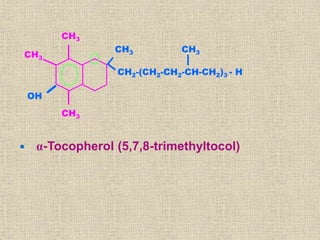
 α -tocopherol : 5,7,8 trimethyl tocol
 β -tocopherol : 5,8 dimethyl tocol
 γ -tocopherol :7,8 dimethyl tocol
 δ -tocopherol : 8 methyl tocopherol
 α –tocopherol is most active and predominant form
of vitamin E
 Tocotrienols : There are four related vitamin E
compounds called α,β,γ and δ tocotrienols
 α-Tocopherol (5,7,8-trimethyltocol)
CH2-(CH2-CH2-CH-CH2)3 - H
CH3
CH3
CH3
CH3
CH3
OH

CH2-(CH2-CH2-CH-CH2)3 - H
CH3
CH3
CH3
OH
CH2-(CH2-CH2-CH-CH2)3 - H
CH3
CH3
CH3
OH
β- Tocopherol (5,8 - dimethyltocol
γ - Tocopherol (7,8 - dimethyltocol)
CH3
CH3
ABSORPTION
 Vitamin E is absorbed along with fat in the upper
small intestine
 Mechanism: Vitamin E combines with Bile salts
(micelles) to form mixed micelle and taken up by
the mucosal cell
 In the mucosal cell, it is incorporated into
chylomicrons
 Dietary vitamin E is incorporated to chylomicrons
 In the circulation, chylomicrons transport vitamin E to
the peripheral tissue or to the liver
 Hepatic vitamin E is incorporated to VLDL
 In the circulation, VLDL is converted LDL
 Vitamin E is transported with LDL to reach the
peripheral tissues including adipose tissue
 Storage: Mainly stored in liver and adipose tissue
 Present in biological membranes, because of its affinity
to phospholipids
 Most of the functions of the vitamin E are related
to its antioxidant property
 It prevents the non-enzymatic oxidations of
various cell components by molecular oxygen and
free radicals such as superoxide and hydrogen
peroxide (H2O2)
 Selenium helps in these functions
 Vitamin E is lipophilic in character and is found in
association with lipoproteins, fat deposits and
cellular membranes
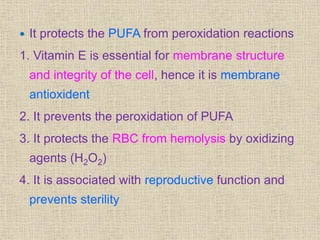
 It protects the PUFA from peroxidation reactions
1. Vitamin E is essential for membrane structure
and integrity of the cell, hence it is membrane
antioxident
2. It prevents the peroxidation of PUFA
3. It protects the RBC from hemolysis by oxidizing
agents (H2O2)
4. It is associated with reproductive function and
prevents sterility
5. Vitamin E preserves and maintains germinal
epithelium of gonads for proper reproductive
function
6. It increases the synthesis of heme by enhancing
the activity of enzyme – δ aminolevulinic acid (ALA)
synthase and ALA dehydratase
7. It is required for cellular respiration –through
ETC (Stabilize coenzyme Q)
8. Vitamin E prevents the oxidation of Vitamin A
and carotenes
9. It is required for proper storage of creatine in
skeletal muscle
10. It is required for absorption of amino acids
from intestine
11. It is involved in synthesis of nucleic acids
12.It protects the liver from toxic compounds such
as carbontetrachloride
13. It works in association with vitamin A,C and
beta-carotene, to delay the onset of cataract
14. Vitamin E is recommended for the prevention of
chronic diseases such as cancer and heart
disease
 Vitamin E prevents oxidation of LDL
 Oxidized LDL promotes heart diseases
 Selinium: It is a component of glutathione
peroxidase and function as antioxidant
 It reduces the requirement of vitamin E in diet
 It is required for normal pancreatic function and
enhancing the absorption of vitamin E
 Males -10 mg/day
 Females - 8 mg/day
 Pregnancy - 10 mg/day
 Lactation - 12 mg/day
 15 mg of vitamin E is equivalent to 33 IU
 Pharmacological dose is 200-400 IU/day
 Sources:
 Rich sources are vegetable oils
 Includes germ oil, sunflower oil, corn oil and
margarine
 In humans, deficiency of vitamin E is seen in
 Premature infants:
 Transfer of vitamin E from meternal blood occurs
during last few weeks of pregnancy
 Premature infants will have vitamin E deficiency
 Impaired absorption: Seen in conditions such as
 abetalipoproteinemia (fat malabsorption)
 Obstructive jaundice
 Intestinal diseases such as celiac spure
 Genetic vitamin E deficiency: It is caused by lack
of a protein that normally transports α-
tocopherol from hepatocytes to VLDL
 Clinical features:
 Hemolytic anemia or macrocytic anemia seen in
premature infants
 In adults, increased susceptibility of erythrocytes
for hemolysis under oxidative stress
 Muscle weakness and proteinuria is seen
Muscular
dystrophy
 Vitamin E deficiency leads to increased oxidation
of PUFA, with consumption of oxygen and
production of peroxides
 Peroxides increase the intracellular hydrolase
activity
 The hydrolases catalyze breakdowns in muscle
and produce muscular dystrophy
 The muscle creatine is low and creatinuria occurs
Hepatic necrosis
 Vitamin E and selenium prevents hepatic necrosis
 Spinocerebellar ataxia and impaired vision:
 Chronic deficiency in children is associated with
ataxia, weakness, loss of touch and position
senses, impaired vision and retinopathy
 Increased lipid peroxidation in nervous tissue
causes neurological lesions
 Oxidation of PUFA in rods leads to oxidative
damage in retina
 Deficiency in animals:
 Muscular dystrophy and reproductive failure
 Vitamin E is least toxic
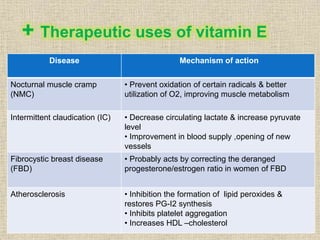
+ Therapeutic uses of vitamin E
Disease Mechanism of action
Nocturnal muscle cramp
(NMC)
• Prevent oxidation of certain radicals & better
utilization of O2, improving muscle metabolism
Intermittent claudication (IC) • Decrease circulating lactate & increase pyruvate
level
• Improvement in blood supply ,opening of new
vessels
Fibrocystic breast disease
(FBD)
• Probably acts by correcting the deranged
progesterone/estrogen ratio in women of FBD
Atherosclerosis • Inhibition the formation of lipid peroxides &
restores PG-I2 synthesis
• Inhibits platelet aggregation
• Increases HDL –cholesterol
 Harper’s Biochemistry 25th Edition.
 Fundamentals of Clinical Chemistry by Tietz.
 Text Book of Medical Biochemistry-A R Aroor.
 Text Book of Biochemistry-DM Vasudevan
 Text Book of Biochemistry-MN Chatterjea
 Text Book of Biochemistry-Dr.U.Satyanarana

Metabolisme vitamin E

  • 1.
     Chemical nature: Vitamin E is chemically known as tocopherol (Greek: tocos=childbirth, piro=to bear and ol=alcohol) • An alcohol was capable to prevent reproductive failure in animals • Hence it is known as anti-sterility vitamin • Chemistry: • Vitamin E is the name given to group of tocopherols and tocotrienols
  • 2.
     About 8tocopherols have been identified  Alpha- tocopherol is most active  The tocopherols are derivatives of 6-hydroxy chromane (tocol) ring with isoprenoid side chain  The antioxidant property is due to the chromane ring  There are four main forms of tocopherols  They are
  • 3.
     α -tocopherol: 5,7,8 trimethyl tocol  β -tocopherol : 5,8 dimethyl tocol  γ -tocopherol :7,8 dimethyl tocol  δ -tocopherol : 8 methyl tocopherol  α –tocopherol is most active and predominant form of vitamin E  Tocotrienols : There are four related vitamin E compounds called α,β,γ and δ tocotrienols
  • 4.
  • 5.
     CH2-(CH2-CH2-CH-CH2)3 - H CH3 CH3 CH3 OH CH2-(CH2-CH2-CH-CH2)3- H CH3 CH3 CH3 OH β- Tocopherol (5,8 - dimethyltocol γ - Tocopherol (7,8 - dimethyltocol) CH3 CH3
  • 7.
    ABSORPTION  Vitamin Eis absorbed along with fat in the upper small intestine  Mechanism: Vitamin E combines with Bile salts (micelles) to form mixed micelle and taken up by the mucosal cell  In the mucosal cell, it is incorporated into chylomicrons
  • 8.
     Dietary vitaminE is incorporated to chylomicrons  In the circulation, chylomicrons transport vitamin E to the peripheral tissue or to the liver  Hepatic vitamin E is incorporated to VLDL  In the circulation, VLDL is converted LDL  Vitamin E is transported with LDL to reach the peripheral tissues including adipose tissue  Storage: Mainly stored in liver and adipose tissue  Present in biological membranes, because of its affinity to phospholipids
  • 9.
     Most ofthe functions of the vitamin E are related to its antioxidant property  It prevents the non-enzymatic oxidations of various cell components by molecular oxygen and free radicals such as superoxide and hydrogen peroxide (H2O2)  Selenium helps in these functions  Vitamin E is lipophilic in character and is found in association with lipoproteins, fat deposits and cellular membranes
  • 10.
     It protectsthe PUFA from peroxidation reactions 1. Vitamin E is essential for membrane structure and integrity of the cell, hence it is membrane antioxident 2. It prevents the peroxidation of PUFA 3. It protects the RBC from hemolysis by oxidizing agents (H2O2) 4. It is associated with reproductive function and prevents sterility
  • 11.
    5. Vitamin Epreserves and maintains germinal epithelium of gonads for proper reproductive function 6. It increases the synthesis of heme by enhancing the activity of enzyme – δ aminolevulinic acid (ALA) synthase and ALA dehydratase 7. It is required for cellular respiration –through ETC (Stabilize coenzyme Q) 8. Vitamin E prevents the oxidation of Vitamin A and carotenes
  • 12.
    9. It isrequired for proper storage of creatine in skeletal muscle 10. It is required for absorption of amino acids from intestine 11. It is involved in synthesis of nucleic acids 12.It protects the liver from toxic compounds such as carbontetrachloride 13. It works in association with vitamin A,C and beta-carotene, to delay the onset of cataract
  • 13.
    14. Vitamin Eis recommended for the prevention of chronic diseases such as cancer and heart disease  Vitamin E prevents oxidation of LDL  Oxidized LDL promotes heart diseases  Selinium: It is a component of glutathione peroxidase and function as antioxidant  It reduces the requirement of vitamin E in diet  It is required for normal pancreatic function and enhancing the absorption of vitamin E
  • 14.
     Males -10mg/day  Females - 8 mg/day  Pregnancy - 10 mg/day  Lactation - 12 mg/day  15 mg of vitamin E is equivalent to 33 IU  Pharmacological dose is 200-400 IU/day  Sources:  Rich sources are vegetable oils  Includes germ oil, sunflower oil, corn oil and margarine
  • 15.
     In humans,deficiency of vitamin E is seen in  Premature infants:  Transfer of vitamin E from meternal blood occurs during last few weeks of pregnancy  Premature infants will have vitamin E deficiency  Impaired absorption: Seen in conditions such as  abetalipoproteinemia (fat malabsorption)  Obstructive jaundice  Intestinal diseases such as celiac spure
  • 16.
     Genetic vitaminE deficiency: It is caused by lack of a protein that normally transports α- tocopherol from hepatocytes to VLDL  Clinical features:  Hemolytic anemia or macrocytic anemia seen in premature infants  In adults, increased susceptibility of erythrocytes for hemolysis under oxidative stress  Muscle weakness and proteinuria is seen
  • 17.
    Muscular dystrophy  Vitamin Edeficiency leads to increased oxidation of PUFA, with consumption of oxygen and production of peroxides  Peroxides increase the intracellular hydrolase activity  The hydrolases catalyze breakdowns in muscle and produce muscular dystrophy  The muscle creatine is low and creatinuria occurs
  • 18.
    Hepatic necrosis  VitaminE and selenium prevents hepatic necrosis  Spinocerebellar ataxia and impaired vision:  Chronic deficiency in children is associated with ataxia, weakness, loss of touch and position senses, impaired vision and retinopathy  Increased lipid peroxidation in nervous tissue causes neurological lesions
  • 19.
     Oxidation ofPUFA in rods leads to oxidative damage in retina  Deficiency in animals:  Muscular dystrophy and reproductive failure  Vitamin E is least toxic
  • 20.
    + Therapeutic usesof vitamin E Disease Mechanism of action Nocturnal muscle cramp (NMC) • Prevent oxidation of certain radicals & better utilization of O2, improving muscle metabolism Intermittent claudication (IC) • Decrease circulating lactate & increase pyruvate level • Improvement in blood supply ,opening of new vessels Fibrocystic breast disease (FBD) • Probably acts by correcting the deranged progesterone/estrogen ratio in women of FBD Atherosclerosis • Inhibition the formation of lipid peroxides & restores PG-I2 synthesis • Inhibits platelet aggregation • Increases HDL –cholesterol
  • 22.
     Harper’s Biochemistry25th Edition.  Fundamentals of Clinical Chemistry by Tietz.  Text Book of Medical Biochemistry-A R Aroor.  Text Book of Biochemistry-DM Vasudevan  Text Book of Biochemistry-MN Chatterjea  Text Book of Biochemistry-Dr.U.Satyanarana