“Erythropoietin – From Bench to 
Bedside " 
K.Sampath kumar,MD,DM,FRCP 
Meenakshi Mission Hospital 
Madurai,India
Focus of my talk 
• Biology of Erythropoietin [EPO] 
• Why EPO should come from Kidneys? Why 
not Lungs ? 
• Practical aspects of usage of EPO in clinic 
• Major clinical trials 
• Use / Abuse of EPO 
• Conclusion
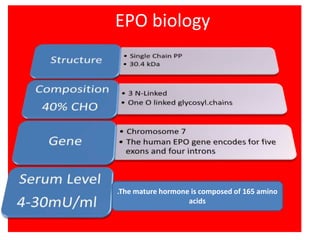
EPO biology 
.The mature hormone is composed of 165 amino 
acids
Bioengineered EPO possible only with mammalian cell lines 
due to addtion of Sugar moiety 
[Unlike Insulin for which bacteria can be utilised]
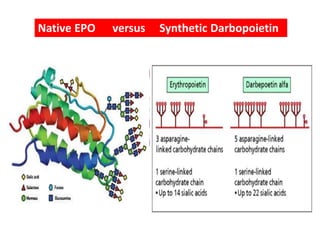
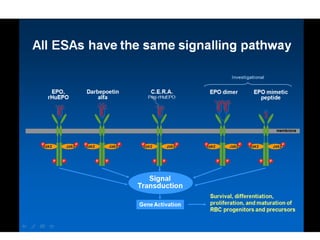
Native EPO versus Synthetic Darbopoietin
Focus of my talk 
• Biology of Erythropoietin [EPO] 
• Why EPO is produced in Kidneys 
• Practical aspects of usage of EPO in clinic 
• Major clinical trials 
• Cautionary notes 
• Conclusion
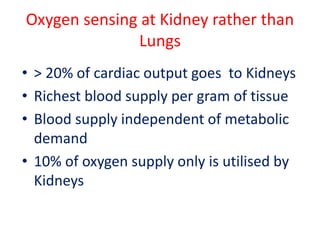
Oxygen sensing at Kidney rather than 
Lungs 
• > 20% of cardiac output goes to Kidneys 
• Richest blood supply per gram of tissue 
• Blood supply independent of metabolic 
demand 
• 10% of oxygen supply only is utilised by 
Kidneys
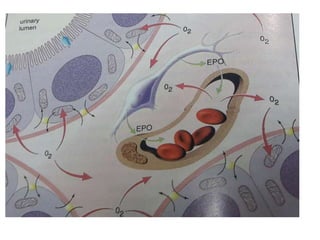
Kidney is a biological critmeter 
Blood supply 
Demand and 
O2 Conc 
45 % Hematocrit is not a random 
Number. It is optimises tissue 
Oxygen delivery with correct viscosity 
And fluidity 
Normal hematocrit 
Of 45 %
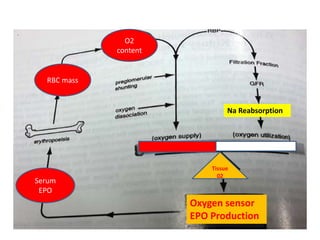
Oxygen sensor 
EPO Production 
O2 
content 
RBC mass 
Serum 
EPO 
Na Reabsorption 
Tissue 
02
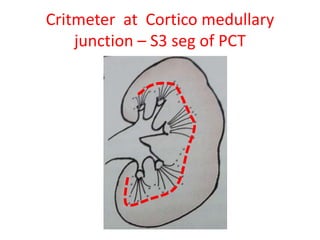
Critmeter at Cortico medullary 
junction – S3 seg of PCT
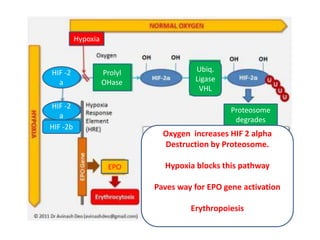
Prolyl 
OHase 
Ubiq. 
Ligase 
VHL 
Proteosome 
degrades 
Hypoxia 
EPO 
HIF -2 
a 
HIF -2 
a 
HIF -2b 
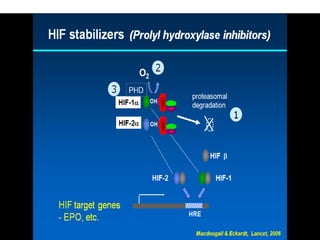
Oxygen increases HIF 2 alpha 
Destruction by Proteosome. 
Hypoxia blocks this pathway 
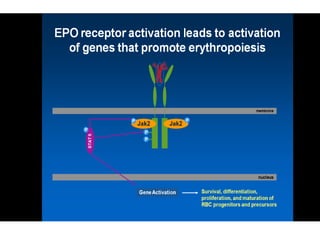
Paves way for EPO gene activation 
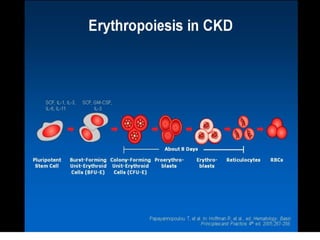
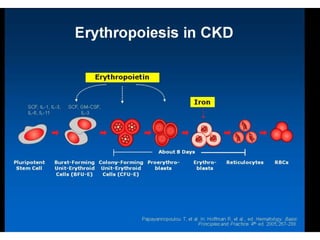
Erythropoiesis
Practice Points in anemia 
management of CKD
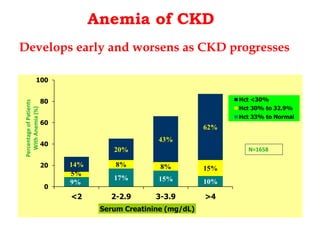
Develops early and worsens as CKD progresses 
9% 
17% 15% 10% 
5% 
8% 8% 15% 
14% 
20% 
43% 
62% 
100 
80 
60 
40 
20 
0 
<2 2-2.9 3-3.9 >4 
Serum Creatinine (mg/dL) 
Hct <30% 
Hct 30% to 32.9% 
Hct 33% to Normal 
Percentage of Patients 
With Anemia (%) 
N=1658 
Anemia of CKD
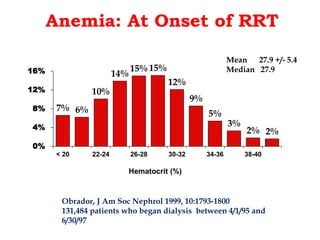
Anemia: At Onset of RRT 
7% 6% 
10% 
14% 
15% 15% 
12% 
9% 
5% 
Mean 27.9 +/- 5.4 
Median 27.9 
3% 
2% 2% 
16% 
12% 
8% 
4% 
0% 
< 20 22-24 26-28 30-32 34-36 38-40 
Hematocrit (%) 
Obrador, J Am Soc Nephrol 1999, 10:1793-1800 
131,484 patients who began dialysis between 4/1/95 and 
6/30/97
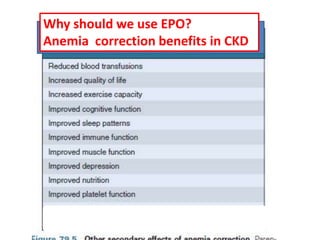
Why should we use EPO? 
Anemia Why Anemia correction should be corrected benefits in CKD 
in CKD
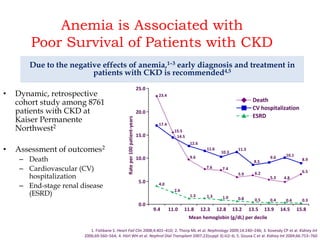
Anemia is Associated with 
Poor Survival of Patients with CKD 
Due to the negative effects of anemia,1–3 early diagnosis and treatment in 
patients with CKD is recommended4,5 
• Dynamic, retrospective 
cohort study among 8761 
patients with CKD at 
Kaiser Permanente 
Northwest2 
• Assessment of outcomes2 
– Death 
– Cardiovascular (CV) 
hospitalization 
– End-stage renal disease 
(ESRD) 
25.0 
23.4 
17.4 
4.0 
9.4 
Rate per 100 patient-years 
15.5 
14.5 
2.6 
12.6 
9.6 
11.6 
10.3 
7.6 7.4 
11.3 
Death 
CV hospitalization 
ESRD 
8.5 
5.9 6.2 
9.0 
10.1 
5.3 4.8 
8.9 
6.5 
1.3 1.3 1.0 0.8 0.5 0.4 0.4 0.3 
11.0 11.8 12.3 12.8 13.2 13.5 13.9 14.5 15.8 
Mean hemoglobin (g/dL) per decile 
20.0 
15.0 
10.0 
5.0 
0.0 
1. Fishbane S. Heart Fail Clin 2008;4:401–410; 2. Thorp ML et al. Nephrology 2009;14:240–246; 3. Kovesdy CP et al. Kidney Int 
2006;69:560–564; 4. Hörl WH et al. Nephrol Dial Transplant 2007;22(suppl 3):iii2–6; 5. Gouva C et al. Kidney Int 2004;66:753–760
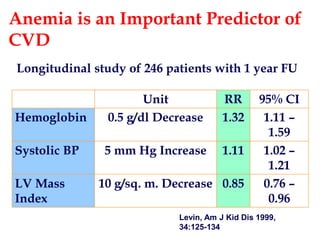
Anemia is an Important Predictor of 
CVD 
Longitudinal study of 246 patients with 1 year FU 
Unit RR 95% CI 
Hemoglobin 0.5 g/dl Decrease 1.32 1.11 – 
1.59 
Systolic BP 5 mm Hg Increase 1.11 1.02 – 
1.21 
Levin, Am J Kid Dis 1999, 
34:125-134 
LV Mass 
Index 
10 g/sq. m. Decrease 0.85 0.76 – 
0.96
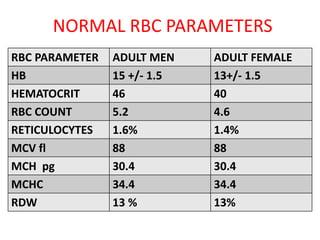
NORMAL RBC PARAMETERS 
RBC PARAMETER ADULT MEN ADULT FEMALE 
HB 15 +/- 1.5 13+/- 1.5 
HEMATOCRIT 46 40 
RBC COUNT 5.2 4.6 
RETICULOCYTES 1.6% 1.4% 
MCV fl 88 88 
MCH pg 30.4 30.4 
MCHC 34.4 34.4 
RDW 13 % 13%
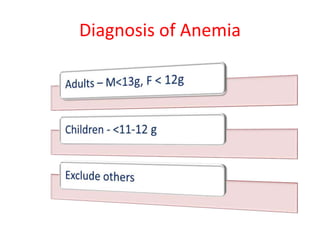
Diagnosis of Anemia
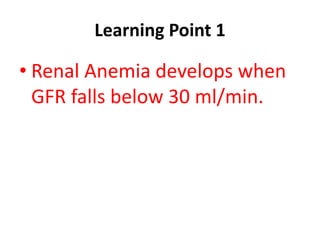
Learning Point 1 
• Renal Anemia develops when 
GFR falls below 30 ml/min.
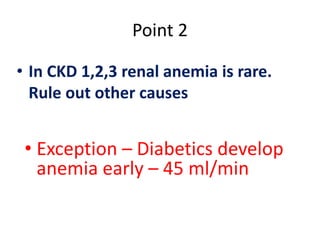
Point 2 
• In CKD 1,2,3 renal anemia is rare. 
Rule out other causes 
• Exception – Diabetics develop 
anemia early – 45 ml/min
Point 3 
• Pure Renal anemia is 
• Normocytic 
• Normochromic 
Either a low[Fe] or high MCV[B12,F] 
Low MCH or MCHC strongly 
suggest other contributory factors 
[ Iron def or hemoglobinopathy]
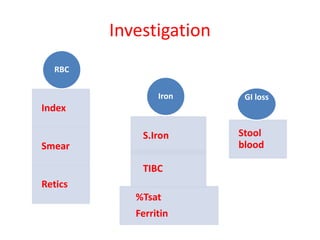
Investigation 
RBC 
Index 
Smear 
Retics 
Iron 
S.Iron 
TIBC 
%Tsat 
Ferritin 
GI loss 
Stool 
blood
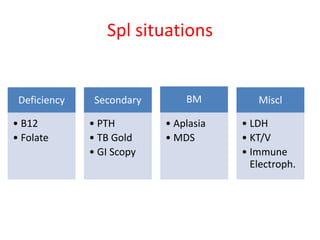
Spl situations 
Deficiency 
• B12 
• Folate 
Secondary 
• PTH 
• TB Gold 
• GI Scopy 
BM 
• Aplasia 
• MDS 
Miscl 
• LDH 
• KT/V 
• Immune 
Electroph.
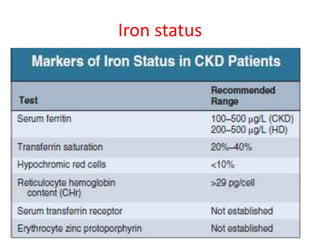
Iron status
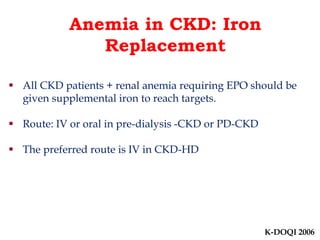
Anemia in CKD: Iron 
Replacement 
 All CKD patients + renal anemia requiring EPO should be 
given supplemental iron to reach targets. 
 Route: IV or oral in pre-dialysis -CKD or PD-CKD 
 The preferred route is IV in CKD-HD 
K-DOQI 2006
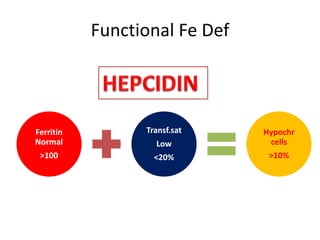
Functional Fe Def 
Ferritin 
Normal 
>100 
Transf.sat 
Low 
<20% 
Hypochr 
cells 
>10%
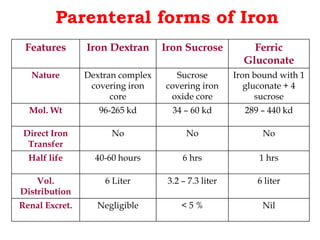
Parenteral forms of Iron 
Features Iron Dextran Iron Sucrose Ferric 
Gluconate 
Nature Dextran complex 
covering iron 
core 
Sucrose 
covering iron 
oxide core 
Iron bound with 1 
gluconate + 4 
sucrose 
Mol. Wt 96-265 kd 34 – 60 kd 289 – 440 kd 
Direct Iron 
Transfer 
No No No 
Half life 40-60 hours 6 hrs 1 hrs 
Vol. 
Distribution 
6 Liter 3.2 – 7.3 liter 6 liter 
Renal Excret. Negligible < 5 % Nil
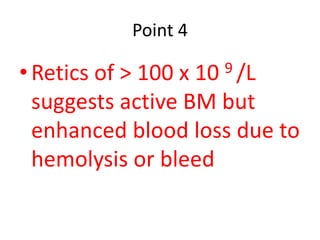
Point 4 
• Retics of > 100 x 10 9 /L 
suggests active BM but 
enhanced blood loss due to 
hemolysis or bleed
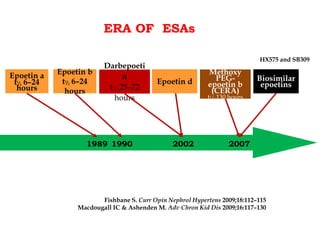
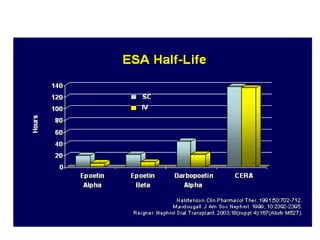
ERA OF ESAs 
Darbepoeti 
n 
t1/2 25–72 
hours 
Epoetin d 
HX575 and SB309 
Fishbane S. Curr Opin Nephrol Hypertens 2009;18:112–115 
Macdougall IC & Ashenden M. Adv Chron Kid Dis 2009;16:117–130 
Epoetin a 
t1/2 6–24 
hours 
Methoxy 
PEG-epoetin 
b 
(CERA) 
t1/2 130 hours 
Epoetin b 
t1/2 6–24 
hours 
1989 1990 2002 2007 
Biosimilar 
epoetins
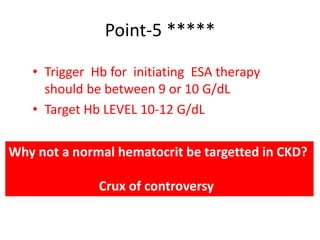
Point-5 ***** 
• Trigger Hb for initiating ESA therapy 
should be between 9 or 10 G/dL 
• Target Hb LEVEL 10-12 G/dL 
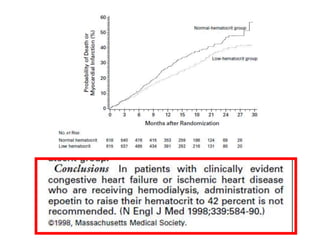
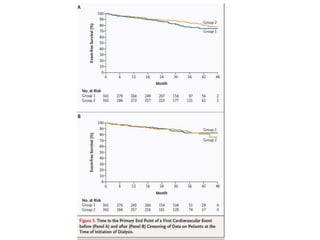
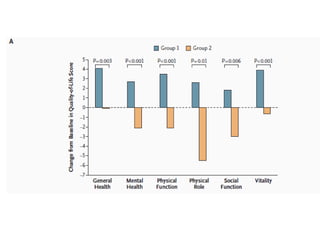
Why not a normal hematocrit be targetted in CKD? 
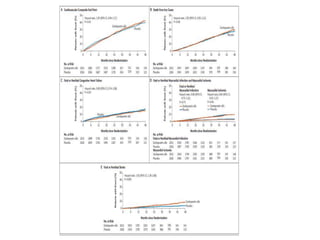
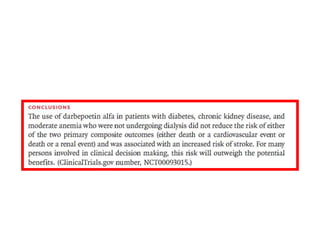
Crux of controversy
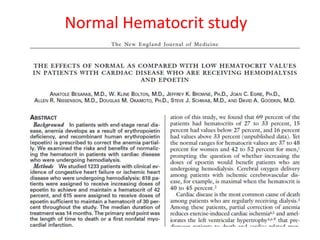
Normal Hematocrit study
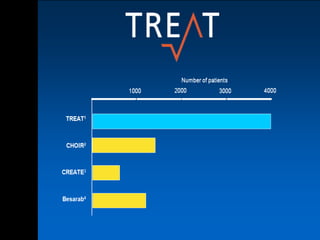
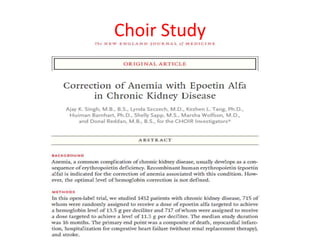
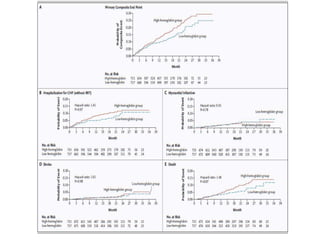
Choir Study
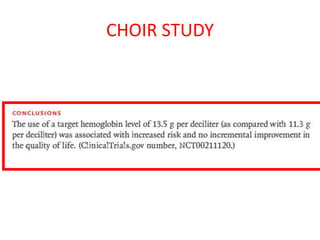
CHOIR STUDY
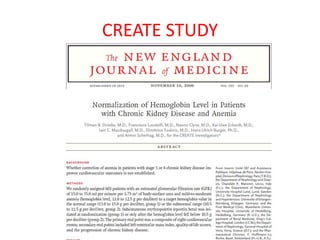
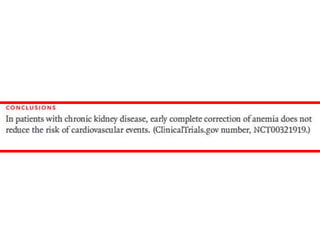
CREATE STUDY
CREATE STUDY
DM/CVA 
CANCER 
CKD 
PHYSIOLO 
GY 
HD/PD/ 
TX 
GENDER/ 
GENES 
AGE/ 
ALTIDUDE 
DISEASE 
SEVERITY 
LIFE STYLE 
IRON 
STATUS
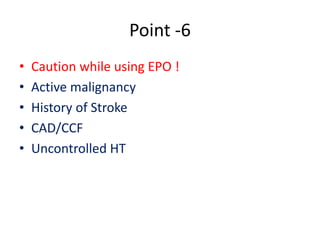
Point -6 
• Caution while using EPO ! 
• Active malignancy 
• History of Stroke 
• CAD/CCF 
• Uncontrolled HT
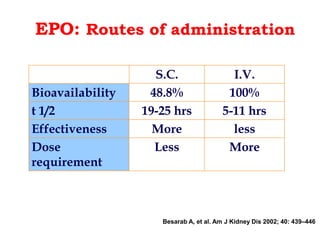
EPO: Routes of administration 
S.C. I.V. 
Bioavailability 48.8% 100% 
t 1/2 19-25 hrs 5-11 hrs 
Effectiveness More less 
Dose 
Less More 
requirement 
Besarab A, et al. Am J Kidney Dis 2002; 40: 439–446
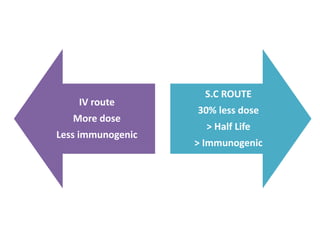
IV route 
More dose 
Less immunogenic 
S.C ROUTE 
30% less dose 
> Half Life 
> Immunogenic
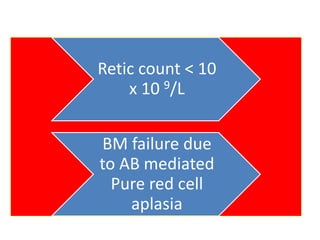
Retic count < 10 
x 10 9/L 
BM failure due 
to AB mediated 
Pure red cell 
aplasia
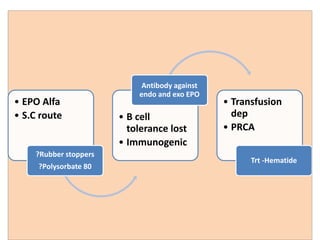
• EPO Alfa 
• S.C route 
?Rubber stoppers 
?Polysorbate 80 
Antibody against 
endo and exo EPO 
• B cell 
tolerance lost 
• Immunogenic 
• Transfusion 
dep 
• PRCA 
Trt -Hematide
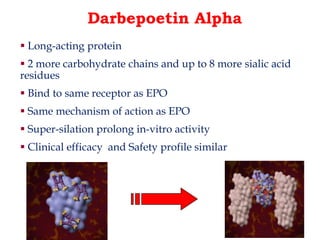
Darbepoetin Alpha 
 Long-acting protein 
 2 more carbohydrate chains and up to 8 more sialic acid 
residues 
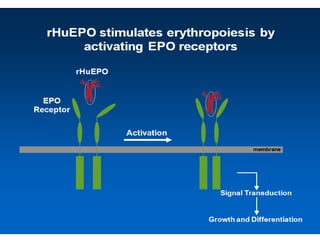
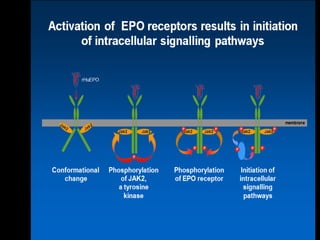
 Bind to same receptor as EPO 
 Same mechanism of action as EPO 
 Super-silation prolong in-vitro activity 
 Clinical efficacy and Safety profile similar
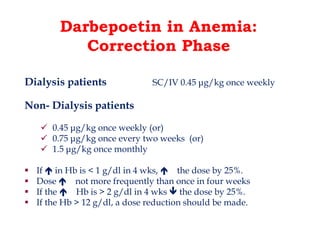
Darbepoetin in Anemia: 
Correction Phase 
Dialysis patients SC/IV 0.45 μg/kg once weekly 
Non- Dialysis patients 
 0.45 μg/kg once weekly (or) 
 0.75 μg/kg once every two weeks (or) 
 1.5 μg/kg once monthly 
 If  in Hb is < 1 g/dl in 4 wks,  the dose by 25%. 
 Dose  not more frequently than once in four weeks 
 If the  Hb is > 2 g/dl in 4 wks  the dose by 25%. 
 If the Hb > 12 g/dl, a dose reduction should be made.
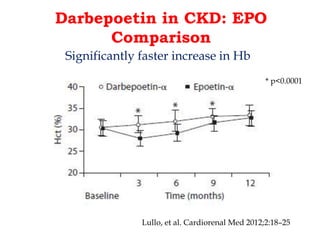
Darbepoetin in CKD: EPO 
Comparison 
Significantly faster increase in Hb 
* p<0.0001 
Lullo, et al. Cardiorenal Med 2012;2:18–25
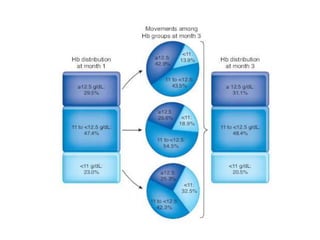
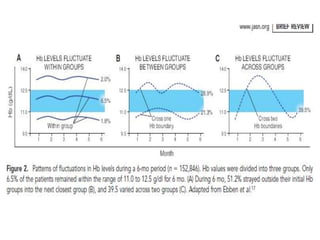
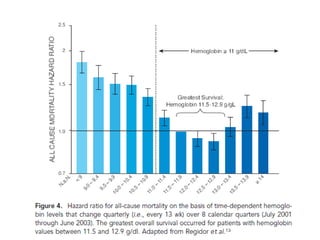
Hemoglobin variability and its 
impact on survival 
A longitudinal survey of HD patients 
showing fluctuations in Hb with its 
impact on survival
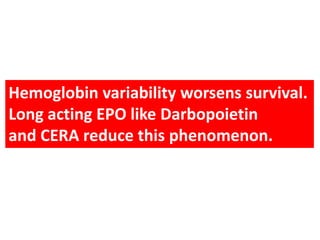
Hemoglobin variability worsens survival. 
Long acting EPO like Darbopoietin 
and CERA reduce this phenomenon.
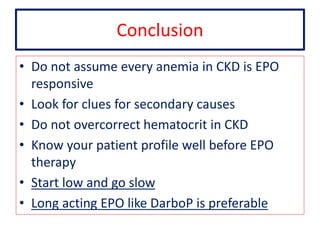
Conclusion 
• Do not assume every anemia in CKD is EPO 
responsive 
• Look for clues for secondary causes 
• Do not overcorrect hematocrit in CKD 
• Know your patient profile well before EPO 
therapy 
• Start low and go slow 
• Long acting EPO like DarboP is preferable

Erythropoetin - From Bench to Bedside

  • 1.
    “Erythropoietin – FromBench to Bedside " K.Sampath kumar,MD,DM,FRCP Meenakshi Mission Hospital Madurai,India
  • 2.
    Focus of mytalk • Biology of Erythropoietin [EPO] • Why EPO should come from Kidneys? Why not Lungs ? • Practical aspects of usage of EPO in clinic • Major clinical trials • Use / Abuse of EPO • Conclusion
  • 3.
    EPO biology .Themature hormone is composed of 165 amino acids
  • 4.
    Bioengineered EPO possibleonly with mammalian cell lines due to addtion of Sugar moiety [Unlike Insulin for which bacteria can be utilised]
  • 5.
    Native EPO versusSynthetic Darbopoietin
  • 12.
    Focus of mytalk • Biology of Erythropoietin [EPO] • Why EPO is produced in Kidneys • Practical aspects of usage of EPO in clinic • Major clinical trials • Cautionary notes • Conclusion
  • 13.
    Oxygen sensing atKidney rather than Lungs • > 20% of cardiac output goes to Kidneys • Richest blood supply per gram of tissue • Blood supply independent of metabolic demand • 10% of oxygen supply only is utilised by Kidneys
  • 14.
    Kidney is abiological critmeter Blood supply Demand and O2 Conc 45 % Hematocrit is not a random Number. It is optimises tissue Oxygen delivery with correct viscosity And fluidity Normal hematocrit Of 45 %
  • 15.
    Oxygen sensor EPOProduction O2 content RBC mass Serum EPO Na Reabsorption Tissue 02
  • 17.
    Critmeter at Corticomedullary junction – S3 seg of PCT
  • 18.
    Prolyl OHase Ubiq. Ligase VHL Proteosome degrades Hypoxia EPO HIF -2 a HIF -2 a HIF -2b Oxygen increases HIF 2 alpha Destruction by Proteosome. Hypoxia blocks this pathway Paves way for EPO gene activation Erythropoiesis
  • 20.
    Practice Points inanemia management of CKD
  • 21.
    Develops early andworsens as CKD progresses 9% 17% 15% 10% 5% 8% 8% 15% 14% 20% 43% 62% 100 80 60 40 20 0 <2 2-2.9 3-3.9 >4 Serum Creatinine (mg/dL) Hct <30% Hct 30% to 32.9% Hct 33% to Normal Percentage of Patients With Anemia (%) N=1658 Anemia of CKD
  • 22.
    Anemia: At Onsetof RRT 7% 6% 10% 14% 15% 15% 12% 9% 5% Mean 27.9 +/- 5.4 Median 27.9 3% 2% 2% 16% 12% 8% 4% 0% < 20 22-24 26-28 30-32 34-36 38-40 Hematocrit (%) Obrador, J Am Soc Nephrol 1999, 10:1793-1800 131,484 patients who began dialysis between 4/1/95 and 6/30/97
  • 23.
    Why should weuse EPO? Anemia Why Anemia correction should be corrected benefits in CKD in CKD
  • 24.
    Anemia is Associatedwith Poor Survival of Patients with CKD Due to the negative effects of anemia,1–3 early diagnosis and treatment in patients with CKD is recommended4,5 • Dynamic, retrospective cohort study among 8761 patients with CKD at Kaiser Permanente Northwest2 • Assessment of outcomes2 – Death – Cardiovascular (CV) hospitalization – End-stage renal disease (ESRD) 25.0 23.4 17.4 4.0 9.4 Rate per 100 patient-years 15.5 14.5 2.6 12.6 9.6 11.6 10.3 7.6 7.4 11.3 Death CV hospitalization ESRD 8.5 5.9 6.2 9.0 10.1 5.3 4.8 8.9 6.5 1.3 1.3 1.0 0.8 0.5 0.4 0.4 0.3 11.0 11.8 12.3 12.8 13.2 13.5 13.9 14.5 15.8 Mean hemoglobin (g/dL) per decile 20.0 15.0 10.0 5.0 0.0 1. Fishbane S. Heart Fail Clin 2008;4:401–410; 2. Thorp ML et al. Nephrology 2009;14:240–246; 3. Kovesdy CP et al. Kidney Int 2006;69:560–564; 4. Hörl WH et al. Nephrol Dial Transplant 2007;22(suppl 3):iii2–6; 5. Gouva C et al. Kidney Int 2004;66:753–760
  • 25.
    Anemia is anImportant Predictor of CVD Longitudinal study of 246 patients with 1 year FU Unit RR 95% CI Hemoglobin 0.5 g/dl Decrease 1.32 1.11 – 1.59 Systolic BP 5 mm Hg Increase 1.11 1.02 – 1.21 Levin, Am J Kid Dis 1999, 34:125-134 LV Mass Index 10 g/sq. m. Decrease 0.85 0.76 – 0.96
  • 26.
    NORMAL RBC PARAMETERS RBC PARAMETER ADULT MEN ADULT FEMALE HB 15 +/- 1.5 13+/- 1.5 HEMATOCRIT 46 40 RBC COUNT 5.2 4.6 RETICULOCYTES 1.6% 1.4% MCV fl 88 88 MCH pg 30.4 30.4 MCHC 34.4 34.4 RDW 13 % 13%
  • 27.
  • 28.
    Learning Point 1 • Renal Anemia develops when GFR falls below 30 ml/min.
  • 29.
    Point 2 •In CKD 1,2,3 renal anemia is rare. Rule out other causes • Exception – Diabetics develop anemia early – 45 ml/min
  • 30.
    Point 3 •Pure Renal anemia is • Normocytic • Normochromic Either a low[Fe] or high MCV[B12,F] Low MCH or MCHC strongly suggest other contributory factors [ Iron def or hemoglobinopathy]
  • 31.
    Investigation RBC Index Smear Retics Iron S.Iron TIBC %Tsat Ferritin GI loss Stool blood
  • 32.
    Spl situations Deficiency • B12 • Folate Secondary • PTH • TB Gold • GI Scopy BM • Aplasia • MDS Miscl • LDH • KT/V • Immune Electroph.
  • 33.
  • 34.
    Anemia in CKD:Iron Replacement  All CKD patients + renal anemia requiring EPO should be given supplemental iron to reach targets.  Route: IV or oral in pre-dialysis -CKD or PD-CKD  The preferred route is IV in CKD-HD K-DOQI 2006
  • 35.
    Functional Fe Def Ferritin Normal >100 Transf.sat Low <20% Hypochr cells >10%
  • 36.
    Parenteral forms ofIron Features Iron Dextran Iron Sucrose Ferric Gluconate Nature Dextran complex covering iron core Sucrose covering iron oxide core Iron bound with 1 gluconate + 4 sucrose Mol. Wt 96-265 kd 34 – 60 kd 289 – 440 kd Direct Iron Transfer No No No Half life 40-60 hours 6 hrs 1 hrs Vol. Distribution 6 Liter 3.2 – 7.3 liter 6 liter Renal Excret. Negligible < 5 % Nil
  • 37.
    Point 4 •Retics of > 100 x 10 9 /L suggests active BM but enhanced blood loss due to hemolysis or bleed
  • 38.
    ERA OF ESAs Darbepoeti n t1/2 25–72 hours Epoetin d HX575 and SB309 Fishbane S. Curr Opin Nephrol Hypertens 2009;18:112–115 Macdougall IC & Ashenden M. Adv Chron Kid Dis 2009;16:117–130 Epoetin a t1/2 6–24 hours Methoxy PEG-epoetin b (CERA) t1/2 130 hours Epoetin b t1/2 6–24 hours 1989 1990 2002 2007 Biosimilar epoetins
  • 39.
    Point-5 ***** •Trigger Hb for initiating ESA therapy should be between 9 or 10 G/dL • Target Hb LEVEL 10-12 G/dL Why not a normal hematocrit be targetted in CKD? Crux of controversy
  • 41.
  • 43.
  • 45.
  • 46.
  • 50.
  • 53.
    DM/CVA CANCER CKD PHYSIOLO GY HD/PD/ TX GENDER/ GENES AGE/ ALTIDUDE DISEASE SEVERITY LIFE STYLE IRON STATUS
  • 54.
    Point -6 •Caution while using EPO ! • Active malignancy • History of Stroke • CAD/CCF • Uncontrolled HT
  • 55.
    EPO: Routes ofadministration S.C. I.V. Bioavailability 48.8% 100% t 1/2 19-25 hrs 5-11 hrs Effectiveness More less Dose Less More requirement Besarab A, et al. Am J Kidney Dis 2002; 40: 439–446
  • 56.
    IV route Moredose Less immunogenic S.C ROUTE 30% less dose > Half Life > Immunogenic
  • 57.
    Retic count <10 x 10 9/L BM failure due to AB mediated Pure red cell aplasia
  • 58.
    • EPO Alfa • S.C route ?Rubber stoppers ?Polysorbate 80 Antibody against endo and exo EPO • B cell tolerance lost • Immunogenic • Transfusion dep • PRCA Trt -Hematide
  • 60.
    Darbepoetin Alpha Long-acting protein  2 more carbohydrate chains and up to 8 more sialic acid residues  Bind to same receptor as EPO  Same mechanism of action as EPO  Super-silation prolong in-vitro activity  Clinical efficacy and Safety profile similar
  • 61.
    Darbepoetin in Anemia: Correction Phase Dialysis patients SC/IV 0.45 μg/kg once weekly Non- Dialysis patients  0.45 μg/kg once weekly (or)  0.75 μg/kg once every two weeks (or)  1.5 μg/kg once monthly  If  in Hb is < 1 g/dl in 4 wks,  the dose by 25%.  Dose  not more frequently than once in four weeks  If the  Hb is > 2 g/dl in 4 wks  the dose by 25%.  If the Hb > 12 g/dl, a dose reduction should be made.
  • 62.
    Darbepoetin in CKD:EPO Comparison Significantly faster increase in Hb * p<0.0001 Lullo, et al. Cardiorenal Med 2012;2:18–25
  • 63.
    Hemoglobin variability andits impact on survival A longitudinal survey of HD patients showing fluctuations in Hb with its impact on survival
  • 67.
    Hemoglobin variability worsenssurvival. Long acting EPO like Darbopoietin and CERA reduce this phenomenon.
  • 68.
    Conclusion • Donot assume every anemia in CKD is EPO responsive • Look for clues for secondary causes • Do not overcorrect hematocrit in CKD • Know your patient profile well before EPO therapy • Start low and go slow • Long acting EPO like DarboP is preferable