Steam Tables
Chapter 5


               Dr.Khaled S. Al-Zahrani
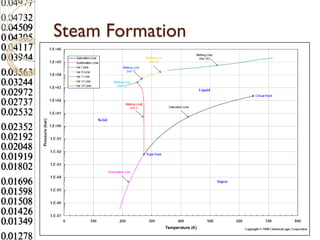
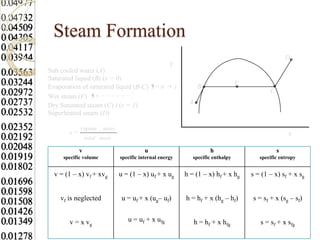
Steam Formation

 T
  C         S = Solid
            L = Liquid                                          Saturated Vapour
            V = Vapour
                                               Critical Point
374 -                                                                    f
                    Saturated Liquid


                                           d       Latent       e
100 -

                     b   Latent   c
  0-


-20 -   a
                S          S+L         L           L+V               V

                                                                                   H
Steam Formation
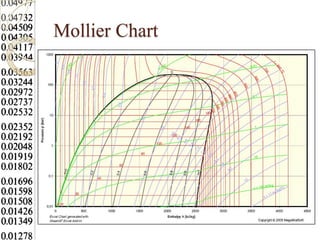
Mollier Chart
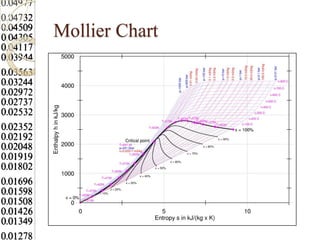
Mollier Chart
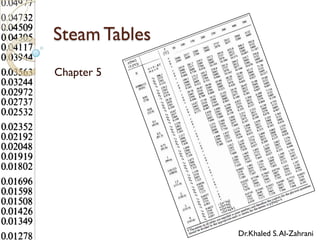
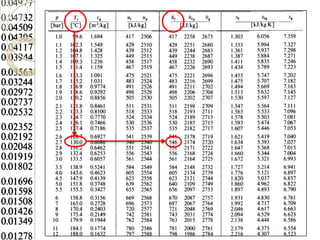
Steam Tables
Steam tables commonly consist of two sets of tables of the
energy transfer properties of water and steam:
    1. saturated steam tables
                 I. Temperature basis
                 II. Pressure basis
    2. superheated steam tables
Both sets of tables are tabulations of
       pressure (P)
       temperature (T)
       specific volume (v)
       specific internal energy (u)
       specific enthalpy (h)
       specific entropy (s)
Steam Tables
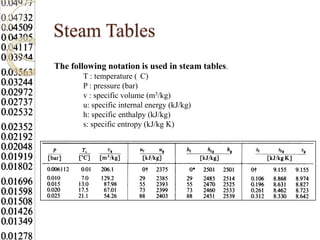
The following notation is used in steam tables.
       T : temperature ( C)
       P : pressure (bar)
       v : specific volume (m3/kg)
       u: specific internal energy (kJ/kg)
       h: specific enthalpy (kJ/kg)
       s: specific entropy (kJ/kg K)
Important points
1. Steam tables give values for 1 kg of water and 1 kg of steam.

2. The steam table gives values of properties from the triple point of
   water to the critical point of steam.

3. If pressure is known use the table on pressure basis.

4. If temperature is known use the table on temperature basis.

5. At low pressure the volume of saturated (vf) liquid is very small as
  compared to the volume of dry steam and usually the specific
  volume of liquid is neglected.
Definitions
   Sub cooled or compressed: is a fluid under thermodynamic
    conditions that force it to be a liquid

   Saturated liquid: fully in the liquid state but is about to vaporize

   Wet steam: When steam contains water in the form of fine water
    particles suspended in steam

   Dry steam: When steam contains no moisture.

   Saturated steam: is steam at equilibrium with liquid water

   Superheated steam: a steam heated above its (boiling point)
    saturation point

   Qality (x): quantity of dry steam in 1 kg of wet steam
Steam Formation
                                                                                                       D
                                                    T
Sub cooled water (A)
Saturated liquid (B) (x = 0)
                                                                   B                F
Evaporation of saturated liquid (B-C) x 0                1
                                                                                               C
Wet steam (F) x
Dry Saturated steam (C) ) (x = 1)                             A
Superheated steam (D)

            vapour     mass
       x
               total mass
                                                                                                       s

           v                             u                              h                          s
     specific volume          specific internal energy          specific enthalpy          specific entropy


  v = (1 – x) vf + xvg        u = (1 – x) uf + x ug          h = (1 – x) hf + x hg      s = (1 – x) sf + x sg


    vf is neglected            u = uf + x (ug– uf)           h = hf + x (hg – hf)       s = sf + x (sg – sf)


       v = x vg                  u = uf + x ufg                   h = hf + x hfg           s = sf + x sfg
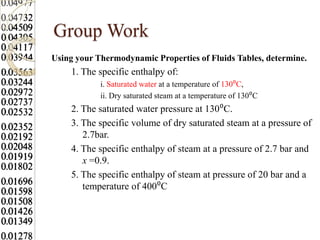
Group Work
Using your Thermodynamic Properties of Fluids Tables, determine.
    1. The specific enthalpy of:
            i. Saturated water at a temperature of 130⁰C,
            ii. Dry saturated steam at a temperature of 130⁰C
    2. The saturated water pressure at 130⁰C.
    3. The specific volume of dry saturated steam at a pressure of
       2.7bar.
    4. The specific enthalpy of steam at a pressure of 2.7 bar and
       x =0.9.
    5. The specific enthalpy of steam at pressure of 20 bar and a
       temperature of 400⁰C
Assignment
Fill in the tables in the given handout

MET 211 steam-tables

  • 1.
    Steam Tables Chapter 5 Dr.Khaled S. Al-Zahrani
  • 2.
    Steam Formation T C S = Solid L = Liquid Saturated Vapour V = Vapour Critical Point 374 - f Saturated Liquid d Latent e 100 - b Latent c 0- -20 - a S S+L L L+V V H
  • 3.
  • 4.
  • 5.
  • 6.
    Steam Tables Steam tablescommonly consist of two sets of tables of the energy transfer properties of water and steam: 1. saturated steam tables I. Temperature basis II. Pressure basis 2. superheated steam tables Both sets of tables are tabulations of pressure (P) temperature (T) specific volume (v) specific internal energy (u) specific enthalpy (h) specific entropy (s)
  • 7.
    Steam Tables The followingnotation is used in steam tables. T : temperature ( C) P : pressure (bar) v : specific volume (m3/kg) u: specific internal energy (kJ/kg) h: specific enthalpy (kJ/kg) s: specific entropy (kJ/kg K)
  • 8.
    Important points 1. Steamtables give values for 1 kg of water and 1 kg of steam. 2. The steam table gives values of properties from the triple point of water to the critical point of steam. 3. If pressure is known use the table on pressure basis. 4. If temperature is known use the table on temperature basis. 5. At low pressure the volume of saturated (vf) liquid is very small as compared to the volume of dry steam and usually the specific volume of liquid is neglected.
  • 9.
    Definitions  Sub cooled or compressed: is a fluid under thermodynamic conditions that force it to be a liquid  Saturated liquid: fully in the liquid state but is about to vaporize  Wet steam: When steam contains water in the form of fine water particles suspended in steam  Dry steam: When steam contains no moisture.  Saturated steam: is steam at equilibrium with liquid water  Superheated steam: a steam heated above its (boiling point) saturation point  Qality (x): quantity of dry steam in 1 kg of wet steam
  • 10.
    Steam Formation D T Sub cooled water (A) Saturated liquid (B) (x = 0) B F Evaporation of saturated liquid (B-C) x 0 1 C Wet steam (F) x Dry Saturated steam (C) ) (x = 1) A Superheated steam (D) vapour mass x total mass s v u h s specific volume specific internal energy specific enthalpy specific entropy v = (1 – x) vf + xvg u = (1 – x) uf + x ug h = (1 – x) hf + x hg s = (1 – x) sf + x sg vf is neglected u = uf + x (ug– uf) h = hf + x (hg – hf) s = sf + x (sg – sf) v = x vg u = uf + x ufg h = hf + x hfg s = sf + x sfg
  • 11.
    Group Work Using yourThermodynamic Properties of Fluids Tables, determine. 1. The specific enthalpy of: i. Saturated water at a temperature of 130⁰C, ii. Dry saturated steam at a temperature of 130⁰C 2. The saturated water pressure at 130⁰C. 3. The specific volume of dry saturated steam at a pressure of 2.7bar. 4. The specific enthalpy of steam at a pressure of 2.7 bar and x =0.9. 5. The specific enthalpy of steam at pressure of 20 bar and a temperature of 400⁰C
  • 13.
    Assignment Fill in thetables in the given handout