OUTLINE
   Introduction
   What is steam
   Types of steam
   Heat exchanger
   Steam in heat exchanger
   Basic ways to improve heat transfer
   Ways to improve steam efficiency
   Problems in steam equipment
   Conclusions
   References
INTRODUCTION
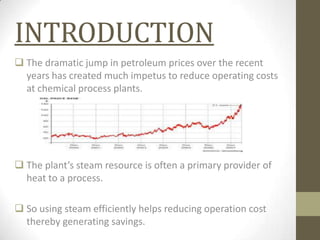
 The dramatic jump in petroleum prices over the recent
  years has created much impetus to reduce operating costs
  at chemical process plants.


 The plant’s steam resource is often a primary provider of
  heat to a process.

 So using steam efficiently helps reducing operation cost
  thereby generating savings.
STEAM
 Steam is the gas formed when water passes from
  the liquid to the gaseous state


 Steam is one of the most common and effective
  heat transfer mediums used in industry
 They are mainly used in heat exchangers,
  turbines, strippers, and chemical reaction vessels
TYPES OF STEAM
 WET STEAM

 Wet steam applies to steam when a portion of its water
  molecules have given up their energy (latent heat) and
  condense to form tiny water droplets
 Also known as saturated steam
 Mixture of water in the liquid state (tiny droplets) and
  gaseous state (steam)
DRY STEAM

Dry steam applies to steam when all its water molecules
 remain in the gaseous state
Known as superheated steam
It's a transparent gas
Superheated steam and liquid water cannot coexist
 under thermodynamic equilibrium
WET STEAM VS. DRY STEAM
WET STEAM
Rapid, even heating through latent heat transfer
High heat transfer coefficient
Originates from water
Used for heating, cooking, drying or other procedures in
 industries
DRY STEAM
Low heat transfer coefficient
Temperature may be extremely high
Sensible heat used to transfer heat
Exclusively used in turbines
HEAT EXCHANGER
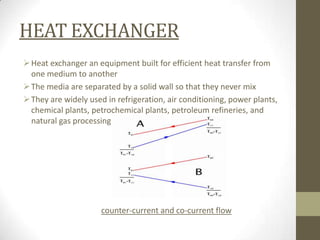
 Heat exchanger an equipment built for efficient heat transfer from
  one medium to another
 The media are separated by a solid wall so that they never mix
 They are widely used in refrigeration, air conditioning, power plants,
  chemical plants, petrochemical plants, petroleum refineries, and
  natural gas processing


                      counter-current and co-current flow
STEAM IN HEAT EXCHANGER
Saturated steam is used in heat exchanger because it has high
 heat transfer coefficient
Heat transfer with saturated steam utilizes the latent heat of
 steam, releasing a large amount of energy as it condenses
Provision is made for condensate recovery
BASIC WAYS TO IMPROVE
HEAT TRANSFER
Temperature difference between the steam and process fluid
 should be high
Using saturated steam instead of superheated steam
 improves efficiency and minimizes operation cost
Higher the flow rate, higher will be the heat transfer
High conductivity of heat exchanger material helps in better
 heat transfer
Larger the surface area of conducting interfaces, greater the
 heat transfer rate
WAYS TO IMPROVE STEAM
EFFICIENCY
STEAM TRAPS

Steam traps are a type of automatic valve that filters out
 condensate (condensed steam) and non-condensable gases
 such as air without letting steam escape
They need to be monitored for leakage and other faults
Replacing faulty traps minimizes loss of steam and improves
 efficiency
CONDENSATE RECOVERY
The condensate from traps can be returned to the boiler
This helps in reducing boiler fuel needs
Reducing boiler fuel needs through condensate recovery leads
 to less air pollution by lowering CO2, NOx and SOx emissions

INSULATING STEAM SYSTEM
Despite high cost, insulation reduces heat loss
Helps save energy

MONITORING LEAKS
Checking the steam distribution lines and valves for leakage
 and fixing them could save energy and enhance efficiency

STEAM METERING
Steam metering provides accurate steam usage statistics
It can be a useful troubleshooting tool
PROBLEMS IN STEAM
EQUIPMENT
WATER HAMMER (STEAM HAMMER)

Steam first supplied to steam distribution piping or steam-
 using equipment, a metallic and repetitive 'bang, bang, bang',
 or even sometimes a violent 'boom' accompanied by vibration
 may be heard
Caused by high levels of accumulated condensate inside the
 equipment
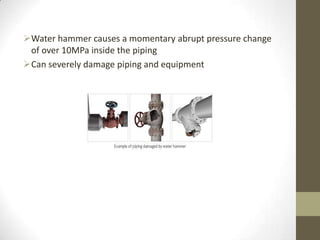
Water hammer causes a momentary abrupt pressure change
 of over 10MPa inside the piping
Can severely damage piping and equipment
FIXING IT

Rapid discharge of condensate is critical from a preventative
 maintenance standpoint
The speed of condensate discharge combined with how
 smoothly the process occurs are two extremely important
 factors in the fight against water hammer in steam-using
 equipment
Proper design and orientation of the equipment
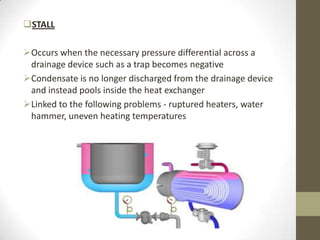
STALL

Occurs when the necessary pressure differential across a
 drainage device such as a trap becomes negative
Condensate is no longer discharged from the drainage device
 and instead pools inside the heat exchanger
Linked to the following problems - ruptured heaters, water
 hammer, uneven heating temperatures
FIXING IT

Increasing trap inlet (primary) pressure
Reducing trap outlet (secondary) pressure
CONCLUSIONS
By proper use of steam, operational cost can be minimized
 and high efficiency is achieved

Condensate recovery and recycling back to boiler helps
 reducing boiler fuel needs thereby minimizing pollution

Damage to equipment can be averted by properly regulating
 the steam

Using steam intelligently lowers carbon emission
REFERENCES
http://www.tlv.com/global/SG/steam-theory


James R. Risko, optimize the Entire Steam System, CEP June
 2008, 31-32

James R. Risko, Understanding Steam Traps, CEP Feb 2011, 21-
 26

James R. Risko, Handle Steam More Intelligently, CHEMICAL
 ENGINEERING www.che.com Nov 2006, 44-48
Efficient use of steam in heat exchanger