Formation and Properties Of
Steam
Submitted to – Prashant sir
Submitted by – Anuharsh Gaur
Introduction: What is Steam?
• Steam is vapour of water and is invisible when
pure and dry
• It is used as the working substance in the
operation of steam engines and steam
turbines
• Steam does not obey laws of perfect gases
until it is perfect dry
Formation of steam at a
constant pressure from water
Theoretical description of above figure
• Consider 1 kg of water at 0 degree Celsius
contained in piston cylinder arrangement as
shown in above figure(i) the piston and
weights maintains a constant pressure in
cylinder
*if we heat water contained in cylinder it will
converted to steam as follows
Contd…..
• The volume of water will increase slightly as increase in
temperature hence it will cause the piston to move
upwards and work is obtained .
• On further heating temperature reaches boiling point ,
the boiling point of water is 100 degree Celsius at
1.103 bar but increases with increase in pressure .
When boiling point is reached, temperature remains
constant and water evaporates thus pushing the piston
up at constant pressure . The specific volume of steam
increases as shown in (iii). At this stage steam will have
some particles of water in suspension and is termed as
wet steam . Process will continue till whole water is
converted to steam
Cont..
• On further heating the suspended water
particles will get converted into steam. The
entire steam in such a state is called dry steam
(iv). It acts as a perfect gas
• On further heating the temperature of steam
starts rising and is termed as superheated
steam(v)
Temperature vs Total Heat Graph
during Steam Formation
Theoretical explanation of above
graph
• The process of steam formation above can
also be explained in graphical form.
• The point A represents the initial condition of
water at 0 degree Celsius and pressure ‘p’.
• The graph is depicted in following three stages
Cont..
1. The heating of water up to boiling temperature
or saturation temperature ‘Ts’is shown by AB
the heat absorbed by water is AF known as
sensible heat
2. The change of state from liquid to steam is
shown by BC heat absorbed during this stage is
FG known as latent heat of vaporization
3. The superheating process is shown by CD heat
absorbed during stage is GH , known as heat of
superheat
Cont..
• If the pressure is increased the boiling
temperature also increase. The point B1
represent the boiling temperature or
saturation temperature at pressure p1 and
point F is point of dry saturated steam
• Line C1D1 shows the constant pressure
process in which steam is super heated
Cont..
• Line passing through points A,B,B1,B2 are
known as saturated liquid line
• Line passing through A1,C,C1,C2 are known
as dry saturated steam line .
Important terms for steam
Basic definitions
• Wet steam – when the steam contains the
moisture or particles of water in suspension .
it is said to be wet steam ,evaporation of
water is not complete and whole of latent
heat is not absorbed
• Dry saturated steam when the wet steam is
further heated and it does not contain any
suspended water particles it is called dry
steam
Cont..
• Superheated steam- when dry steam is further
heated at constant pressure thus raising its
temperature i.e. it is said to be super heated
steam
• Sensible heat – it is the amount of heat
absorbed by 1 kg of water to raise the
temperature from 0 degree to temperature of
saturation point
cont
• Latent heat of vaporization- it is the amount of
heat required to evaporate 1 kg of water at its
boiling point without changing its
temperature
• Specific volume – it is defined as volume
occupied per unit mass at a given temperature
and pressure.
Advantages of Superheated Steam
• We already know that when dry steam is
further heated then the steam is superheated
steam . The process of superheating follows
Charles law
1 . It contain more heat content and has more
power to do a specific work
2. Increased thermal efficiency
Internal energy of the system
• It is the actual heat energy stored in the
system above the freezing point of water
• It is calculated by subtracting external work
done during evaporation from enthalpy or
total heat of steam .
Dryness Fraction
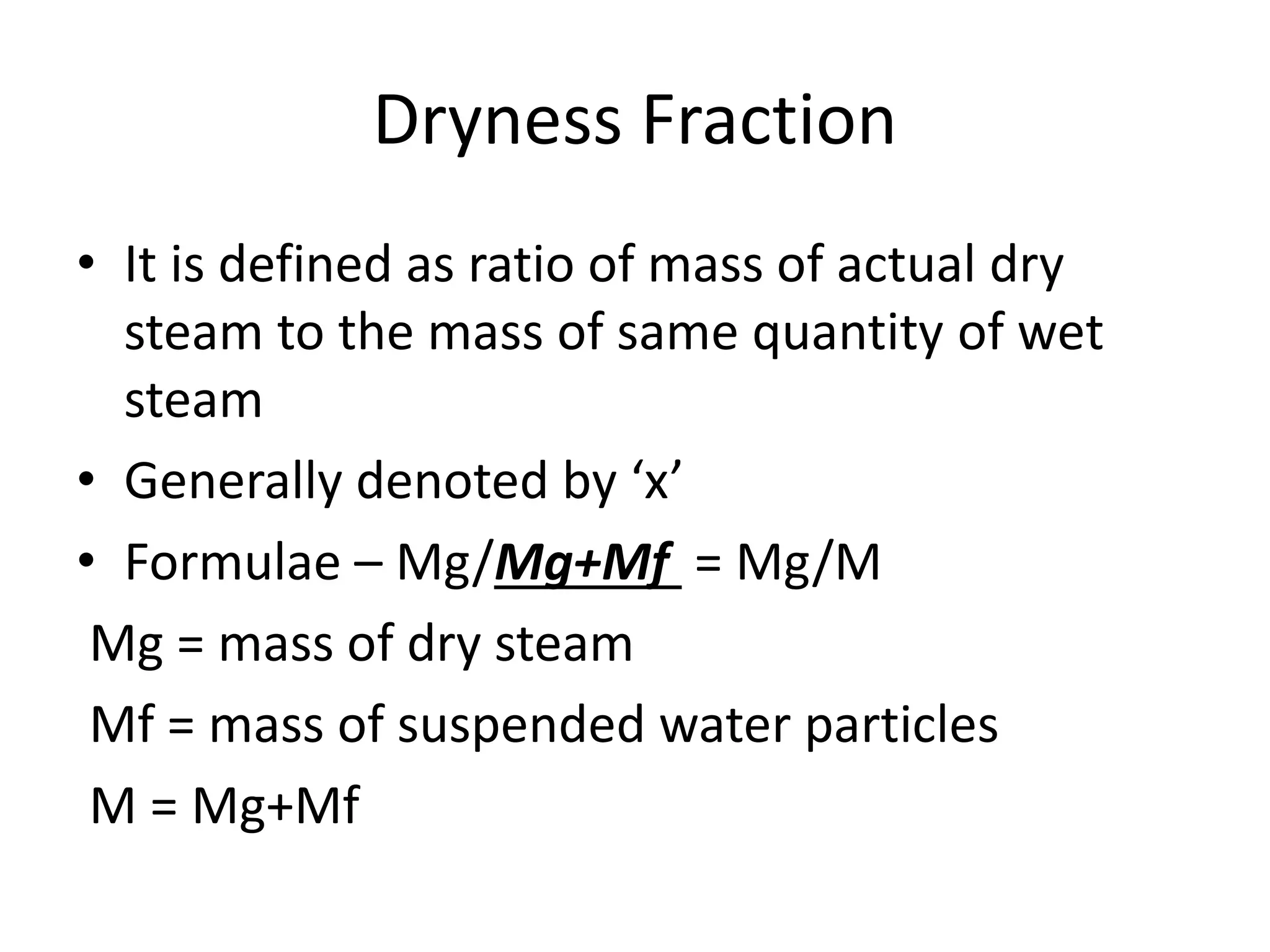
• It is defined as ratio of mass of actual dry
steam to the mass of same quantity of wet
steam
• Generally denoted by ‘x’
• Formulae – Mg/Mg+Mf = Mg/M
Mg = mass of dry steam
Mf = mass of suspended water particles
M = Mg+Mf
References
• Slideshare.net
• Google.com
• Wikipedia.org
Thank you

Formation and properties of steam

  • 1.
    Formation and PropertiesOf Steam Submitted to – Prashant sir Submitted by – Anuharsh Gaur
  • 2.
    Introduction: What isSteam? • Steam is vapour of water and is invisible when pure and dry • It is used as the working substance in the operation of steam engines and steam turbines • Steam does not obey laws of perfect gases until it is perfect dry
  • 3.
    Formation of steamat a constant pressure from water
  • 5.
    Theoretical description ofabove figure • Consider 1 kg of water at 0 degree Celsius contained in piston cylinder arrangement as shown in above figure(i) the piston and weights maintains a constant pressure in cylinder *if we heat water contained in cylinder it will converted to steam as follows
  • 6.
    Contd….. • The volumeof water will increase slightly as increase in temperature hence it will cause the piston to move upwards and work is obtained . • On further heating temperature reaches boiling point , the boiling point of water is 100 degree Celsius at 1.103 bar but increases with increase in pressure . When boiling point is reached, temperature remains constant and water evaporates thus pushing the piston up at constant pressure . The specific volume of steam increases as shown in (iii). At this stage steam will have some particles of water in suspension and is termed as wet steam . Process will continue till whole water is converted to steam
  • 7.
    Cont.. • On furtherheating the suspended water particles will get converted into steam. The entire steam in such a state is called dry steam (iv). It acts as a perfect gas • On further heating the temperature of steam starts rising and is termed as superheated steam(v)
  • 8.
    Temperature vs TotalHeat Graph during Steam Formation
  • 9.
    Theoretical explanation ofabove graph • The process of steam formation above can also be explained in graphical form. • The point A represents the initial condition of water at 0 degree Celsius and pressure ‘p’. • The graph is depicted in following three stages
  • 10.
    Cont.. 1. The heatingof water up to boiling temperature or saturation temperature ‘Ts’is shown by AB the heat absorbed by water is AF known as sensible heat 2. The change of state from liquid to steam is shown by BC heat absorbed during this stage is FG known as latent heat of vaporization 3. The superheating process is shown by CD heat absorbed during stage is GH , known as heat of superheat
  • 11.
    Cont.. • If thepressure is increased the boiling temperature also increase. The point B1 represent the boiling temperature or saturation temperature at pressure p1 and point F is point of dry saturated steam • Line C1D1 shows the constant pressure process in which steam is super heated
  • 12.
    Cont.. • Line passingthrough points A,B,B1,B2 are known as saturated liquid line • Line passing through A1,C,C1,C2 are known as dry saturated steam line .
  • 13.
  • 14.
    Basic definitions • Wetsteam – when the steam contains the moisture or particles of water in suspension . it is said to be wet steam ,evaporation of water is not complete and whole of latent heat is not absorbed • Dry saturated steam when the wet steam is further heated and it does not contain any suspended water particles it is called dry steam
  • 15.
    Cont.. • Superheated steam-when dry steam is further heated at constant pressure thus raising its temperature i.e. it is said to be super heated steam • Sensible heat – it is the amount of heat absorbed by 1 kg of water to raise the temperature from 0 degree to temperature of saturation point
  • 16.
    cont • Latent heatof vaporization- it is the amount of heat required to evaporate 1 kg of water at its boiling point without changing its temperature • Specific volume – it is defined as volume occupied per unit mass at a given temperature and pressure.
  • 17.
    Advantages of SuperheatedSteam • We already know that when dry steam is further heated then the steam is superheated steam . The process of superheating follows Charles law 1 . It contain more heat content and has more power to do a specific work 2. Increased thermal efficiency
  • 18.
    Internal energy ofthe system • It is the actual heat energy stored in the system above the freezing point of water • It is calculated by subtracting external work done during evaporation from enthalpy or total heat of steam .
  • 19.
    Dryness Fraction • Itis defined as ratio of mass of actual dry steam to the mass of same quantity of wet steam • Generally denoted by ‘x’ • Formulae – Mg/Mg+Mf = Mg/M Mg = mass of dry steam Mf = mass of suspended water particles M = Mg+Mf
  • 20.
  • 21.