GUJARAT TECHNOLOGICAL UNIVERSITY
BIRLA VISHVAKARMAMAHAVIDYALAYA
(ENGINEERING COLLEGE)
VALLABH VIDYANAGAR
SUBJECT: ELEMENTS OF MECHANICAL ENGINEERING
(CODE-2110006)
BE First Level Second Semester (Self Finance)
Department : Production
Topic : Properties of steam
Steam and Its Properties
Steam is the gaseous phase of water. It utilizes
heat during the process and carries large
quantities of heat later. Hence, it
could be used as a working substance for heat
engines. Steam is generated in boilers at
constant pressure. Generally,
steam may be obtained starting from ice or
straight away from the water by adding heat to
it.
Steam and its type
 Steam exists in following states or types or conditions.
(i) Wet steam (saturated steam)
(ii) Dry steam (dry saturated steam)
(iii) Superheated steam
(iv) Supersaturated steam water, which is one of the Pure
Substance, exists in three phases:
(i) Solid phase as ice (freezing of water)
(ii) Liquid phase as water (melting of ice)
(iii) Gaseous phase as steam (vaporization of water)
Formation Of steam
Formation of Steam
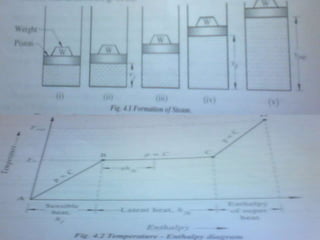
temperature-Enthalpy Diagram t-h diagram)
The graphical representation of transformation of 1 kg of
ice into 1 kg of superheated steam at constant pressure
(temperature vs. enthalpy) is known as t-h diagram.
shows the various stages of formation of steam starting
from ice
shows the correspomding t-h diagram.
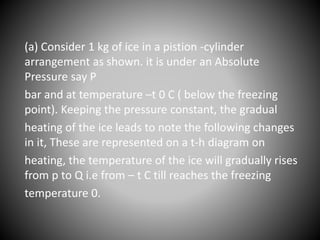
(a) Consider 1 kg of ice in a pistion -cylinder
arrangement as shown. it is under an Absolute
Pressure say P
bar and at temperature –t 0 C ( below the freezing
point). Keeping the pressure constant, the gradual
heating of the ice leads to note the following changes
in it, These are represented on a t-h diagram on
heating, the temperature of the ice will gradually rises
from p to Q i.e from – t C till reaches the freezing
temperature 0.
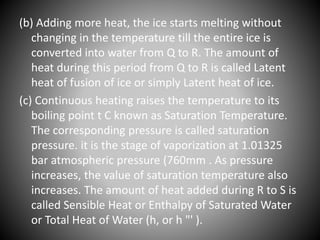
(b) Adding more heat, the ice starts melting without
changing in the temperature till the entire ice is
converted into water from Q to R. The amount of
heat during this period from Q to R is called Latent
heat of fusion of ice or simply Latent heat of ice.
(c) Continuous heating raises the temperature to its
boiling point t C known as Saturation Temperature.
The corresponding pressure is called saturation
pressure. it is the stage of vaporization at 1.01325
bar atmospheric pressure (760mm . As pressure
increases, the value of saturation temperature also
increases. The amount of heat added during R to S is
called Sensible Heat or Enthalpy of Saturated Water
or Total Heat of Water (h, or h "' ).
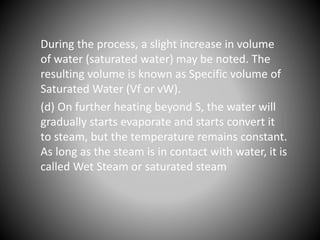
During the process, a slight increase in volume
of water (saturated water) may be noted. The
resulting volume is known as Specific volume of
Saturated Water (Vf or vW).
(d) On further heating beyond S, the water will
gradually starts evaporate and starts convert it
to steam, but the temperature remains constant.
As long as the steam is in contact with water, it is
called Wet Steam or saturated steam
(e) On further heating the temperature remains constant, but the
entire water converts to steam. But still it will be wet steam. The
total heat supplied from OOC is called Enthalpy of Wet Steam (h
wet). The resulting volume is known as Specific Volume of Wet
Steam (v wet)
(f) On further heating the wet steam, the water particles, which are
in suspension, will start evaporating gradually and at a particular
moment the final particles just evaporates. The steam at that
moment corresponding to point T is called Dry Steam or Dry
Saturated Steam. The resulting volume is known as Specific
Volume of Dry Steam (vg). This steam not obeys the gas laws.
The amount of heat added during S to T is called Latent Heat of
Vaporization of Steam or Latent Heat of Steam (hfg). During the
process, the saturation temperature remains constant. The total
heat supplied from O'C is called Enthalpy of Dry Steam (hg).
(g) On further heating beyond point T to U the temperature starts
from ts to tu, the point of interest. This
process is called Super heating. The steam so obtained is called
Super Heated Steam. It obeys gas laws.
Dry saturated steam:
A steam at the saturation temprature corresponding to
a given pressure and having no water molecules in it is
known as dry saturated steam or dry steam.
Since the dry saturated steam does not contain any water
molecules in it, its dryness fraction will be unity.
Superheated steam:
When a dry saturated steam is heated further at the given
constant pressure, its temperature rise beyond its
saturation temperature. The steam in this state is said to
be superheated.
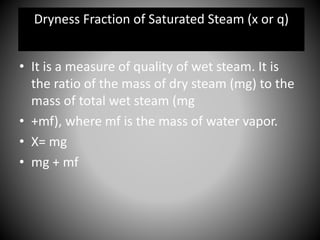
• It is a measure of quality of wet steam. It is
the ratio of the mass of dry steam (mg) to the
mass of total wet steam (mg
• +mf), where mf is the mass of water vapor.
• X= mg
• mg + mf
Dryness Fraction of Saturated Steam (x or q)
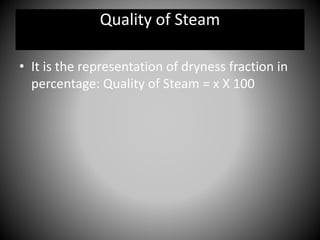
• It is the representation of dryness fraction in
percentage: Quality of Steam = x X 100
Quality of Steam
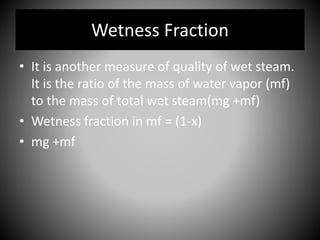
• It is another measure of quality of wet steam.
It is the ratio of the mass of water vapor (mf)
to the mass of total wet steam(mg +mf)
• Wetness fraction in mf = (1-x)
• mg +mf
Wetness Fraction
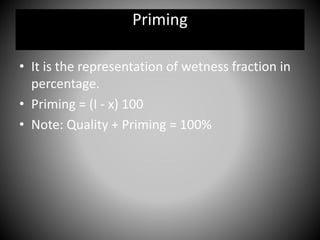
• It is the representation of wetness fraction in
percentage.
• Priming = (I - x) 100
• Note: Quality + Priming = 100%
Priming
• It is the mass of steam per unit of volume of
steam at the given pressure and temperature.
It is the reciprocal of the specific volume.
• P= 1/v
Density of Steam (p), kg/m3
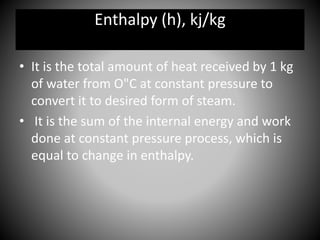
• It is the total amount of heat received by 1 kg
of water from O"C at constant pressure to
convert it to desired form of steam.
• It is the sum of the internal energy and work
done at constant pressure process, which is
equal to change in enthalpy.
Enthalpy (h), kj/kg
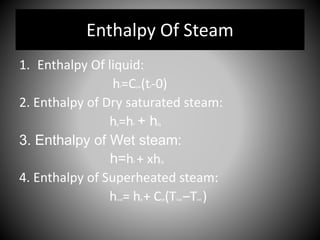
Enthalpy Of Steam
1. Enthalpy Of liquid:
hf=Cpw(tf-0)
2. Enthalpy of Dry saturated steam:
hg=hf + hfg
3. Enthalpy of Wet steam:
h=hf + xhfg
4. Enthalpy of Superheated steam:
hsup= hg + Cps(Tsup –Tsat )
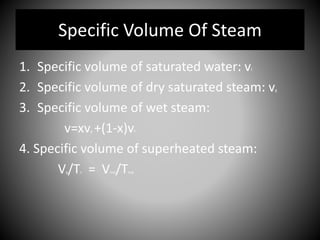
Specific Volume Of Steam
1. Specific volume of saturated water: vf
2. Specific volume of dry saturated steam: vg
3. Specific volume of wet steam:
v=xvg +(1-x)vf
4. Specific volume of superheated steam:
Vg/Ts = Vsup/Tsup
Prepared by :
• Shyam govani(130080125005)
• Krushal kakadiya(130080125006)
• Dhruvit kardani(130080125007)
• Vishal lapsiwala(130080125010)
• Smit patel(130080125030)
Thank you..!!!

Steam and its properties

  • 1.
    GUJARAT TECHNOLOGICAL UNIVERSITY BIRLAVISHVAKARMAMAHAVIDYALAYA (ENGINEERING COLLEGE) VALLABH VIDYANAGAR SUBJECT: ELEMENTS OF MECHANICAL ENGINEERING (CODE-2110006) BE First Level Second Semester (Self Finance) Department : Production Topic : Properties of steam
  • 2.
    Steam and ItsProperties Steam is the gaseous phase of water. It utilizes heat during the process and carries large quantities of heat later. Hence, it could be used as a working substance for heat engines. Steam is generated in boilers at constant pressure. Generally, steam may be obtained starting from ice or straight away from the water by adding heat to it.
  • 3.
    Steam and itstype  Steam exists in following states or types or conditions. (i) Wet steam (saturated steam) (ii) Dry steam (dry saturated steam) (iii) Superheated steam (iv) Supersaturated steam water, which is one of the Pure Substance, exists in three phases: (i) Solid phase as ice (freezing of water) (ii) Liquid phase as water (melting of ice) (iii) Gaseous phase as steam (vaporization of water)
  • 4.
    Formation Of steam Formationof Steam temperature-Enthalpy Diagram t-h diagram) The graphical representation of transformation of 1 kg of ice into 1 kg of superheated steam at constant pressure (temperature vs. enthalpy) is known as t-h diagram. shows the various stages of formation of steam starting from ice shows the correspomding t-h diagram.
  • 5.
    (a) Consider 1kg of ice in a pistion -cylinder arrangement as shown. it is under an Absolute Pressure say P bar and at temperature –t 0 C ( below the freezing point). Keeping the pressure constant, the gradual heating of the ice leads to note the following changes in it, These are represented on a t-h diagram on heating, the temperature of the ice will gradually rises from p to Q i.e from – t C till reaches the freezing temperature 0.
  • 7.
    (b) Adding moreheat, the ice starts melting without changing in the temperature till the entire ice is converted into water from Q to R. The amount of heat during this period from Q to R is called Latent heat of fusion of ice or simply Latent heat of ice. (c) Continuous heating raises the temperature to its boiling point t C known as Saturation Temperature. The corresponding pressure is called saturation pressure. it is the stage of vaporization at 1.01325 bar atmospheric pressure (760mm . As pressure increases, the value of saturation temperature also increases. The amount of heat added during R to S is called Sensible Heat or Enthalpy of Saturated Water or Total Heat of Water (h, or h "' ).
  • 8.
    During the process,a slight increase in volume of water (saturated water) may be noted. The resulting volume is known as Specific volume of Saturated Water (Vf or vW). (d) On further heating beyond S, the water will gradually starts evaporate and starts convert it to steam, but the temperature remains constant. As long as the steam is in contact with water, it is called Wet Steam or saturated steam
  • 9.
    (e) On furtherheating the temperature remains constant, but the entire water converts to steam. But still it will be wet steam. The total heat supplied from OOC is called Enthalpy of Wet Steam (h wet). The resulting volume is known as Specific Volume of Wet Steam (v wet) (f) On further heating the wet steam, the water particles, which are in suspension, will start evaporating gradually and at a particular moment the final particles just evaporates. The steam at that moment corresponding to point T is called Dry Steam or Dry Saturated Steam. The resulting volume is known as Specific Volume of Dry Steam (vg). This steam not obeys the gas laws. The amount of heat added during S to T is called Latent Heat of Vaporization of Steam or Latent Heat of Steam (hfg). During the process, the saturation temperature remains constant. The total heat supplied from O'C is called Enthalpy of Dry Steam (hg).
  • 10.
    (g) On furtherheating beyond point T to U the temperature starts from ts to tu, the point of interest. This process is called Super heating. The steam so obtained is called Super Heated Steam. It obeys gas laws.
  • 11.
    Dry saturated steam: Asteam at the saturation temprature corresponding to a given pressure and having no water molecules in it is known as dry saturated steam or dry steam. Since the dry saturated steam does not contain any water molecules in it, its dryness fraction will be unity. Superheated steam: When a dry saturated steam is heated further at the given constant pressure, its temperature rise beyond its saturation temperature. The steam in this state is said to be superheated.
  • 12.
    • It isa measure of quality of wet steam. It is the ratio of the mass of dry steam (mg) to the mass of total wet steam (mg • +mf), where mf is the mass of water vapor. • X= mg • mg + mf Dryness Fraction of Saturated Steam (x or q)
  • 13.
    • It isthe representation of dryness fraction in percentage: Quality of Steam = x X 100 Quality of Steam
  • 14.
    • It isanother measure of quality of wet steam. It is the ratio of the mass of water vapor (mf) to the mass of total wet steam(mg +mf) • Wetness fraction in mf = (1-x) • mg +mf Wetness Fraction
  • 15.
    • It isthe representation of wetness fraction in percentage. • Priming = (I - x) 100 • Note: Quality + Priming = 100% Priming
  • 16.
    • It isthe mass of steam per unit of volume of steam at the given pressure and temperature. It is the reciprocal of the specific volume. • P= 1/v Density of Steam (p), kg/m3
  • 17.
    • It isthe total amount of heat received by 1 kg of water from O"C at constant pressure to convert it to desired form of steam. • It is the sum of the internal energy and work done at constant pressure process, which is equal to change in enthalpy. Enthalpy (h), kj/kg
  • 18.
    Enthalpy Of Steam 1.Enthalpy Of liquid: hf=Cpw(tf-0) 2. Enthalpy of Dry saturated steam: hg=hf + hfg 3. Enthalpy of Wet steam: h=hf + xhfg 4. Enthalpy of Superheated steam: hsup= hg + Cps(Tsup –Tsat )
  • 19.
    Specific Volume OfSteam 1. Specific volume of saturated water: vf 2. Specific volume of dry saturated steam: vg 3. Specific volume of wet steam: v=xvg +(1-x)vf 4. Specific volume of superheated steam: Vg/Ts = Vsup/Tsup
  • 20.
    Prepared by : •Shyam govani(130080125005) • Krushal kakadiya(130080125006) • Dhruvit kardani(130080125007) • Vishal lapsiwala(130080125010) • Smit patel(130080125030)
  • 21.