Properties of Pure
Substances
• Simple System: A simple system is one in which the effects of motion, viscosity, fluid shear, capillarity,
anisotropic stress, and external force fields are absent
• Homogeneous Substance: A substance tha t has uniform thermodynamic properties throughout is said to be
homogeneous
• Pure Substance: A pure substance has a homogeneous and invariable chemical composition and may exist in
more than one phase
Examples:
1. Water (solid, liquid, and vapor phases)
2. Mixture of liquid water and water vapor
3. Carbon dioxide, CO2
4. Nitrogen, N2
5. Mixtures of gases, such as air, as long as there is no change of phase
Introduction
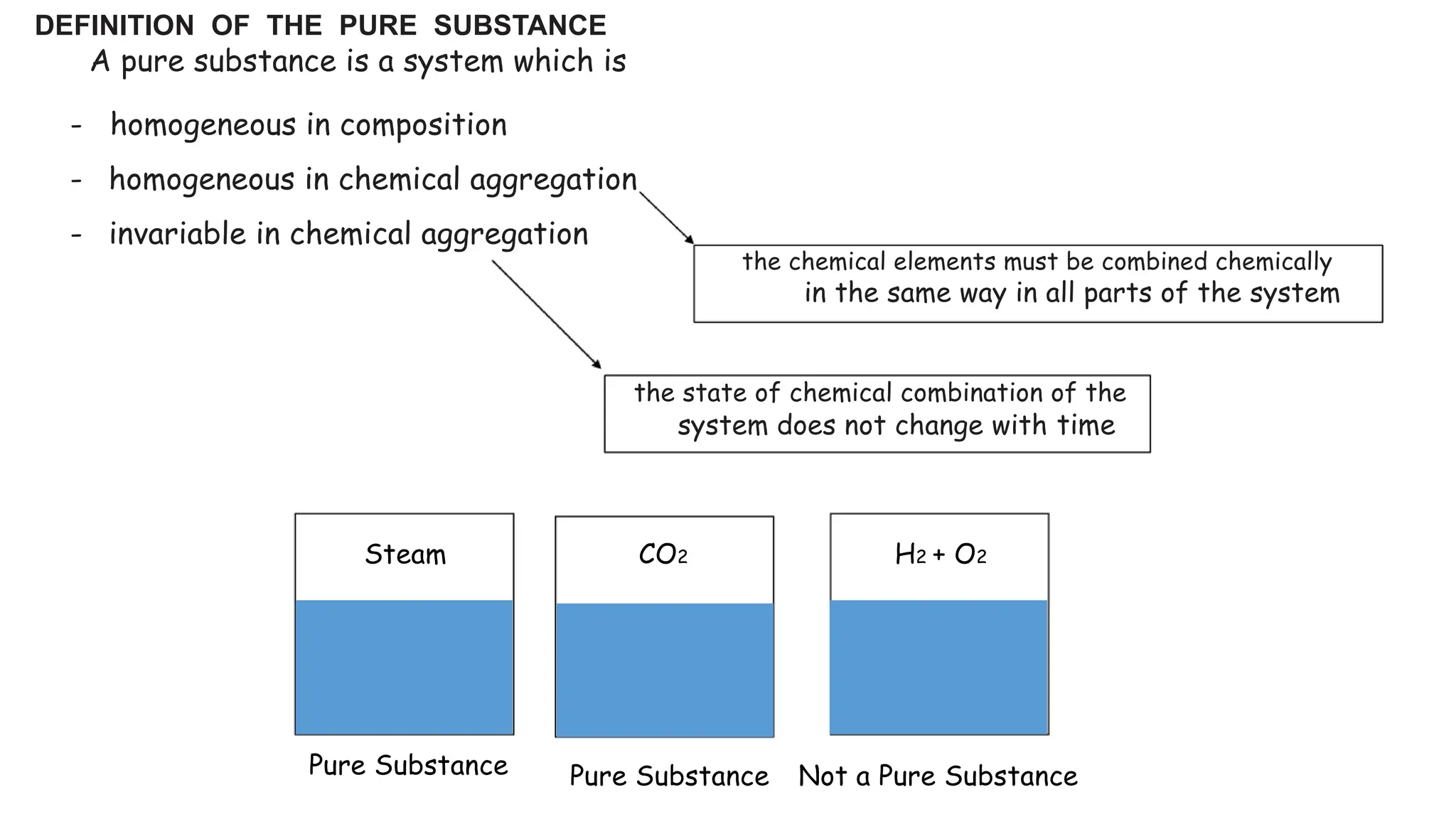
DEFINITION OF THE PURE SUBSTANCE
A pure substance is a system which is
- homogeneous in composition
- homogeneous in chemical aggregation
- invariable in chemical aggregation
the state of chemical combination of the
system does not change with time
the chemical elements must be combined chemically
in the same way in all parts of the system
Steam CO2 H2 + O2
Pure Substance Pure Substance Not a Pure Substance
• Let's consider the results of heating liquid water from 20 C, 1 atm. while keeping the pressure
o
constant
- We will follow the constant pressure process
- First place liquid water in a piston-cylinder device where a fixed weight is placed on the piston
to keep the pressure of the water constant at all times
- As liquid water is heated while the pressure is held constant, the following events occur
• Process 1 - 2
The temperature
:
- and specific volume will increase from
the
compressed liquid, or subcooled liquid, state 1, to the saturated liquid
state 2
- In the compressed liquid region, th e properties of the liquid are
approximately equal to the properties of the saturated liquid state at
the temperature
State 1
P = 1 atm.
T = 20 C
o
Phase Change of a Pure Substance
• Process 2-3:
- At state 2 the liquid has reached the temperature at which it begins to boil, called the
saturation temperature, and is said to exist as a saturated liquid
- Properties at the saturated liquid state are noted by the subscript f and v2 = vf
- During the phase change both the temperature and pressure remain constant (according to
the International Temperature Scale of 1990, ITS-90, water boils at 99.975 C & 100 C when the
o o
pressure is 1 atm or 101.325 kPa)
- At state 3 the liquid and vapor phase are in equilibrium and any point on the line between
states 2 and 3 has the same temperature and pressure
State 2
P = 1 atm.
T = 100 C
o
State 3
P = 1 atm.
T = 100 C
o
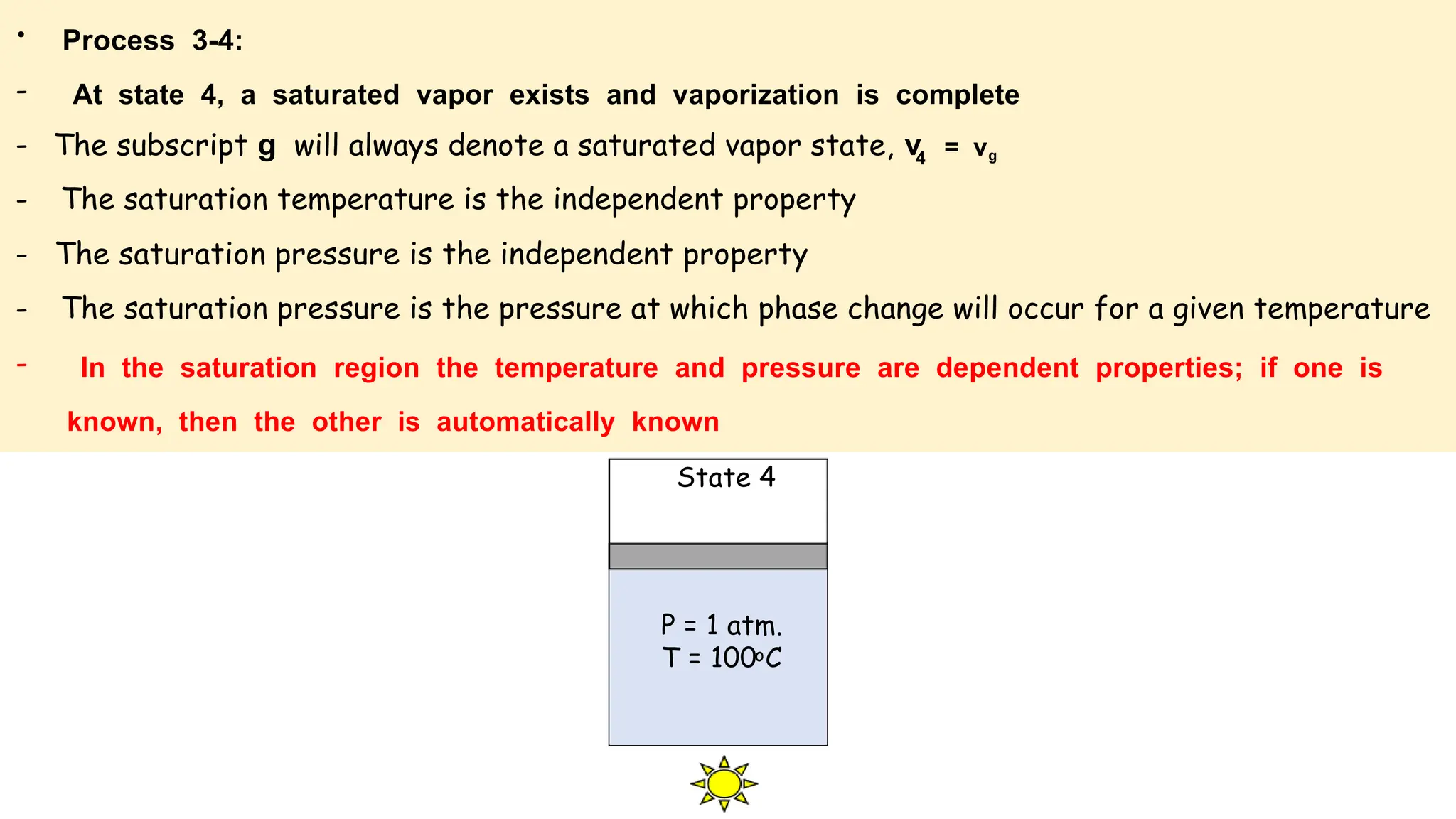
• Process 3-4:
- At state 4, a saturated vapor exists and vaporization is complete
- The subscript g will always denote a saturated vapor state, v4 = vg
- The saturation temperature is the independent property
- The saturation pressure is the independent property
- The saturation pressure is the pressure at which phase change will occur for a given temperature
- In the saturation region the temperature and pressure are dependent properties; if one is
known, then the other is automatically known
State 4
P = 1 atm.
T = 100 C
o
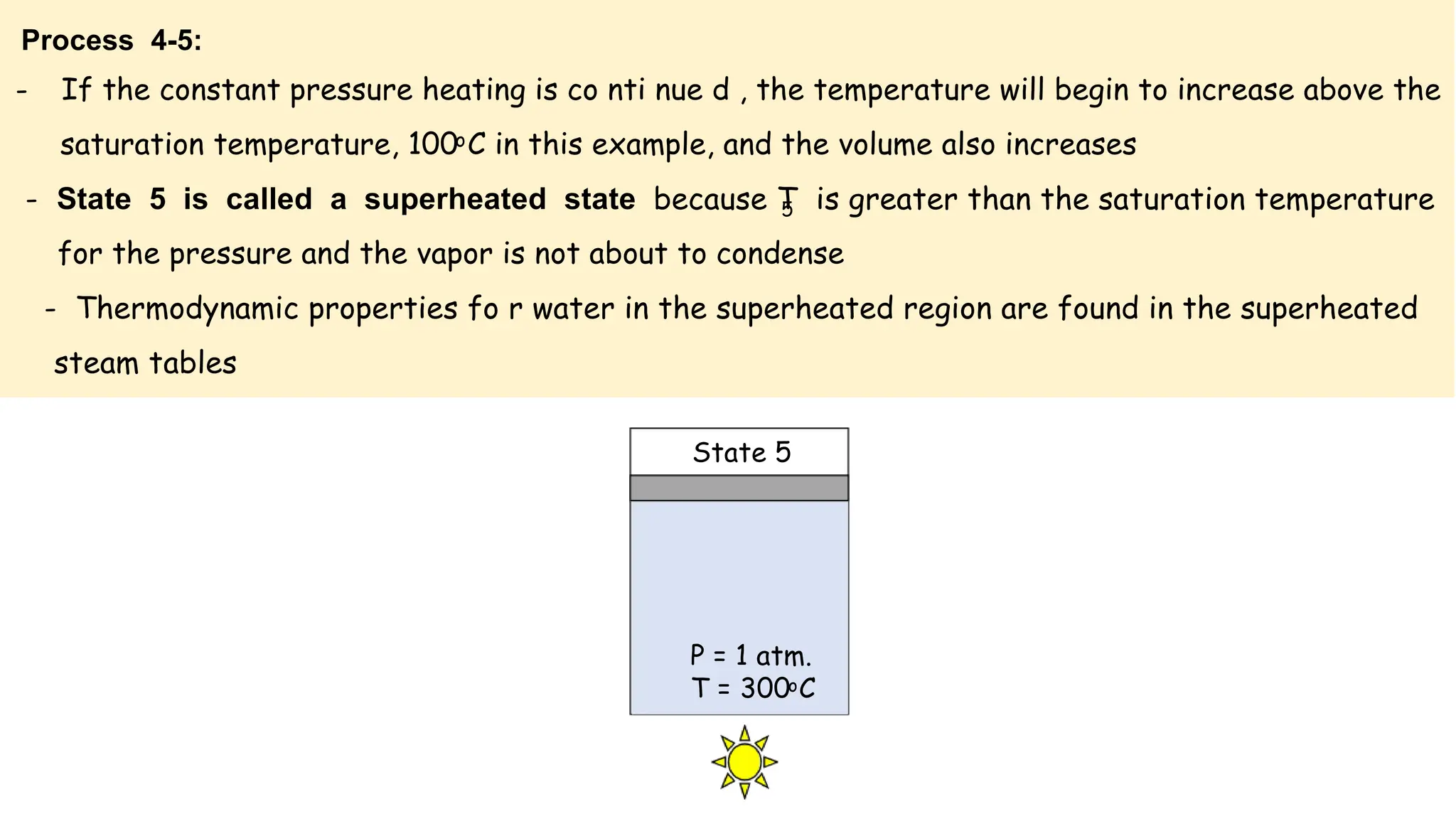
Process 4-5:
- If the constant pressure heating is co nti nue d , the temperature will begin to increase above the
saturation temperature, 100 C in this example, and the volume also increases
o
- State 5 is called a superheated state because T is greater than the saturation temperature
5
for the pressure and the vapor is not about to condense
- Thermodynamic properties fo r water in the superheated region are found in the superheated
steam tables
State 5
P = 1 atm.
T = 300 C
o
99.975
Theory of flowing Steam Generation
� x �m
SG fuel x HV = �q
�q = dh - vdp
Constant Pressure Steam Generation:
�q = dh - vdp =0
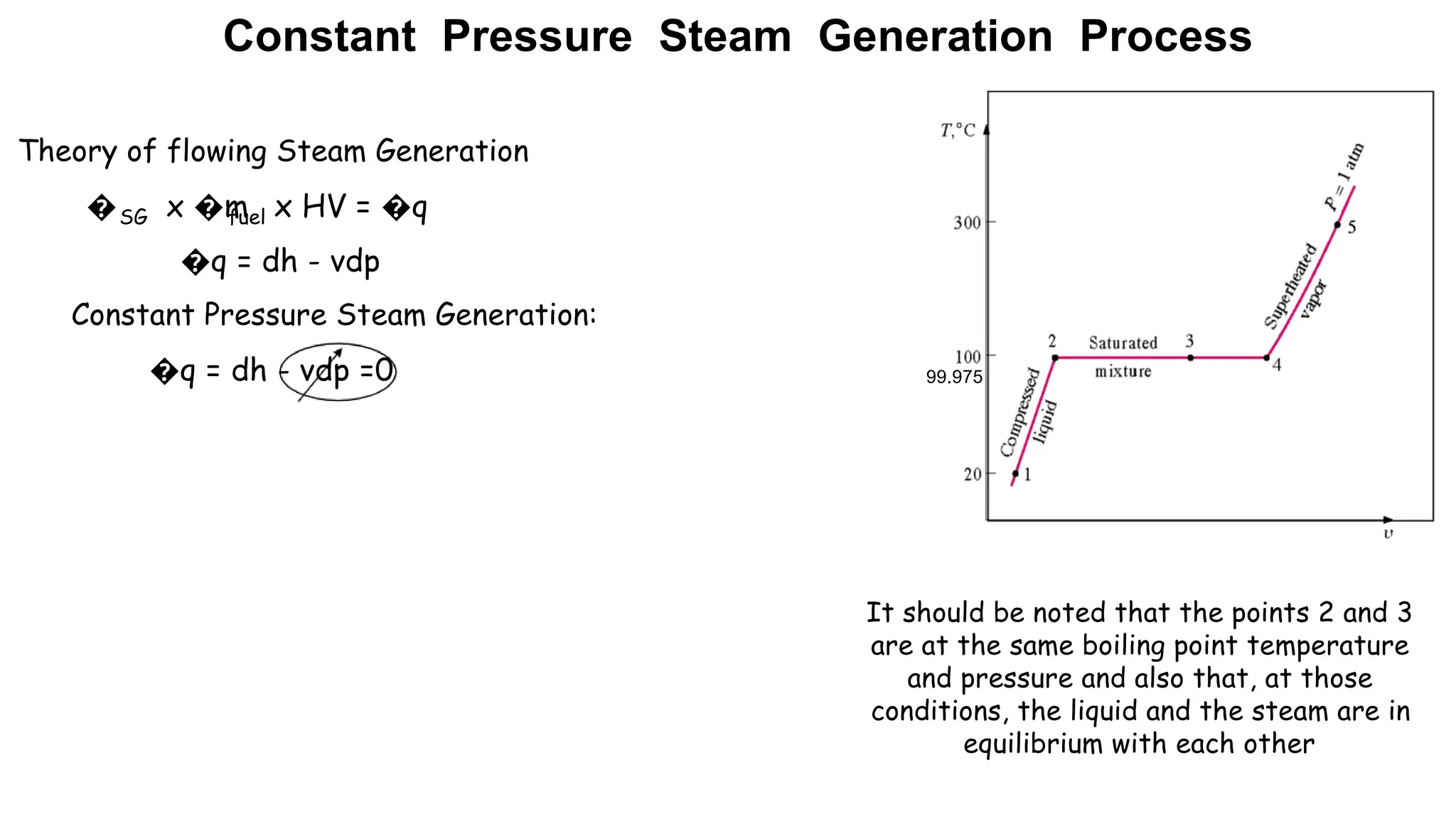
Constant Pressure Steam Generation Process
It should be noted that the points 2 and 3
are at the same boiling point temperature
and pressure and also that, at those
conditions, the liquid and the steam are in
equilibrium with each other
• Wet steam: A mixture of water plus steam (liquid plus vapor) at the boiling point temperature of
water at a given pressure
- Quality of steam refers to the fraction or percentage
of gaseous steam in a wet steam mixture
• Dry steam: Steam, at the given pressure, that contains no water (also referred to as saturated
steam)
- The steam quality = 100%.
- At the top of steam generator units for producing
saturated steam, there are moisture separators used to
remove residual water droplets from outgoing steam
• Superheated steam: Dry steam, at the given pressure, that has been heated to a temperature
higher than the boiling point of water at that pressure
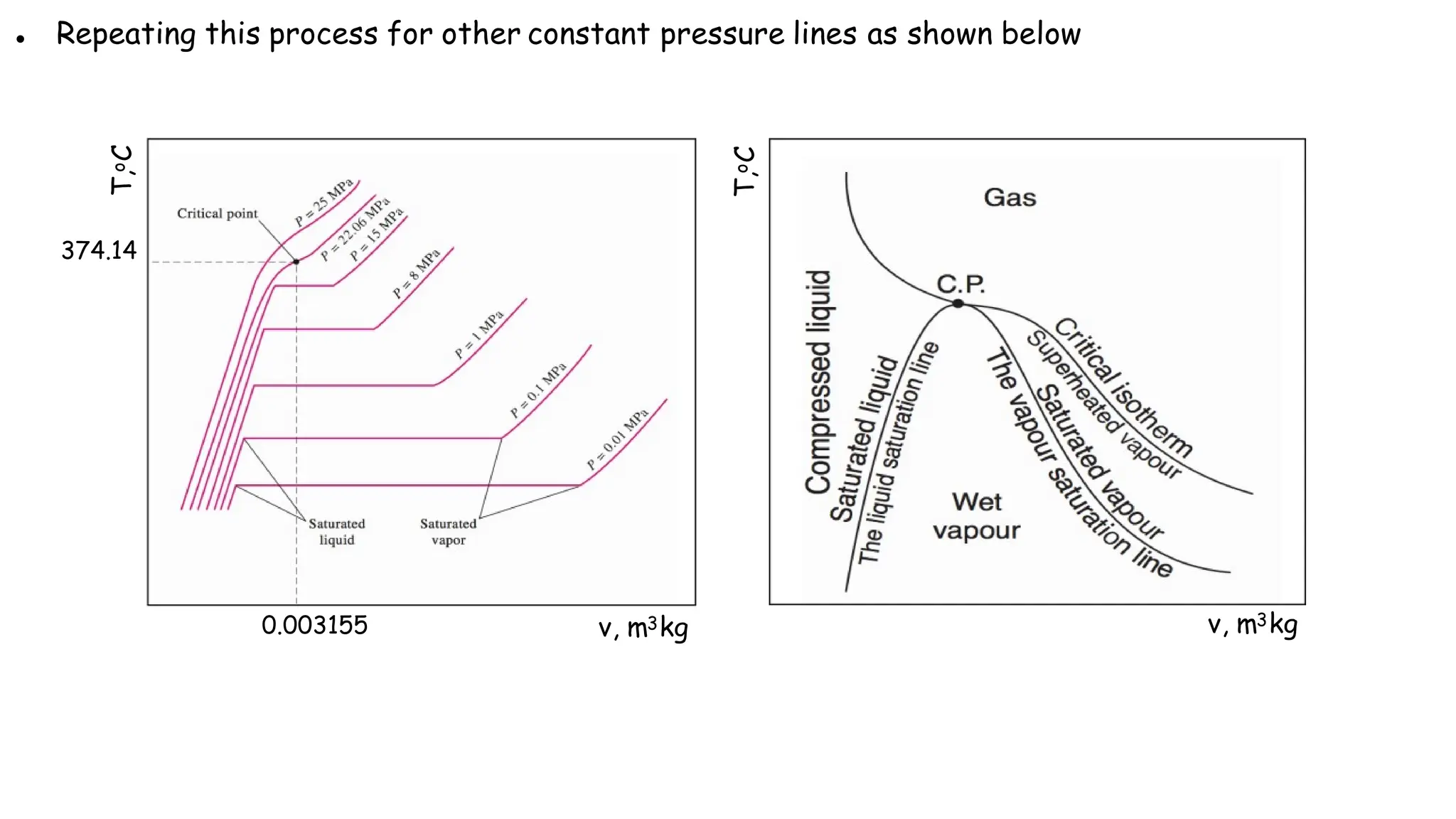
• Repeating this process for other constant pressure lines as shown below
T,
C
o
v, m3kg
v, m3kg
374.14
0.003155
T,
C
o
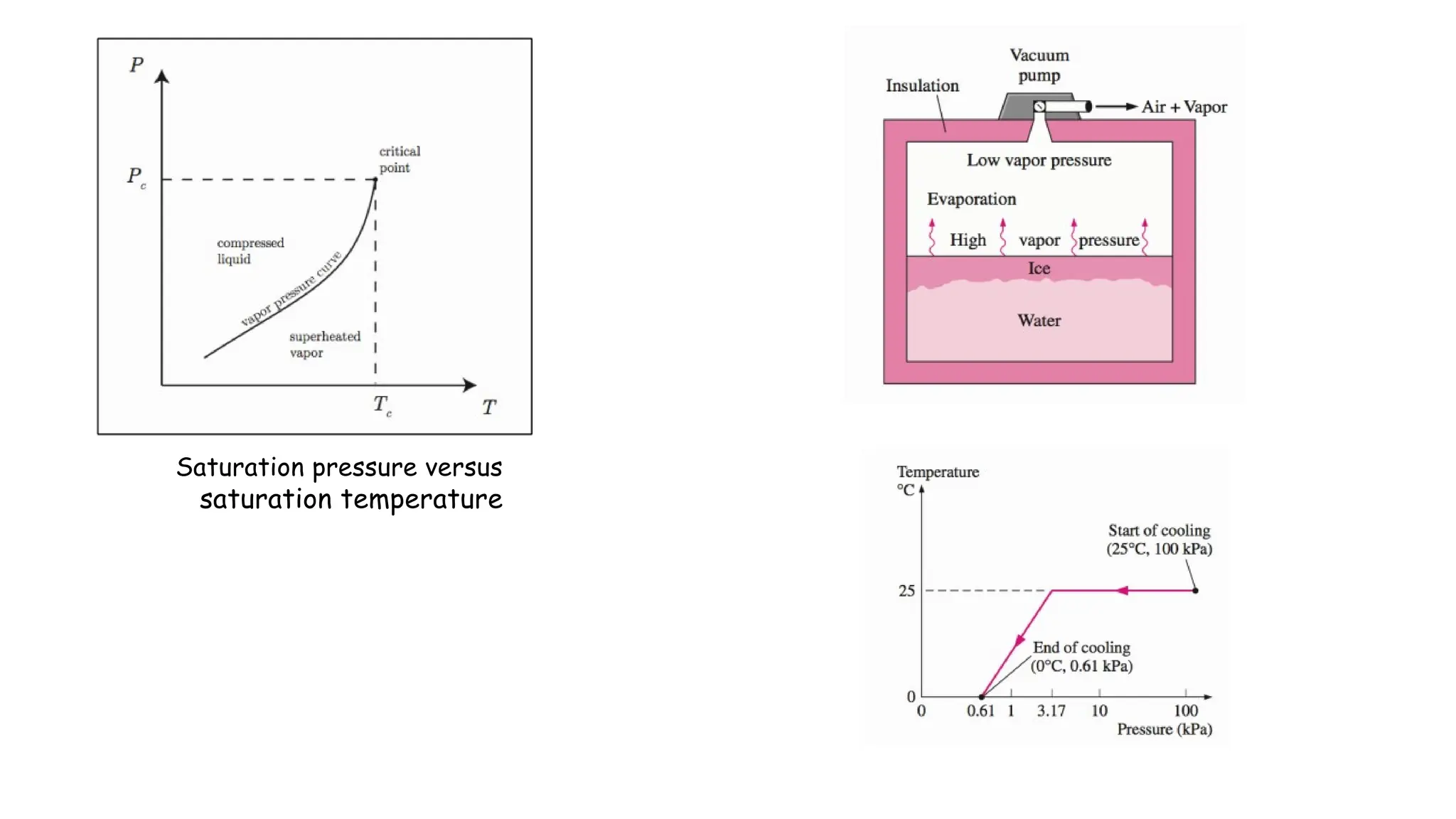
Saturation pressure versus
saturation temperature
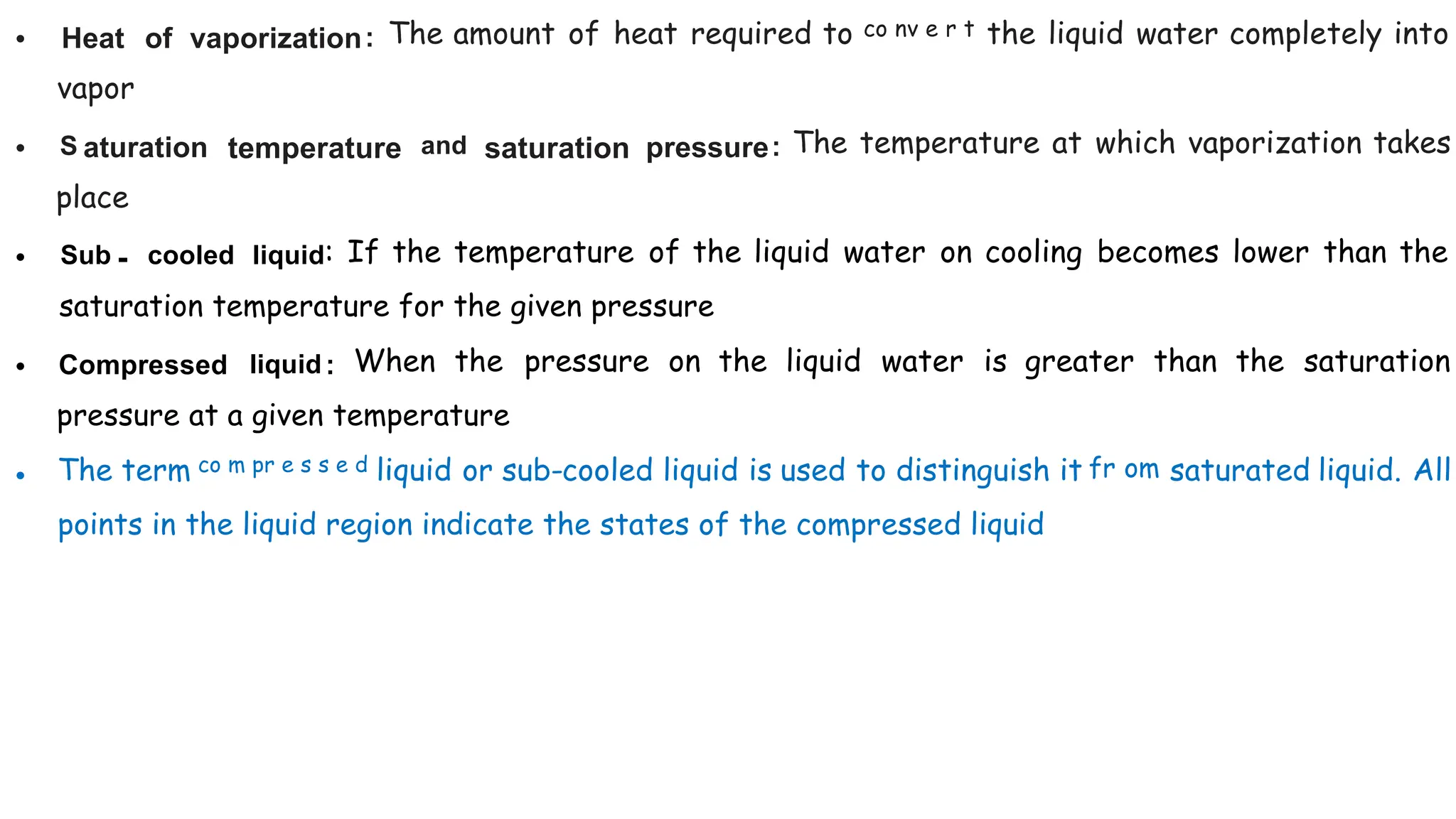
• Heat of vaporization: The amount of heat required to co nv e r t the liquid water completely into
vapor
• S aturation temperature and saturation pressure: The temperature at which vaporization takes
place
• Sub - cooled liquid: If the temperature of the liquid water on cooling becomes lower than the
saturation temperature for the given pressure
• Compressed liquid : When the pressure on the liquid water is greater than the saturation
pressure at a given temperature
• The term co m pr e s s e d liquid or sub-cooled liquid is used to distinguish it fr om saturated liquid. All
points in the liquid region indicate the states of the compressed liquid
• Superheated temperature: When all the liquid has been evaporated completely and heat is
further added, the temperature of the vapor increases
- When the temperature increases above the saturation temperature (in this case 100°C), the
vapor is known as the superheated vapor
- There is rapid increase in volume and the piston moves upwards
• Degree of superheat: The difference between the superheated temperature and the saturation
temperature at the given pressure
• W hen the pressure is greater than the critical pressure, the liquid water is directly
converted into superheated steam.
• As there is no definite point at which the liquid water changes into superheated steam, it is
generally called liquid water when the temperature is less than the critical temperature and
superheated steam when the temperature is above the critical temperature
99.61 C
o
179.88 C
o
T,
C
o
v, m kg
3
P2 = 1000 kPa
P1 = 100 kPa
The region between the saturated liquid line and the saturated vapor
line is called by these terms: saturated liquid-vapor mixture region,
wet region (i.e., a mixture of saturated liquid and saturated vapor),
two-phase region, and just the saturation region
All of the saturated
vapor states are
connected, the
saturated vapor line is
established
saturated liquid and saturated vapor line
intersect at the critical point and form
what is often called the “steam dome”
All of the saturated liquid
states are connected,
the saturated liquid line is
established
The region to the right
of the saturated vapor
line and above the critical
temperature is called the
superheated region
The region to the left of
the saturated liquid line
and below the critical
temperature is called the
compressed liquid region
• Notice that the trend of the temperature following a constant pressure line is to increase with
increasing volume and the trend of the pressure following a constant temperature line is to
decrease with increasing volume
P,
C
o
v, m kg
3
T = constant lines on
this diagram have a
downward trend
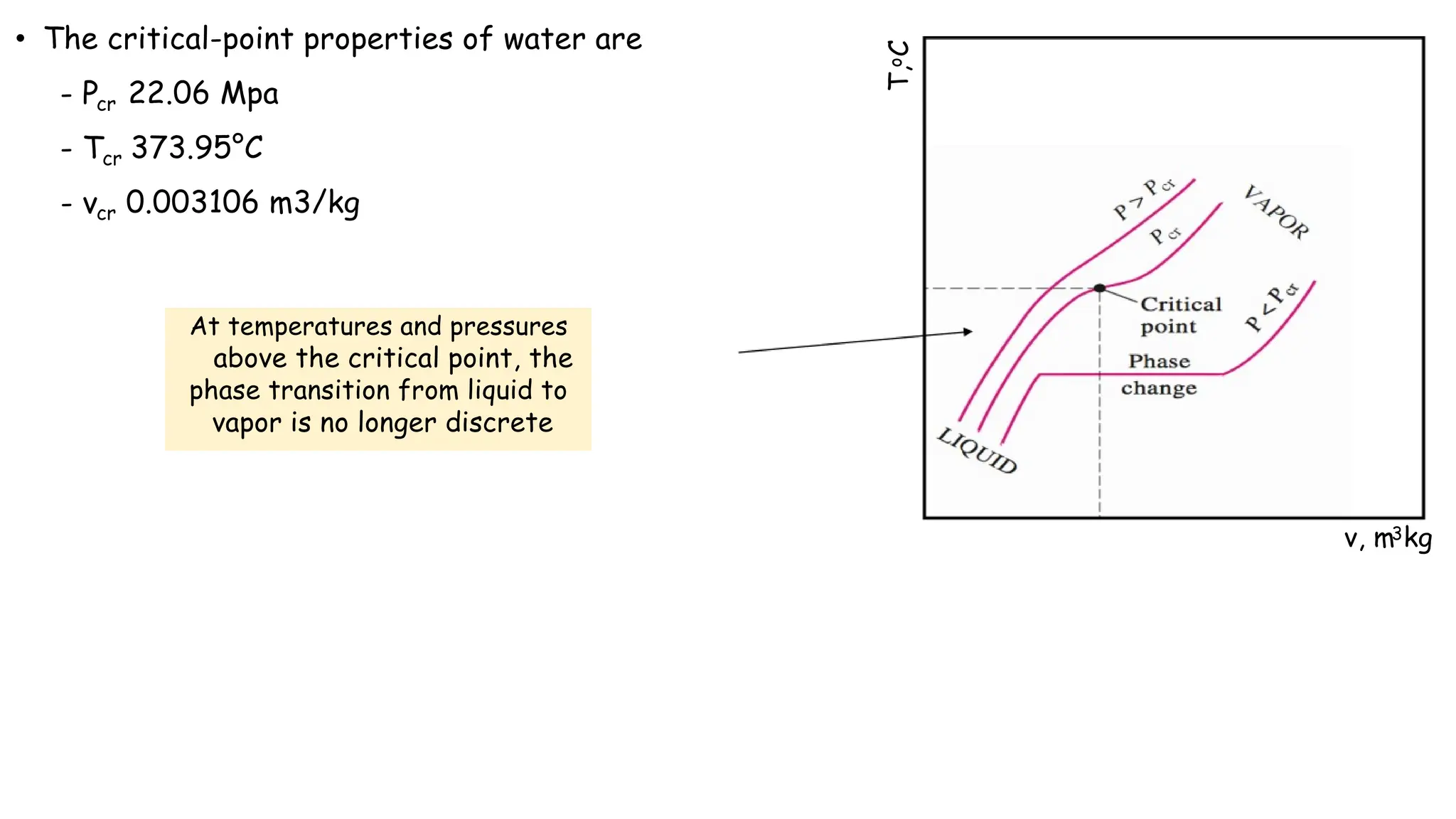
At temperatures and pressures
above the critical point, the
phase transition from liquid to
vapor is no longer discrete
v, m kg
3
T,
C
o
• The critical-point properties of water are
- Pcr 22.06 Mpa
- Tcr 373.95°C
- vcr 0.003106 m3/kg
•
•
The triple point of water is 0.01 C, 0.6117 kPa
The critical point of water is 373.95 C, 22.064 MPa
o
o
Pressure
Temperature
P-T diagram, often called the phase diagram, for pure substances
•
•
•
P
P
rocess
rocess
Process
:
:
liquid to vapor transition
solid to liquid transition
: solid to vapor transition
• It must be understood that only on p
the triple point represented by a point
-T diagram is
•
•
On p
On a
-V diagram it
U-V diagram
is
it
a
is
line
a triangle
The triple point is merely
the point of intersection
of sublimation and
vaporization curves
Pressure
Temperature
• Since state 3 is a mixture of saturated liquid and saturated vapor, how do we locate it on
the T-v diagram?
- To establish the location of state 3, a parameter called the quality x is defined as
x =
mass
mass
m
m +m
saturated vapor
total
g
f g
=
Quality and Saturated Liquid-Vapor Mixture
Saturated Vapor vg
Saturated Liquid vf
Saturated Liquid
= Vapor Mixture vfg
v, m kg
3
T,
C;
P
o
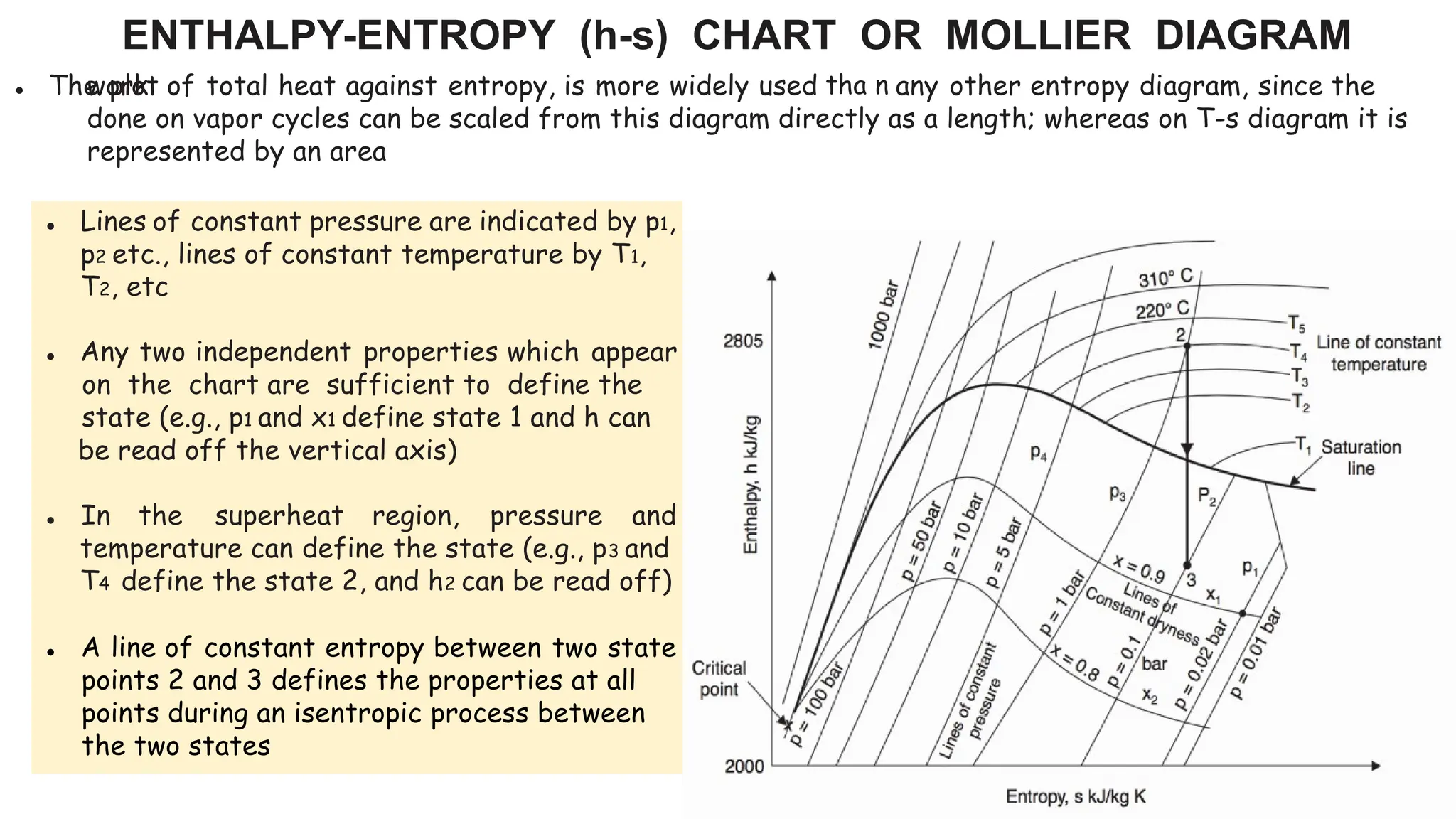
• The plot of total heat against entropy, is more widely used tha n any other entropy diagram, since the
work
done on vapor cycles can be scaled from this diagram directly as a length; whereas on T-s diagram it is
represented by an area
ENTHALPY-ENTROPY (h-s) CHART OR MOLLIER DIAGRAM
• Lines of constant pressure are indicated by p1,
p2 etc., lines of constant temperature by T1,
T2, etc
• Any two independent properties which appear
on the chart are sufficient to define the
state (e.g., p1 and x1 define state 1 and h can
be read off the vertical axis)
• In the superheat region, pressure and
temperature can define the state (e.g., p3 and
T4 define the state 2, and h2 can be read off)
• A line of constant entropy between two state
points 2 and 3 defines the properties at all
points during an isentropic process between
the two states
• For any state, at least two properties should be
known to determine the other unknown
properties of steam at that state
• The Mollier diagram is used only when quality is
greater than 50% and for superheated steam
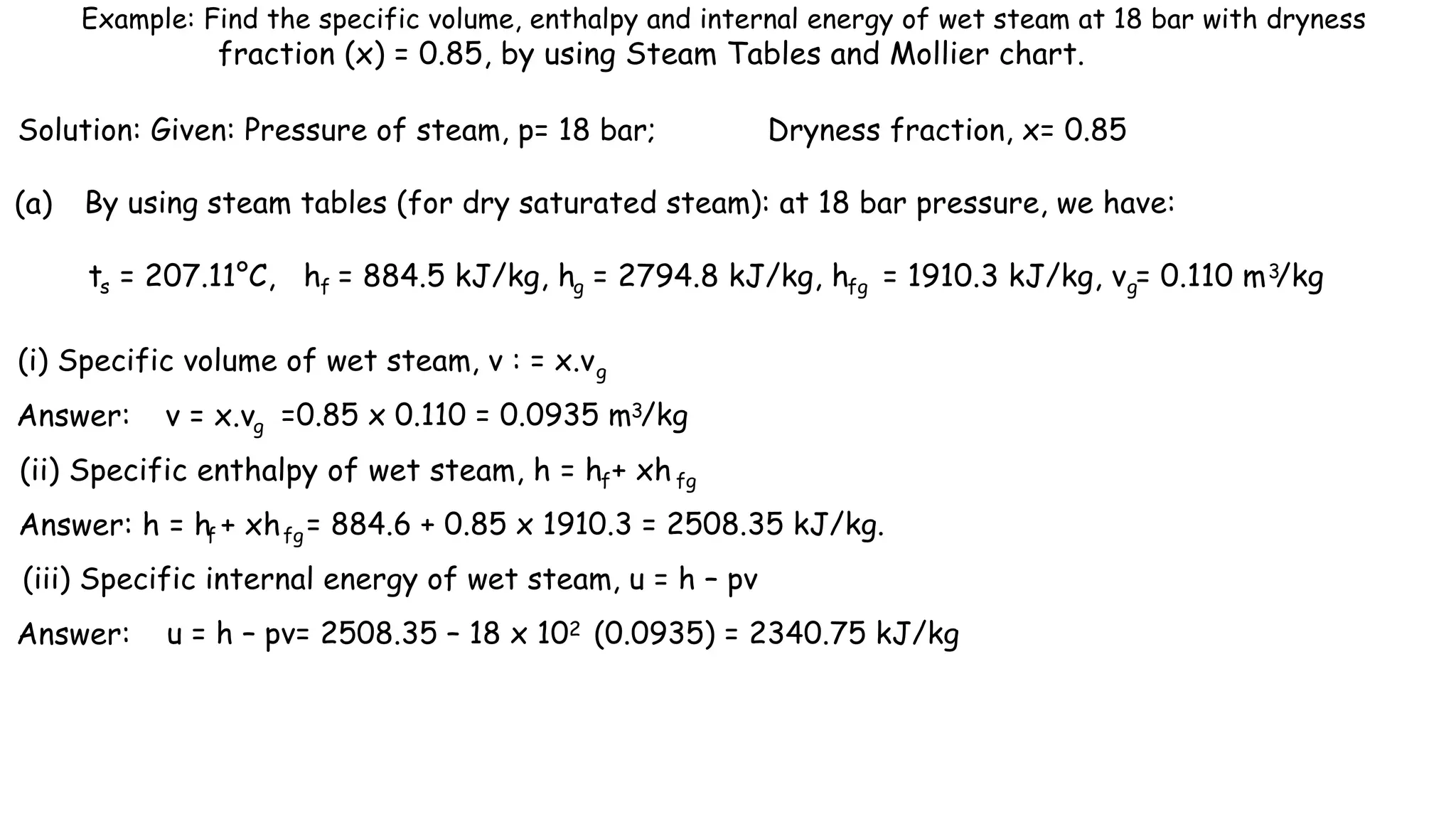
Example: Find the specific volume, enthalpy and internal energy of wet steam at 18 bar with dryness
fraction (x) = 0.85, by using Steam Tables and Mollier chart.
Solution: Given: Pressure of steam, p= 18 bar; Dryness fraction, x= 0.85
(a) By using steam tables (for dry saturated steam): at 18 bar pressure, we have:
ts = 207.11°C, hf = 884.5 kJ/kg, hg = 2794.8 kJ/kg, hfg = 1910.3 kJ/kg, v = 0.110 m /kg
g
3
(i) Specific volume of wet steam, v : = x.vg
Answer: v = x.vg =0.85 x 0.110 = 0.0935 m /kg
3
(ii) Specific enthalpy of wet steam, h = h + xh
f fg
Answer: h = h + xh
f fg= 884.6 + 0.85 x 1910.3 = 2508.35 kJ/kg.
(iii) Specific internal energy of wet steam, u = h – pv
Answer: u = h – pv= 2508.35 – 18 x 102 (0.0935) = 2340.75 kJ/kg
Locate point ‘1’ at an intersection of 18 bar pressure line and 0.85 dryness fraction line.
Read the value of enthalpy (h) and specific volume (v) from Mollier diagram corresponding to point ‘1’.
(i)
(ii)
(iii)
Specific enthalpy of wet steam, h = 2508 KJ/kg
Specific volume of wet steam, v = 0.0935 m /kg
Specific Internal energy of wet steam, u = h – pv = 2508 – 18 x 10 (0.0935) = 2340 kJ/kg
3
2
Measurement of dryness fraction
• The quality of wet steam is defined by its dryness fraction
• When the dryness fraction, pressure and temperature of the steam are known, then the state of
wet steam is fully defined
• In a steam plant it is at times necessary to know the state of the steam
• Many of the steam prime-movers are supplied with superheated steam
• The enthalpy (total heat) of such a steam is readily determined when its pressure and
temperature are known
• However, there are many cases in which saturated steam or wet steam is supplied
• The measurement of its temperature, when pressure is known, simply confirms the fact that the
steam is saturated or wet
- In no way it gives any information as to either the quality of steam or the enthalpy of steam
- For wet steam, this entails finding the dryness fraction

thermodynamics unit 4 MechanicalEng.pptx

  • 2.
  • 3.
    • Simple System:A simple system is one in which the effects of motion, viscosity, fluid shear, capillarity, anisotropic stress, and external force fields are absent • Homogeneous Substance: A substance tha t has uniform thermodynamic properties throughout is said to be homogeneous • Pure Substance: A pure substance has a homogeneous and invariable chemical composition and may exist in more than one phase Examples: 1. Water (solid, liquid, and vapor phases) 2. Mixture of liquid water and water vapor 3. Carbon dioxide, CO2 4. Nitrogen, N2 5. Mixtures of gases, such as air, as long as there is no change of phase Introduction
  • 4.
    DEFINITION OF THEPURE SUBSTANCE A pure substance is a system which is - homogeneous in composition - homogeneous in chemical aggregation - invariable in chemical aggregation the state of chemical combination of the system does not change with time the chemical elements must be combined chemically in the same way in all parts of the system Steam CO2 H2 + O2 Pure Substance Pure Substance Not a Pure Substance
  • 5.
    • Let's considerthe results of heating liquid water from 20 C, 1 atm. while keeping the pressure o constant - We will follow the constant pressure process - First place liquid water in a piston-cylinder device where a fixed weight is placed on the piston to keep the pressure of the water constant at all times - As liquid water is heated while the pressure is held constant, the following events occur • Process 1 - 2 The temperature : - and specific volume will increase from the compressed liquid, or subcooled liquid, state 1, to the saturated liquid state 2 - In the compressed liquid region, th e properties of the liquid are approximately equal to the properties of the saturated liquid state at the temperature State 1 P = 1 atm. T = 20 C o Phase Change of a Pure Substance
  • 6.
    • Process 2-3: -At state 2 the liquid has reached the temperature at which it begins to boil, called the saturation temperature, and is said to exist as a saturated liquid - Properties at the saturated liquid state are noted by the subscript f and v2 = vf - During the phase change both the temperature and pressure remain constant (according to the International Temperature Scale of 1990, ITS-90, water boils at 99.975 C & 100 C when the o o pressure is 1 atm or 101.325 kPa) - At state 3 the liquid and vapor phase are in equilibrium and any point on the line between states 2 and 3 has the same temperature and pressure State 2 P = 1 atm. T = 100 C o State 3 P = 1 atm. T = 100 C o
  • 7.
    • Process 3-4: -At state 4, a saturated vapor exists and vaporization is complete - The subscript g will always denote a saturated vapor state, v4 = vg - The saturation temperature is the independent property - The saturation pressure is the independent property - The saturation pressure is the pressure at which phase change will occur for a given temperature - In the saturation region the temperature and pressure are dependent properties; if one is known, then the other is automatically known State 4 P = 1 atm. T = 100 C o
  • 8.
    Process 4-5: - Ifthe constant pressure heating is co nti nue d , the temperature will begin to increase above the saturation temperature, 100 C in this example, and the volume also increases o - State 5 is called a superheated state because T is greater than the saturation temperature 5 for the pressure and the vapor is not about to condense - Thermodynamic properties fo r water in the superheated region are found in the superheated steam tables State 5 P = 1 atm. T = 300 C o
  • 9.
    99.975 Theory of flowingSteam Generation � x �m SG fuel x HV = �q �q = dh - vdp Constant Pressure Steam Generation: �q = dh - vdp =0 Constant Pressure Steam Generation Process It should be noted that the points 2 and 3 are at the same boiling point temperature and pressure and also that, at those conditions, the liquid and the steam are in equilibrium with each other
  • 10.
    • Wet steam:A mixture of water plus steam (liquid plus vapor) at the boiling point temperature of water at a given pressure - Quality of steam refers to the fraction or percentage of gaseous steam in a wet steam mixture • Dry steam: Steam, at the given pressure, that contains no water (also referred to as saturated steam) - The steam quality = 100%. - At the top of steam generator units for producing saturated steam, there are moisture separators used to remove residual water droplets from outgoing steam • Superheated steam: Dry steam, at the given pressure, that has been heated to a temperature higher than the boiling point of water at that pressure
  • 11.
    • Repeating thisprocess for other constant pressure lines as shown below T, C o v, m3kg v, m3kg 374.14 0.003155 T, C o
  • 12.
  • 13.
    • Heat ofvaporization: The amount of heat required to co nv e r t the liquid water completely into vapor • S aturation temperature and saturation pressure: The temperature at which vaporization takes place • Sub - cooled liquid: If the temperature of the liquid water on cooling becomes lower than the saturation temperature for the given pressure • Compressed liquid : When the pressure on the liquid water is greater than the saturation pressure at a given temperature • The term co m pr e s s e d liquid or sub-cooled liquid is used to distinguish it fr om saturated liquid. All points in the liquid region indicate the states of the compressed liquid
  • 14.
    • Superheated temperature:When all the liquid has been evaporated completely and heat is further added, the temperature of the vapor increases - When the temperature increases above the saturation temperature (in this case 100°C), the vapor is known as the superheated vapor - There is rapid increase in volume and the piston moves upwards • Degree of superheat: The difference between the superheated temperature and the saturation temperature at the given pressure • W hen the pressure is greater than the critical pressure, the liquid water is directly converted into superheated steam. • As there is no definite point at which the liquid water changes into superheated steam, it is generally called liquid water when the temperature is less than the critical temperature and superheated steam when the temperature is above the critical temperature
  • 15.
    99.61 C o 179.88 C o T, C o v,m kg 3 P2 = 1000 kPa P1 = 100 kPa The region between the saturated liquid line and the saturated vapor line is called by these terms: saturated liquid-vapor mixture region, wet region (i.e., a mixture of saturated liquid and saturated vapor), two-phase region, and just the saturation region All of the saturated vapor states are connected, the saturated vapor line is established saturated liquid and saturated vapor line intersect at the critical point and form what is often called the “steam dome” All of the saturated liquid states are connected, the saturated liquid line is established The region to the right of the saturated vapor line and above the critical temperature is called the superheated region The region to the left of the saturated liquid line and below the critical temperature is called the compressed liquid region
  • 16.
    • Notice thatthe trend of the temperature following a constant pressure line is to increase with increasing volume and the trend of the pressure following a constant temperature line is to decrease with increasing volume P, C o v, m kg 3 T = constant lines on this diagram have a downward trend
  • 17.
    At temperatures andpressures above the critical point, the phase transition from liquid to vapor is no longer discrete v, m kg 3 T, C o • The critical-point properties of water are - Pcr 22.06 Mpa - Tcr 373.95°C - vcr 0.003106 m3/kg
  • 18.
    • • The triple pointof water is 0.01 C, 0.6117 kPa The critical point of water is 373.95 C, 22.064 MPa o o Pressure Temperature P-T diagram, often called the phase diagram, for pure substances • • • P P rocess rocess Process : : liquid to vapor transition solid to liquid transition : solid to vapor transition • It must be understood that only on p the triple point represented by a point -T diagram is • • On p On a -V diagram it U-V diagram is it a is line a triangle The triple point is merely the point of intersection of sublimation and vaporization curves Pressure Temperature
  • 19.
    • Since state3 is a mixture of saturated liquid and saturated vapor, how do we locate it on the T-v diagram? - To establish the location of state 3, a parameter called the quality x is defined as x = mass mass m m +m saturated vapor total g f g = Quality and Saturated Liquid-Vapor Mixture Saturated Vapor vg Saturated Liquid vf Saturated Liquid = Vapor Mixture vfg v, m kg 3 T, C; P o
  • 20.
    • The plotof total heat against entropy, is more widely used tha n any other entropy diagram, since the work done on vapor cycles can be scaled from this diagram directly as a length; whereas on T-s diagram it is represented by an area ENTHALPY-ENTROPY (h-s) CHART OR MOLLIER DIAGRAM • Lines of constant pressure are indicated by p1, p2 etc., lines of constant temperature by T1, T2, etc • Any two independent properties which appear on the chart are sufficient to define the state (e.g., p1 and x1 define state 1 and h can be read off the vertical axis) • In the superheat region, pressure and temperature can define the state (e.g., p3 and T4 define the state 2, and h2 can be read off) • A line of constant entropy between two state points 2 and 3 defines the properties at all points during an isentropic process between the two states
  • 21.
    • For anystate, at least two properties should be known to determine the other unknown properties of steam at that state • The Mollier diagram is used only when quality is greater than 50% and for superheated steam
  • 22.
    Example: Find thespecific volume, enthalpy and internal energy of wet steam at 18 bar with dryness fraction (x) = 0.85, by using Steam Tables and Mollier chart. Solution: Given: Pressure of steam, p= 18 bar; Dryness fraction, x= 0.85 (a) By using steam tables (for dry saturated steam): at 18 bar pressure, we have: ts = 207.11°C, hf = 884.5 kJ/kg, hg = 2794.8 kJ/kg, hfg = 1910.3 kJ/kg, v = 0.110 m /kg g 3 (i) Specific volume of wet steam, v : = x.vg Answer: v = x.vg =0.85 x 0.110 = 0.0935 m /kg 3 (ii) Specific enthalpy of wet steam, h = h + xh f fg Answer: h = h + xh f fg= 884.6 + 0.85 x 1910.3 = 2508.35 kJ/kg. (iii) Specific internal energy of wet steam, u = h – pv Answer: u = h – pv= 2508.35 – 18 x 102 (0.0935) = 2340.75 kJ/kg
  • 23.
    Locate point ‘1’at an intersection of 18 bar pressure line and 0.85 dryness fraction line. Read the value of enthalpy (h) and specific volume (v) from Mollier diagram corresponding to point ‘1’. (i) (ii) (iii) Specific enthalpy of wet steam, h = 2508 KJ/kg Specific volume of wet steam, v = 0.0935 m /kg Specific Internal energy of wet steam, u = h – pv = 2508 – 18 x 10 (0.0935) = 2340 kJ/kg 3 2
  • 24.
    Measurement of drynessfraction • The quality of wet steam is defined by its dryness fraction • When the dryness fraction, pressure and temperature of the steam are known, then the state of wet steam is fully defined • In a steam plant it is at times necessary to know the state of the steam • Many of the steam prime-movers are supplied with superheated steam • The enthalpy (total heat) of such a steam is readily determined when its pressure and temperature are known • However, there are many cases in which saturated steam or wet steam is supplied • The measurement of its temperature, when pressure is known, simply confirms the fact that the steam is saturated or wet - In no way it gives any information as to either the quality of steam or the enthalpy of steam - For wet steam, this entails finding the dryness fraction