











Engineering 112
Foundations of Engineering
Student Information
      Sheet
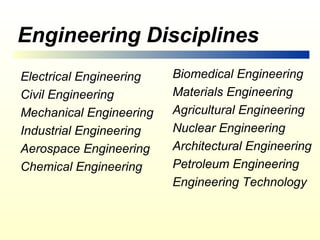
Engineering Disciplines
Electrical Engineering   Biomedical Engineering
Civil Engineering        Materials Engineering
Mechanical Engineering   Agricultural Engineering
Industrial Engineering   Nuclear Engineering
Aerospace Engineering    Architectural Engineering
Chemical Engineering     Petroleum Engineering
                         Engineering Technology
Cour se Syllabus

   Purpose
   Material
   Exams
   Grading
   Course Policies
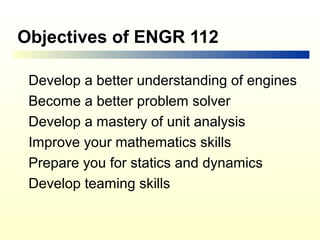
Objectives of ENGR 112

 Develop a better understanding of engines
 Become a better problem solver
 Develop a mastery of unit analysis
 Improve your mathematics skills
 Prepare you for statics and dynamics
 Develop teaming skills
Course Calendar
A Brief History of EGR111/112
 These courses were added to the
 curriculum at TAMU in the early 1990’s.
 12 disciplines require these courses.
 The courses were first taught at SFA
 starting in the Fall of 2002.
 They are part of an articulation agreement
 with TAMU.
 They also transfer to other universities.
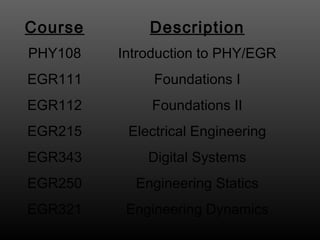
Course       Description
PHY108   Introduction to PHY/EGR
EGR111        Foundations I
EGR112       Foundations II
EGR215    Electrical Engineering
EGR343       Digital Systems
EGR250     Engineering Statics
EGR321    Engineering Dynamics
Pre-
Course          DUAL   Minor
         EGR
PHY108                
EGR111                
EGR112                
EGR215    ~      ~      
EGR342    ~      ~      
PHY250    ~            
PHY321    ~            
Teaming Expectations

 Many of the activities in ENGR 112
 require collaboration with other class
 members
 Each student will be assigned to a team
 All students will receive team training
Before Wednesday…

 Get a Note Book and Text Book
 Double Check you Schedule
   4th Class Day
   12th Class Day
   Mid-Semester
 Complete Problems 1 – 5 on HW1
Can you boil water at room
      temperature?
How can you design a
room that is completely
        silent?
Thermodynamics

Chapter 11
Thermodynamics
 Developed during the 1800’s to explain how
  steam engines converted heat into work.


 Thought Questions:
  Is heat just like light and sound?
  Is there a “speed of heat”?
     Answer: Not really.
11.1 Forces of Nature

 Gravity Force
 Electromagnetic Force
 Strong Force
                  Nuclear Forces
 Weak Force
Chapter 11 - Thermodynamics

11.1 - Forces of Nature
11.2 - Structure of Matter
11.3 - Temperature
11.4 - Pressure
11.5 - Density
11.6 - States of Matter
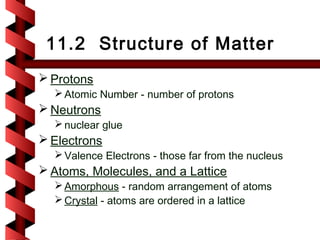
11.2 Structure of Matter
 Protons
   Atomic Number - number of protons
 Neutrons
   nuclear glue
 Electrons
   Valence Electrons - those far from the nucleus
 Atoms, Molecules, and a Lattice
   Amorphous - random arrangement of atoms
   Crystal - atoms are ordered in a lattice
Which is colder?
  Metal or Wood?
11.3 Temperature

 Measured in Fahrenheit, Celsius, and
  Kelvin

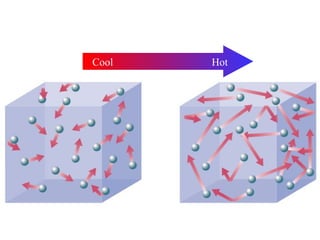
 Rapidly moving molecules have a high
  temperature

 Slowly moving molecules have a low
  temperature
Cool   Hot
What is “absolute zero”?
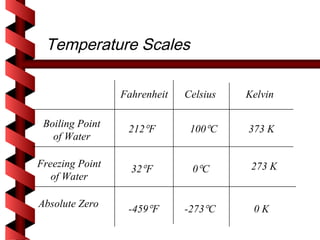
Temperature Scales

                 Fahrenheit   Celsius   Kelvin

 Boiling Point    212°F        100°C    373 K
   of Water

Freezing Point                           273 K
                   32°F        0°C
   of Water

Absolute Zero     -459°F      -273°C     0K
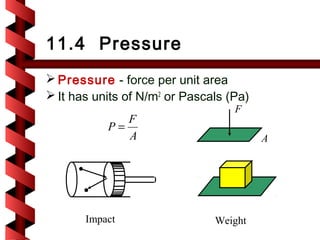
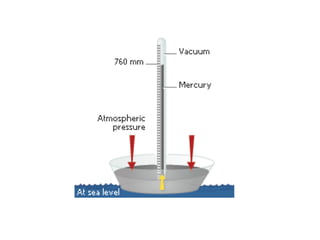
11.4 Pressure
 Pressure - force per unit area
 It has units of N/m2 or Pascals (Pa)
                                   F
              F
           P=
              A                          A


       Impact                  Weight
Pressure

 What are the possible units for
  pressure?
  N/m2
  Pascal    1 Pa = 1 N/m2
  atm       1 atm = 1 × 10⁵ Pa
  psi       1 psi = 1 lb/inch2
  mm Hg     1 atm = 760 mm Hg
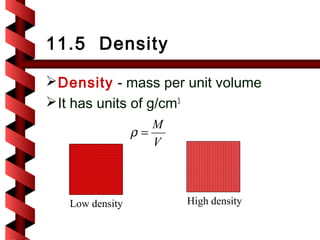
11.5 Density

 Density - mass per unit volume
 It has units of g/cm3
                    M
                 ρ=
                    V


   Low density          High density
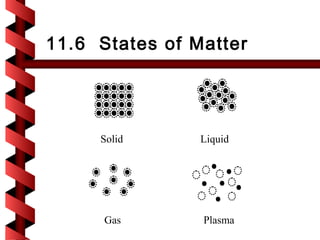
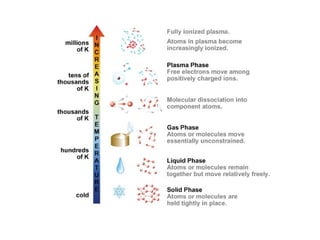
11.6 States of Matter


     Solid      Liquid


      Gas       Plasma
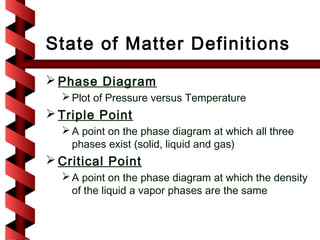
State of Matter Definitions
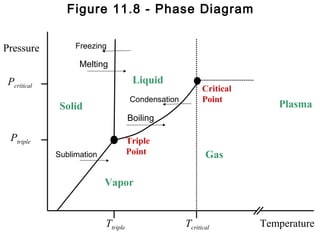
 Phase Diagram
   Plot of Pressure versus Temperature
 Triple Point
   A point on the phase diagram at which all three
    phases exist (solid, liquid and gas)
 Critical Point
   A point on the phase diagram at which the density
    of the liquid a vapor phases are the same
Figure 11.8 - Phase Diagram


Pressure          Freezing

                   Melting

 Pcritical                            Liquid
                                                          Critical
                                     Condensation         Point
              Solid                                                     Plasma
                                     Boiling

  Ptriple                            Triple
             Sublimation             Point                 Gas

                           Vapor


                           Ttriple                  Tcritical        Temperature
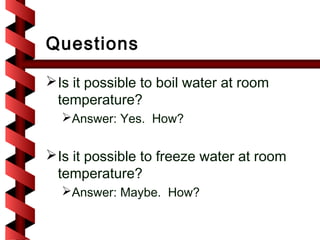
Questions

 Is it possible to boil water at room
  temperature?
  Answer: Yes. How?


 Is it possible to freeze water at room
  temperature?
  Answer: Maybe. How?
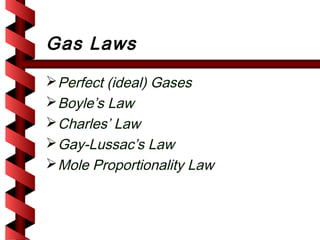
Gas Laws
 Perfect (ideal) Gases
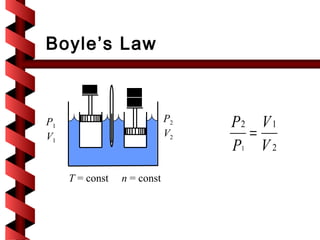
 Boyle’s Law
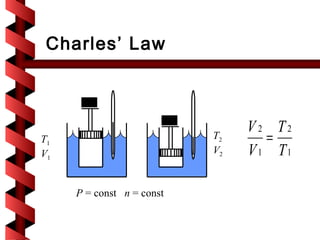
 Charles’ Law
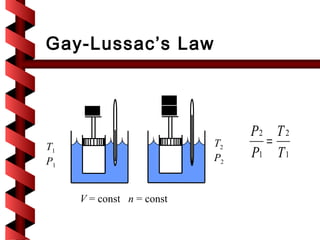
 Gay-Lussac’s Law
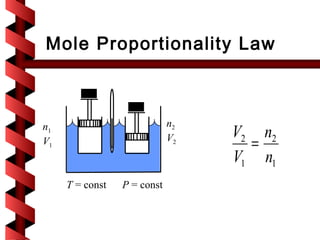
 Mole Proportionality Law
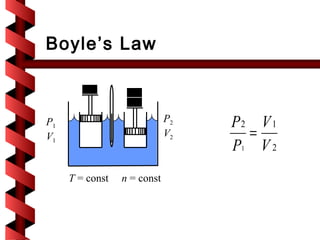
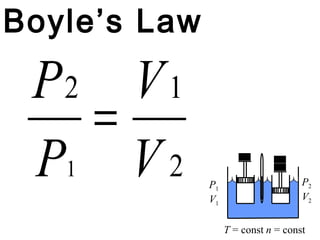
Boyle’s Law


P1                           P2   P2 V 1
V1                           V2     =
                                  P1 V 2
     T = const   n = const
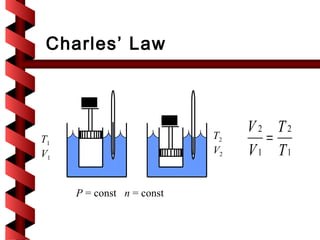
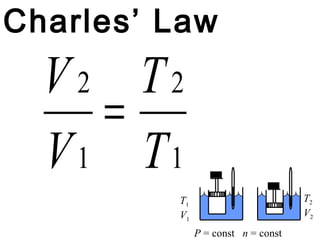
Charles’ Law


                                V2 T2
T1                         T2     =
V1                         V2   V1 T1

     P = const n = const
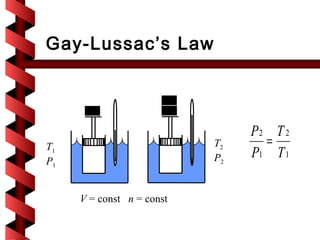
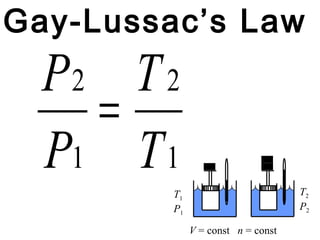
Gay-Lussac’s Law


                                P2 T 2
T1                         T2     =
P1                         P2   P1 T 1

     V = const n = const
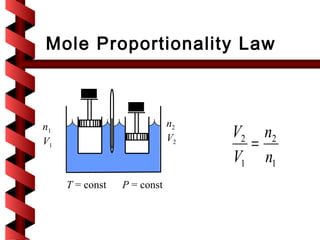
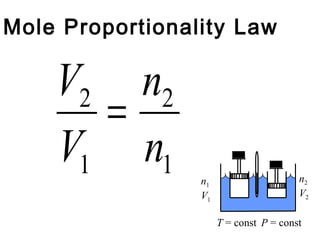
Mole Proportionality Law


n1                           n2
                                  V2 n2
V1                           V2
                                    =
                                  V1 n1
     T = const   P = const
Thermodynamics

Chapter 11
Homework 1
Boyle’s Law


P1                           P2   P2 V 1
V1                           V2     =
                                  P1 V 2
     T = const   n = const
Charles’ Law


                                V2 T2
T1                         T2     =
V1                         V2   V1 T1

     P = const n = const
Gay-Lussac’s Law


                                P2 T 2
T1                         T2     =
P1                         P2   P1 T 1

     V = const n = const
Mole Proportionality Law


n1                           n2
                                  V2 n2
V1                           V2
                                    =
                                  V1 n1
     T = const   P = const
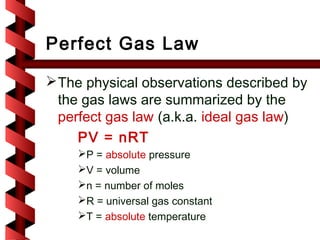
Perfect Gas Law

 The physical observations described by
  the gas laws are summarized by the
  perfect gas law (a.k.a. ideal gas law)
     PV = nRT
    P = absolute pressure
    V = volume
    n = number of moles
    R = universal gas constant
    T = absolute temperature
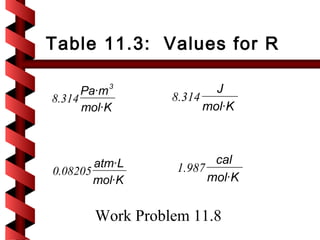
Table 11.3: Values for R

      Pa·m3
                         J
8.314            8.314
      mol·K            mol·K


        atm·L            cal
0.08205           1.987
        mol·K           mol·K


       Work Problem 11.8
Thermodynamics

Chapter 11
Movie R.A.T.
RAT Movies

 For the movies that follow, identify the
  gas law as a team.
 Only the recorder should do the writing.
 Turn in the team’s work with the team
  name at the top of the page.
Balloon Example (Handout)
 A balloon is filled with air to a pressure of 1.1
  atm.
 The filled balloon has a diameter of 0.3 m.
 A diver takes the balloon underwater to a depth
  where the pressure in the balloon is 2.3 atm.
 If the temperature of the balloon does not
  change, what is the new diameter of the
  balloon? Use three significant figures.
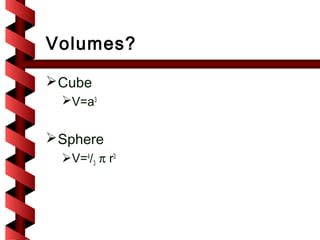
Volumes?

 Cube
  V=a3


 Sphere
  V=4/3 π r3
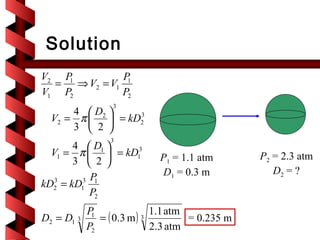
Solution
V2 P         P
  = ⇒ V2 = V1 1
    1
V1 P2        P2
                  3
      4  D2 
  V2 = π   = kD2
                 3

      3  2 
                 3
       4  D1 
  V1 = π   = kD13          P1 = 1.1 atm        P2 = 2.3 atm
       3  2 
                              D1 = 0.3 m            D2 = ?
         3 P
kD2 = kD1 1
   3

           P2
            P                1.1 atm
D2 = D1 3    1
               = ( 0.3 m ) 3         = 0.235 m
            P2               2.3 atm
Work
 Work = Force × Distance
 W = F ∆x

 The unit for work is the Newton-meter
  which is also called a Joule.
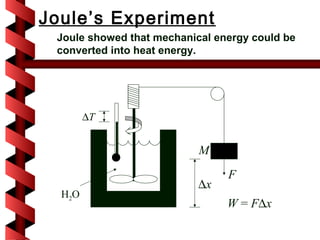
Joule’s Experiment
 Joule showed that mechanical energy could be
 converted into heat energy.


        ∆T


                           M
                                F
                           ∆x
  H2O
                                W = F∆x
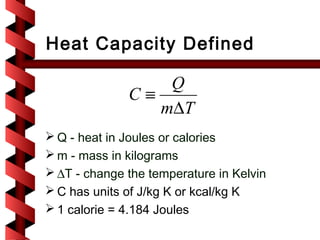
Heat Capacity Defined

                  Q
              C≡
                 m∆T
 Q - heat in Joules or calories
 m - mass in kilograms
 ∆T - change the temperature in Kelvin
 C has units of J/kg K or kcal/kg K
 1 calorie = 4.184 Joules
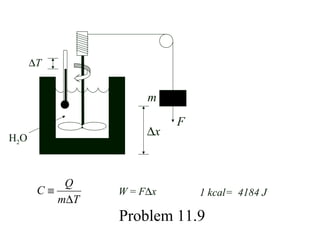
∆T


                     m
                          F
H2O
                     ∆x


           Q
       C≡       W = F∆x       1 kcal= 4184 J
          m∆T
                Problem 11.9
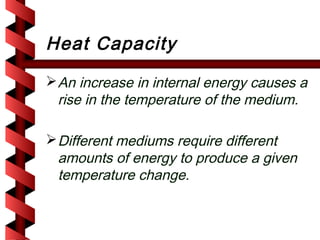
Heat Capacity
 An increase in internal energy causes a
  rise in the temperature of the medium.

 Different mediums require different
  amounts of energy to produce a given
  temperature change.
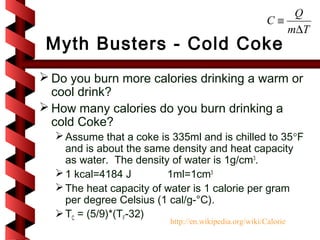
Q
                                                        C≡
                                                           m∆T
 Myth Busters - Cold Coke
 Do you burn more calories drinking a warm or
  cool drink?
 How many calories do you burn drinking a
  cold Coke?
   Assume that a coke is 335ml and is chilled to 35°F
    and is about the same density and heat capacity
    as water. The density of water is 1g/cm3.
   1 kcal=4184 J        1ml=1cm3
   The heat capacity of water is 1 calorie per gram
    per degree Celsius (1 cal/g-°C).
   TC = (5/9)*(TF-32)
                          http://en.wikipedia.org/wiki/Calorie
Thermodynamics

Chapter 11
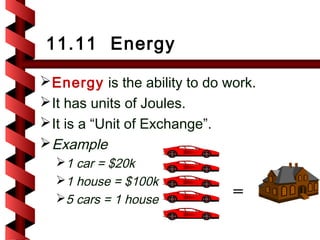
11.11 Energy

 Energy is the ability to do work.
 It has units of Joules.
 It is a “Unit of Exchange”.
 Example
  1 car = $20k
  1 house = $100k
  5 cars = 1 house            =
11.11 Energy Equivalents

 What is the case for nuclear power?
  1 kg coal » 42,000,000 joules
  1 kg uranium » 82,000,000,000,000 joules
  1 kg uranium » 2,000,000 kg coal!!
11.11.3 Energy Flow

 Heat is the energy flow resulting from a
  temperature difference.
 Note: Heat and temperature are not the
  same.
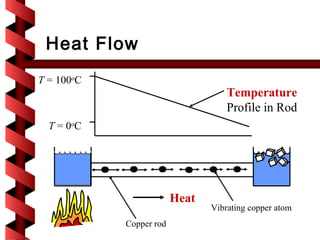
Heat Flow
T = 100oC
                                     Temperature
                                     Profile in Rod
  T = 0o C


                          Heat
                                 Vibrating copper atom
             Copper rod
11.12 Reversibility

 Reversibility is the ability to run a
  process back and forth infinitely without
  losses.
 Reversible Process
  Example: Perfect Pendulum
 Irreversible Process
  Example: Dropping a ball of clay
“Movie Making”

 Reversibility
  Movies of reversible phenomena appear
   the same when played forward and
   backward.

 Irreversibilities
  The opposite is true.
Reversible Process

 Examples:
  Perfect Pendulum
  Mass on a Spring
  Dropping a perfectly elastic ball
  Perpetual motion machines
  More?
Irreversible Processes

 Examples:
  Dropping a ball of clay
  Hammering a nail
  Applying the brakes to your car
  Breaking a glass
  More?
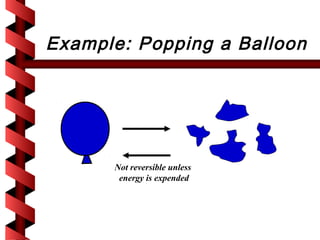
Example: Popping a Balloon


      Not reversible unless
       energy is expended
Sources of Irreversibilities

 Friction (force drops)
 Voltage drops
 Pressure drops
 Temperature drops
 Concentration drops
First Law of Thermodynamics
 energy can neither be created nor
  destroyed
Second Law of
 Thermodynamics
 naturally occurring processes are
  directional
 these processes are naturally
  irreversible
Third Law of Thermodynamics
 a temperature of absolute zero is not
  possible
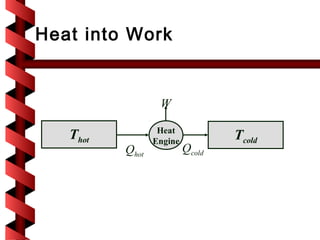
Heat into Work


                  W

                  Heat
   Thot          Engine
                                  Tcold
          Qhot            Qcold
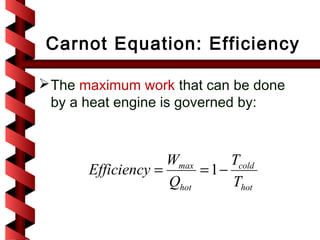
Carnot Equation: Efficiency

 The maximum work that can be done
  by a heat engine is governed by:


                    Wmax      Tcold
       Efficiency =      = 1−
                    Qhot      Thot
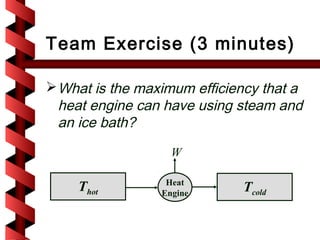
Team Exercise (3 minutes)

 What is the maximum efficiency that a
  heat engine can have using steam and
  an ice bath?
                   W

                  Heat
    Thot         Engine
                              Tcold
Work into Heat
 Although there are limits on the
  amount of heat converted to work,
  work may be converted to heat with
  100% efficiency.
Chapter 12
Heat Capacity for Constant
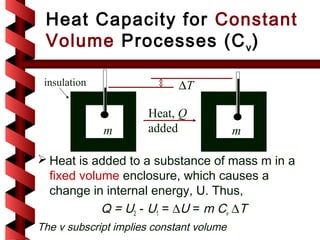
 Volume Processes (C v )

 insulation                  ∆T

                      Heat, Q
              m       added               m

 Heat is added to a substance of mass m in a
  fixed volume enclosure, which causes a
  change in internal energy, U. Thus,
            Q = U2 - U1 = ∆U = m Cv ∆T
The v subscript implies constant volume
Heat Capacity for Constant
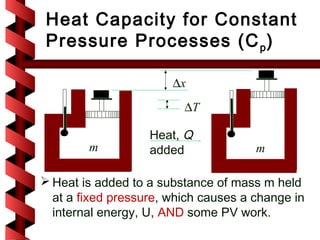
Pressure Processes (C p )

                       ∆x
                         ∆T

                   Heat, Q
        m          added              m

 Heat is added to a substance of mass m held
  at a fixed pressure, which causes a change in
  internal energy, U, AND some PV work.
C p Defined

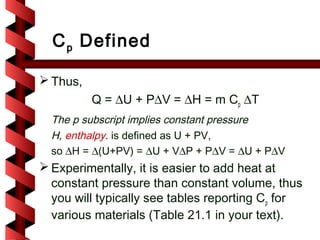
 Thus,
          Q = ∆U + P∆V = ∆H = m Cp ∆T
  The p subscript implies constant pressure
  H, enthalpy. is defined as U + PV,
  so ∆H = ∆(U+PV) = ∆U + V∆P + P∆V = ∆U + P∆V
 Experimentally, it is easier to add heat at
  constant pressure than constant volume, thus
  you will typically see tables reporting Cp for
  various materials (Table 21.1 in your text).
Individual Exercises (5 min.)

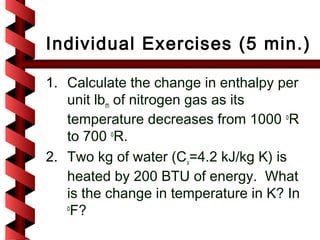
1. Calculate the change in enthalpy per
   unit lbm of nitrogen gas as its
   temperature decreases from 1000 oR
   to 700 oR.
2. Two kg of water (Cv=4.2 kJ/kg K) is
   heated by 200 BTU of energy. What
   is the change in temperature in K? In
   o
     F?
Solution
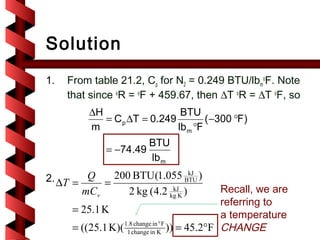
1.   From table 21.2, Cp for N2 = 0.249 BTU/lbmoF. Note
     that since oR = oF + 459.67, then ∆T oR = ∆T oF, so
          ∆H                   BTU
             = C p ∆T = 0.249         ( −300 °F)
          m                   lb m °F
                         BTU
              = −74.49
                         lb m
2. ∆T =  Q    200 BTU(1.055 BTU ) kJ
            =
        mCv      2 kg (4.2 kg K )
                            kJ                 Recall, we are
                                               referring to
      = 25.1 K                                 a temperature
      = ((25.1 K)( 1.8change in KF )) = 45.2°F CHANGE
                    1
                       change in °
Homework
Exercise
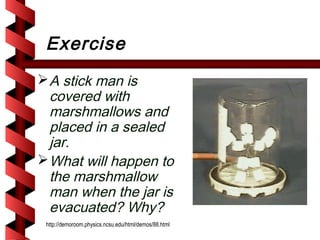
 A stick man is
  covered with
  marshmallows and
  placed in a sealed
  jar.
 What will happen to
  the marshmallow
  man when the jar is
  evacuated? Why?
 http://demoroom.physics.ncsu.edu/html/demos/88.html
Solution
 Click to activate, then click play
 Suggestion: view at 200%


                  marshmallow.mov
Other Homework Questions
What’s next?
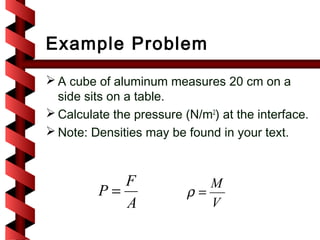
Example Problem
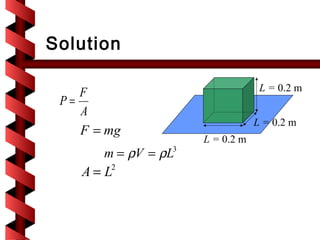
 A cube of aluminum measures 20 cm on a
  side sits on a table.
 Calculate the pressure (N/m2) at the interface.
 Note: Densities may be found in your text.


            F                M
         P=               ρ=
            A                V
Solution

    F                              L = 0.2 m
 P=
    A
                                  L = 0.2 m
    F = mg
                      L = 0.2 m
       m = ρV = ρL3
    A= L2
Heat/Work Conversions
 Heat can be converted to work using
  heat engines
  Jet engines (planes)
  steam engines (trains)
  internal combustion engines (automobiles)
Team Exercise (2 minutes)

 On the front of the page write down 2
  benefits of working in a team.
 On the back write down 1 obstacle that
  we must overcome to work in
  engineering teams.
 You have two minutes…
Why Teamwork

Working in groups enhances activities
in active/collaborative learning
Generate more ideas for solutions
Division of labor
Because that’s the way the real world
works!!
  Industry values teaming skills
Why Active/Collaborative
Learning

 Active
  countless studies have shown
   improvement in:
     short-term retention of material,
     long-term retention of material,
     ability to apply material to new situations
 Collaborative
  by not wasting time on things you already
   know we can make the best use of class
   time
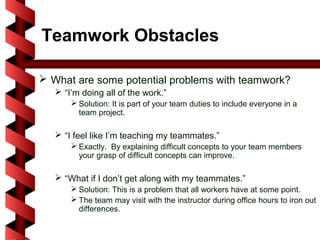
Teamwork Obstacles

 What are some potential problems with teamwork?
    “I’m doing all of the work.”
        Solution: It is part of your team duties to include everyone in a
         team project.

    “I feel like I’m teaching my teammates.”
        Exactly. By explaining difficult concepts to your team members
         your grasp of difficult concepts can improve.

    “What if I don’t get along with my teammates.”
        Solution: This is a problem that all workers have at some point.
        The team may visit with the instructor during office hours to iron out
         differences.
Project One
The Rubber Band Heat Engine
Example Problems
 from Homework
Let’s take notes…
Boyle’s Law

 P2 V 1
   =
 P1 V 2       P1
              V1
                                     P2
                                     V2


                   T = const n = const
Charles’ Law
  V2 T2
    =
  V1 T1
         T1                         T2
         V1                         V2
              P = const n = const
Gay-Lussac’s Law
  P2 T 2
    =
  P1 T 1
         T1                         T2
         P1                         P2

              V = const n = const
Mole Proportionality Law

    V2 n2
      =
    V1 n1        n1                     n2
                 V1                     V2

                      T = const P = const
Problems

 Homework 1
  11
  12
  13
 In-class Assignment
  Problem 1
Problems

 Homework 1
  14
 In-class Assignment
  Problem 2

02 chapter 11 thermodynamics

  • 1.
  • 2.
  • 3.
    Engineering Disciplines Electrical Engineering Biomedical Engineering Civil Engineering Materials Engineering Mechanical Engineering Agricultural Engineering Industrial Engineering Nuclear Engineering Aerospace Engineering Architectural Engineering Chemical Engineering Petroleum Engineering Engineering Technology
  • 4.
    Cour se Syllabus Purpose Material Exams Grading Course Policies
  • 5.
    Objectives of ENGR112 Develop a better understanding of engines Become a better problem solver Develop a mastery of unit analysis Improve your mathematics skills Prepare you for statics and dynamics Develop teaming skills
  • 6.
  • 7.
    A Brief Historyof EGR111/112 These courses were added to the curriculum at TAMU in the early 1990’s. 12 disciplines require these courses. The courses were first taught at SFA starting in the Fall of 2002. They are part of an articulation agreement with TAMU. They also transfer to other universities.
  • 8.
    Course Description PHY108 Introduction to PHY/EGR EGR111 Foundations I EGR112 Foundations II EGR215 Electrical Engineering EGR343 Digital Systems EGR250 Engineering Statics EGR321 Engineering Dynamics
  • 9.
    Pre- Course DUAL Minor EGR PHY108    EGR111    EGR112    EGR215 ~ ~  EGR342 ~ ~  PHY250 ~   PHY321 ~  
  • 10.
    Teaming Expectations Manyof the activities in ENGR 112 require collaboration with other class members Each student will be assigned to a team All students will receive team training
  • 11.
    Before Wednesday…  Geta Note Book and Text Book  Double Check you Schedule  4th Class Day  12th Class Day  Mid-Semester  Complete Problems 1 – 5 on HW1
  • 12.
    Can you boilwater at room temperature?
  • 13.
    How can youdesign a room that is completely silent?
  • 14.
  • 15.
    Thermodynamics  Developed duringthe 1800’s to explain how steam engines converted heat into work.  Thought Questions: Is heat just like light and sound? Is there a “speed of heat”? Answer: Not really.
  • 16.
    11.1 Forces ofNature  Gravity Force  Electromagnetic Force  Strong Force Nuclear Forces  Weak Force
  • 17.
    Chapter 11 -Thermodynamics 11.1 - Forces of Nature 11.2 - Structure of Matter 11.3 - Temperature 11.4 - Pressure 11.5 - Density 11.6 - States of Matter
  • 18.
    11.2 Structure ofMatter  Protons  Atomic Number - number of protons  Neutrons  nuclear glue  Electrons  Valence Electrons - those far from the nucleus  Atoms, Molecules, and a Lattice  Amorphous - random arrangement of atoms  Crystal - atoms are ordered in a lattice
  • 19.
    Which is colder? Metal or Wood?
  • 20.
    11.3 Temperature  Measuredin Fahrenheit, Celsius, and Kelvin  Rapidly moving molecules have a high temperature  Slowly moving molecules have a low temperature
  • 21.
    Cool Hot
  • 22.
  • 23.
    Temperature Scales Fahrenheit Celsius Kelvin Boiling Point 212°F 100°C 373 K of Water Freezing Point 273 K 32°F 0°C of Water Absolute Zero -459°F -273°C 0K
  • 24.
    11.4 Pressure  Pressure- force per unit area  It has units of N/m2 or Pascals (Pa) F F P= A A Impact Weight
  • 25.
    Pressure  What arethe possible units for pressure? N/m2 Pascal 1 Pa = 1 N/m2 atm 1 atm = 1 × 10⁵ Pa psi 1 psi = 1 lb/inch2 mm Hg 1 atm = 760 mm Hg
  • 27.
    11.5 Density  Density- mass per unit volume  It has units of g/cm3 M ρ= V Low density High density
  • 28.
    11.6 States ofMatter Solid Liquid Gas Plasma
  • 30.
    State of MatterDefinitions  Phase Diagram  Plot of Pressure versus Temperature  Triple Point  A point on the phase diagram at which all three phases exist (solid, liquid and gas)  Critical Point  A point on the phase diagram at which the density of the liquid a vapor phases are the same
  • 31.
    Figure 11.8 -Phase Diagram Pressure Freezing Melting Pcritical Liquid Critical Condensation Point Solid Plasma Boiling Ptriple Triple Sublimation Point Gas Vapor Ttriple Tcritical Temperature
  • 32.
    Questions  Is itpossible to boil water at room temperature? Answer: Yes. How?  Is it possible to freeze water at room temperature? Answer: Maybe. How?
  • 33.
    Gas Laws  Perfect(ideal) Gases  Boyle’s Law  Charles’ Law  Gay-Lussac’s Law  Mole Proportionality Law
  • 34.
    Boyle’s Law P1 P2 P2 V 1 V1 V2 = P1 V 2 T = const n = const
  • 35.
    Charles’ Law V2 T2 T1 T2 = V1 V2 V1 T1 P = const n = const
  • 36.
    Gay-Lussac’s Law P2 T 2 T1 T2 = P1 P2 P1 T 1 V = const n = const
  • 37.
    Mole Proportionality Law n1 n2 V2 n2 V1 V2 = V1 n1 T = const P = const
  • 38.
  • 39.
    Boyle’s Law P1 P2 P2 V 1 V1 V2 = P1 V 2 T = const n = const
  • 40.
    Charles’ Law V2 T2 T1 T2 = V1 V2 V1 T1 P = const n = const
  • 41.
    Gay-Lussac’s Law P2 T 2 T1 T2 = P1 P2 P1 T 1 V = const n = const
  • 42.
    Mole Proportionality Law n1 n2 V2 n2 V1 V2 = V1 n1 T = const P = const
  • 43.
    Perfect Gas Law The physical observations described by the gas laws are summarized by the perfect gas law (a.k.a. ideal gas law) PV = nRT P = absolute pressure V = volume n = number of moles R = universal gas constant T = absolute temperature
  • 44.
    Table 11.3: Valuesfor R Pa·m3 J 8.314 8.314 mol·K mol·K atm·L cal 0.08205 1.987 mol·K mol·K Work Problem 11.8
  • 45.
  • 46.
    RAT Movies  Forthe movies that follow, identify the gas law as a team.  Only the recorder should do the writing.  Turn in the team’s work with the team name at the top of the page.
  • 47.
    Balloon Example (Handout) A balloon is filled with air to a pressure of 1.1 atm.  The filled balloon has a diameter of 0.3 m.  A diver takes the balloon underwater to a depth where the pressure in the balloon is 2.3 atm.  If the temperature of the balloon does not change, what is the new diameter of the balloon? Use three significant figures.
  • 48.
    Volumes?  Cube V=a3  Sphere V=4/3 π r3
  • 49.
    Solution V2 P P = ⇒ V2 = V1 1 1 V1 P2 P2 3 4  D2  V2 = π   = kD2 3 3  2  3 4  D1  V1 = π   = kD13 P1 = 1.1 atm P2 = 2.3 atm 3  2  D1 = 0.3 m D2 = ? 3 P kD2 = kD1 1 3 P2 P 1.1 atm D2 = D1 3 1 = ( 0.3 m ) 3 = 0.235 m P2 2.3 atm
  • 50.
    Work  Work =Force × Distance  W = F ∆x  The unit for work is the Newton-meter which is also called a Joule.
  • 51.
    Joule’s Experiment Jouleshowed that mechanical energy could be converted into heat energy. ∆T M F ∆x H2O W = F∆x
  • 52.
    Heat Capacity Defined Q C≡ m∆T  Q - heat in Joules or calories  m - mass in kilograms  ∆T - change the temperature in Kelvin  C has units of J/kg K or kcal/kg K  1 calorie = 4.184 Joules
  • 53.
    ∆T m F H2O ∆x Q C≡ W = F∆x 1 kcal= 4184 J m∆T Problem 11.9
  • 54.
    Heat Capacity  Anincrease in internal energy causes a rise in the temperature of the medium.  Different mediums require different amounts of energy to produce a given temperature change.
  • 55.
    Q C≡ m∆T Myth Busters - Cold Coke  Do you burn more calories drinking a warm or cool drink?  How many calories do you burn drinking a cold Coke?  Assume that a coke is 335ml and is chilled to 35°F and is about the same density and heat capacity as water. The density of water is 1g/cm3.  1 kcal=4184 J 1ml=1cm3  The heat capacity of water is 1 calorie per gram per degree Celsius (1 cal/g-°C).  TC = (5/9)*(TF-32) http://en.wikipedia.org/wiki/Calorie
  • 56.
  • 57.
    11.11 Energy  Energyis the ability to do work.  It has units of Joules.  It is a “Unit of Exchange”.  Example 1 car = $20k 1 house = $100k 5 cars = 1 house =
  • 58.
    11.11 Energy Equivalents What is the case for nuclear power? 1 kg coal » 42,000,000 joules 1 kg uranium » 82,000,000,000,000 joules 1 kg uranium » 2,000,000 kg coal!!
  • 59.
    11.11.3 Energy Flow Heat is the energy flow resulting from a temperature difference.  Note: Heat and temperature are not the same.
  • 60.
    Heat Flow T =100oC Temperature Profile in Rod T = 0o C Heat Vibrating copper atom Copper rod
  • 61.
    11.12 Reversibility  Reversibilityis the ability to run a process back and forth infinitely without losses.  Reversible Process Example: Perfect Pendulum  Irreversible Process Example: Dropping a ball of clay
  • 62.
    “Movie Making”  Reversibility Movies of reversible phenomena appear the same when played forward and backward.  Irreversibilities The opposite is true.
  • 63.
    Reversible Process  Examples: Perfect Pendulum Mass on a Spring Dropping a perfectly elastic ball Perpetual motion machines More?
  • 64.
    Irreversible Processes  Examples: Dropping a ball of clay Hammering a nail Applying the brakes to your car Breaking a glass More?
  • 65.
    Example: Popping aBalloon Not reversible unless energy is expended
  • 66.
    Sources of Irreversibilities Friction (force drops)  Voltage drops  Pressure drops  Temperature drops  Concentration drops
  • 67.
    First Law ofThermodynamics energy can neither be created nor destroyed
  • 68.
    Second Law of Thermodynamics naturally occurring processes are directional these processes are naturally irreversible
  • 69.
    Third Law ofThermodynamics a temperature of absolute zero is not possible
  • 70.
    Heat into Work W Heat Thot Engine Tcold Qhot Qcold
  • 71.
    Carnot Equation: Efficiency The maximum work that can be done by a heat engine is governed by: Wmax Tcold Efficiency = = 1− Qhot Thot
  • 72.
    Team Exercise (3minutes)  What is the maximum efficiency that a heat engine can have using steam and an ice bath? W Heat Thot Engine Tcold
  • 73.
    Work into Heat Although there are limits on the amount of heat converted to work, work may be converted to heat with 100% efficiency.
  • 74.
  • 75.
    Heat Capacity forConstant Volume Processes (C v ) insulation ∆T Heat, Q m added m  Heat is added to a substance of mass m in a fixed volume enclosure, which causes a change in internal energy, U. Thus, Q = U2 - U1 = ∆U = m Cv ∆T The v subscript implies constant volume
  • 76.
    Heat Capacity forConstant Pressure Processes (C p ) ∆x ∆T Heat, Q m added m  Heat is added to a substance of mass m held at a fixed pressure, which causes a change in internal energy, U, AND some PV work.
  • 77.
    C p Defined Thus, Q = ∆U + P∆V = ∆H = m Cp ∆T The p subscript implies constant pressure H, enthalpy. is defined as U + PV, so ∆H = ∆(U+PV) = ∆U + V∆P + P∆V = ∆U + P∆V  Experimentally, it is easier to add heat at constant pressure than constant volume, thus you will typically see tables reporting Cp for various materials (Table 21.1 in your text).
  • 78.
    Individual Exercises (5min.) 1. Calculate the change in enthalpy per unit lbm of nitrogen gas as its temperature decreases from 1000 oR to 700 oR. 2. Two kg of water (Cv=4.2 kJ/kg K) is heated by 200 BTU of energy. What is the change in temperature in K? In o F?
  • 79.
    Solution 1. From table 21.2, Cp for N2 = 0.249 BTU/lbmoF. Note that since oR = oF + 459.67, then ∆T oR = ∆T oF, so ∆H BTU = C p ∆T = 0.249 ( −300 °F) m lb m °F BTU = −74.49 lb m 2. ∆T = Q 200 BTU(1.055 BTU ) kJ = mCv 2 kg (4.2 kg K ) kJ Recall, we are referring to = 25.1 K a temperature = ((25.1 K)( 1.8change in KF )) = 45.2°F CHANGE 1 change in °
  • 80.
  • 81.
    Exercise  A stickman is covered with marshmallows and placed in a sealed jar.  What will happen to the marshmallow man when the jar is evacuated? Why? http://demoroom.physics.ncsu.edu/html/demos/88.html
  • 82.
    Solution  Click toactivate, then click play  Suggestion: view at 200% marshmallow.mov
  • 83.
  • 84.
  • 85.
    Example Problem  Acube of aluminum measures 20 cm on a side sits on a table.  Calculate the pressure (N/m2) at the interface.  Note: Densities may be found in your text. F M P= ρ= A V
  • 86.
    Solution F L = 0.2 m P= A L = 0.2 m F = mg L = 0.2 m m = ρV = ρL3 A= L2
  • 87.
    Heat/Work Conversions  Heatcan be converted to work using heat engines Jet engines (planes) steam engines (trains) internal combustion engines (automobiles)
  • 88.
    Team Exercise (2minutes)  On the front of the page write down 2 benefits of working in a team.  On the back write down 1 obstacle that we must overcome to work in engineering teams.  You have two minutes…
  • 89.
    Why Teamwork Working ingroups enhances activities in active/collaborative learning Generate more ideas for solutions Division of labor Because that’s the way the real world works!! Industry values teaming skills
  • 90.
    Why Active/Collaborative Learning  Active countless studies have shown improvement in: short-term retention of material, long-term retention of material, ability to apply material to new situations  Collaborative by not wasting time on things you already know we can make the best use of class time
  • 91.
    Teamwork Obstacles  Whatare some potential problems with teamwork?  “I’m doing all of the work.”  Solution: It is part of your team duties to include everyone in a team project.  “I feel like I’m teaching my teammates.”  Exactly. By explaining difficult concepts to your team members your grasp of difficult concepts can improve.  “What if I don’t get along with my teammates.”  Solution: This is a problem that all workers have at some point.  The team may visit with the instructor during office hours to iron out differences.
  • 92.
    Project One The RubberBand Heat Engine
  • 93.
  • 94.
  • 95.
    Boyle’s Law P2V 1 = P1 V 2 P1 V1 P2 V2 T = const n = const
  • 96.
    Charles’ Law V2 T2 = V1 T1 T1 T2 V1 V2 P = const n = const
  • 97.
    Gay-Lussac’s Law P2 T 2 = P1 T 1 T1 T2 P1 P2 V = const n = const
  • 98.
    Mole Proportionality Law V2 n2 = V1 n1 n1 n2 V1 V2 T = const P = const
  • 99.
    Problems  Homework 1 11 12 13  In-class Assignment Problem 1
  • 100.
    Problems  Homework 1 14  In-class Assignment Problem 2

Editor's Notes

  • #25 change impact and weight to something cool like bevo...
  • #26 change impact and weight to something cool like bevo...
  • #28 fill boxes