MESOPOTAMIA
THE CRADLE OF CIVILIZATION
GROUP 2 (8-14)| HUMANITIES| F.Y. B arch | SEM II
WHERE MESOPOTAMIA IS LOCATED?
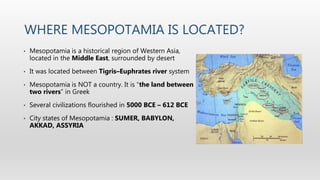
• Mesopotamia is a historical region of Western Asia,
located in the Middle East, surrounded by desert
• It was located between Tigris–Euphrates river system
• Mesopotamia is NOT a country. It is “the land between
two rivers” in Greek
• Several civilizations flourished in 5000 BCE – 612 BCE
• City states of Mesopotamia : SUMER, BABYLON,
AKKAD, ASSYRIA
GEOGRAPHIC FEATURES OF MESOPOTAMIA
• Tigris-Euphrates Rivers: Inhabitants settled there because of
the plentiful water supply. Created the world's first irrigation
system.
• Cradle of civilization: First civilizations began in Mesopotamia
ca.14,000BCE. Also called The Fertile Crescent
• The Fertile Crescent: Crescent-shaped region in the Middle
East, spans modern-day Iraq together with the southeastern
fringe of Turkey and the western fringes of Iran, Syria,
Lebanon, Israel, Palestine, Jordan, and Egypt.
• Soil: People came to Mesopotamia because the soil between
the two rivers was very fertile.
• Less Rainfall
• Hot & Dry Climate
HISTORY OF MESOPOTAMIA
• Over the centuries many different people lived in this area
creating a collection of Independent states.
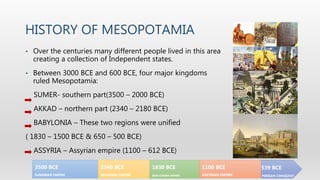
• Between 3000 BCE and 600 BCE, four major kingdoms
ruled Mesopotamia:
SUMER- southern part(3500 – 2000 BCE)
AKKAD – northern part (2340 – 2180 BCE)
BABYLONIA – These two regions were unified
( 1830 – 1500 BCE & 650 – 500 BCE)
ASSYRIA – Assyrian empire (1100 – 612 BCE)
SUMERIAN EMPIRE
3500 BCE
AKKADIAN EMPIRE
2340 BCE
BABYLONIAN EMPIRE
1830 BCE
ASSYRIAN EMPIRE
1100 BCE 539 BCE
PERSIAN CONQUEST
MESOPOTAMIA THROUGH LENSES
CULTURE, SOCIETY, CONTEXT, ART, ARCHITECTURE, AESTHETICS
CULTURE OF MESOPOTAMIA
FESTIVAL
Had ceremonies each month
Theme was determined by 6
factors:
The Lunar Phase
Annual Agricultural Phase
Equinox & Solstice
The local mythos and its divine
Patrons
New year Festival
MUSIC
Main songs were for the Gods
Some described important
events
Songs amused both, kings
and ordinary people alike
Passed on from generation to
generation
Oud, small string instrument, was
used by Mesopotamians
GAMES
Hunting was popular among
Assyrian kings
Boxing and Wrestling was
featured in art
A form of Polo- men sitting on shoulders of men rather
than horses
Majore – similar to Rugby but played with wooden ball
Royal Game of Ur – Board game similar to
Backgammon
FAMILY LIFE
Became more patriarchal
Men were more powerful
than women
Earlier ruled by “Council of
Elder”
Gradually, status of women
fell, and of men increased
Only royal male offspring
went to school
Girls had to stay at home and learn
about the household
Women had rights and could own
land/property or get a divorce
SOCIETY OF MESOPOTAMIA
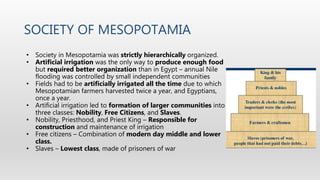
• Society in Mesopotamia was strictly hierarchically organized.
• Artificial irrigation was the only way to produce enough food
but required better organization than in Egypt – annual Nile
flooding was controlled by small independent communities
• Fields had to be artificially irrigated all the time due to which
Mesopotamian farmers harvested twice a year, and Egyptians,
once a year.
• Artificial irrigation led to formation of larger communities into
three classes: Nobility, Free Citizens, and Slaves.
• Nobility, Priesthood, and Priest King – Responsible for
construction and maintenance of irrigation
• Free citizens – Combination of modern day middle and lower
class.
• Slaves – Lowest class, made of prisoners of war
CONTEXT OF MESOPOTAMIA
• Mesopotamia is also defined by a changing succession of ruling bodies
from different areas and cities that seized control over a period of
thousands of years.
• It is part of the Fertile Crescent, an area also known as “Cradle of Civilization”
for the number of innovations that arose from the early societies in this
region, which are among some of the earliest known human civilizations on
earth.
• The first script to be used was based on pictures, and is therefore known as
“pictographic”. They first appeared around 3500 BCE.
• One of the major contributions of ancient Mesopotamia to government
practice was the development of written law codes. The most famous of
these is the Code of Hammurabi, written about 1780 BCE
• Warfare was endemic in early Mesopotamian society, as cities quarreled over
land and water rights. The Sumerian city-states organized the first true
armies in history.
Excerpt from Hammurabis Code
ART OF MESOPOTAMIA
The Sumerians
• Worked in gold, lapis, clay and
wood
• They made: intricate chairs-
from wood and reeds- and
musical instruments.
• Best at Pottery
• Used it as a money system,
trading pottery for food and
other items.
• They made beautiful jewelry
from gold and lapis.
The Babylonians
• They too worked in gold, lapis,
wood and clay
• Also made jewelry, musical
instruments, small statues,
intricate chairs, weapons, and
mosaics.
• Continued the art of pottery.
• They added massive sculpture,
which they created to represent
and honor their gods.
• Made the first colored egg
shells!
The Assyrians
• They did not create the
small statues and objects
of art as the Sumerians and
the Babylonian people did.
• They created murals and
paintings that showed
them fighting or hunting.
• We can tell a lot about
their daily life from these
paintings and murals.
ARCHITECTURE OF MESOPOTAMIA
• Temples were often the most central and important buildings in
Mesopotamian city states
• The largest temples were ziggurats
• Because of a lack of timber and stone, most buildings in Mesopotamia
were made from mud bricks held together with plaited layers of reeds.
• There were few trees or even big rocks in the regions settled by the
Sumerians, Babylonians and Assyrians.
• The most readily available materials were sand and clay and reeds
from marshes.
• Even bricks that had been fire-baked deteriorated relatively quickly.
• Consequently very little of the ancient cities remain except for some
foundations.
• The two main traditional forms of building construction are post-and-
beam and arched
• One quality shared by Mesopotamian and Egyptian architecture was
the flat roof
AESTHETICS OF MESOPOTAMIA
• Mesopotamian sculpture comes in all sizes, and appears in
the round and as reliefs.
• It often depicts animals, such as goats, rams, bulls and
lions, as well as mythical creatures such as lions and bulls
with men’s heads.
• Others show gods and goddesses, as well as priests and
worshippers.
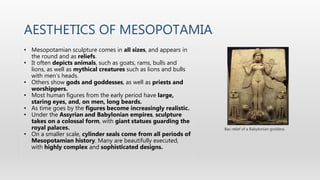
• Most human figures from the early period have large,
staring eyes, and, on men, long beards.
• As time goes by the figures become increasingly realistic.
• Under the Assyrian and Babylonian empires, sculpture
takes on a colossal form, with giant statues guarding the
royal palaces.
• On a smaller scale, cylinder seals come from all periods of
Mesopotamian history. Many are beautifully executed,
with highly complex and sophisticated designs.
Bas relief of a Babylonian goddess

Mesopotamia

  • 1.
    MESOPOTAMIA THE CRADLE OFCIVILIZATION GROUP 2 (8-14)| HUMANITIES| F.Y. B arch | SEM II
  • 2.
    WHERE MESOPOTAMIA ISLOCATED? • Mesopotamia is a historical region of Western Asia, located in the Middle East, surrounded by desert • It was located between Tigris–Euphrates river system • Mesopotamia is NOT a country. It is “the land between two rivers” in Greek • Several civilizations flourished in 5000 BCE – 612 BCE • City states of Mesopotamia : SUMER, BABYLON, AKKAD, ASSYRIA
  • 3.
    GEOGRAPHIC FEATURES OFMESOPOTAMIA • Tigris-Euphrates Rivers: Inhabitants settled there because of the plentiful water supply. Created the world's first irrigation system. • Cradle of civilization: First civilizations began in Mesopotamia ca.14,000BCE. Also called The Fertile Crescent • The Fertile Crescent: Crescent-shaped region in the Middle East, spans modern-day Iraq together with the southeastern fringe of Turkey and the western fringes of Iran, Syria, Lebanon, Israel, Palestine, Jordan, and Egypt. • Soil: People came to Mesopotamia because the soil between the two rivers was very fertile. • Less Rainfall • Hot & Dry Climate
  • 4.
    HISTORY OF MESOPOTAMIA •Over the centuries many different people lived in this area creating a collection of Independent states. • Between 3000 BCE and 600 BCE, four major kingdoms ruled Mesopotamia: SUMER- southern part(3500 – 2000 BCE) AKKAD – northern part (2340 – 2180 BCE) BABYLONIA – These two regions were unified ( 1830 – 1500 BCE & 650 – 500 BCE) ASSYRIA – Assyrian empire (1100 – 612 BCE) SUMERIAN EMPIRE 3500 BCE AKKADIAN EMPIRE 2340 BCE BABYLONIAN EMPIRE 1830 BCE ASSYRIAN EMPIRE 1100 BCE 539 BCE PERSIAN CONQUEST
  • 5.
    MESOPOTAMIA THROUGH LENSES CULTURE,SOCIETY, CONTEXT, ART, ARCHITECTURE, AESTHETICS
  • 6.
    CULTURE OF MESOPOTAMIA FESTIVAL Hadceremonies each month Theme was determined by 6 factors: The Lunar Phase Annual Agricultural Phase Equinox & Solstice The local mythos and its divine Patrons New year Festival MUSIC Main songs were for the Gods Some described important events Songs amused both, kings and ordinary people alike Passed on from generation to generation Oud, small string instrument, was used by Mesopotamians GAMES Hunting was popular among Assyrian kings Boxing and Wrestling was featured in art A form of Polo- men sitting on shoulders of men rather than horses Majore – similar to Rugby but played with wooden ball Royal Game of Ur – Board game similar to Backgammon FAMILY LIFE Became more patriarchal Men were more powerful than women Earlier ruled by “Council of Elder” Gradually, status of women fell, and of men increased Only royal male offspring went to school Girls had to stay at home and learn about the household Women had rights and could own land/property or get a divorce
  • 7.
    SOCIETY OF MESOPOTAMIA •Society in Mesopotamia was strictly hierarchically organized. • Artificial irrigation was the only way to produce enough food but required better organization than in Egypt – annual Nile flooding was controlled by small independent communities • Fields had to be artificially irrigated all the time due to which Mesopotamian farmers harvested twice a year, and Egyptians, once a year. • Artificial irrigation led to formation of larger communities into three classes: Nobility, Free Citizens, and Slaves. • Nobility, Priesthood, and Priest King – Responsible for construction and maintenance of irrigation • Free citizens – Combination of modern day middle and lower class. • Slaves – Lowest class, made of prisoners of war
  • 8.
    CONTEXT OF MESOPOTAMIA •Mesopotamia is also defined by a changing succession of ruling bodies from different areas and cities that seized control over a period of thousands of years. • It is part of the Fertile Crescent, an area also known as “Cradle of Civilization” for the number of innovations that arose from the early societies in this region, which are among some of the earliest known human civilizations on earth. • The first script to be used was based on pictures, and is therefore known as “pictographic”. They first appeared around 3500 BCE. • One of the major contributions of ancient Mesopotamia to government practice was the development of written law codes. The most famous of these is the Code of Hammurabi, written about 1780 BCE • Warfare was endemic in early Mesopotamian society, as cities quarreled over land and water rights. The Sumerian city-states organized the first true armies in history. Excerpt from Hammurabis Code
  • 9.
    ART OF MESOPOTAMIA TheSumerians • Worked in gold, lapis, clay and wood • They made: intricate chairs- from wood and reeds- and musical instruments. • Best at Pottery • Used it as a money system, trading pottery for food and other items. • They made beautiful jewelry from gold and lapis. The Babylonians • They too worked in gold, lapis, wood and clay • Also made jewelry, musical instruments, small statues, intricate chairs, weapons, and mosaics. • Continued the art of pottery. • They added massive sculpture, which they created to represent and honor their gods. • Made the first colored egg shells! The Assyrians • They did not create the small statues and objects of art as the Sumerians and the Babylonian people did. • They created murals and paintings that showed them fighting or hunting. • We can tell a lot about their daily life from these paintings and murals.
  • 10.
    ARCHITECTURE OF MESOPOTAMIA •Temples were often the most central and important buildings in Mesopotamian city states • The largest temples were ziggurats • Because of a lack of timber and stone, most buildings in Mesopotamia were made from mud bricks held together with plaited layers of reeds. • There were few trees or even big rocks in the regions settled by the Sumerians, Babylonians and Assyrians. • The most readily available materials were sand and clay and reeds from marshes. • Even bricks that had been fire-baked deteriorated relatively quickly. • Consequently very little of the ancient cities remain except for some foundations. • The two main traditional forms of building construction are post-and- beam and arched • One quality shared by Mesopotamian and Egyptian architecture was the flat roof
  • 11.
    AESTHETICS OF MESOPOTAMIA •Mesopotamian sculpture comes in all sizes, and appears in the round and as reliefs. • It often depicts animals, such as goats, rams, bulls and lions, as well as mythical creatures such as lions and bulls with men’s heads. • Others show gods and goddesses, as well as priests and worshippers. • Most human figures from the early period have large, staring eyes, and, on men, long beards. • As time goes by the figures become increasingly realistic. • Under the Assyrian and Babylonian empires, sculpture takes on a colossal form, with giant statues guarding the royal palaces. • On a smaller scale, cylinder seals come from all periods of Mesopotamian history. Many are beautifully executed, with highly complex and sophisticated designs. Bas relief of a Babylonian goddess

Editor's Notes

  • #3 Insert a map of your country.
  • #4 Insert a picture of one of the geographic features of your country.
  • #5 Insert a picture illustrating a season in your country.
  • #7 Insert a picture of an animal and or plant found in your country.
  • #8 Insert a picture of an animal and or plant found in your country.
  • #9 Insert a picture of an animal and or plant found in your country.
  • #10 Insert a picture of an animal and or plant found in your country.
  • #11 Insert a picture of an animal and or plant found in your country.
  • #12 Insert a picture of an animal and or plant found in your country.