Chapter IV


        PRESENTATION, ANALYSIS, AND INTERPRETATION OF FINDINGS


       This chapter presents the findings of the study in illustrative tables and analysis as well as

interpretation based from the treatment of the data.


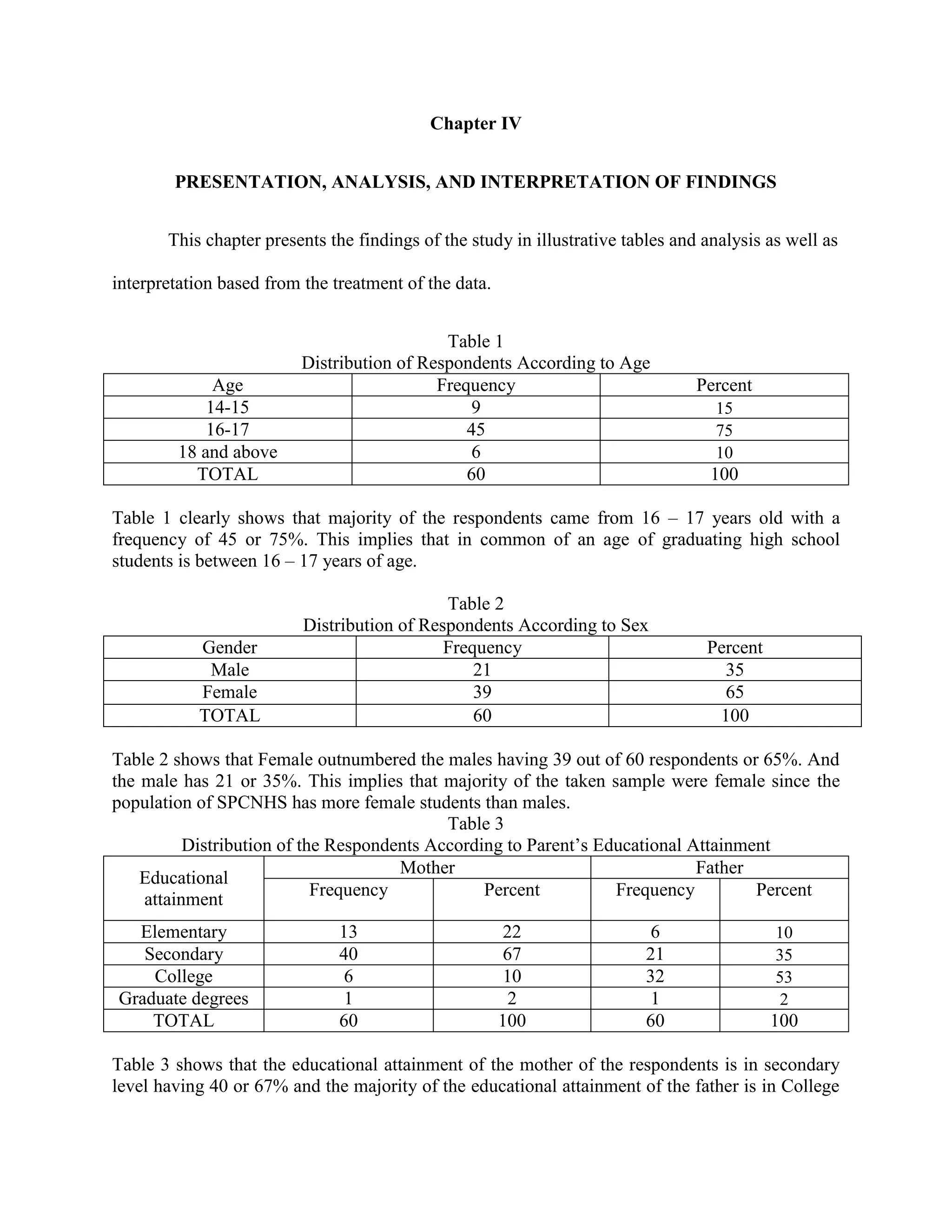
                                            Table 1
                         Distribution of Respondents According to Age
              Age                          Frequency                             Percent
             14-15                              9                                  15
             16-17                             45                                  75
         18 and above                           6                                  10
           TOTAL                               60                                  100

Table 1 clearly shows that majority of the respondents came from 16 – 17 years old with a
frequency of 45 or 75%. This implies that in common of an age of graduating high school
students is between 16 – 17 years of age.

                                             Table 2
                          Distribution of Respondents According to Sex
           Gender                            Frequency                            Percent
            Male                                 21                                 35
           Female                                39                                 65
           TOTAL                                 60                                100

Table 2 shows that Female outnumbered the males having 39 out of 60 respondents or 65%. And
the male has 21 or 35%. This implies that majority of the taken sample were female since the
population of SPCNHS has more female students than males.
                                            Table 3
          Distribution of the Respondents According to Parent’s Educational Attainment
                                      Mother                                 Father
    Educational
                            Frequency            Percent          Frequency         Percent
    attainment
  Elementary                   13                       22                 6                10
   Secondary                   40                       67                21                35
    College                     6                       10                32                53
Graduate degrees                1                        2                 1                 2
    TOTAL                      60                      100                60                100

Table 3 shows that the educational attainment of the mother of the respondents is in secondary
level having 40 or 67% and the majority of the educational attainment of the father is in College
level having 32 or 53%. This implies that the husband has attained a higher degree than their
wives.

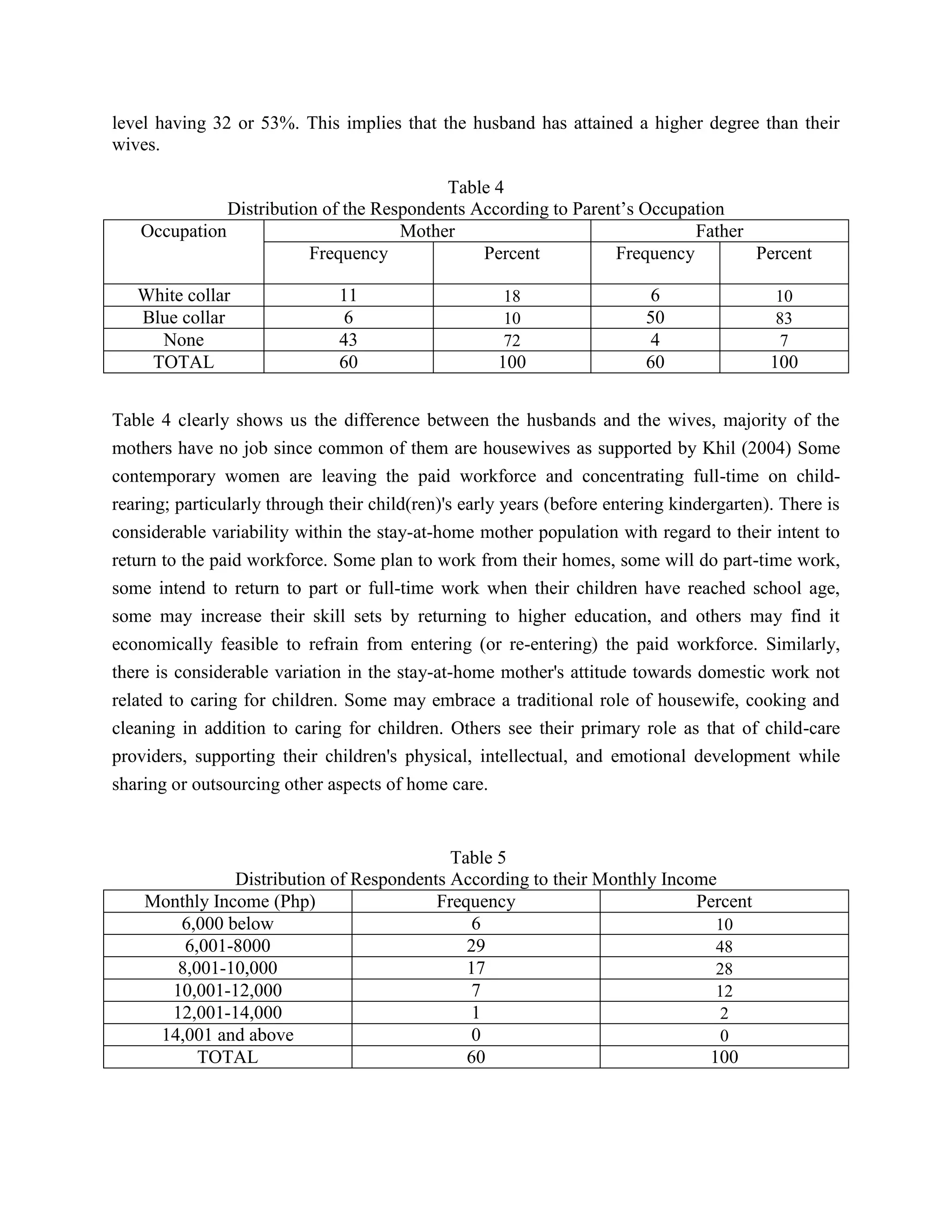
                                          Table 4
              Distribution of the Respondents According to Parent’s Occupation
   Occupation                        Mother                               Father
                         Frequency             Percent          Frequency        Percent

   White collar                11                     18                   6                10
   Blue collar                  6                     10                  50                83
     None                      43                     72                   4                 7
    TOTAL                      60                    100                  60               100


Table 4 clearly shows us the difference between the husbands and the wives, majority of the
mothers have no job since common of them are housewives as supported by Khil (2004) Some
contemporary women are leaving the paid workforce and concentrating full-time on child-
rearing; particularly through their child(ren)'s early years (before entering kindergarten). There is
considerable variability within the stay-at-home mother population with regard to their intent to
return to the paid workforce. Some plan to work from their homes, some will do part-time work,
some intend to return to part or full-time work when their children have reached school age,
some may increase their skill sets by returning to higher education, and others may find it
economically feasible to refrain from entering (or re-entering) the paid workforce. Similarly,
there is considerable variation in the stay-at-home mother's attitude towards domestic work not
related to caring for children. Some may embrace a traditional role of housewife, cooking and
cleaning in addition to caring for children. Others see their primary role as that of child-care
providers, supporting their children's physical, intellectual, and emotional development while
sharing or outsourcing other aspects of home care.


                                           Table 5
               Distribution of Respondents According to their Monthly Income
    Monthly Income (Php)                 Frequency                        Percent
       6,000 below                            6                             10
        6,001-8000                           29                             48
       8,001-10,000                          17                             28
      10,001-12,000                           7                             12
      12,001-14,000                           1                              2
     14,001 and above                         0                              0
          TOTAL                              60                            100
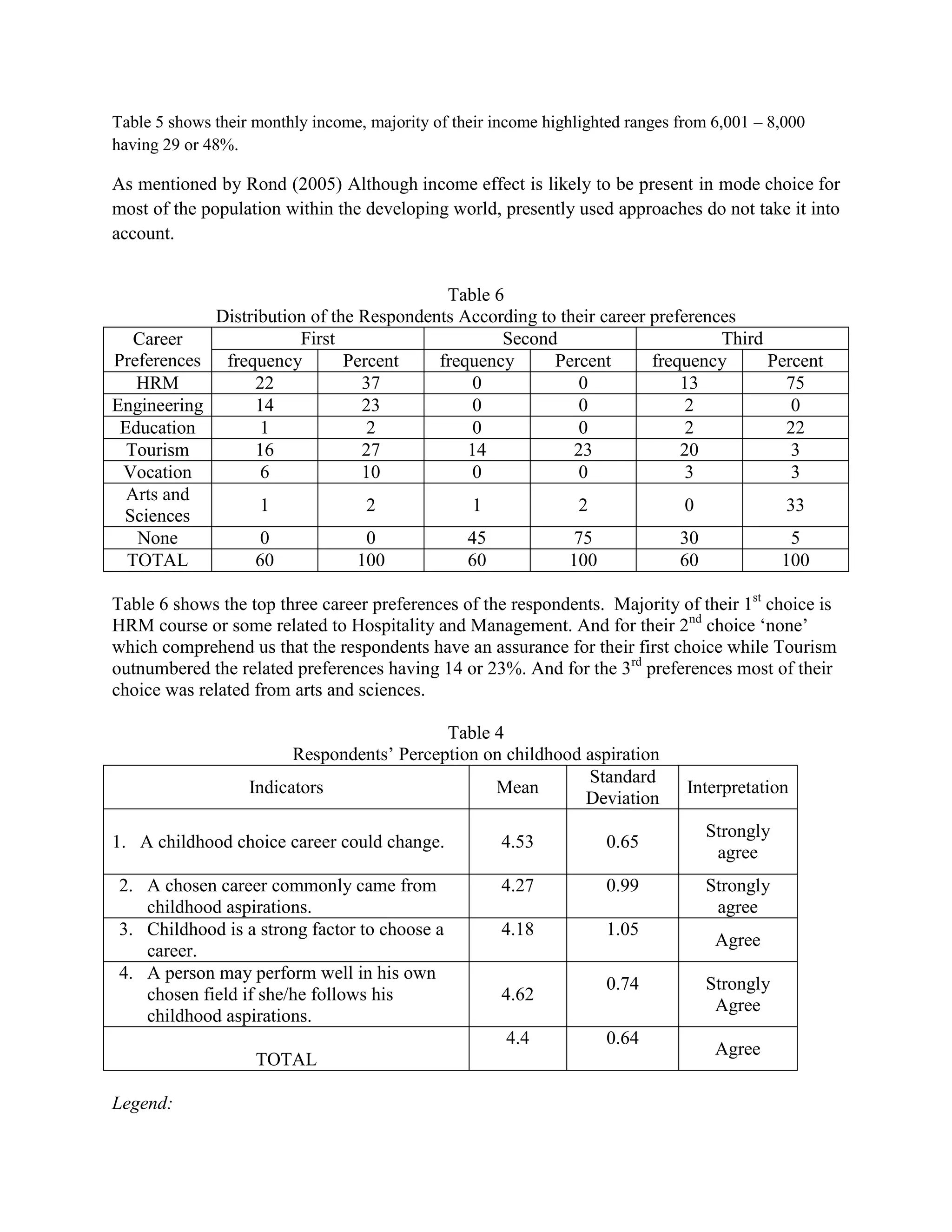
Table 5 shows their monthly income, majority of their income highlighted ranges from 6,001 – 8,000
having 29 or 48%.

As mentioned by Rond (2005) Although income effect is likely to be present in mode choice for
most of the population within the developing world, presently used approaches do not take it into
account.


                                          Table 6
            Distribution of the Respondents According to their career preferences
   Career              First                     Second                        Third
Preferences frequency         Percent    frequency      Percent       frequency      Percent
   HRM           22              37           0             0             13           75
Engineering      14              23           0             0              2            0
 Education        1               2           0             0              2           22
  Tourism        16              27          14            23             20            3
 Vocation         6              10           0             0              3            3
  Arts and
                  1               2           1             2              0           33
 Sciences
   None           0               0          45            75             30            5
  TOTAL          60             100          60           100             60          100

Table 6 shows the top three career preferences of the respondents. Majority of their 1st choice is
HRM course or some related to Hospitality and Management. And for their 2nd choice ‘none’
which comprehend us that the respondents have an assurance for their first choice while Tourism
outnumbered the related preferences having 14 or 23%. And for the 3rd preferences most of their
choice was related from arts and sciences.

                                            Table 4
                         Respondents’ Perception on childhood aspiration
                                                              Standard
                   Indicators                     Mean                           Interpretation
                                                              Deviation
                                                                                   Strongly
1. A childhood choice career could change.             4.53          0.65
                                                                                    agree
 2. A chosen career commonly came from                 4.27          0.99          Strongly
    childhood aspirations.                                                          agree
 3. Childhood is a strong factor to choose a           4.18          1.05
                                                                                     Agree
    career.
 4. A person may perform well in his own
                                                                     0.74          Strongly
    chosen field if she/he follows his                 4.62
                                                                                    Agree
    childhood aspirations.
                                                       4.4           0.64
                                                                                     Agree
                    TOTAL

Legend:
4.21 – 5.0 : Strongly Agree
3.41 – 4.20 : Agree
2.61 – 3.40 : Uncertain
1.81 – 2.60 : Disagree
1.0 – 1.80 : Strongly Disagree

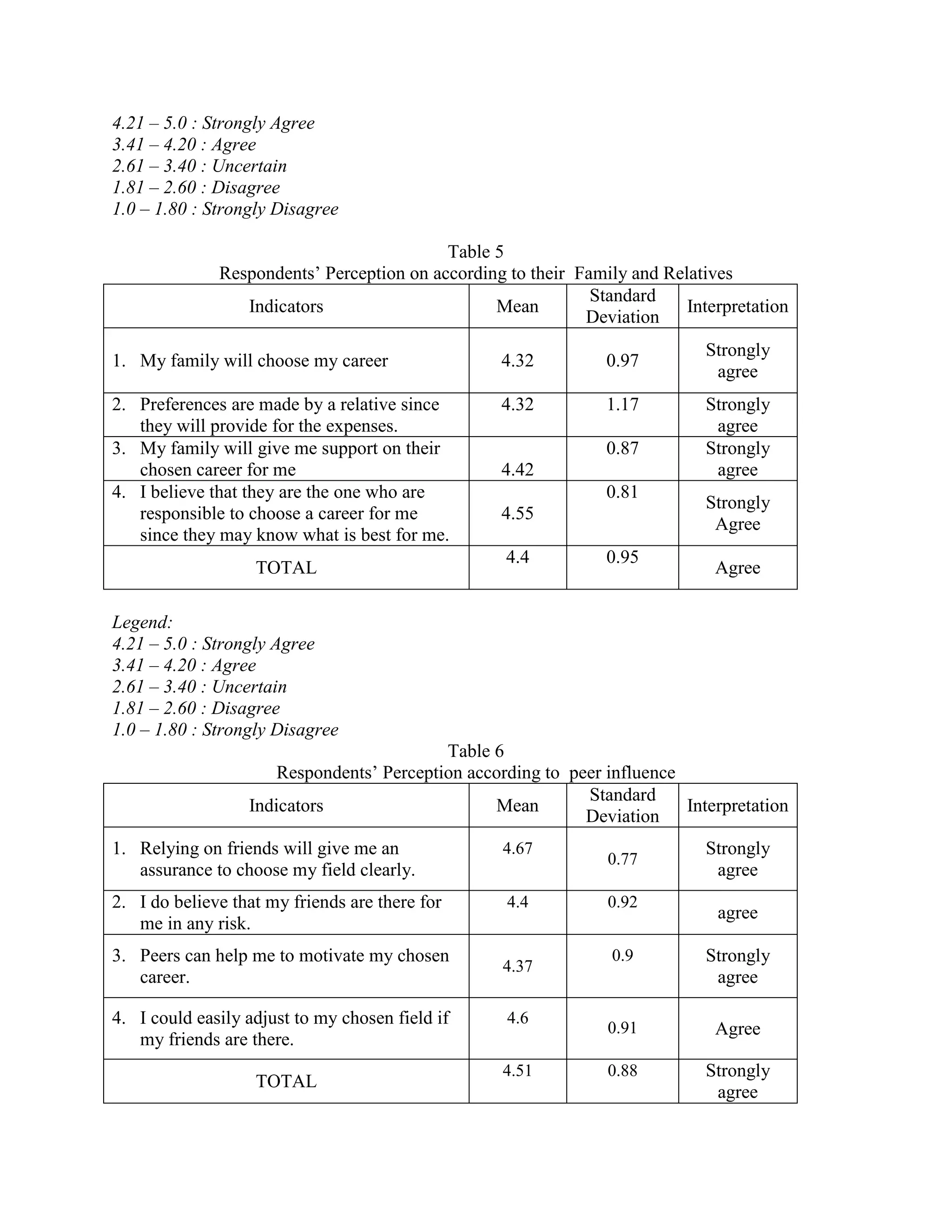
                                           Table 5
              Respondents’ Perception on according to their Family and Relatives
                                                              Standard
                 Indicators                      Mean                     Interpretation
                                                             Deviation
                                                                             Strongly
1. My family will choose my career                4.32          0.97
                                                                              agree
2. Preferences are made by a relative since       4.32          1.17         Strongly
   they will provide for the expenses.                                        agree
3. My family will give me support on their                      0.87         Strongly
   chosen career for me                           4.42                        agree
4. I believe that they are the one who are                      0.81
                                                                             Strongly
   responsible to choose a career for me          4.55
                                                                              Agree
   since they may know what is best for me.
                                                   4.4          0.95
                   TOTAL                                                      Agree

Legend:
4.21 – 5.0 : Strongly Agree
3.41 – 4.20 : Agree
2.61 – 3.40 : Uncertain
1.81 – 2.60 : Disagree
1.0 – 1.80 : Strongly Disagree
                                           Table 6
                      Respondents’ Perception according to peer influence
                                                             Standard
                  Indicators                     Mean                     Interpretation
                                                             Deviation
1. Relying on friends will give me an             4.67                       Strongly
                                                                0.77
   assurance to choose my field clearly.                                      agree
2. I do believe that my friends are there for      4.4          0.92
                                                                              agree
   me in any risk.
3. Peers can help me to motivate my chosen                       0.9         Strongly
                                                  4.37
   career.                                                                    agree

4. I could easily adjust to my chosen field if     4.6
                                                                0.91          Agree
   my friends are there.
                                                  4.51          0.88         Strongly
                   TOTAL
                                                                              agree
Legend:
4.21 – 5.0 : Strongly Agree
3.41 – 4.20 : Agree
2.61 – 3.40 : Uncertain
1.81 – 2.60 : Disagree
1.0 – 1.80 : Strongly Disagree

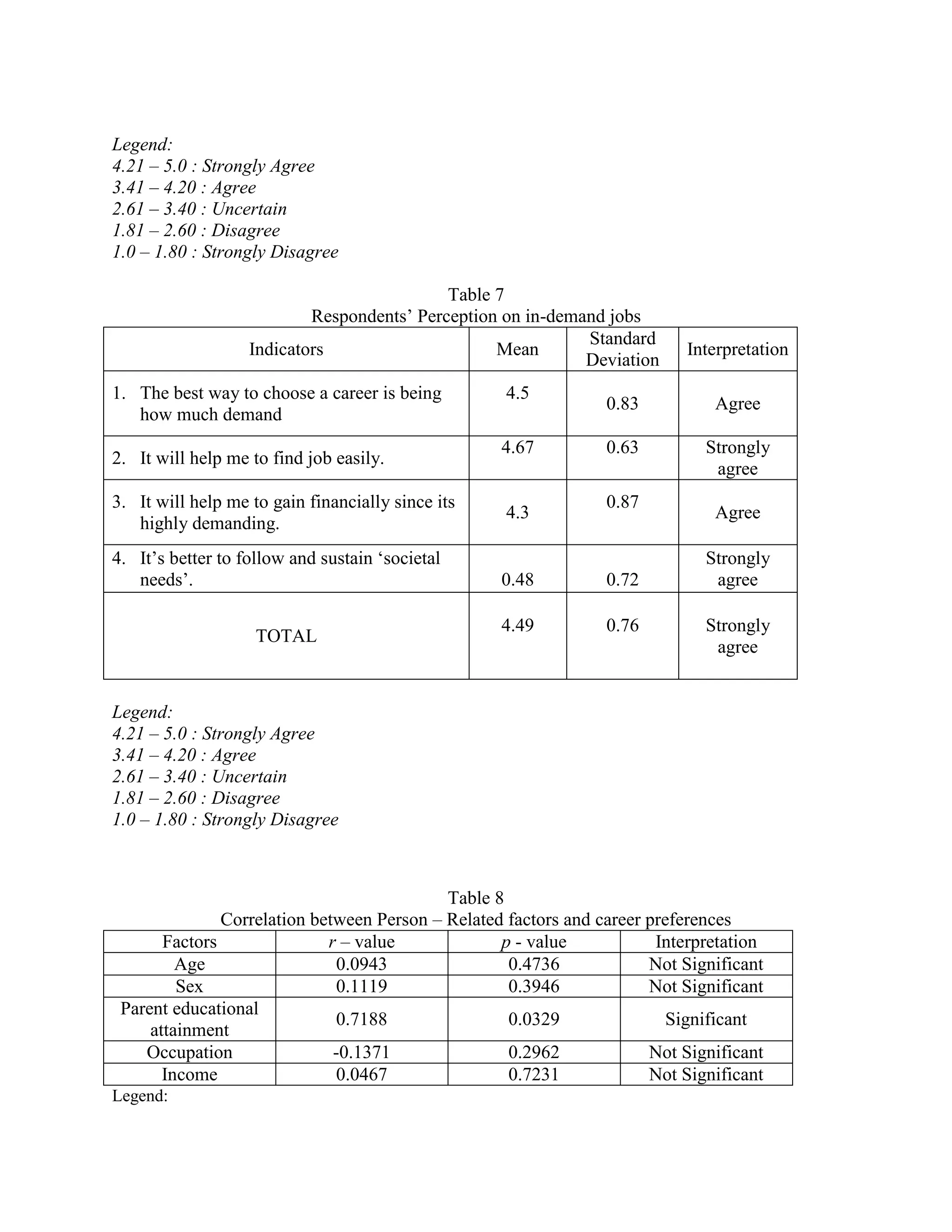
                                            Table 7
                           Respondents’ Perception on in-demand jobs
                                                             Standard
                   Indicators                     Mean                     Interpretation
                                                             Deviation
1. The best way to choose a career is being        4.5
                                                                 0.83          Agree
   how much demand
                                                   4.67          0.63         Strongly
2. It will help me to find job easily.
                                                                               agree
3. It will help me to gain financially since its                 0.87
                                                   4.3                         Agree
   highly demanding.
4. It’s better to follow and sustain ‘societal                                Strongly
   needs’.                                         0.48          0.72          agree

                                                   4.49          0.76         Strongly
                    TOTAL
                                                                               agree


Legend:
4.21 – 5.0 : Strongly Agree
3.41 – 4.20 : Agree
2.61 – 3.40 : Uncertain
1.81 – 2.60 : Disagree
1.0 – 1.80 : Strongly Disagree


                                            Table 8
               Correlation between Person – Related factors and career preferences
       Factors               r – value             p - value            Interpretation
         Age                  0.0943                0.4736             Not Significant
         Sex                  0.1119                0.3946             Not Significant
 Parent educational
                              0.7188                0.0329                Significant
     attainment
    Occupation                -0.1371               0.2962             Not Significant
       Income                 0.0467                0.7231             Not Significant
Legend:
p > 0.05 – Not significant
       p < 0.05 – Significant

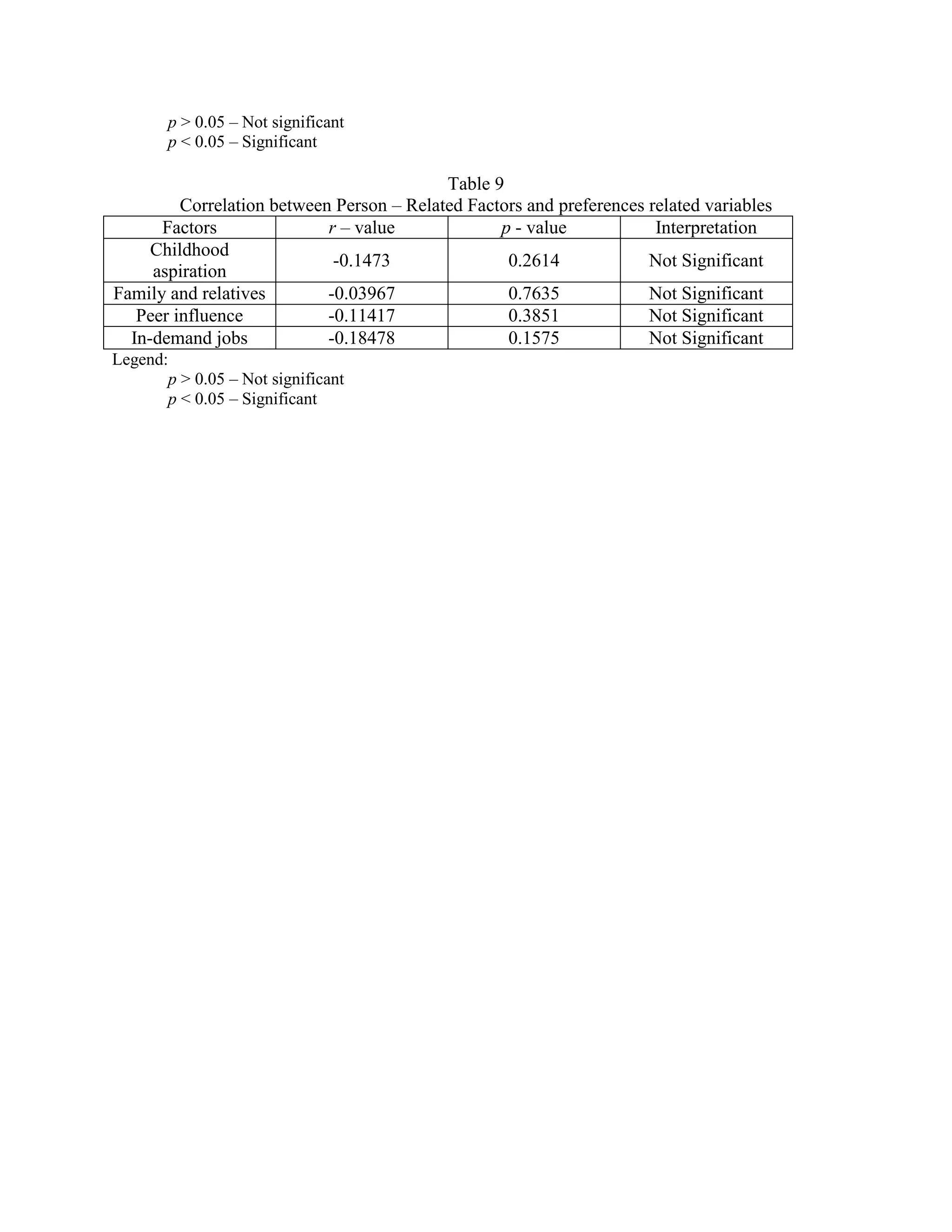
                                           Table 9
         Correlation between Person – Related Factors and preferences related variables
      Factors               r – value             p - value            Interpretation
     Childhood
                             -0.1473               0.2614             Not Significant
     aspiration
Family and relatives        -0.03967               0.7635             Not Significant
   Peer influence           -0.11417               0.3851             Not Significant
  In-demand jobs            -0.18478               0.1575             Not Significant
Legend:
       p > 0.05 – Not significant
       p < 0.05 – Significant

Chapter iv

  • 1.
    Chapter IV PRESENTATION, ANALYSIS, AND INTERPRETATION OF FINDINGS This chapter presents the findings of the study in illustrative tables and analysis as well as interpretation based from the treatment of the data. Table 1 Distribution of Respondents According to Age Age Frequency Percent 14-15 9 15 16-17 45 75 18 and above 6 10 TOTAL 60 100 Table 1 clearly shows that majority of the respondents came from 16 – 17 years old with a frequency of 45 or 75%. This implies that in common of an age of graduating high school students is between 16 – 17 years of age. Table 2 Distribution of Respondents According to Sex Gender Frequency Percent Male 21 35 Female 39 65 TOTAL 60 100 Table 2 shows that Female outnumbered the males having 39 out of 60 respondents or 65%. And the male has 21 or 35%. This implies that majority of the taken sample were female since the population of SPCNHS has more female students than males. Table 3 Distribution of the Respondents According to Parent’s Educational Attainment Mother Father Educational Frequency Percent Frequency Percent attainment Elementary 13 22 6 10 Secondary 40 67 21 35 College 6 10 32 53 Graduate degrees 1 2 1 2 TOTAL 60 100 60 100 Table 3 shows that the educational attainment of the mother of the respondents is in secondary level having 40 or 67% and the majority of the educational attainment of the father is in College
  • 2.
    level having 32or 53%. This implies that the husband has attained a higher degree than their wives. Table 4 Distribution of the Respondents According to Parent’s Occupation Occupation Mother Father Frequency Percent Frequency Percent White collar 11 18 6 10 Blue collar 6 10 50 83 None 43 72 4 7 TOTAL 60 100 60 100 Table 4 clearly shows us the difference between the husbands and the wives, majority of the mothers have no job since common of them are housewives as supported by Khil (2004) Some contemporary women are leaving the paid workforce and concentrating full-time on child- rearing; particularly through their child(ren)'s early years (before entering kindergarten). There is considerable variability within the stay-at-home mother population with regard to their intent to return to the paid workforce. Some plan to work from their homes, some will do part-time work, some intend to return to part or full-time work when their children have reached school age, some may increase their skill sets by returning to higher education, and others may find it economically feasible to refrain from entering (or re-entering) the paid workforce. Similarly, there is considerable variation in the stay-at-home mother's attitude towards domestic work not related to caring for children. Some may embrace a traditional role of housewife, cooking and cleaning in addition to caring for children. Others see their primary role as that of child-care providers, supporting their children's physical, intellectual, and emotional development while sharing or outsourcing other aspects of home care. Table 5 Distribution of Respondents According to their Monthly Income Monthly Income (Php) Frequency Percent 6,000 below 6 10 6,001-8000 29 48 8,001-10,000 17 28 10,001-12,000 7 12 12,001-14,000 1 2 14,001 and above 0 0 TOTAL 60 100
  • 3.
    Table 5 showstheir monthly income, majority of their income highlighted ranges from 6,001 – 8,000 having 29 or 48%. As mentioned by Rond (2005) Although income effect is likely to be present in mode choice for most of the population within the developing world, presently used approaches do not take it into account. Table 6 Distribution of the Respondents According to their career preferences Career First Second Third Preferences frequency Percent frequency Percent frequency Percent HRM 22 37 0 0 13 75 Engineering 14 23 0 0 2 0 Education 1 2 0 0 2 22 Tourism 16 27 14 23 20 3 Vocation 6 10 0 0 3 3 Arts and 1 2 1 2 0 33 Sciences None 0 0 45 75 30 5 TOTAL 60 100 60 100 60 100 Table 6 shows the top three career preferences of the respondents. Majority of their 1st choice is HRM course or some related to Hospitality and Management. And for their 2nd choice ‘none’ which comprehend us that the respondents have an assurance for their first choice while Tourism outnumbered the related preferences having 14 or 23%. And for the 3rd preferences most of their choice was related from arts and sciences. Table 4 Respondents’ Perception on childhood aspiration Standard Indicators Mean Interpretation Deviation Strongly 1. A childhood choice career could change. 4.53 0.65 agree 2. A chosen career commonly came from 4.27 0.99 Strongly childhood aspirations. agree 3. Childhood is a strong factor to choose a 4.18 1.05 Agree career. 4. A person may perform well in his own 0.74 Strongly chosen field if she/he follows his 4.62 Agree childhood aspirations. 4.4 0.64 Agree TOTAL Legend:
  • 4.
    4.21 – 5.0: Strongly Agree 3.41 – 4.20 : Agree 2.61 – 3.40 : Uncertain 1.81 – 2.60 : Disagree 1.0 – 1.80 : Strongly Disagree Table 5 Respondents’ Perception on according to their Family and Relatives Standard Indicators Mean Interpretation Deviation Strongly 1. My family will choose my career 4.32 0.97 agree 2. Preferences are made by a relative since 4.32 1.17 Strongly they will provide for the expenses. agree 3. My family will give me support on their 0.87 Strongly chosen career for me 4.42 agree 4. I believe that they are the one who are 0.81 Strongly responsible to choose a career for me 4.55 Agree since they may know what is best for me. 4.4 0.95 TOTAL Agree Legend: 4.21 – 5.0 : Strongly Agree 3.41 – 4.20 : Agree 2.61 – 3.40 : Uncertain 1.81 – 2.60 : Disagree 1.0 – 1.80 : Strongly Disagree Table 6 Respondents’ Perception according to peer influence Standard Indicators Mean Interpretation Deviation 1. Relying on friends will give me an 4.67 Strongly 0.77 assurance to choose my field clearly. agree 2. I do believe that my friends are there for 4.4 0.92 agree me in any risk. 3. Peers can help me to motivate my chosen 0.9 Strongly 4.37 career. agree 4. I could easily adjust to my chosen field if 4.6 0.91 Agree my friends are there. 4.51 0.88 Strongly TOTAL agree
  • 5.
    Legend: 4.21 – 5.0: Strongly Agree 3.41 – 4.20 : Agree 2.61 – 3.40 : Uncertain 1.81 – 2.60 : Disagree 1.0 – 1.80 : Strongly Disagree Table 7 Respondents’ Perception on in-demand jobs Standard Indicators Mean Interpretation Deviation 1. The best way to choose a career is being 4.5 0.83 Agree how much demand 4.67 0.63 Strongly 2. It will help me to find job easily. agree 3. It will help me to gain financially since its 0.87 4.3 Agree highly demanding. 4. It’s better to follow and sustain ‘societal Strongly needs’. 0.48 0.72 agree 4.49 0.76 Strongly TOTAL agree Legend: 4.21 – 5.0 : Strongly Agree 3.41 – 4.20 : Agree 2.61 – 3.40 : Uncertain 1.81 – 2.60 : Disagree 1.0 – 1.80 : Strongly Disagree Table 8 Correlation between Person – Related factors and career preferences Factors r – value p - value Interpretation Age 0.0943 0.4736 Not Significant Sex 0.1119 0.3946 Not Significant Parent educational 0.7188 0.0329 Significant attainment Occupation -0.1371 0.2962 Not Significant Income 0.0467 0.7231 Not Significant Legend:
  • 6.
    p > 0.05– Not significant p < 0.05 – Significant Table 9 Correlation between Person – Related Factors and preferences related variables Factors r – value p - value Interpretation Childhood -0.1473 0.2614 Not Significant aspiration Family and relatives -0.03967 0.7635 Not Significant Peer influence -0.11417 0.3851 Not Significant In-demand jobs -0.18478 0.1575 Not Significant Legend: p > 0.05 – Not significant p < 0.05 – Significant