APRIL 7, 2017
Tayabas Western Academy, De Gala street, Candelaria, Quezon, PHILIPPINES
MINDFUL BREATHING: An introduction for getting educationally mind-up
By Carie Justine P. Estrellado
indfulness is a popular topic in the public realm and being promoted by high profile
stars and athletes as a means of improving health and well-being. While mindfulness
seems to be a popular trend being adopted by individuals, it is also beginning to be
considered in various areas of public policy, including education policy. There is growing
interest in the use of mindfulness practices in education to enhance and supplement instruction.
Mindfulness practices have been hypothesized to positively affect cognitive and academic
performance and skills related to the learning process (e.g., attention, self-regulation,
management of stress) as well as enhance social skills and as a vehicle for a more holistic
approach to developing the “whole person” (Maynard, Solis, and Miller 2014)
Mindful breathing as its glance in the
Philippine setting, particularly in
Candelaria, Quezon coexist the idea of
mind-up curriculum and being mindful.
Unbeknownst for many Filipino educators
“reaping fruits is easier than before, if we’ll
just have a moment of it” that’s how we,
Academicians want to share. There are
many foreign literatures elevate the
consciousness of applying the so called self-
moment concentration and probably
turning it as a practice of meditation.
However, mindfulness is somewhat a
proliferation of innovative strategy that
suits every sector it’s already an educational
issue. Though, the writer seems to find
numerous research findings regarding this
study (mindfulness) internationally, it’s a
bit cumbersome to find a locale study
(Philippine area). As to mention, Tayabas
Western Academy situated in Quezon
province has initiated the curriculum, yet to
think – a big question mark was filled the
mind’s eye, even teachers wondered; we
started the practice way back 2014, doing it
religiously every flag raising ceremony,
during PLC’s (Professional Learning
Community) notably, as a product of that,
we imbibe eventually the mindful breathing
as a school culture.
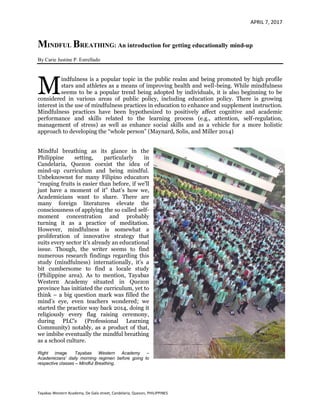
Right image. Tayabas Western Academy –
Academicians’ daily morning regimen before going to
respective classes – Mindful Breathing.
M
APRIL 7, 2017
Tayabas Western Academy, De Gala street, Candelaria, Quezon, PHILIPPINES
Mindful breathing takes place before taking junior high school examinations (left image); Students keenly participate a
minute of mindful breathing exercise (right image)
he way to share it, is to teach it; the way to teach it, is by internalizing it; As mentioned
by Schoeberlein (2009) School-based learning is complex, in part because teachers and
students carry individual webs of knowledge, attitudes, skills, and behaviours into an
interactive classroom environment. Learning is most effective when teachers initiate the
process of weaving these varied webs together. To do so, teachers need to understand their own
inner experiences, recognize their students’ needs, and implement appropriate educational
strategies. The teacher’s own skills in attention and awareness drive this process; the stronger
these skills, the better the outcomes—for everyone.
Indeed, the gist of mindfulness bears on the teacher per se, the linings and ponderous practices
should exhibit in ours, so we, educators should be the first prototype of our students though
arduous and constricted in numerous tasks, we (teachers) still have time to teach what we
implement and convicted in since the common goal of every school is students’ improvement we
neither hesitate nor neglect the said curriculum as if it will the betterment of all. And that’s what
makes a habit – breath in and out.
Carie Justine P. Estrellado
High School Teacher and
Mindful Curriculum Advocate
cariejustineestrellado@gmail.com
Sources:
Brandy R. Maynard, Michael R. Solis, & Veronica Miller (2014) Mindfulness-Based Interventions for Improving Academic Achievement, Behavior
and Socio-Emotional Functioning of Primary and Secondary Students: A Systematic Review. The Campbell Collaboration
Schoeberlein, Deborah (2009) Mindful Teaching and Teaching Mindfulness Wisdom Publications 199 Elm Street Somerville. MA 02144. USA
Weare, Katherine (2014) Evidence for Mindfulness: Impacts on the Wellbeing and Performance of School Staff. Universities of Exeter and
Southampton.skw@soton.ac.uk
T

mindful breathing (Philippines)

  • 1.
    APRIL 7, 2017 TayabasWestern Academy, De Gala street, Candelaria, Quezon, PHILIPPINES MINDFUL BREATHING: An introduction for getting educationally mind-up By Carie Justine P. Estrellado indfulness is a popular topic in the public realm and being promoted by high profile stars and athletes as a means of improving health and well-being. While mindfulness seems to be a popular trend being adopted by individuals, it is also beginning to be considered in various areas of public policy, including education policy. There is growing interest in the use of mindfulness practices in education to enhance and supplement instruction. Mindfulness practices have been hypothesized to positively affect cognitive and academic performance and skills related to the learning process (e.g., attention, self-regulation, management of stress) as well as enhance social skills and as a vehicle for a more holistic approach to developing the “whole person” (Maynard, Solis, and Miller 2014) Mindful breathing as its glance in the Philippine setting, particularly in Candelaria, Quezon coexist the idea of mind-up curriculum and being mindful. Unbeknownst for many Filipino educators “reaping fruits is easier than before, if we’ll just have a moment of it” that’s how we, Academicians want to share. There are many foreign literatures elevate the consciousness of applying the so called self- moment concentration and probably turning it as a practice of meditation. However, mindfulness is somewhat a proliferation of innovative strategy that suits every sector it’s already an educational issue. Though, the writer seems to find numerous research findings regarding this study (mindfulness) internationally, it’s a bit cumbersome to find a locale study (Philippine area). As to mention, Tayabas Western Academy situated in Quezon province has initiated the curriculum, yet to think – a big question mark was filled the mind’s eye, even teachers wondered; we started the practice way back 2014, doing it religiously every flag raising ceremony, during PLC’s (Professional Learning Community) notably, as a product of that, we imbibe eventually the mindful breathing as a school culture. Right image. Tayabas Western Academy – Academicians’ daily morning regimen before going to respective classes – Mindful Breathing. M
  • 2.
    APRIL 7, 2017 TayabasWestern Academy, De Gala street, Candelaria, Quezon, PHILIPPINES Mindful breathing takes place before taking junior high school examinations (left image); Students keenly participate a minute of mindful breathing exercise (right image) he way to share it, is to teach it; the way to teach it, is by internalizing it; As mentioned by Schoeberlein (2009) School-based learning is complex, in part because teachers and students carry individual webs of knowledge, attitudes, skills, and behaviours into an interactive classroom environment. Learning is most effective when teachers initiate the process of weaving these varied webs together. To do so, teachers need to understand their own inner experiences, recognize their students’ needs, and implement appropriate educational strategies. The teacher’s own skills in attention and awareness drive this process; the stronger these skills, the better the outcomes—for everyone. Indeed, the gist of mindfulness bears on the teacher per se, the linings and ponderous practices should exhibit in ours, so we, educators should be the first prototype of our students though arduous and constricted in numerous tasks, we (teachers) still have time to teach what we implement and convicted in since the common goal of every school is students’ improvement we neither hesitate nor neglect the said curriculum as if it will the betterment of all. And that’s what makes a habit – breath in and out. Carie Justine P. Estrellado High School Teacher and Mindful Curriculum Advocate cariejustineestrellado@gmail.com Sources: Brandy R. Maynard, Michael R. Solis, & Veronica Miller (2014) Mindfulness-Based Interventions for Improving Academic Achievement, Behavior and Socio-Emotional Functioning of Primary and Secondary Students: A Systematic Review. The Campbell Collaboration Schoeberlein, Deborah (2009) Mindful Teaching and Teaching Mindfulness Wisdom Publications 199 Elm Street Somerville. MA 02144. USA Weare, Katherine (2014) Evidence for Mindfulness: Impacts on the Wellbeing and Performance of School Staff. Universities of Exeter and Southampton.skw@soton.ac.uk T