Mesopotamia
The Worlds First Civilization
What is a civilization?
Civilizations (SIH•vuh•luh•ZAY•
shuhns) are complex societies. They
have cities, organized
governments, art, religion, class
divisions, and a writing system.
Why were river valleys important?
Farming - large amounts of people
could be fed
Trade - goods and ideas to move from
place to place.
Cities - grow up in these valleys and
became the centers of civilizations.
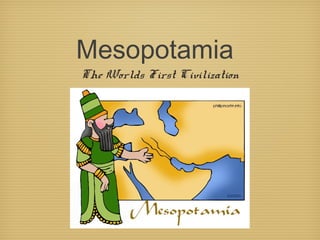
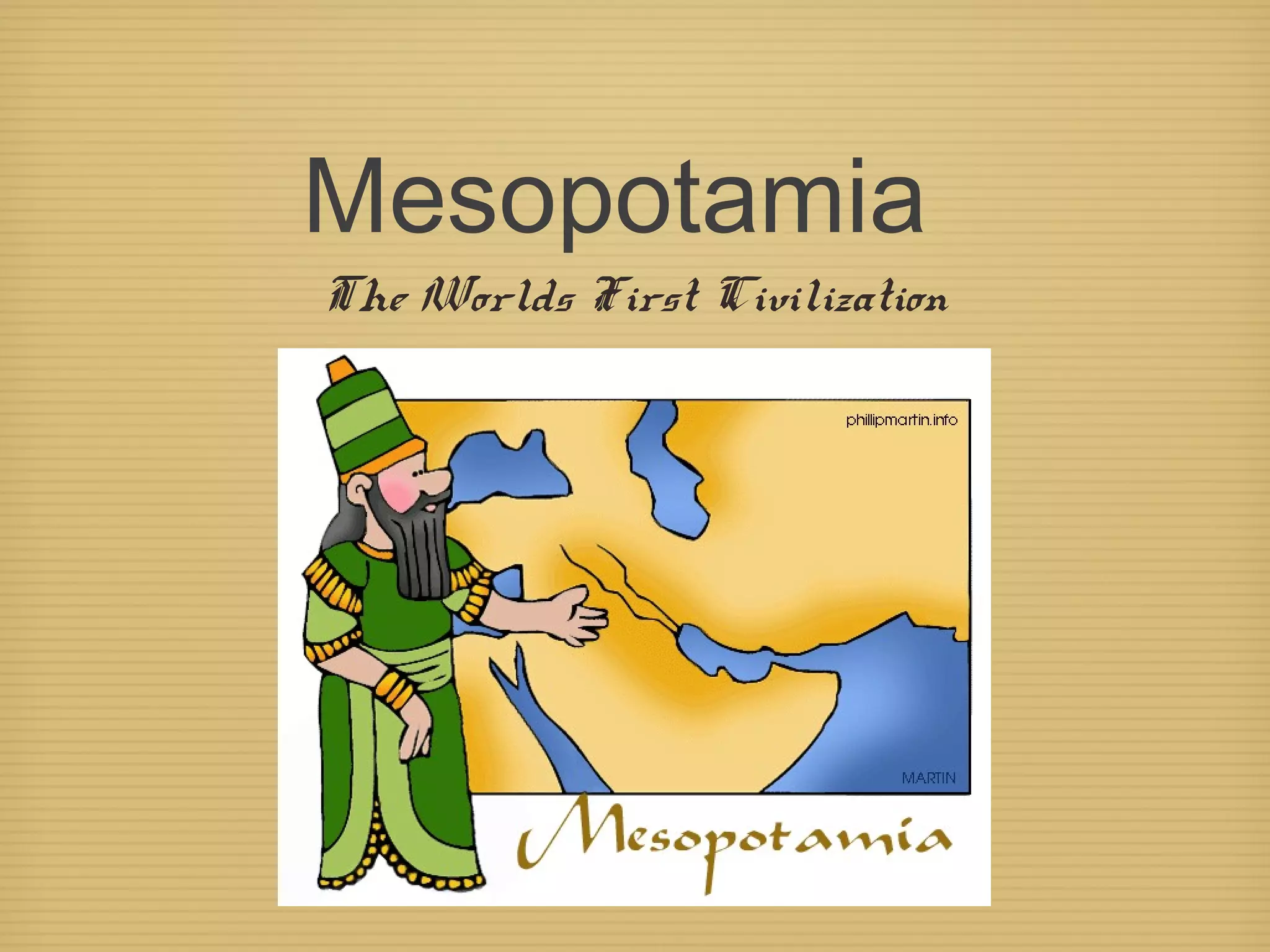
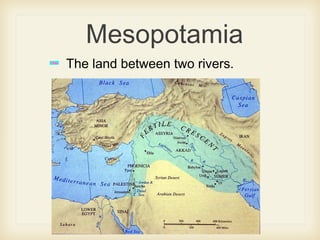
Mesopotamia
The land between two rivers.
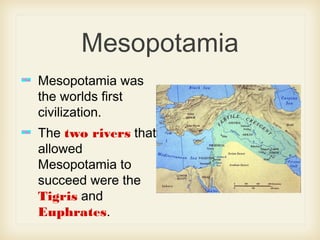
Mesopotamia
Mesopotamia was
the worlds first
civilization.
The two rivers that
allowed
Mesopotamia to
succeed were the
Tigris and
Euphrates.
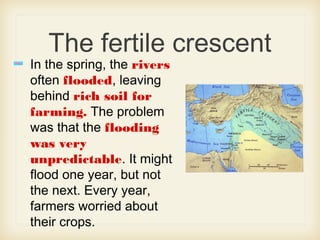
The fertile crescent
In the spring, the rivers
often flooded, leaving
behind rich soil for
farming. The problem
was that the flooding
was very
unpredictable. It might
flood one year, but not
the next. Every year,
farmers worried about
their crops.
Irrigation
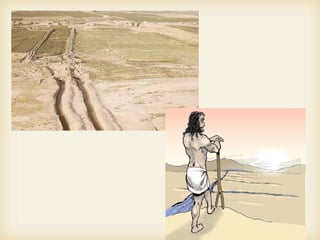
Over time, the farmers learned to build
dams and channels to control the
seasonal floods. They also built walls,
waterways, and ditches to bring water
to their fields. This way of watering
crops is called irrigation. Irrigation
allowed the farmers to grow plenty of
food and support a large population.
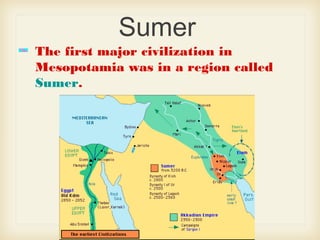
Sumer
The first major civilization in
Mesopotamia was in a region called
Sumer.
Food in Sumer
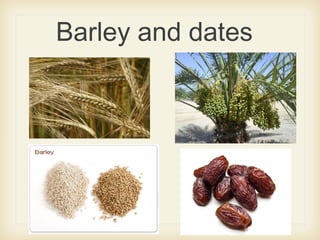
The Sumerians grew several kinds of
crops. The most valuable one was barley,
which was used to make flour and bread.
Dates were also very valuable to the
Sumerians. They were eaten once ripe or
else they were dried for future
consumption. Dates also made an
excellent wine.
Barley and dates
City-states
Each Sumerian city and the land
around it became a separate city-state.
Each city-state had its own
government and was not part of any
larger unit.
Social Classes in Sumer
Upper class - kings, priests, warriors,
and government officials.
Middle class - artisans, merchants,
farmers, and fishers. These people
made up the largest group.
Lower class - enslaved people who
worked on farms or in the temples.
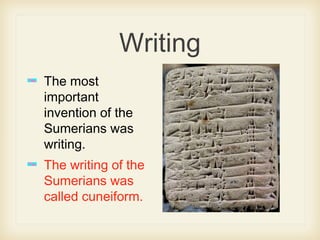
Writing
The most
important
invention of the
Sumerians was
writing.
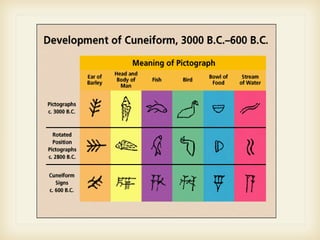
The writing of the
Sumerians was
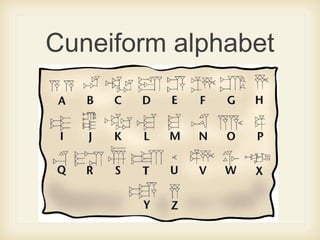
called cuneiform.
Cuneiform alphabet
TheEpic of Gilgamesh
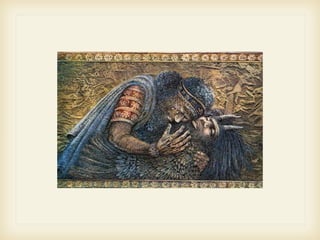
The most famous piece of literature from
Sumer is the Epic of Gilgamesh.
An epic is a long poem that tells the story
of a hero. The hero Gilgamesh is a king
who travels around the world with a
friend and performs great deeds. When
his friend dies, Gilgamesh searches for a
way to live forever.
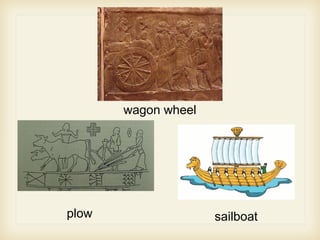
Sumerian Inventions
wagon wheel
plow
sailboat
number system based on 60
geometry
12 month calendar
wagon wheel
plow sailboat
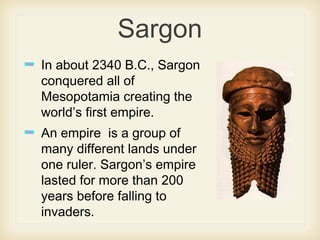
Sargon
In about 2340 B.C., Sargon
conquered all of
Mesopotamia creating the
world’s first empire.
An empire is a group of
many different lands under
one ruler. Sargon’s empire
lasted for more than 200
years before falling to
invaders.
Hammurabi
Hammurabi is best known for his law code,
or collection of laws.
Law 5: If a judge makes an error through his
own fault when trying a case, he must pay a
fine, be removed from the judge’s bench,
and never judge another case.
Law 195: If a son strikes his father, the
son’s hands shall be cut off.

Mesopotamia (2)

  • 1.
  • 2.
    What is acivilization? Civilizations (SIH•vuh•luh•ZAY• shuhns) are complex societies. They have cities, organized governments, art, religion, class divisions, and a writing system.
  • 3.
    Why were rivervalleys important? Farming - large amounts of people could be fed Trade - goods and ideas to move from place to place. Cities - grow up in these valleys and became the centers of civilizations.
  • 4.
  • 5.
    Mesopotamia Mesopotamia was the worldsfirst civilization. The two rivers that allowed Mesopotamia to succeed were the Tigris and Euphrates.
  • 6.
    The fertile crescent Inthe spring, the rivers often flooded, leaving behind rich soil for farming. The problem was that the flooding was very unpredictable. It might flood one year, but not the next. Every year, farmers worried about their crops.
  • 7.
    Irrigation Over time, thefarmers learned to build dams and channels to control the seasonal floods. They also built walls, waterways, and ditches to bring water to their fields. This way of watering crops is called irrigation. Irrigation allowed the farmers to grow plenty of food and support a large population.
  • 9.
    Sumer The first majorcivilization in Mesopotamia was in a region called Sumer.
  • 10.
    Food in Sumer TheSumerians grew several kinds of crops. The most valuable one was barley, which was used to make flour and bread. Dates were also very valuable to the Sumerians. They were eaten once ripe or else they were dried for future consumption. Dates also made an excellent wine.
  • 11.
  • 12.
    City-states Each Sumerian cityand the land around it became a separate city-state. Each city-state had its own government and was not part of any larger unit.
  • 13.
    Social Classes inSumer Upper class - kings, priests, warriors, and government officials. Middle class - artisans, merchants, farmers, and fishers. These people made up the largest group. Lower class - enslaved people who worked on farms or in the temples.
  • 14.
    Writing The most important invention ofthe Sumerians was writing. The writing of the Sumerians was called cuneiform.
  • 16.
  • 17.
    TheEpic of Gilgamesh Themost famous piece of literature from Sumer is the Epic of Gilgamesh. An epic is a long poem that tells the story of a hero. The hero Gilgamesh is a king who travels around the world with a friend and performs great deeds. When his friend dies, Gilgamesh searches for a way to live forever.
  • 19.
    Sumerian Inventions wagon wheel plow sailboat numbersystem based on 60 geometry 12 month calendar
  • 20.
  • 21.
    Sargon In about 2340B.C., Sargon conquered all of Mesopotamia creating the world’s first empire. An empire is a group of many different lands under one ruler. Sargon’s empire lasted for more than 200 years before falling to invaders.
  • 22.
    Hammurabi Hammurabi is bestknown for his law code, or collection of laws. Law 5: If a judge makes an error through his own fault when trying a case, he must pay a fine, be removed from the judge’s bench, and never judge another case. Law 195: If a son strikes his father, the son’s hands shall be cut off.