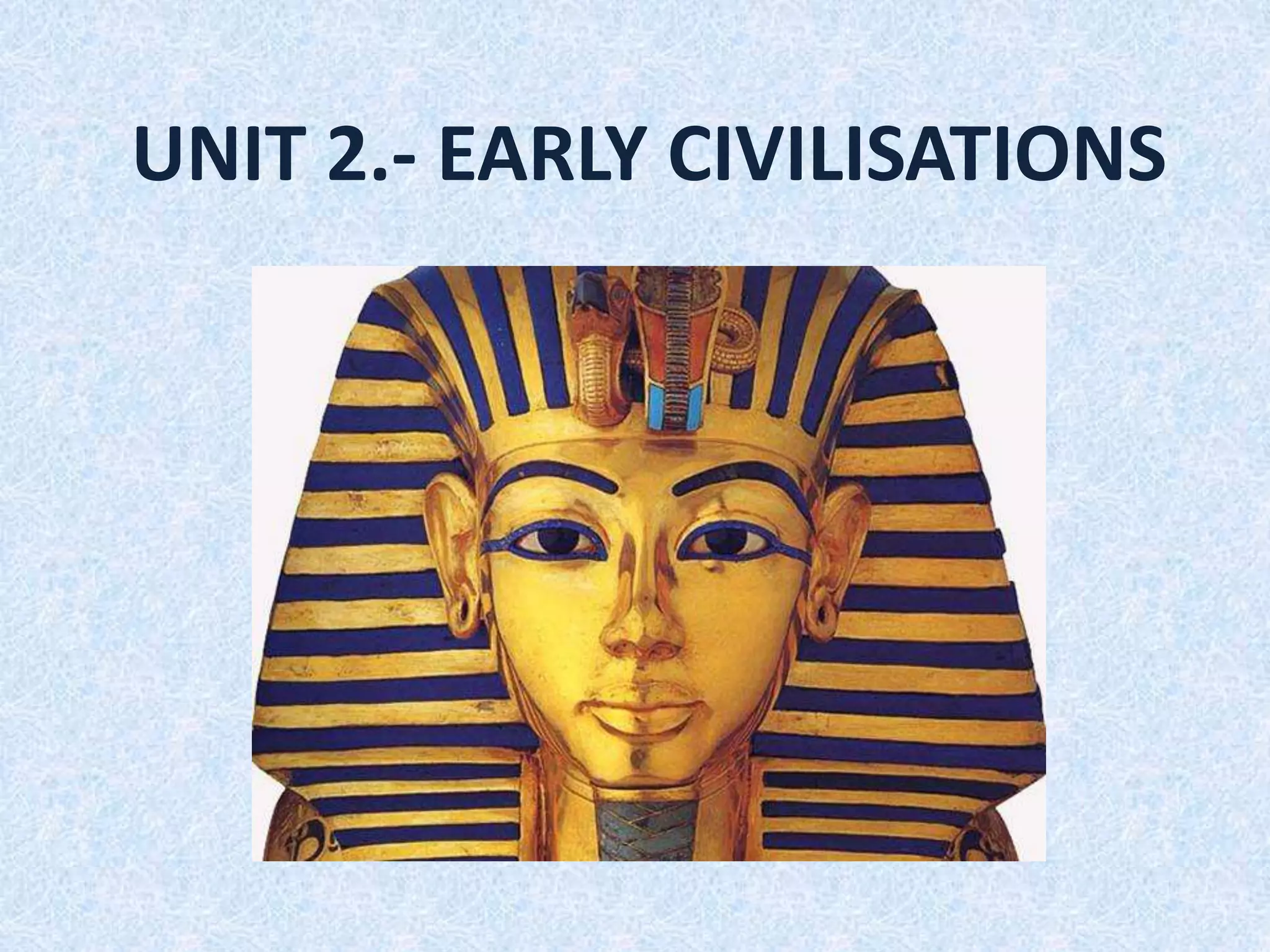
UNIT 2.- EARLY CIVILISATIONS
WELCOME TO A NEW CLASS OF HISTORY
• Today, we are going to start with the study of history.
• We don´t forget the previous period of time: prehistory
PREHISTORY HISTORY
Before the
invention of
writing
After the
invention of
writing
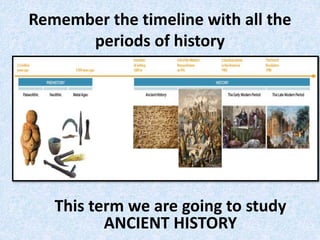
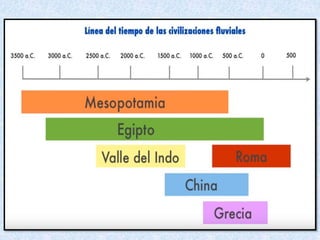
Remember the timeline with all the
periods of history
This term we are going to study
ANCIENT HISTORY
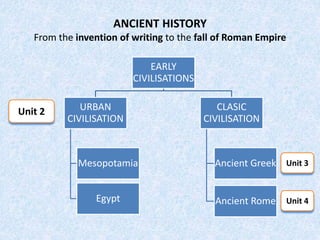
EARLY
CIVILISATIONS
URBAN
CIVILISATION
Mesopotamia
Egypt
CLASIC
CIVILISATION
Ancient Greek
Ancient Rome
ANCIENT HISTORY
From the invention of writing to the fall of Roman Empire
Unit 2
Unit 4
Unit 3
BEFORE STARTING WITH THE STUDY OF EARLY CIVILISATION…
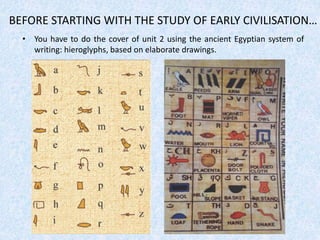
• You have to do the cover of unit 2 using the ancient Egyptian system of
writing: hieroglyphs, based on elaborate drawings.
EARLY CIVILISATION:
Mesopotamia and Egypt
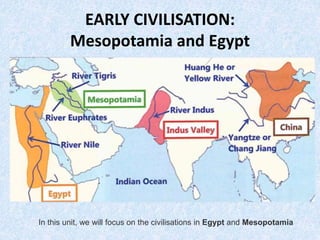
In this unit, we will focus on the civilisations in Egypt and Mesopotamia
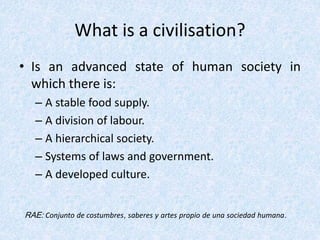
What is a civilisation?
• Is an advanced state of human society in
which there is:
– A stable food supply.
– A division of labour.
– A hierarchical society.
– Systems of laws and government.
– A developed culture.
RAE: Conjunto de costumbres, saberes y artes propio de una sociedad humana.
MESOPOTAMIA AND EGYPT.
Common characteristics
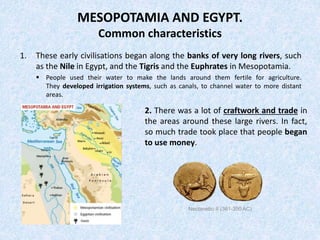
1. These early civilisations began along the banks of very long rivers, such
as the Nile in Egypt, and the Tigris and the Euphrates in Mesopotamia.
 People used their water to make the lands around them fertile for agriculture.
They developed irrigation systems, such as canals, to channel water to more distant
areas.
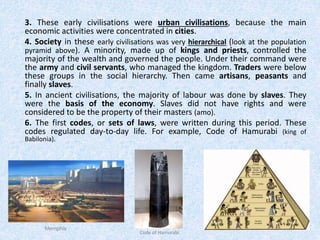
2. There was a lot of craftwork and trade in
the areas around these large rivers. In fact,
so much trade took place that people began
to use money.
Nectanebo II (361-350 AC)
3. These early civilisations were urban civilisations, because the main
economic activities were concentrated in cities.
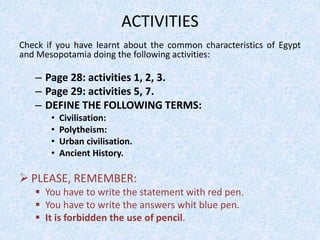
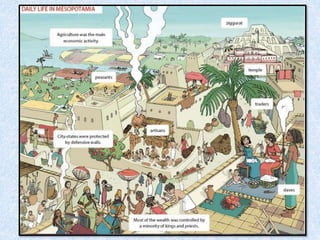
4. Society in these early civilisations was very hierarchical (look at the population
pyramid above). A minority, made up of kings and priests, controlled the
majority of the wealth and governed the people. Under their command were
the army and civil servants, who managed the kingdom. Traders were below
these groups in the social hierarchy. Then came artisans, peasants and
finally slaves.
5. In ancient civilisations, the majority of labour was done by slaves. They
were the basis of the economy. Slaves did not have rights and were
considered to be the property of their masters (amo).
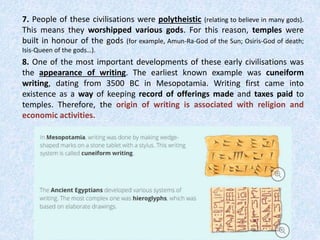
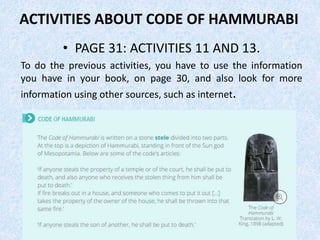
6. The first codes, or sets of laws, were written during this period. These
codes regulated day-to-day life. For example, Code of Hamurabi (king of
Babilonia).
Memphis
Code of Hamurabi
7. People of these civilisations were polytheistic (relating to believe in many gods).
This means they worshipped various gods. For this reason, temples were
built in honour of the gods (for example, Amun-Ra-God of the Sun; Osiris-God of death;
Isis-Queen of the gods…).
8. One of the most important developments of these early civilisations was
the appearance of writing. The earliest known example was cuneiform
writing, dating from 3500 BC in Mesopotamia. Writing first came into
existence as a way of keeping record of offerings made and taxes paid to
temples. Therefore, the origin of writing is associated with religion and
economic activities.
ACTIVITIES
Check if you have learnt about the common characteristics of Egypt
and Mesopotamia doing the following activities:
– Page 28: activities 1, 2, 3.
– Page 29: activities 5, 7.
– DEFINE THE FOLLOWING TERMS:
• Civilisation:
• Polytheism:
• Urban civilisation.
• Ancient History.
 PLEASE, REMEMBER:
 You have to write the statement with red pen.
 You have to write the answers whit blue pen.
 It is forbidden the use of pencil.
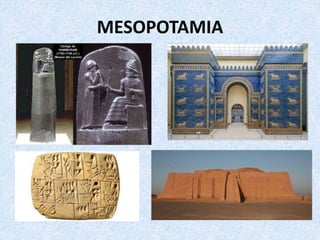
MESOPOTAMIA
MESOPOTAMIA
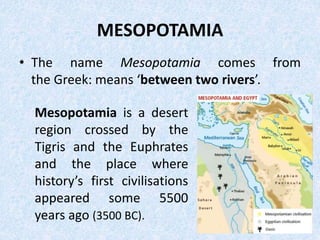
• The name Mesopotamia comes from
the Greek: means ‘between two rivers’.
Mesopotamia is a desert
region crossed by the
Tigris and the Euphrates
and the place where
history’s first civilisations
appeared some 5500
years ago (3500 BC).
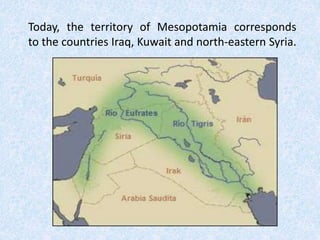
Today, the territory of Mesopotamia corresponds
to the countries Iraq, Kuwait and north-eastern Syria.
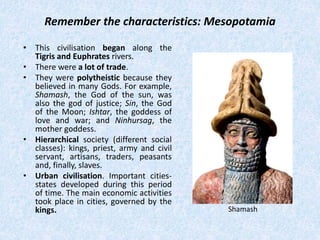
Remember the characteristics: Mesopotamia
• This civilisation began along the
Tigris and Euphrates rivers.
• There were a lot of trade.
• They were polytheistic because they
believed in many Gods. For example,
Shamash, the God of the sun, was
also the god of justice; Sin, the God
of the Moon; Ishtar, the goddess of
love and war; and Ninhursag, the
mother goddess.
• Hierarchical society (different social
classes): kings, priest, army and civil
servant, artisans, traders, peasants
and, finally, slaves.
• Urban civilisation. Important cities-
states developed during this period
of time. The main economic activities
took place in cities, governed by the
kings. Shamash
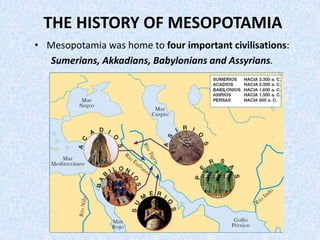
THE HISTORY OF MESOPOTAMIA
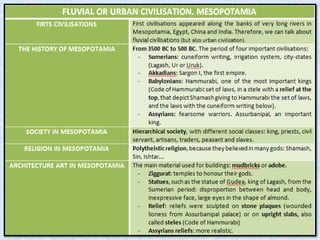
• Mesopotamia was home to four important civilisations:
Sumerians, Akkadians, Babylonians and Assyrians.
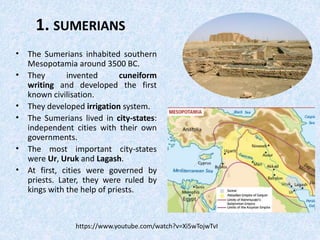
1. SUMERIANS
• The Sumerians inhabited southern
Mesopotamia around 3500 BC.
• They invented cuneiform
writing and developed the first
known civilisation.
• They developed irrigation system.
• The Sumerians lived in city-states:
independent cities with their own
governments.
• The most important city-states
were Ur, Uruk and Lagash.
• At first, cities were governed by
priests. Later, they were ruled by
kings with the help of priests.
https://www.youtube.com/watch?v=Xi5wTojwTvI
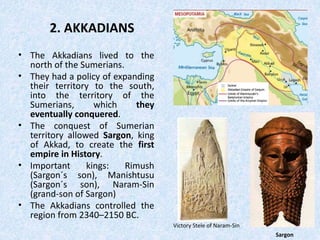
2. AKKADIANS
• The Akkadians lived to the
north of the Sumerians.
• They had a policy of expanding
their territory to the south,
into the territory of the
Sumerians, which they
eventually conquered.
• The conquest of Sumerian
territory allowed Sargon, king
of Akkad, to create the first
empire in History.
• Important kings: Rimush
(Sargon´s son), Manishtusu
(Sargon´s son), Naram-Sin
(grand-son of Sargon)
• The Akkadians controlled the
region from 2340–2150 BC.
Sargon
Victory Stele of Naram-Sin
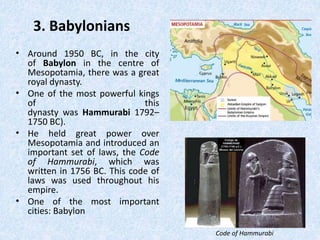
3. Babylonians
• Around 1950 BC, in the city
of Babylon in the centre of
Mesopotamia, there was a great
royal dynasty.
• One of the most powerful kings
of this
dynasty was Hammurabi 1792–
1750 BC).
• He held great power over
Mesopotamia and introduced an
important set of laws, the Code
of Hammurabi, which was
written in 1756 BC. This code of
laws was used throughout his
empire.
• One of the most important
cities: Babylon
Code of Hammurabi
4. Assyrians
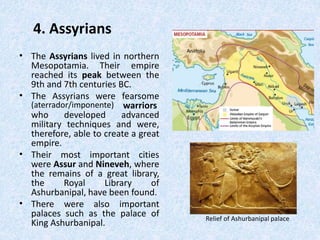
• The Assyrians lived in northern
Mesopotamia. Their empire
reached its peak between the
9th and 7th centuries BC.
• The Assyrians were fearsome
(aterrador/imponente) warriors
who developed advanced
military techniques and were,
therefore, able to create a great
empire.
• Their most important cities
were Assur and Nineveh, where
the remains of a great library,
the Royal Library of
Ashurbanipal, have been found.
• There were also important
palaces such as the palace of
King Ashurbanipal.
Relief of Ashurbanipal palace
ACTIVITIES ABOUT CODE OF HAMMURABI
• PAGE 31: ACTIVITIES 11 AND 13.
To do the previous activities, you have to use the information
you have in your book, on page 30, and also look for more
information using other sources, such as internet.
MESOPOTAMIAN ARCHITECTURE
• What materials did the Mesopotamians use for building?
The terrain of Mesopotamia is not very rocky, so the main
building material used was bricks made of mud (barro) or
mudbricks (barro cocido) or bricks made of adobe (mixture of sand, mud,
clay) sun-dried. Because of this, very little architecture has survived the test
of time, as mudbricks are less resistant than stone.
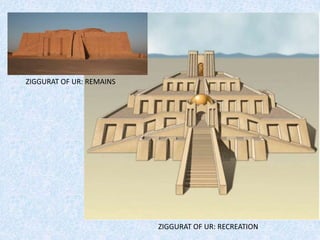
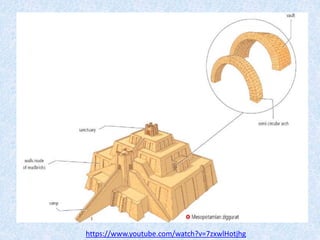
ZIGGURATS
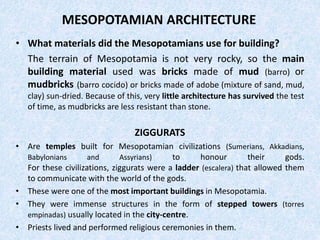
• Are temples built for Mesopotamian civilizations (Sumerians, Akkadians,
Babylonians and Assyrians) to honour their gods.
For these civilizations, ziggurats were a ladder (escalera) that allowed them
to communicate with the world of the gods.
• These were one of the most important buildings in Mesopotamia.
• They were immense structures in the form of stepped towers (torres
empinadas) usually located in the city-centre.
• Priests lived and performed religious ceremonies in them.
ZIGGURAT OF UR: RECREATION
ZIGGURAT OF UR: REMAINS
https://www.youtube.com/watch?v=7zxwlHotjhg
MESOPOTAMIAN SCULPTURE
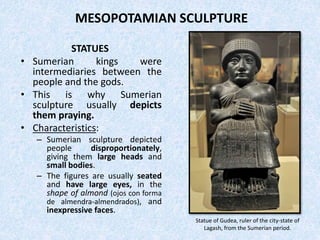
STATUES
• Sumerian kings were
intermediaries between the
people and the gods.
• This is why Sumerian
sculpture usually depicts
them praying.
• Characteristics:
– Sumerian sculpture depicted
people disproportionately,
giving them large heads and
small bodies.
– The figures are usually seated
and have large eyes, in the
shape of almond (ojos con forma
de almendra-almendrados), and
inexpressive faces.
Statue of Gudea, ruler of the city-state of
Lagash, from the Sumerian period.
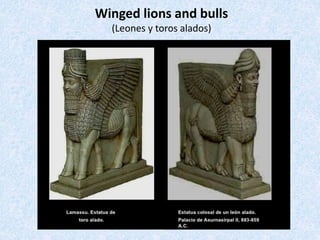
Winged lions and bulls
(Leones y toros alados)
MESOPOTAMIAN SCULPTURE
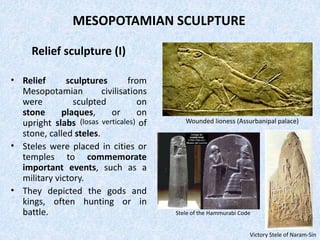
Relief sculpture (I)
• Relief sculptures from
Mesopotamian civilisations
were sculpted on
stone plaques, or on
upright slabs (losas verticales) of
stone, called steles.
• Steles were placed in cities or
temples to commemorate
important events, such as a
military victory.
• They depicted the gods and
kings, often hunting or in
battle.
Wounded lioness (Assurbanipal palace)
Victory Stele of Naram-Sin
Stele of the Hammurabi Code
MESOPOTAMIAN SCULPTURE
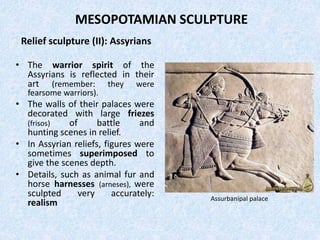
Relief sculpture (II): Assyrians
• The warrior spirit of the
Assyrians is reflected in their
art (remember: they were
fearsome warriors).
• The walls of their palaces were
decorated with large friezes
(frisos) of battle and
hunting scenes in relief.
• In Assyrian reliefs, figures were
sometimes superimposed to
give the scenes depth.
• Details, such as animal fur and
horse harnesses (arneses), were
sculpted very accurately:
realism Assurbanipal palace
MESOPOTAMIAN SCULPTURE
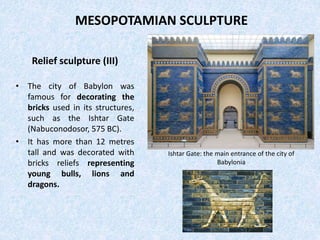
Relief sculpture (III)
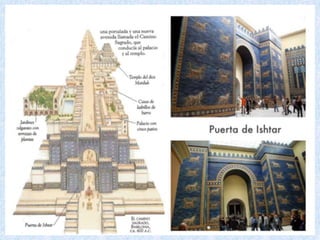
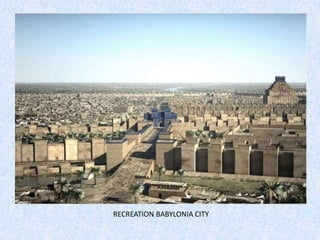
• The city of Babylon was
famous for decorating the
bricks used in its structures,
such as the Ishtar Gate
(Nabuconodosor, 575 BC).
• It has more than 12 metres
tall and was decorated with
bricks reliefs representing
young bulls, lions and
dragons.
Ishtar Gate: the main entrance of the city of
Babylonia
RECREATION BABYLONIA CITY
MESOPOTAMIAN LITERATURE
• As you know, writing developed in Mesopotamia as a way of
recording payments, offerings and taxes brought to temples.
• But did you know that the first great work of literature was
written by the Sumerians?
• The Epic of Gilgamesh was an epic POEM about
Gilgamesh, the king of the Mesopotamian city-state
Uruk. The poem is written on 12 tablets. We know
about the poem today as some tablets have survived.
– “Ea habló al valiente Enlil, diciendo: «Tú, el más sabio de los
dioses, tú, héroe, ¿cómo pudiste, sin respeto alguno, causar el
diluvio? ¡Castiga al pecador por sus pecados, castiga al ofensor
por su ofensa! ¡(Sin embargo), sé benévolo para que [la
humanidad] no sea cercenada!”.
More information about Gilgamesh epic poem:
http://www.nationalgeographic.com.es/historia/grandes-reportajes/la-epopeya-de-gilgamesh_6746
Enheduana: akkadian princess
(daughter of Sargon I)
• The earliest author and poet that we know by name.
IMPORTANT
• If you have time and you want to improve YOUR
FINAL MARK, write a short description about
Enheduana and one of her poems.
• Date of delivery: 28/04/2017
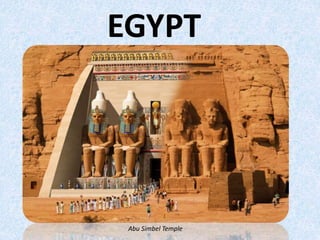
EGYPT
Abu Simbel Temple
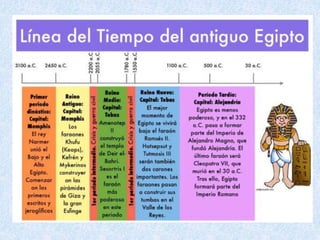
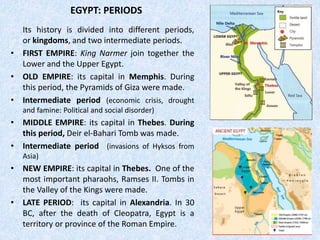
EGYPT: PERIODS
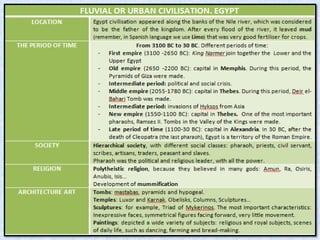
Its history is divided into different periods,
or kingdoms, and two intermediate periods.
• FIRST EMPIRE: King Narmer join together the
Lower and the Upper Egypt.
• OLD EMPIRE: its capital in Memphis. During
this period, the Pyramids of Giza were made.
• Intermediate period (economic crisis, drought
and famine: Political and social disorder)
• MIDDLE EMPIRE: its capital in Thebes. During
this period, Deir el-Bahari Tomb was made.
• Intermediate period (invasions of Hyksos from
Asia)
• NEW EMPIRE: its capital in Thebes. One of the
most important pharaohs, Ramses II. Tombs in
the Valley of the Kings were made.
• LATE PERIOD: its capital in Alexandria. In 30
BC, after the death of Cleopatra, Egypt is a
territory or province of the Roman Empire.
SOCIETY
 Hierarchical society: pharaohs, priests, army and civil servants
(scribes), artisans, traders, peasants and, finally, slaves.
• The PHARAOH was the most powerful person in Ancient Egypt. He
was the political and religious leader of the Egyptians, and
was considered to be the incarnation of the god Horus (instead of the
God of the heavens, the god of the Earth).
– As political leader, he also owned all the land, made laws, collected
taxes and was the head of the military.
– As religious leader, he performed rituals and built temples to honour
the gods.
• The pharaoh had a court of priests, that supervised the
worshipping of the gods at the temples (centers that collected
offerings and taxes from the common people), and scribes, who were
civil servants with a knowledge of hieroglyphic writing.
• Artisans, traders or peasants, who paid taxes on the land they
farmed and were required to work on the great royal and religious
structures.
• Slaves: they were people that did not have rights and were
considered to be the property of their masters.
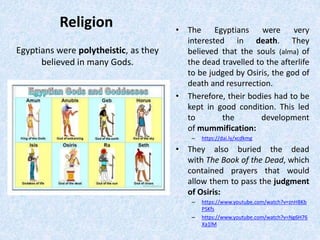
Religion • The Egyptians were very
interested in death. They
believed that the souls (alma) of
the dead travelled to the afterlife
to be judged by Osiris, the god of
death and resurrection.
• Therefore, their bodies had to be
kept in good condition. This led
to the development
of mummification:
– https://dai.ly/xcdkmg
• They also buried the dead
with The Book of the Dead, which
contained prayers that would
allow them to pass the judgment
of Osiris:
– https://www.youtube.com/watch?v=znH8Kb
PSKfs
– https://www.youtube.com/watch?v=Ng6H76
Xa1lM
Egyptians were polytheistic, as they
believed in many Gods.
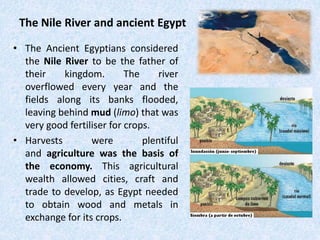
The Nile River and ancient Egypt
• The Ancient Egyptians considered
the Nile River to be the father of
their kingdom. The river
overflowed every year and the
fields along its banks flooded,
leaving behind mud (limo) that was
very good fertiliser for crops.
• Harvests were plentiful
and agriculture was the basis of
the economy. This agricultural
wealth allowed cities, craft and
trade to develop, as Egypt needed
to obtain wood and metals in
exchange for its crops.
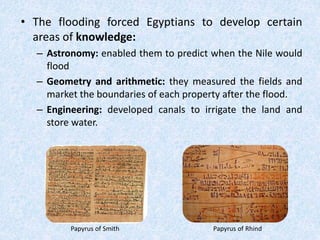
• The flooding forced Egyptians to develop certain
areas of knowledge:
– Astronomy: enabled them to predict when the Nile would
flood
– Geometry and arithmetic: they measured the fields and
market the boundaries of each property after the flood.
– Engineering: developed canals to irrigate the land and
store water.
Papyrus of Smith Papyrus of Rhind
INVESTIGATION ACTIVITY
• For the next class, look for information about Papyrus of
Smith and Rhind and write in your notebook the result of
your investigation.
• Papyrus of Smith: is an ancient Egyptian medical text; it
describes 48 cases of injuries, fractures, wounds,
dislocations and tumors
– Caso 45 Título: Instrucciones concernientes a tumores en su
pecho. Examen: Si examina a un hombre con un tumor abultado
en su pecho y encuentra que la hinchazón se ha extendido sobre
su pecho, y si pone su mano sobre ese pecho, sobre esos
tumores, y los encuentra fríos y no hay fiebre, y no tienen
granulación, y no forman líquido y no generan secreciones, y se
tocan como bultos. Veredicto: Debería decir con respecto a él:
“Uno que tiene tumores abultados, una enfermedad que debo
contener”. Tratamiento: No hay tratamiento. Si encuentra
tumores abultados en cualquier miembro de un hombre, deberá
tratarlo de acuerdo a estas direcciones. (Que no se haga nada).
• Papyrus of Rhind: is one of the best known examples
of Egyptian mathematics: arithmetic, geometry…
EGYPTIAN ARCHITECTURE AND ART
TOMBS
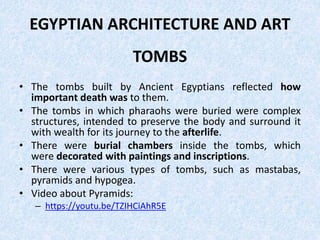
• The tombs built by Ancient Egyptians reflected how
important death was to them.
• The tombs in which pharaohs were buried were complex
structures, intended to preserve the body and surround it
with wealth for its journey to the afterlife.
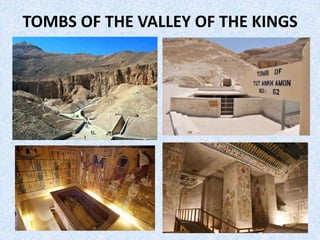
• There were burial chambers inside the tombs, which
were decorated with paintings and inscriptions.
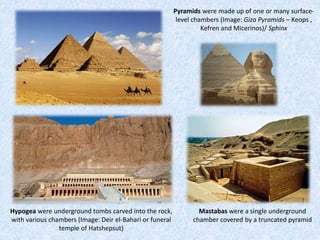
• There were various types of tombs, such as mastabas,
pyramids and hypogea.
• Video about Pyramids:
– https://youtu.be/TZIHCiAhR5E
Hypogea were underground tombs carved into the rock,
with various chambers (Image: Deir el-Bahari or funeral
temple of Hatshepsut)
Pyramids were made up of one or many surface-
level chambers (Image: Giza Pyramids – Keops ,
Kefren and Micerinos)/ Sphinx
Mastabas were a single underground
chamber covered by a truncated pyramid
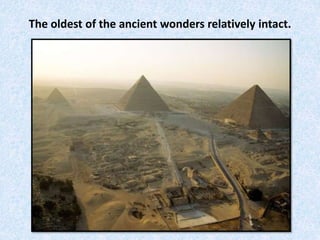
The oldest of the ancient wonders relatively intact.
TOMBS OF THE VALLEY OF THE KINGS
Temples
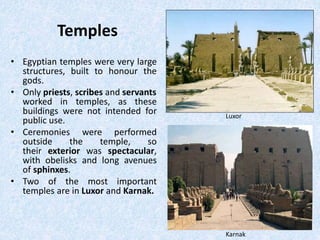
• Egyptian temples were very large
structures, built to honour the
gods.
• Only priests, scribes and servants
worked in temples, as these
buildings were not intended for
public use.
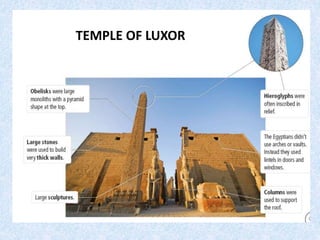
• Ceremonies were performed
outside the temple, so
their exterior was spectacular,
with obelisks and long avenues
of sphinxes.
• Two of the most important
temples are in Luxor and Karnak.
Luxor
Karnak
TEMPLE OF LUXOR
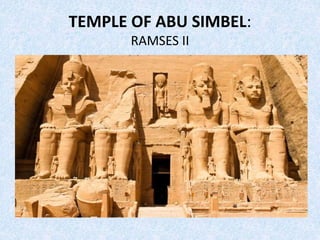
TEMPLE OF ABU SIMBEL:
RAMSES II
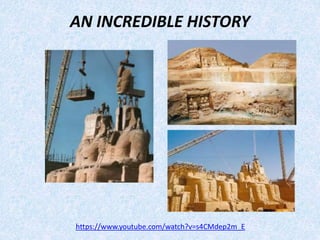
AN INCREDIBLE HISTORY
https://www.youtube.com/watch?v=s4CMdep2m_E
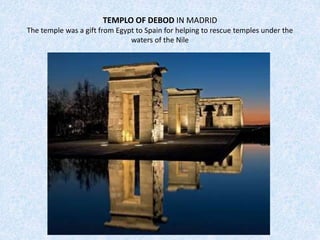
TEMPLO OF DEBOD IN MADRID
The temple was a gift from Egypt to Spain for helping to rescue temples under the
waters of the Nile
Sculpture
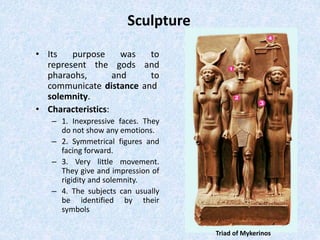
• Its purpose was to
represent the gods and
pharaohs, and to
communicate distance and
solemnity.
• Characteristics:
– 1. Inexpressive faces. They
do not show any emotions.
– 2. Symmetrical figures and
facing forward.
– 3. Very little movement.
They give and impression of
rigidity and solemnity.
– 4. The subjects can usually
be identified by their
symbols
Triad of Mykerinos
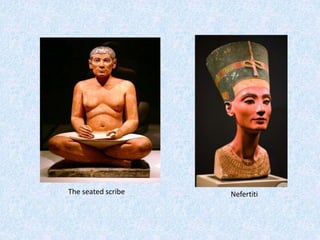
NefertitiThe seated scribe
Painting
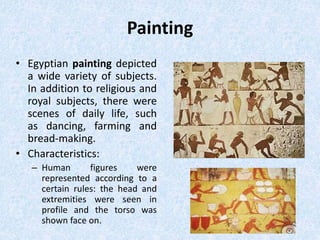
• Egyptian painting depicted
a wide variety of subjects.
In addition to religious and
royal subjects, there were
scenes of daily life, such
as dancing, farming and
bread-making.
• Characteristics:
– Human figures were
represented according to a
certain rules: the head and
extremities were seen in
profile and the torso was
shown face on.
INVESTIGATION ACTIVITY
• After watching this video
https://www.khanacademy.org/humanities/world-
history/history-beginnings/ancient/v/rosetta-stone-196-b-c-e,
and looking for information on internet,
answer the following questions:
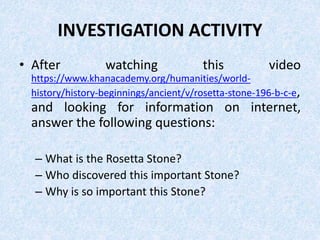
– What is the Rosetta Stone?
– Who discovered this important Stone?
– Why is so important this Stone?
OTHER EARLY CIVILISATIONS
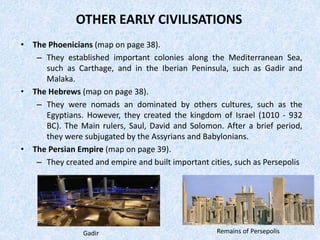
• The Phoenicians (map on page 38).
– They established important colonies along the Mediterranean Sea,
such as Carthage, and in the Iberian Peninsula, such as Gadir and
Malaka.
• The Hebrews (map on page 38).
– They were nomads an dominated by others cultures, such as the
Egyptians. However, they created the kingdom of Israel (1010 - 932
BC). The Main rulers, Saul, David and Solomon. After a brief period,
they were subjugated by the Assyrians and Babylonians.
• The Persian Empire (map on page 39).
– They created and empire and built important cities, such as Persepolis
Remains of PersepolisGadir

Unit 2. Early civilisation

  • 1.
    UNIT 2.- EARLYCIVILISATIONS
  • 2.
    WELCOME TO ANEW CLASS OF HISTORY • Today, we are going to start with the study of history. • We don´t forget the previous period of time: prehistory PREHISTORY HISTORY Before the invention of writing After the invention of writing
  • 3.
    Remember the timelinewith all the periods of history This term we are going to study ANCIENT HISTORY
  • 4.
    EARLY CIVILISATIONS URBAN CIVILISATION Mesopotamia Egypt CLASIC CIVILISATION Ancient Greek Ancient Rome ANCIENTHISTORY From the invention of writing to the fall of Roman Empire Unit 2 Unit 4 Unit 3
  • 5.
    BEFORE STARTING WITHTHE STUDY OF EARLY CIVILISATION… • You have to do the cover of unit 2 using the ancient Egyptian system of writing: hieroglyphs, based on elaborate drawings.
  • 6.
    EARLY CIVILISATION: Mesopotamia andEgypt In this unit, we will focus on the civilisations in Egypt and Mesopotamia
  • 8.
    What is acivilisation? • Is an advanced state of human society in which there is: – A stable food supply. – A division of labour. – A hierarchical society. – Systems of laws and government. – A developed culture. RAE: Conjunto de costumbres, saberes y artes propio de una sociedad humana.
  • 9.
    MESOPOTAMIA AND EGYPT. Commoncharacteristics 1. These early civilisations began along the banks of very long rivers, such as the Nile in Egypt, and the Tigris and the Euphrates in Mesopotamia.  People used their water to make the lands around them fertile for agriculture. They developed irrigation systems, such as canals, to channel water to more distant areas. 2. There was a lot of craftwork and trade in the areas around these large rivers. In fact, so much trade took place that people began to use money. Nectanebo II (361-350 AC)
  • 10.
    3. These earlycivilisations were urban civilisations, because the main economic activities were concentrated in cities. 4. Society in these early civilisations was very hierarchical (look at the population pyramid above). A minority, made up of kings and priests, controlled the majority of the wealth and governed the people. Under their command were the army and civil servants, who managed the kingdom. Traders were below these groups in the social hierarchy. Then came artisans, peasants and finally slaves. 5. In ancient civilisations, the majority of labour was done by slaves. They were the basis of the economy. Slaves did not have rights and were considered to be the property of their masters (amo). 6. The first codes, or sets of laws, were written during this period. These codes regulated day-to-day life. For example, Code of Hamurabi (king of Babilonia). Memphis Code of Hamurabi
  • 11.
    7. People ofthese civilisations were polytheistic (relating to believe in many gods). This means they worshipped various gods. For this reason, temples were built in honour of the gods (for example, Amun-Ra-God of the Sun; Osiris-God of death; Isis-Queen of the gods…). 8. One of the most important developments of these early civilisations was the appearance of writing. The earliest known example was cuneiform writing, dating from 3500 BC in Mesopotamia. Writing first came into existence as a way of keeping record of offerings made and taxes paid to temples. Therefore, the origin of writing is associated with religion and economic activities.
  • 12.
    ACTIVITIES Check if youhave learnt about the common characteristics of Egypt and Mesopotamia doing the following activities: – Page 28: activities 1, 2, 3. – Page 29: activities 5, 7. – DEFINE THE FOLLOWING TERMS: • Civilisation: • Polytheism: • Urban civilisation. • Ancient History.  PLEASE, REMEMBER:  You have to write the statement with red pen.  You have to write the answers whit blue pen.  It is forbidden the use of pencil.
  • 13.
  • 14.
    MESOPOTAMIA • The nameMesopotamia comes from the Greek: means ‘between two rivers’. Mesopotamia is a desert region crossed by the Tigris and the Euphrates and the place where history’s first civilisations appeared some 5500 years ago (3500 BC).
  • 15.
    Today, the territoryof Mesopotamia corresponds to the countries Iraq, Kuwait and north-eastern Syria.
  • 16.
    Remember the characteristics:Mesopotamia • This civilisation began along the Tigris and Euphrates rivers. • There were a lot of trade. • They were polytheistic because they believed in many Gods. For example, Shamash, the God of the sun, was also the god of justice; Sin, the God of the Moon; Ishtar, the goddess of love and war; and Ninhursag, the mother goddess. • Hierarchical society (different social classes): kings, priest, army and civil servant, artisans, traders, peasants and, finally, slaves. • Urban civilisation. Important cities- states developed during this period of time. The main economic activities took place in cities, governed by the kings. Shamash
  • 17.
    THE HISTORY OFMESOPOTAMIA • Mesopotamia was home to four important civilisations: Sumerians, Akkadians, Babylonians and Assyrians.
  • 18.
    1. SUMERIANS • TheSumerians inhabited southern Mesopotamia around 3500 BC. • They invented cuneiform writing and developed the first known civilisation. • They developed irrigation system. • The Sumerians lived in city-states: independent cities with their own governments. • The most important city-states were Ur, Uruk and Lagash. • At first, cities were governed by priests. Later, they were ruled by kings with the help of priests. https://www.youtube.com/watch?v=Xi5wTojwTvI
  • 19.
    2. AKKADIANS • TheAkkadians lived to the north of the Sumerians. • They had a policy of expanding their territory to the south, into the territory of the Sumerians, which they eventually conquered. • The conquest of Sumerian territory allowed Sargon, king of Akkad, to create the first empire in History. • Important kings: Rimush (Sargon´s son), Manishtusu (Sargon´s son), Naram-Sin (grand-son of Sargon) • The Akkadians controlled the region from 2340–2150 BC. Sargon Victory Stele of Naram-Sin
  • 20.
    3. Babylonians • Around1950 BC, in the city of Babylon in the centre of Mesopotamia, there was a great royal dynasty. • One of the most powerful kings of this dynasty was Hammurabi 1792– 1750 BC). • He held great power over Mesopotamia and introduced an important set of laws, the Code of Hammurabi, which was written in 1756 BC. This code of laws was used throughout his empire. • One of the most important cities: Babylon Code of Hammurabi
  • 21.
    4. Assyrians • TheAssyrians lived in northern Mesopotamia. Their empire reached its peak between the 9th and 7th centuries BC. • The Assyrians were fearsome (aterrador/imponente) warriors who developed advanced military techniques and were, therefore, able to create a great empire. • Their most important cities were Assur and Nineveh, where the remains of a great library, the Royal Library of Ashurbanipal, have been found. • There were also important palaces such as the palace of King Ashurbanipal. Relief of Ashurbanipal palace
  • 23.
    ACTIVITIES ABOUT CODEOF HAMMURABI • PAGE 31: ACTIVITIES 11 AND 13. To do the previous activities, you have to use the information you have in your book, on page 30, and also look for more information using other sources, such as internet.
  • 24.
    MESOPOTAMIAN ARCHITECTURE • Whatmaterials did the Mesopotamians use for building? The terrain of Mesopotamia is not very rocky, so the main building material used was bricks made of mud (barro) or mudbricks (barro cocido) or bricks made of adobe (mixture of sand, mud, clay) sun-dried. Because of this, very little architecture has survived the test of time, as mudbricks are less resistant than stone. ZIGGURATS • Are temples built for Mesopotamian civilizations (Sumerians, Akkadians, Babylonians and Assyrians) to honour their gods. For these civilizations, ziggurats were a ladder (escalera) that allowed them to communicate with the world of the gods. • These were one of the most important buildings in Mesopotamia. • They were immense structures in the form of stepped towers (torres empinadas) usually located in the city-centre. • Priests lived and performed religious ceremonies in them.
  • 25.
    ZIGGURAT OF UR:RECREATION ZIGGURAT OF UR: REMAINS
  • 26.
  • 27.
    MESOPOTAMIAN SCULPTURE STATUES • Sumeriankings were intermediaries between the people and the gods. • This is why Sumerian sculpture usually depicts them praying. • Characteristics: – Sumerian sculpture depicted people disproportionately, giving them large heads and small bodies. – The figures are usually seated and have large eyes, in the shape of almond (ojos con forma de almendra-almendrados), and inexpressive faces. Statue of Gudea, ruler of the city-state of Lagash, from the Sumerian period.
  • 28.
    Winged lions andbulls (Leones y toros alados)
  • 29.
    MESOPOTAMIAN SCULPTURE Relief sculpture(I) • Relief sculptures from Mesopotamian civilisations were sculpted on stone plaques, or on upright slabs (losas verticales) of stone, called steles. • Steles were placed in cities or temples to commemorate important events, such as a military victory. • They depicted the gods and kings, often hunting or in battle. Wounded lioness (Assurbanipal palace) Victory Stele of Naram-Sin Stele of the Hammurabi Code
  • 30.
    MESOPOTAMIAN SCULPTURE Relief sculpture(II): Assyrians • The warrior spirit of the Assyrians is reflected in their art (remember: they were fearsome warriors). • The walls of their palaces were decorated with large friezes (frisos) of battle and hunting scenes in relief. • In Assyrian reliefs, figures were sometimes superimposed to give the scenes depth. • Details, such as animal fur and horse harnesses (arneses), were sculpted very accurately: realism Assurbanipal palace
  • 31.
    MESOPOTAMIAN SCULPTURE Relief sculpture(III) • The city of Babylon was famous for decorating the bricks used in its structures, such as the Ishtar Gate (Nabuconodosor, 575 BC). • It has more than 12 metres tall and was decorated with bricks reliefs representing young bulls, lions and dragons. Ishtar Gate: the main entrance of the city of Babylonia
  • 33.
  • 34.
    MESOPOTAMIAN LITERATURE • Asyou know, writing developed in Mesopotamia as a way of recording payments, offerings and taxes brought to temples. • But did you know that the first great work of literature was written by the Sumerians? • The Epic of Gilgamesh was an epic POEM about Gilgamesh, the king of the Mesopotamian city-state Uruk. The poem is written on 12 tablets. We know about the poem today as some tablets have survived. – “Ea habló al valiente Enlil, diciendo: «Tú, el más sabio de los dioses, tú, héroe, ¿cómo pudiste, sin respeto alguno, causar el diluvio? ¡Castiga al pecador por sus pecados, castiga al ofensor por su ofensa! ¡(Sin embargo), sé benévolo para que [la humanidad] no sea cercenada!”. More information about Gilgamesh epic poem: http://www.nationalgeographic.com.es/historia/grandes-reportajes/la-epopeya-de-gilgamesh_6746
  • 35.
    Enheduana: akkadian princess (daughterof Sargon I) • The earliest author and poet that we know by name. IMPORTANT • If you have time and you want to improve YOUR FINAL MARK, write a short description about Enheduana and one of her poems. • Date of delivery: 28/04/2017
  • 36.
  • 38.
    EGYPT: PERIODS Its historyis divided into different periods, or kingdoms, and two intermediate periods. • FIRST EMPIRE: King Narmer join together the Lower and the Upper Egypt. • OLD EMPIRE: its capital in Memphis. During this period, the Pyramids of Giza were made. • Intermediate period (economic crisis, drought and famine: Political and social disorder) • MIDDLE EMPIRE: its capital in Thebes. During this period, Deir el-Bahari Tomb was made. • Intermediate period (invasions of Hyksos from Asia) • NEW EMPIRE: its capital in Thebes. One of the most important pharaohs, Ramses II. Tombs in the Valley of the Kings were made. • LATE PERIOD: its capital in Alexandria. In 30 BC, after the death of Cleopatra, Egypt is a territory or province of the Roman Empire.
  • 39.
    SOCIETY  Hierarchical society:pharaohs, priests, army and civil servants (scribes), artisans, traders, peasants and, finally, slaves. • The PHARAOH was the most powerful person in Ancient Egypt. He was the political and religious leader of the Egyptians, and was considered to be the incarnation of the god Horus (instead of the God of the heavens, the god of the Earth). – As political leader, he also owned all the land, made laws, collected taxes and was the head of the military. – As religious leader, he performed rituals and built temples to honour the gods. • The pharaoh had a court of priests, that supervised the worshipping of the gods at the temples (centers that collected offerings and taxes from the common people), and scribes, who were civil servants with a knowledge of hieroglyphic writing. • Artisans, traders or peasants, who paid taxes on the land they farmed and were required to work on the great royal and religious structures. • Slaves: they were people that did not have rights and were considered to be the property of their masters.
  • 40.
    Religion • TheEgyptians were very interested in death. They believed that the souls (alma) of the dead travelled to the afterlife to be judged by Osiris, the god of death and resurrection. • Therefore, their bodies had to be kept in good condition. This led to the development of mummification: – https://dai.ly/xcdkmg • They also buried the dead with The Book of the Dead, which contained prayers that would allow them to pass the judgment of Osiris: – https://www.youtube.com/watch?v=znH8Kb PSKfs – https://www.youtube.com/watch?v=Ng6H76 Xa1lM Egyptians were polytheistic, as they believed in many Gods.
  • 41.
    The Nile Riverand ancient Egypt • The Ancient Egyptians considered the Nile River to be the father of their kingdom. The river overflowed every year and the fields along its banks flooded, leaving behind mud (limo) that was very good fertiliser for crops. • Harvests were plentiful and agriculture was the basis of the economy. This agricultural wealth allowed cities, craft and trade to develop, as Egypt needed to obtain wood and metals in exchange for its crops.
  • 42.
    • The floodingforced Egyptians to develop certain areas of knowledge: – Astronomy: enabled them to predict when the Nile would flood – Geometry and arithmetic: they measured the fields and market the boundaries of each property after the flood. – Engineering: developed canals to irrigate the land and store water. Papyrus of Smith Papyrus of Rhind
  • 43.
    INVESTIGATION ACTIVITY • Forthe next class, look for information about Papyrus of Smith and Rhind and write in your notebook the result of your investigation. • Papyrus of Smith: is an ancient Egyptian medical text; it describes 48 cases of injuries, fractures, wounds, dislocations and tumors – Caso 45 Título: Instrucciones concernientes a tumores en su pecho. Examen: Si examina a un hombre con un tumor abultado en su pecho y encuentra que la hinchazón se ha extendido sobre su pecho, y si pone su mano sobre ese pecho, sobre esos tumores, y los encuentra fríos y no hay fiebre, y no tienen granulación, y no forman líquido y no generan secreciones, y se tocan como bultos. Veredicto: Debería decir con respecto a él: “Uno que tiene tumores abultados, una enfermedad que debo contener”. Tratamiento: No hay tratamiento. Si encuentra tumores abultados en cualquier miembro de un hombre, deberá tratarlo de acuerdo a estas direcciones. (Que no se haga nada). • Papyrus of Rhind: is one of the best known examples of Egyptian mathematics: arithmetic, geometry…
  • 44.
    EGYPTIAN ARCHITECTURE ANDART TOMBS • The tombs built by Ancient Egyptians reflected how important death was to them. • The tombs in which pharaohs were buried were complex structures, intended to preserve the body and surround it with wealth for its journey to the afterlife. • There were burial chambers inside the tombs, which were decorated with paintings and inscriptions. • There were various types of tombs, such as mastabas, pyramids and hypogea. • Video about Pyramids: – https://youtu.be/TZIHCiAhR5E
  • 45.
    Hypogea were undergroundtombs carved into the rock, with various chambers (Image: Deir el-Bahari or funeral temple of Hatshepsut) Pyramids were made up of one or many surface- level chambers (Image: Giza Pyramids – Keops , Kefren and Micerinos)/ Sphinx Mastabas were a single underground chamber covered by a truncated pyramid
  • 46.
    The oldest ofthe ancient wonders relatively intact.
  • 47.
    TOMBS OF THEVALLEY OF THE KINGS
  • 48.
    Temples • Egyptian templeswere very large structures, built to honour the gods. • Only priests, scribes and servants worked in temples, as these buildings were not intended for public use. • Ceremonies were performed outside the temple, so their exterior was spectacular, with obelisks and long avenues of sphinxes. • Two of the most important temples are in Luxor and Karnak. Luxor Karnak
  • 49.
  • 50.
    TEMPLE OF ABUSIMBEL: RAMSES II
  • 51.
  • 52.
    TEMPLO OF DEBODIN MADRID The temple was a gift from Egypt to Spain for helping to rescue temples under the waters of the Nile
  • 53.
    Sculpture • Its purposewas to represent the gods and pharaohs, and to communicate distance and solemnity. • Characteristics: – 1. Inexpressive faces. They do not show any emotions. – 2. Symmetrical figures and facing forward. – 3. Very little movement. They give and impression of rigidity and solemnity. – 4. The subjects can usually be identified by their symbols Triad of Mykerinos
  • 54.
  • 55.
    Painting • Egyptian paintingdepicted a wide variety of subjects. In addition to religious and royal subjects, there were scenes of daily life, such as dancing, farming and bread-making. • Characteristics: – Human figures were represented according to a certain rules: the head and extremities were seen in profile and the torso was shown face on.
  • 56.
    INVESTIGATION ACTIVITY • Afterwatching this video https://www.khanacademy.org/humanities/world- history/history-beginnings/ancient/v/rosetta-stone-196-b-c-e, and looking for information on internet, answer the following questions: – What is the Rosetta Stone? – Who discovered this important Stone? – Why is so important this Stone?
  • 59.
    OTHER EARLY CIVILISATIONS •The Phoenicians (map on page 38). – They established important colonies along the Mediterranean Sea, such as Carthage, and in the Iberian Peninsula, such as Gadir and Malaka. • The Hebrews (map on page 38). – They were nomads an dominated by others cultures, such as the Egyptians. However, they created the kingdom of Israel (1010 - 932 BC). The Main rulers, Saul, David and Solomon. After a brief period, they were subjugated by the Assyrians and Babylonians. • The Persian Empire (map on page 39). – They created and empire and built important cities, such as Persepolis Remains of PersepolisGadir