Buying Merchandise
14-2
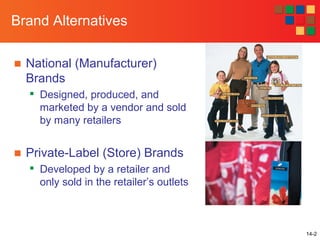
Brand Alternatives
■ National (Manufacturer)
Brands

Designed, produced, and
marketed by a vendor and sold
by many retailers
■ Private-Label (Store) Brands

Developed by a retailer and
only sold in the retailer’s outlets
14-3
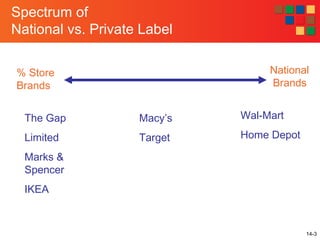
Spectrum of
National vs. Private Label
The Gap
Limited
Marks &
Spencer
IKEA
Wal-Mart
Home Depot
% Store
Brands
National
Brands
Macy’s
Target
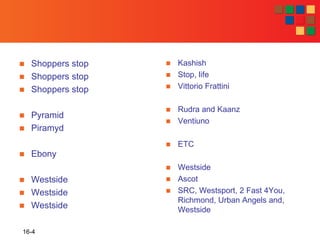
■ Shoppers stop
■ Shoppers stop
■ Shoppers stop
■ Pyramid
■ Piramyd
■ Ebony
■ Westside
■ Westside
■ Westside
■ Kashish
■ Stop, life
■ Vittorio Frattini
■ Rudra and Kaanz
■ Ventiuno
■ ETC
■ Westside
■ Ascot
■ SRC, Westsport, 2 Fast 4You,
Richmond, Urban Angels and,
Westside
16-4
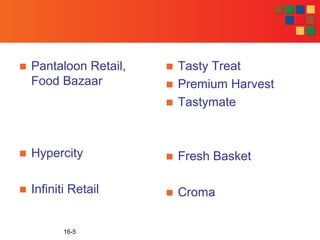
■ Pantaloon Retail,
Food Bazaar
■ Hypercity
■ Infiniti Retail
■ Tasty Treat
■ Premium Harvest
■ Tastymate
■ Fresh Basket
■ Croma
16-5
14-6
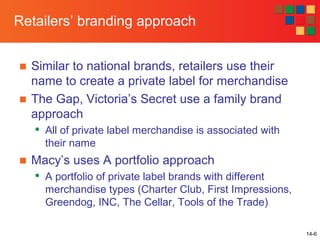
Retailers’ branding approach
■ Similar to national brands, retailers use their
name to create a private label for merchandise
■ The Gap, Victoria’s Secret use a family brand
approach

All of private label merchandise is associated with
their name
■ Macy’s uses A portfolio approach

A portfolio of private label brands with different
merchandise types (Charter Club, First Impressions,
Greendog, INC, The Cellar, Tools of the Trade)
14-7
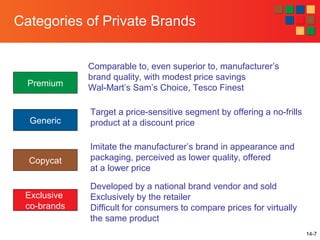
Categories of Private Brands
Premium
Generic
Copycat
Exclusive
co-brands
Comparable to, even superior to, manufacturer’s
brand quality, with modest price savings
Wal-Mart’s Sam’s Choice, Tesco Finest
Target a price-sensitive segment by offering a no-frills
product at a discount price
Imitate the manufacturer’s brand in appearance and
packaging, perceived as lower quality, offered
at a lower price
Developed by a national brand vendor and sold
Exclusively by the retailer
Difficult for consumers to compare prices for virtually
the same product
14-8
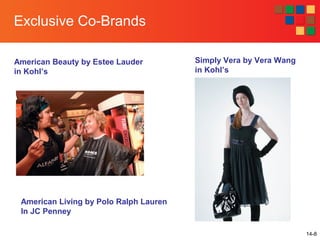
Exclusive Co-Brands
American Living by Polo Ralph Lauren
In JC Penney
American Beauty by Estee Lauder
in Kohl’s
Simply Vera by Vera Wang
in Kohl’s
■ Sam's Choice, and Great Value are all dominant labels as are many
of its proprietary brands in apparel and other categories.
■ The company is expanding its presence in the "green" arena, with
more eco-friendly lines of bedding, cleaners, and food. There's even
milk made without artificial growth hormones under the Great Value
name.
■ Brand shops are prominent at Wal-Mart, particularly for
entertainment properties appealing to younger audiences such as
High School Musical and Hannah Montana from Disney Consumer
Products. Wal-Mart's ability to obtain exclusives on such wildly
popular licenses as High School Musical digital downloads have
helped the retailer attract a younger, more contemporary shopper
■ http://www.licensemag.com/license-global/top-25-global-retailers
14-9
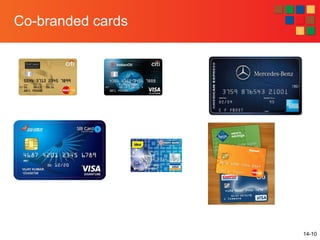
Co-branded cards
14-10
14-11
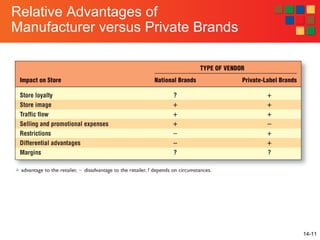
Relative Advantages of
Manufacturer versus Private Brands
14-12
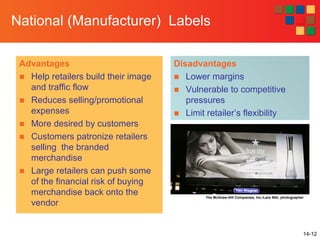
National (Manufacturer) Labels
Advantages
■ Help retailers build their image
and traffic flow
■ Reduces selling/promotional
expenses
■ More desired by customers
■ Customers patronize retailers
selling the branded
merchandise
■ Large retailers can push some
of the financial risk of buying
merchandise back onto the
vendor
Disadvantages
■ Lower margins
■ Vulnerable to competitive
pressures
■ Limit retailer’s flexibility
The McGraw-Hill Companies, Inc./Lars Niki, photographer
14-13
Private Labels
Advantages
■ Unique merchandise not
available at competitive outlets
■ Exclusivity boosts store loyalty
■ Difficult for customers to
compare price with competitors
■ Higher margins
Disadvantages
■ Require significant
investments in design, global
manufacturing sourcing
■ Need to develop expertise in
developing and promoting
brand
■ Unable to sell excess
merchandise
■ Typically less desirable for
customers
14-14
Buying National Brand Merchandise
■ Buying decision for fashion apparel/accessories:

5-6 times a year

Many months before delivery

Withhold open-to-buy (OTB) for new items with
fashion change
■ Buying decision for staple merchandise:

Less frequent

Continuous replenishment
14-15
Meeting National Brand Vendors
■ Wholesale Market Centers

National Markets,Regional Markets
■ Trade Shows
■ Internet Exchanges

Worldwide Retail Exchange
■ Meeting Vendors at Your Company
14-16
National Brand Buying Process
■ Meet with vendors
■ Discuss performance of vendor’s merchandise during
the previous season
■ Review the vendor’s offering for the coming season
■ May place orders for the coming season
■ Sometimes they do not buy at market, but review
merchandise, return to their offices to discuss with the
buying team before negotiating with vendors
14-17
Developing Private Label Merchandise
■ In-House: Large retailers (e.g., JCPenney, Macy’s, The Gap,
American Eagle Outfitters) have divisions specialized in
• identifying trends, designing, specifying products
• Selecting manufacturers
• Monitoring and managing manufacturing conditions and product quality
■ Acquisition:
• one of the world’s biggest contract manufacturers, importers, distributors of
apparel
• Have manufacturing operations and joint ventures
• Also provides private label merchandise for Abercrombie & Fitch, Lane Bryant,
New York & Company, Chico’s
■ Outsource: ex. Li & Fung – partnered with many specialty retailers
14-18
Sourcing Private Label Merchandise
After decisions are made on what and how much private
label merchandise will be acquired,
■ Designers develop specifications
■ Sourcing departments find a manufacturer,
negotiate a contract, and monitor the production
process, or
■ Use Reverse Auctions to get quality private label
merchandise at low prices
14-19
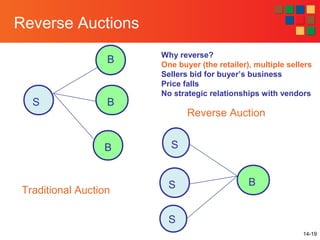
B
S
S
S
Reverse Auction
S
B
B
B
Traditional Auction
Reverse Auctions
Why reverse?
One buyer (the retailer), multiple sellers
Sellers bid for buyer’s business
Price falls
No strategic relationships with vendors
14-20
Negotiating with Vendors
Two-way
communication
designed to reach an
agreement when two
parties have both
shared and conflicting
interests.
Royalty-Free/CORBIS
14-21
Tips for Effective Negotiations
■ Have at least many negotiators as the vendor
■ Choose a good place to negotiate
■ Be Aware of real deadlines
■ Separate people from problem
■ Insist on objective Information
■ Invent options for mutual gain
■ Let the other party do the talking
■ Know how far to go
■ Don’t burn bridges
■ Don’t assume
14-22
Strategic (Partnering) Relationships
Retailer and vendor
committed to maintaining
relationships over the
long-term and investing
in mutually beneficial
opportunities
14-23
Building Blocks for Strategic Partnerships
•Stockbyte/Punchstock Images
■ Mutual Trust
■ Open Communication
■ Common Goals
■ Credible Commitments
14-24
Legal and Ethical Issues
Terms of Conditions of Purchase
■ Restricts the prices and terms that vendors can offer to
retailers
■ Forbid vendors from offering different terms and
conditions to different retailers for the same merchandise
and quantity
■ Different prices can be offered if

The costs of manufacturing, selling, and delivery are different

The retailers are providing different functions (e.g., distribution,
store service, etc.)
14-25
Legal and Ethical Issues
Resale Price Maintenance (RPM)
■ A requirement imposed by a vendor that a
retailer cannot sell an item for less than a
specific price – the manufacturer’s suggested
retail price (MRP)

For ensure adequate margin for retailers, but some
retailers do not appreciate RPM to have the flexibility
on pricing

Reduces free riding of discount stores
14-26
Chargebacks
■ A practice used by retailers in which they deduct
money from the amount they owe a vendor
without getting vendor approval.
■ Two Reasons:

merchandise isn’t selling

vendor mistakes
■ Difficult for vendors - Disrupt relationships
14-27
Slotting Allowances/ Buybacks
■ Stocklifts, Lift-outs
■ Used to get products into retail stores.
■ Two scenarios:

Retailer allows a vendor to create space for its
goods by “buying back” a competitors inventory and
removing it from a retailer’s system.

Retailer forces a vendor to buyback slow-moving
merchandise.
14-28
Counterfeit Merchandise
■ Goods made and sold without the permission of the owner
of a trademark, a copyright, or a patented invention that is
legally protected in the country where it is marketed
■ Major problem is counterfeiting intellectual property
14-29
Gray-Market and Diverted Merchandise
■ Gray- Market Merchandise (parallel imports)
■ Diverted Merchandise is similar to gray-market
merchandise except there need not be distribution
across international boundaries.
14-30
Exclusive Dealing Agreements
■ Occur when a manufacturer or wholesaler
restricts a retailer into carrying only its
products and nothing from competing vendors

Example: Safeway – Coca-Cola
■ Illegal when they restrict competition
14-31
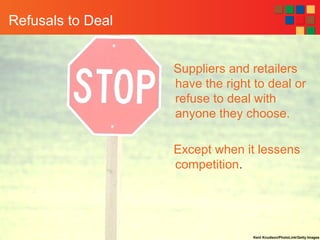
Refusals to Deal
Suppliers and retailers
have the right to deal or
refuse to deal with
anyone they choose.
Except when it lessens
competition.
Kent Knudson/PhotoLink/Getty Images

Merchandise buying

  • 1.
  • 2.
    14-2 Brand Alternatives ■ National(Manufacturer) Brands  Designed, produced, and marketed by a vendor and sold by many retailers ■ Private-Label (Store) Brands  Developed by a retailer and only sold in the retailer’s outlets
  • 3.
    14-3 Spectrum of National vs.Private Label The Gap Limited Marks & Spencer IKEA Wal-Mart Home Depot % Store Brands National Brands Macy’s Target
  • 4.
    ■ Shoppers stop ■Shoppers stop ■ Shoppers stop ■ Pyramid ■ Piramyd ■ Ebony ■ Westside ■ Westside ■ Westside ■ Kashish ■ Stop, life ■ Vittorio Frattini ■ Rudra and Kaanz ■ Ventiuno ■ ETC ■ Westside ■ Ascot ■ SRC, Westsport, 2 Fast 4You, Richmond, Urban Angels and, Westside 16-4
  • 5.
    ■ Pantaloon Retail, FoodBazaar ■ Hypercity ■ Infiniti Retail ■ Tasty Treat ■ Premium Harvest ■ Tastymate ■ Fresh Basket ■ Croma 16-5
  • 6.
    14-6 Retailers’ branding approach ■Similar to national brands, retailers use their name to create a private label for merchandise ■ The Gap, Victoria’s Secret use a family brand approach  All of private label merchandise is associated with their name ■ Macy’s uses A portfolio approach  A portfolio of private label brands with different merchandise types (Charter Club, First Impressions, Greendog, INC, The Cellar, Tools of the Trade)
  • 7.
    14-7 Categories of PrivateBrands Premium Generic Copycat Exclusive co-brands Comparable to, even superior to, manufacturer’s brand quality, with modest price savings Wal-Mart’s Sam’s Choice, Tesco Finest Target a price-sensitive segment by offering a no-frills product at a discount price Imitate the manufacturer’s brand in appearance and packaging, perceived as lower quality, offered at a lower price Developed by a national brand vendor and sold Exclusively by the retailer Difficult for consumers to compare prices for virtually the same product
  • 8.
    14-8 Exclusive Co-Brands American Livingby Polo Ralph Lauren In JC Penney American Beauty by Estee Lauder in Kohl’s Simply Vera by Vera Wang in Kohl’s
  • 9.
    ■ Sam's Choice,and Great Value are all dominant labels as are many of its proprietary brands in apparel and other categories. ■ The company is expanding its presence in the "green" arena, with more eco-friendly lines of bedding, cleaners, and food. There's even milk made without artificial growth hormones under the Great Value name. ■ Brand shops are prominent at Wal-Mart, particularly for entertainment properties appealing to younger audiences such as High School Musical and Hannah Montana from Disney Consumer Products. Wal-Mart's ability to obtain exclusives on such wildly popular licenses as High School Musical digital downloads have helped the retailer attract a younger, more contemporary shopper ■ http://www.licensemag.com/license-global/top-25-global-retailers 14-9
  • 10.
  • 11.
  • 12.
    14-12 National (Manufacturer) Labels Advantages ■Help retailers build their image and traffic flow ■ Reduces selling/promotional expenses ■ More desired by customers ■ Customers patronize retailers selling the branded merchandise ■ Large retailers can push some of the financial risk of buying merchandise back onto the vendor Disadvantages ■ Lower margins ■ Vulnerable to competitive pressures ■ Limit retailer’s flexibility The McGraw-Hill Companies, Inc./Lars Niki, photographer
  • 13.
    14-13 Private Labels Advantages ■ Uniquemerchandise not available at competitive outlets ■ Exclusivity boosts store loyalty ■ Difficult for customers to compare price with competitors ■ Higher margins Disadvantages ■ Require significant investments in design, global manufacturing sourcing ■ Need to develop expertise in developing and promoting brand ■ Unable to sell excess merchandise ■ Typically less desirable for customers
  • 14.
    14-14 Buying National BrandMerchandise ■ Buying decision for fashion apparel/accessories:  5-6 times a year  Many months before delivery  Withhold open-to-buy (OTB) for new items with fashion change ■ Buying decision for staple merchandise:  Less frequent  Continuous replenishment
  • 15.
    14-15 Meeting National BrandVendors ■ Wholesale Market Centers  National Markets,Regional Markets ■ Trade Shows ■ Internet Exchanges  Worldwide Retail Exchange ■ Meeting Vendors at Your Company
  • 16.
    14-16 National Brand BuyingProcess ■ Meet with vendors ■ Discuss performance of vendor’s merchandise during the previous season ■ Review the vendor’s offering for the coming season ■ May place orders for the coming season ■ Sometimes they do not buy at market, but review merchandise, return to their offices to discuss with the buying team before negotiating with vendors
  • 17.
    14-17 Developing Private LabelMerchandise ■ In-House: Large retailers (e.g., JCPenney, Macy’s, The Gap, American Eagle Outfitters) have divisions specialized in • identifying trends, designing, specifying products • Selecting manufacturers • Monitoring and managing manufacturing conditions and product quality ■ Acquisition: • one of the world’s biggest contract manufacturers, importers, distributors of apparel • Have manufacturing operations and joint ventures • Also provides private label merchandise for Abercrombie & Fitch, Lane Bryant, New York & Company, Chico’s ■ Outsource: ex. Li & Fung – partnered with many specialty retailers
  • 18.
    14-18 Sourcing Private LabelMerchandise After decisions are made on what and how much private label merchandise will be acquired, ■ Designers develop specifications ■ Sourcing departments find a manufacturer, negotiate a contract, and monitor the production process, or ■ Use Reverse Auctions to get quality private label merchandise at low prices
  • 19.
    14-19 B S S S Reverse Auction S B B B Traditional Auction ReverseAuctions Why reverse? One buyer (the retailer), multiple sellers Sellers bid for buyer’s business Price falls No strategic relationships with vendors
  • 20.
    14-20 Negotiating with Vendors Two-way communication designedto reach an agreement when two parties have both shared and conflicting interests. Royalty-Free/CORBIS
  • 21.
    14-21 Tips for EffectiveNegotiations ■ Have at least many negotiators as the vendor ■ Choose a good place to negotiate ■ Be Aware of real deadlines ■ Separate people from problem ■ Insist on objective Information ■ Invent options for mutual gain ■ Let the other party do the talking ■ Know how far to go ■ Don’t burn bridges ■ Don’t assume
  • 22.
    14-22 Strategic (Partnering) Relationships Retailerand vendor committed to maintaining relationships over the long-term and investing in mutually beneficial opportunities
  • 23.
    14-23 Building Blocks forStrategic Partnerships •Stockbyte/Punchstock Images ■ Mutual Trust ■ Open Communication ■ Common Goals ■ Credible Commitments
  • 24.
    14-24 Legal and EthicalIssues Terms of Conditions of Purchase ■ Restricts the prices and terms that vendors can offer to retailers ■ Forbid vendors from offering different terms and conditions to different retailers for the same merchandise and quantity ■ Different prices can be offered if  The costs of manufacturing, selling, and delivery are different  The retailers are providing different functions (e.g., distribution, store service, etc.)
  • 25.
    14-25 Legal and EthicalIssues Resale Price Maintenance (RPM) ■ A requirement imposed by a vendor that a retailer cannot sell an item for less than a specific price – the manufacturer’s suggested retail price (MRP)  For ensure adequate margin for retailers, but some retailers do not appreciate RPM to have the flexibility on pricing  Reduces free riding of discount stores
  • 26.
    14-26 Chargebacks ■ A practiceused by retailers in which they deduct money from the amount they owe a vendor without getting vendor approval. ■ Two Reasons:  merchandise isn’t selling  vendor mistakes ■ Difficult for vendors - Disrupt relationships
  • 27.
    14-27 Slotting Allowances/ Buybacks ■Stocklifts, Lift-outs ■ Used to get products into retail stores. ■ Two scenarios:  Retailer allows a vendor to create space for its goods by “buying back” a competitors inventory and removing it from a retailer’s system.  Retailer forces a vendor to buyback slow-moving merchandise.
  • 28.
    14-28 Counterfeit Merchandise ■ Goodsmade and sold without the permission of the owner of a trademark, a copyright, or a patented invention that is legally protected in the country where it is marketed ■ Major problem is counterfeiting intellectual property
  • 29.
    14-29 Gray-Market and DivertedMerchandise ■ Gray- Market Merchandise (parallel imports) ■ Diverted Merchandise is similar to gray-market merchandise except there need not be distribution across international boundaries.
  • 30.
    14-30 Exclusive Dealing Agreements ■Occur when a manufacturer or wholesaler restricts a retailer into carrying only its products and nothing from competing vendors  Example: Safeway – Coca-Cola ■ Illegal when they restrict competition
  • 31.
    14-31 Refusals to Deal Suppliersand retailers have the right to deal or refuse to deal with anyone they choose. Except when it lessens competition. Kent Knudson/PhotoLink/Getty Images