Rubber
Manufacturing
Rubber Production: India and
world
• India is the third largest producer of
rubber in the world.
• It is the fourth largest consumer of
natural rubber.
• It is the fifth largest consumer of
natural rubber and synthetic rubber
together in the world.
Rubber Consumption in India
• Automotive tyre sector: 50%
consumption of all kinds of rubbers
• Bicycles tyres and tubes: 15%
• Footwear: 12%
• Belts and hoses: 6%
• Camelback and latex products: 7%
• Other products: 10%
MRF
• Career
• Do you want to be part of the dream
Marketing team of the No.1 tyre maker ?
If yes, fill in the form and send us.
Join us and be part of the Wining Team.
Footwear
Surgical and pharmaceutical
products
Marketable forms of Rubber
• 1.Sheet Rubber.
• 2.Crepe Rubber.
• 3.Preserved Field Latex and Latex
concentrates.
• 4.Block Rubber.
Types of rubber
• Sheet ruber
• Used in tyre industry
• Crepe rubber
• Used to construct shoe soles as well as boot
soles.
• Technically Specified Rubber
• Motorcycle and bicycle tyres
• Gloves, Mattress, Condoms, Toys, Balloon or
Catheters
Block Rubber
• Electrical supply industry, utilities,
automotive etc
• Hawai Slippers
• Auto Mobile Bushing ,Oil Seal ,Gasket
and
• rubber mats.
Raw Materials
• Natural latex - This is a white fluid
obtained from the rubber tree.
• Sheet rubber – Rubber obtained after
Primary Processing
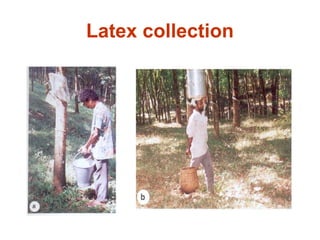
Latex Collection
• Natural rubber is collected from
plantations as
• Latex
• Field Coagulum
Precoagulation
• Normally field latex coagulates after 4
to 6 h of tapping.
• Latex coagulation during
transportation is undesirable as it
hampers further processing.
• Ammonia is a popular anti-Cogulant.
Latex Collection
• Flow of latex usually ceases 2 to 3 h
after tapping.
• Latex is transferred from collection
cups to buckets.
• Buckets containing latex should not be
kept exposed to sunlight.
Sheet rubber
• Latex brought is strained through 40
and 60 mesh stainless steel sieves.
• Dry rubber content is estimated with a
metrolac.
• Latex is diluted in bulking tanks to a
standard consistency of ½ kg of dry
rubber for every 4 litres of diluted latex.
Sheet Processing
• Sieving
•
• Bulking
• Addition of Chemicals
• Coagulation
• Sheeting
• Dripping
• Drying
•
Coagulation
• Aluminium Pans – 40 x 30 x 7 cm size.
• 4 litres of standardised latex is taken in
each pan.
• Sheets weigh 50 g when dried.
Coagulation
• Formic acid is the commonly used
chemical.
• 1.5 ml per pan.
Latex collection
Latex collection centre
Dry rubber content estimation
Pans stacked for latex
coagulation
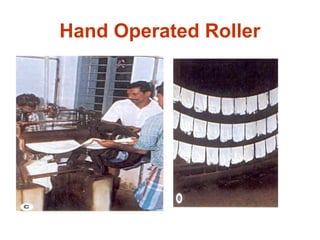
Rolling
• Thorough washing of the coagulum
during and/or after sheeting is
essential to remove acid residues.
• Sheeted either in a sheeting battery or
smooth rollers to thickness of 3 mm
and finally passed through grooved
roller.
Hand Operated Roller
Smoking
• Dripped in shade for 2 to 3 hrs.
• Dried in smoke house at temp bet 40
deg and 60 deg.
• First day 40 - 43 deg C.
• Second and Fourth day-not exceeding
60 deg C.
Smoke house
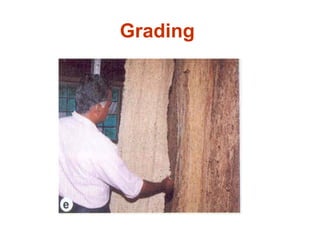
Grading
Baling
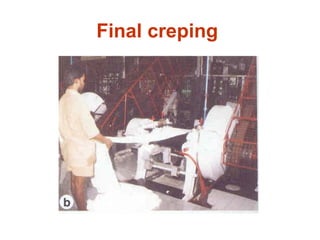
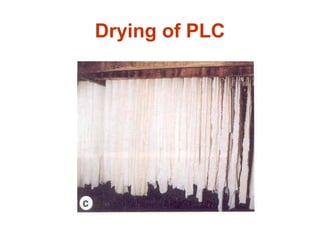
Crepe rubber
• Crop collected as field coagulum can
be processed only into crepe or block
rubber.
Machining of latex coagulum
Final creping
Drying of PLC
Grading
Packing of sole crepe
Baling of EBC
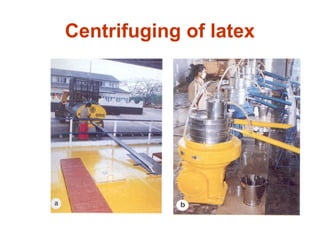
Latex Concentrates
• Centrifugation involves the separation
of preserved field latex into two
fractions.
• One containing the concentrating latex
of more than 60% dry rubber.
• Other containing 4-8% dry rubber by a
suitable centrifuge machine.
Unloading of field latex
Centrifuging of latex
Technically specified rubber
• RSS and crepe rubbers are graded by
visual comparison.
• Synthetic rubbers are graded by
technical specification.
• Processing of Natural rubbers in
technically specified form.
Technical specifications
• Dirt Content
• Ash content
• Volatile content
• Nitrogen content
• Plasticity
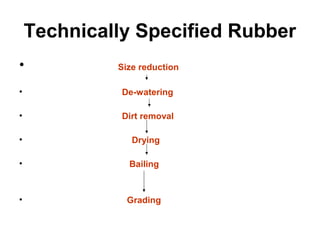
Technically Specified Rubber
• Size reduction
• De-watering
• Dirt removal
• Drying
• Bailing
• Grading
Field Coagulum
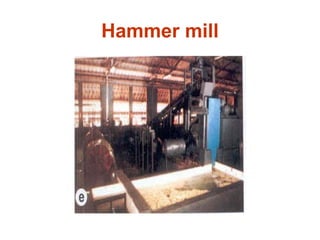
Hammer mill
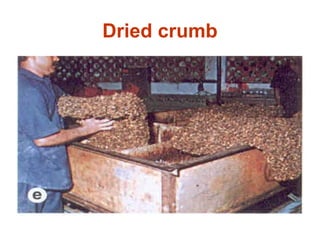
Dried crumb
Ribbed Sheets
• Sheet rubber commands 75 % in the
Indian Natural Rubber .
• RSS-1
• RSS -2
• RSS-3
• Global natural rubber output is slightly lower
than consumption and that has helped
rubber prices to touch high levels during
2005 and 2006.
• Tokyo Commodity Exchange, Singapore
Commodity Exchange and Agriculture
Futures Exchange in Bangkok are the major
global rubber futures market.
• The three national commodity exchanges in
India offer futures contracts in rubber
• Most popular grades used by Indian
tyre makers are known as ribbed
smoked sheet or RSS-4.
• The main spot markets for rubber in
the country are Kottayam, Cochin and
Kozhikode in Kerala.
Grades of NR
• Among these 4 forms/types, the first
three are in the dry form and almost
90% of the total NR produced in the
world are at present marketed in these
3 forms.
•

Rubber Manufacturing

  • 1.
  • 4.
    Rubber Production: Indiaand world • India is the third largest producer of rubber in the world. • It is the fourth largest consumer of natural rubber. • It is the fifth largest consumer of natural rubber and synthetic rubber together in the world.
  • 5.
    Rubber Consumption inIndia • Automotive tyre sector: 50% consumption of all kinds of rubbers • Bicycles tyres and tubes: 15% • Footwear: 12% • Belts and hoses: 6% • Camelback and latex products: 7% • Other products: 10%
  • 6.
  • 7.
    • Career • Doyou want to be part of the dream Marketing team of the No.1 tyre maker ? If yes, fill in the form and send us. Join us and be part of the Wining Team.
  • 12.
  • 13.
  • 14.
    Marketable forms ofRubber • 1.Sheet Rubber. • 2.Crepe Rubber. • 3.Preserved Field Latex and Latex concentrates. • 4.Block Rubber.
  • 15.
    Types of rubber •Sheet ruber • Used in tyre industry • Crepe rubber • Used to construct shoe soles as well as boot soles. • Technically Specified Rubber • Motorcycle and bicycle tyres • Gloves, Mattress, Condoms, Toys, Balloon or Catheters
  • 16.
    Block Rubber • Electricalsupply industry, utilities, automotive etc • Hawai Slippers • Auto Mobile Bushing ,Oil Seal ,Gasket and • rubber mats.
  • 17.
    Raw Materials • Naturallatex - This is a white fluid obtained from the rubber tree. • Sheet rubber – Rubber obtained after Primary Processing
  • 18.
    Latex Collection • Naturalrubber is collected from plantations as • Latex • Field Coagulum
  • 19.
    Precoagulation • Normally fieldlatex coagulates after 4 to 6 h of tapping. • Latex coagulation during transportation is undesirable as it hampers further processing. • Ammonia is a popular anti-Cogulant.
  • 20.
    Latex Collection • Flowof latex usually ceases 2 to 3 h after tapping. • Latex is transferred from collection cups to buckets. • Buckets containing latex should not be kept exposed to sunlight.
  • 21.
    Sheet rubber • Latexbrought is strained through 40 and 60 mesh stainless steel sieves. • Dry rubber content is estimated with a metrolac. • Latex is diluted in bulking tanks to a standard consistency of ½ kg of dry rubber for every 4 litres of diluted latex.
  • 22.
    Sheet Processing • Sieving • •Bulking • Addition of Chemicals • Coagulation • Sheeting • Dripping • Drying •
  • 23.
    Coagulation • Aluminium Pans– 40 x 30 x 7 cm size. • 4 litres of standardised latex is taken in each pan. • Sheets weigh 50 g when dried.
  • 24.
    Coagulation • Formic acidis the commonly used chemical. • 1.5 ml per pan.
  • 25.
  • 26.
  • 27.
  • 28.
    Pans stacked forlatex coagulation
  • 29.
    Rolling • Thorough washingof the coagulum during and/or after sheeting is essential to remove acid residues. • Sheeted either in a sheeting battery or smooth rollers to thickness of 3 mm and finally passed through grooved roller.
  • 30.
  • 31.
    Smoking • Dripped inshade for 2 to 3 hrs. • Dried in smoke house at temp bet 40 deg and 60 deg. • First day 40 - 43 deg C. • Second and Fourth day-not exceeding 60 deg C.
  • 32.
  • 33.
  • 34.
  • 35.
    Crepe rubber • Cropcollected as field coagulum can be processed only into crepe or block rubber.
  • 36.
  • 37.
  • 38.
  • 39.
  • 40.
  • 41.
  • 42.
    Latex Concentrates • Centrifugationinvolves the separation of preserved field latex into two fractions. • One containing the concentrating latex of more than 60% dry rubber. • Other containing 4-8% dry rubber by a suitable centrifuge machine.
  • 43.
  • 44.
  • 46.
    Technically specified rubber •RSS and crepe rubbers are graded by visual comparison. • Synthetic rubbers are graded by technical specification. • Processing of Natural rubbers in technically specified form.
  • 47.
    Technical specifications • DirtContent • Ash content • Volatile content • Nitrogen content • Plasticity
  • 48.
    Technically Specified Rubber •Size reduction • De-watering • Dirt removal • Drying • Bailing • Grading
  • 49.
  • 50.
  • 51.
  • 53.
    Ribbed Sheets • Sheetrubber commands 75 % in the Indian Natural Rubber . • RSS-1 • RSS -2 • RSS-3
  • 54.
    • Global naturalrubber output is slightly lower than consumption and that has helped rubber prices to touch high levels during 2005 and 2006. • Tokyo Commodity Exchange, Singapore Commodity Exchange and Agriculture Futures Exchange in Bangkok are the major global rubber futures market. • The three national commodity exchanges in India offer futures contracts in rubber
  • 55.
    • Most populargrades used by Indian tyre makers are known as ribbed smoked sheet or RSS-4. • The main spot markets for rubber in the country are Kottayam, Cochin and Kozhikode in Kerala.
  • 56.
    Grades of NR •Among these 4 forms/types, the first three are in the dry form and almost 90% of the total NR produced in the world are at present marketed in these 3 forms. •