MM2
CHAPTER 16
MANAGING RETAILING
PRANAY SINDHU
IMTH 23-25
1. MODERN
RETAIL
ENVIRONMEN
T
RETAILING: “All the activities in selling goods
or services directly to final consumers for
personal, nonbusiness use”
It does not matter how the goods or services
are sold (in person, by mail, by telephone, by
vending machine, or online) or where (in a
store, on the street, or in the consumer’s
home).
MODERN RETAIL
MARKETING
ENVIRONMENT –
COMPETITIVE
RETAIL MARKET
STRUCTURE
• NEW RETAIL FORMS AND
COMBINATIONS
• To better satisfy customers’ need for
convenience, a variety of new retail forms
have emerged. EXAMPLES:
• Bookstores with coffee shops and vice-
versa
• Gas stations with food stores – Nainital
Momos on Hindustan Petroleum Petrol
Pumps
• Hospitals with Starbucks Coffee
• RETAILER CONSOLIDATION
• “Concentration of market power in
the hands of a few large retailers.”
• Giant retailers such as Reliance
Smart, Vijetha, Ratnadeep and
Walmart can deliver good service
and immense volumes of product to
masses of consumers at appealing
prices because of:
• Superior information systems
• Logistical systems
• Buying power
• GROWTH OF MOBILE RETAILING
• Consumers are fundamentally changing
the way they shop, increasingly using a
cell phone to DM a friend/relative/public
about a product while shopping in stores.
• GROWTH OF OMNICHANNEL RETAILING
• Retailing has evolved from a purely brick-
and-mortar format to a scenario in which
retailers have augmented their physical
locations with online stores designed to
cater to consumers who prefer shopping
online – SHOWROOMING.
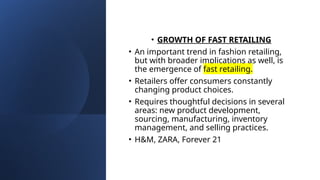
• GROWTH OF FAST RETAILING
• An important trend in fashion retailing,
but with broader implications as well, is
the emergence of fast retailing.
• Retailers offer consumers constantly
changing product choices.
• Requires thoughtful decisions in several
areas: new product development,
sourcing, manufacturing, inventory
management, and selling practices.
• H&M, ZARA, Forever 21
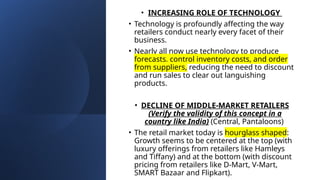
• INCREASING ROLE OF TECHNOLOGY
• Technology is profoundly affecting the way
retailers conduct nearly every facet of their
business.
• Nearly all now use technology to produce
forecasts, control inventory costs, and order
from suppliers, reducing the need to discount
and run sales to clear out languishing
products.
• DECLINE OF MIDDLE-MARKET RETAILERS
(Verify the validity of this concept in a
country like India) (Central, Pantaloons)
• The retail market today is hourglass shaped:
Growth seems to be centered at the top (with
luxury offerings from retailers like Hamleys
and Tiffany) and at the bottom (with discount
pricing from retailers like D-Mart, V-Mart,
SMART Bazaar and Flipkart).
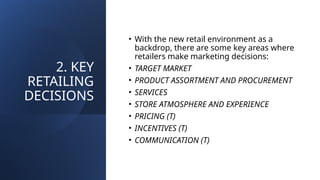
2. KEY
RETAILING
DECISIONS
• With the new retail environment as a
backdrop, there are some key areas where
retailers make marketing decisions:
• TARGET MARKET
• PRODUCT ASSORTMENT AND PROCUREMENT
• SERVICES
• STORE ATMOSPHERE AND EXPERIENCE
• PRICING (T)
• INCENTIVES (T)
• COMMUNICATION (T)
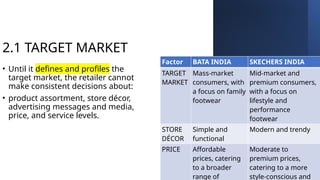
2.1 TARGET MARKET
• Until it defines and profiles the
target market, the retailer cannot
make consistent decisions about:
• product assortment, store décor,
advertising messages and media,
price, and service levels.
Factor BATA INDIA SKECHERS INDIA
TARGET
MARKET
Mass-market
consumers, with
a focus on family
footwear
Mid-market and
premium consumers,
with a focus on
lifestyle and
performance
footwear
STORE
DÉCOR
Simple and
functional
Modern and trendy
PRICE Affordable
prices, catering
to a broader
range of
Moderate to
premium prices,
catering to a more
style-conscious and
2.2 PRODUCT
ASSORTMENT
AND (2.3)
PROCUREMEN
T
• The retailer’s product assortment must
match the target market’s shopping
expectations in both breadth and depth.
• Product differentiation is crucial for retailers
to attract and retain customers (Retailer
KNOWN for its BEST
QUALITY/PROFESSIONALISM)
• EXAMPLE:
• Destination categories, which are product
categories that significantly influence
shoppers' store choices, play a vital role in a
retailer's success (Reliance Fresh known for
its FRESHEST PRODUCE drives customers to
buy groceries from that store itself).
• After deciding on the product-
assortment strategy, the retailer
must establish merchandise
sources, policies, and practices.
• ‘Merchandise managers’ are
responsible for developing product
assortments and listening to
presentations from their suppliers’
salespeople.
2.4
SERVICES
• Another differentiator – reliable customer service,
whether face to face, across phone lines, or via online
chat.
• Retailers position themselves as offering one of three
levels of service:
• Self-service—Self-service is the cornerstone of all
discount operations. For customers willing to carry
out their own “locate–compare–select” process.
• Limited service—These retailers carry more shopping
goods and offer services such as credit and
merchandise-return privileges. Customers typically
find their own goods, though they can ask for
assistance.
• Full service—Salespeople are ready to assist in every
phase of the “locate–compare–select” process. The
high staffing cost and many services, along with the
higher proportion of specialty goods and slower-
moving items, result in high-cost retailing - CROMA
2.5 STORE
ATMOSPHERICS
AND
EXPERIENCE
• Retailers must consider all the
senses in shaping the customer’s
experience.
• Varying the tempo of music affects
average time and dollars spent in
the supermarket; slow music can
lead to higher sales.
• Target Market – Young adults :: Store
Music – Trending songs on IG reels
• Name some stores whose store
atmospherics are just BETTER than
others.
2.6 PRICING
• Prices are a key positioning factor and
must be set in relationship to the target
market, product-and service assortment
mix, and competition.
• All retailers would like high sales volumes
and high gross margins, but the two do
not usually go together. Most retailers fall
into the high-markup, lower-volume group
(fine specialty stores) or the low-markup,
higher-volume group (mass
merchandisers and discount stores).
• In addition to managing their prices,
retailers must manage their price image,
which reflects the overall perception that
consumers have about the level of prices
at a given retailer.
2.7
INCENTIVES
• Retailers vary in the degree to which they
use incentives. Two extreme strategies
stand out: everyday low pricing and high–
low pricing.
• A retailer using everyday low pricing (EDLP)
charges a constant low price with little or
no price promotion or special sales.
Constant prices eliminate week to-week
price uncertainty.
• In high–low pricing, the retailer charges
higher prices on an everyday basis but
runs frequent promotions featuring prices
temporarily lower than prices at the EDLP
level.
2.8
COMMUNICATIONS
• Retailers use a wide range of communication tools
to generate traffic and purchases.
• They place ads, run special sales, issue coupons,
send e-mail promotions, present frequent-shopper
reward programs and in-store food sampling, and
put coupons on shelves or at check-out points.
3. MANAGING
OMNICHANNE
L RETAILING
• Retailers must decide which channels to
employ to reach their customers—
increasingly, the answer is multiple
channels.
• This increased reliance on multiple
channels means that channels should be
designed to work together effectively.
• THREE TYPES OF RETAILERS:
• BRICK-AND-MORTAR RETAILERS
(DEPARTMENT/OFFLINE/PHYSICAL)
• ONLINE STORES (PURE-CLICK)
• OMNICHANNEL COMPANIES (BRICK-
AND-CLICK STORE)
• OMNICHANNEL RETAILING:
• “seamlessly integrating multiple
sales channels, including brick-and-
mortar stores, online platforms, and
mobile apps, to provide a consistent
and personalized customer
experience across all touchpoints.”
• Nykaa, Pepperfry, Lenskart
4.
MANAGING
PRIVATE
LABELS
• “A private label is a brand owned by a
retailer and sold exclusively under its
own name, often as a lower-priced
alternative to established brands.”
• Why retailers go the private label
way?
• these brands can be more
profitable – manufacturers with
higher capacity can develop these
products for a small price –
promotion, advertising, research
costs are marginal in comparison
to others.
MANUFACTURER VS PVT
LABEL: STRATEGY 01
• FIGHT SELECTIVELY
• Manufacturers can successfully
compete against private labels by
focusing on innovation OR brand
building OR premiumization.
• By creating strong brands and
offering high-quality products
that meet the needs of
consumers, manufacturers can
maintain their market share and
protect their profits.
• HUL, ITC
• PARTNER EFFECTIVELY
• Manufacturers can effectively
partner with retailers by seeking
win-win relationships that
complement the retailer's private
labels.
• By working together,
manufacturers and retailers can
expand their reach, improve their
product assortment, and offer
more value to consumers.
• Titan partnering up with Reliance
Retail
MANUFACTURER VS PVT
LABEL: STRATEGY 02
MANUFACTURER VS PVT
LABEL: STRATEGY 03
• INNOVATE BRILLIANTLY
• Innovate brilliantly with new
products to help beat private
labels.
• Continuously launching
incrementally new products
keeps the manufacturer
brands looking fresh, but the
firm must also periodically
launch radically new products
and protect the intellectual
property of all brands.
• Create winning value
propositions by imbuing brands
with symbolic imagery as well as
functional quality that beats
private labels.
• Hindustan Unilever's Lux soap,
Dabur India's Dabur Red Paste,
and ITC's Aashirvaad Atta have
all created strong brands by
combining meaningful imagery
with superior functional quality,
appealing to consumers on both
an emotional and rational level.
MANUFACTURER VS PVT
LABEL: STRATEGY 04
5.
WHOLESALIN
G
• Includes all the activities in selling
goods or services to those who buy
for resale or business use
• Wholesaler vs retailer:
• wholesalers pay less attention to
promotion, atmosphere, and
location because they are dealing
with business customers rather than
final consumers.
• wholesale transactions are usually
larger than retail transactions, and
wholesalers usually cover a larger
trade area than retailers.
• Two types of wholesaler:
• Merchant wholesaler: Buy directly
from the manufacturer, take title to
the merchandise they handle, store
the product, and then sell it to the
customer
• Brokers and agents: Do not take
ownership of the goods they buy
and sell
----END OF CHAPTER 16----

Marketing M2_CHAPTER 16: MANAGING RETAILING

  • 1.
  • 2.
    1. MODERN RETAIL ENVIRONMEN T RETAILING: “Allthe activities in selling goods or services directly to final consumers for personal, nonbusiness use” It does not matter how the goods or services are sold (in person, by mail, by telephone, by vending machine, or online) or where (in a store, on the street, or in the consumer’s home).
  • 3.
    MODERN RETAIL MARKETING ENVIRONMENT – COMPETITIVE RETAILMARKET STRUCTURE • NEW RETAIL FORMS AND COMBINATIONS • To better satisfy customers’ need for convenience, a variety of new retail forms have emerged. EXAMPLES: • Bookstores with coffee shops and vice- versa • Gas stations with food stores – Nainital Momos on Hindustan Petroleum Petrol Pumps • Hospitals with Starbucks Coffee
  • 4.
    • RETAILER CONSOLIDATION •“Concentration of market power in the hands of a few large retailers.” • Giant retailers such as Reliance Smart, Vijetha, Ratnadeep and Walmart can deliver good service and immense volumes of product to masses of consumers at appealing prices because of: • Superior information systems • Logistical systems • Buying power
  • 5.
    • GROWTH OFMOBILE RETAILING • Consumers are fundamentally changing the way they shop, increasingly using a cell phone to DM a friend/relative/public about a product while shopping in stores. • GROWTH OF OMNICHANNEL RETAILING • Retailing has evolved from a purely brick- and-mortar format to a scenario in which retailers have augmented their physical locations with online stores designed to cater to consumers who prefer shopping online – SHOWROOMING.
  • 6.
    • GROWTH OFFAST RETAILING • An important trend in fashion retailing, but with broader implications as well, is the emergence of fast retailing. • Retailers offer consumers constantly changing product choices. • Requires thoughtful decisions in several areas: new product development, sourcing, manufacturing, inventory management, and selling practices. • H&M, ZARA, Forever 21
  • 7.
    • INCREASING ROLEOF TECHNOLOGY • Technology is profoundly affecting the way retailers conduct nearly every facet of their business. • Nearly all now use technology to produce forecasts, control inventory costs, and order from suppliers, reducing the need to discount and run sales to clear out languishing products. • DECLINE OF MIDDLE-MARKET RETAILERS (Verify the validity of this concept in a country like India) (Central, Pantaloons) • The retail market today is hourglass shaped: Growth seems to be centered at the top (with luxury offerings from retailers like Hamleys and Tiffany) and at the bottom (with discount pricing from retailers like D-Mart, V-Mart, SMART Bazaar and Flipkart).
  • 8.
    2. KEY RETAILING DECISIONS • Withthe new retail environment as a backdrop, there are some key areas where retailers make marketing decisions: • TARGET MARKET • PRODUCT ASSORTMENT AND PROCUREMENT • SERVICES • STORE ATMOSPHERE AND EXPERIENCE • PRICING (T) • INCENTIVES (T) • COMMUNICATION (T)
  • 9.
    2.1 TARGET MARKET •Until it defines and profiles the target market, the retailer cannot make consistent decisions about: • product assortment, store décor, advertising messages and media, price, and service levels. Factor BATA INDIA SKECHERS INDIA TARGET MARKET Mass-market consumers, with a focus on family footwear Mid-market and premium consumers, with a focus on lifestyle and performance footwear STORE DÉCOR Simple and functional Modern and trendy PRICE Affordable prices, catering to a broader range of Moderate to premium prices, catering to a more style-conscious and
  • 10.
    2.2 PRODUCT ASSORTMENT AND (2.3) PROCUREMEN T •The retailer’s product assortment must match the target market’s shopping expectations in both breadth and depth. • Product differentiation is crucial for retailers to attract and retain customers (Retailer KNOWN for its BEST QUALITY/PROFESSIONALISM) • EXAMPLE: • Destination categories, which are product categories that significantly influence shoppers' store choices, play a vital role in a retailer's success (Reliance Fresh known for its FRESHEST PRODUCE drives customers to buy groceries from that store itself).
  • 11.
    • After decidingon the product- assortment strategy, the retailer must establish merchandise sources, policies, and practices. • ‘Merchandise managers’ are responsible for developing product assortments and listening to presentations from their suppliers’ salespeople.
  • 12.
    2.4 SERVICES • Another differentiator– reliable customer service, whether face to face, across phone lines, or via online chat. • Retailers position themselves as offering one of three levels of service: • Self-service—Self-service is the cornerstone of all discount operations. For customers willing to carry out their own “locate–compare–select” process. • Limited service—These retailers carry more shopping goods and offer services such as credit and merchandise-return privileges. Customers typically find their own goods, though they can ask for assistance. • Full service—Salespeople are ready to assist in every phase of the “locate–compare–select” process. The high staffing cost and many services, along with the higher proportion of specialty goods and slower- moving items, result in high-cost retailing - CROMA
  • 13.
    2.5 STORE ATMOSPHERICS AND EXPERIENCE • Retailersmust consider all the senses in shaping the customer’s experience. • Varying the tempo of music affects average time and dollars spent in the supermarket; slow music can lead to higher sales. • Target Market – Young adults :: Store Music – Trending songs on IG reels • Name some stores whose store atmospherics are just BETTER than others.
  • 14.
    2.6 PRICING • Pricesare a key positioning factor and must be set in relationship to the target market, product-and service assortment mix, and competition. • All retailers would like high sales volumes and high gross margins, but the two do not usually go together. Most retailers fall into the high-markup, lower-volume group (fine specialty stores) or the low-markup, higher-volume group (mass merchandisers and discount stores). • In addition to managing their prices, retailers must manage their price image, which reflects the overall perception that consumers have about the level of prices at a given retailer.
  • 15.
    2.7 INCENTIVES • Retailers varyin the degree to which they use incentives. Two extreme strategies stand out: everyday low pricing and high– low pricing. • A retailer using everyday low pricing (EDLP) charges a constant low price with little or no price promotion or special sales. Constant prices eliminate week to-week price uncertainty. • In high–low pricing, the retailer charges higher prices on an everyday basis but runs frequent promotions featuring prices temporarily lower than prices at the EDLP level.
  • 16.
    2.8 COMMUNICATIONS • Retailers usea wide range of communication tools to generate traffic and purchases. • They place ads, run special sales, issue coupons, send e-mail promotions, present frequent-shopper reward programs and in-store food sampling, and put coupons on shelves or at check-out points.
  • 17.
    3. MANAGING OMNICHANNE L RETAILING •Retailers must decide which channels to employ to reach their customers— increasingly, the answer is multiple channels. • This increased reliance on multiple channels means that channels should be designed to work together effectively. • THREE TYPES OF RETAILERS: • BRICK-AND-MORTAR RETAILERS (DEPARTMENT/OFFLINE/PHYSICAL) • ONLINE STORES (PURE-CLICK) • OMNICHANNEL COMPANIES (BRICK- AND-CLICK STORE)
  • 18.
    • OMNICHANNEL RETAILING: •“seamlessly integrating multiple sales channels, including brick-and- mortar stores, online platforms, and mobile apps, to provide a consistent and personalized customer experience across all touchpoints.” • Nykaa, Pepperfry, Lenskart
  • 19.
    4. MANAGING PRIVATE LABELS • “A privatelabel is a brand owned by a retailer and sold exclusively under its own name, often as a lower-priced alternative to established brands.” • Why retailers go the private label way? • these brands can be more profitable – manufacturers with higher capacity can develop these products for a small price – promotion, advertising, research costs are marginal in comparison to others.
  • 20.
    MANUFACTURER VS PVT LABEL:STRATEGY 01 • FIGHT SELECTIVELY • Manufacturers can successfully compete against private labels by focusing on innovation OR brand building OR premiumization. • By creating strong brands and offering high-quality products that meet the needs of consumers, manufacturers can maintain their market share and protect their profits. • HUL, ITC • PARTNER EFFECTIVELY • Manufacturers can effectively partner with retailers by seeking win-win relationships that complement the retailer's private labels. • By working together, manufacturers and retailers can expand their reach, improve their product assortment, and offer more value to consumers. • Titan partnering up with Reliance Retail MANUFACTURER VS PVT LABEL: STRATEGY 02
  • 21.
    MANUFACTURER VS PVT LABEL:STRATEGY 03 • INNOVATE BRILLIANTLY • Innovate brilliantly with new products to help beat private labels. • Continuously launching incrementally new products keeps the manufacturer brands looking fresh, but the firm must also periodically launch radically new products and protect the intellectual property of all brands. • Create winning value propositions by imbuing brands with symbolic imagery as well as functional quality that beats private labels. • Hindustan Unilever's Lux soap, Dabur India's Dabur Red Paste, and ITC's Aashirvaad Atta have all created strong brands by combining meaningful imagery with superior functional quality, appealing to consumers on both an emotional and rational level. MANUFACTURER VS PVT LABEL: STRATEGY 04
  • 22.
    5. WHOLESALIN G • Includes allthe activities in selling goods or services to those who buy for resale or business use • Wholesaler vs retailer: • wholesalers pay less attention to promotion, atmosphere, and location because they are dealing with business customers rather than final consumers. • wholesale transactions are usually larger than retail transactions, and wholesalers usually cover a larger trade area than retailers.
  • 23.
    • Two typesof wholesaler: • Merchant wholesaler: Buy directly from the manufacturer, take title to the merchandise they handle, store the product, and then sell it to the customer • Brokers and agents: Do not take ownership of the goods they buy and sell
  • 24.