Brands Versus Private
Labels: Fighting To Win
GROUP 1
Introduction
• Sometime in the 1970s, things began to change, slowly, as retailers started to develop national
chains. Ex. Sears, Costco, Tesco and Wal-Mart, plunged eagerly into global markets over the last
two decades of the previous millennium.
• The twentieth century was the century of manufacturer brands. Consumers moved from no-name
products of inconsistent quality produced by local factories in the nineteenth century to branded
products from global manufacturers led by Coca-Cola, Disney, Johnson & Johnson’s , Levis ,
Procter & Gamble, Nestle and Unilever.
• Initially consumers bought manufacturer endorsed brands as symbols of quality, trust, affluence.
These brands were consumed as symbols of aspirations, images and lifestyles.
• Manufacturer brands reached consumers through distributors and retailers.
• For most of the twentieth century, retailers were relatively small, compared with their largest
suppliers. This allowed branded manufacturers to ride a wave of quality products, innovation, and
mass advertising to establish their power over distribution channels. Manufacturers exploited this
power over retailers by becoming branded bulldozers, forcing retailers to accept.
BRANDED LABELS
• A brand is a distinguishing name and/or symbol (such as a logo, trademark, or package design)
intended to identify the goods or services of either one seller or a group of sellers, and to
differentiate those goods or services from those of competitors.
• Brands are trustworthy, delivering quality, consistency and innovation at fair price. A product is
something that is made in a factory; a brand is something that is bought by a customer.
• A product can be copied by a competitor, a brand is unique. A product can be quickly outdated, a
successful brand is timeless. Branding is about building a unique identity which can be protected
and sustained against competition.
• We often come across two products which when compared on ingredients are identical, when
compared on the packaging are identical and when tested in consumer blind tests are considered
identical. Still, the consumers are willing to pay considerably more for the version with the known
brand. A product can be “copied” but a real brand cannot.
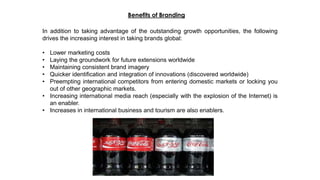
In addition to taking advantage of the outstanding growth opportunities, the following
drives the increasing interest in taking brands global:
• Lower marketing costs
• Laying the groundwork for future extensions worldwide
• Maintaining consistent brand imagery
• Quicker identification and integration of innovations (discovered worldwide)
• Preempting international competitors from entering domestic markets or locking you
out of other geographic markets.
• Increasing international media reach (especially with the explosion of the Internet) is
an enabler.
• Increases in international business and tourism are also enablers.
Benefits of Branding
PRIVATE LABELS
• The term private label can be defined as products marketed by retailers and other members of the
distribution chain. Private Label is any brand that is owned by the retailer or the distributor and is
sold only in its own outlets. They are also called in-store brands.
• Strong Private Labels have been exported by one retailer to another, typically based on an
exclusive agreement. That brand be the retailer’s own name or a name created exclusively by that
retailer.
• From apparel, healthcare products and furnishings to consumer items, private labels are making
their presence felt in a variety of retail items in the country. In the dogfight world of retail, the
private label is emerging as a new business model. Most retail chains in the country are
increasingly relying on private labels to bridge the gap in their product mix and are targeting
specific needs of consumers.
• Though, private labels at present constitute about 5% of the organized retail business, experts feel
they can grow up to 30% once retail brands develop in the country. Retailers like Pantaloons,
Shopper’s Stop, More, Reliance, Tesco, Lulu and Carrefour are expanding their range of private
label products from cosmetics and food to clothing to improve the profit margins of their stores.
Some Private Label are as follows
P’S Of Private label
 Product: quality is equal to brand.
 Partnership: work in extra mile in terms of support, marketing,
merchandising.
 Pricing: provides the high perceived value to customer without leaving
profit.
 Position: position mark the one that you want to compete directly against
 Personnel: as per requirement
 Promotion: by display and through features to gain customer attention.
 Pride: take pride in your brand, treat it and market it with the respect it
deserves
TYPES OF PRIVATE LABEL
 Store brands - The retailer's name is very evident on the packaging.
 Store sub-brands - Products where the retailer's name is low-key on the
packaging.
 Umbrella branding - A generic brand, independent from the name of the
retailer.
The Private Label Threat
 The improved quality of private label products : The gap between Private
label and brand name products have been narrowed in the last ten years.
 The development of premium private label brands : Innovative retailers
have also come up with premium based private label brands that delivers
quality superior to that of national brands.
 European supermarkets success with private labels : European
supermarkets have higher private label sales as compared to U.S
supermarket also pretax profits.
Contnd….
 The emergence of new channels : Mass merchandisers, warehouse clubs,
and other channels account for growing percentages of sales of dry
groceries , household cleaning products and health and beauty aids.
 The creation of new categories : They are continually expanding into new
and diverse categories and also following some general trends and have
developed private label market for products beyond traditional staples.
What drives private label shares ?
 Product category characteristics
 New product activity
 Private label characteristics
 Price and promotion factors
 Retail characteristics
Brand strength
 The purchase process favors brand name products : Customers still requires
an assurance of quality during their point of purchase and sale rather than
not having the opportunity to inspect the alternatives.
 Brand name goods have a solid foundation : Build through delivery of
consistent quality and strong customer equities over decades of
advertising.
 Brand strengths the economy : 48% of the packaged goods buyers knew
what brands they wanted before entering the store up from 44 % in 1991
Cntnd…
 National brands have value for retailers: Retailers much not only stock but
also promote the national brands
 Excessive emphasis on private labels dilutes their strength: Excessive
emphasis on private labels led to consumer's perceptions that the retailers
assortment was incomplete resulting in low profits and reduced store
traffic.
If You Don’t , Don’t start
 Brand name manufacturers make private label goods only to use
occasional excess production capacity .
 Excess stock can be sold in a private label.
 The manufacturer may start taking orders for the private label where the
market share of its own brand is weak.
 The company’s strategy may be confused.
2.Private Label production can lead in
additional costs
 Manufacturing costs
 Distribution complexities
 Packages and labels have to be changed for each private label customer
 Inventory holding costs also increase
 Private label offerings end up in a manufacturer’s strongest accounts
 It is hard for the company to focus on both brands.
 Demand for private labels from the retailers.
4.Private-label manufacturing cannot be
contained, and inevitably it may cannibalize
national-brand sales.
Advantages and Disadvantages of
Private label
Advantages
• Lower Prices
• Better Margins
• Offer consumer greater value
• Bargaining power to the retailer
Disadvantages
• Conflict with other brands in the category.
• Higher R&D expense
• Higher marketing expense
• If product fails, will create negative image
• Inventory risk
Why do retailers get involved in Private
Labels?
 Retail consolidation has had a strong influence on Private Label. Store brands have become a
way for retailers to differentiate themselves from their competitors and to create loyalty to their
stores in an evermore tightly concentrated marketplace.
 From the retailer perspective, there are clear advantages in developing its own Private Labels.
Few reasons are:
1. Simple financial evaluation (maximizing turnover and margins).
2. Offering a price driven assortment towards consumers and hereby opening this consumer
segment while fighting the competition.
3. Building loyalty and image to the chain.
4. Creating an alternative to brands and getting more manufacturing cost insights. Hereby
increasing the negotiation power.
5. Covering special segments which could otherwise not be offered.
Strategies
 Invest in brand equities: Brand name is the most important asset for a
company.
 Innovate wisely: Desperate to increase sales presence can harm their gain
and market share.
 Use fighting brand sparingly: to prevent the huge loss that would occur if a
leading national brand tried to drop price.
 Build trade relationships: to build trade relationships with retailers and
wholesalers. Conduct business and satisfaction survey with customers and
retailers too.
 Manage the price Spread: brand manufacture must monitor the price gap
between each national brand and other brands including private label.
Strategies
 Exploit sales promotion techniques: to stop retailers by displaying national
brand and private label on the same platform or to make signs of
compare and save.
 Manage each category: low private label penetration in order to sustain
the barriers to sustain the entry.
 Use category profit pools as a performance measure: to measure
performance by understanding market share and volume of products as a
primary measurement tool.

Brand versus private labels

  • 1.
    Brands Versus Private Labels:Fighting To Win GROUP 1
  • 2.
    Introduction • Sometime inthe 1970s, things began to change, slowly, as retailers started to develop national chains. Ex. Sears, Costco, Tesco and Wal-Mart, plunged eagerly into global markets over the last two decades of the previous millennium. • The twentieth century was the century of manufacturer brands. Consumers moved from no-name products of inconsistent quality produced by local factories in the nineteenth century to branded products from global manufacturers led by Coca-Cola, Disney, Johnson & Johnson’s , Levis , Procter & Gamble, Nestle and Unilever. • Initially consumers bought manufacturer endorsed brands as symbols of quality, trust, affluence. These brands were consumed as symbols of aspirations, images and lifestyles. • Manufacturer brands reached consumers through distributors and retailers. • For most of the twentieth century, retailers were relatively small, compared with their largest suppliers. This allowed branded manufacturers to ride a wave of quality products, innovation, and mass advertising to establish their power over distribution channels. Manufacturers exploited this power over retailers by becoming branded bulldozers, forcing retailers to accept.
  • 3.
    BRANDED LABELS • Abrand is a distinguishing name and/or symbol (such as a logo, trademark, or package design) intended to identify the goods or services of either one seller or a group of sellers, and to differentiate those goods or services from those of competitors. • Brands are trustworthy, delivering quality, consistency and innovation at fair price. A product is something that is made in a factory; a brand is something that is bought by a customer. • A product can be copied by a competitor, a brand is unique. A product can be quickly outdated, a successful brand is timeless. Branding is about building a unique identity which can be protected and sustained against competition. • We often come across two products which when compared on ingredients are identical, when compared on the packaging are identical and when tested in consumer blind tests are considered identical. Still, the consumers are willing to pay considerably more for the version with the known brand. A product can be “copied” but a real brand cannot.
  • 4.
    In addition totaking advantage of the outstanding growth opportunities, the following drives the increasing interest in taking brands global: • Lower marketing costs • Laying the groundwork for future extensions worldwide • Maintaining consistent brand imagery • Quicker identification and integration of innovations (discovered worldwide) • Preempting international competitors from entering domestic markets or locking you out of other geographic markets. • Increasing international media reach (especially with the explosion of the Internet) is an enabler. • Increases in international business and tourism are also enablers. Benefits of Branding
  • 5.
    PRIVATE LABELS • Theterm private label can be defined as products marketed by retailers and other members of the distribution chain. Private Label is any brand that is owned by the retailer or the distributor and is sold only in its own outlets. They are also called in-store brands. • Strong Private Labels have been exported by one retailer to another, typically based on an exclusive agreement. That brand be the retailer’s own name or a name created exclusively by that retailer. • From apparel, healthcare products and furnishings to consumer items, private labels are making their presence felt in a variety of retail items in the country. In the dogfight world of retail, the private label is emerging as a new business model. Most retail chains in the country are increasingly relying on private labels to bridge the gap in their product mix and are targeting specific needs of consumers. • Though, private labels at present constitute about 5% of the organized retail business, experts feel they can grow up to 30% once retail brands develop in the country. Retailers like Pantaloons, Shopper’s Stop, More, Reliance, Tesco, Lulu and Carrefour are expanding their range of private label products from cosmetics and food to clothing to improve the profit margins of their stores.
  • 6.
    Some Private Labelare as follows
  • 7.
    P’S Of Privatelabel  Product: quality is equal to brand.  Partnership: work in extra mile in terms of support, marketing, merchandising.  Pricing: provides the high perceived value to customer without leaving profit.  Position: position mark the one that you want to compete directly against  Personnel: as per requirement  Promotion: by display and through features to gain customer attention.  Pride: take pride in your brand, treat it and market it with the respect it deserves
  • 8.
    TYPES OF PRIVATELABEL  Store brands - The retailer's name is very evident on the packaging.  Store sub-brands - Products where the retailer's name is low-key on the packaging.  Umbrella branding - A generic brand, independent from the name of the retailer.
  • 9.
    The Private LabelThreat  The improved quality of private label products : The gap between Private label and brand name products have been narrowed in the last ten years.  The development of premium private label brands : Innovative retailers have also come up with premium based private label brands that delivers quality superior to that of national brands.  European supermarkets success with private labels : European supermarkets have higher private label sales as compared to U.S supermarket also pretax profits.
  • 10.
    Contnd….  The emergenceof new channels : Mass merchandisers, warehouse clubs, and other channels account for growing percentages of sales of dry groceries , household cleaning products and health and beauty aids.  The creation of new categories : They are continually expanding into new and diverse categories and also following some general trends and have developed private label market for products beyond traditional staples.
  • 11.
    What drives privatelabel shares ?  Product category characteristics  New product activity  Private label characteristics  Price and promotion factors  Retail characteristics
  • 12.
    Brand strength  Thepurchase process favors brand name products : Customers still requires an assurance of quality during their point of purchase and sale rather than not having the opportunity to inspect the alternatives.  Brand name goods have a solid foundation : Build through delivery of consistent quality and strong customer equities over decades of advertising.  Brand strengths the economy : 48% of the packaged goods buyers knew what brands they wanted before entering the store up from 44 % in 1991
  • 13.
    Cntnd…  National brandshave value for retailers: Retailers much not only stock but also promote the national brands  Excessive emphasis on private labels dilutes their strength: Excessive emphasis on private labels led to consumer's perceptions that the retailers assortment was incomplete resulting in low profits and reduced store traffic.
  • 14.
    If You Don’t, Don’t start  Brand name manufacturers make private label goods only to use occasional excess production capacity .  Excess stock can be sold in a private label.  The manufacturer may start taking orders for the private label where the market share of its own brand is weak.  The company’s strategy may be confused.
  • 15.
    2.Private Label productioncan lead in additional costs  Manufacturing costs  Distribution complexities  Packages and labels have to be changed for each private label customer  Inventory holding costs also increase
  • 16.
     Private labelofferings end up in a manufacturer’s strongest accounts  It is hard for the company to focus on both brands.  Demand for private labels from the retailers. 4.Private-label manufacturing cannot be contained, and inevitably it may cannibalize national-brand sales.
  • 17.
    Advantages and Disadvantagesof Private label Advantages • Lower Prices • Better Margins • Offer consumer greater value • Bargaining power to the retailer Disadvantages • Conflict with other brands in the category. • Higher R&D expense • Higher marketing expense • If product fails, will create negative image • Inventory risk
  • 18.
    Why do retailersget involved in Private Labels?  Retail consolidation has had a strong influence on Private Label. Store brands have become a way for retailers to differentiate themselves from their competitors and to create loyalty to their stores in an evermore tightly concentrated marketplace.  From the retailer perspective, there are clear advantages in developing its own Private Labels. Few reasons are: 1. Simple financial evaluation (maximizing turnover and margins). 2. Offering a price driven assortment towards consumers and hereby opening this consumer segment while fighting the competition. 3. Building loyalty and image to the chain. 4. Creating an alternative to brands and getting more manufacturing cost insights. Hereby increasing the negotiation power. 5. Covering special segments which could otherwise not be offered.
  • 19.
    Strategies  Invest inbrand equities: Brand name is the most important asset for a company.  Innovate wisely: Desperate to increase sales presence can harm their gain and market share.  Use fighting brand sparingly: to prevent the huge loss that would occur if a leading national brand tried to drop price.  Build trade relationships: to build trade relationships with retailers and wholesalers. Conduct business and satisfaction survey with customers and retailers too.  Manage the price Spread: brand manufacture must monitor the price gap between each national brand and other brands including private label.
  • 20.
    Strategies  Exploit salespromotion techniques: to stop retailers by displaying national brand and private label on the same platform or to make signs of compare and save.  Manage each category: low private label penetration in order to sustain the barriers to sustain the entry.  Use category profit pools as a performance measure: to measure performance by understanding market share and volume of products as a primary measurement tool.