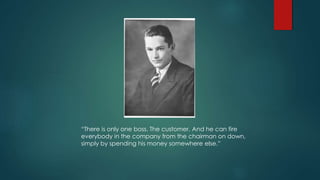
“There is only one boss. The customer. And he can fire
everybody in the company from the chairman on down,
simply by spending his money somewhere else.”
RETAILING : PRIVATE LABELS & THE
NEW RETAIL ENVIRONMENT
PRESENTED BY:
Nishant Agarwal (2013174)
Nishant Renjith (2013175)
Nishidh Lad (2013176)
Nitesh Beriwal (2013177)
Nitesh Singh Patel (2013178)
SECTION-D
What is Retailing?
 Sales of goods and services to the ultimate consumer for the
personal, family or household use.
 Any organization selling to final consumers- whether it is
manufacturer, wholesaler or retailer.
 In the channel of distribution, retailing is where customer meets the
product.
 Exchange
Types of Retailers
1. Store Retailers
2. Non store Retailers
3. Corporate retail organization
Store Retailers
1. Speciality Store : Narrow Product line.
Store Retailers
2. Department Stores: Several product lines
Store Retailers
3. Supermarkets:
 Large
 Low cost,
 Low margin,
 High Volume,
 Self Service store,
 Meets all household and food products
Store Retailers
4. Convenience store/ Drug stores: Small store in the
residential area open 24/7
Store Retailers
5. Discount store:
 Low price
 Low margin
 High volume store
 Standard
 Specialized Merchandize
E.g. Walmart
Store Retailers
6. Extreme value or hard discount store:
Store Retailers
7. Off Price Retailers : Leftover goods, overruns, irregular merchandise
sold at less than retail.
Store Retailers
8.Superstore: Huge selling space, routinely purchased food and
household items, plus services
Consumer Preference
1. Self service
2. Self selection
3. Limited service
4. Full service
NONSTORE RETAILING
1. Direct Selling:
 Multilevel selling
 Network selling
NONSTORE RETAILING
2. Direct Marketing:
 Telemarketing
 Television direct response marketing
 Electronic shopping
NONSTORE RETAILING
3. Automatic Vending:
CORPORATE RETAILING AND
FRANCHISING
1. Consumer Cooperative:
 Owned by customers
 Members contribute money to open their own store
 Vote on its policies
 Elect a group
 Manage it
 Receive dividends
CORPORATE RETAILING AND
FRANCHISING
2. Franchise Organization :
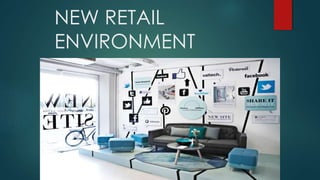
NEW RETAIL
ENVIRONMENT
What Has Triggered the
CHANGE….
•Fast changing Macro and Micro
Environment
•Growing consumer expectations.
•Exhaustive Competitive pressure.
•Growth of Urbanization.
•High disposable income.
NEW RETAIL FORMS &
COMBINATIONS
•Bookstores featuring Coffee
Shops.
•Gas stations including food
stores.
•Shopping malls and stations
having peddlers’ carts in their
aisles.
Store Based & Non Store
Based Retailing.
•Increased offerings through mails,
cell phones and internet.
•Non store based retailers enjoy
convenience leverage.
•Store based retailers coming online
to compete.
•More and more experiential touch
being given to the physical stores.
GROWTH OF GIANT RETAILERS..
•Inherit superior information systems, logistical systems
and buying power.
•Crowding out small manufacturers.
•Suggest even companies for improvement and
innovations.
•Includes huge market share.
Growing Investment In
Technology..
•Improved ways of forecasting, inventory control
and order processing.
•In store programming on LED’s, electronic shelf
labeling and smart shopping carts getting
common.
•Digital advertising and different payment methods
creating further space.
•Global Retailers snatching grounds.
•Growth of Shopper Marketing.
Influencing customers at the
point of purchase.
Marketing Decisions
Target Market
Channels
Product Assortment
Prices
Services
Store Atmosphere
Store Activities and Experiences
Communications
Location
Target Market
Channels
The collection of goods or services that
a business provides to consumers. The
main characteristics of a company's product
assortment are:
(1) its length or number of products,
(2) its breadth or number of product lines,
(3) its depth or number of product varieties
within a product line and
(4) how products relate to each other in a
retail environment.
Product Assortment
Price
Fine Specialty Stores:
High-Markup, Lower-
volume group
Mass Merchandisers and
Discount Stores: Low-markup,
Higher-volume group
Services
Prepurchase
Services
•Advertising
•Fitting rooms
•Fashion shows
Postpurchase
Services
•Shipping & Delivery
•Alterations
•InstallationsAncillary
Services
•Parking
•Repairs
•Rest rooms
Store Atmosphere
Communication
Location
 Central Business Districts
 Regional Shopping Centers
 Community Shopping centers
 Shopping strips
 A Location with a larger Store
 Stand-alone stores
PRIVATE LABELS
I DON’T WANT TO TALK IN TERMS OF MARKET SHARE.
I DON’T WANT TO SHARE MY MARKET WITH ANYONE.
-LARRY LIGHT, CEO
WAL-MART
Definition
 Private labels are retailer brands.
 Brands owned & sold by retailer & distributed by retailer.
The Beginning
A&P’s 8 O'clock
Coffee in 1900s
Background of PLB
 Earlier referred as Cheaper & Low quality alternatives for national
brands.
 Just a profit making concept which needed no marketing effort
 Tescos Value Range in 1995 was the first value pay brand
 Other retailers like Sainsbury etc. quickly followed the suit
 In India in 2000s this concept came up & Future Brand came up with
“SACH” toothbrush & toothpaste range.
Why Did It All Begin?
 Shift of power from National brand marketers
to National Retailers
 High Quality & Low Price
 Historical perspective of key retailers of a
strong house brand.
How does PLB work?
 Winning strategy for improving store image and profitability.
 Offers value for money
 Increases the price competitiveness
 16-23% less price for the consumers as compared to national brands
 Differentiating factor as exclusively available at the particular store
only
 Consumers get an assurance that they can directly interact with the
owner of the brand
Would You Prefer A PLB Over A
National Brand?
Yes
43%
May Be
44%
No
13%
Yes May Be No
If Yes, Then Why?
Quality
42%
Trust on that retail store
24%
Cheaper Price
25%
No, I wouldn't prefer
9%
Quality Trust on that retail store Cheaper Price No, I wouldn't prefer
If No, Then Why?
Don’t want to change
brand preference
30%
No trust on quality
18%
I can give it a try
52%
Don’t want to change brand preference No trust on quality I can give it a try
How Was Your PLB Buying
Experience?
Average
22%
Awesome
6%
Good
63%
Not Tried
9%
Average Awesome Good Not Tried
Would You Like To Repeat Your PLB
Experience
Yes
89%
No
11% 0%0%
Yes No
Food Dominates India’s Private
Label Market
 According to Nielsen’s Survey “Food”
captures 76% of the India’s Private label
Market
PRIVATE LABEL GROWTH
vs
MODERN TREND GROWTH
ADVANTAGES
1. DIFFERENTIATION
HIGHER MARGINS
FREEDOM TO CREATE OWN
MARKETING PLAN
 Independence to retailer to use its own innovative marketing
strategies
 For National Brands, Poor marketing strategy by the
manufacturer not only results in the failure of the product, but
also erodes the profit margin of the retailer
FREEDOM WITH PRICING STRATEGY
 Similar to the Marketing Strategy, Private Labels also give the
retailers to a chance to adopt their own pricing strategy
 Shields retailers from the losses due to longer shelf life of poorly
priced products
 Retailers can directly pass on the price benefits to the customer
Strong Customer Positioning
 Develops Customer Loyalty
 Uniqueness of Private Labels, helps to build brand loyalty
 Customer Loyalty has significant advantage over its competitors
Private Labels (Examples)
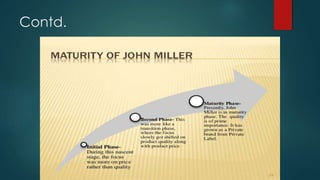
JOHN MILLER – AN ILLUSTRATION OF
SUCCESS
Facts about John Miller
 Came into existence in 1995 as an extension of Pantaloons
 Ranges between Rs. 800-1500
 Targeted at Premium segment customer
 Over the years it has grown from a private label to a private brand.
KEY TO SUCCESS OF JOHN MILLER
 One of the very first private labels in the apparel industry in India
 High quality at low price
 Reasonable Price Range
 Attractive option for value buyers
Contd.
DISADVANTAGES
 Highly Competitive Market
 High risk with reputation of the brand.
 Risk of getting into a price war
 Dependent on the supplier
 Excess focus on private labels inside the stores
CONCLUSION
 Win – Win situation for both, customer and retailer
 Lower prices and Higher margins
 Quality is comparable to that of National Brands
 Value for money products
 Extra care and detail
Contd.
 Huge growth potential
 Deeper Market penetration required
 Innovative Marketing and promotions are the need of the hour
Private Labels

Private Labels

  • 1.
    “There is onlyone boss. The customer. And he can fire everybody in the company from the chairman on down, simply by spending his money somewhere else.”
  • 2.
    RETAILING : PRIVATELABELS & THE NEW RETAIL ENVIRONMENT PRESENTED BY: Nishant Agarwal (2013174) Nishant Renjith (2013175) Nishidh Lad (2013176) Nitesh Beriwal (2013177) Nitesh Singh Patel (2013178) SECTION-D
  • 3.
    What is Retailing? Sales of goods and services to the ultimate consumer for the personal, family or household use.  Any organization selling to final consumers- whether it is manufacturer, wholesaler or retailer.  In the channel of distribution, retailing is where customer meets the product.  Exchange
  • 4.
    Types of Retailers 1.Store Retailers 2. Non store Retailers 3. Corporate retail organization
  • 5.
    Store Retailers 1. SpecialityStore : Narrow Product line.
  • 6.
    Store Retailers 2. DepartmentStores: Several product lines
  • 7.
    Store Retailers 3. Supermarkets: Large  Low cost,  Low margin,  High Volume,  Self Service store,  Meets all household and food products
  • 8.
    Store Retailers 4. Conveniencestore/ Drug stores: Small store in the residential area open 24/7
  • 9.
    Store Retailers 5. Discountstore:  Low price  Low margin  High volume store  Standard  Specialized Merchandize E.g. Walmart
  • 10.
    Store Retailers 6. Extremevalue or hard discount store:
  • 11.
    Store Retailers 7. OffPrice Retailers : Leftover goods, overruns, irregular merchandise sold at less than retail.
  • 12.
    Store Retailers 8.Superstore: Hugeselling space, routinely purchased food and household items, plus services
  • 13.
    Consumer Preference 1. Selfservice 2. Self selection 3. Limited service 4. Full service
  • 14.
    NONSTORE RETAILING 1. DirectSelling:  Multilevel selling  Network selling
  • 15.
    NONSTORE RETAILING 2. DirectMarketing:  Telemarketing  Television direct response marketing  Electronic shopping
  • 16.
  • 17.
    CORPORATE RETAILING AND FRANCHISING 1.Consumer Cooperative:  Owned by customers  Members contribute money to open their own store  Vote on its policies  Elect a group  Manage it  Receive dividends
  • 18.
  • 19.
  • 20.
    What Has Triggeredthe CHANGE…. •Fast changing Macro and Micro Environment •Growing consumer expectations. •Exhaustive Competitive pressure. •Growth of Urbanization. •High disposable income.
  • 21.
    NEW RETAIL FORMS& COMBINATIONS •Bookstores featuring Coffee Shops. •Gas stations including food stores. •Shopping malls and stations having peddlers’ carts in their aisles.
  • 22.
    Store Based &Non Store Based Retailing. •Increased offerings through mails, cell phones and internet. •Non store based retailers enjoy convenience leverage. •Store based retailers coming online to compete. •More and more experiential touch being given to the physical stores.
  • 23.
    GROWTH OF GIANTRETAILERS.. •Inherit superior information systems, logistical systems and buying power. •Crowding out small manufacturers. •Suggest even companies for improvement and innovations. •Includes huge market share.
  • 24.
    Growing Investment In Technology.. •Improvedways of forecasting, inventory control and order processing. •In store programming on LED’s, electronic shelf labeling and smart shopping carts getting common. •Digital advertising and different payment methods creating further space.
  • 25.
    •Global Retailers snatchinggrounds. •Growth of Shopper Marketing. Influencing customers at the point of purchase.
  • 26.
    Marketing Decisions Target Market Channels ProductAssortment Prices Services Store Atmosphere Store Activities and Experiences Communications Location
  • 27.
  • 28.
  • 29.
    The collection ofgoods or services that a business provides to consumers. The main characteristics of a company's product assortment are: (1) its length or number of products, (2) its breadth or number of product lines, (3) its depth or number of product varieties within a product line and (4) how products relate to each other in a retail environment. Product Assortment
  • 30.
    Price Fine Specialty Stores: High-Markup,Lower- volume group Mass Merchandisers and Discount Stores: Low-markup, Higher-volume group
  • 31.
    Services Prepurchase Services •Advertising •Fitting rooms •Fashion shows Postpurchase Services •Shipping& Delivery •Alterations •InstallationsAncillary Services •Parking •Repairs •Rest rooms
  • 32.
  • 33.
  • 34.
    Location  Central BusinessDistricts  Regional Shopping Centers  Community Shopping centers  Shopping strips  A Location with a larger Store  Stand-alone stores
  • 35.
    PRIVATE LABELS I DON’TWANT TO TALK IN TERMS OF MARKET SHARE. I DON’T WANT TO SHARE MY MARKET WITH ANYONE. -LARRY LIGHT, CEO WAL-MART
  • 36.
    Definition  Private labelsare retailer brands.  Brands owned & sold by retailer & distributed by retailer.
  • 37.
    The Beginning A&P’s 8O'clock Coffee in 1900s
  • 38.
    Background of PLB Earlier referred as Cheaper & Low quality alternatives for national brands.  Just a profit making concept which needed no marketing effort  Tescos Value Range in 1995 was the first value pay brand  Other retailers like Sainsbury etc. quickly followed the suit  In India in 2000s this concept came up & Future Brand came up with “SACH” toothbrush & toothpaste range.
  • 39.
    Why Did ItAll Begin?  Shift of power from National brand marketers to National Retailers  High Quality & Low Price  Historical perspective of key retailers of a strong house brand.
  • 40.
    How does PLBwork?  Winning strategy for improving store image and profitability.  Offers value for money  Increases the price competitiveness  16-23% less price for the consumers as compared to national brands  Differentiating factor as exclusively available at the particular store only  Consumers get an assurance that they can directly interact with the owner of the brand
  • 41.
    Would You PreferA PLB Over A National Brand? Yes 43% May Be 44% No 13% Yes May Be No
  • 42.
    If Yes, ThenWhy? Quality 42% Trust on that retail store 24% Cheaper Price 25% No, I wouldn't prefer 9% Quality Trust on that retail store Cheaper Price No, I wouldn't prefer
  • 43.
    If No, ThenWhy? Don’t want to change brand preference 30% No trust on quality 18% I can give it a try 52% Don’t want to change brand preference No trust on quality I can give it a try
  • 44.
    How Was YourPLB Buying Experience? Average 22% Awesome 6% Good 63% Not Tried 9% Average Awesome Good Not Tried
  • 45.
    Would You LikeTo Repeat Your PLB Experience Yes 89% No 11% 0%0% Yes No
  • 46.
    Food Dominates India’sPrivate Label Market  According to Nielsen’s Survey “Food” captures 76% of the India’s Private label Market
  • 47.
  • 48.
  • 49.
  • 50.
  • 51.
    FREEDOM TO CREATEOWN MARKETING PLAN  Independence to retailer to use its own innovative marketing strategies  For National Brands, Poor marketing strategy by the manufacturer not only results in the failure of the product, but also erodes the profit margin of the retailer
  • 52.
    FREEDOM WITH PRICINGSTRATEGY  Similar to the Marketing Strategy, Private Labels also give the retailers to a chance to adopt their own pricing strategy  Shields retailers from the losses due to longer shelf life of poorly priced products  Retailers can directly pass on the price benefits to the customer
  • 53.
    Strong Customer Positioning Develops Customer Loyalty  Uniqueness of Private Labels, helps to build brand loyalty  Customer Loyalty has significant advantage over its competitors
  • 54.
  • 55.
    JOHN MILLER –AN ILLUSTRATION OF SUCCESS Facts about John Miller  Came into existence in 1995 as an extension of Pantaloons  Ranges between Rs. 800-1500  Targeted at Premium segment customer  Over the years it has grown from a private label to a private brand.
  • 56.
    KEY TO SUCCESSOF JOHN MILLER  One of the very first private labels in the apparel industry in India  High quality at low price  Reasonable Price Range  Attractive option for value buyers
  • 57.
  • 58.
    DISADVANTAGES  Highly CompetitiveMarket  High risk with reputation of the brand.  Risk of getting into a price war  Dependent on the supplier  Excess focus on private labels inside the stores
  • 59.
    CONCLUSION  Win –Win situation for both, customer and retailer  Lower prices and Higher margins  Quality is comparable to that of National Brands  Value for money products  Extra care and detail
  • 60.
    Contd.  Huge growthpotential  Deeper Market penetration required  Innovative Marketing and promotions are the need of the hour