Food Parks
Backward Integration
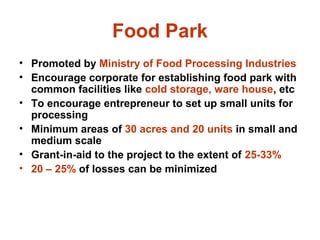
Food Park
• Promoted by Ministry of Food Processing Industries
• Encourage corporate for establishing food park with
common facilities like cold storage, ware house, etc
• To encourage entrepreneur to set up small units for
processing
• Minimum areas of 30 acres and 20 units in small and
medium scale
• Grant-in-aid to the project to the extent of 25-33%
• 20 – 25% of losses can be minimized
Seven Wastes
• Overproduction – the making of too much, too early or just in
case.
• Waiting – where materials or information are waiting to produce
to the next process. They are not moving or having value
added
• Transporting – where materials (or information) are being
transported into, out of or around the factory, Transport cannot
be fully eliminated, but the aim is to minimize it.
• Inappropriate processing – using machinery or equipment
which is inappropriate in terms of ‘capacity’ to perform an
operation.
• Unnecessary inventory – which ties up capital and space and
prevents identification of problems
• Defects – defined in terms of product defects, rework defects,
scrap defects or service defects.
• Unnecessary motion – the ergonomics of the work place
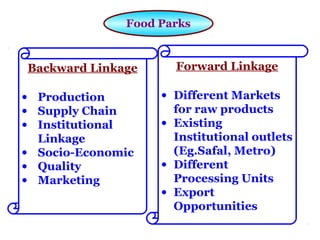
Forward Linkage
• Different Markets
for raw products
• Existing
Institutional outlets
(Eg.Safal, Metro)
• Different
Processing Units
• Export
Opportunities
Backward Linkage
• Production
• Supply Chain
• Institutional
Linkage
• Socio-Economic
• Quality
• Marketing
Food Parks
Schematic Profile of a Rubber Park
Rubber
Park
Ribbed
Sheets
Crepe
Rubber
Technically
specified
rubber
Latex
centrifugation
Modified rubber
(superior
processing rubber
Centralised
Testing/ QC Lab
R & D Centre
DRC Measuring
Unit
Reception
Warehouse - 1
Warehouse - 2
Warehouse - 3
Warehouse - 4
E.T.P.
Chemical
storage
unit
Water
Supply Workshop
Medical
Facilities Bank
Essential
Staff
Quarters
Library
Latex TankCommon Services
Value added
rubber
products
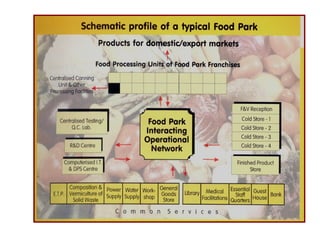
Schematic Profile of a Food Park
Food parks
Food parks

Food parks

  • 1.
  • 2.
    Food Park • Promotedby Ministry of Food Processing Industries • Encourage corporate for establishing food park with common facilities like cold storage, ware house, etc • To encourage entrepreneur to set up small units for processing • Minimum areas of 30 acres and 20 units in small and medium scale • Grant-in-aid to the project to the extent of 25-33% • 20 – 25% of losses can be minimized
  • 3.
    Seven Wastes • Overproduction– the making of too much, too early or just in case. • Waiting – where materials or information are waiting to produce to the next process. They are not moving or having value added • Transporting – where materials (or information) are being transported into, out of or around the factory, Transport cannot be fully eliminated, but the aim is to minimize it. • Inappropriate processing – using machinery or equipment which is inappropriate in terms of ‘capacity’ to perform an operation. • Unnecessary inventory – which ties up capital and space and prevents identification of problems • Defects – defined in terms of product defects, rework defects, scrap defects or service defects. • Unnecessary motion – the ergonomics of the work place
  • 5.
    Forward Linkage • DifferentMarkets for raw products • Existing Institutional outlets (Eg.Safal, Metro) • Different Processing Units • Export Opportunities Backward Linkage • Production • Supply Chain • Institutional Linkage • Socio-Economic • Quality • Marketing Food Parks
  • 7.
    Schematic Profile ofa Rubber Park Rubber Park Ribbed Sheets Crepe Rubber Technically specified rubber Latex centrifugation Modified rubber (superior processing rubber Centralised Testing/ QC Lab R & D Centre DRC Measuring Unit Reception Warehouse - 1 Warehouse - 2 Warehouse - 3 Warehouse - 4 E.T.P. Chemical storage unit Water Supply Workshop Medical Facilities Bank Essential Staff Quarters Library Latex TankCommon Services Value added rubber products
  • 8.